Mexican cuisine is as time-consuming as it is delicious.
Frida Kahlo fans attracted to the idea of duplicating some dishes from the banquet served at her wedding to fellow artist Diego Rivera should set aside ample time, so as to truly enjoy the experience of making chiles rellenos and nopales salad from scratch.
Sarah Urist Green’s Kahlo-themed cooking lesson, above, adapted from Marie-Pierre Colle and Frida’s stepdaughter Guadalupe Rivera’s 1994 cookbook Frida’s Fiestas: Recipes and Reminiscences of Life with Frida Kahlo, is refreshingly frank about the challenges of tackling these types of dishes, especially for those of us whose grandmas ran more toward Jell‑O salad.
Her self-deprecation should go a long way toward reassuring less-skilled cooks that perfection is not the goal.
The art cooking videos are immensely fun to make… And what I’m trying to do is reach people who aren’t necessarily outwardly into art or don’t know whether they’re into art so they’re not going to click on a video that’s strictly about art. But if you can present art ideas through a cooking tutorial perhaps they’ll be more open to it. I love to cook. And I love to think about that side of art history.
To that end, she takes a couple of bite-sized art breaks, to introduce viewers to Frida’s life and work, while the tomatoes are roasting.
As tempting as it is for old Frida hands to skip this well-charted terrain, doing so will not make dinner ready any faster. Why not enjoy the non-cooking related sections with the easiest item on the menu—a tequila shot?
Don’t trick yourself into thinking there’s nothing more to learn.
For instance, I did not know the Spanish for “I can’t get over this hangover,” but Frida’s pet parrot did. (Didn’t know that either.)
Green also offers some quick how-tos that could come in handy for other, less time-consuming dishes, like a sandwich or a plate of homemade pasta—everything from how to make homemade tomato sauce to denuding prickly pear cactus pads of their non-edible spines.
If you’re undaunted by the Frida recipes, perhaps you should proceed to Salvador Dali’s towering Bush of Crayfish in Viking herbs, or the Futurists’ highly suggestive Meat Sculpture. Other recipes come from Vincent Van Gogh and Georgia O’Keeffe. See above.
Gregorian chants became a thing very briefly in the early 1990s, when German electronic group Enigma combined them with the Soul II Soul “Keep On Movin’” drum loop and that everpresent shakuhachi sample for “Sadness Part One”. And then that song was *everywhere* for the first half of the 90s, giving rise to chillout music like the Orb and The Future Sound of London.
Gregorian music faded away as a trend in dance music, but it’s never really gone away. Bolstered by some claims that the soothing voices help increase alpha waves in the brain, groups like Gregorian (created by Enigma’s Frank Peterson) set about arranging pop songs in the Gregorian style, starting in 1999.
Others have followed suit, or should I say followed cowl (such as Auscultate, which created the Queen cover below).
But Gregorian (the group) is the king of them all, and Petersen’s project has gone on to sell over 5.5 million albums.
Corny or not, the project is immensely popular worldwide, and has produced ten “Masters of Chant” albums, along with Christmas CDs and such. And while our current pop stars have to get into athletic condition for their Vegas-like shows, there’s something to be said for a group of blokes just standing around on stage singing in unison like they’re in a crypt. Looks like a decent gig. Here’s a full concert:
Ted Mills is a freelance writer on the arts who currently hosts the artist interview-based FunkZone Podcast and is the producer of KCRW’s Curious Coast. You can also follow him on Twitter at @tedmills, read his other arts writing at tedmills.com and/or watch his films here.
All of us here in the 2010s have, at one time or another, been street photographers. But up until 1838, nobody had ever been a street photographer. In that year when camera phones were well beyond even the ken of science fiction, Louis Daguerre, the inventor of the daguerreotype process and one of the fathers of photography itself, took the first photo of a human being. In so doing he also became the first street photographer, capturing as his picture did not just a human being but the urban environment inhabited by that human being, in this case Paris’ Boulevard du Temple. Daguerre’s picture begins the historical journey through 181 years of street photography, one street photo per year all soundtracked with period-appropriate songs, in the video above.
From the dawn of the practice, street photography (unlike smile-free early photographic portraiture) has shown life as it’s actually lived. Like the lone Parisian who happened to be standing still long enough for Daguerre’s camera to capture, the people populating these images go about their business with no concern for, or even awareness of, being photographed.
The earliest street photographs come mostly from Europe — London’s Trafalgar Square, Copenhagen’s former Ulfeldts Plads (now Gråbrødretorv), Rome’s Via di Ripetta — but as photography spread, so spread street photography. Rapidly industrializing cities in America and elsewhere in the former British Empire soon get in on the action, and a few decades later scenes from the cities of Asia, Africa, and the Middle East begin to appear.
Each of these 181 street photographs was taken for a reason, though most of those reasons are now unknown to us. But some pictures make it obvious, especially in the case of the startlingly common subgenre of post-disaster street photography: we see the aftermath of an 1858 brewery fire in Montreal, an 1866 explosion in Sydney, an 1874 flood in Pittsburgh, a 1906 earthquake in San Francisco, and a 1920 bombing in New York. Each of these pictures tells a story of a moment in the life of a particular city, but together they tell the story of the city itself, as it has over the past two centuries grown outward, upward, and in every other way necessary to accommodate growing populations; transportation technologies like bicycles, streetcars, automobiles; spaces like squares, cinemas, and cafés; and above all, the ever-diversifying forms of human life lived within them.
Based in Seoul, Colin Marshall writes and broadcasts on cities, language, and culture. His projects include the book The Stateless City: a Walk through 21st-Century Los Angeles and the video series The City in Cinema. Follow him on Twitter at @colinmarshall, on Facebook, or on Instagram.
Behind the awarding of the Nobel Prize in Literature, there are stories upon stories, some as juicy as those in the work of winners like William Faulkner or Gabriel García Márquez—and some just as devastating to the parties involved. Last year’s award was postponed after sexual assault allegations lead to several members to resigning. (There will be two prizes awarded for 2019.) The charges needed to be aired, but if you’re looking for details about how the secretive committee selects the nominees and winners, you’ll have to wait a while.
“The Swedish Academy keeps all information about nominations and selections for the prestigious award secret for 50 years,” writes Allison Flood at The Guardian. Newly unsealed documents from the Academy have shone light on Jean-Paul Sartre’s rejection of the prize in 1964, and the shunning of Samuel Beckett in 1968 by committee chairman Anders Österling, who found his work too nihilistic (Beckett won the following year), and of Vladimir Nabokov, whose Lolita Österling declared “immoral.”
Perhaps the saddest of Nobel stories has taken on even more vivid detail, not only through newly opened files of the Nobel Prize committee, but also recently declassified CIA documents that show how the agency used Boris Pasternak’s Doctor Zhivagoas a propaganda tool (handing out hasty re-translations into Russian to Soviet visitors at the World’s Fair). In October 1958, the author was awarded the Nobel Prize in Literature. He had, as The Guardian reported in October of that year, intended to “accept it in person in Stockholm next month.” He may have had little reason to think he could not do so.
Despite his role as a perpetual thorn in the side of the Soviet government, and their attempts to suppress his work and refusal to allow Doctor Zhivagoto be published, the repressive regime mostly gave Pasternak his relative freedom, even after the novel was smuggled abroad, translated, and released to an international readership. Whether or not the Nobel committee chose him as an anti-Communist statement, as some have alleged, made no difference to his reputation around the world as a penetrating realist in the great Russian novelistic tradition.
The award might have been perceived as a validation of Russian letters, but the Soviets saw it as a threat. They had “raged” against Doctor Zhivago and its “anti-Marxist” passages, “but that only increased its popularity,” writes Ben Panko at Smithsonian. Pasternak had already been “repeatedly nominated for the Nobel Prize” and the “worldwide buzz around his new book pushed him to the top of the list in 1958.” Upon learning of the win, he sent a telegram to the committee that read, in part, “Thankful, glad, proud, confused.”
Days later, as The Guardian wrote, Pasternak decided to decline the award “without having consulted even his friends.” He sent a short telegram to the Swedish Academy reading:
Considering the meaning this award has been given in the society to which I belong, I must reject this undeserved prize which has been presented to me. Please do not receive my voluntary rejection with displeasure. — Pasternak.
The author’s “decision” was not as abrupt as it might have seemed. In the days after his win, a storm raged, as he put it. Even before the declassified trove of information, readers around the world could follow the story, “which had more twists and turns than a Cold War-era spy novel,” Tina Jordan writes at The New York Times. It played out in the papers “with one front-page story after another.” Pasternak angered the Soviets by expressing his “delight” at winning the prize in an interview. He was denounced in Soviet newspapers, called by a Pravda editor a “malevolent Philistine” and “libeler,” and his book described as “low-grade reactionary hackwork.”
Pasternak faced exile in the days after he gave up the prize and issued a forced public apology in Pravda on November 6. The Academy held the ceremony in his absence and placed his award in trust “in case he may some day have a chance to accept them,” the Times reported. Pasternak had hoped to be reinstated to the Soviet Writer’s Union, which had expelled him, and had hoped that his novel would be published in his own country and language in his lifetime.
Neither of these things occurred. The events surrounding the Nobel broke him. His health began to fail and he died two years later in 1960. Pasternak’s son Yevgeny describes in moving detail seeing his father the night after he turned down the Nobel. “I couldn’t recognize my father when I saw him that evening. Pale, lifeless face, tired painful eyes, and only speaking about the same thing: ‘Now it all doesn’t matter, I declined the Prize.’” Doctor Zhivagowas published in the Soviet Union in 1988. “The following year,” notes Panko, “Yevgeny was allowed to go to Oslo and retrieve his father’s denied prize.”
Looking for free, professionally-read audio books from Audible.com? That could include Doctor Zhivago. Here’s a great, no-strings-attached deal. If you start a 30 day free trial with Audible.com, you can download two free audio books of your choice. Get more details on the offer here.
In the mid-seventies, many people felt excluded from and disdained by the mainstream of rock and roll, which had largely come to represent itself as a straight white boys and girls club full of superrich rock stars. The narrow image fostered attitudes of implicit racism and homophobia that exploded in the 1979 “Disco Sucks” backlash. This despite the fact that rock and roll began as interracial music built on the flamboyantly ambiguous sexuality of Little Richard, the racy short stories of Chuck Berry, the grooves of Chubby Checker, the edgy beats of Bo Diddley, and a great many unsung black female performers.
Now we tend to remember 70s rock differently, not so much as the era of KISS or the Eagles, but as the transgressive time of David Bowie, Iggy Pop, Lou Reed, and Freddie Mercury, of the huge commercial and creative triumphs of women-led bands like Fleetwood Mac and Heart, of punk and new wave outsiders setting the template for four decades of alternative rock: The Ramones, Patti Smith, the Sex Pistols, Blondie, The Clash, Joy Division, Talking Heads, Gary Numan, Kraftwerk…. We remember it, still, as a time when rock was mostly white, and when black artists mostly recorded disco, funk, soul, and R&B.
The record industry and radio markets had segregated, and it would stay that way into the 80s, though jazz artists like Miles Davis made serious inroads into rock experimentation, bands like Parliament/Funkadelic released hard rock psychedelia, Prince channeled both Little Richard and Chuck Berry, and early punks like Detroit’s Death and Philadelphia’s Pure Hell made groundbreaking punk and metal. The former escaped critical notice, but the latter became famous, then disappeared from rock history for decades.
Death, the visionary trio of brothers who were recently rediscovered and celebrated, never really made it in their time outside of a small circle. Pure Hell, on the other hand, were an integral part of the New York punk scene and stars in Europe, and have been forgotten by most official punk histories. They “lived with the New York Dolls and played with Sid Vicious,” writes Cassidy George at Dazed, “but they’ve been largely written out of cultural history.” They are sometimes written back in, just as, to their dismay, they were promoted: as the “first black punk band.” But there’s far more to their history than that.
“I don’t want to be remembered just because we were black,” says singer Kenny “Stinker” Gordon. “I want to be remembered for being a part of the first tier of punk in the 70s.” He is not exaggerating. New York Dolls guitarist Johnny Thunders promoted the band, leading to gigs as Max’s Kansas City and a feature in Andy Warhol’s Interview magazine, “marking their ‘place’ in a scene of cultural influencers.” They appeared in a 1978 issue of Melody Maker during their UK tour, in a photo with Sid Vicious, who wears his swastika t‑shirt and padlock and chain. (Gordon also wore a swastika t‑shirt onstage.) Just one of many second-page write-ups in Melody Maker, NME, and the European press.
All of the hype surrounding the band is part of the historical record, for those who look through backpages and archives, but their music has mostly gone unheard for over a generation, largely because their album Noise Addiction only came out in 2006. After they released their first single in ‘78, then refused to change their sound for a record deal, their manager Curtis Knight absconded with the master tapes and refused to release them. Listen to their debut single, a cover of “These Boots Are Made for Walking,” above. Melody Maker called it, with a wink, “the former Nancy Sinatra hit.” The song reached number four on the UK alternative charts.
Pure Hell describe their journey through the mid-seventies New York punk scene in the montage of interview clips at the top, scored by wicked, riff-laden recordings of their songs. The story began with four friends from a tough neighborhood in West Philadelphia. “We dressed in drag and wore wigs, basically daring people to bother us. People in the neighborhood would say, ‘Don’t go into houses with those guys, you may not come out!’” They were pressured to join a gang, says bassist Lenny “Steel” Boles, but refused. They packed up a U‑Haul and moved into the Chelsea Hotel, then played their first show across the street at Mother’s.
Legendary stories about the band abound. (They played Sid Vicious’ last appearance onstage and were caught up in the media circus surrounding Nancy Spungen’s death). What’s most interesting about them is the music and their lasting influence, despite what Boles describes as being “snubbed” by record labels unless they agreed to “do this Motown thing, saying like, ‘You guys are black so you’ve gotta do something that’s danceable.” After losing their manager and their masters, they settled in L.A., where they played with the Germs and the Cramps but “lost their momentum,” writes George.
“It was totally over by 1980,” says Gordon. All the same, their heavy proto-metal sound, drawing from reggae and Hendrix as much as from Bowie and Nancy Sinatra, sparked the admiration of many emerging punk bands, including Washington, DC legends Bad Brains, who acknowledge the debt their furious reggae/metal thrash owes to Pure Hell. Bad Brains broke color barriers in New York a few years later, and got most of the credit for it, largely because Pure Hell left behind nothing but a mysterious single and a “rumor,” says Henry Rollins, “that they had made an album and that it was sitting in a closet.”
After the tapes resurfaced, nearly everyone who heard the record became an instant fan, including Rollins. “If the album had come out when they made it, that would have been a game changer,” he says. “I believe [it] would have had a tremendous impact. It’s one of those missed opportunity stories.” But it is also a found opportunity story. They are now getting recognition for their music and historical role. In 2012 they reformed to play their first show since 1979, with Rancid, Buzzcocks, Public Image Ltd, and Social Distortion. Pure Hell will find their way back into the story of New York punk, and it will be a more interesting story for their rediscovery.
Wayne’s World kind of ruined “Stairway to Heaven” for me. Yes, it’s been 27 years, but I still can’t help but think of Wayne turning to the camera with his stoner grin, saying “Denied!” when the guitar store clerk points out a “No Stairway to Heaven” sign. It was not a song I took particularly seriously, but I respected the fact that it took itself so seriously… and threaded my way out of the room if someone picked up a guitar, earnestly cocked an ear, and played those gentle opening notes.
Now I giggle even when I hear the magisterial original intro. This is not the fault of Zeppelin but of the many who approach the Zeppelin temple of rock grandiosity unprepared, attempting riffs that only Jimmy Page could pull off with authority. At least the joke gave us a way to talk about the phenomenon: in lesser hands than Led Zeppelin’s “Stairway” can sound… well, a bit ridiculous (with apologies to Dolly Parton.) Although accused (and acquitted) of ripping off the opening notes to Spirit’s instrumental “Taurus,” the song is all Zeppelin in every possible way.
“Stairway” is a representative sampler pack of the band’s signature moves: mixing folk rock and heavy metal with a Delta blues heart; exploding in thunderheads of John Bonham drum fills and a world-famous Page solo; Plant screaming cryptic lyrics that vaguely reference Tarot, Tolkien, English folk traditions and “a bustle in your hedgerow”; John Paul Jones’ wildly underrated multi-instrumental genius; bizarre charges of Satanic messages encoded backwards in the record…. (bringing to mind another Wayne’s World actor’s character.)
“Stairway… crystallized the essence of the band,” said Page later. “It had everything there and showed us at our best. It was a milestone.” It set a very high bar for big, emotional rock songs. “All epic anthems must measure themselves against ‘Stairway to Heaven,’” writes Rolling Stone. It is “epic in every sense of the word,” says the Polyphonic video at the top, including the literary sense. It can “make you feel like you’re part of a different time, part of a different world. It can make you feel like you’re part of a story.”
That story? “One of the greatest narrative structures in human history,” the Hero’s Journey, as so famously elaborated by Joseph Campbell in The Hero With a Thousand Faces—an archetypal mythological arc that has “permeated stories for as long as humans have told them.” Not only do Robert Plant’s mystical lyrics reflect this ancient narrative, but the song’s composition also enacts it, building stage by stage, from questioning to questing to battling to returning with the wisdom of how “to be a rock and not to roll.”
The song’s almost classical structure is, of course, no accident, but it is also no individual achievement. Hear the story of its composition, and why it has been so influential, despite the jokes at the expense of those it influenced, in the Polyphonic video at the top and straight from Jimmy Page himself in the interview above.
Out of all of Zeppelin’s many epic journeys, “Stairway” best represents “the reason,” as cultural critic Steven Hyden writes, “why that band endures… the mythology, that Joseph Campbell idea of an epic journey into the wild that Zeppelin’s music represents, the sense that when you listen to this band, you feel like you’re plugging into something bigger and more profound than a band.” Or that the band is opening a doorway to something bigger and more profound than themselves.
The HBO TV show Game of Thrones, like its source books, George R.R. Martin’s A Song of Ice and Fire, is classified as “fantasy,” but that term as literary classification has become unmoored from its literal meaning. A person’s fantasy is most typically a matter of wish fulfillment, which should put super-hero media at the center of the genre: We regular mortals wish to be powerful and strong, to save the day and be recognized as a hero. Certain elements of classical fantasy fall under this description: Frodo in Lord of the Rings gets to save the world while remaining more or less ordinary (well, yes, he can turn invisible with the ring, but that becomes problematic), and Harry Potter qualifies as a kid super-hero.
Another key element of fantasy is obviously the imagination, which can be deployed as in dreams and the psychedelic art that draws on dream experience to come up with ever-more-fantastical imagery, ever more amazing situations and powers one could fantasize about possessing. However, the imagination also seeks to expand the fantasized creation, to make its world wider and richer, to fill in the details, and almost inevitably to try to make the fantasy more “realistic.” What would it actually be like to have super powers? Would you suffer emotional trauma from damaging all those villains? What about collateral damage? If you get to ride on a dragon, how do you take care of it? What (who) does it eat?
George R.R. Martin writes in the tradition popularized by J.R.R. Tolkien of “high fantasy,” which involves not only characters of high stature engaged in epic struggles, but typically involves a very fleshed out alternative world with its own slightly different laws. The more spelled out these laws are, the more nuts and bolts of the workings of the world are specified, the more realism and hence suffering can be depicted. A Song of Ice and Fire describes its rotating cast of protagonists with such a degree of detail that readers are (as in much literature) able to identify with them, to see the world through their eyes, but they suffer so much that such alternate lives as these books offer readers would hardly be anyone’s fantasy in the sense of wish fulfillment. A visual presentation like a TV show by necessity can’t be as clear about whose eyes the viewer is supposed to see events through (we see through the camera instead), but nonetheless Game of Thrones invites us to live through (some of) its characters, to identify with them, through their exertions of power, through their reactions to loss and triumph. But such identifications will always be imperfect, given that these characters have been drawn as living in a world that is fundamentally foreign to us, not because there are zombies and dragons, but because HBO viewers are for the most part living comfortably in a peaceful country, not having been systematically and often personally exposed to horrible sufferings.
Hear Mark Linsenmayer and Wes Alwan, regular hosts of The Partially Examined Life Philosophy Podcast, along with guest Sabrina Weiss, discuss the psychological and social aspects of the show, but in what is depicted on screen and how these play out in our society’s relationship to this grand spectacle.
How are the world’s honey bees doing? Just a few years ago, word spread that they were on the verge of a mysterious extinction. Look for updates on their situation now and you get contradictory results, all of them fairly recent, from “Bees Are Still Dying” to “Bees Are Bouncing Back From Colony Collapse Disorder” to “Yes, the Bees Are Still in Trouble” to “The Bee Apocalypse Was Never Real.” But whether they’re in existential danger or not, bees at least now have their very own McDonald’s — bees in certain parts of Sweden, anyway.
“McDonald’s has created a tiny replica of one of its restaurants, too small for any human to eat there,” writes Emily Chudy in the Independent. “The replica, dubbed the ‘McHive,’ is a fully-functioning beehive designed to look like a McDonald’s restaurant and features seating, a drive-through and an entrance. The brainchild of set designer Nicklas Nilsson, the hive is part of an initiative which has seen beehives placed on certain Swedish branches of the franchise.” This project seems to be the first insect-scale restaurant for Nilsson, whose past work includes costume design on the video for David Bowie’s “Blackstar.”
You can see footage of the McHive’s design and assembly process, as well as an assembled McHive full of its “thousands of important guests,” in the video at the top of the post. There are more photos at designboom, which quotes the project’s advertising agency NORD DDB as saying that “the initiative started out locally but is now growing.” In addition to installing beehives on their rooftops, more Swedish McDonald’s franchisees “have also started replacing the grass around their restaurants with flowers and plants that are important for the wellbeing of wild bees.”
Why so much concern about honey bees in the first place? Chudy quotes a Greenpeace estimate that they “perform about 80% of all pollination and a single bee colony can pollinate 300 million flowers each day.” Bees do the hard work of keeping a surprisingly large part of the natural world working as we’ve always known it to, and to the extent that bees die out, much else may die out as well, with potential knock-on effects many would prefer not to think about. But then, the taste for predictions of ecological disaster on the internet seems only to have grown since we first noticed the problem with bees: if you really want to feel motivated to petition your local McDonald’s to put up a McHive, try Googling the phrase “catastrophic collapse of nature.”
Based in Seoul, Colin Marshall writes and broadcasts on cities, language, and culture. His projects include the book The Stateless City: a Walk through 21st-Century Los Angeles and the video series The City in Cinema. Follow him on Twitter at @colinmarshall, on Facebook, or on Instagram.
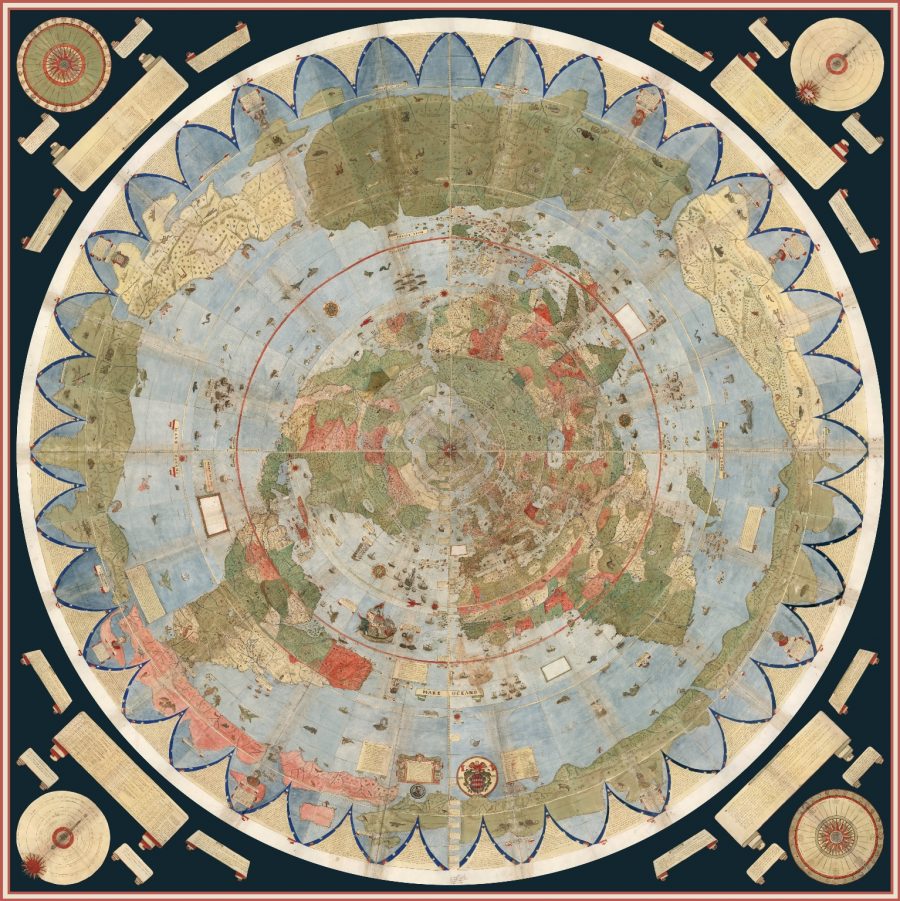
Three years ago, we highlighted one of the most comprehensive map collections in existence, the David Rumsey Map Collection, then newly moved to Stanford University. The Rumsey Collection, we wrote then, “contains a seemingly inexhaustible supply of cartographic images”—justifiable hyperbole, considering the amount of time it would take any one person to absorb the over 150,000 physical artifacts Rumsey has amassed in one place.
By 2016, Rumsey had made almost half the collection—over 67,000 images—freely available in a digital archive that has been growing since 1996. Each entry features high-resolution scans for specialists (you can download them for free) and more manageable image sizes for enthusiasts; a wealth of data about provenance and historical context; and digital, user-friendly tools that use crowd-sourcing to measure the accuracy of antiquated maps against GPS renderings.
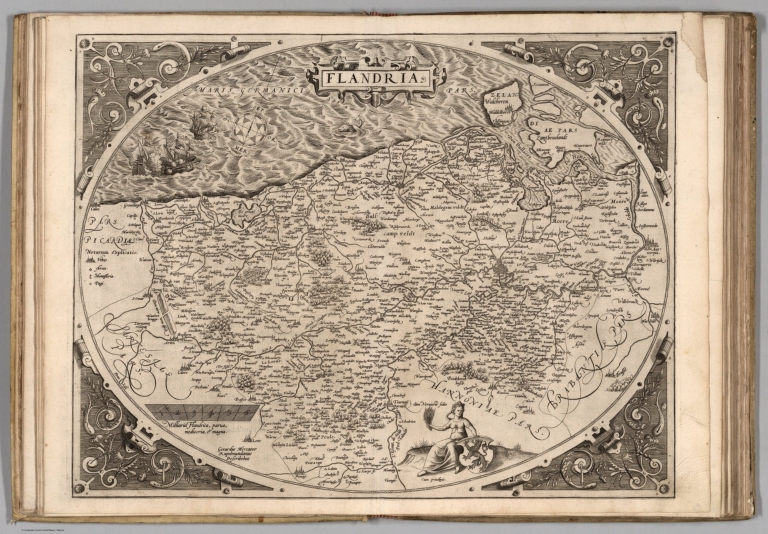
The Ortellus “Theatrum” holds “a unique position in the history of cartography,” notes the Rumsey Collection, as “’the world’s first regularly produced atlas.’” It was also the first example of a “Theatre of the World,” a style that would become ubiquitous in the following century, and it was “the first undertaking of its kind to reduce the best available maps to a uniform format.”
To make this document even more compelling, it contains its own bibliography. Ortellus “mentioned the names of the authors of the original maps” he drew from “and added a great many names of other cartographers and geographers.” Not all of the 91,000 and counting maps in the Rumsey digital collection combine this degree of stylistic mastery, historical import, and scholarly rigor. But a survey of the Collection’s categories will produce few that disappoint in any one of these areas.
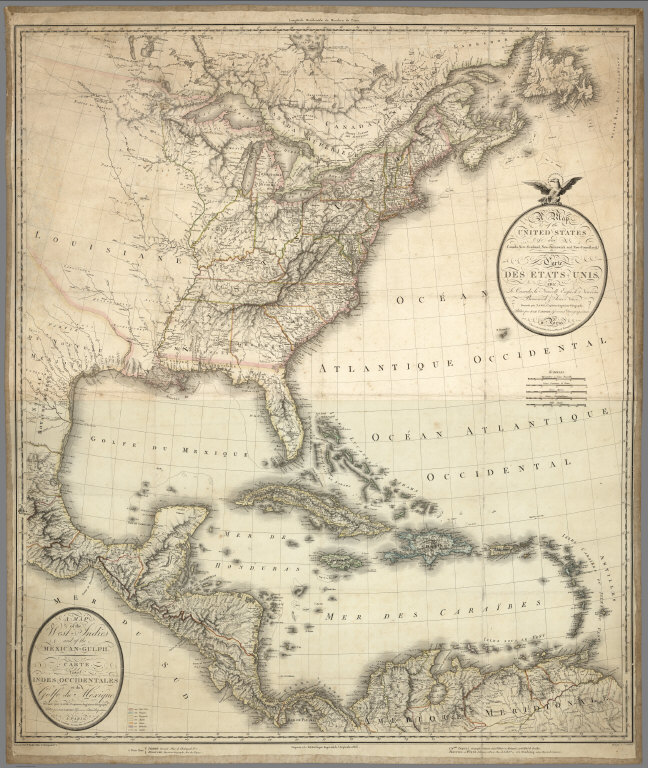
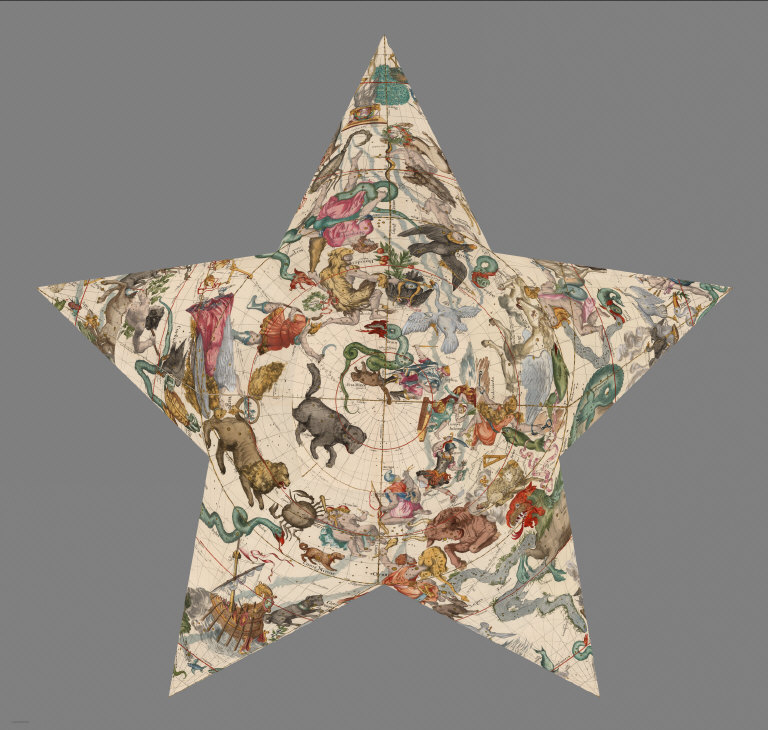
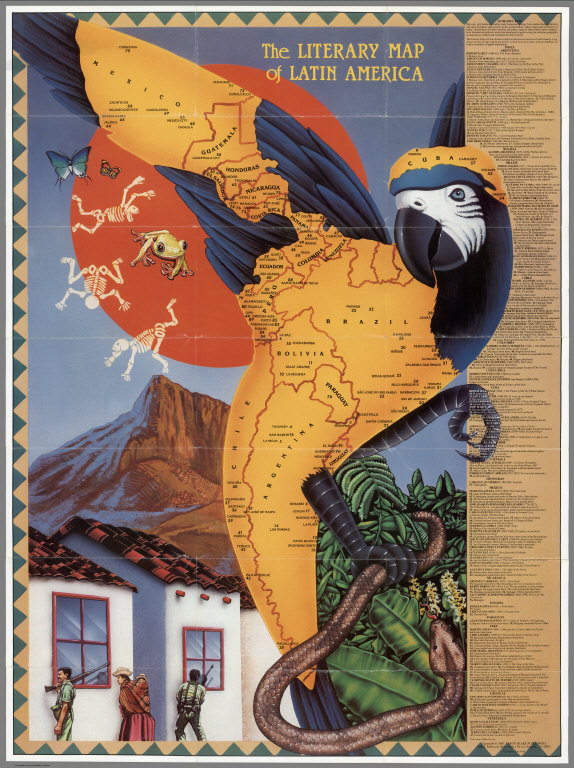
The “important and rare” 1806 map of the U.S. and West Indies by Charles Piquet; the Tolkien-like Vergleichendes Tableau der bedeutendsten Hoehen der Erde, from 1855, a “decorative chart… showing comparative tables of the greatest mountains and volcanoes of the world”; the almost-expressionist map of Cheltenham from 1899 by the Geological Survey of Great Britain and Ireland; the fancifully-illustrated star-shaped star chart made by Ignace Gaston Pardies in 1693; Mike Cressy’s 1988 “Literary Map of Latin America”…..
This briefest overview of the Collection’s highlights already feels exhaustive. No matter your level of interest in maps, from the casual to the lifelong obsessive, The David Rumsey collection will deliver multiple points of entry to maps you never knew existed, and with them, new ways of seeing cities, regions, nations, territories, continents, planets, and beyond. Enter the collection here.
It’s becoming an annual ritual. Every summer Bill Gates offers us a reading list–5‑books to take on vacation. As you’ll see, his list assumes that even if you’re physically on vacation, your mind isn’t. The curious mind takes no breaks. Bill writes:
Upheaval, by Jared Diamond. I’m a big fan of everything Jared has written, and his latest is no exception. The book explores how societies react during moments of crisis. He uses a series of fascinating case studies to show how nations managed existential challenges like civil war, foreign threats, and general malaise. It sounds a bit depressing, but I finished the book even more optimistic about our ability to solve problems than I started. More here.
Nine Pints, by Rose George. If you get grossed out by blood, this one probably isn’t for you. But if you’re like me and find it fascinating, you’ll enjoy this book by a British journalist with an especially personal connection to the subject. I’m a big fan of books that go deep on one specific topic, so Nine Pints (the title refers to the volume of blood in the average adult) was right up my alley. It’s filled with super-interesting facts that will leave you with a new appreciation for blood. More here.
A Gentleman in Moscow, by Amor Towles. It seems like everyone I know has read this book. I finally joined the club after my brother-in-law sent me a copy, and I’m glad I did. Towles’s novel about a count sentenced to life under house arrest in a Moscow hotel is fun, clever, and surprisingly upbeat. Even if you don’t enjoy reading about Russia as much as I do (I’ve read every book by Dostoyevsky), A Gentleman in Moscow is an amazing story that anyone can enjoy. More here.
Presidents of War, by Michael Beschloss. My interest in all aspects of the Vietnam War is the main reason I decided to pick up this book. By the time I finished it, I learned a lot not only about Vietnam but about the eight other major conflicts the U.S. entered between the turn of the 19th century and the 1970s. Beschloss’s broad scope lets you draw important cross-cutting lessons about presidential leadership. More here.
The Future of Capitalism, by Paul Collier. Collier’s latest book is a thought-provoking look at a topic that’s top of mind for a lot of people right now. Although I don’t agree with him about everything—I think his analysis of the problem is better than his proposed solutions—his background as a development economist gives him a smart perspective on where capitalism is headed.
If you would like to support the mission of Open Culture, consider making a donation to our site. It’s hard to rely 100% on ads, and your contributions will help us continue providing the best free cultural and educational materials to learners everywhere. You can contribute through PayPal, Patreon, and Venmo (@openculture). Thanks!
Rock and roll needs its outsiders, its prodigious weirdos, tricksters and pastiche artists to reinvigorate moribund genres and put things together no one thought would go. No two people fit the description better than Frank Zappa and Captain Beefheart (Don Van Vliet), sometime collaborators, frenemies, and parallel evil geniuses with crack teams of musical henchmen at the ready—Zappa the genre-hopping virtuoso and music business supervillain; Beefheart the mad bluesman with a Beat poet’s heart and Merry Prankster’s sense of humor….
Their intense on-again-off-again musical relationship threatened to come apart for good during the recording of Beefheart’s Zappa-produced weirdo masterpiece Trout Mask Replica. These troubled stages of their association are what we often talk about when we talk about Zappa/Beefheart, when they discovered, writes Ultimate Classic Rock, “that their creative processes and work habits—Zappa was disciplined and exacting, while Beefheart preferred to be spontaneous and freeform—couldn’t have been more at odds.”
A little over a decade earlier, before either of them had musical careers necessitating work habits, the two began recording together in “either late 1958 or early 1959,” notes Dangerous Minds. They had known each other since high school in Lancaster, California, where their shared sensibilities brought them together: “The two found they had a similar taste in music, and quickly bonded over a shared love of blues, doo-wop, and R&B records.”
Presaging all of the ways they would go on to warp, cannibalize, and mash up these genres, “Lost in a Whirlpool,” with music by Zappa and lyrics by Van Vliet, was one of several songs they had begun writing while still teenagers. Zappa tells the story of the recording in a 1989 interview:
“Lost in a Whirlpool” was taped on one of those tape recorders that you have in a school in the audio/visual department. We went into this room, this empty room at the junior college in Lancaster, after school, and got this tape recorded, and just turned it on. The guitars are me and my brother (Bobby Zappa) and the vocal is Don Vliet.
The story of “Lost in a Whirlpool” goes back even farther. When I was in high school in San Diego in ‘55, there was a guy who grew up to be a sports writer named Larry Littlefield. He, and another guy named Jeff Harris, and I used to hang out, and we used to make up stories, little skits and stuff, you know, dumb little teenage things. One of the plots that we cooked up was about a person who was skindiving—San Diego’s a surfer kind of an area—skindiving in the San Diego sewer system [laughter], and talking about encountering brown, blind fish. [laughter] It was kind of like the Cousteau expedition of its era. [laughter] So, when I moved to Lancaster from San Diego, I had discussed this scenario with Vliet, and that’s where the lyrics come from. It’s like a musical manifestation of this other skindiving scenario.
Scatological skindiving seems like such a perfect conceptual summary of the shared Zappa/Beefheart ethos it’s a wonder they didn’t use the title themselves. Despite their growing creative differences and incompatible temperaments, they collaborated into the mid-70s.
In 1975, twenty years after cooking up the story of skindiving in the San Diego sewers, they “regaled their fans with the amusingly titled (mostly) live album, Bongo Fury,” Ultimate Classic Rock writes, “a historic ceasefire in their otherwise turbulent relationship that would sadly prove all too fleeting.” The record is the result of an “intensive, 30-date tour” in which “Beefheart contributed harmonica, occasional sax, and numerous displays of his eccentric poetry and one-of-a-kind vocals to the [Zappa] ensemble’s repertoire.” Above, hear Bongo Fury’s “Advance Romance,” as classic a slice of Zappa/Beefheart oddball blues as their very first recordings from the late 50s.
We're hoping to rely on loyal readers, rather than erratic ads. Please click the Donate button and support Open Culture. You can use Paypal, Venmo, Patreon, even Crypto! We thank you!
Open Culture scours the web for the best educational media. We find the free courses and audio books you need, the language lessons & educational videos you want, and plenty of enlightenment in between.