Is there any subject that can’t be covered in a TED Talk?
Apparently not. You can make a TED Talk about anything, even nothing, as veteran improviser and rookie Saturday Night Live writer, Will Stephen, demonstrated at a recent TEDx event in New York City.
What you shouldn’t do is deviate from TED’s established presentation tropes. Stephen may be punking us with his How to Sound Smart in Your TEDx Talk, above, but aspirant TED speakers should take notes. One can’t practice observational humor without being a keen observer. Stephen’s insights are as good a playbook as any for that unmistakeable TED-style delivery:
Use your hands.
Engage the audience by asking them a question that will result in a show of hands…
By show of hands, how many of you have been asked a question before?
Hit ‘em with an endearing, personal anecdote.
Projections will enhance your credibility.
Replay the clip with the sound down, as Stephen suggests, and it’s still obvious what he’s doing — giving a TED Talk. (The familiar camera work and editing don’t hurt either.)
Even if you’re not planning on nominating yourself to become a TED speaker in the near future, Stephen’s lesson should prove handy next time you’re called upon to do some public speaking, whether running for President or delivering the toast at your best friend’s wedding.
And nothing is certainly not the only topic of substance upon which Stephen can discourse. Witness his Tinder Strategy Powerpoint.
Hmm, maybe there are some TED-proof subjects after all…
Painting, as any Art History 101 lecturer will tell you, found the motivation to turn abstract when photography trumped it in the game of lifelike representation. But what pushes photography, and even motion pictures, to give abstraction a try? The vast majority of films made today still represent reality in some basically direct fashion, but almost since the first appearance of the medium, certain artists have tried to push it in other directions. If you know the work of only one abstract filmmaker, you probably know the work of Stan Brakhage, craftsman of such vivid and distressed cinematic experiences as Cat’s Cradle and Dog Star Man. But who preceded him?
The title of the very first abstract filmmaker has been disputed, but we at least know who made several early abstract masterpieces. Today we present two of them, Hans Richter’s Rhythmus21, made in 1921, and from three years later, Viking Eggeling’s Symphonie Diagonale. “Clocking in at just over three minutes, it’s a significant departure from the newsreels, romances, cliff-hangers, and penny-dreadfuls that made up the bulk of film production in the early 20s,” writes the Getty’s Jannon Stein of Richter’s hypnotically geometric picture, “the first decade in which the film industry began to play a major economic and cultural role around the world.”
But Richter, Stein continues, “credited his friend Viking Eggeling with the idea of exploring the possibilities for abstract animation. In fact, they’d worked together on a series of paintings on scrolls that preceded both of Richter’s first films, as well as Symphonie Diagonale,” which you can watch just above. This version opens with an endorsement from no less daring a mind than architect-artist-theoretician Frederick John Kiesler, who describes it as “the best abstract film yet conceived” and “an experiment to discover the basic principles of the organization of time intervals in the film medium.” I, personally, would call it something like a pure shot of the art-deco aesthetic which we now know, of course, not from the film it produced in the 20s, but the architecture.
That may excite you or it may not, but words have never quite suited the abstract. If Richter, Eggeling, Brakhage, or any who came between them or have come after them share a mission, that mission involves making movies that no words can really describe. Eggeling would pass on the year after Symphonie Diagonale, but Richter would go on to a long life and career that included other projects meant to take film beyond its conventional uses, such as 1947’s “story of dreams mixed with reality,” Dreams that Money Can Buy. Even now, in the 21st century, it seems that the medium has a long way to go before it makes use of all the creative space available to it — which should only encourage the next Richters and Eggelings of the world.
Last week, Ted Mills told you how Plymouth University orchestrated a wonderful project called Moby-Dick The Big Read, which resulted in celebrities–like Benedict Cumberbatch, John Waters, Mary Oliver, Stephen Fry, and Tilda Swinton–reading the entirety of Herman Melville’s Moby-Dick, and making the recording free to download.
This weekend, we happily discovered another unabridged reading of Melville’s great American novel, this one coming out of the 2015 London Literature Festival, held at the Southbank Centre in London. Over four days, Moby-Dick was read by writers, actors, comedians, members of the public and even Melville’s great-great-great-granddaughter. You can stream a recording of the epic reading on Soundcloud right below. You might want to make a good strong pot of coffee because it runs 24 hours.
If you would like to support the mission of Open Culture, consider making a donation to our site. It’s hard to rely 100% on ads, and your contributions will help us continue providing the best free cultural and educational materials to learners everywhere. You can contribute through PayPal, Patreon, and Venmo (@openculture). Thanks!
Back in the late 1950s, George Martin (may he rest in peace) began his career as a producer recording two albums with the comedian Peter Sellers–The Best Of Sellers and Songs for Swinging Sellers. When he joined forces with the Beatles a few years later, Martin put the comedian in touch with the lads from Liverpool, and they became fast friends. This relationship paved the way for some good comedy. As you might recall, Sellers made a cameo appearance on “The Music of Lennon and McCartney” in 1964, and read “A Hard Day’s Night” in a way that comically recalls Laurence Olivier’s 1955 performance inRichard III. (Watch the spoof here.) And then, also during the mid 60s, Sellers recorded a comic reading of “She Loves You” — once in the voice of Dr. Strangelove (above), again with cockney and upper-crusty accents (both right below), and finally with an Irish twist (the last item). The recordings were all released posthumously between 1981 and 1983 on albums no longer in circulation. Sellers clearly had a thing for accents. Here you can also explore his Complete Guide to the Accents of the British Isles.
Cockney
Upper Crust
Irish
A version of this post first appeared on Open Culture in February, 2012.
If you would like to support the mission of Open Culture, consider making a donation to our site. It’s hard to rely 100% on ads, and your contributions will help us continue providing the best free cultural and educational materials to learners everywhere. You can contribute through PayPal, Patreon, and Venmo (@openculture). Thanks!
“The first thing to notice about movies made in the classic Hollywood studio era,” writes New Yorker film critic Richard Brody, “from the twenties through the fifties, is the stillness of the actors — not a static, microphone-bound stand-and-deliver theatricality but a lack of fidgetiness even while in motion, a self-mastery that precludes uncontrolled or incidental gestures,” an acting style reflective of the fact, Brody suspects, that “American people of the era really were more tightly controlled, more repressed by the general expectation of public decorum and expressive restraint.”
This has made it tough for filmmakers (in the case of Brody’s piece, Paul Thomas Anderson making TheMaster, who pulled it off more convincingly than anyone else in recent memory) who want to do proper period pieces set in those days: “even if stylists manage to get the clothing right, actors today — people today — have been raised by and large to let their emotions govern their behavior,” and current actors “can hardly represent the past without investing it with the attitudes of our own day, which is why most new period pieces seem either thin or unintentionally ironic.”
They’d have an especially formidable task set out for them in speaking, without any apparent irony, in the mid-atlantic accent, just as much a fixture of classic Hollywood acting as that physical self-mastery. Even if you haven’t heard its name, you’ve heard the accent, which gets examined in the HowStuffWorks video at the top of the post “Why Do People in Old Movies Talk Weird?” The “old-timey voice” you hear in newsreels from movies like His Girl Friday (watch it online here) and figures like Katharine Hepburn, Franklin D. Roosevelt, George Plimpton, and William F. Buckley, historically “the hallmark of aristocratic America,” acquired, usually in New England boarding schools, as “an international norm for communication.”
The video points out its signal qualities, from its “quasi-British elements” like a softening of Rs to its “emphasis on clipped, sharped Ts,” resulting in a speech pattern that “isn’t completely British, not completely American” — one we can only place, in other words, somewhere in the mid-Atlantic ocean. The accent emerged as an optimal manner of speaking in “the early days of radio” when speakers couldn’t reproduce bass vary well, and it vanished not long after the Second World War, when teachers stopped passing it along to their students. Has the time has come for the true ironists among us to bring it back?
The writers who most stay with me are those who tend to write about reading: its pleasures, difficulties, and at times impossibility. Wallace Stevens, Franz Kafka, and Vladimir Nabokov belong in this category. Stevens’ essays in The Necessary Angelattempt to reconcile Plato and the Poets; reading for him is akin to a mystical union with ideas. For Kafka, reading is an act of ascetic self-harm: we should read only books that “wound and stab us… wake us up with a blow on the head… affect us like a disaster… grieve us deeply.” And for Nabokov reading can be a form of disciplined edification… and dissection. He wields his critical mind like a scalpel in his collected Lectures on Literature, in which we find a “little quiz” he devised for his students to test their thinking about what makes a “good reader.” One such quality, he suggests is the possession of an “artistic sense.”
Good readers, Nabokov suggests, should already have acquired this sense before they even approach a book. This doubtless leaves a great many people out, though he also implies in his criteria that learned qualities as well as innate ones play a role in the activity of reading, and that “artistic sense” can be learned. But Nabokov did not simply make a list—that would give it away too easily and we wouldn’t learn anything (about, perhaps, the qualities of bad readers). The professorial novelist never missed a chance to educate, and occasionally condescend to, his readers. In this case, he made a quiz with “ten definitions of a reader, and from these ten,” he had students choose the “four definitions that would combine to make a good reader.”
Take his good reader quiz, below, and see if you can quickly identify the other three qualities Nabokov requires. I doubt you’ll have much trouble. He provides his answers further down.
Select four answers to the question what should a reader be to be a good reader:
1. The reader should belong to a book club.
2. The reader should identify himself or herself with the hero or heroine.
3. The reader should concentrate on the social-economic angle.
4. The reader should prefer a story with action and dialogue to one with none.
5. The reader should have seen the book in a movie.
6. The reader should be a budding author.
7. The reader should have imagination.
8. The reader should have memory.
9. The reader should have a dictionary.
10. The reader should have some artistic sense.
The students leaned heavily on emotional identification, action, and the social-economic or historical angle. Of course, as you have guessed, the good reader is one who has imagination, memory, a dictionary, and some artistic sense–which sense I propose to develop in myself and in others whenever I have the chance.
If you would like to support the mission of Open Culture, consider making a donation to our site. It’s hard to rely 100% on ads, and your contributions will help us continue providing the best free cultural and educational materials to learners everywhere. You can contribute through PayPal, Patreon, and Venmo (@openculture). Thanks!
Swedish musician Martin Molin’s Marble Machine, above, looks like the kind of top heavy, enchanted contraption one might find in a Miyazaki movie, galloping through the countryside on its skinny legs.
Those slender stems are but one of the design flaws that bother its creator, who notes that he hadn’t really taken into account the destructive power of 2000 flowing marbles (or more accurately, 11mm steel ball bearings).
It’s natural for someone so close to the project to fixate on its imperfections, but I think it’s safe to say that the rest of us will be bedazzled by all the giant musical Rube Goldberg device gets right. Hannes Knutsson’s “making of” videos below detail some of Molin’s labors, from recreating the sound of a snare drum with coasters, a contact mic and a box of basmati rice, to cutting wooden gears from a customizable template that anyone can download off the Internet.
If it looks like a time consuming endeavor, it was. Molin wound up devoting 14 months to what he had conceived of as a short term project, eventually designing and fabricating 3,000 internal parts.
The finished product is a feat of digital, musical, and physical skill. As Molin told Wired,
I grew up making music on Midi, and everyone makes music on a grid nowadays, on computers. Even before digital they made fantastic, programmable music instruments. In bell towers and church towers that play a melody they always have a programming wheel exactly like the one that is on the marble machine.
The “making of” videos highlight the difference between the recorded audio signal and the sound in the room where the machine is being operated. There’s something immensely satisfying about the insect-like click of all those marbles working in concert as they activate the various instruments and notes.
The machine also appears to give its inventor a rather brisk cardio workout.
Early 20th century modernism often seems to come out of nowhere, especially when our exposure to it comes in the form of a survey of singular great works. Each sculpture, film, or painting can seem sui generis, as though left by an alien civilization for us to find and admire.
But when you spend a great deal more time with modern art—looking over artists’ entire body of work and seeing how various schools and individuals developed together—it becomes apparent that all art, even the most radical or strange, evolves in dialogue with art, and that no artist works fully in isolation.
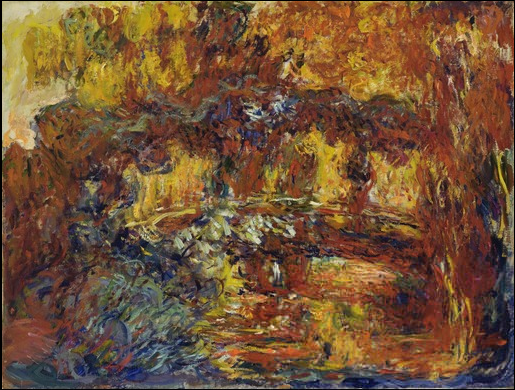
Take, for example, Monet’s Japanese Footbridge, above, from 1920. It’s a scene from his garden the early impressionist had painted many times over the decades. In this, one of his final paintings of the bridge, we see a riot of reds, oranges, and yellows in gestural brushstrokes that almost obscure the scene entirely. Though we know Monet had failing eyesight due to cataracts, a condition that lead to the vivid colors he saw in this period, it’s hard not to see some homage to Van Gogh, upon whose work Monet’s had a tremendous influence.
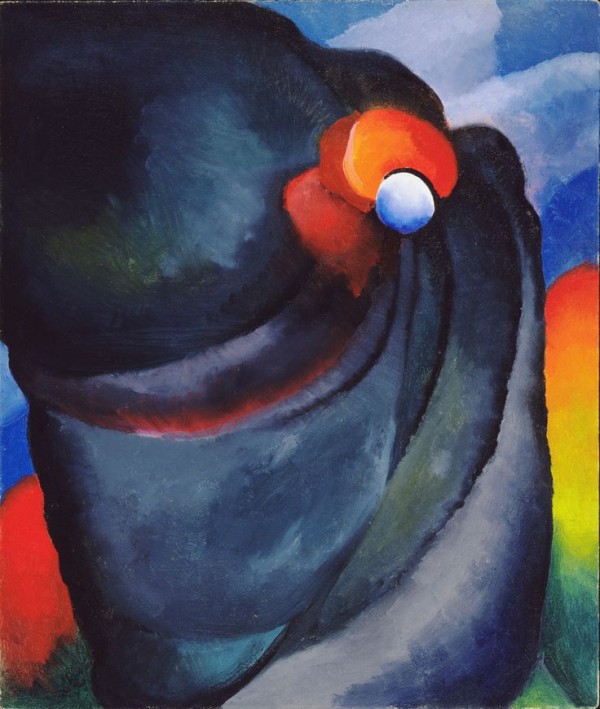
Above, we have Georgia O’Keeffe’s Lake George, Coat and Red from 1919, which abstracts the vivid patches of color characteristic of Edouard Manet’s work and the fauvism of Henri Matisse, both of whom greatly influenced American modernists like O’Keeffe, Edward Hopper, and Charles Demuth. These paintings reside at the Museum of Modern Art in New York (MoMA), along with many thousands more that show us the development and interrelationship of modern art in Europe and America. And you can see close to half of them, whether they’re on display or not, at the MoMA’s digital collection.
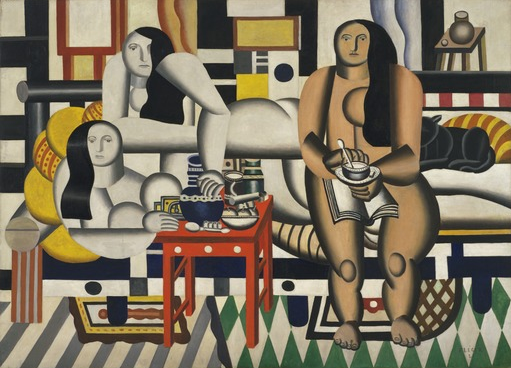
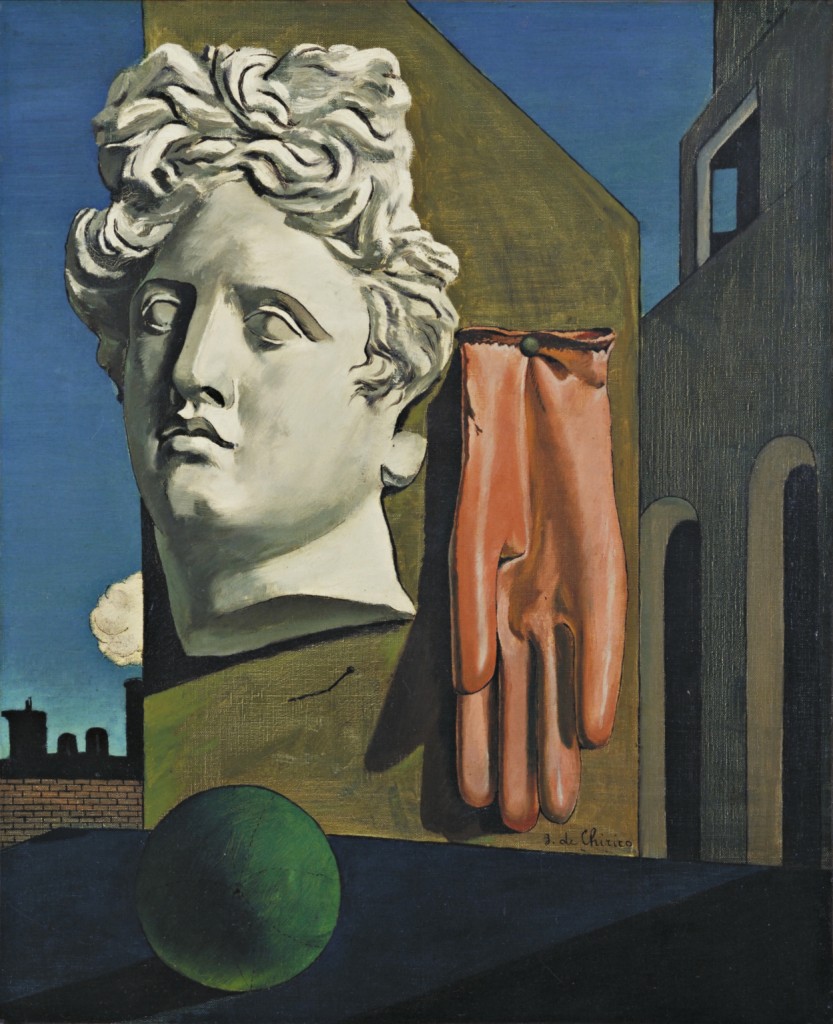
This online collection houses 90,000 works of art in all, to be precise. You can see, for example, Giorgio de Chirico’s The Song of Love, above, a typical painting for the surrealist that shows how much influence he had on the later Salvador Dali, who was only ten years old at the time of this work. At the top of the post, Fernand Leger’s Three Women, from 1921, shows the futurist and later pop art French painter in conversation with Picasso and Henri Rousseau.
From today on everybody around the world can access, study, print or remix a 3D dataset of Nefertiti’s head in high resolution. This data is accessible under a public domain without any charge, this torrent provides you a STL-file (100 MB)…
“Nefertiti Hack” goes on to say: “ ‘The Other Nefertiti’ is an artistic intervention by the two German artists Nora Al-Badri and Jan Nikolai Nelles. Al-Badri and Nelles scanned the head of Nefertiti clandestinely in the Neues Museum Berlin without permission of the Museum and they hereby announce the release of the 3D data of Nefertiti’s head under a Creative Commons Licence.… With regard to the notion of belonging and possession of objects of other cultures, the artists’ intention is to make cultural objects publicly accessible.”
As if not already controversial, this act of artistic vigilantism recently became more contentious when 3D scanning experts started questioning whether Al-Badri and Nelles could have produced such high quality scans with a Kinect hidden under a jacket (shown on a video here). It seems implausible, they say. And it has left some wondering, writes The New York Times, whetherAl-Badri and Nelles “somehow acquired the museum’s own scan of the bust, scanned a high-quality copy or produced the scan by some other means.” The answer is not yet clear.
In the meantime, according to Hyperallergic, the artists themselves used their scans “to create a 3D-printed, one-to-one polymer resin model” of the Nefertiti bust, which, they claim, “is the most precise replica of the bust ever made.” And that bust “will reside permanently in the American University of Cairo later this year as a stand-in for the original, 3,300-year-old work that was removed from its country of origin shortly after its discovery in 1912 by German archaeologists in Amarna.”
If there are updates to the story, I am sure Hyperallergic will have them.
If you would like to support the mission of Open Culture, consider making a donation to our site. It’s hard to rely 100% on ads, and your contributions will help us continue providing the best free cultural and educational materials to learners everywhere. You can contribute through PayPal, Patreon, and Venmo (@openculture). Thanks!
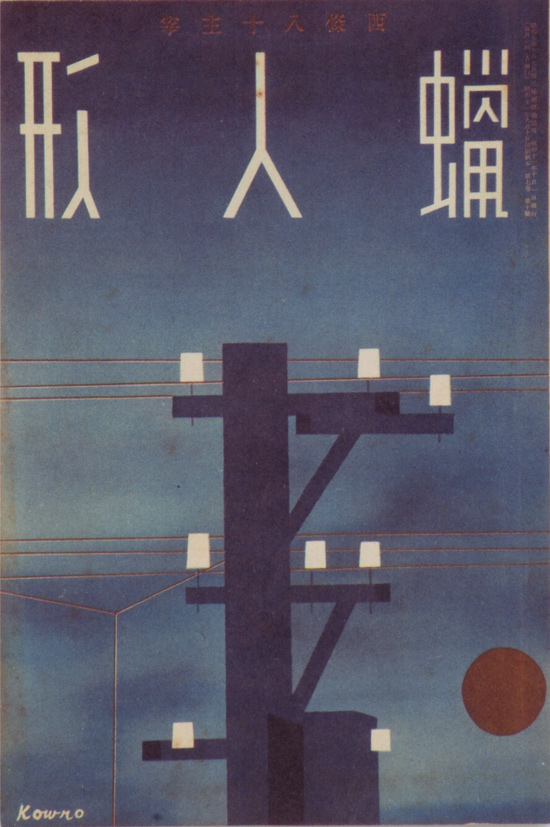
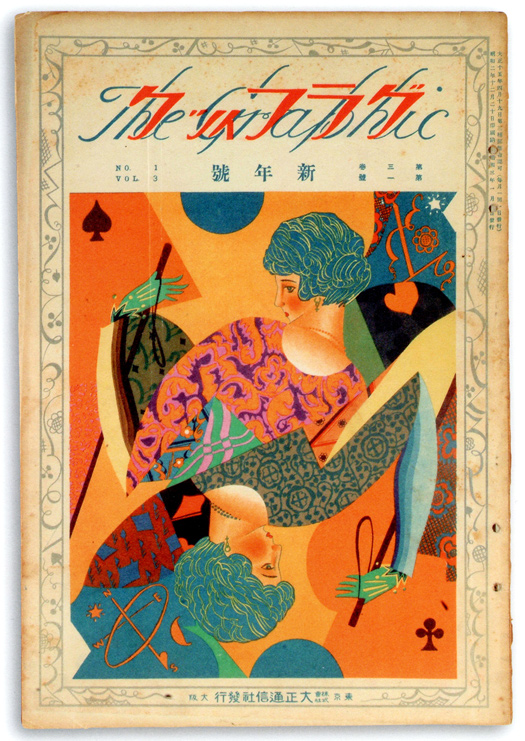
I just last week returned from a visit to Tokyo, where I did what I always do there: shop for magazines. Despite not paying the magazine shelves a whole lot of attention in Korea, where I live, and practically none at all in America, where I’m from, I can’t resist lingering for hours over the ones in Japan, a country whose print publishing industry seems much stronger than that of any other, and whose publications showcase the culture’s formidable design sensibility that has only grown more compelling over the centuries.
Will Schofield, who runs the international and historical book design blog 50 Watts, knows this, and he also knows that Japanese design has been making magazine covers interesting since Japan first had magazines to cover. The images here come from two of his posts, Extraordinary early 20th century magazine covers from Japan and 25 Vintage Magazine Covers from Japan. The earlier ones, which he describes as a mixture of “charming children’s covers with the creepy modernist covers,” come from Bookcover Design in Japan 1910s-40s. “Published in 2005 by PIE Books,” writes Schofield, “this incredible book is already out-of-print and becoming hard to find (it was actually hard for me to find and I spend hours per day searching for rare books).”
As for the more recent post, he writes that it “began as a compilation of magazine covers from the website of a Japanese antiquarian dealer. I dug through all 1500 or so images and saved (like a good little digital hoarder) hundreds to feature, though only 8 made the first cut.”
Both posts together present a curated collection of nearly 50 mostly prewar Japanese magazine covers, still vivid and of a decidedly high artistic standards these 70 to 103 years later. On my own shopping trip, I picked up an issue of Free & Easy, my favorite men’s style magazine published anywhere — its final issue, incidentally, and one whose cover, despite depicting no less an American icon than Dick Tracy, admirably carries this tradition of Japanese magazine art one step further.
It has long been thought that the so-called “Golden Ratio” described in Euclid’s Elements has “implications for numerous natural phenomena… from the leaf and seed arrangements of plants” and “from the arts to the stock market.” So writes astrophysicist Mario Livio, head of the science division for the institute that oversees the Hubble Telescope. And yet, though this mathematical proportion has been found in paintings by Leonardo da Vinci to Salvador Dali—two examples that are only “the tip of the iceberg in terms of the appearances of the Golden Ratio in the arts”—Livio concludes that it does not describe “some sort of universal standard for ‘beauty.’” Most art of “lasting value,” he argues, departs “from any formal canon for aesthetics.” We can consider Livio a Golden Ratio skeptic.
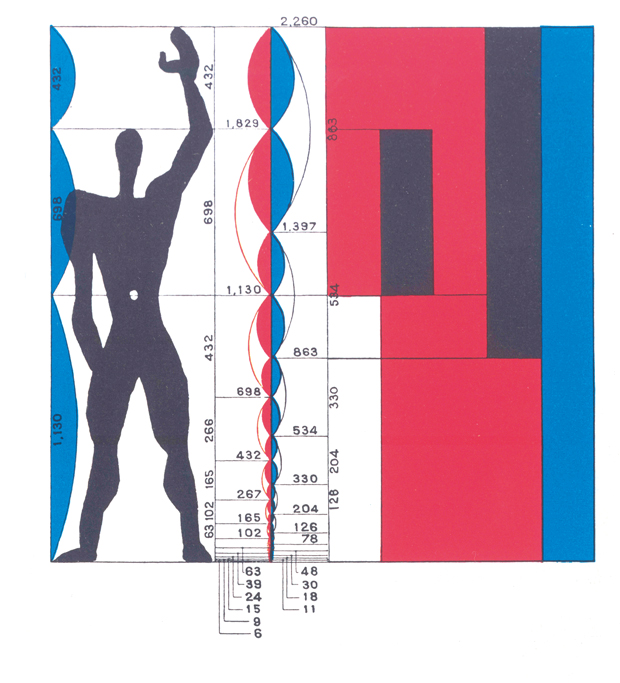
Far on the other end of a spectrum of belief in mathematical art lies Le Corbusier, Swiss architect and painter in whose modernist design some see an almost totalitarian mania for order. Using the Golden Ratio, Corbusier designed a system of aesthetic proportions called Modulor, its ambition, writes William Wiles at Icon, “to reconcile maths, the human form, architecture and beauty into a single system.”
Praised by Einstein and adopted by a few of Corbusier’s contemporaries, Modulor failed to catch on in part because “Corbusier wanted to patent the system and earn royalties from buildings using it.” In place of Leonardo’s Vitruvian Man, Corbusier proposed “Modulor Man” (below) the “mascot of [his] system for reordering the universe.”
Perhaps now, we need an artist to render a “Fractal Man”—or Fractal Gender Non-Specific Person—to represent the latest enthusiastic findings of math in the arts. This time, scientists have quantified beauty in language, a medium sometimes characterized as so imprecise, opaque, and unscientific that the Royal Society was founded with the motto “take no one’s word for it” and Ludwig Wittgenstein deflated philosophy with his conclusion in the Tractatus, “Whereof one cannot speak, thereof one must be silent.” (Speaking, in this sense, meant using language in a highly mathematical way.) Words—many scientists and philosophers have long believed—lie, and lead us away from the cold, hard truths of pure mathematics.
To determine whether the books had fractal structures, the academics looked at the variation of sentence lengths, finding that each sentence, or fragment, had a structure that resembled the whole of the book.
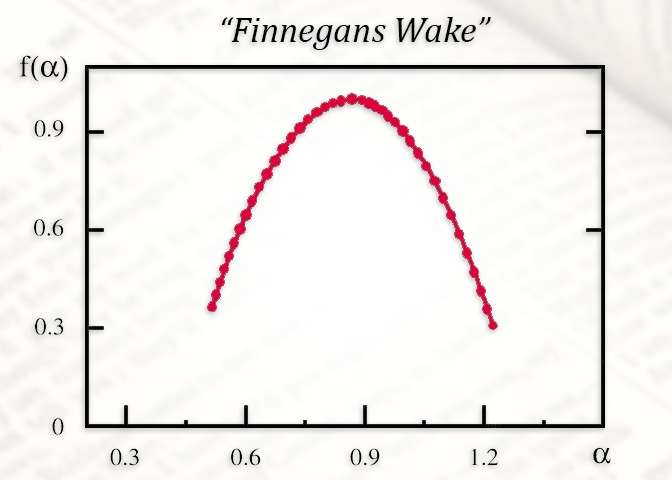
And it isn’t only Joyce. Through a statistical analysis of 113 works of literature, the researchers found that many texts written by the likes of Dickens, Shakespeare, Thomas Mann, Umberto Eco, and Samuel Beckett had multifractal structures. The most mathematically complex works were stream-of-consciousness narratives, hence the ultimate complexity of Finnegans Wake, which Professor Stanisław Drożdż, co-author of the paper published at Information Sciences, describes as “the absolute record in terms of multifractality.” (The graph at the top shows the results of the novel’s analysis, which produced a shape identical to pure mathematical multifractals.)
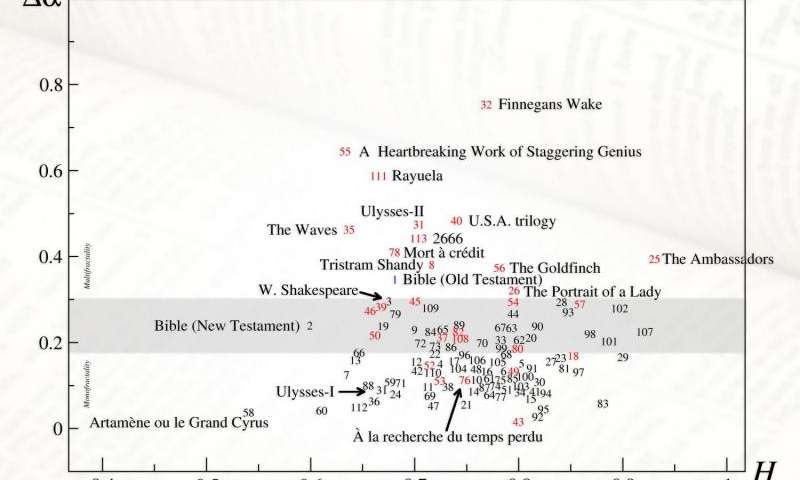
This study produced some inconsistencies, however. In the graph above, you can see how many of the titles surveyed ranked in terms of their “multifractality.” A close second to Joyce’s classic work, surprisingly, is Dave Egger’s post-modern memoir A Heartbreaking Work of Staggering Genius, and much, much further down the scale, Marcel Proust’s Remembrance of Things Past. Proust’s masterwork, writes Phys.org, shows “little correlation to multifractality” as do certain other books like Ayn Rand’s Atlas Shrugged. The measure may tell us little about literary quality, though Professor Drożdż suggests that “it may someday help in a more objective assignment of books to one genre or another.” Irish novelist Eimear McBride finds this “upshot” disappointing. “Surely there are more interesting questions about the how and why of writers’ brains arriving at these complex, but seemingly instinctive, fractals?” she told The Guardian.
Of the finding that stream-of-consciousness works seem to be the most fractal, McBride says, “By its nature, such writing is concerned not only with the usual load-bearing aspects of language—content, meaning, aesthetics, etc—but engages with language as the object in itself, using the re-forming of its rules to give the reader a more prismatic understanding…. Given the long-established connection between beauty and symmetry, finding works of literature fractally quantifiable seems perfectly reasonable.” Maybe so, or perhaps the Polish scientists have fallen victim to a more sophisticated variety of the psychological sharpshooter’s fallacy that affects “Bible Code” enthusiasts? I imagine we’ll see some fractal skeptics emerge soon enough. But the idea that the worlds-within-worlds feeling one gets when reading certain books—the sense that they contain universes in miniature—may be mathematically verifiable sends a little chill up my spine.
We're hoping to rely on loyal readers, rather than erratic ads. Please click the Donate button and support Open Culture. You can use Paypal, Venmo, Patreon, even Crypto! We thank you!
Open Culture scours the web for the best educational media. We find the free courses and audio books you need, the language lessons & educational videos you want, and plenty of enlightenment in between.










-Monet.jpg)
