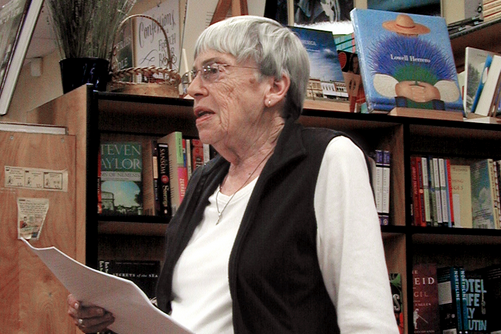
Mind Webs, a 1970’s radio series created by WHA Radio in Wisconsin, featured dramatized readings of classic sci fi stories by the likes of Arthur C. Clarke, Ray Bradbury and Philip K. Dick. You can learn more about the series, and access a complete set of recordings here. Below, we’ve highlighted for you a dramatization of an Ursula K. Le Guin story, “The End.” It’s rare to encounter an audio recording of a Le Guin story online, so we hope you enjoy. “The End” is now added to our collection: 1,000 Free Audio Books: Download Great Books for Free. And if you’re looking to immerse yourself in Le Guin’s fiction, give her groundbreaking novel The Left Hand of Darknessa try. It won the Hugo and Nebula Awards (the top award for fantasy/sci-fi novels) in 1969.
Looking for free, professionally-read audio books from Audible.com? Here’s a great, no-strings-attached deal. If you start a 30 day free trial with Audible.com, you can download two free audio books of your choice. Get more details on the offer here.
And note this: Audiobooks.com also has a free trial offer where you can download a free audiobook. Details.
Sherlock Holmes has become such a cultural fixture since he first appeared in print that all of us have surely, at one time or another, considered reading through the London detective’s complete case files. But where to start? One can always begin at the beginning with that first print appearance, Sir Arthur Conan Doyle’s 1887 novel A Study in Scarlet. But how best to progress through the Sherlock Holmes canon, a body of 56 short stories and four novels (and that number counting only the material written by Conan Doyle himself), some more essential than others?
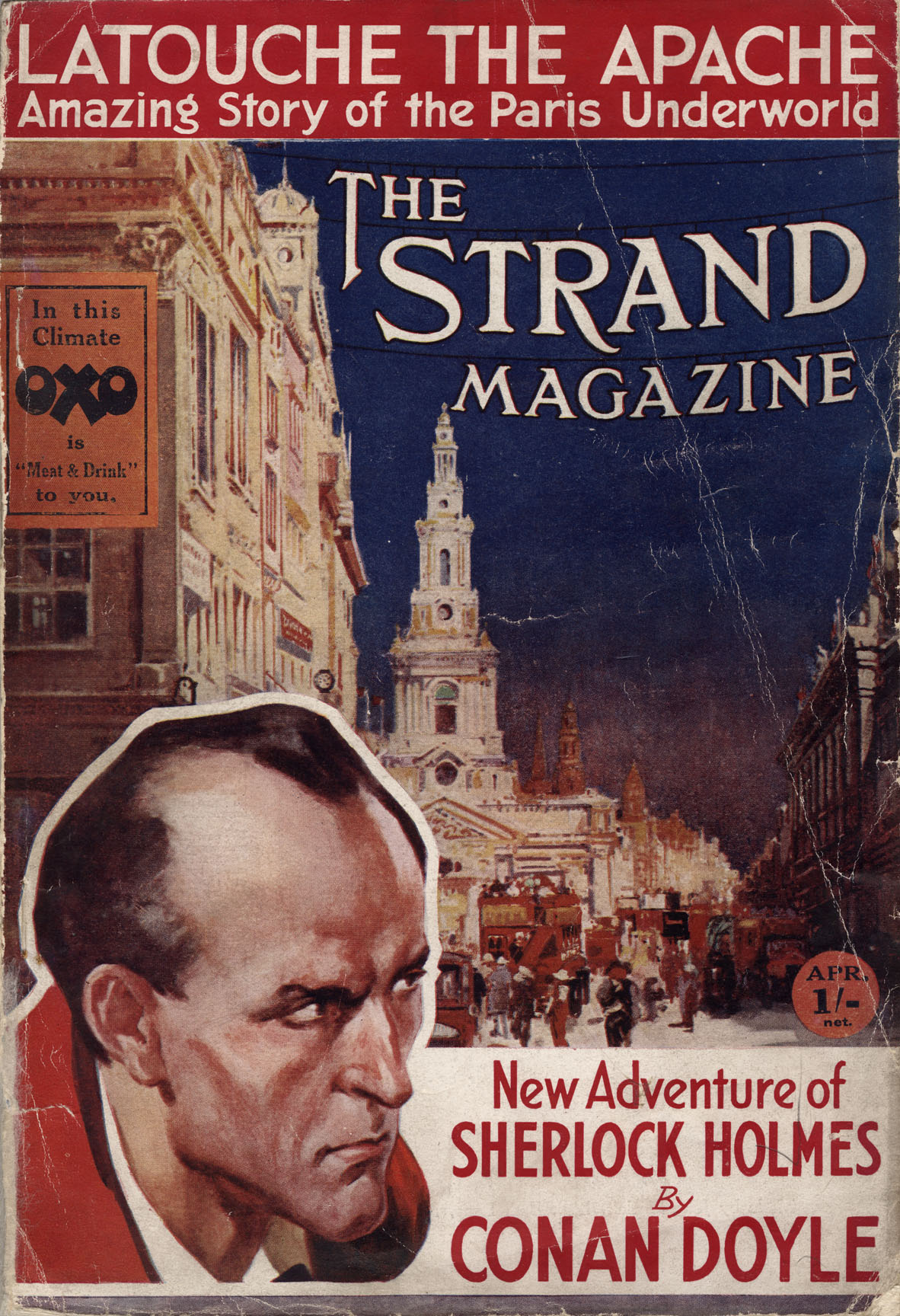
You might consider reading the adventures of Sherlock Holmes according to the preferences of Sherlock Holmes’ creator. We know these preferences because of a 1927 competition in The Strand Magazine, where the character’s popularity first blew up, which asked readers to name the twelve best Sherlock Holmes stories. They asked Conan Doyle the same question, and the list he came up with runs as follows:
“The Final Problem” (“we could hardly leave out the story which deals with the only foe who ever really extended Holmes, and which deceived the public (and Watson) into the erroneous inference of his death”)
“A Scandal in Bohemia” (since, as the first short story in the series, “it opened the path for the others,” and “it has more female interest than is usual”)
“The Musgrave Ritual” (for its inclusion of “a historical touch which gives it a little added distinction” and “a memory from Holmes’ early life”)
“The Reigate Squires” (in which “on the whole, Holmes himself shows perhaps the most ingenuity”)
He later added seven more favorites, including some he’d written after The Strand’s contest took place:
“When this competition was first mooted I went into it in a most light-hearted way,” wrote Conan Doyle, “thinking that it would be the easiest thing in the world to pick out the twelve best of the Holmes stories. In practice I found that I had engaged myself in a serious task.” And those who call themselves Sherlock Holmes enthusiasts know that, though they may have begun reading the stories with an equally light heart, they soon found themselves going deeper and deeper into Holmes’ world in a much more serious way than they’d expected. Starting with Conan Doyle’s selections may set you down the very same path; when you finally come out the other side, feel free to name your own top twelve stories in the comments below.
Before the internet became our primary source of information and entertainment—before it became for many companies a primary revenue stream—it promised to revolutionize education. We would see a democratic spread of knowledge, old hierarchies would crumble, ancient divisions would cease to matter in the new primordial cyber-soup where anyone with entry-level consumer hardware and the patience to learn basic HTML could create a platform and a community. And even as that imagined utopia became just another economy, with its own winners and losers, large—and free—educational projects still seemed perfectly feasible.
These days, that potential hasn’t exactly evaporated, but we’ve had an increasing number of reasons—the threatened status of net neutrality prominent among them—to curb our enthusiasm. Yet as we remind you daily here at Open Culture, free educational resources still abound online, even if the online world isn’t as radical as some radicals had hoped. Frequently, those resources reside in online libraries like the Internet Archive, who store some of the best educational material from pre-internet times—such as theNBC University Theater, a program that comes from another transitional time for another form of mass media: radio.
Before payola and television took over in the fifties, radio also showed great potential for democratizing education. In 1942, at the height of the Golden Age of Radio, NBC “reinaugurated” a previous concept for what it called the NBC University of the Air. “Throughout the mid-1940s,” writes the Digital Deli, an online museum of golden age radio, “NBC produced some twenty-five productions specifically designed to both educate and entertain. Indeed, many of those programs were incorporated into the curricula of high schools, colleges and universities throughout the U.S. and Canada.”
After 1948, the program was retooled as NBC University Theater, then simply NBC Theater. “Irrespective of the title change,” however, the program “continued to maintain the same high standards and continued to expand the number of colleges offering college credit for listening to and studying the programs’s offerings.” Digital Deli has the full details of this proto-MOOC’s curriculum. It consists of listening to adaptations of “great American stories,” great “world” stories–from Voltaire, Swift, and others–and adaptations of modern American and British fiction and “Great Works of World Literature.”
In short, the NBC University Theater adaptations might substitute for a college-level literary education for those unable to attend a college or university. In the playlist above, you can hear every episode from the show’s final run from 1948 to 1951. We begin with an adaptation of Sinclair Lewis’s Main Street and end with Thomas Hardy’s “The Withered Arm.” In-between hear classic radio drama adaptations of everything from Austen to Faulkner and Hemingway to Ibsen. There are 110 episodes in total.
Each episode features commentary from distinguished authors and critics, including Robert Penn Warren, E.M. Forster, and Katherine Anne Porter. “Apart from the obvious academic value” of the series, writes Digital Deli, “it’s clear that considerable thought—and daring—went into the selections as well.” Despite the tremendous increase in college attendance through the G.I. Bill, this was a period of “rising hostility towards academics, purely intellectual pursuits, and the free exchange of philosophies in general.”
The ensuing decade of the fifties might be characterized culturally, writes Digital Deli, as an “intellectual vacuum”—anti-intellectual attitudes swept the country, fueled by Cold War political repression. And radio became primarily a means of entertainment and advertising, competing with television for an audience. Quality radio dramas continued—most notably of excellent science fiction. But never again would an educational program of NBC University Theater’s scope, ambition, and radical potential appear on U.S. radio waves.
The border-obsessed map animator known as Emperor Tigerstar views war from a distance. The Emperor leaves such details as journal entries, letters home, and tales of valor and cowardice for other history buffs.
His niche is meticulously clocking the defeat and triumph in terms of shifting territories, by year, by fortnight, and, in the case of World War Iand World War II, by day.
The Blue and the Gray are here represented by blue and red, with the mustard-colored disputed border states picking sides before the first minute is out. (The Union’s Naval Blockade is in formation within seconds.)
Legend:
Maroon = Confederate States of America and territories
Red = Areas occupied by Confederate forces
Pink = Gains for that Day
Dark Blue = United States of America and territories
Blue = Areas occupied by Union forces.
Light blue = Gains for that day
Yellow = Border states / disputed areas.
The magnitude is moving, especially when paired with ground-level observations, be they fictional, historical or eyewitness.
Even the place-names on the map, which now were merely quaint, would take on the sound of crackling flame and distant thunder, the Biblical, Indian and Anglo-Saxon names of hamlets and creeks and crossroads, for the most part unimportant in themselves until the day when the armies came together, as often by accident as on purpose, to give the scattered names a permanence and settle what manner of life future generations were to lead.
Ayun Halliday is an author, illustrator, and Chief Primatologist of the East Village Inky zine. Her play, Fawnbook, opens in New York City later this fall. Follow her @AyunHalliday
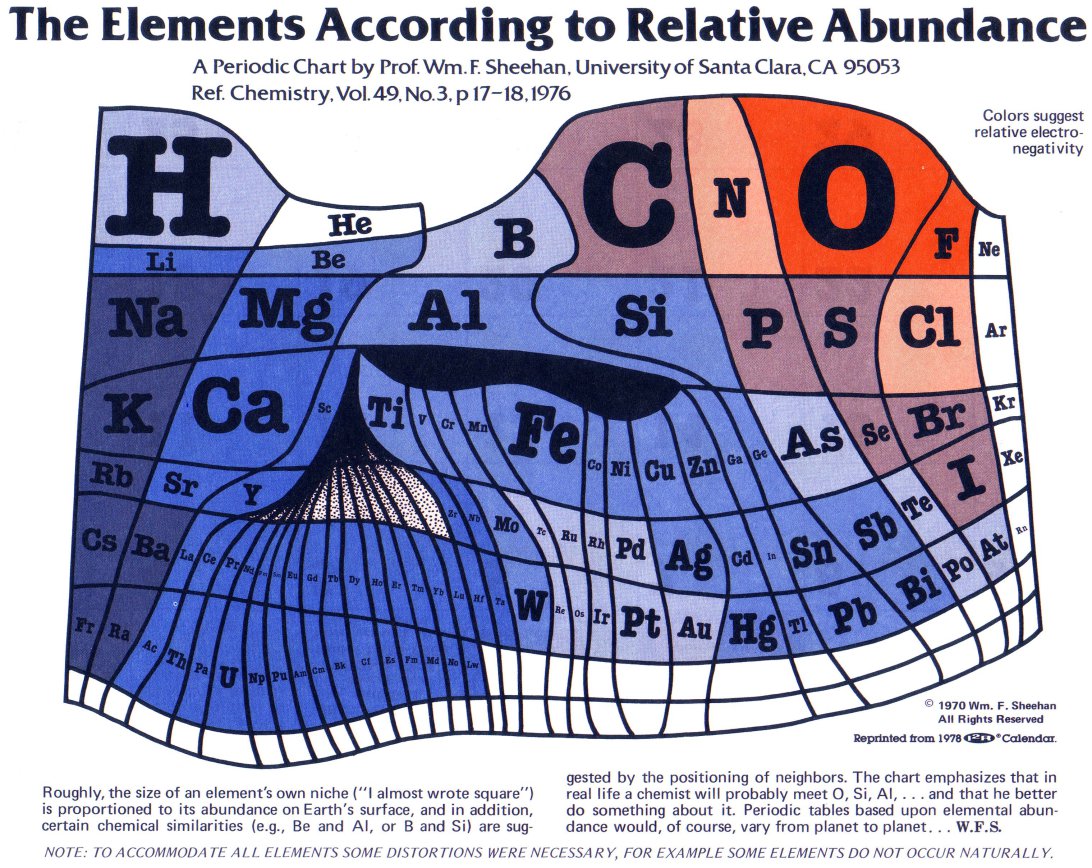
When you learned about The Periodic Table of Elements in high school, it probably didn’t look like this. Above, we have a different way of visualizing the elements. Created by Professor William F. Sheehan at Santa Clara University in 1970, this chart takes the elements (usually shown like this) and scales them relative to their abundance on the Earth’s surface. In the small print beneath the chart, Sheehan notes “The chart emphasizes that in real life a chemist will probably meet O, Si, Al [Oxygen, Silicon and Aluminum] and that he better do something about it.” Click here to see the chart — and the less abundant elements — in a larger format. Below we have a few more creative takes on the Periodic Table.
Follow Open Culture on Facebook and Twitter and share intelligent media with your friends. Or better yet, sign up for our daily email and get a daily dose of Open Culture in your inbox.
If you want to prepare for a career practicing law, you could do much worse than joining Harvard University’s debate team. But if, far on the other end of the spectrum of the American experience, you end up deep on the wrong side of the law, going to prison rather than college, you need not relinquish your dreams of excelling at this traditional intellectual sport. We now have the precedent to prove it: “Months after winning a national title,” reports the Guardian’s Lauren Gambino, “Harvard’s debate team has fallen to a group of New York prison inmates.”
“The showdown,” which revolved around the question of whether public schools should be allowed to turn away undocumented students, “took place at the Eastern correctional facility in New York, a maximum-security prison where convicts can take courses taught by faculty from nearby Bard College, and where inmates have formed a popular debate club.” They call this program the Bard Prison Initiative, under which inmates have the chance to earn a Bard College degree (through a non-vocational “liberal arts curriculum, including literature, foreign language, philosophy, history and the social sciences, mathematics, science, and the arts”) at satellite campuses established in six New York state prisons. You can see this selective, rigorous and highly unusual educational institution in action in the Washington Post video above. And also in a 2011 PBS News Hour profile below.
The Bard Prison Initiative’s debate victory over Harvard made for a notable event in the program’s history indeed. “But it’s also worth pointing out,” writes Peter Holley, author of the Post article, “the fallacy of our underlying assumptions about such a matchup — the first (and most pernicious) being that criminals aren’t smart. If a definitive link between criminality and below-average intelligence exists, nobody has found it.” The Bard Prison Initiative has operated on that premise since 2001, and its debate team’s previous high-profile win saw it beating that of West Point — all, you may hardly believe, through old-fashioned research, without any kind of access to the internet. If you’d like to leave your condolences for the Harvard College Debating Union, you may do so at their Facebook page. You can also make a worthwhile financial contribution to the Bard Prison Initiative here.
UK film monthly magazine Sight & Sound’s most recent issue is dedicated to “The Female Gaze: 100 Overlooked Films Directed by Women.” The list of 100 films runs some 20 pages, and the edition also collects mini essays from actors like Greta Gerwig, Isabelle Huppert, and Tilda Swinton; directors like Jane Campion and Claire Denis, and critics like Amy Taubin and Camille Paglia, all focusing on female-directed films that deserve a second look.
Many of the filmmakers are fairly obscure, but even better known directors are represented here with lesser-known selections, like Ida Lupino’s Outrage (and not her noir classic The Hitchhiker) and Kathryn Bigelow’s The Loveless, her first feature co-directed with Monty Montgomery and featuring a young Willem Dafoe. (Fact: Until Bigelow won for The Hurt Locker in 2010, no woman had earned a Best Director Oscar).
Presented in chronological order, the list of 100 Overlooked Films Directed by Women features many landmarks in film history, like Lotte Reiniger’s 1926 The Adventures of Prince Achmed, the first feature-length animated film, which we recently highlighted here. Open Culture has also previously discussed Germaine Dulac’s 1928 surrealist film The Seashell and the Clergyman.
Lois Weber’s 1913 Suspense, her short film co-directed with Philippe Smalley (view it at the top of the post), is one of the first examples of cross-cutting to create tension, and it even features a three-way split frame. Cross-cutting is a technique all thrillers have used since. (And Weber stars in the film as well.)
Sight & Sound also profiles Stephanie Rothman, the first female director to work for Roger Corman, and her 1971 film The Velvet Vampire, a West Coast take on a gothic genre. Jessie Maple, who made Will in 1981, was the first African-American woman to become a part of New York’s camera operator’s union.
Then there’s the careers of filmmakers whose lives were cut short: Soviet director Larisa Shepitko died in a car crash at 40, leaving behind two masterpieces, while Elia Kazan’s wife Barbara Loden made her debut with Wanda in 1970 and passed away soon after, too young.
Many of these films are difficult or impossible to find, and Sight & Sound includes an online article of eight more films that might be lost for good, like the aforementioned Lois Weber’s only color film White Heat, or the only film actor Lillian Gish directed, Remodeling Her Husband.
Readers interested in the contributions of women filmmakers will want to explore the Women Film Pioneers website hosted by Columbia University.
Ted Mills is a freelance writer on the arts who currently hosts the FunkZone Podcast. You can also follow him on Twitter at @tedmills, read his other arts writing at tedmills.com and/or watch his films here.
Back in June we highlighted Neil Halloran’s 15 minute film, The Fallen of World War II, which used “innovative data visualization techniques to put the human cost of WW II into perspective, showing how some 70 million lives were lost within civilian and military populations across Europe and Asia, from 1939 to 1945.” It’s a pretty staggering illustration of the deadliest war. As the film went viral, Halloran raised money that would enable him to develop new films exploring “other trends of war and peace — from drones and terrorism to democracy and peacekeeping.” He has also translated the film into six different languages. They all went online in the last few weeks. Here they are: Russian, Japanese, Polish, French, German, and Serbian.
Above, you can watch the original in English (certainly worth doing if you were vacationing in June), and you might also explore the accompanying interactive web site here.
Follow Open Culture on Facebook and Twitter and share intelligent media with your friends. Or better yet, sign up for our daily email and get a daily dose of Open Culture in your inbox. And if you want to make sure that our posts definitely appear in your Facebook newsfeed, just follow these simple steps.
As you know if you saw our previous posts featuring Leonard Nimoy’s readings of stories by Ray Bradbury and Isaac Asimov, the late Star Trek icon could — unsurprisingly, perhaps — tell a science-fiction tale with the best of them. It turns out that he could also give masterful readings of science fiction from other eras too, as far back as the earliest works to define the genre, which we’ve discovered after hearing his performance of H.G. Wells’ The War of the Worlds, an out-of-print edition recently digitized from cassette tape and posted to Youtube in twoparts.
With this story of Earth invaded from “across the gulf of space” by aliens with “minds that are to our minds as ours are to those of the beasts that perish, intellects vast and cool and unsympathetic,” Wells did much to help give science fiction the form we recognize today. The War of the Worlds came out in book form in 1898, preceded by such similarly speculative and innovative works as The Time Machine and The Invisible Man, and then followed by the likes of The First Men in the Moon and The Shape of Things to Come. (Find most of these works neatly packaged in the HG Wells Classic Collection.) This Leonard Nimoy recording originally came out in 1976, published by the record label Caedmon, known for doing plenty of innovation of their own in the then-yet-unnamed field of audiobooks.
Caedmon put out not just this album and the one with Nimoy reading Bradbury, but others featuring Kurt Vonnegut, Vincent Price, Tennessee Williams, T.S. Eliot, Ernest Hemingway, and Sylvia Plath. As much as science-fiction die-hards will enjoy hearing this pairing of Nimoy and Wells here, some will certainly want to track down the actual LP — not just for the collectors’ value, but because it features liner notes by none other than that other vastly influential creator of sci-fi as we know it, Isaac Asimov. It looks like there’s one used copy on Amazon. The reading, we should note, is an abridged version of the original text.
The lag time between our imagining of social equality and its arrival can be significantly long indeed, or it least it can seem so, given the limitations of human mortality. 113 years may not be an especially long time for a tree, say, or even a very healthy Galapagos tortoise, but if you or I had been alive in 1902, chances are we’d never know that in 2015 the president of Europe’s most powerful nation is a woman, as are two major presidential candidates in the United States. Given the amount of inequality we still see worldwide, this may not always feel like a triumph. In 1902, it might have seemed like “nothing but fantasy.”
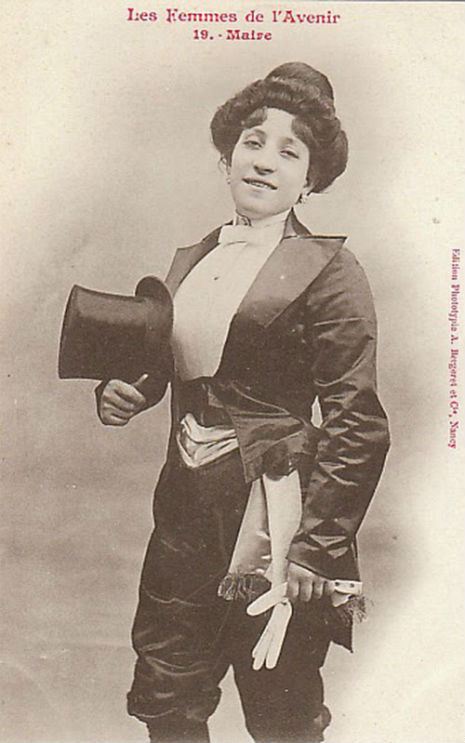
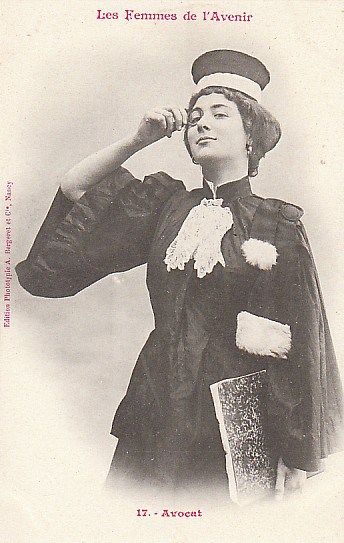
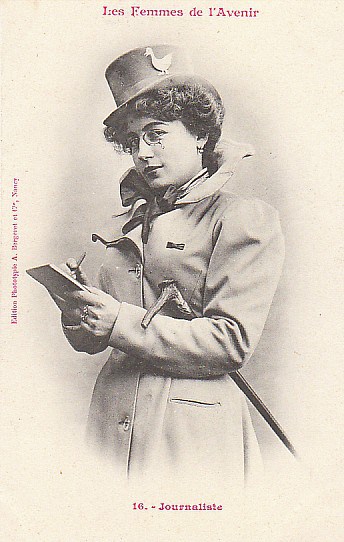
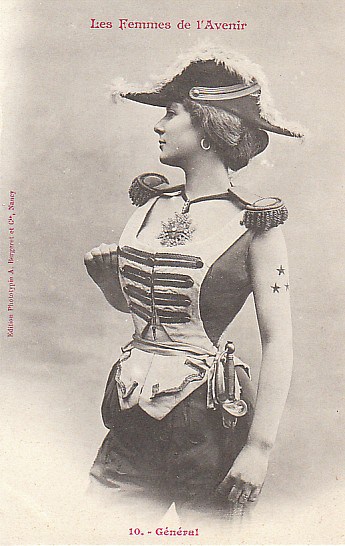
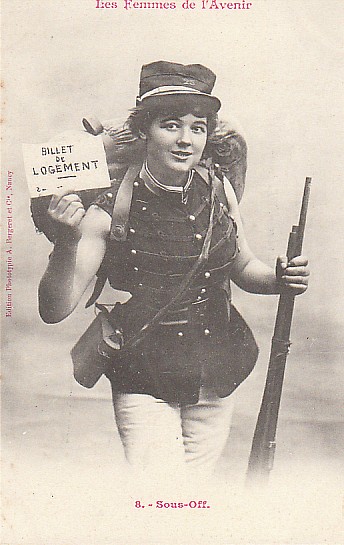
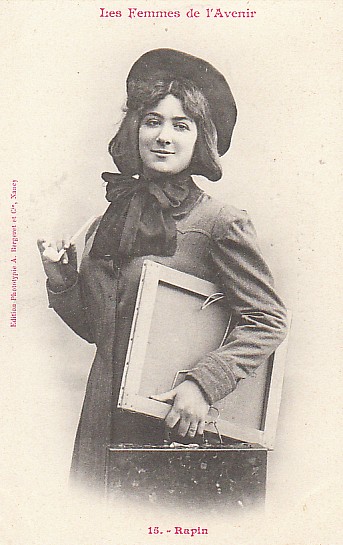
And yet even then, it was certainly possible to foresee women occupying all the roles that men did, through the lenses, writes Laura Hudson at Boing Boing, of “fantasy and science fiction,” which “can often help us open our minds behind the limitations of the world we live in and imagine a better one instead.” In 1902, artist Albert Bergeret was commissioned to create the trading cards you see here—just a small selection of twenty total photographs called “Les Femmes de l’Avenir”—Women of the Future. Only one theme among many in a series of different sets of cards, this “retrofuturistic attempt to expand the role of women in society” showed us a “small and fashionable world” where “women were given a more equal role in society, not to mention spectacular hats.”
That may be so, but just as we can never accurately see the future, we can also never reach consensus on the meaning of the past. The Daily Mail’s Maysa Rawi agrees with Hudson about the “pin-up quality to many of the images,” which show “an awful lot of arm.” And yet Rawi disparages the entire set as “meant to capture men’s fantasies rather than be part of any feminist movement.” I’ll admit, I don’t see the cards this way at all, nor do I think the categories are mutually exclusive. Pin-up girls have also represented social power, albeit mainly sexual power. Scantily-clad female superheroes like Wonder Woman, though crafted to appeal to the fantasies of teenage boys, are also powerful because… well, they have superpowers.
Perhaps that’s one way to look at Bergeret’s cards. He is not mocking his subjects, nor hyper-sexualizing them, but presenting, as each card indicates, advanced futuristic beings who didn’t yet exist in his time. The Daily Mail captions several of the photos with factoids about women’s advances in French history. In some cases, Bergeret did not have to extrapolate far. Women could practice law in 1900; women served in the army during the French Revolution, but did not fight. Colleges had been open to women since 1879. A few women worked as doctors and journalists in Bergeret’s time. Marie Curie, you’ll recall, had discovered polonium, coined the term “radioactivity,” and would win the Nobel Prize in 1903. Queen Victoria had ruled over half the world.
But French women would have to wait several more decades to enter most of the professions represented. No matter how sexy—and in some cases ridiculous—some of the costumes in these photos, Bergeret shot the models with poise, style, and dignity. Perhaps he and many in his audience could easily imagine female generals, mayors, firewomen, soldiers, etc. Yet one particular card stands out. It portrays a self-satisfied, Bohemian model labeled “rapin”—which a reader below informs us is “an argot word for (bad) painter.”
Founded and directed by physicist Lawrence Krauss, Arizona State’s Origins Project has for several years brought together some of the biggest minds in the sciences and humanities for friendly debates and conversations about “the 21st Century’s greatest challenges.” Previous all-star panels have included Krauss, Neil DeGrasse Tyson, Bill Nye, Brian Greene, and Richard Dawkins. Stephen Hawking has graced the ASU Origins Project stage, as has actor and science communicator Alan Alda. And this past March, in a sold-out, highly-anticipated Origins Project event, Krauss welcomed Noam Chomsky to the stage for a lengthy interview, which you can watch above.
Although Krauss says he’s wary of hero worship in his laudatory introduction, he nonetheless finds himself asking “What Would Noam Chomsky Do” when faced with a dilemma. He also points out that Chomsky has been “marginalized in U.S. media” for his anti-war, anarchist political views. Those views, of course, come widely into play during the conversation, which ranges from the theory and purpose of education—a subject Chomsky has expounded on a great deal in books and interviews—to the fate of political dissidents throughout history.
Chomsky also gives us his views on science and technology, particularly in the Q&A portion of the talk above, in which he answers questions about artificial intelligence—another subject he’s touched on in the past—and animal experimentation, among a great many other topics. Krauss mostly hangs back during the initial discussion but takes a more active role in the session above, offering views on medical and scientific ethics that will be familiar to those who follow his atheist activism and championing of rationality over religious dogma.
As Chomsky puts it, “the environment, the commons… they’re a common possession, but space is even more so. For individuals to allow institutions like corporations to have any control over it is devastating in its consequences. It will also almost certainly undermine serious research.” He refers to the example of most modern computing—developed under publicly-funded government programs, then marketed and sold back to us by corporations. Krauss makes a case for unmanned space exploration as the cost-effective option, and both thinkers discuss the problem of militarizing space, the ultimate goal of Cold War space programs before the fall of the Soviet Union. The conversation is rich and revealing and makes an excellent supplement to the already rich discussion Krauss and Chomsky have in the videos above.
We're hoping to rely on loyal readers, rather than erratic ads. Please click the Donate button and support Open Culture. You can use Paypal, Venmo, Patreon, even Crypto! We thank you!
Open Culture scours the web for the best educational media. We find the free courses and audio books you need, the language lessons & educational videos you want, and plenty of enlightenment in between.