Here’s a flawed but fascinating little film about the life of Vladimir Nabokov, examined through the prism of his most famous book.
How Do You Solve a Problem Like Lolita?first aired on British television in 2009. The host is Stephen Smith, a culture correspondent for BBC Newsnight. We don’t know the rest of Smith’s resume, but in watching the documentary we get the feeling he may have picked up a little of his journalistic sensibility from the British tabloids.
The problem referred to in the title is the sense–at least among Smith’s friends–that there is something “pervy” about Nabokov’s 1955 novel, Lolita, and that this raises certain questions about the author’s own sexual penchants. “Was it a morality play,” Smith asks at the outset, “or the fantasy of a dirty old man?”
It’s a contemptible point of departure. But How Do You Solve a Problem Like Lolita? manages to be worthwhile in spite of itself. It’s filled with interesting old footage of Nabokov talking about himself and his work, as well as contemporary footage of the writer’s old haunts in Russia, America and Switzerland. The film is a kind of travelogue. Watching it is like taking a one-hour tour through a fascinating landscape with an amiable but slightly annoying guide.
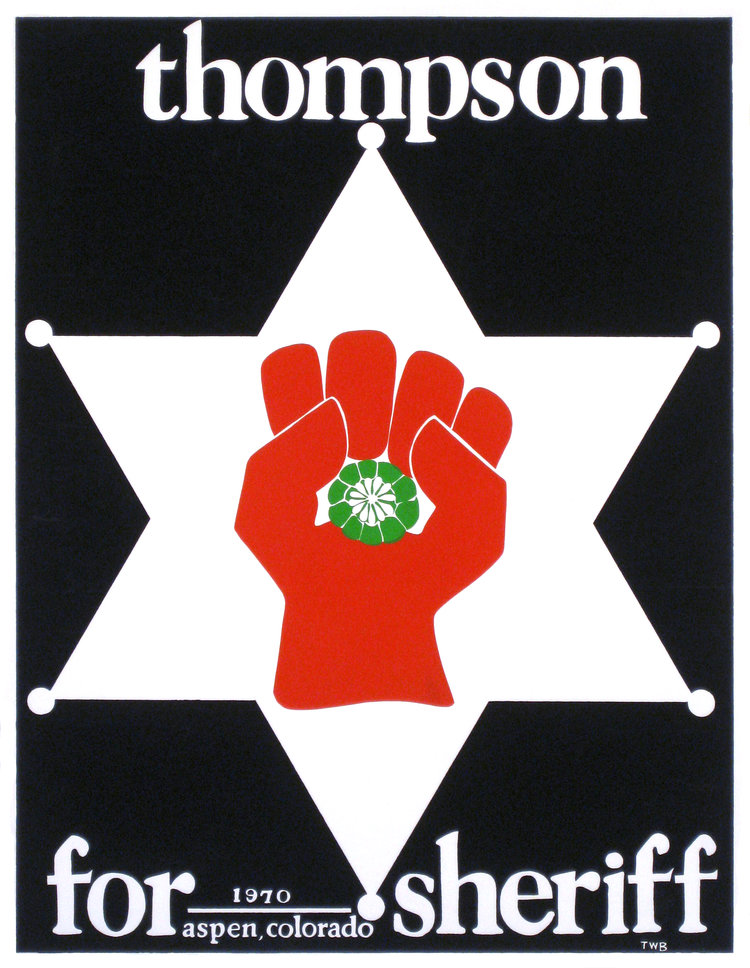
In 1970, Hunter S. Thompson was looking to become the new sheriff in town — the town being Aspen, Colorado. In a heated election, Thompson ran against a traditional, conservative candiate, Carrol Whitmire, on what he called the “freak power” platform, which mostly called for the legalization of marijuana and unconventional environmental protections.
As Thompson later explained in his essay “Freak Power in The Rockies,” hundreds of Haight-Ashbury refugees moved to Aspen after the ill-fated “Summer of Love” in 1967, and they became part of the general population. In the town, registered Republicans historically outweighed registered Democrats by a two-to-one margin.
But both camps were outweighed by independents, which included “a jangled mix of Left/Crazies and Birchers; cheap bigots, dope dealers, nazi ski instructors and spaced off ‘psychedelic farmers’ with no politics at all beyond self-preservation,” remembers Thompson. So, winning an election came down to registering indie voters and getting them to the polls — something that was easier said than done, it turns out.
In the short term, Hunter S. Thompson lost the “Battle of Aspen” by 300–500 votes, depending on whose accounts you read. In the long-term, he arguably won. 42 years after Thompson made the legalization of marijuana his central campaign promise, Colorado voters passed Amendment 64, legalizing marijuana for recreational use. Somewhere, the would-be gonzo politician is smiling.
After Jimi Hendrix’s discharge from the army, he earned his living as a traveling musician on the so-called Chitlin’ Circuit—the circuit of venues throughout the segregated South that booked black musicians. Hendrix backed such giants of R&B, soul, and electric blues as Wilson Pickett and Sam Cooke, and during those early years with his own band the King Casuals, the Nashville scene he’d settled into, and the circuit gigs, he perfected the stylistic quirks and stunts that would make him world famous just a few years later—playing right-handed guitars upside down as a lefty, playing solos with his teeth and behind his head—often to the irritation of his bandmates and employers. He wanted to do his own thing, but he paid his dues, jamming with and learning from some of the top acts in early rock & roll while Eric Clapton and Keith Richards were listening to those same groups on the radio, painstakingly copying their sound.
After nearly two years on the circuit, the restless and flamboyant young Hendrix, chafing under the direction of strict bandleaders, finally had enough of Tennessee and moved to Harlem to strike out on his own, but he still worked as a sideman: he recorded with the Isley Brothers, toured with Little Richard, and in 1965, he made his first ever TV appearance with a pair of Long Island singers named Buddy and Stacy on Nashville’s Channel 5 program Night Train, doing the Junior Walker & the All Stars top-ten hit “Shotgun.” In the video above you can see Hendrix (to the right of the drummer), grooving behind the foppishly-dressed vocal duo. Note how his moves are out of sync with the rest of the band, all right-handed players. Note how his pompadour is slightly unkempt. Note, if you watch closely, his right hand traveling up and down the neck of his guitar, pulling off some killer runs—in a song that stays on one note for the duration—even while stuck behind the action.
This performance marks one of the last times Hendrix would stand in the shadows of other bandleaders. After working steadily in the studio as a session player in 1966, he formed his own band, the Blue Flame (as Jimmy James), and took up residence at the historic Café Wha? in Greenwich Village (where my father saw him play, he tells me, and was floored, having no idea who the guy was). ’66 is the year Hendrix fully crossed over (some said sold out; some said sold his soul) from the soul/R&B circuit to mainstream rock & roll success. He wouldn’t crack the U.S. until his legendary appearance at the Monterey Pop Festival in June of 1967, but after forming the Jimi Hendrix Experience in late ’66, he wowed audiences in Europe with his first single “Hey Joe,” and appeared on UK TV shows Ready Steady Go! and Top of the Pops. Three months before Monterey, the band appeared on popular German TV program Beat Club. Check out their performance above, doing “Hey Joe” and “Purple Haze.” Hendrix doesn’t set any fires, but he does get in a solo with his teeth.
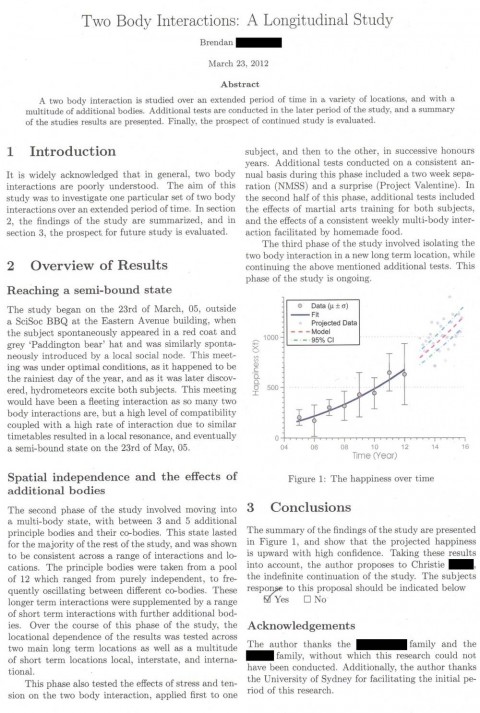
On reddit, a user wrote yesterday, “My boyfriend of 7 years and I are both physicists. Here’s how he proposed to me.” Yes, the marriage proposal is a physics paper of sorts, called “Two Body Interactions: A Longitudinal Study,” that concludes:
The summary of the findings of the study are presented in Figure 1 and that that the project happiness is upward with high confidence. Taking these results into account, the author proposes to Christie the indefinite continuation of the study. The subjects response to their proposal should be indicated below [by checking the “Yes” or “No” box].
Brendan McMonigal and Christie Nelan (pictured here) met at the University of Sydney seven years ago. They will tie the knot this coming May, and we hope you’ll wish them the best.…
As everyone surely knows by now, today would have been Johnny Cash’s 81st birthday, and he’s been rightly celebrated all around the internet for his one-of-a-kind country persona as “The Man in Black.” Cash was so well-loved in part because, like only a handful of other country stars (Hank Williams, Patsy Cline, Dolly Parton, Emmylou Harris), he transcended the genre, winning fans from every conceivable corner. The outlaw singer was also no stranger to TV and film cameras, once hosting his own talk show and appearing in several dozen films and TV shows as himself.
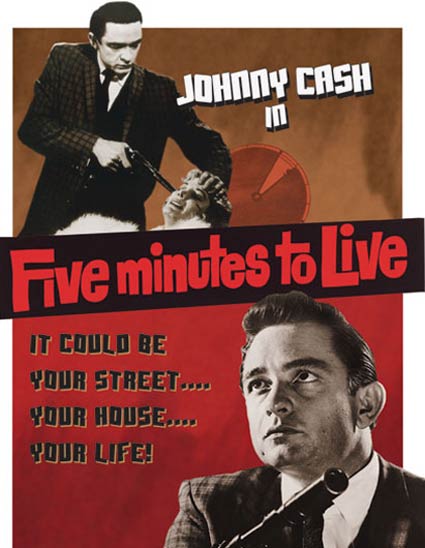
But did you know that Cash once had a starring feature film role alongside Vic Tayback and Ron Howard? That’s right, in the 1961 crime drama above, Five Minutes to Live, Cash plays Johnny Cabot, described by Rotten Tomatoes as “a bloodthirsty New Jersey gangster who is forced to hide out in a small California suburb after killing a cop during a job gone wrong.”
Cabot is a musical crook, who tricks his way into a bank president’s home by convincing the president’s wife he’s a guitar salesman. Once inside, he terrorizes her and sings menacing songs in her direction. Ron Howard plays the victimized woman’s son Bobby, and another country great, guitarist Merle Travis, has a small role as a bowling alley owner. It’s all in keeping, I guess, with the Johnny Cash outlaw legend (though he may have regretted the lurid, grindhouse movie poster below).
Five Minutes to Live was re-released in 1966 as Door-to-Door Maniac. Whatever you call it, you may hear more about this movie soon: Speed director Jan de Bont has been brought on to direct a remake in the near future. And yes, there’s been talk (if only tongue-in-cheek) of casting Joaquin Phoenix in the Cash role.
Five Minutes to Live is in the public domain, and we’ve added it to our collection of 500 Free Movies Online.
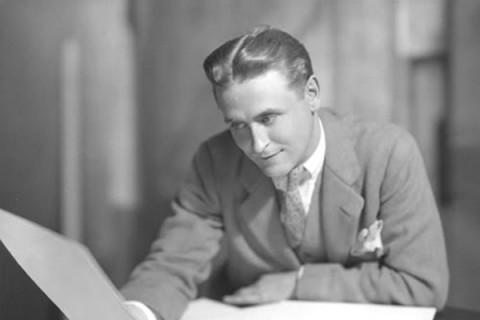
F. Scott Fitzgerald is often portrayed as a natural-born writer. “His talent,” says Ernest Hemingway in A Moveable Feast, “was as natural as the pattern that was made by the dust on a butterfly’s wings.” But Fitzgerald saw himself in a different light. “What little I’ve accomplished,” he said, “has been by the most laborious and uphill work.”
Last week we brought you Seven Tips From Ernest Hemingway on How to Write Fiction. Today we’re back with a similar list of advice from Hemingway’s friend and rival Fitzgerald. We’ve selected seven quotations from F. Scott Fitzgerald on Writing, which was edited by Larry W. Phillips and published in 1985 as a companion to the Hemingway book. As in the previous post, we’ve organized the advice under our own headings and added some brief commentary.
1: Start by taking notes.
Fitzgerald made a habit of recording his stray thoughts and observations in notebooks. He organized the entries into categories like “Feelings and emotions,” “Conversations and things overheard” and “Descriptions of girls.” When Fitzgerald was giving writing advice to his mistress Sheilah Graham in the late 1930s, he advised her to do the same. In her 1940 memoir, Beloved Infidel, Graham quotes Fitzgerald as saying:
You must begin by making notes. You may have to make notes for years.… When you think of something, when you recall something, put it where it belongs. Put it down when you think of it. You may never recapture it quite as vividly the second time.
2: Make a detailed outline of your story.
When Fitzgerald was working on a novel, he would surround himself with charts outlining the various movements and histories of his characters. In a 1936 letter to novelist John O’Hara, he advises the younger novelist to start with a big outline:
Invent a system Zolaesque…but buy a file. On the first page of the file put down an outline of a novel of your times enormous in scale (don’t worry, it will contract by itself) and work on the plan for two months. Take the central point of the file as your big climax and follow your plan backward and forward from that for another three months. Then draw up something as complicated as a continuity from what you have and set yourself a schedule.
3: Don’t describe your work-in-progress to anyone.
Fitzgerald’s policy was never to talk with other people about the book he was working on. In a 1940 letter to his daughter Scottie, he says:
I think it’s a pretty good rule not to tell what a thing is about until it’s finished. If you do you always seem to lose some of it. It never quite belongs to you so much again.
4: Create people, not types.
Fitzgerald was known for creating emblematic characters, but he said it was accidental. “I had no idea of originating an American flapper when I first began to write,” he said in a 1923 interview for Metropolitan magazine. “I simply took girls who I knew very well and, because they interested me as unique human beings, I used them for my heroines.” In the opening sentence of his 1926 short story, “The Rich Boy,” Fitzgerald explains the principle:
Begin with an individual, and before you know it you find that you have created a type; begin with a type, and you find that you have created–nothing.
5: Use familiar words.
In a 1929 letter to his college friend and fellow writer John Peale Bishop, Fitzgerald says:
6: Use verbs, not adjectives, to keep your sentences moving.
In a 1938 letter to his daughter, Fitzgerald writes:
About adjectives: all fine prose is based on the verbs carrying the sentences. They make sentences move. Probably the finest technical poem in English is Keats’ “Eve of Saint Agnes.” A line like “The hare limped trembling through the frozen grass,” is so alive that you race through it, scarcely noticing it, yet it has colored the whole poem with its movement–the limping, trembling and freezing is going on before your own eyes.
7: Be ruthless.
A writer has to make some hard choices. Fitzgerald warns about the danger of becoming too attached to something you’ve written. Keep an objective eye on the whole piece, he says, and if something isn’t working get rid of it. In a 1933 Saturday Evening Post article titled “One Hundred False Starts,” he writes:
I am alone in the privacy of my faded blue room with my sick cat, the bare February branches waving at the window, an ironic paper weight that says Business is Good, a New England conscience–developed in Minnesota–and my greatest problem:
“Shall I run it out? Or shall I turn back?”
Shall I say:
“I know I had something to prove, and it may develop farther along in the story?”
Or:
“This is just bullheadedness. Better throw it away and start over.”
The latter is one of the most difficult decisions that an author must make. To make it philosophically, before he has exhausted himself in a hundred-hour effort to resuscitate a corpse or disentangle innumerable wet snarls, is a test of whether or not he is really a professional. There are often occasions when such a decision is doubly difficult. In the last stages of a novel, for instance, where there is no question of junking the whole, but when an entire favorite character has to be hauled out by the heels, screeching, and dragging half a dozen good scenes with him.
Some online scrabbling led me to the BBC’s Horrible Histories’ brief overview of the “causes of World War I” (above). Wow. If only this series—and, ahem, the Internet—had existed when I was the boy’s age! I think it’s safe to say my attention would have been captured. It’s silly, yes, but that’s the whole point. The players’ over-the-top comedic style ensures that even the driest of historical facts will stick, as anyone who’s watched Michael Cera bring Alexander Hamilton to life in Drunk History can attest. It’s the perfect gateway for further study.
Horrible Histories’ take on World War I proved such a hit, the boy immediately delved into other periods, often when he was supposed to be doing other things, like playing Minecraft or watching YouTube (technically, I guess this sort of counts). Still it’s gratifying to hear him studding his conversation with casual references to the Borgias, the Tudors, and Martin Luther. It makes me want to learn more, or at least bring myself up-to-speed on the videos. In the words of Schoolhouse Rock, knowledge is power.
A WWI centennial’s looming, folks. Don’t get caught with your drawers down.
Ayun Halliday graduated from Northwestern University with a degree in theater and has been making up for it ever since. Follow her @AyunHalliday
I’ll confess, when it comes to computers, I’m pretty much strictly a user. And these days, with the potential freedom and creatively afforded by open access software, the endless hacks for virtually everything, and the availability of free online computer classes, that seems like kind of a lame admission. So I’m tempted to rectify my programming ignorance by pushing through what promises to be a rigorous intro to computer science, CS50, Harvard’s introductory course for both majors and non-majors alike. The course offers a broad knowledge base to build on, as you can see from the description below:
Topics include abstraction, algorithms, encapsulation, data structures, databases, memory management, security, software development, virtualization, and websites. Languages include C, PHP, and JavaScript plus SQL, CSS, and HTML. Problem sets inspired by real-world domains of biology, cryptography, finance, forensics, and gaming. Designed for concentrators and non-concentrators alike, with or without prior programming experience.
Harvard has made this course available free to anyone—via YouTube, iTunes, and the course page—with a series of lectures filmed during the Fall 2011 semester. The class is led by David J. Malan, an enthusiastic young professor and Senior Lecturer on Computer Science at Harvard, and himself a product of Harvard’s Computer Science program. Professor Malan has also offered Harvard’s CS50 as a MOOC through edX. In the introductory lecture to CS50 (above), Malan promises that “this is one of those rare courses that actually squeezes your brain so much and your schedule so much that by the end of the semester you actually feel smarter.”
Professor Malan has become something of a hot shot at Harvard. His mission—to make computer science more accessible and far less daunting. He’s done this in part by generously making several of his courses available free online to non-Harvard students. In addition to CS50, Malan offers the following courses for those who want to pursue programming or web design further:
And if you still need some selling on the values and virtues of computer science, watch Malan below deliver an inspiring talk called “And the Geek Shall Inherit the Earth” at Harvard Thinks Big 2010 (Harvard’s version of TED Talks).
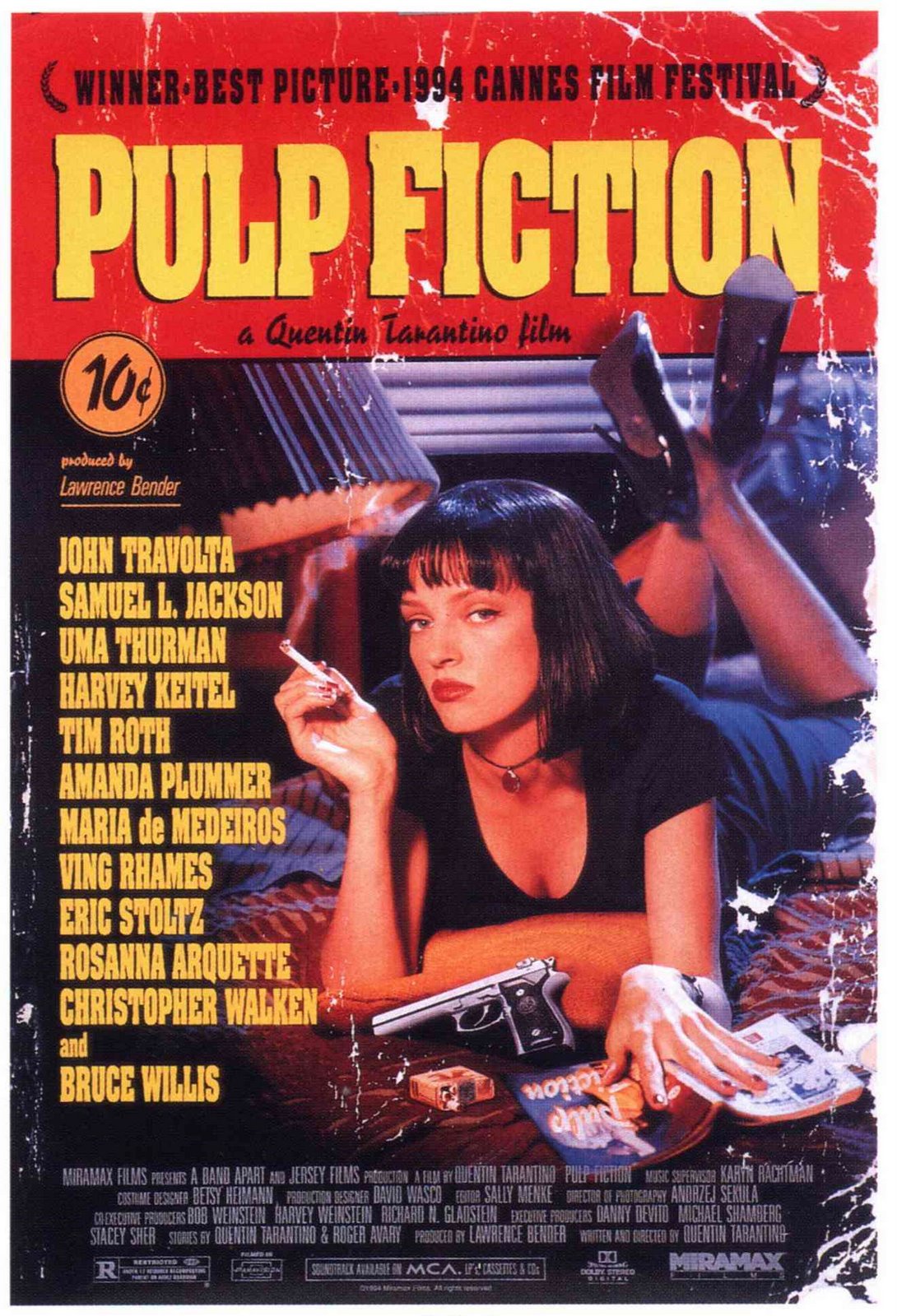
Steel yourselves, moviegoers over thirty: the cinematic phenomenon known as Pulp Fiction happened nineteen years ago. Which means that the making of Pulp Fiction happened twenty years ago. Vanity Fair’s Mark Seal has seized this occasion to write “Cinema Tarantino: The Making of Pulp Fiction,” an oral history of the conception of the one movie that, more than any other, stoked the American indie-film boom of the nineties to its full cultural blaze. Seal quotes Harvey Weinstein, a force of this movement at the helm of Miramax Films and Tarantino’s longtime business collaborator, as describing Pulp Fiction as “the first independent movie that broke all the rules,” which “set a new dial on the movie clock.” Though possessed of a legendary way with hyperbole, Weinstein may have this time put it too mildly.
As a moviegoer slightly under thirty, I grew up regarding Pulp Fiction as the movie cool grown-ups loved (I remember my dad buying the poster almost immediately after seeing the film), only knowing that it had something to do with McDonald’s Quarter- Pounders in France. Seal’s article sheds special light on the picture’s genesis for those too young to have engaged with the considerable industry buzz at the time, using not just the recollections of John Travolta, Bruce Willis, Samuel Jackson, Uma Thurman, Harvey Keitel, and Tarantino himself, but also of instrumental behind-the-scenes figures like co-writer Roger Avary, agent Mike Simpson, and typist Linda Chen. Before you petition your local revival cinemas to hold tribute screenings, have another shot of Pulp Fiction backstory by watching the on-set footage above. It opens on not just any set, but Jackrabbit Slim’s, the very same fictional theme restaurant Pulp Fiction’s creators remember so vividly in the article.
Colin Marshall hosts and produces Notebook on Cities and Culture and writes essays on literature, film, cities, Asia, and aesthetics. He’s at work on a book about Los Angeles, A Los Angeles Primer. Follow him on Twitter at @colinmarshall.
Most professional musicians have a very special relationship with their instruments. Male guitarists treat their favorite guitars like girlfriends—maybe better in some cases. Traveling cellists buy airline tickets for instruments. It’s just too risky to put your livelihood in cargo.
Not so for Terje Insungset, a Norwegian musician who, among other things, carves instruments out of ice. His background is in jazz and traditional Scandinavian music, but he’s built a reputation as an artist who makes music on unconventional materials. Considering where he is from, it’s not surprising that he has turned his attention to ice and its musical potential.
Turns out the sound of an ice xylophone is lovely—soft, deep, tinkly. The ice horn sounds like a lonely beast calling out across the tundra. Insungset collaborates with vocalist Mari Kvien Brunvoll. Together they perform around the world, sometimes indoors and sometimes in the snow, with elaborate microphone cords draped around and beautiful lighting.
Insungset has also built instruments out of arctic birch, slate, cow bells and granite. His interest in ice as a material developed when he was commissioned to play music in a frozen waterfall at the 1994 Winter Olympics in Lillehammer, Norway.
Unlike most musicians, he has to build his instruments in situ, as he did for recent concerts in Canada where the temperature was 36 below zero with a light wind. Perfect weather for ice music.
Édith Piaf’s life was anything but rosy. Born in a Parisian slum, she was abandoned by her mother and lived for awhile in a brothel run by her grandmother. As a teenager she sang on the streets for money. She was addicted to alcohol and drugs for much of her life, and her later years were marred by chronic pain. Through it all, Piaf managed to hold onto a basically optimistic view of life. She sang with a lyrical abandon that seemed to transcend the pain and sorrow of living.
On April 3, 1954 Piaf was the guest of honor on the French TV show La Joie de Vivre. She was 38 years old but looked much older. She had recently undergone a grueling series of “aversion therapy” treatments for alcoholism, and was by that time in the habit of taking morphine before going onstage. Cortisone treatments for arthritis made the usually wire-thin singer look puffy. But when Piaf launches into her signature song, “La Vie en Rose” (see above), all of that is left behind.
Nine years after this performance, when Piaf died, her friend Jean Cocteau said of her: “Like all those who live on courage, she didn’t think about death–she defied it. Only her voice remains, that splendid voice like black velvet.”
Follow Open Culture on Facebook and Twitter and share intelligent media with your friends. Or better yet, sign up for our daily email and get a daily dose of Open Culture in your inbox. And if you want to make sure that our posts definitely appear in your Facebook newsfeed, just follow these simple steps.
We're hoping to rely on loyal readers, rather than erratic ads. Please click the Donate button and support Open Culture. You can use Paypal, Venmo, Patreon, even Crypto! We thank you!
Open Culture scours the web for the best educational media. We find the free courses and audio books you need, the language lessons & educational videos you want, and plenty of enlightenment in between.