When studying history’s most famous creators, we must never forget that they always produced failures as well as successes, and often failures as impressive as their successes. Take Thomas Edison, widely regarded as the great American inventor for his work on the light bulb, the movie camera, and the phonograph. We all know about those achievements, all of which shaped technologies which went on to near-universal use, but have you heard of Edison’s still-pioneering but rather less well-known work in the field of talking dolls?
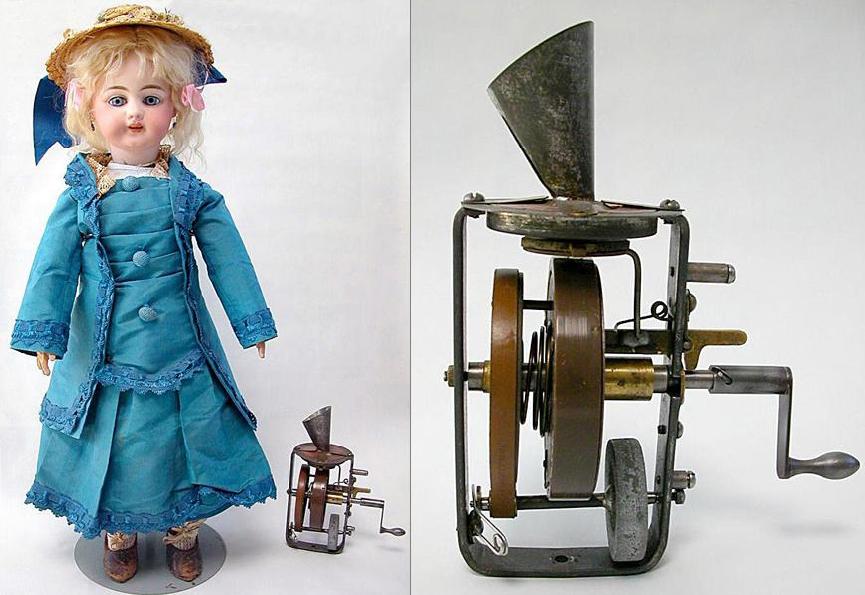
Many of us in the past few generations grew up with talking dolls of one kind or another. But had we been children in 1890, we might have grown up with the very first talking dolls, for which Edison designed an internal mechanism that played one of several wax cylinders pre-recorded with various child-oriented songs, prayers, and nursery rhymes. Or rather, we might have grown up with them if we came from wealthy families: they cost between $10 and $20 in 1890 dollars, or up to $526 in today’s dollars.
And even at that price, Edison’s talking dolls provided not just the lowest of lo-fi listening experiences, but resoundingly creepy ones at that. “The public reacted as one does when confronted with a grandmother’s massive doll collection: You averted your eyes in fear,” writes PBS’ Joshua Barajas. “After six weeks into production, the dolls were deemed too scary and pulled from the market, the New York Times reported.”
But now, thanks to optical audio-scanning technology unimaginable in Edison’s day, we can hear the dolls’ renditions of “Twinkle, Twinkle, Little Star,” “Hickory, Dickory, Dock,” and — most eerily of all — “Now I Lay Me Down to Sleep” just as the children of 1890 would have heard them. But even this seriously wrongheaded-seeming product paved the way for not just the less disturbing Furbys and Teddy Ruxpins of more recent childhoods, but, given its unprecedented use of auto recordings made for entertainment purposes, the entire record industry — and, of course, the minor but robust subgenre of talking-doll horror movies.
The Henson Rarities site on YouTube keeps giving and giving. Not only has it given us access to some of Jim Henson’s earliest (and delightfully violent) commercials, but it has discovered this: a pilot of The Orson Welles Show from 1979. The show was never aired, and you might be able to discern why from checking it out.
It’s the height of ‘70s excess with wide collars, polyester shirts, various forms of pre-show indulgences, and it’s all underlit like a nightclub, not a talk show set. Orson Welles doesn’t interview his first guest Burt Reynolds, but instead immediately throws the questions to the audience, turning the first half of the show into an ur-Actors Studio episode. (An eagle eyed YouTube commentator points out a young–but unverified–Joe Dante in the audience.) And the entire show has the feeling of very, very rough footage saved by editing and heaping on tablespoons of canned laughter.
Eventually Welles introduces “a little company of cloth headed comedians” that was already in its third season of the Muppet Show and about to premiere its first movie. (That first Muppet Movie, by the way, features Welles near the end as a movie executive.)
Welles, who calls himself a magician more often than a director in this episode, no doubt loves the magic behind the Muppets. Even when the lights are fully upon Henson and his frog puppet, we never question that Kermit is not real. In the 50th minute, Welles introduces both Henson (“picture Rasputin as an Eagle Scout” says the director) and Frank Oz (“A man who truly fits his name.”)
The show peters out with a magic trick, an appearance by Angie Dickinson (more tricks!) and a final Welles monolog, who reads Jenny Kissed Me by James Leigh Hunt. Like the poem, there’s a shadow of maudlin mortality hanging over all of Welles’ lines throughout the show. Six years later Welles would pass away with his final movie unfinished, still waiting for the cash that he hoped programs like The Orson Welles Show would bring.
Ted Mills is a freelance writer on the arts who currently hosts the FunkZone Podcast. You can also follow him on Twitter at @tedmills, read his other arts writing at tedmills.com and/or watch his films here.
Above, Le Musée National du Moyen-Âge (otherwise known as The National Museum of the Middle Ages) and The University of Geneva recreate fight scenes from the 15th century, demonstrating the movements and techniques of combatants who clanked around in full suits of armor. If you’re like me, you’re watching with surprise — surprised by their agility and dexterity. Wasn’t quite expecting that!
If you don’t read French, it’s worth noting that the video starts with a demonstration of mobility, then explores medieval fighting techniques, from stabbing an opponent right between the eyes, to striking a mortal blow on the ground. The video was brought to the web by Le Figaro.
If you would like to support the mission of Open Culture, consider making a donation to our site. It’s hard to rely 100% on ads, and your contributions will help us continue providing the best free cultural and educational materials to learners everywhere. You can contribute through PayPal, Patreon, and Venmo (@openculture). Thanks!
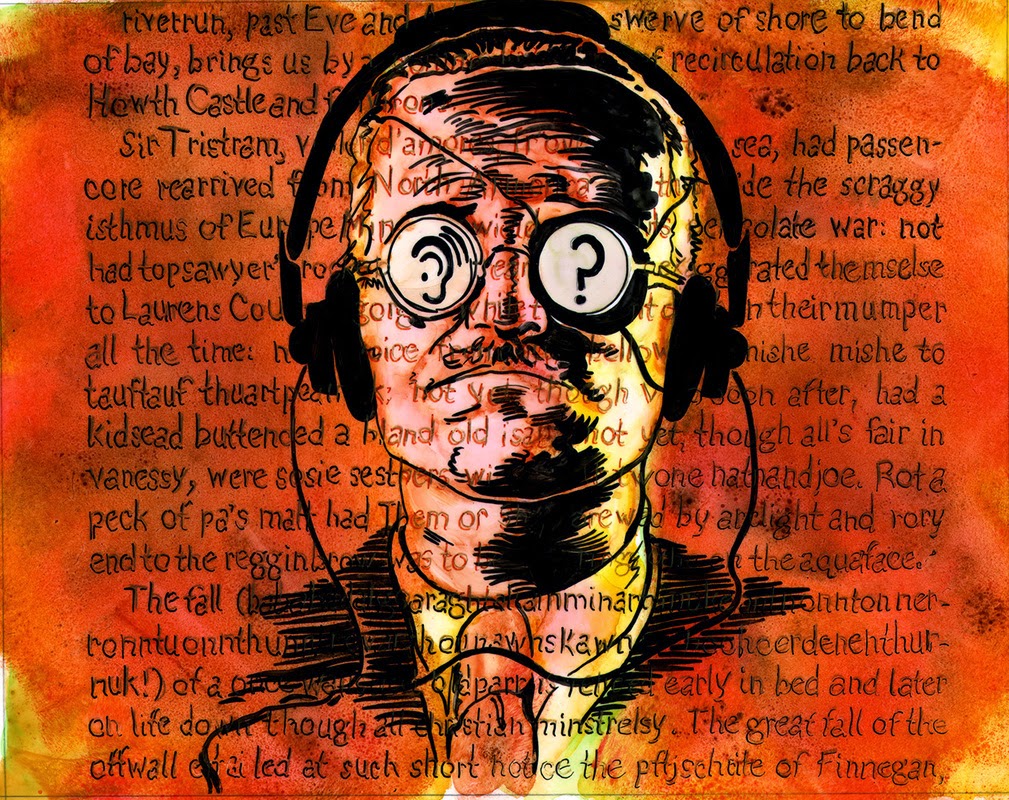
James Joyce’s final and most difficult novel Finnegans Wake unlocks a lot of its secrets when read aloud, preferably in an Irish accent. In this way, Joyce’s multilayered wordplay makes sense aurally even if all the meaning might not be apparent on paper. (His brother, Stanislaus, called it “the work of a psychopath.”)
An audiobook version would be good—-and there is one by Patrick Healy from 1992 (listen online) —but one with music would be much better. This month, Waywords and Meansigns, a project co-founded by Derek Pyle, has released its version of the novel with each of its 17 chapters performed by a different group of musicians and readers. The full text is represented here in a staggering 30+ hours. (You can read along here.)
“Our hope was to create a version of Joyce’s book that would be accessible to newcomers, but still feel fresh and exciting for devoted students and scholars,” says Pyle.
As with all compilation albums, some tracks are better than others. Mariana Lanari & Sjoerd Leijten’s opening chapter chops and cuts various voices together with a hypnotic electronic backing, recreating the confusion of those opening pages and the barrage of influences and voices. They also perform the final chapter. (Lanari is part of the RongWrong Finnegans Wake Reading Group in Amsterdam.) Peter Quadrino, Jake Reading & Evan James take on Book 3, Chapter 3, with a mix of faux-Tom Waits and Martin Denny providing the backdrop. (Quadrino is leader of the Finnegans Wake Reading Group of Austin, Texas) The jazzier the backdrop, by the by, does reveal Joyce’s connection to the Beat poets. Other tracks are dry and more straight-forward: face it, not everybody has the most beautiful reading voice. It is definitely a labor of love, and reveals how many FW reading groups there are around the globe.
Other artists involved in the project include saxophonist Hayden Chisholm, and painter Robert Amos, whose work you can find at the James Joyce Bistro in Victoria, British Columbia.
Ted Mills is a freelance writer on the arts who currently hosts the FunkZone Podcast. You can also follow him on Twitter at @tedmills, read his other arts writing at tedmills.com and/or watch his films here.
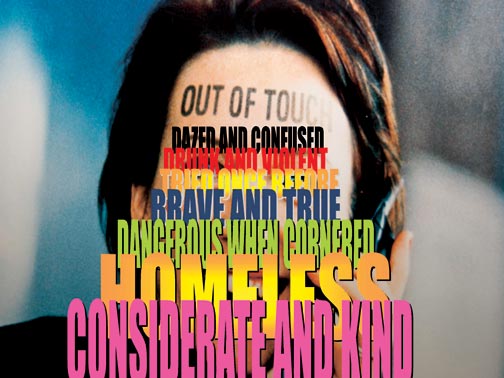
A decade ago, I voluntarily watched a Powerpoint presentation. That may sound unremarkable, but under normal circumstances I go to almost any length to avoid Powerpoint presentations. I throw my lot in with The Visual Display of Quantitative Informationauthor Edward Tufte, known for his indictment of the “Powerpoint cognitive style” that “routinely disrupts, dominates, and trivializes content.” But this particular Powerpoint presentation didn’t happen under normal circumstances: it came from none other than artist, writer, and former Talking Head David Byrne.
Byrne may have done a number of such presentations under the banner of “I Love Powerpoint,” but he and Tufte regard that omnipresent Microsoft slideshow application more similarly than you might think. “Having never used the program before, I found it limiting, inflexible, and biased, like most software,” Byrne wrote of his user experience in Wired. “On top of that, PowerPoint makes hilariously bad-looking visuals.” And yet, “although I began by making fun of the medium, I soon realized I could actually create things that were beautiful. I could bend the program to my own whim and use it as an artistic agent.”
The fruits of Byrne’s experimentation, apart from those talks in the 2000s, include the book Envisioning Epistemological Emotional Information, a collection of his Powerpoint “pieces that were moving, despite the limitations of the ‘medium.’ ” You can find more information on davidbyrne.com’s art page, which documents the host of non-musical projects Byrne has pulled off in his post-Heads career, including whimsical urban bike racks installed in Manhattan and Brooklyn. The short Wall Street Journal video at the top of the post documents the project, which fits right in the wheelhouse of a such a design-minded, New York-based, bicycle-loving kind of guy.
Byrne, as his musical output might have you expect, tends to stray from too-established forms whenever possible. Just above, we have one example of his works in the form of the corporate sign, each image of which shows the name of a big, bland company when viewed from one angle, and a world like “TRUST,” “GRACE,” or “COURAGE” when viewed from another. “Multinational tombstones nestled in the (landscaped) pastoral glade,” Byrne’s site calls these enhanced photographs taken in North Carolina’s office park-intensive Research Triangle. “A utopian vision in the American countryside.”
However witty, amusing, and even frivolous it may look on its face, Byrne’s infrastructural, corporate, and Powerpoint-ified art also accomplishes what all the best art must: making us see things differently. He may not have made me love Powerpoint, but I’ve never quite looked at any slideshow created in the program in quite the same way since — not that anyone else has since created one that I could sit through wholly without objection. Still, all the best art also gives us something to aspire to.
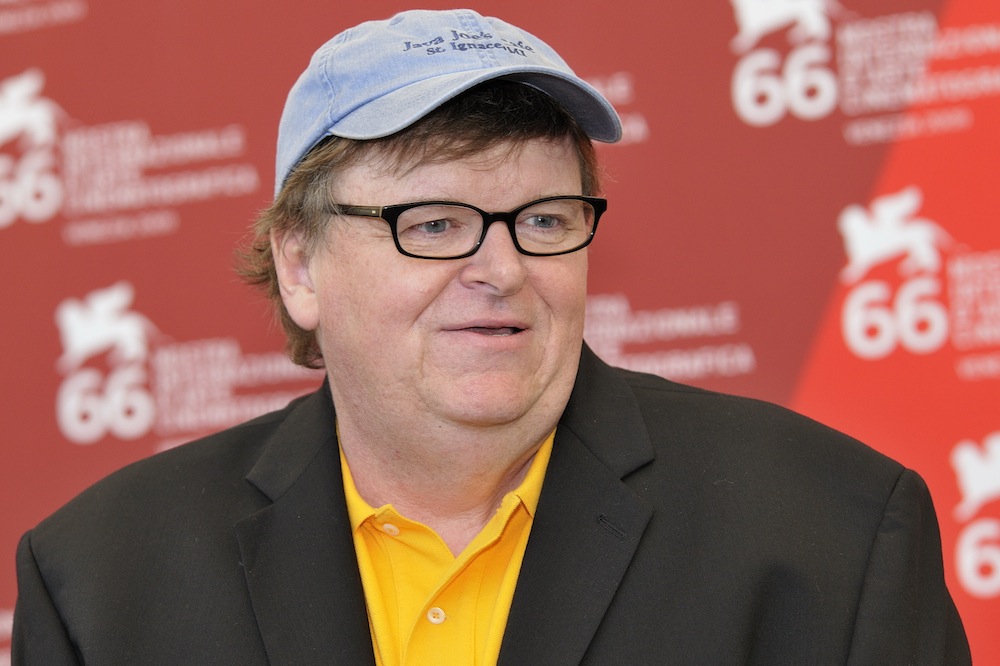
You don’t rile up as many people as Michael Moore has without mastering the art of button pushing. Clint Eastwood threatened to kill him (allegedly). Christopher Hitchens, echoing the sentiments of many Iraq war supporters, called his work “dishonest and demagogic.” And the State Department—opponents of both socialized healthcare and the Cuban government—attempted to discredit Moore with lies about his film Sicko. Those are some powerful enemies, especially for a “comedian and a populist” whose only weapons are cameras, microphones, and bestselling topical rants. On the other hand, Moore inspires millions of regular folks. As far back as 2004, a profile in TheNew Yorker described the simultaneously angry and jovial documentarian as “a political hero” to millions who “revere” him.
How does a documentary filmmaker create such passion? Moore, writes The New Yorker, intentionally provokes; but he is also “exquisitely sensitive to his audience’s mood and response. The harshness of his comedy, the proportion of comedy to political anger, the flattery or mockery of the audience, the number and type of swearwords he uses….” All carefully controlled. And all of it adds up to something more than documentary. Moore treats the term almost as a pejorative, as he told an audience in his keynote speech at the 2014 Toronto International Film Festival’s Doc Conference. Typical documentarians, Moore said, “sound like a scold. Like you’re Mother Superior with a wooden ruler in your hand.”
Some critics of Moore make this very charge against him. Nonetheless, his ability to move people, both in theaters and live audiences, to tears, peals of laughter, and fits of rage, speaks of much more than humorless moralism. Documentarians, Moore says in the 13-point “manifesto” of his speech, should aspire to more. Hence his first rule, which he derives partly from Fight Club. Below it, see abridgments of the other twelve guidelines, and read Moore’s speech in its entirety at Indiewire. If he repeats himself, and he does, a lot, I suppose it’s because he feels the point is important enough to drive home many times:
1. The first rule of documentaries is: Don’t make a documentary — make a MOVIE.
…the audience, the people who’ve worked hard all week — it’s Friday night, and they want to go to the movies. They want the lights to go down and be taken somewhere. They don’t care whether you make them cry, whether you make them laugh, whether you even challenge them to think — but damn it, they don’t want to be lectured, they don’t want to see our invisible wagging finger popping out of the screen. They want to be entertained.
2. Don’t tell me shit I already know.
Oh, I see — you made the movie because there are so many people who DON’T know about genetically modified foods. And you’re right. There are. And they just can’t wait to give up their Saturday to learn about it
3. The modern documentary sadly has morphed into what looks like a college lecture, the college lecture mode of telling a story.
That has to stop. We have to invent a different way, a different kind of model.
4. I don’t like Castor Oil…. Too many of your documentaries feel like medicine.
The people don’t want medicine. If they need medicine, they go to the doctor. They don’t want medicine in the movie theaters. They want Goobers, they want popcorn, and they want to see a great movie.
5. The Left is boring.
…we’ve lost our sense of humor and we need to be less boring. We used to be funny. The Left was funny in the 60s, and then we got really too damn serious. I don’t think it did us any good.
6. Why don’t more of your films go after the real villains — and I mean the REAL villains?
Why aren’t you naming names? Why don’t we have more documentaries that are going after corporations by name? Why don’t we have more documentaries going after the Koch Brothers and naming them by name?
7. I think it’s important to make your films personal.
I don’t mean to put yourself necessarily in the film or in front of the camera. Some of you, the camera does not like you. Do not go in front of the camera. And I would count myself as one of those. … But people want to hear the voice of a person. The vast majority of these documentary films that have had the most success are the ones with a personal voice.
8. Point your cameras at the cameras.
Show the people why the mainstream media isn’t telling them what is going on.
9. Books and TV have nonfiction figured out. People love to watch Stewart and Colbert. Why don’t you make films that come from that same spirit?
Why wouldn’t you want the same huge audience they have? Why is it that the American audience says, I love nonfiction books and I love nonfiction TV — but there’s no way you’re dragging me into a nonfiction movie! Yet, they want the truth AND they want to be entertained. Yes, repeat after me, they want to be entertained!
10. As much as possible, try to film only the people who disagree with you.
That is what is really interesting. We learn so much more by you training your camera on the guy from Exxon or General Motors and getting him to just blab on.
11. The audience is part of the film.
While you are filming a scene for your documentary, are you getting mad at what you are seeing? Are you crying? Are you cracking up so much that you are afraid that the microphone is going to pick it up? If that is happening while you are filming it, then there is a very good chance that’s how the audience is going to respond, too. Trust that. You are the audience, too.
12. Less is more. You already know that one.
Edit. Cut. Make it shorter. Say it with fewer words. Fewer scenes. Don’t think your shit smells like perfume. It doesn’t.
13. Finally… Sound is more important than picture.
Pay your sound woman or sound man the same as you pay the DP, especially now with documentaries. Sound carries the story. It’s true in a fiction film, too.
So there you have it aspiring filmmakers. Should you to wish to galvanize, polarize, move, and inspire your audience as you tell them the truth (as you see it), you’d do well to take a few pointers from Michael Moore. Political differences—and homicidal urges—aside, even particularly right-leaning documentary directors might consider taking a few pages from Moore’s playbook. A few media personalities, it seems, already have, at least when it comes to defining their purpose. One last time, with feeling, for the TL;DR crowd: “Yes, repeat after me, [audiences] want to be entertained! If you can’t accept that you are an entertainer with your truth, then please get out of the business.”
Every ten years, film journal Sight and Sound conducts a worldwide survey of film critics to decide which films are considered the best ever made. Started in 1952, the poll is now widely regarded as the most important and respected out there.
And the critical consensus for a long time was that the masterpiece Citizen Kane by Orson Welles (born 100 years ago today, by the way) is the best of the best. The film topped the list for five decades from 1962 until 2002. Then in 2012, perhaps out of Kane fatigue, Alfred Hitchcock’s Vertigo muscled its way to the top.
That’s what the critics think. But what about the filmmakers?
Beginning in 1992, Sight and Sound started to poll famed directors about their opinions. People like Martin Scorsese, Francis Ford Coppola, Mike Leigh and Michael Mann. So what is the best movie ever made according to 358 directors polled in 2012? Kane? Vertigo? Perhaps Jean Renoir’s brilliant Rules of the Game, the only movie to appear in the top ten for all seven critics polls? No.
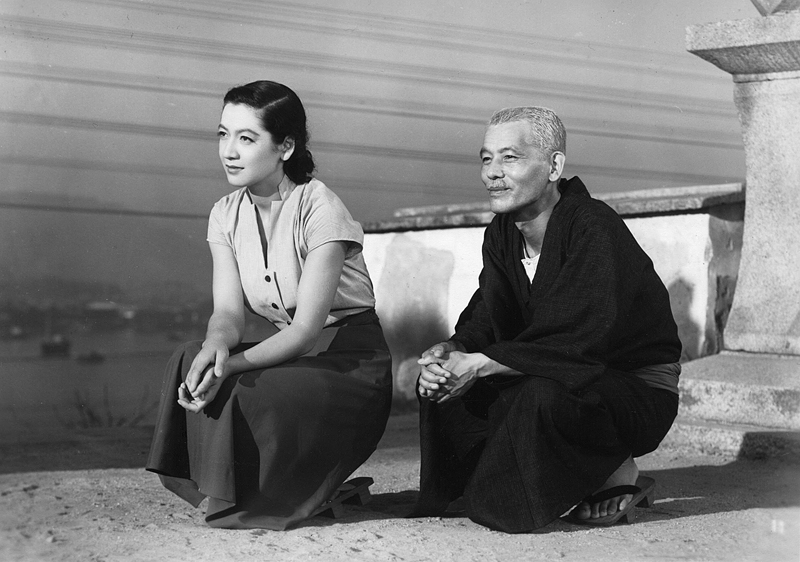
It’s a surprising, an enlightened, choice. Ozu’s work is miles away from the flash of Kane and the psychosexual weirdness of Vertigo. Tokyo Story is a gentle, nuanced portrait of a family whose bonds are slowly, inexorably being frayed by the demands of modernization. The movie’s emotional power is restrained and cumulative; by the final credits you’ll be overwhelmed both with a Buddhist sense of the impermanence of all things and a strong urge to call your mother.
But perhaps the reason filmmakers picked Tokyo Story of all the other cinematic masterpieces out there is because of Ozu’s unique approach to film. Since the days of D. W. Griffith, almost every filmmaker under the sun, even cinematic rebels like Jean-Luc Godard, followed some basic conventions of the form like continuity editing, the 180-degree rule and matching eyelines. Ozu discarded all of that. Instead, he constructed a highly idiosyncratic cinematic language revolving around match cuts and rigorously composed shots. His film form was radical but his stories were universal. That is the paradox of Ozu. You can see the trailer of the movie above.
Citizen Kane does make number two on the list but the film is tied with another formally rigorous masterpiece – Stanley Kubrick’s 2001: A Space Odyssey. Next on the list is perhaps the best movie ever about making a movie – Federico Fellini’s 8 ½. And Ozu’s film might be number one, but Francis Ford Coppola is the only filmmaker to have two movies on the list – The Godfather and Apocalypse Now. And that’s no mean feat.
Jonathan Crow is a Los Angeles-based writer and filmmaker whose work has appeared in Yahoo!, The Hollywood Reporter, and other publications. You can follow him at @jonccrow. And check out his blog Veeptopus, featuring lots of pictures of badgers and even more pictures of vice presidents with octopuses on their heads. The Veeptopus store is here.
From Oscar Boyson comes “A Short History of the World’s Most Important Art Exhibition,” the first of a series of films that will take us inside the Venice Biennale, the prestigious art exhibition that dates back to 1895.
Produced by Artsy and UBS, the short film “pulls back the curtain on the event’s reach, extending beyond art and into politics and history at large,” and helps “us navigate the cultural influence of this somewhat enigmatic, 120-year-old tradition. For a longer look at Italy’s most important art fair, you can watch The Vice Guide to the Venice Biennale.
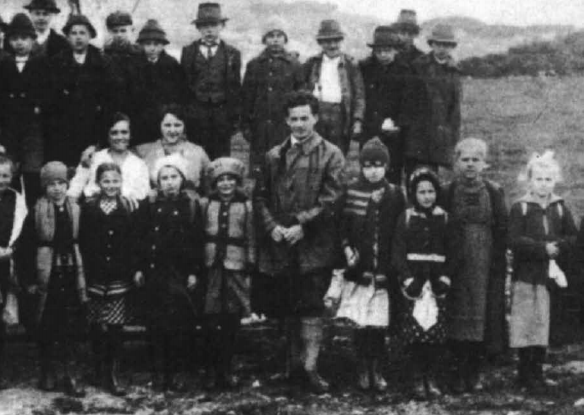
Ludwig Wittgenstein finished writing the Tractatus Logico-Philosophicus, the achievement for which most of us remember him, in 1918; three years later came its first publication in Germany. And to what problem did Wittgenstein put his luminous philosophical mind in the interim? Teaching a class of elementary schoolers in rural Austria. “Well on his way to being considered the greatest philosopher alive,” as Spencer Robins puts it in a thorough Paris Review post on Wittgenstein’s teaching stint, he also found himself “convinced he was a moral failure.” Searching for a solution, he got rid of his family fortune, left the “Palais Wittgenstein” in which he’d grown up, and out of “a romantic idea of what it would be like to work with peasants—an idea he’d gotten from reading Tolstoy,” went to teach kids in the middle of nowhere. See them all above.\
“I am to be an elementary-school teacher in a tiny village called Trattenbach,” Wittgenstein wrote to his own teacher and friend Bertrand Russell in a letter dated October 23, 1921. A month later, in another letter, he described his circumstances as those of “odiousness and baseness,” complaining that “I know human beings on the average are not worth much anywhere, but here they are much more good-for-nothing and irresponsible than elsewhere.” The great philosopher’s experiment in primary education would appear not to have gone well.
And yet Wittgenstein comes off, by many accounts, as an exemplary and almost unbelievably engaged teacher. He and his students, in Robins’ words, “designed steam engines and buildings together, and built models of them; dissected animals; examined things with a microscope Wittgenstein brought from Vienna; read literature; learned constellations lying under the night sky; and took trips to Vienna, where they stayed at a school run by his sister Hermine.” Hermine herself remembered the kids “positively climbing over each other in their eagerness” to answer their philosopher-teacher’s questions, and at least one particularly promising kid among them received Wittgenstein’s extensive extracurricular instruction — and even an offer of adoption.
We might also consider Wittgenstein a champion, in his own way, of equal treatment for the sexes: unlike other teachers in rural early 20th-century Austria, he expected the girls to solve the very same vertiginously difficult math problems he put to the boys. But by the same token, he doled out corporal punishment to them just as equally when they got the answer wrong, and even when they didn’t grasp the concepts at hand as swiftly as he might have liked. This rough treatment culminated in “the Haidbauer incident,” an occasion of child-smacking consequential enough in Wittgenstein’s life to merit its own Wikipedia page, and which effectively ended his educational involvement with youngsters. The incident reportedly left an 11-year-old schoolboy “unconscious after being hit on the head during class.”
“Ultimately, he was to alienate the villagers of Trattenbach with his tyrannical and often bullying behavior, the result of a mind unable to empathize with the stage at which some of his pupils found themselves in their learning,” writes education blogger Alex Beard in his own post on Wittgenstein-as teacher. “Today we would admire his high expectations and the purity of his intention as an educator, but look rather less kindly on the Ohrfeige (ear-boxing) and Haareziehen (hair-pulling) that his students later recalled.” We modern-day Wittgenstein fans have to ask ourselves what wonders we might we have learned had fate assigned our elementary-school selves to his classroom — and whether we would have graduated to our next year unscathed.
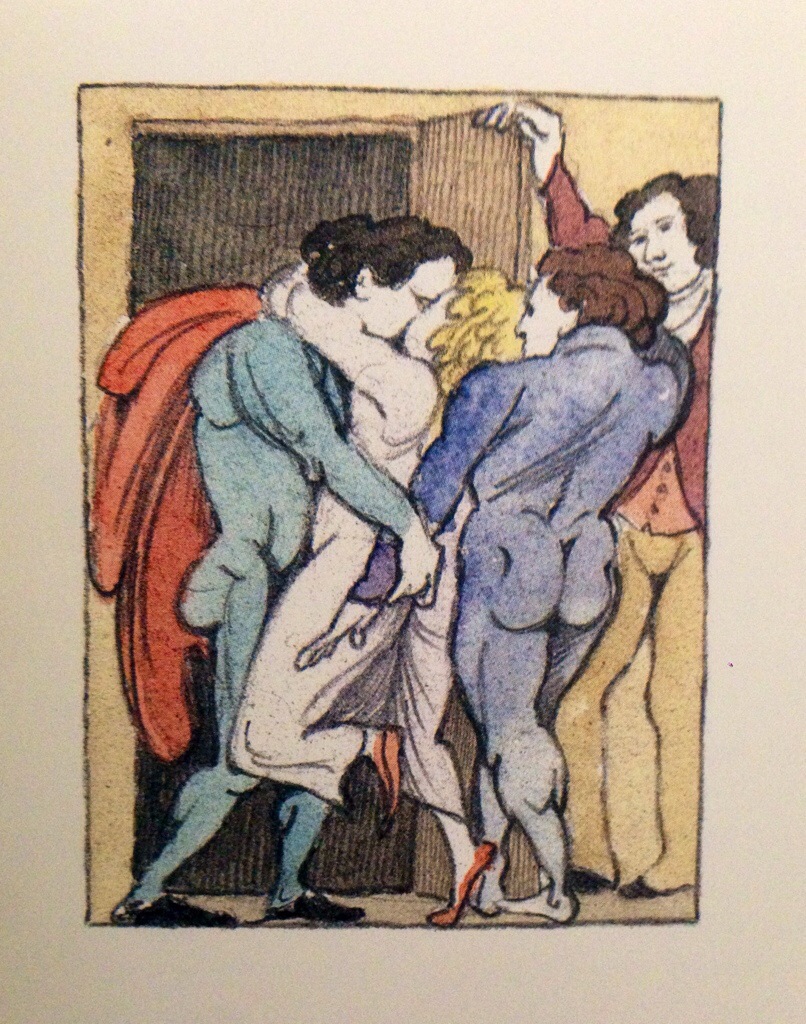
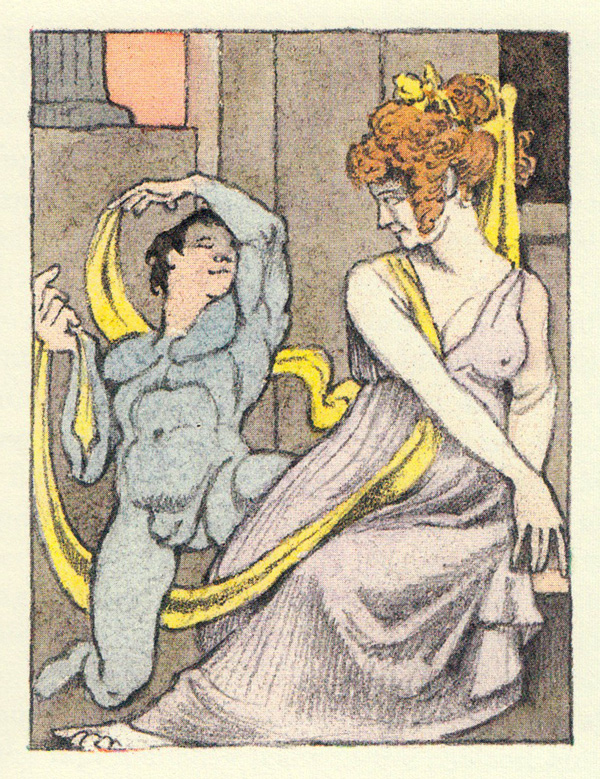
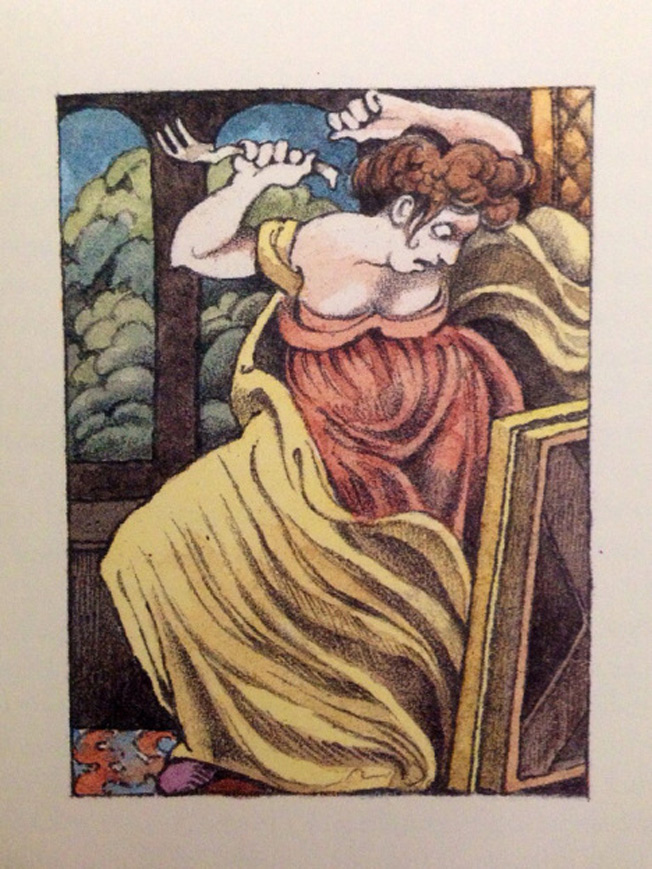
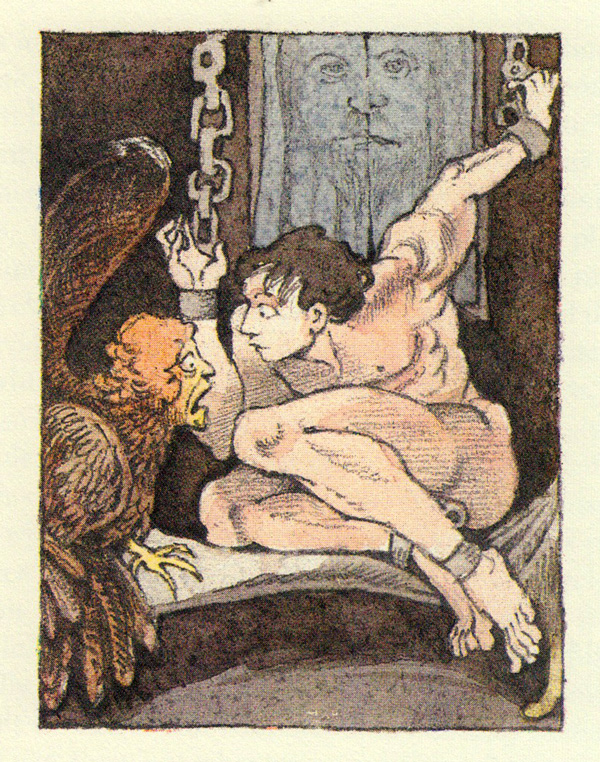
Maurice Sendak—like some few other exceptional children’s authors—also did work for adults, and in at least one case, did adult work, in his illustrations for a controversial 1995 edition of Herman Melville’s Pierre: or, The Ambiguities. The drawings are erotic, as well as homoerotic, illustrating the gay subtext in the novel. Sendak may seem like an unlikely illustrator for the Moby Dick author’s work; he was already an unlikely American children’s literary icon—“Jewish, gay, poor,” he nonetheless became “a major cultural influence,” writes blog BLT. As Sendak declared in an interview with Bill Moyers, he learned to “find a separate peace” from his own anxiety not through religious faith but through a “total faith in art.” “My gods,” Sendak told Moyers, “are Herman Melville, Emily Dickinson, Mozart,” among others. The author of Pierre figured highly in that divine hierarchy.
But Melville, at the time of Pierre’s publication, was not loved as a god. Shunned by critics and the reading public after the devastating reception accorded Moby Dick, his self-professed greatest work, Melville felt further humiliated when his publisher demanded he accept 20 cents on the dollar instead of 50 for the next novel, Pierre. Crushed, he signed the new contract. Then, though he had been satisfied with Pierre, considering the novel finished at the end of 1851, he added 150 pages, much of it a scathing, sardonic indictment of the literary establishment, including a non-too-subtle chapter titled “Young Literature in America.”
Whether the expansion was, as Maria Popova suggests at Brain Pickings, an eloquent riposte to his critics, or, as Library Journal suggests, made at the behest of his publishers (unlikely) is unclear. University of Delaware professor Herschel Parker, the Melville scholar who edited the Sendak edition of Pierre,admits, “we had NOT known when the expansion started and had not known just why.” Sendak himself describes Pierre as “a great and ingenious work of art.” Of the notion that Melville’s additions were “a vindictive diatribe against all his critics” Sendak speculates, “he might have been mad and hurt—He must have been mad and hurt. But he wouldn’t have spent that much time on a book being just mad and hurt.”
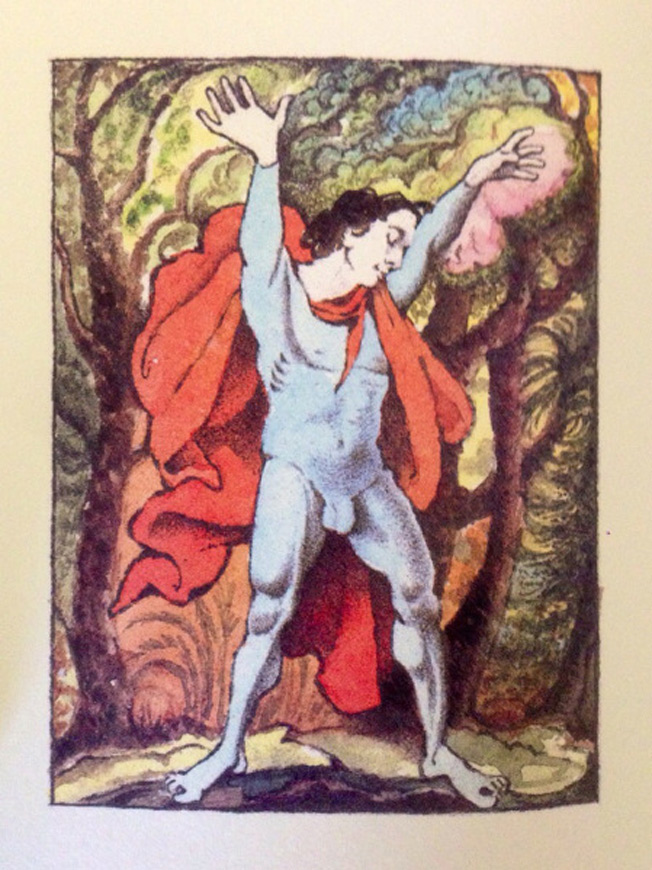
Sendak, a lifelong amateur Melville scholar, knows what he’s talking about. His familiarity with the author is such that his opinion was cited approvingly in the acknowledgments of a scholarly edition of Moby Dick. Despite Sendak’s comments in defense of Melville’s later additions, his and Parker’s version of Pierre attempts to strip them out and restore the novel to its earlier form, one Melville called his “Kraken book.” Sendak apparently initiated the project in order to publish the drawings. In them, writes John Bryan in a review for College English, “Pierre is a full-blown adolescent: muscular, ecstatic, desperate, devoted, and lonely; he is the man-child invincible.” The novel’s hero spends much of his time a blue Superman outfit, “red cape and all,” so tight “that it is skin itself, concealing nothing.”
Bibliokept compares the illustrations to William Blake. They also contain references to Goya and other artists who explored the grotesque, as well as the morbid, transgressive sexuality of the Pre-Raphaelite painters. “Nowhere else in the history of Melville illustration,” writes John Bryan, “do we find such openings into the latent sexuality of Melville’s prose.” Brain Pickings describes the drawings as “the most sexually expressive of any of his work, featuring 27 discernible nipples and 11 male ‘packages’…. Bold, unapologetic, and incredibly sensual, the illustrations are also subtly subversive in their treatment of gender identity and stereotypes.”
You can experience Dostoevsky in the original. You can experience Dostoevsky in translation. Or how about an experience of Dostoevsky in animation? Today we’ve rounded up two particularly notable examples of that last, both of which take up their unconventional project of adaptation with suitably unconventional animation techniques. At the top of the post, we have the first part (and just below we have the second) of Dostoevsky’s story “The Dream of a Ridiculous Man,” re-imagined by Russian animator Alexander Petrov.
The animation, as Josh Jones wrote here in 2014, “uses painstakingly hand-painted cells to bring to life the alternate world the narrator finds himself navigating in his dream. From the flickering lamps against the dreary, darkened cityscape of the ridiculous man’s waking life to the shifting, sunlit sands of the dreamworld, each detail of the story is finely rendered with meticulous care.” A haunting visual style for this haunting piece of late Dostoevsky in full-on existentialist mode.
Just below, you can see a longer and more ambitious adaptation of one of Dostoevsky’s much longer, much more ambitious works: Crime and Punishment. This half-hour animated version by Polish filmmaker Piotr Dumala, Mike Springer wrote here in 2012, gets “told expressionistically, without dialogue and with an altered flow of time. The complex and multi-layered novel is pared down to a few central characters and events,” all of them portrayed with a form of labor-intensive “destructive animation” in which Dumala engraved, painted over, and then re-engraved each frame on plaster, a method where “each image exists only long enough to be photographed and then painted over to create a sense of movement.”
If you’d now like to plunge into Dostoevsky’s literary world and find out if it compels you, too, to create strikingly unconventional animations — or any other sort of project inspired by the writer’s epic grappling with life’s greatest, most troubling themes — you can do it for free with our collection of Dostoevsky eBooks and audiobooks.
We're hoping to rely on loyal readers, rather than erratic ads. Please click the Donate button and support Open Culture. You can use Paypal, Venmo, Patreon, even Crypto! We thank you!
Open Culture scours the web for the best educational media. We find the free courses and audio books you need, the language lessons & educational videos you want, and plenty of enlightenment in between.