Instead of the usual apology email, the man who once turned some test footage into a weird short film made a quick video to screen at the award show. It’s…Lynchian.
The video features a Barbie doll—-renamed Trixie for this short—-lying on a purple blanket and taking a call from Lynch, who is out shopping for Trixie’s makeup. Hearing Lynch’s version of a woman’s voice is strange enough, but he goes on to chastise the young girl when she suggests sunbathing nude is a form of meditation. Then follows Lynch’s pitch for Transcendental Meditation, which he’s been using as a creative boon since before Eraserhead. See our previous post: David Lynch Explains How Meditation Enhances Our Creativity. And also: David Lynch Talks Meditation with Paul McCartney.
Ted Mills is a freelance writer on the arts who currently hosts the FunkZone Podcast. You can also follow him on Twitter at @tedmills, read his other arts writing at tedmills.com and/or watch his films here.
I grew up with a simplistic, moralizing official history of the Civil Rights movement, one full of platitudes and false dichotomies: a sanitized version of Martin Luther King, Jr. stood as the model of a “good” Civil Rights leader; Malcolm X, the Black Panthers, and other radicals were vilified as “bad” Civil Rights leaders—or Anti-American terrorists. We read “Letter From a Birmingham Jail,” but nothing from Angela Davis, Huey Newton, Eldridge Cleaver, or Stokely Carmichael. This is how most histories go, official narratives being what they are. There are heroes and villains, and little in-between. However, there is much more ambiguity surrounding events than most of us choose to accept. I came to see things much differently regarding the Black Panther Party, though not in a way that makes me feel like trading insults with strangers on the internet. I reserve the right to make up my own mind. You must also make up yours.
But one must be informed. Which is why projects like The Black Panthers: Vanguard of the Revolution—whose Kickstarter campaign video you can see above—are so important. It weighs heavily to be writing this now, as tragedies all too familiar to the figures in the film still play out tonight and nearly every night across the U.S. We owe it to ourselves to know the histories of the current struggle, both official and unofficial. I overheard someone say recently that getting a genuine education requires taking “two sets of notes.” For those raised with a one-dimensional textbook history of the Civil Rights movement, The Black Panthers: Vanguard of the Revolution is like another set of notes, along with other films like Goran Olsson’s The Black Power Mixtape: 1967–1975, Lee Lew-Lee’s All Power to the People! The Black Panther Party and Beyond, and Mario and Melvin Van Peebles’ fictionalized history Panther.
These films provide interesting and excellent introductions to the subject, but Stanley Nelson’s documentary offers, as he puts it, “the first comprehensive look at the rise and fall of the Black Panther Party.” Nelson is an award-winning veteran documentarian whose films include Freedom Riders, Freedom Summer, Jonestown: The Life and Death of People’s Temple, and The Murder of Emmett Till. He began The Black Panthers seven years ago, and its current release, audiences have told him, “could not have come at a better time.” The film has already premiered for “a select audience” at Sundance, New York’s Museum of Modern Art, and L.A.‘s Pan African Film Festival. With eight days to go, the Kickstarter to fund the doc’s multi-city theatrical release has almost reached its goal of $50,000. See their page to help them get all the way there.
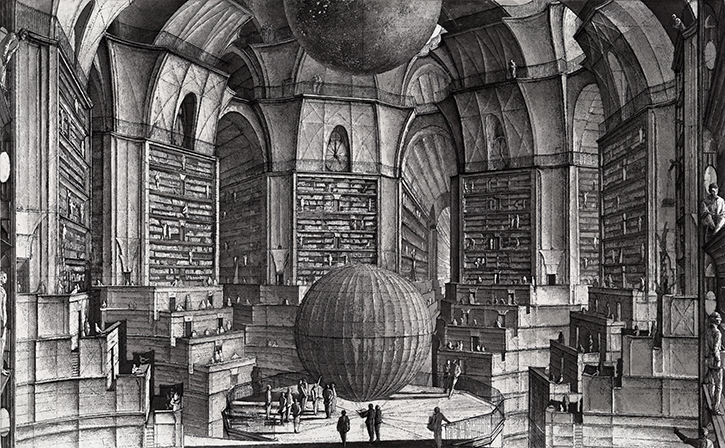
Jorge Luis Borges specialized in envisioning the unenvisionable: a map the same size as the land it depicts, an event whose possible outcomes all occur simultaneously, a single point in space containing all other points in space, a vast library containing all possible books. That last, the setting, subject, and title of his short story “The Library of Babel,” has given readers much to think about since its first publication in 1941, and in recent decades has done more than its part to bolster Borges’ posthumous reputation as a seer of our unprecedentedly rich but often difficult-to-navigate new media landscape.
Borges imagined the Library of Babel comprising a huge number of connected hexagonal rooms lined by bookshelves. “Each shelf contains thirty-five books of uniform format; each book is of four hundred and ten pages; each page, of forty lines, each line, of some eighty letters which are black in color.” Each book contains a different combination of letters, and in total they contain all possible combinations of letters, with the result that the Library as a whole contains
Everything: the minutely detailed history of the future, the archangels’ autobiographies, the faithful catalogues of the Library, thousands and thousands of false catalogues, the demonstration of the fallacy of those catalogues, the demonstration of the fallacy of the true catalogue, the Gnostic gospel of Basilides, the commentary on that gospel, the commentary on the commentary on that gospel, the true story of your death, the translation of every book in all languages, the interpolations of every book in all books.
This vision has inspired a fair few thinkers, including most recently Brooklyn author and programmer Jonathan Basile. “I was lying in bed one night and the idea of an online Library of Babel popped into my head,” he says in an interview with Flavorwire. “My first thought was — it must exist already. It seems like such a natural extension of the capabilities of a computer that I was sure someone would have made it. The next day I looked for it, a bit excitedly, and was disappointed. From then on, it’s kind of been a reluctant destiny for me.”
As the fruit of that destiny, we have libraryofbabel.info, a new web site that will theoretically come to contain exactly what Borges’ Library of Babel contains: the text of every possible 410-page book. You can start looking through them by searching for text, viewing a random book, or browsing by hexagonal chamber. You’ll notice that the vast, vast majority of Basile’s Library of Babel offers nothing but nonsense — the very same thing, in other words, that Borges’ does, which in his telling causes great frustration among the luckless librarians charged with maintaining the place.
But a visit to the online Library of Babel should bring you to the same question the original story does: to what extent does meaning reside in the physical world, and to what extent does it reside in our minds? And what would Borges himself make of all this? “He was never one to take the border between reality and fiction too seriously,” says Basile. “Reading his story is already, in its own way, entering the world of the library. In a sense it’s a horror story, but it feels to me more like a black comedy. Perhaps he would just laugh.”
Remember disfiguring binders with band logos and lyrics, doodling in the margins of textbooks, idly marking the fore edges with ball point designs?
At most, such pursuits helped pass a few minutes in study hall.
How long would it take to undo all this handiwork?
Clearly much, much longer than it took to create. In the above episode of the Japanese documentary series, The Fascinating Repairmen, Tokyo-based book conservator Nobuo Okano brings over 30 years of experience to bear on a tattered, middle school English-to-Japanese dictionary. This is not the sort of job that can be rushed.
Its original owner must be driven by sentiment in hiring a master craftsman to restore the book as a present for his college-bound daughter. Surely it would be just as easy, possibly even more convenient, for the young woman in question to look up vocabulary online. If keeping things old school is the goal, I guarantee a recently published paperback would prove far cheaper than conservator Okano’s laborious fix.
He spends four hours just turning and pressing its battered pages—all 1000 of them—with tweezers and a tiny pink iron.
He also scrapes the spine free of crumbling glue, resets tattered maps, preserves the old cover’s title as a decorative element for the new one, and dispatches the initials of a teenage crush with one chop of his blade. (So much for sentiment…)
One need not speak Japanese to admire the painstaking craftsmanship that will keep this beat-up old book out of the landfill.
Would there be such a thing as philosophy had there been no such person—or literary character, at least—as Socrates? Surely people the world over have always asked questions about the nature of reality, and come up with all sorts of speculative answers. But the particular form of inquiry known as the Socratic method—a blanket presumption of ignorance—would not have become the dominant force in Western intellectual history without its namesake. And that is, of course, not all. In the work of Socrates’ highly imaginative student, interpreter, and biographer Plato, we find, as Alfred North Whitehead suggested, a “wealth of general ideas” that have made for “an inexhaustible mine of suggestion” for philosophers since antiquity.
As bluesman Robert Johnson did for rock and roll, Socrates more or less single-handedly invented the formulas of Western thought. He might be called the first philosophical rock star—and judging by the Guns N’ Roses soundtrack to the animated video above, the producers of the Greek Public Television series Animated Philosophers seem to feel the same. Dubbed into English, and with character animation that owes more than a little to South Park, this episode makes the case for Socrates’ importance to philosophy as tantamount to Christ’s in Christianity. Overstated? Perhaps, but the argument is by no means a thin one.
To make the point, writer, editor, and host George Chatzivasileiou interviews Greek philosophers like Vasilis Karamanis and Vasilis Kalfas, who basically agree with Roman orator Cicero’s characterization of Socrates bringing “philosophy down from the heavens to the earth”… as well as, says Kalfas, “into the city” as a “teacher of the citizen” in a modern democratic city-state. A key part of Socrates’ appeal is that he “did not take anything for granted, no matter how obvious it may have seemed.” Though this attitude is as much a performance as it is a genuine admission of ignorance, the Socratic approach nonetheless set the standards of intellectual integrity in the West.
The comparison with Christ is relevant in more ways than one. The fathers of the Christian church relied as much on Plato and his student Aristotle—sometimes it seems even more so—as they did on the Bible. Perhaps chief among early theologians, Bishop Augustine of Hippo receives the animated rock star treatment above in another episode of Animated Philosophers, this one subtitled in English. The many other episodes in the series—on Plato, Aristotle, Democritus, Empedocles, Parmenides, Plotinus, Epicurus, Heraclitus, and Pythagoras—are all available on Youtube, but only in the original Greek with no titles or dubbing. It’s no great surprise the series focuses almost exclusively on Greek philosophers. And yet, national pride notwithstanding, the ancient civilization does have legitimate claim to the origins of the discipline, especially in that most influential figure of them all, Socrates.
As a promotional posting, WQXR also created this mashup of 46 recordings in 3 minutes, showing the varying approaches to Stravinsky’s score, and the wildly different dynamics of interpretation.
Sixteen years after the work’s tumultuous live premiere in 1913, both Stravinsky and conductor Pierre Monteux competed to record the first version in 1929 in Paris. That was followed in 1930 by Leopold Stokowski and the Philadelphia Orchestra, whose re-recorded version would become the most famous when it appeared in Walt Disney’s Fantasia. That film did more to bring Stravinsky to wide swathes of society, from kids to grandparents, than any other performance. Plus it had frickin’ dinosaurs:
This mashup is pretty schizoid, but shows the personalities and influences of each conductor: Leonard Bernstein creates a colorful and sparkling Rite; Pierre Boulez is like a machine; Karajan is thunderous. The various piano interpretations lose none of their bite after being resigned to the keyboard. And Stravinsky’s 1960 recording with the Columbia Symphony Orchestra (aka the New York Philharmonic, renamed for contractual reasons) is also here, sounding just that little bit sweeter than the rest.
Ted Mills is a freelance writer on the arts who currently hosts the FunkZone Podcast. You can also follow him on Twitter at @tedmills, read his other arts writing at tedmills.com and/or watch his films here.
In the 1930s, the systems theorist, designer and inventor Buckminster Fuller created the Dymaxion car — an aerodynamic concept car that managed to get 30 miles per gallon while topping out at 90 miles per hour, and transporting 11 passengers. Like Fuller’s Dymaxion house, the three-wheel Dymaxion car could be disassembled and re-assembled with ease. You can see vintage videos of both here.
The concept car didn’t get much beyond the concept stage. Only three original versions were built, one of which rolled over at the 1933 World’s Fair, leaving the driver dead, three passengers injured, and investors reluctant to bring the car to market. In 2010, the British architect Sir Norman Foster built a replica of the Dymaxion. You can see Dan Neil, of The Wall Street Journal, take the car on a harrowing test drive above. And if you’re intrigued enough to learn more, you can hunt down the 2012 documentary called The Last Dymaxion (watch a trailer of the film here).
If you would like to support the mission of Open Culture, consider making a donation to our site. It’s hard to rely 100% on ads, and your contributions will help us continue providing the best free cultural and educational materials to learners everywhere. You can contribute through PayPal, Patreon, and Venmo (@openculture). Thanks!
In the clip above, Martin Scorsese talks about a group of films that, in his words, have “enriched me, educated me, disturbed me, moved me in a way that have awakened me to new possibilities in cinema.” Those words will remind many of us of our experiences with Scorsese’s own pictures, which raises a big question: what movement could possibly have enough power to enrich, educate, disturb, move, and cinematically awaken a man who has done so much enriching, educating, disturbing, moving, and cinematic awakening himself?
Scorsese speaks of the cinema of South Korea, especially the wave that, over the past twenty years, has brought the global film scene such auteurs as Park Chan-wook (Joint Security Area, Oldboy, Stoker), Lee Chang-dong (Oasis, Secret Sunshine, Poetry), and Kim Ki-duk (Spring, Summer, Fall, Winter… and Spring, 3‑Iron, Pietà). But he adds that, “for me, there’s something especially interesting about the films of Hong Sangsoo. It’s got to do with his masterful sense of storytelling. In each of his films that I’ve managed to see, everything kind of starts unassumingly” — but then things “unpeel like an orange.”
Only in one respect can I compare myself to Martin Scorsese: a love of Hong Sangsoo movies. I even wrote an essay for The Quarterly Conversation a few years back trying to explain the artistry of this most prolific Korean director, who has put out sixteen alcohol-soaked, cigarette-clouded, social and sexual awkwardness-saturated features to date. Some call Hong “the Korean Woody Allen,” which gets at the fact that his many comedies of manners pass through more moods than comedy and deal with more than manners, but that doesn’t capture his penchant for rich formal and structural experimentation — stories told multiple times, through different perspectives, using clashing sets of facts, and so on — which delights cinephiles everywhere.
This has made Hong a big name on the festival circuit — he usually has a project or two making the rounds at any given time — on which his latest movie Hill of Freedom received much critical acclaim. Telling of a Japanese man’s trip to Seoul to track down his Korean ex-girlfriend through a disordered pile of letters he sent her all at once, the mostly English-language movie shows the internationalization of not just Hong’s appeal, but of his work itself. It allows few of its characters to speak their native language, resulting in the kind of meaningful inarticulacy that he’d previously had to get his all-Korean casts drunk to achieve.
You can take the plunge into Hong’s cut-up and meticulously rearranged cinematic world of inept, jealously idealistic men, women that I’ve elsewhere described as “eerily unrepentant studies in blank calculation and frigid pliability,” and the catastrophes into which they lead themselves by starting with his debut The Day the Pig Fell into a Well, available free on the Korean Film Archive’s Youtube channel.
I recently went to Korea to record a podcast interview with Seoul-based film scholar Marc Raymond about how Hong’s films reflect modern Korean life. It turns out they reflect it pretty well, something I’ll see for myself later this year when, after having studied the Korean language for nearly a decade, I move to Korea — all out of an interest first stoked by Hong Sangsoo.
Back in December, Ayun Halliday took you inside an MRI machine to explore the neuroscience of jazz improvisation and musical creativity. Along the way, you got to see Johns Hopkins surgeon Charles Limb jam on a keyboard inside one of those crowded, claustrophobia-inducing tubes. How could you beat that for entertainment?
Today, we return with a new video showing another way the MRI machine is giving scientists new insights into the making of music. This time the focus is on how we produce sounds when we sing. When “we sing or speak, the vocal folds—the two small pieces of tissue [in our neck]—come together and, as air passes over them, they vibrate,” and produce sound. That’s basically what happens. We know that. But the typical MRI machine, capturing about 10 frames per second, is too slow to really let scientists break down the action of the larynx. Enter the new, high speed MRI machine at the Beckman Institute at the University of Illinois, working at 100 frames per second. It does the trick.
Above, you can see the new machine in action, as a volunteer sings ‘If I Only Had a Brain.’ Get more of the backstory over at the Beckman Institute.
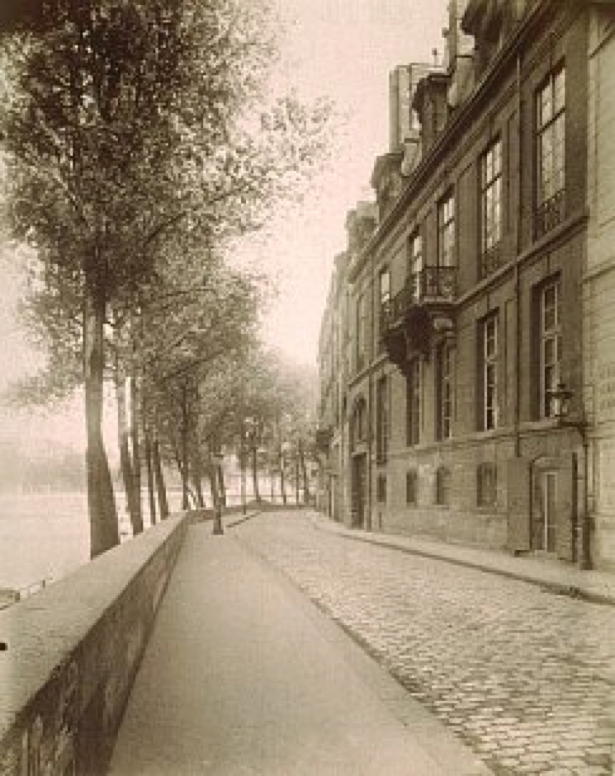
Hôtel de Lauzun, the meeting place of the Club des Hachichins
It may be cliché to say so, but there does seem to be a strong correlation between experiments with mind-altering chemicals and some of the most intriguing experiments in literary style. Samuel Taylor Coleridge, Arthur Rimbaud, William S. Burroughs, Hunter S. Thompson…. Of course, it is necessary to point out that these talented writers were already that—talented writers—substances or no. As one of Rimbaud’s modern children, Patti Smith, declares, drugs are “not really how one accesses the imagination. It can be a tool, but when that tool starts to master you, you’ll lose touch with your craft.”
This seems to have happened to Smith’s literary idol. One of Rimbaud’s literary heroes, Charles Baudelaire, also eventually succumbed to his excessive use of laudanum, alcohol, and opium. But at one time, Baudelaire dabbled with a much less destructive drug, hashish, along with a coterie of other artists, including Alexandre Dumas, Gérard de Nerval, Victor Hugo, Honoré de Balzac, and painter Eugène Delacroix. The French greats gathered in a gothic house, from 1844–1849, under the moniker Club des Hachichins and partook of the drug, introduced to it by medical doctor Jacques-Joseph Moreau and writer and journalist Théophile Gautier. Writes The Guardian:
…ritualistically garbed in Arab clothing, they drank strong coffee, liberally laced with hashish, which Moreau called dawamesk, in the Arabic manner. It looked, reported the members, like a greenish preserve, its ingredients a mixture of hashish, cinnamon, cloves, nutmeg, pistachio, sugar, orange juice, butter and cantharides. Some of them would write of their “stoned” experiences, although not all. Balzac attended the club but preferred not to indulge, though some time in 1845 the great man cracked and ate some. He told fellow members he had heard celestial voices and seen visions of divine paintings.
Baudelaire declared the hash admixture “the playground of the seraphim” and “a little green sweetmeat.” And yet, like Balzac, he “rarely, if indeed ever, indulged.” Gautier would write of the poet, “It is possible and even probable that Baudelaire did try hascheesh once or twice by way of physiological experiment, but he never made continuous use of it. Besides, he felt much repugnance for that sort of happiness, bought at the chemist’s and taken away in the vest-pocket.”
This “repugnance” did not keep Baudelaire from other drugs. And it did not keep him from writing a short book in 1860 on hash and opium, Artificial Paradises(Les Paradis Artificiels). The Paris Reviewreprints an excerpt of one section, “The Poem of Hashish”—not in fact a poem, but a descriptive essay. Translated by Aleister Crowley—another writer whose experiments with chemical excess contributed to some of the strangest books written in English—Baudelaire’s prose is almost medical in its precision. In part a response to Thomas de Quincy’s 1821 drug memoir Confession’s of an English Opium Eater, the symbolist poet’s treatise does not draw the conclusions one might expect.
Though he writes stunningly vivid, almost seductive, descriptions of hash intoxication, instead of praising the creative effects of drugs, Baudelaire disparages their use and warns of addiction, especially for the artist. At one point, he writes, “He who would resort to a poison in order to think would soon be incapable of thinking without the poison. Can you imagine this awful sort of man whose paralyzed imagination can no longer function without the benefit of hashish or opium?” Baudelaire recognized these stifling effects even as he lapsed into addiction himself, describing in withering terms the search “in pharmacy” for an escape from “his habitaculum of mire.”
You can read an excerpt of the Crowley-translated “The Poem of Hashish” at The Paris Review’s site and the full translation here. Those who have indulged in their own cannabis experiments—legally or otherwise—will surely recognize the poetic accuracy of his hash portrait, so perfect that it’s hard to believe he didn’t partake at least once or twice at the all-star Club des Hachichins:
Hashish often brings about a voracious hunger, nearly always an excessive thirst … Such a state would not be supportable if it lasted too long, and if it did not soon give place to another phase of intoxication, which in the case above cited interprets itself by splendid visions, tenderly terrifying, and at the same time full of consolations. This new state is what the Easterns call Kaif. It is no longer the whirlwind or the tempest; it is a calm and motionless bliss, a glorious resignèdness. Since long you have not been your own master; but you trouble yourself no longer about that. Pain, and the sense of time, have disappeared; or if sometimes they dare to show their heads, it is only as transfigured by the master feeling, and they are then, as compared with their ordinary form, what poetic melancholy is to prosaic grief.
Perhaps you’ve seen Scottish actor Brian Cox in blockbuster films like Braveheart, The Bourne Identity, or Troy. Or, if you’re lucky enough, you’ve seen him perform with the Royal Shakespeare Company in critically-acclaimed performances of The Taming of The Shrew and Titus Andronicus. But there’s perhaps another role you haven’t seen him in: tutor of toddlers. Several years back, Cox taught Theo, then only 30 months old, the famous soliloquy from Hamlet, hoping to show there’s a Shakespearean actor in all of us. Later, Cox talked to the BBC about his “masterclass” with Theo and what he took away from the experience. Watch him muse right below:
We're hoping to rely on loyal readers, rather than erratic ads. Please click the Donate button and support Open Culture. You can use Paypal, Venmo, Patreon, even Crypto! We thank you!
Open Culture scours the web for the best educational media. We find the free courses and audio books you need, the language lessons & educational videos you want, and plenty of enlightenment in between.