Having owned an iPhone for all of one month, I’m still a bit leery of all it can purportedly do for me. Convenience is great, but I’m not sure I’m ready to cede control of all the little tasks, challenges, and puzzles my own imperfect brain has been handling more or less well for nearly half a century.
I don’t hate blundering. And I really like interacting with librarians, local residents, and strangers who might be willing to use my camera to take a group photo in a restaurant or scenic location.
Filmmaker Miranda July’s just released Somebody is, I suspect, something of a niche app.
If you cringe at the idea of flash mobs, Improv Everywhere, and audience interactive theater, it is most definitely not for you.
It’s absolutely perfect for me (or will be once I get up to speed on my touchscreen.)
Basically, you take a selfie, create a profile, and wait for a stranger to select you to deliver a live message as his or her proxy. In addition to trawling the area for the designated recipient, you may be called upon to weep, hug, or get on your knees to get that message across.
Will you make a new friend? Probably not, but you will definitely share a moment.
And because no good deed goes unrewarded, your performance will be open to the vagaries of customer review, a humiliation July does not shy from in the promotional video above.
Is this app for real?
Yes, especially if you live in LA, New York, or another culturally rich Somebody hotspot.
If you don’t—or if receiving a message delivered, in all likelihood, by a tech savvy hipster, makes your flesh crawl—you can still enjoy the film as a comment on our digital existence, as well as a reflection of July’s ongoing desire to connect.
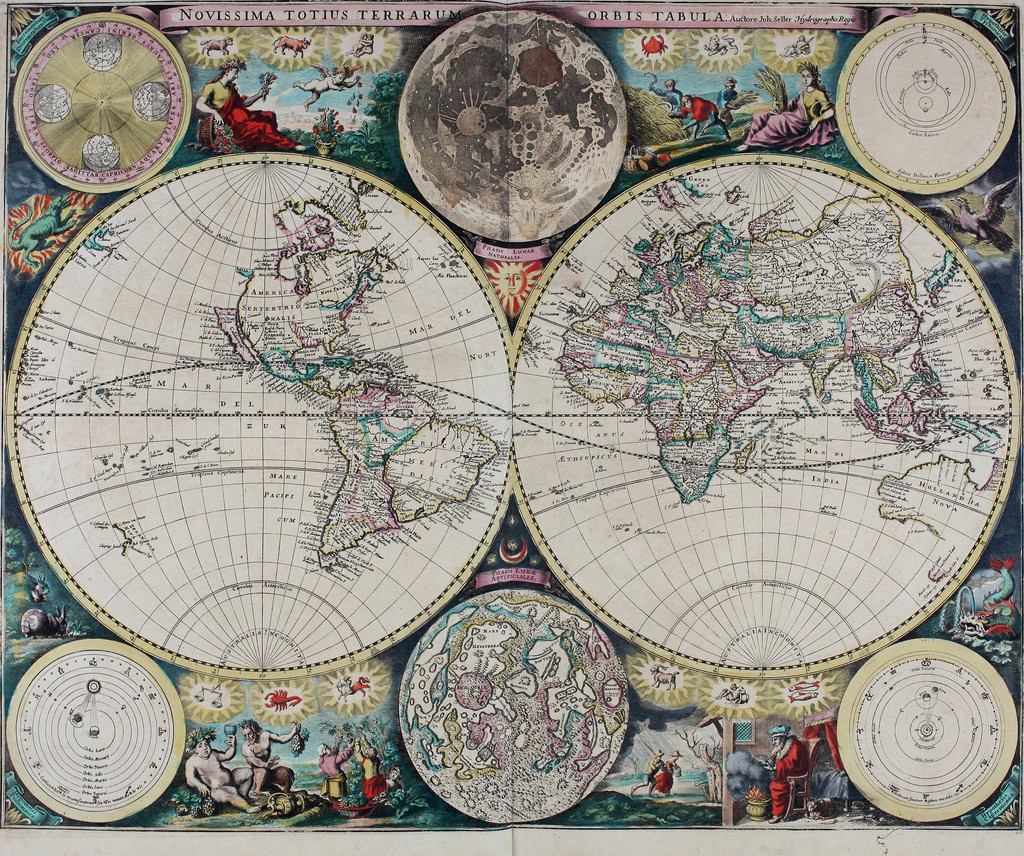
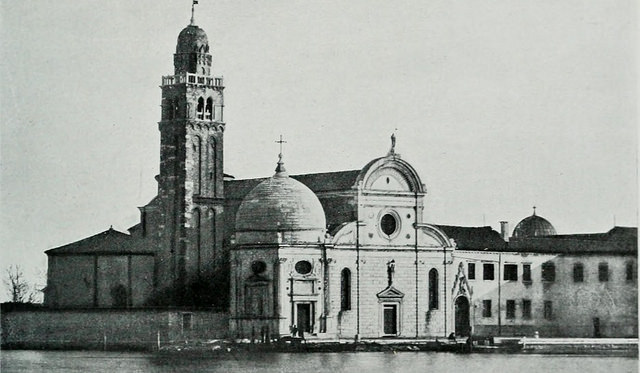
Thanks to Kalev Leetaru, a Yahoo! Fellow in Residence at Georgetown University, you can now head over to a new collection at Flickr and search through an archive of 2.6 million public domain images, all extracted from books, magazines and newspapers published over a 500 year period. Eventually this archive will grow to 14.6 million images.
This new Flickr archive accomplishes something quite important. While other projects (e.g., Google Books) have digitized books and focused on text — on printed words — this project concentrates on images. Leetaru told the BBC, “For all these years all the libraries have been digitizing their books, but they have been putting them up as PDFs or text searchable works.” “They have been focusing on the books as a collection of words. This inverts that.”
The Flickr project draws on 600 million pages that were originally scanned by the Internet Archive. And it uses special software to extract images from those pages, plus the text that surrounds the images. I arrived at the image above when I searched for “automobile.” The page associated with the image tells me that the image comes from an old edition of the iconic American newspaper, The Saturday Evening Post. A related link puts the image in context, allowing me to see that we’re dealing with a 1920 ad for an REO Speedwagon. Now you know the origin of the band’s name!
I should probably add a note about how to search through the archive, because it’s not entirely obvious. From the home page of the archive, you can do a keyword search. As you’re filling in the keyword, Flickr will autopopulate the box with the words “Internet Archive Book Images’ Photostream.” Make sure you click on those autopopulated words, or else your search results will include images from other parts of Flickr.
Or here’s an easier approach: simply go to this interior page and conduct a search. It should yield results from the book image archive, and nothing more.
In case you’re wondering, all images can be downloaded for free. They’re all public domain.
I watched Star Warsfor the first time in 1977 at the tender age of four. And like a lot of people in my generation and younger, that first time was a major, formative experience in my life. I got all the toys. I fantasized about being Han Solo. And during the summer of ’83, I blew my allowance by watching Return of the Jedi every day for a week in the theater. George Lucas’ epic space opera is the reason why I spent a lifetime watching, making and writing about movies. And if you asked any movie critic, fan or filmmaker who grew up in the ‘80s, they will probably tell you a similar story.
Over the years though, Lucas succumbed to the dark side of the Force. His prequel trilogy, starting with truly god awful The Phantom Menace (1999), is as visually overstuffed as it is cinematically inert. (Somewhere, there’s a dissertation to be written about how widespread feelings of betrayal from the prequels psychically prepared America for the anxiety and disappointments of the Bush administration.)
Worse, fans who want to console themselves by watching Star Wars as they remember seeing it back in the ‘80s are out of luck. Lucas has been quietly butchering the original movies by adding CGI, sound effects and even whole characters – like (gag) Jar Jar Binks — to successive special edition updates. The problem is these updated versions feel bifurcated. It’s as if two different movies with two different aesthetics were clumsily stitched together. Lucas’ spare, muscular compositions in the original movie sit uneasily next to its cartoony, over-wrought additions. Yet this Frankenstein version is the one that Lucas insists you watch. The original cut is just plain not for sale. Lucas even refused to give the National Film Registry the 1977 cut of Star Wars for future preservation. “It’s like this is the movie I wanted it to be,” said Lucas in an interview in 2004, “and I’m sorry if you saw half a completed film and fell in love with it, but I want it to be the way I want it to be.”
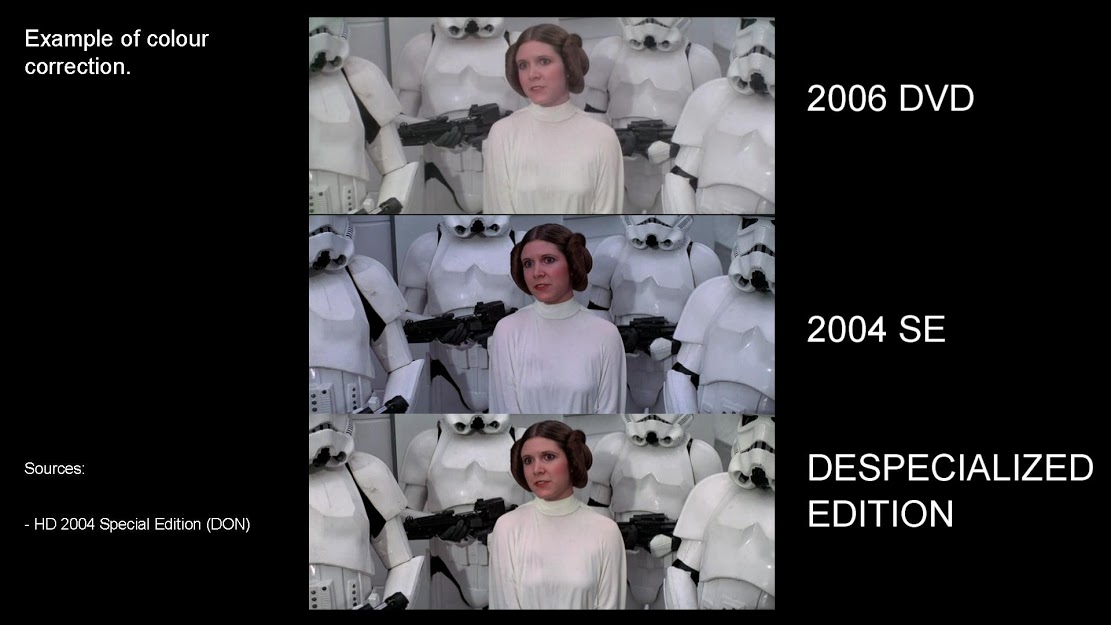
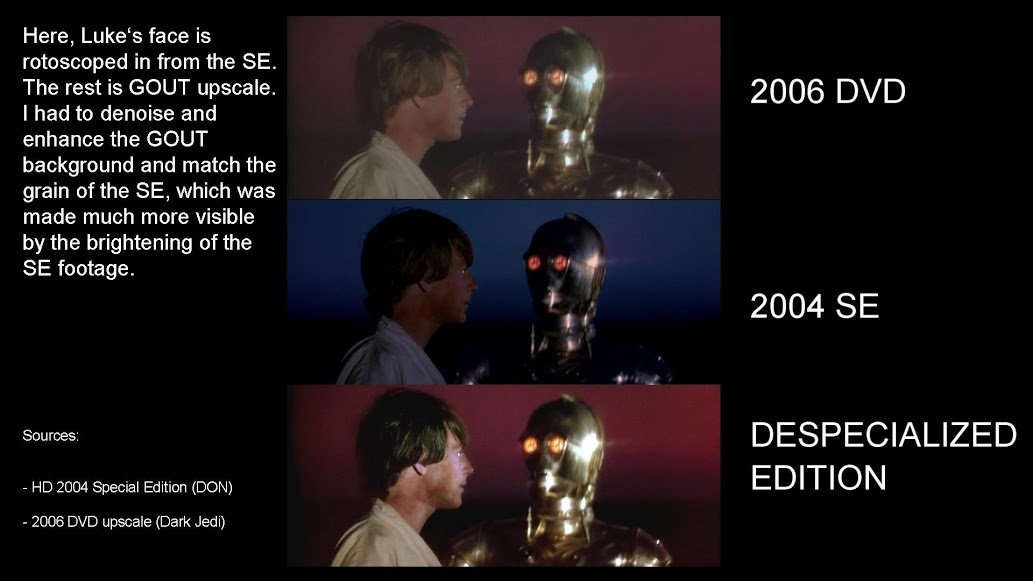
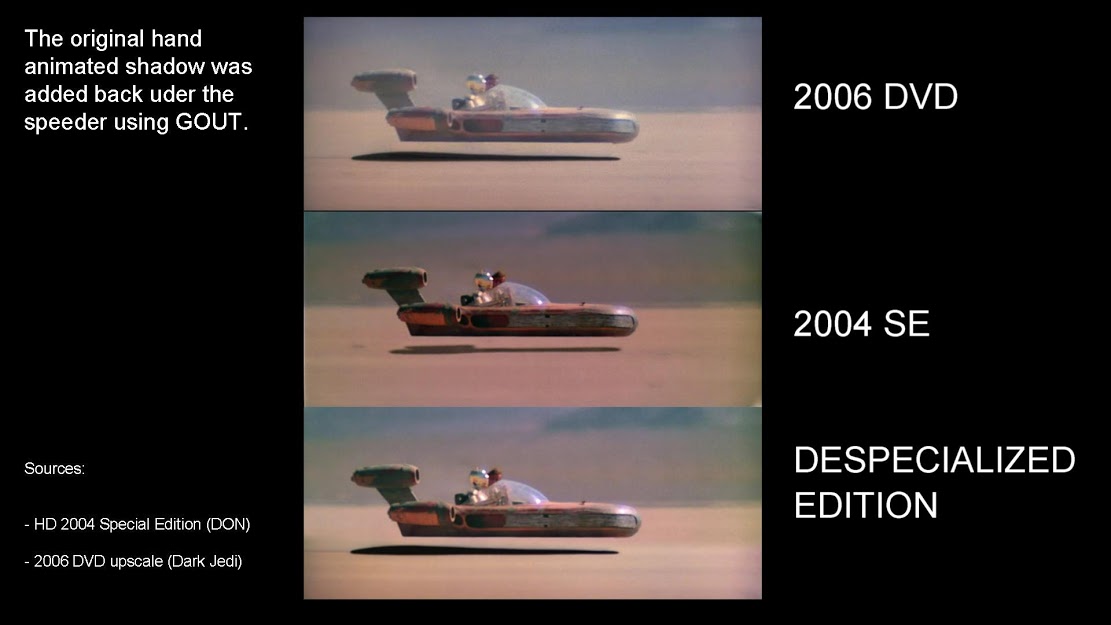
Thankfully, hardcore Star Wars fans are telling Lucas, respectfully, to go cram it. As Rose Eveleth in The Atlantic reports, a dedicated online community has set out to create a “despecialized” edition of Star Wars that strips away all of Lucas’s digital nonsense and restores the movie to its original 1977 state. The de facto leader of this movement is Petr Harmy, a 25-year-old guy from the Czech Republic who with the help of a legion of technically savvy film nerds has pieced together footage from existing prints and older DVD releases to create the Despecialized Edition v. 2.5. (Directions on where you can locate it are here.) Above Harmy talks in detail about how he accomplished this feat. And below you can see some side-by-side comparisons. More can be found on Petr Harmy’s page. Finally, in the comments section below, Harmy also points us toward pages with Despecialized stills for Star Wars and The Empire Strikes Back.
Jonathan Crow is a Los Angeles-based writer and filmmaker whose work has appeared in Yahoo!, The Hollywood Reporter, and other publications. You can follow him at @jonccrow. And check out his blog Veeptopus, featuring one new drawing of a vice president with an octopus on his head daily.
Last month we featured the particulars of novelist Haruki Murakami’s passion for jazz, including a big Youtube playlist of songs selected from Portrait in Jazz, his book of essays on the music. But we also alluded to Murakami’s admission of running to a soundtrack provided by The Lovin’ Spoonful, which suggests listening habits not enslaved to purism. His books — one of the very best known of which takes its name straight from a Beatles song (“Norwegian Wood”) —tend to come pre-loaded with references to several varieties of music, almost always Western and usually American. “The Fierce Imagination of Haruki Murakami,” Sam Anderson’s profile of the writer on the occasion of the release of his previous novel 1Q84, name-checks not just Stan Getz but Janáček’s Sinfonietta, The Rolling Stones’ Sympathy for the Devil, Eric Clapton’s Reptile, Bruce Springsteen’s version of “Old Dan Tucker,” and The Many Sides of Gene Pitney. The title of Murakami’s newColorless Tsukuru Tazaki and His Years of Pilgrimage,writes The Week’s Scott Meslow, references Franz Liszt’s ‘Years of Pilgrimage’ suite, “which plays a central role in the novel’s narrative. The pointed reference isn’t exactly a major detour from Murakami.”
Given the writer’s increasing reliance on music and the notion of “songs that literally have the power to change the world,” to say nothing of his “ability to single-handedly drive musical trends,” it can prove an illuminating exercise to assemble Murakami playlists. Selecting 96 tracks, Meslow has created his own playlist (above) that emphasizes the breadth of genre in the music incorporated into Murakami’s fiction: from Ray Charles to Brenda Lee, Duke Ellington to Bobby Darin, Glenn Gould to the Beach Boys. Each song appears in one of Murakami’s novels, and Meslow even includes citations for each track: “I had some coffee while listening to Maynard Ferguson’s ‘Star Wars.’ ” “Her milk was on the house if she would play the Beatles’ ‘Here Comes the Sun,’ said the girl.” “Imagine The Greatest Hits of Bobby Darin minus ‘Mack the Knife.’ That’s what my life would be like without you.” “The room begins to darken. In the deepening darkness, ‘I Can’t Go For That’ continues to play.” It all coheres in something to listen to while exploring Murakami’s world: in your imagination, in real life, or in his trademark realms between.
To listen to the playlist above, you will first need to download Spotify. Please note that once you mouse over the playlist, you can scroll through all 96 songs. Look for the vertical scrollbar along the right side of the playlist.
Photo above is attributed to “wakarimasita of Flickr”
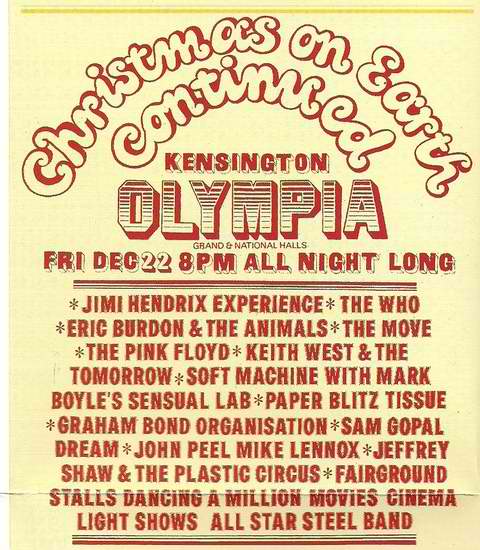
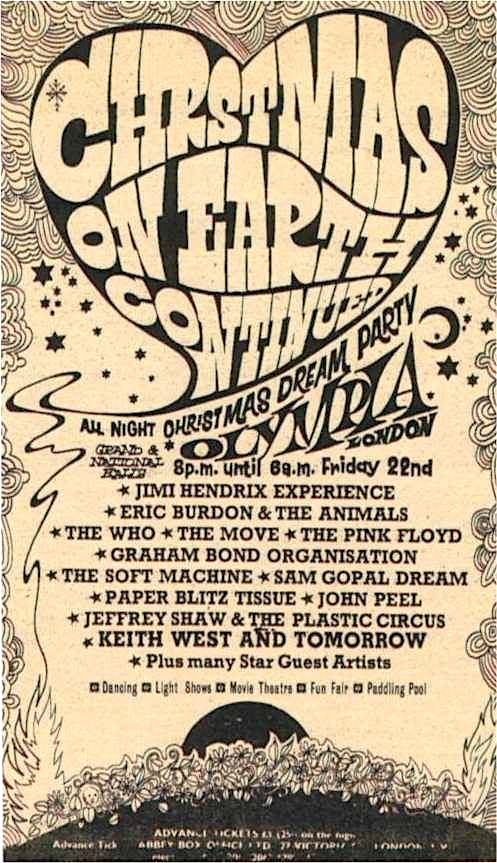
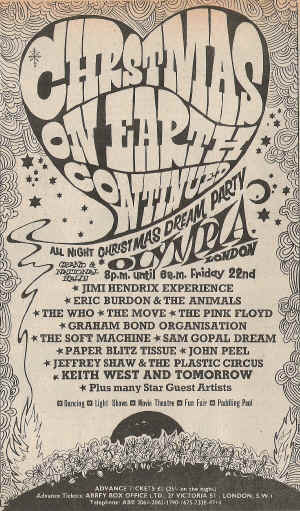
A truly spectacular event, 1967’s “Christmas on Earth Continued”—a super-concert described in one promo poster as an “All Night Christmas Dream Party”—gets sadly remembered as the last major show Syd Barret played with Pink Floyd—ending the set dazed and motionless onstage, his arms hanging limp at his sides. Barrett’s breakdown wasn’t the only thing that kept this massive happening, “the last gasp of the British underground scene,” from taking off as it should have.
As the blog Marmalade Skies recalls, the concert, held in the “vast London Olympia,” had “hopelessly inadequate” publicity.” This, and a “particularly severe winter freeze” meant sparse attendance and “financial disaster for the organizers.” In addition, a planned film of the event failed to materialize, “owing to poor picture quality of the footage.”
Despite all this, it seems, you really had to have been there. The lineup alone will make lovers of 60s psych-rock salivate: Jimi Hendrix Experience, Eric Burdon, Pink Floyd, The Move, Soft Machine, Tomorrow… The Who didn’t make it, but the unbilled Traffic did. We’re lucky to have some of the footage from that winter night. Check out Traffic below (with a very young Steve Winwood), playing “Dear Mr. Fantasy.”
Liberal England blogger Jonathan Calder calls the Traffic clip “priceless” and quotes Marmalade Skies’ vivid description of the nights festivities:
Soft Machine, with Kevin Ayers resplendent in pre-punk black string vest, climaxed with the ultimate Dada version of ‘We did it again’ as Robert Wyatt leapt into a full bath of water, that just happened to be on-stage with them! At least, we assumed it was water.
Tomorrow powered through their unique mix of heavily Beatles influenced psychedelia. During ‘Strawberry Fields Forever’ Twink (drums) and Junior (bass) performed a mimed fight whilst being subjected to the most powerful strobe light effects I’ve ever witnessed. Steve Howe was a revelation, moving from raga to classical to Barrett — style anarchy with an almost arrogant ease.
Traffic, still with Dave Mason, even performed ‘Hole in my shoe’. Steve Winwood was into his white cheesecloth period, and their music was so unlike anything else around that they occupied a totally original space. The song, ‘Here we go round the Mulberry Bush’ was very typical of their trippy, watery sound at that time.
Hendrix — voom! All light shows were killed for his performance. Noel Redding was constantly niggling Jimi, playing bass behind his head as Jimi performed his tricks with his guitar. It was the first time I saw Hendrix with his Gibson Flying Arrow, and the tension on-stage produced some electrifying music.
At the top of the post see Hendrix in backstage footage, effortlessly coaxing some beautiful 12-bar blues from that Gibson flying V. The film clips of him onstage—blowing an obviously very turned-on audience’s collective mind—will convince you this was the only place on earth to be on December 22, 1967.
And that fateful Floyd performance? We don’t seem to have any film, but we do have the audio, and you can hear it below, slightly sped up, it seems. The band were debuting their new 3D lightshow, which—as much as Barrett’s sad loss of his faculties—left quite an impression on the crowd. One anonymous commenter on Calder’s blog, who claims to have seen been in attendance at the tender age of 18, writes, “I was so impressed with the Soft Machine and Pink Floyd lightshows that I bought an old movie projector from a thrift shop and me and my flatmate spent hours putting color slides into the projector grate and watched them melt psychedelically on the wall.” No doubt impressionable youngsters all over the UK indulged in similar kinds of good clean fun, with Piper at the Gates of Dawn on the hi-fi. If like me, you were born too late to experience the zenith of the psychedelic 60s, then flip off the lights, let your trippiest screen saver take over, and listen to Pink Floyd deconstruct themselves below.
Vice.com’s food channel, Munchies, spent time with Naomichi Yasuda and learned the dos and don’ts of eating sushi. And they kindly summarized some practices that are permitted and verboten.
It’s okay to use your fingers to eat cut sushi rolls.
Don’t combine ginger and sushi, or ginger and soy sauce. Ginger is a palate cleanser in between bites.
When dipping sushi into soy sauce, dip fish-side down.
Never shake soy sauce off of sushi. That’s like shaking your wanker in public.
The video above just begins to scratch the surface. If you head over to TheSushiFAQ, you can find a long list of rules and suggestions that will round out your sushi-eating etiquette. Here are some additional tips to keep in mind: Never put wasabi directly in the shoyu dish. And know that Sashimi is only to be eaten with your chopsticks, not with your hands. Got it? There will be a quiz tomorrow.
Ludwig Wittgenstein, enfant terrible or idiot savant? A student of the great Bertrand Russell and protégé of renowned mathematician and logician Gottlob Frege, the angry young upstart’s Tractatus Logico-Philosophicus put both elder thinkers on notice: The days of their comfortable assumptions were numbered, in a series of austere, cryptic aphorisms and symbolic propositions that make very little sense to those of us who lack the prodigious intellects of Russell and Frege. While Wittgenstein is often dismissed, writes Paul Horwich at New York Times’ philosophy blog “The Stone,” as “self indulgently obscure,” perhaps the real reason many academic philosophers reject his work is that it renders them superfluous. Philosophy, Wittgenstein obliquely claimed in his half-mystical, hyper-logical treatise, “can’t give us the kind of knowledge generally regarded as its raison d’être.”
Given the Tractatus’s firebombing of an entire area of human endeavor, it’s no surprise it hasn’t fared well in many traditional departments, but that hasn’t stopped Wittgenstein’s work from finding purchase elsewhere, influencing modern artists like Jasper Johns, the Coen Brothers, and, not least surely, Finnish avant garde composer and musician M.A. Numminen.
This odd character, who caused a stir in the 60s by setting sex guides to music, took it upon himself to do the same for many of the Tractatus’s propositions, and the results are, well…. Listen for yourself. At the top of the post, we have video of Numminen performing the fifth and final movement of his Tractatus suite—the famous final proposition of that strange little book: “Whereof one cannot speak, thereof one must be silent” (“Woven man nicht sprechen kann, darüber muss man schweigen”). Numminen sings this in German, in his high-pitched, creaking voice. The rest of the suite he sings in English. Just above, hear the first movement, “The World Is…,” and below, hear movements 2–4, “In Order To Tell…,” “A Thought Is…,” and “The General Form Of A Truth Function.” He even sings the symbols, in breathless transcription. You can stream and download the full suite at Ubuweb and follow along at the Tractatus hypertext here.
Should Numminen’s tinpan alley-like compositions strike you as a particularly ridiculous setting for Wittgenstein’s genius, fear not; the Motet below (“Excerota Tractati Logico-Philosophici”), by composer Elisabeth Lutyens, treats the eccentric German’s work with a great deal more reverence.
I submit to you the proposition that a sufficiently masterful composition can survive in not just any key, but any context, any time, any sensibility, or any instrumentation. To allow you to evaluate this proposition, I submit to you John Coltrane’s “A Love Supreme.” The saxophonist’s half-hour suite, an artistic freedom-embracing hymn to the higher power Coltrane saw as having imbued him with not just life but a formidable skill on his instrument, came as an eponymous album from Impulse! Records in 1965. (Listen here.) Having won innumerable accolades in the near-half-century since, it now seems to have a permanent place on everyone’s list of the greatest jazz recordings of all time. About such a pillar of a work, only one question can remain: how would it sound on the bagpipes?
Here to satiate your curiosity comes Rufus Harley, the first jazz musician ever to take up the Scottish great Highland bagpipe as his main, er, horn. At the top of the post, you can hear him play a bit of “A Love Supreme” live on that signature instrument. He would also work other well-known pieces into his act, such as “Amazing Grace,” a song most commonly played in funerals. And indeed, it took a funeral to turn Harley on to the bagpipe’s untapped potential.
“Moved by the pipes of the Black Watch Scottish Marching Band who were playing for the funeral of slain President John F. Kennedy in November, 1963,” says his bio at Hip Wax, he lined up “a $120 set of pipes from a pawn shop and help from musician-teacher Dennis Sandole,” and “the world’s only jazz bagpipist was on his way” — to places like the CBS game show I’ve Got a Secret, three years later, an appearance you can watch just above. You can learn more about Harley’s remarkable life and surprisingly funky career on Jazz City TV’s The Original Rufus Harley Story below.
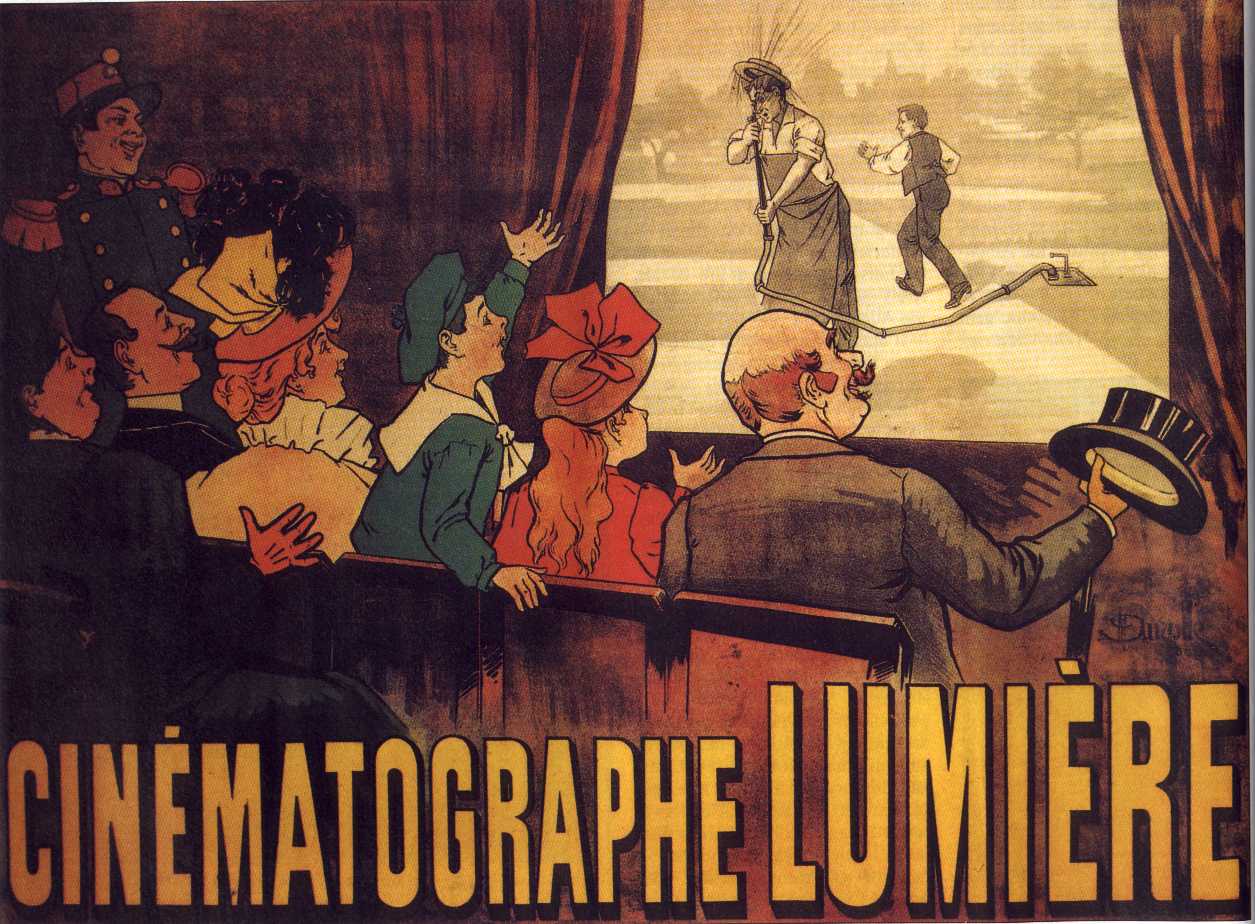
When Auguste and Louis Lumière unveiled their invention, the Cinématographe, at the Salon Indien du Grand Café in Paris on December 28, 1895, the art form of film was born. Prior to that, other inventors looked for ways to photographically capture motion in a commercially successful way but failed. Thomas Edison, for instance, hawked a device called the Kinetoscope that looked a bit like a View-Master strapped to a pulpit. It was big, bulky and, most importantly, offered an experience to a single viewer at a time. The Cinématographe, on the other hand, projected images on a wall, creating, for the first time ever, a movie audience.
The Lumière brothers screened 10 short films that night, each running about 50 seconds long. They are, as you might expect, about as primitive as you can get. Basic elements of cinema like editing or camera movement were decades away from evolving into the cinematic grammar that we take for granted today.
The Lumière brother’s first film was called Workers Leaving The Lumière Factory in Lyon (La Sortie des usines Lumière à Lyon) and that’s entirely what the short shows: a single static shot of dozens of men and women, all of whom seem to be wearing hats, leaving a factory for the day. It is a documentary in its most elemental form.
Above is The Waterer Watered (L’Arroseur arrosé), cinema’s first comedy. It shows a gardener watering some plants before a naughty kid steps on the hose, cutting off its flow. When the gardener looks down the nozzle, the kid takes his foot off the hose and Bam! — the world’s first example of someone getting punked on camera.
And below you can see the Lumière’s most famous early short, screened in early 1896. It shows a train arriving at a station. The camera was placed right at the edge of the platform so the train sweeps past the frame on a strong, dynamic diagonal. Legend has it that audiences thought that the train was coming straight at them and panicked. That’s probably not true but it did, for the first time, demonstrate the visual drama that can be created by a well-placed camera.
Jonathan Crow is a Los Angeles-based writer and filmmaker whose work has appeared in Yahoo!, The Hollywood Reporter, and other publications. You can follow him at @jonccrow. And check out his blog Veeptopus, featuring one new drawing of a vice president with an octopus on his head daily.
According to official propaganda, Kim Jong-Il was a remarkably impressive individual. He learned to walk when he was just three weeks old; he wrote 1,500 books while at university; and, during his first and only game of golf, he scored 11 holes in one. Yet for some reason becoming the world’s first North Korean professional golf player didn’t seem to interest Kim. He wanted to make movies. So, in 1978, while his father Kim Il-Sung was still the country’s supreme leader, Kim set out to modernize the film industry of the Democratic People’s Republic of Korea.
“The North’s filmmakers are just doing perfunctory work,” Kim said to South Korean film director Shin Sang-ok. “They don’t have any new ideas…their works have the same expressions, redundancies, the same old plots. All our movies are filled with crying and sobbing. I didn’t order them to portray that kind of thing.”
Of course, Kim’s bold plan to jumpstart the industry was to kidnap Shin and his wife, both celebrities in South Korea. He was abducted in Hong Kong and, when he had the temerity to try to escape, he ended up spending four years toiling in prison, subsisting on little more than grass and a little rice. Eventually, Shin was approached by Kim and given an offer he dare not refuse: make movies in North Korea.
Like the films cranked out in China during the height of the Cultural Revolution, North Korean movies are largely propaganda delivery systems designed exclusively for a domestic audience. After Shin’s kidnapping, DPRK movies started to get just a bit less didactic. Simon Fowler, who writes probably the only English-language blog on North Korean cinema, just wrote an article for The Guardian where he selected the best films to come out of the Hermit kingdom. You can watch a few of these movies here and find the others at The Guardian. They might be goofy, maudlin and ham-fisted, but for movie mavens and aficionados of Communist kitsch, they are fascinating.
Perhaps the most important North Korean movie ever is The Flower Girl (1972). Watch it above. Set during Japan’s colonial occupation of Korea, the film follows a young woman who endures one injustice after another at the hands of the Japanese before Kim Il-Sung’s army marches into her village and saves the day. The movie set the template for many of the movies to come afterwards. As Fowler writes, “the importance of The Flower Girl within the DPRK cannot be overestimated. The star, Hong Yong-hee, adorns the one won bank note in North Korea, and is revered as a national hero. Although not always an easy watch, those wanting to learn more about the average North Koreans’ sensibilities could do far worse than to watch this picturesque but tragic film.”
Hong Kil Dong (1986) is clearly one of the movies Shin Sang-ok influenced; it foregrounded entertainment over ideology, a rarity at that point in the country’s film history. The movie is about a character from Korean literature who, like Robin Hood, not only robs from the rich and gives to the poor but knows how to deliver a beatdown. Hong plays out like a particularly low-budget Shaw Brothers kung fu spectacle with plenty of flying kicks, sword play and wire work.
And finally, there’s Pulgasari (1985), North Korea’s attempt at making a kaiju movie. Set in feudal times, the film is about a statue that comes to life, grows to monstrous proportions and, unable to sate its unquenchable thirst for metal, starts to smash things. Shin managed to get technical help for the movie from Toho, the same Japanese studio that cranked all those Godzilla movies. In fact, they even got veteran kaiju actor, Kenpachiro Satsuma, to don a rubber suit for this movie. Years later, Pulgasari was released in Japan about the same time as Roland Emmerich’s god awful Hollywood remake of Godzilla (not to be confused with Gareth Edward’s god awful Hollywood remake from earlier this year). Satsuma publically stated what a lot of Japanese privately thought – Pulgasari is better than Emmerich’s big-budget dud.
Not long after Shin completed Pulgasari, he and his wife managed to escape in Vienna thanks to the help of the CIA and a host of other unlikely parties. Kim Jong-Il might have had super human abilities, but talent retention did not seem to be one of them.
You can watch the three films listed above, plus Marathon Runner and Centre Forwardover at The Guardian.
Jonathan Crow is a Los Angeles-based writer and filmmaker whose work has appeared in Yahoo!, The Hollywood Reporter, and other publications. You can follow him at @jonccrow. And check out his blog Veeptopus, featuring one new drawing of a vice president with an octopus on his head daily.
Thanks to Laura Dern, David Lynch took the ALS Ice Bucket Challenge. And, of course, there’s a twist — which involves a double shot of espresso and Lynch playing “Somewhere Over the Rainbow” on the trumpet. If you ever wondered what Lynch looks like without his classic quiff, you won’t want to miss this one minute bit.
We're hoping to rely on loyal readers, rather than erratic ads. Please click the Donate button and support Open Culture. You can use Paypal, Venmo, Patreon, even Crypto! We thank you!
Open Culture scours the web for the best educational media. We find the free courses and audio books you need, the language lessons & educational videos you want, and plenty of enlightenment in between.