While not all science fiction is dystopian—far from it—a question does arise when the subject of that most pessimistic of genres comes up: is all dystopian literature science fiction? In a post a couple days ago, we brought you five of Anthony Burgess’s favorite dystopian novels, a list that would seem to answer with a resounding No. For one thing, Burgess includes what we might count as historical fiction on his list—Norman Mailer’s The Naked and the Dead. Is Orwell’s 1984 science fiction? It makes more sense, perhaps, to call it political satire, or “speculative fiction,” the term dystopian novelist Margaret Atwood prefers.
In the introduction to her essay collectionIn Other Worlds, Atwood defines “speculative fiction” as “realistic and plausible” whereas science fiction contains more fantastic elements. Hairsplitting maybe, but for Atwood it means that dystopias—at least her dystopias—are not simply philosophical thought experiments divorced from lived reality, like much utopian fiction. They are projections, and at times imaginative transcriptions, of the present, showing us what may already be happening right under our noses, or what might be right around the corner.
As Burgess wrote of 1984, “It is possible to say that the ghastly future Orwell foretold has not come about simply because he foretold it: we were warned in time.” In other words—the totalitarian future Orwell foresaw was entirely possible in England and America, and needless to say, already largely a reality in places like Stalin’s Soviet Union and current-day North Korea. In our Burgess post, we asked our readers to name their favorite dystopian novels (or films). However we define dystopia—as dark futurist fantasy, sci-fi, or “speculative fiction” about nasty things on the verge of coming to pass, we’ll never lack for examples.
The list of novels below below offers a range of futuristic tales, some more realistic and plausible, some more fantastic. Like Burgess, readers had a broad definition of “dystopian” as a genre. I was surprised, however, that no one mentioned any of Atwood’s excellent novels, so I’ll throw in both Oryx and Crake and The Handmaid’s Tale as my picks.
We now find ourselves about a third of the way through March, more interestingly known as Women’s History Month, a time filled with occasions to round up and learn more about the creations and accomplishments of women through the centuries. And “who better to honor this March than history’s influential feminists?” writes Lynn Lobash on the New York Public Library’s website.
We’ve previously featured treasures from the New York Public Library, including art posters, maps, restaurant menus, theater ephemera, and a host of digitized high-resolution images. Today it’s time to highlight one of the many recommended reading lists that the NYPL’s librarians regularly create for the reading public. “Know Your Feminisms”–a book list “essential for understanding the history of feminism and the women’s rights movement”–could easily be used in a Feminism 101 course. It runs chronologically, beginning with these ten volumes (the quoted descriptions come from Lynn Lobash):
A Room of One’s Own by Virginia Woolf (1929). “This essay examines the question of whether a woman is capable of producing work on par with Shakespeare. Woolf asserts that ‘a woman must have money and a room of her own if she is to write fiction.’ ”
The Second Sex by Simone de Beauvoir (1949). “A major work of feminist philosophy, the book is a survey of the treatment of women throughout history.”
The Feminine Mystique by Betty Friedan (1963). “Friedan examines what she calls ‘the problem that has no name’ – the general sense of malaise among women in the 1950s and 1960s.”
Les Guérillères by Monique Wittig (1969). “An imagining of an actual war of the sexes in which women warriors are equipped with knives and guns.”
The Female Eunuch by Germaine Greer (1970). “Greer makes the argument that women have been cut off from their sexuality through (a male conceived) consumer society-produced notion of the ‘normal’ woman.”
Sexual Politics by Kate Millett (1970). “Based on her PhD dissertation, Millett’s book discusses the role patriarchy (in the political sense) plays in sexual relations. To make her argument, she (unfavorably) explores the work of D.H Lawrence, Henry Miller, and Sigmund Freud, among others.”
Sister Outsider by Audre Lorde (1984). “In this collection of essays and speeches, Lorde addresses sexism, racism, black lesbians, and more.”
The Beauty Myth by Naomi Wolf (1990). “Wolf explores “normative standards of beauty” which undermine women politically and psychologically and are propagated by the fashion, beauty, and advertising industries.”
Gender Trouble by Judith Butler (1990). “Influential in feminist and queer theory, this book introduces the concept of ‘gender performativity’ which essentially means, your behavior creates your gender.”
Feminism is for everybody by bell hooks (2000). “Hooks focuses on the intersection of gender, race, and the sociopolitical.”
To see the very newest books the NYPL has put in this particular canon, the latest of which came out just last year, take a look at the complete list on their site. There you’ll also find “Well Done, Sister Suffragette!,” a shorter collection of five books on history’s fighters for women’s rights: the slave-turned-orator Sojourner Truth, activist Elizabeth Cady Stanton, social reformer Susan B. Anthony, nineteenth amendment-promoter Alice Paul, and radical Catholic journalist Dorothy Day.
Unless you’re an audio engineer, you’ll have little reason to know what the term “convolution reverb” means. But it’s a fascinating concept nonetheless. Technicians bring high-end microphones, speakers, and recording equipment to a particularly resonant space—a grain silo, for example, or famous concert hall. They capture what are called “impulse responses,” signals that contain the acoustic characteristics of the location. The technique produces a three dimensional audio imprint—enabling us to recreate what it would sound like to sing, play the piano or guitar, or stage an entire concert in that space. As Adrienne LaFrance writes in The Atlantic, “you can apply [impulse responses] to a recording captured in another space and make it sound as though that recording had taken place in the original building.”
This kind of mapping, writes Allison Meier at Hyperallergic, allows researchers to “build an archive of a building’s sound, with all its nuances, echoes, and ricochets, that could survive even if the building fell.” And that is precisely what researchers have been doing since 2014 in ancient Greek Byzantine churches. The project began when Sharon Gerstel, Professor of Byzantine Art History and Archeology at UCLA, and Chris Kyriakakis, director of the Immersive Audio Laboratory at the University of Southern California, met to discuss their mutual interest in capturing the sound of these spaces.
(Hear them both explain the genesis of the project in the CBC interview above.) The two researchers traveled to Thessaloniki, coincidentally, Kyriakakis’ hometown, and began, as Gerstel puts it, to “measure the churches.” LaFrance’s Atlantic article gives us a detailed description of the measurement process, which involves playing and recording a tone that sweeps through the audible frequency spectrum. You’ll hear it in the video at the top of the post as a “chirp”—bouncing off the various architectural surfaces as the voices of singers would have hundreds of years ago.
In that video and in the audio recording above, chanters in a studio had the audio characteristics of these churches applied to their voices, recreating the sounds that filled the spaces in the early Christian centuries. As another member of the team, James Donahue—Professor of Music Production and Engineering at Berklee College of Music—discovered, the churches had been acoustically designed to produce specific sound effects. “It wasn’t just about the architecture,” says Donahue, “they had these big jugs that were put up there to sip certain frequencies out of the air… They built diffusion, a way to break up the sound waves… They were actively trying to tune the space.” In addition, the builders “discovered something that we call slap echo. [In the ancient world], they described it as the sound of angels’ wings.”
The project not only allows art historians to enter the past, but it also preserves that past far into the future, creating what LaFrance calls a “museum of lost sound.” After all, the churches themselves will eventually recede into history. “Some of these buildings may not exist later,” says Kyriakakis, “Some of these historic buildings are being destroyed.” With immersive video and audio technology, we will still be able to experience much of their grandeur long after they’re gone.
Who can now deny that, in the internet, we have the greatest educational tool ever conceived by mankind? Surely no Open Culture reader would deny it, anyway, nor could they fail to take an interest in a new startup aiming to increase the internet’s educational power further still: Pindex, which calls itself “a Pinterest for education.” No other company has yet staked that territory out, and certainly no other company has done it with the support of Stephen Fry.
The Telegraph’s Cara McCoogan describes Pindex, which launched just last month (visit it here), as “a self-funded online platform that creates and curates educational videos and infographics for teachers and students,” founded and run by a four-person team.
Fry’s role in the quartet includes offering “creative direction,” but he’s also put his unmistakable voice to one of Pindex’s first videos, an “explainer about the Large Hadron Collider, dark matter and extra dimensions. Other videos will focus on science and technology, including ones on the Hyperloop, colonising Mars, and robots and drones. Mr Fry is expected to do the voiceovers for several of these.”
One of the hardest things to master as an independent musician is the art of promotion. Though many artists are extroverts and attention-seekers, many more are by nature introverted, or at least inner-directed, and disinclined to embrace the tools of the marketing trade. In days of yore, when such things as major record labels still roamed the earth at large, much of the promotion could be left up to those majestic, lumbering beasts. These days, when the majority of working musicians have to keep their day jobs and learn to do their own production, styling, booking, and PR, it’s essential to get over any squeamishness about blowing your own horn. If you’re looking for pointers, consider the example of self-invented musical genius Sun Ra, a master of self-promotion.
No one better understood what Sun Ra was up to than Sun Ra himself, and he knew how to sell his very out-there free jazz movement to a public used to more mundane presentations. As Mike Walsh at Mission Creep succinctly puts it, “nothing about Sun Ra’s six-decade musical career could be called normal.” He more or less re-invented what it meant to be a jazz musician and bandleader. It was in the 1950s that he really came into his own. After working steadily as a touring sideman for several other musicians, the man born Herman Blount changed his name first to Le Sony’r Ra, then Sun Ra, and put together his famous “Arkestra.”
His shows began to incorporate the elaborate costuming he became known for, and he would often stop the music “to lecture on his favorite subjects,” writes Jez Nelson at The Guardian, “Egyptology and space. He began to claim he had been abducted by aliens and was in fact from Saturn.” The act was both deadly serious space opera (he rehearsed his band for 12 hours at a stretch, after all) and absurdist schtick, and it both transported audiences to new worlds and made them laugh out loud.
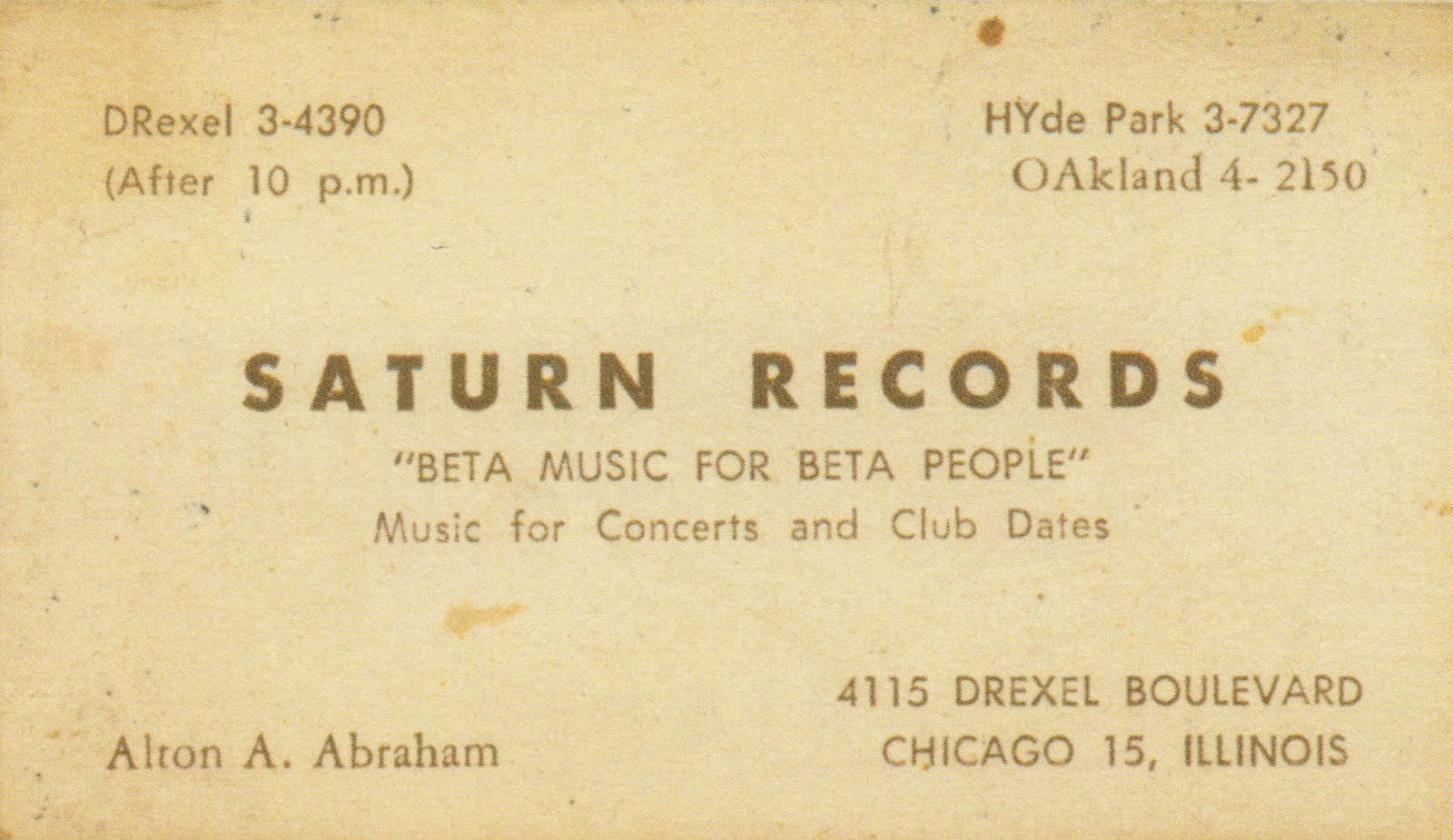
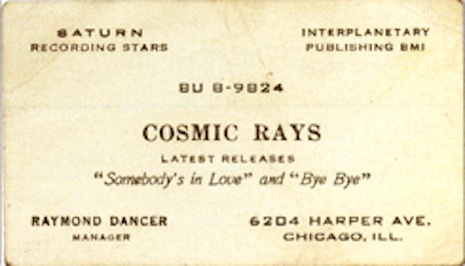
Sun Ra’s business cards from the 50s capture this tonal spectrum between avant-garde performance art and high-concept free jazz comedy. Advertising new releases, a band-for-hire, and ongoing local Chicago residencies, they combine the strict professionalism of a working bandleader with the wordplay and silliness Ra loved: he calls his coterie “Atonites,” which psychology professor Robert L. Campbell reads as meaning both “worshippers of Aton,” Egyptian sun god, and “performers of atonal music.” Audiences are invited to “Dance the Outer Space Way. Hear songs sung the Outer Space Way by Clyde ‘Out of Space’ Williams” (onetime singer with the band). And the card at the top of the post makes perhaps the simplest, most compelling pitch of them all: “Why buy old sounds?” Indeed.
Journalist, essayist, and novelist Eric Blair, better known as George Orwell, has the distinction of writing not just one, but two of the most well-known cautionary novels about totalitarian governments: 1984 and Animal Farm. You’ve likely read at least one of them, perhaps both, and you’ve likely seen either or both of the film adaptations based on these books. Were this the totality of Orwell’s legacy, it would surely be secure for many decades to come—and perhaps many hundreds of years. Who knows how our descendants will remember us; but whether they manage to fully transcend authoritarianism or still wrestle with it many generations later, the name of Orwell may forever be associated with its threatening rise.
And yet, had Orwell never written a word of fictional prose, we would probably still invoke his name as an important journalistic witness to the 20th century’s bloodiest conflicts over fascism. He directly participated in the Spanish Civil War, fighting with the Marxist resistance group POUM (Partido Obrero de Unificación Marxista). The horrific takeover of Spain by Francisco Franco, with help from Hitler’s Luftwaffe, paralleled the Nazi’s gradual takeover of Western Europe, and the experience changed not only Orwell’s outlook, but that of Europeans generally. As he wrote in his personal account of the war, Homage to Catalonia, “People then had something we haven’t got now. They didn’t think of the future as something to be terrified of….”
Orwell’s tour of duty in Spain ended in 1937 when he was shot in the throat; later he and his wife Eileen were charged with “rabid Trotskyism” by pro-Soviet Spanish communists. The Orwells retired to Morocco to recuperate. There, Orwell began keeping a diary, which he maintained until 1942, chronicling his impressions and experiences throughout the war years as he and Eileen made their way out of Morocco and back to England. You can follow their journeys in a Google Maps project here. And you can read all of Orwell’s diary entries at the website of The Orwell Prize, “Britain’s most prestigious prize for political writing.” The Prize site began blogging Orwell’s entries in 2008—70 years to the day after the first entry—and continued in “real time” thereafter until 2012.
The first entries reveal little, showing us “a largely unknown Orwell, whose great curiosity is focused on plants, animals, woodwork,” and other domestic concerns. Then, from about September, 1938 on, we see “the Orwell whose political observations and critical thinking have enthralled and inspired generations since his death in 1950. Whether writing about the Spanish Civil War or sloe gin, geraniums or Germany, Orwell’s perceptive eye and rebellion against the ‘gramophone mind’ he so despised are obvious.” These diaries—posted with explanatory footnotes—preserve a keen eyewitness to history, one who had been tested in war and seen firsthand the danger fascism posed. Orwell’s experiences gave him material for the novels for which we best remember him. And his personal and journalistic accounts give us a gripping firsthand portrait of life under the threat of Nazi victory.
From Sir Thomas More’s 1516 philosophical novel Utopia to Disney’s 2016 adult-friendly kids’ movie Zootopia, the genre of the “-topia” has been remarkably durable. Taking Plato’s Republic as their model, the first utopian fictions flourished in an optimistic age, when political philosophy imagined a perfect union between government and science. Such fiction portrayed mostly harmonious, high-functioning civilizations as contrasts to real, imperfect societies—and yet, as modern industry began to threaten human well-being and formerly idealized forms of government acquired a tyrannical hue, the genre began to project into the future not hopes of freedom, ease, and plenty but rather fears of mass suffering, imprisonment, and misrule. In place of utopias, modernity gave us dystopias, terrifying fictions of a hellish future birthed by war, totalitarian rule, gross economic inequality, and misapplied technologies.
Before John Stuart Mill coined the word “dystopia” in 1868, pessimistic post-Enlightenment thinker Jeremy Bentham created an earlier, perhaps even scarier, word, “cacotopia,” the “imagined seat of the worst government.” This was the term favored by Anthony Burgess, author of one of the most unsettling dystopian novels of the last century, A Clockwork Orange. Depicting a chaotic future England filled with extreme criminal violence and an unnerving government solution, the novel can be read as either, writes Ted Gioia, “a look into the morality of an individual, or as an inquiry into the morality of the State.” It seems to me that this dual focus marks a central feature of much successful dystopian fiction: despite its thoroughly grim and pessimistic nature, the best representatives of the genre present us with human characters who have some agency, however limited, and who can choose to revolt from the oppressive conditions (and usually fail in the attempt) or to fully acquiesce and remain complicit.
The rebellion of a single non-conformist generally forms the basis of conflict in dystopian fiction, as we’ve seen in recent, populist iterations like The Hunger Games series and their more derivative counterparts. And yet, in most classic dystopian novels, the hero remains an anti-hero—or an un-hero, rather: unexceptional, unimportant, and generally unnoticed until he or she decides to cross a line. A few of Burgess’s own favorites of the genre roughly follow this classic formula, including Orwell’s 1984. In the short list below, Burgess comments on five works of dystopian fiction he held in particularly high regard. Two of them, Aldous Huxley’s Island and Russell Hoban’s Riddley Walker, break the mold, and show us two opposite extremes of civilizations perfected, and completely annihilated, by Western progress. Burgess’s first choice, Norman Mailer’s The Naked and the Dead seems not to fit at all, being an account of past atrocities rather than a speculative look into the future.
Nevertheless, Burgess seems willing to stretch the boundaries of what we typically think of as dystopian fiction in order to include books that offer, as Mailer’s novel has it, “a preview of the future.” See Burgess’s picks below, and read excerpts from his commentary on these five novels. You can read his full descriptions at The International Anthony Burgess Foundation website.
The futility of war is well presented. The island to be captured has no strategic importance. The spirit of revolt among the men is stirred by an accident: the patrol stumbles into a hornets’ nest and runs away, dropping weapons and equipment, the naked leaving the dead behind them. An impulse can contain seeds of human choice: we have not yet been turned entirely into machines. Mailer’s pessimism was to come later — in The Deer Park and Barbary Shore and An American Dream — but here, with men granting themselves the power to opt out of the collective suicide of war, there is a heartening vision of hope. This is an astonishingly mature book for a twenty-five-year-old novelist. It remains Mailer’s best, and certainly the best war novel to emerge from the United States.
This is one of the few dystopian or cacotopian visions which have changed our habits of thought. It is possible to say that the ghastly future Orwell foretold has not come about simply because he foretold it: we were warned in time. On the other hand, it is possible to think of this novel as less a prophecy than the comic joining together of two disparate things — an image of England as it was in the immediate post-war era, a land of gloom and shortages, and the bizarrely impossible notion of British intellectuals taking over the government of the country (and, for that matter, the whole of the English-speaking world).
Jael 97 is facially overprivileged: her beauty must be reduced to a drab norm. But, like the heroes and heroines of all cacotopian novels, she is an eccentric. Seeing for the first time the west tower of Ely Cathedral, one of the few lofty structures left unflattened by the war, she experiences a transport of ecstasy and wishes to cherish her beauty. Her revolt against the regime results in no brutal reimposition of conformity — only in the persuasions of sweet reason. This is no Orwellian future. It is a world incapable of the dynamic of tyranny. Even the weather is always cool and grey, with no room for either fire or ice. The state motto is ‘Every valley shall be exalted.’ This is a brilliant projection of tendencies already apparent in the post-war British welfare state but, because the book lacks the expected horrors of cacotopian fiction, it has met less appreciation than Nineteen Eighty-Four.
Nobody is scientifically conditioned to be happy: this new world is really brave. It has learned a great deal from Eastern religion and philosophy, but it is prepared to take the best of Western science, technology and art. The people themselves are a sort of ideal Eurasian race, equipped with fine bodies and Huxleyan brains, and they have read all the books that Huxley has read.
All this sounds like an intellectual game, a hopeless dream in a foundering world, but Huxley was always enough of a realist to know that there is a place for optimism. Indeed, no teacher can be a pessimist, and Huxley was essentially a teacher. In Island the good life is eventually destroyed by a brutal, stupid, materialistic young raja who wants to exploit the island’s mineral resources.
England… after nuclear war, is trying to organize tribal culture after the total destruction of a centralized industrial civilization. The past has been forgotten, and even the art of making fire has to be relearned. The novel is remarkable not only for its language but for its creation of a whole set of rituals, myths and poems. Hoban has built a whole world from scratch.
Burgess’s list gives us such a small sampling of dystopian fiction, and with so many classic and contemporary examples about, it’s tempting to add to his list (one wonders why he chooses Huxley’s Island and not Brave New World). There’s no reason why we can’t. If you’re so inclined, tell us your favorite dystopian novels, or films, in the comments, with a brief description of their merits.
This week, we’re launching the beginning of a new, ongoing series. We’re creating guides that will teach you how to learn important subjects on your own, using free resources available on the web. Want an example? Just look below. Here you’ll find a list of free resources–online courses, instructional videos, YouTube channels, textbooks, etc.–that will teach how to code for free. If we’re missing great items, please add your suggestions in the comments below.
This collection is just a start, and it will continue to grow over time. In the meantime, if there are other guides you’d like to see us develop in the coming weeks, please let us know in the comments section too. We’re happy to get your feedback.
How to Code (Software)
Codecademy: A free site for learning everything from Making a Website to Python in a “user active” style—meaning that users can use tutorials to design projects of their own choosing. The site also makes it easy to track your progress. Other topics you can learn include: Create an Interactive Website, Ruby, Javascript, HTML & CSS, SQL and more. Register and sign up for all classes here. (See our post on Codecademy here.)
Code School: Code School courses are built around a creative theme and storyline so that it feels like you’re playing a game, not sitting in a classroom. The site offers a set of free courses covering JavaScript, jQuery, Python, Ruby and more.
Free Code Camp: An open source community that helps you learn to code. You can work through self-paced coding challenges, build projects, and earn certifications. According to Wired, the site “features a sequence of online tutorials to help the absolute beginner learn become a web developer, starting with building a simple webpage. Students move on to programming with JavaScript and, eventually, learning to build complete web applications using modern frameworks such as Angular and Node.”
The Odin Project: Made by the creators of Viking Code School, an online coding bootcamp, the Odin Project offers free coding lessons in web development. Topics include: HTML, CSS, JavaScript & jQuery, Ruby programming, Ruby on Rails. Find an introduction to the curriculum here.
Google’s Python Class: A free class (used within Google itself) for people with a little bit of programming experience who want to learn Python. The class includes written materials, lecture videos, and lots of code exercises to practice Python coding.
Google’s C++ Course: Welcome to Google’s C++ Class. This class includes written materials, lecture videos, examples, and exercises to practice C++ coding.
Online Computer/Coding Courses from Major Universities:
You can find dozens of free courses, covering all facets of coding, listed in our collection of Free Online Computer Science Courses. The courses come from top universities.
Harvard’s Popular Intro to Computer Science: Get free access to Harvard’s popular introductory coding course designed for majors and non-majors alike. Combines courses typically known elsewhere as “CS1” and “CS2.”
YouTube Channels for Learning Coding: Channels you might want to visit include:
Coder’s Guide: Features videos on HTML web development, cross-platform Java programming, beginner .net programming with Visual Basic and client side JavaScript web development.
Code Course: Learn to code and build things with easy to follow tutorials. A number of videos focus on PHP. Find more materials on the channel’s web site.
LearnCode.academy: HTML, CSS, JavaScript, CSS Layouts, Responsive Design etc.
The New Boston: Programming, web design, networking, video game development, graphic design, etc.
The Google Developers Channel: Offers lessons, talks, the latest news & best practices in subjects like Android, Chrome, Web Development, Polymer, Performance, iOS & more.
Free Programming Textbooks from Github: Access 500+ “free programming books that cover more than 80 different programming languages on the popular web-based Git repository hosting service.”
If you would like to support the mission of Open Culture, consider making a donation to our site. It’s hard to rely 100% on ads, and your contributions will help us continue providing the best free cultural and educational materials to learners everywhere. You can contribute through PayPal, Patreon, and Venmo (@openculture). Thanks!
I get into a lot of conversations these days about how we used to consider technological progress good by definition, but now — despite or maybe because of the farther-progressed-than-ever state of our technology — we feel a bit wary about it all. We line up for the latest smartphone, but as we do we reflect upon how it increasingly looks we’ll never line up for the jetpacks, flying cars, and moon colonies we dreamed of in childhood. We enjoy our phones, but we resent them as well, remembering those long-ago assurances that technology would increase our leisure, not fill it with anxiety about insufficiently rapid responses, nagging leftover work, and missed-out-on information of every kind. When did the trust between our tech and ourselves break down?
Not so recently, it turns out — or rather, not just recently. The human-technology relationship goes through its good times and its bad patches, and at any given time some of us like the direction its progress looks to be moving in more than others do. You may have heard of one particularly well-known technological critic of the early twentieth century, a cartoonist by the name of Rube Goldberg. More likely, you’ve heard of the preposterously elaborate machines he drew in his cartoons.
One representative example, an “automatic suicide device for unlucky stock speculators,” involves the ring of a phone (“probably a message from your broker saying you are wiped out”) which wakes up a dozing office manager whose stretching hits a lever which launches a toy glider which hits a dwarf whose jumping up and down in pain works a jack which lifts up a pig to the level of a potato, and when he eats the potato… well, in any case, the process ends up, some time later, pulling the trigger of a gun mounted right over the tickertape machine. “If the telephone call is not from your broker,” Goldberg notes, you’ll never find out the mistake because you’ll be dead anyway.
“The surrealism of Goldberg’s cartoon inventions,” writes Brendan O’Connor at The Verge, while meant to entertain, “also reveals a dark skepticism of the era in which they were made. The machines were symbols, Goldberg wrote, of ‘man’s capacity for exerting maximum effort to accomplish minimal results.’ ” They had a strong appeal in that “era of increasing automation, and increasing concern about automation, exemplified in Charlie Chaplin’s 1936 masterpiece Modern Times. One of the film’s dystopian curiosities, the Billows Feeding Machine, invented by Mr. J. Widdecombe Billows, has a distinctly Rube Goldbergian quality to it — this is likely no coincidence, as Goldberg and Chaplin were friends.”
In the clip at the top, we see the Billows Feeding Machine in action, not quite fulfilling its promise to “eliminate the lunch hour, increase your production, and decrease your overhead.” The disappointed higher-ups render their verdict: “It’s no good — it isn’t practical.” A modern-day J. Widdecombe Billows would know better how to respond to them: it’s still in beta.
To me the question was not, “Would I cook this as a native would?” but rather, “How would a native cook this if he had my ingredients, my kitchen, my background?” It’s obviously a different dish. But as Jacques Pépin once said to me, you never cook a recipe the same way twice, even if you try. I never maintained that my way of cooking was the “best” way to cook, only that it’s a practical way to cook. (I’m lazy, I’m rushed, and I’m not all that skillful, and many people share those qualities.)
If you’ve made it to adulthood without learning how to cook, or for that matter, how to eat for the good of your body and the planet, Bittman is your man.
With the exception of his baroque, James Beard-inspired scrambled eggs, his recipes are swift and simple, and his well documented flexibility makes him a good fit for any number of palates and dietary restrictions.
Having introduced the world to the idea of eating “vegan before six,” he ditched his cushy New York Times columnist gig to start a plant-based meal kit service in San Francisco. The Purple Carrot’s stated goal is not to get people to give up meat, but rather to up their intake of home cooked dishes that are good for their health as well as the environment.
Ergo, he’s likely not too chagrinned that this collection of Bittman’s “most-loved recipes,” in a career spanning more than 1500 bylines at the New York Times, includes such ingredients as chorizo, mayonnaise, chicken, and eggs.
Below you can find a selection (a baker’s dozen) of favorite Bittman recipes for chefs at all levels, including absolute beginners, to try. (The complete list is here.) Their ingredients are fairly straightforward, though Holly Golightly types who store books in the oven, may have to upgrade the kitchen with some ramekins and a pastry cutter.
Classic Scones [top]: Those without a food processor can do as my grandma, an excellent, unfussy farm cook did, and cut the butter into the dough with two forks.
Vegetable Soup: This one presumes a microwave. You can do it the old fashioned way by adding some water or boxed vegetable stock to a stovetop pot. See? Cooking is easy!
Sautéed Shrimp With Capers and Olives: Unless your veganism is shaping up to be a 24/7 commitment, you’re gonna have to learn how to devein shrimp sometime, pal.
Grilled Corn: You don’t even have to have a working kitchen! Just a hibachi and a bowl!
Mexican Chocolate Tofu Pudding: If one might frame a vegan dessert in terms of killing birds, this is the stone that will polish off your fear of tofu, ramekins…and vegan desserts!
Champagne Cocktail: Congratulations! You’re a chef! Toast your accomplishments.
Find all of Bittman’s New York Times recipes here. And even more on his website.
What with the lavish attention he and his collaborators pay to art, design, costuming, framing, composition, and editing — and especially considering the pains he and his collaborators take to reference and adapt pieces of the art of cinema that came before them — who does it surprise that Wes Anderson become such a fruitful subject for video essayists? His films, from the humble feature debut Bottle Rocket and sophomore breakout Rushmore to more recent extensions of his project like Moonrise Kingdom and The Grand Budapest Hotel, can seem made especially for cinephiles handy with Final Cut to take apart, and put back together again.
Zhou also includes three in-depth blog posts by film scholar David Bordwell on Anderson’s shot-consciousness, The Grand Budapest Hotel, and Moonrise Kingdom. “Now, never ask me about Wes Anderson again,” having already re-emphasized that he does not, in any case, take video essay requests. But if you’d like to continue seeing him make video essays on whichever subjects he does choose going forward, have a look at Every Frame a Painting’s Patreon page to find out how you can support his always-stimulating examinations of never-Anderson auteurs.
(And if you still can’t do without more Anderson, spend some time with the related content below.)
We're hoping to rely on loyal readers, rather than erratic ads. Please click the Donate button and support Open Culture. You can use Paypal, Venmo, Patreon, even Crypto! We thank you!
Open Culture scours the web for the best educational media. We find the free courses and audio books you need, the language lessons & educational videos you want, and plenty of enlightenment in between.











/cdn0.vox-cdn.com/uploads/chorus_asset/file/3629700/76_suicide_copy.0.png)