Back in September, we highlighted an animation that humorously imagined David Bowie and Brian Eno’s collaboration on the song, “Warszawa,” which eventually appeared on the album, Low. The cartoon was created by The Brothers McLeod, and they’re now back with an animation called “365 — One Year, One Film, One Second a Day.” The title pretty much says it all. But if you want more background information, here’s how Vimeo frames the clip: “Greg [McLeod] animated one second of animation every day for the 365 days of the year 2013. There was no storyline, script or storyboard. The ideas come from things read, seen or experienced on the day, with a little artistic license for good measure.” The result you can watch above. Also find daily stills from the project on Facebook.
In 1968, years before American Graffiti, Raiders of the Lost Ark and, shudder, the Star Wars prequels, George Lucas was a struggling filmmaker with a couple of experimental films movies under his belt. His short Electronic Labyrinth THX 1138 4EB took first prize at the National Student Film Festival, but he had yet to make the plunge into feature films. So he did what many other artists and creative types did in the past – he glommed onto a more successful friend.
The friend in this case was Francis Ford Coppola, who by 1968 had already directed three features and was starting production of his latest movie, The Rain People. Lucas talked his friend into letting him shoot a behind-the-scenes documentary about the production. The resulting doc, Filmmaker –A Diary By George Lucas, is a fascinating document of the early days of New Hollywood and the struggles of getting an independent movie made. You can watch it above.
Shot in a cinéma vérité matter, Lucas captures Coppola at his most charming, creative and passionate – dealing with the studios over the phone, consulting with a baby-faced James Caan on set and struggling to shoot a scene while battling the stomach flu. He was even forced to shave his trademark beard so as not to upset any of the local anti-hippy constabularies. The film shows Coppola making up the film as he went along. At one point, he re-writes a scene to incorporate an actual local parade. Filmmaker makes an interesting contrast with that other Coppola documentary, Hearts of Darkness, made on the set of Apocalypse Now. Here he’s filled with a youthful vigor that in Hearts, deep in the jungles of the Philippines, has transformed into half-mad egomania. Of course, the shoot for Rain People wasn’t anywhere near as epic or disastrous as Apocalypse.
On set, Lucas shot and recorded sound for the doc all by himself and generally made himself as unobtrusive as possible. “George was around in a very quiet way,” recalledRain People producer Ron Colby. “You’d look around and suddenly there’d be George in a corner with his camera. He’d just kind of drift around.”
The movie proved to be valuable for Lucas’s confidence as a filmmaker. He later described making the movie as “more therapy than anything else. “At night, after production had wrapped for the day, Lucas would go off to write the script to his first feature THX-1138.
Filmmaker finally premiered in 1977, the year that Lucas released Star Wars and completely stepped out from the shadow of his friend and mentor Coppola.
Jonathan Crow is a Los Angeles-based writer and filmmaker whose work has appeared in Yahoo!, The Hollywood Reporter, and other publications. You can follow him at @jonccrow. And check out his blog Veeptopus, featuring lots of pictures of badgers and even more pictures of vice presidents with octopuses on their heads. The Veeptopus store is here.
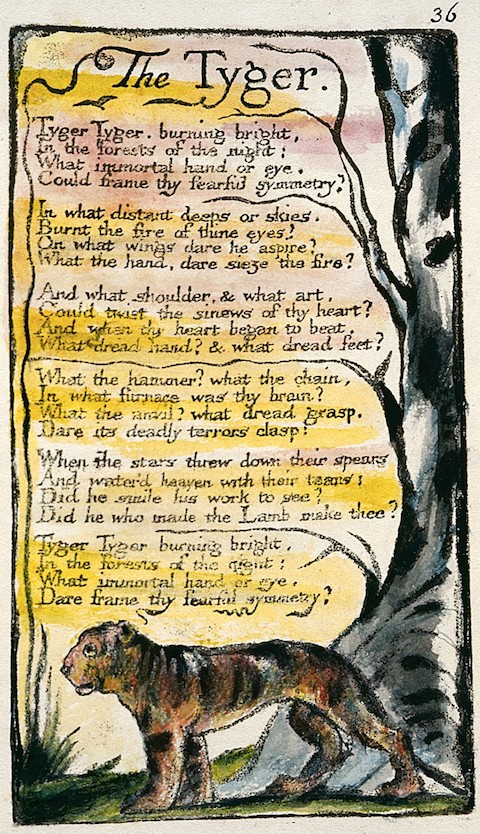
There was once a time, if you can believe it, when Allen Ginsberg could take the poetry of William Blake, sing it in a recording studio, and then MGM Records would release it as a long-playing album. I refer to the time, of course, of “the sixties,” that half-mythical era that seems to have run from around 1966 to 1972. Smack in the middle of the sixties, thus defined, came this distinctive release, Songs of Innocence and Experience by William Blake, tuned by Allen Ginsberg, recorded in December 1969 and released in 1970.
Every reader familiar with Blake, of course, knows Songs of Innocence and of Experience as a book, an illustrated collection of poems first self-published in 1789 and in 1794 re-issued and expanded as Songs of Innocence and of Experience Showing the Two Contrary States of the Human Soul. This work of an 18th-century poet captured the imagination of the 20th-century poet Ginsberg, and not just as reading material; he came to believe that not only did Blake intend his words to be sung, but that he himself could render them faithfully in song — as well as play the piano and harmonium in accompaniment.
You can hear hear the fruit of Ginsberg’s musical-poetic reconstructive labors at the top of the post, at the Internet Archive, or at PennSound, which not only offers each track individually but also its lyrics and sometimes even links to the corresponding page from the original book at the William Blake Archive. When we think of sixties-defining albums, we think of Blonde on Blonde,AreYou Experienced?, Sgt, Pepper’s Lonely Hearts Club Band, that sort of thing, and rightly so, but a project like Songs of Innocence and Experience by William Blake, tuned by Allen Ginsberg speaks just as much to what became possible in that artistic Cambrian explosion of an era.
Just above, hear émigré Russian novelist Vladimir Nabokov, author of Lolita read the opening sentences of that novel in both English and Russian, after offering some brief comments on his relationship to his former native country. Then, after a few minutes of discussion of a work that became incorporated into his Ada or Ardor: A Family Chronicle, we get Nabokov the cantankerous critic. Or rather, Nabokov, the critic of critics. The author had little regard for critics themselves. In a Paris Review interview, he opines that the only purpose of literary criticism was that it “gives readers, including the author of the book, some information about the critic’s intelligence, or honesty, or both.” In the filmed interview above (at the 3:24 mark), Nabokov points his lance at the inflated popular notion of “great books”:
I’ve been perplexed and amused by fabricated notions about so-called “great books.” That, for instance, Mann’s asinine Death in Venice, or Pasternak’s melodramatic, vilely written Doctor Zhivago, or Faulkner’s corncobby chronicles can be considered masterpieces, or at least what journalists term “great books,” is to me the same sort of absurd delusion as when a hypnotized person makes love to a chair.
Nonetheless, after his takedown of such venerated names as Thomas Mann, Boris Pasternak, and the “corncobby” William Faulkner, Nabokov doesn’t hesitate to name his “greatest masterpieces of 20th century prose.” They are, in this order:
4) The first half of Proust’s fairy tale, In Search of Lost Time
So there you have it, from the mouth of the master himself. Should you hang in there for the next clip, you will hear Nabokov read from his notebook titled “Things I Detest.” How seriously we are to take any of this is hard to say—one never really knows with Nabokov.
In 1977, erudite Argentine writer Jorge Luis Borges delivered a series of seven lectures in Buenos Aires on a variety of topics, including Dante’s Divine Comedy, nightmares, and the Kabbalah. (The lecture series is collected in an English translation entitled Seven Nights.) One of the lectures is simply called “Buddhism,” and in it, Borges presents an overview of the ancient Eastern religion. Borges had previously made scattered reference to Buddhist subjects in his writing, though he certainly never devoted as much attention to it as he did Catholicism or Judaism, a faith and heritage he found endlessly fascinating and admirable.
His portrait of Buddhism, though much less in depth, is no less sympathetic. The lecture is adapted, it seems, from a short book written the previous year, Qué es el Budismo?, a “clear and concise explanation of the religion, its value systems, and how some of its principal teachings share some similarities with other faiths.” So writes the blog Vaguely Borgesian, who also comment that Borges’ book—and by extension the lecture—“rarely goes beyond what one might find on say a Wikipedia article on Buddhism.” That may be so, but—as we can see in this English translation of Borges’ lecture—the author does several times during his summary offer some distinctly Borgesian commentary of his own. Below are just a few excerpts:
Buddism’s Tolerance:
[Buddhism’s] longevity can be explained for historical reasons, but such reasons are fortuitous or, rather, they are debatable, fallible. I think there are two fundamental causes. The first is Buddhism’s tolerance. That strange tolerance does not correspond, as is the case with other religions, to distinct epochs: Buddism was always tolerant.
It has never had recourse to steel or fire, has never thought that steel or fire were persuasive…. A good Buddhist can be Lutheran, or Methodist, or Calvinist, or Sintoist, or Taoist, or Catholic; he can be a proselyte to Islam or Judaism, with complete freedom. But it is not permissible for a Christian, a Jew or a Muslim to be a Buddhist.
On the Historical Existence of the Buddha:
We may disbelieve this legend. I have a Japanese friend, a Zen Buddhist, with whom I have had long and friendly arguments. I told him that I believed in the historic truth of Buddha. I believed and I believe that two thousand five hundred years ago there was a Nepalese prince called Siddharta or Gautama who became the Buddha, that is, the Awoken, the Lucid One – as opposed to us who are asleep or who are dreaming this long dream which is life. I remember one of Joyce’s phrases: “History is a nightmare from which I want to awake.” Well then, Siddharta, at thirty years of age, awoke and became Buddha.
On Buddhism and Belief:
The other religions demand much more credulity on our part. If we are Christians we must believe that one of the three persons of the Divinity condescended to become a man and was crucified in Judea. If we are Muslims we must believe that there is no other god than God and that Mohammad is his apostle. We can be good Buddhists and deny that Buddha existed. Or, rather, we may think, we must think that our belief in history isn’t important: what is important is to believe in the Doctrine. Nevertheless, the legend of Buddha is so beautiful that we cannot help but refer to it.
Borges has much more to say in the full lecture on Buddhist cosmology and history. He concludes with the very respectful statement below:
What I have said today is fragmentary. It would have been absurd for me to have expounded on a doctrine to which I have dedicated many years – and of which I have understood little, really – with a wish to show a museum piece. Buddhism is not a museum piece for me: it is a path to salvation. Not for me, but for millions of people. It is the most widely held religion in the world and I believe that I have treated it with respect when explaining it tonight.
To learn more about Borges and Buddhism, see this article, and the watch the video above, a short introduction to a lecture course given by Borges’ friend Amelia Barili at UC Berkeley.
Click the image above to access the interactive infographic.
The daily life of great authors, artists and philosophers has long been the subject of fascination among those who look upon their work in awe. After all, life can often feel like, to quote Elbert Hubbard, “one damned thing after another” — a constant muddle of obligations and responsibilities interspersed with moments of fleeting pleasure, wrapped in gnawing low-level existential panic. (Or, at least, it does to me.) Yet some people manage to transcend this perpetual barrage of office meetings, commuter traffic and the unholy allure of reality TV to create brilliant work. It’s easy to think that the key to their success is how they structure their day.
Mason Currey’s blog-turned-book Daily Rituals describes the workaday life of great minds from W.H. Auden to Immanuel Kant, from Flannery O’Connor to Franz Kafka. The one thing that Currey’s project underlines is that there is no magic bullet. The daily routines are as varied as the people who follow them– though long walks, a ridiculously early wake up time and a stiff drink are common to many.
One school of thought for creating is summed up by Gustave Flaubert’s maxim, “Be regular and orderly in your life, so that you may be violent and original in your work.” Haruki Murakami has a famously rigid routine that involves getting up at 4am and writing for nine hours straight, followed by a daily 10km run. “The repetition itself becomes the important thing; it’s a form of mesmerism. I mesmerize myself to reach a deeper state of mind. But to hold to such repetition for so long—six months to a year—requires a good amount of mental and physical strength. In that sense, writing a long novel is like survival training. Physical strength is as necessary as artistic sensitivity.” He admits that his schedule allows little room for a social life.
Then there’s the fantastically prolific Belgian author George Simenon, who somehow managed to crank out 425 books over the course of his career. He would go for weeks without writing, followed by short bursts of frenzied activity. He would also wear the same outfit everyday while working on his novel, regularly take tranquilizers and somehow find the time to have sex with up to four different women a day.
Most writers fall somewhere in between. Toni Morrison, for instance, has a routine that that seems far more relatable than the superman schedules of Murakami or Simeon. Since she juggled raising two children and a full time job as an editor at Random House, Morrison simply wrote when she could. “I am not able to write regularly,” she once told The Paris Review. “I have never been able to do that—mostly because I have always had a nine-to-five job. I had to write either in between those hours, hurriedly, or spend a lot of weekend and predawn time.”
Above is a way cool infographic of the daily routines of 26 different creators, created by Podio.com. And if you want to see an interactive version of the same graphic but with rollover bits of trivia, just click here. You’ll learn that Voltaire slept only 4 hours a day and worked constantly. Victor Hugo preferred to take a morning ice bath on his roof. And Maya Angelou preferred to work in an anonymous hotel room.
Jonathan Crow is a Los Angeles-based writer and filmmaker whose work has appeared in Yahoo!, The Hollywood Reporter, and other publications. You can follow him at @jonccrow. And check out his blog Veeptopus, featuring lots of pictures of badgers and even more pictures of vice presidents with octopuses on their heads. The Veeptopus store is here.
Last summer we time traveled back to 1964 and showed you the very first TV appearance of David Bowie. Here, we found Bowie, only 17 years old, presenting himself as the spokesman for “The Society for the Prevention of Cruelty to Long-Haired Men.” Long hair wasn’t widely accepted in the England of 1964, and, with a touch of humor, Bowie was taking a stand. “I think we’re all fairly tolerant, but for the last two years we’ve had comments like ‘Darling!’ and ‘Can I carry your handbag?’ thrown at us, and I think it just has to stop now.”
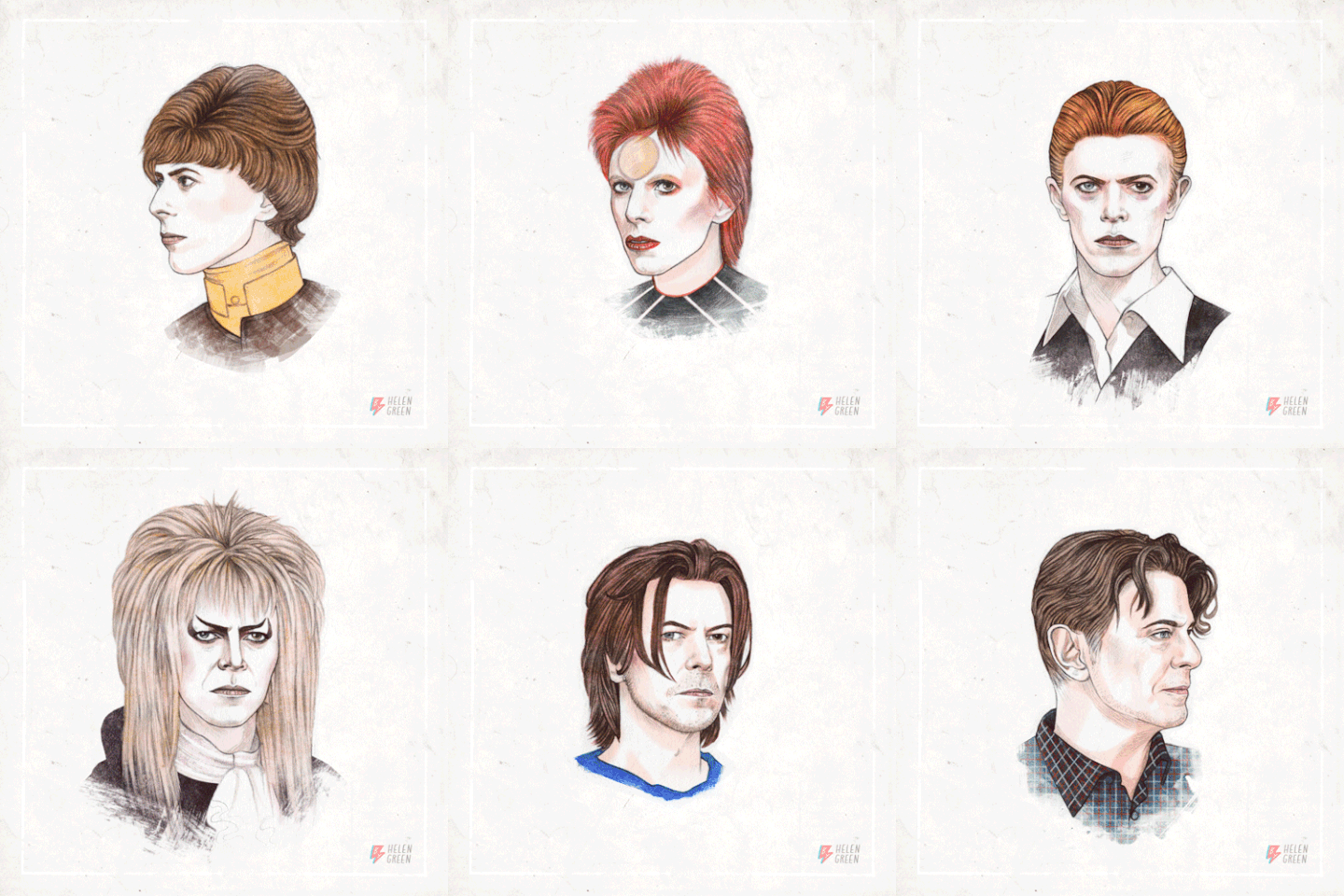
Bowie’s obsession with hair never went away. Creative hairstyles would come and go throughout the years. And they’re all on display in an animated gif, which Helen Green published on her Tumblr last week to celebrate the musician’s 68th birthday.
If you would like to support the mission of Open Culture, consider making a donation to our site. It’s hard to rely 100% on ads, and your contributions will help us continue providing the best free cultural and educational materials to learners everywhere. You can contribute through PayPal, Patreon, and Venmo (@openculture). Thanks!
The Beatles’ Sgt. Pepper’s Lonely Heart’s Club Band may or may not still be the “greatest rock album of all time,” but—as the presenter in the documentary above remarks—it most certainly is “an extraordinary mirror of its age.” The album also marks several great leaps forward in studio recording techniques and pop songwriting, as well as production time and cost. Sgt. Pepper’s took five months to make and cost 40,000 pounds. By contrast, the first Beatles album, Please Please Me, was recorded live in a single day for a cost of about 400 pounds.
The band decided to make such investments in the studio after becoming fed up with constant touring. In addition to the grueling schedule, John Lennon had alienated many of the band’s religious American fans with the flippant “more popular than Jesus” remark. And in the Philippines, they failed to turn up for an event put on by Ferdinand Marcos, offending both the dictator and his wife; they “barely escaped with their lives,” we’re told above. Furthermore, amplification technology being what it was at the time, there was no possibility of the band’s sound on stage competing with the volume of screaming fans in the stadium crowds, and they found themselves nearly drowned out at every show.
They retreated somewhat—Harrison to India to work with Ravi Shankar, Lennon to Spain to work with filmmaker Richard Lester—until they were rallied by Paul McCartney, whom Ringo calls “the workaholic” of the band. Having firmly decided to leave the road behind for good, says McCartney, they “very much felt that it could be done better from a record than from anywhere else,” that “the record could go on tour.” Recording began on November 24, 1966 with “Strawberry Fields Forever,” a track that didn’t even appear on the album, but on its follow-up, Magical Mystery Tour.
We’re treated in the documentary to the original recording of the song, with commentary from George Martin, who explains that recording technology at the time was “in a primitive state,” only just entering the multitrack stage. Limited to four tracks at a time, engineers could not separate each instrument onto its own individual track as they do today but were forced to combine them. This limitation forced musicians and producers to make firm decisions about arrangements and commit to them with a kind of discipline that has gone by the wayside with the ease and convenience of digital technology. Martin talks at length about the making of each of the songs on the album, patiently explaining how they came to sound the way they do.
As a musician and occasional engineer myself, I find that the heart of the documentary is these moments with Martin as he plays back the recordings, track by track, enthusiastically recounting the production process. But there’s much more here to inspire fans, including interviews with the classical musicians who played on the album, stories from Paul, George, and Ringo about the writing and development of the songs, and even an interview with reclusive Beach Boy and studio wizard Brian Wilson about his Pet Sounds, an experimental precursor and inspiration for Sgt. Pepper’s. We do not hear much about that famous album cover, but you can read all about it here.
For Paul McCartney, “the big difference” Sgt. Pepper’s made was that previously “people played it a bit safe in popular music.” The Beatles “suddenly realized you didn’t have to.” Over the next few months, they cobbled together their personal influences into a glorious pastiche of rock, pop, balladeering, vaudevillian show tunes, psychedelic studio experimentation, television advertising jingles, and Indian and symphonic music—creating the world’s first concept album. Nothing like it had ever been heard before, and it may not be too much of a stretch to say that nearly every pop record since owes some debt, however small, to Sgt. Pepper’s, whether by way of the songwriting, the conceptual ingenuity, or the studio experimentation. To see the influence the album had on a handful of popular English musicians forty years later, watch the BBC television special above, produced in honor of the album’s fortieth anniversary and featuring bands like Travis, the Magic Numbers, and the Kaiser Chiefs covering the album in its entirety.
Seeing how the ever-more-distinctive cinema of Paul Thomas Anderson has developed from his feature debut Hard Eight to his new Thomas Pynchon adaptation Inherent Vice, you have to wonder how he learned his craft. Boogie Nights, Magnolia, Punch-Drunk Love, The Master: ambitious pictures like these, artistically unusual and heavily referential but also surprisingly popular, make you sense an unschooled filmmaker behind the camera (a path to filmmaking greatness best exemplified by Quentin Tarantino).
But Anderson didn’t get this far entirely without higher education: let the record show that he did spend two semesters at Emerson College — a brief period, but one in which he took an English class from none other than David Foster Wallace. “It was the first teacher I fell in love with,” he told Marc Maron in an interview on Maron’s podcast WTF . “I’d never found anybody else like that at any of the other schools I’d been to.” Anderson even called Wallace, a professor “generous with his phone number,” to discuss “a couple crazy ideas” on a paper he was writing about Don DeLillo’s White Noise at “midnight the night before it was due.”
(At The Paris Review, Dan Piepenbringhas more on the intersection of Anderson’s life and Wallace’s, including the latter’s opinions on the former’s movies: “he was a fan of Boogie Nights, which he told a friend was ‘exactly the story’ he’d wanted to write. He was less jazzed about Magnolia, though, which he found pretentious, hollow, and ‘100% gradschoolish in a bad way.‘”)
Anderson also enrolled at New York University’s film school, but rather than staying only two semesters, he stayed only two days. In the clip up top, from an interview with critic Elvis Mitchell, Anderson recounts the whole of his NYU experience. His first instructor announced, “If anyone is here to write Terminator 2, get out.” And so Anderson thought, “What if I do want to write Terminator 2? Terminator 2’s a pretty awesome movie.” (An assessment, incidentally, from which Wallace’s greatly differs.) When he turned in a page from a David Mamet script for his first assignment and his unsuspecting teacher gave it a C+, Anderson knew he had to leave. Living off of the tuition NYU returned to him, he got to work on a short film of his own.
“My filmmaking education consisted of finding out what filmmakers I liked were watching, then seeing those films,” he told the Los Angeles Times. “I learned the technical stuff from books and magazines, and with the new technology you can watch entire movies accompanied by audio commentary from the director. You can learn more from John Sturges’ audio track on the Bad Day at Black Rock laserdisc than you can in 20 years of film school.” He said that just a few years after leaving NYU, when he hit it big with Boogie Nights — a film whose highly entertaining DVD commentary from Anderson himself provides another few years’ worth of film school at least.
There may be no more a macabrely misogynistic sentence in English literature than Edgar Allan Poe’s contention that “the death… of a beautiful woman” is “unquestionably the most poetical topic in the world.” (His perhaps ironic observation prompted Sylvia Plath to write, over a hundred years later, “The woman is perfected / Her dead / Body wears the smile of accomplishment.”) The sentence comes from Poe’s 1846 essay “The Philosophy of Composition,” and if this work were only known for its literary fetishization of what Elisabeth Bronfen calls “an aesthetically pleasing corpse”—marking deep anxieties about both “female sexuality and decay”—then it would indeed still be of interest to feminists and academics, though not perhaps to the average reader.
But Poe has much more to say that does not involve a romance with dead women. The essay delivers on its title’s promise. It is here that we find Poe’s famous theory of what good literature is and does, achieving what he calls “unity of effect.” This literary “totality” results from a collection of essential elements that the author deems indispensable in “constructing a story,” whether in poetry or prose, that produces a “vivid effect.”
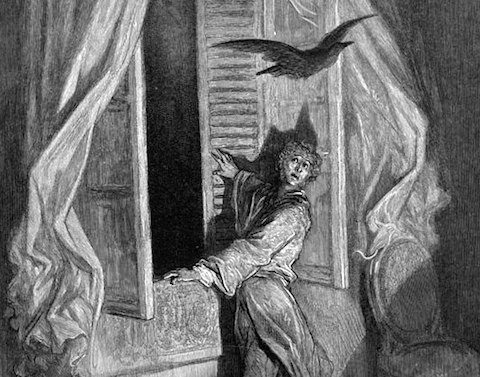
To illustrate what he means, Poe walks us through an analysis of his own work, “The Raven.” We are to take for granted as readers that “The Raven” achieves its desired effect. Poe has no misgivings about that. But how does it do so? Against commonplace ideas that writers “compose by a species of fine frenzy—an ecstatic intuition,” Poe has not “the least difficulty in recalling to mind the progressive steps of any of my compositions”—steps he considers almost “mathematical.” Nor does he consider it a “breach of decorum” to pull aside the curtain and reveal his tricks. Below, in condensed form, we have listed the major points of Poe’s essay, covering the elements he considers most necessary to “effective” literary composition.
Know the ending in advance, before you begin writing.
“Nothing is more clear,” writes Poe, “than that every plot, worth the name, must be elaborated to its dénouement before any thing be attempted with the pen.” Once writing commences, the author must keep the ending “constantly in view” in order to “give a plot its indispensable air of consequence” and inevitability.
Keep it short—the “single sitting” rule.
Poe contends that “if any literary work is too long to be read at one sitting, we must be content to dispense with the immensely important effect derivable from unity of impression.” Force the reader to take a break, and “the affairs of the world interfere” and break the spell. This “limit of a single sitting” admits of exceptions, of course. It must—or the novel would be disqualified as literature. Poe cites Robinson Crusoe as one example of a work of art “demanding of no unity.” But the single sitting rule applies to all poems, and for this reason, he writes, Milton’s Paradise Lost fails to achieve a sustained effect.
Decide on the desired effect.
The author must decide in advance “the choice of impression” he or she wishes to leave on the reader. Poe assumes here a tremendous amount about the ability of authors to manipulate readers’ emotions. He even has the audacity to claim that the design of the “The Raven” rendered the work “universally appreciable.” It may be so, but perhaps it does not universally inspire an appreciation of Beauty that “excites the sensitive soul to tears”—Poe’s desired effect for the poem.
Choose the tone of the work.
Poe claims the highest ground for his work, though it is debatable whether he was entirely serious. As “Beauty is the sole legitimate province of the poem” in general, and “The Raven” in particular, “Melancholy is thus the most legitimate of all poetical tones.” Whatever tone one chooses, however, the technique Poe employs, and recommends, likely applies. It is that of the “refrain”—a repeated “key-note” in word, phrase, or image that sustains the mood. In “The Raven,” the word “Nevermore” performs this function, a word Poe chose for its phonetic as much as for its conceptual qualities.
Poe claims that his choice of the Raven to deliver this refrain arose from a desire to reconcile the unthinking “monotony of the exercise” with the reasoning capabilities of a human character. He at first considered putting the word in the beak of a parrot, then settled on a Raven—“the bird of ill omen”—in keeping with the melancholy tone.
Determine the theme and characterization of the work.
Here Poe makes his claim about “the death of a beautiful woman,” and adds, “the lips best suited for such topic are those of a bereaved lover.” He chooses these particulars to represent his theme—“the most melancholy,” Death. Contrary to the methods of many a writer, Poe moves from the abstract to the concrete, choosing characters as mouthpieces of ideas.
Establish the climax.
In “The Raven,” Poe says, he “had now to combine the two ideas, of a lover lamenting his deceased mistress and a Raven continuously repeating the word ‘Nevermore.’” In bringing them together, he composed the third-to-last stanza first, allowing it to determine the “rhythm, the metre, and the length and general arrangement” of the remainder of the poem. As in the planning stage, Poe recommends that the writing “have its beginning—at the end.”
Determine the setting.
Though this aspect of any work seems the obvious place to start, Poe holds it to the end, after he has already decided why he wants to place certain characters in place, saying certain things. Only when he has clarified his purpose and broadly sketched in advance how he intends to acheive it does he decide “to place the lover in his chamber… richly furnished.” Arriving at these details last does not mean, however, that they are afterthoughts, but that they are suggested—or inevitably follow from—the work that comes before. In the case of “The Raven,” Poe tells us that in order to carry out his literary scheme, “a close circumscription of space is absolutely necessary to the effect of insulated incident.”
Throughout his analysis, Poe continues to stress—with the high degree of repetition he favors in all of his writing—that he keeps “originality always in view.” But originality, for Poe, is not “a matter, as some suppose, of impulse or intuition.” Instead, he writes, it “demands in its attainment less of invention than negation.” In other words, Poe recommends that the writer make full use of familiar conventions and forms, but varying, combining, and adapting them to suit the purpose of the work and make them his or her own.
Though some of Poe’s discussion of technique relates specifically to poetry, as his own prose fiction testifies, these steps can equally apply to the art of the short story. And though he insists that depictions of Beauty and Death—or the melancholy beauty of death—mark the highest of literary aims, one could certainly adapt his formula to less obsessively morbid themes as well.
Humorist David Sedaris has become something of a local hero in his adopted home of West Sussex, England. And for fairly unexpected reasons. Repulsed by the litter problem in England, Sedaris began spending 3–8 hours each day picking up trash along the side of various roads. Day in, day out. Fast forward a few years, and the local community honored Sedaris by naming a garbage truck after him — “Pig Pen Sedaris.” And now we have him testifying before the MPs on the Communities and Local Government Committee. If you like C‑SPAN, you will love these 2+ hours of video.
We're hoping to rely on loyal readers, rather than erratic ads. Please click the Donate button and support Open Culture. You can use Paypal, Venmo, Patreon, even Crypto! We thank you!
Open Culture scours the web for the best educational media. We find the free courses and audio books you need, the language lessons & educational videos you want, and plenty of enlightenment in between.