Then let’s also add Salvador Dali to the list. In 1958, Wallace tried to demystify “the enigma that is Salvador Dali,” and it didn’t go terribly well. It turns out that surrealist painters give surreal answers to conventional interview questions too. Pretty quickly, Wallace capitulates and says, “I must confess, you lost me halfway through.” Happily for us, the video makes for some good viewing more than 50 years later.
If you would like to support the mission of Open Culture, consider making a donation to our site. It’s hard to rely 100% on ads, and your contributions will help us continue providing the best free cultural and educational materials to learners everywhere. You can contribute through PayPal, Patreon, and Venmo (@openculture). Thanks!
We’re tackling another big question today with the help of Harvard economic historian Niall Ferguson. And the question goes like this: Why has the West created so much prosperity and stability over the past several centuries, when the rest of the world did not? For Ferguson, the “great divergence” can be explained by six big ideas, or what he calls killer apps for the benefit of his technophile TED audience:
1. Competition
2. The Scientific Revolution
3. Property Rights
4. Modern Medicine
5. The Consumer Society
6. Work Ethic
These apps, it turns out, are open source. Anyone can download and use them. And that’s precisely what Asia has done. The great divergence is over (baby blue)…
In 2009, Richard Dawkins invited Lawrence Krauss, an internationally-known theoretical physicist and author of The Physics of Star Trek, to talk about some big enchilada questions. What is our current picture of the universe? When did the universe begin? What came before it? How could something come from nothing? And what will happen to the universe in the future?
Krauss takes us back to the foundational work of Einstein and Hubble, then moves us through important breakthroughs in modern theoretical physics, ones that have helped us unravel some of these big questions. Give Professor Krauss 53 minutes, and he’ll give you the universe … and a few jokes along the way.
Late last week, Stephen King treated an audience at George Mason University to a 10-minute reading from his upcoming book Dr. Sleep . It’s not just any other book. It’s the sequel to The Shining, his 1977 thriller that Stanley Kubrick fammously adapted to film. (Don’t miss Making the Shining here.)
King first started talking about a sequel in 2009, and now we’re getting our first taste of what’s to come. At long last, you will know what happened to Danny Torrance.
John Hodgman, your favorite quirky, mustachioed humorist, made an appearance at the Maker Faire festival in NYC earlier this month. And, in the DIY spirit of the event, he gave a 30+ minute comic riff on material appearing in his upcoming book That is All — a compendium of “complete world knowledge” that can help you survive an apocalypse. The better part of the talk focuses, quite naturally, on the magic of magic tricks — something we all need to know more about…
Get ready for it. This week, Knopf will release Paulo Coelho’s latest novel, Aleph. And we’re taking bets on three questions. How many copies will be legally sold? (The Alchemist has sold more than 65 million copies.) How many copies will be pirated and given away? And to what extent will the circulation of illegal copies actually benefit legit sales?
In recent years, Coelho has become something of a willing conspirator in the pirating of his own work. Sometimes he links on his own blog to pirated copies floating around the web. Other times he makes the texts available (in multiple languages) in a nice shareable widget.
Coelho explains how his adventures in self-pirating got underway in a Q&A appearing in yesterday’s New York Times.
Q. You’ve also had success distributing your work free. You’re famous for posting pirated version of your books online, a very unorthodox move for an author.
A. I saw the first pirated edition of one of my books, so I said I’m going to post it online. There was a difficult moment in Russia; they didn’t have much paper. I put this first copy online and I sold, in the first year, 10,000 copies there. And in the second year it jumped to 100,000 copies. So I said, “It is working.” Then I started putting other books online, knowing that if people read a little bit and they like it, they are going to buy the book. My sales were growing and growing, and one day I was at a high-tech conference, and I made it public.
Q. Weren’t you afraid of making your publisher angry?
A. I was afraid, of course. But it was too late. When I returned to my place, the first phone call was from my publisher in the U.S. She said, “We have a problem.”
Q. You’re referring to Jane Friedman, who was then the very powerful chief executive of HarperCollins?
A. Yes, Jane. She’s tough. So I got this call from her, and I said, “Jane, what do you want me to do?” So she said, let’s do it officially, deliberately. Thanks to her my life in the U.S. changed.
The rest of the interview continues here. And, in the meantime, you can find several Coelho books catalogued in our collection of Free eBooks.
Thanks to Google and the Israel Museum in Jerusalem, you can now fire up your browser and start taking a good, close look at The Dead Sea Scrolls, the ancient biblical texts found between 1947 and 1956, right on the shores of the Dead Sea. The Scrolls were originally written between the third and first centuries BCE, and they constitute the oldest known pieces of the Hebrew Bible. Since 1965, they have been on display in Jerusalem. But no matter where you live, you can view five digitized Dead Sea Scrolls, each photographed at a resolution of 1,200 megapixels. That’s roughly 200 times greater than your average camera.
Back in 1970, three psychology professors pulled off a hoax that doubled as medical research. They brought Dr. Myron L. Fox, “an authority on the application of mathematics to human behavior,” to a conference near Lake Tahoe and let him talk about “Mathematical Game Theory as Applied to Physician Education.” Little did the audience know that Fox wasn’t actually a researcher or scholar. He was actually an actor who had played parts in Hogan’s Heroes and Batman. And he was given a gibberish-filled script to learn only the day before. Nonetheless, the educators in the crowd ate up his meaningless talk, and it allowed the researchers to draw the conclusion that “style was more influential than content in providing learner satisfaction.” A nice way of saying that jargon and cant can sometimes take you a long way in the academy — in the humanities and sciences alike. More backstory here. H/T Metafilter
Every year, thousands of American high school students read a common selection of great novels — classics loved by young and old readers alike. Today, we have selected 20 of the most popular books and highlighted ways that you can download versions for free, mostly as free audio books and ebooks, and sometimes as movies and radio dramas. You will find more great works — and sometimes other digital formats — in our twin collections: 600 Free eBooks for iPad, Kindle & Other Devices and 550 Free Audio Books. So please give them a good look over, and if we’re missing a novel you want, don’t forget Audible.com’s 14 day trial. It will let you download an audio book for free, pretty much any one you want.
1984 by George Orwell: Read Online
Although published in 1949, 1984 still captures our imagination generations later because it offers one of the best literary accounts of totalitarianism ever published. And it’s simply a great read.
Brave New World by Aldous Huxley: eText — Free Radio Dramatization (by Huxley himself)
Little known fact. Huxley once taught George Orwell French at Eton. And, years later his 1931 classic, Brave New World, is often mentioned in the same breath with 1984 when it comes to great books that describe a dystopian future.
Frankenstein by Mary Shelley - Free ebook — Free Audio Book (MP3) — Radio Drama version (1938) — Movie
Mary Shelley started writing the great monster novel when she was only 18 and completed it when she was 21. The 1823 gothic novel is arguably one of your first works of science fiction.
Heart of Darkness by Joseph Conrad: Free eBook — Free Audio Book (iTunes) — Radio Dramatization by Orson Welles (MP3)
More than 100 years after its publication (1902), Conrad’s novella still offers the most canonical look at colonialism and imperialism. So powerful was its influence that Orson Welles dramatized it in 1938, and the book also famously inspired Coppola’s Apocalypse Now in 1979.
Pride & Prejudice by Jane Austen – Free eBook — Free Audio Book (iTunes)
Jane Austen’s 1813 novel remains as popular as ever. To date, it has sold more than 20 million copies, and, every so often, it finds itself adapted to a new film, TV or theater production. A must read.
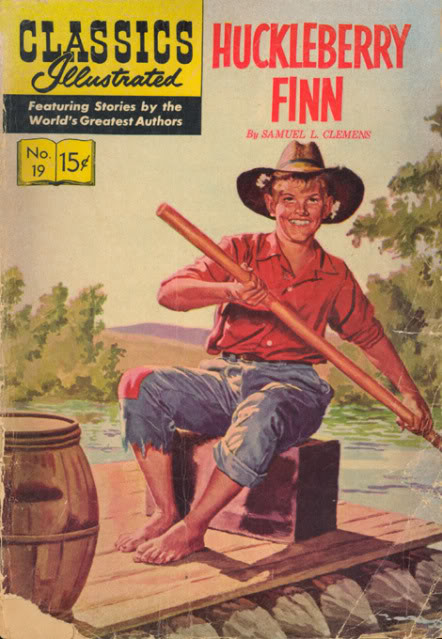
The Adventures of Huckleberry Finn by Mark Twain — Free eBook — Free Audio Book (iTunes)
When you think Huckleberry Finn, you think Great American Novel. It was controversial when it was first published in 1884, and it remains so today. But nonetheless Twain’s classic is a perennial favorite for readers around the world.
The Call of the Wild by Jack London — Free eBook — Free Audio Book (iTunes) The Call of the Wild, first published in 1903, is regarded as Jack London’s masterpiece. It’s “a tale about unbreakable spirit and the fight for survival in the frozen Alaskan Klondike.”
The Crucible by Arthur Miller - Free Audio Book from Audible.com
Arthur Miller’s 1952 play used the Salem witch trials of 1692 and 1693 to offer a commentary on McCarthyism that tarnished America during the 1950s. Today, The Crucible occupies a central place in America’s literary canon.
The Grapes of Wrath by John Steinbeck — Free Audio Book from Audible.com
This 1939 novel won the Pulitzer Prize in 1940 and later helped Steinbeck win the Nobel Prize for Literature in 1962. It’s perhaps the most important book to give literary expression to the Great Depression.
The Odyssey by Homer – Free eBook — Free Audio Book
The Western literary tradition begins with Homer’s epic poems The Iliad (etext here) and The Odyssey, both written some 2800 years ago. It has been said that “if the Iliad is the world’s greatest war epic, then the Odyssey is literature’s grandest evocation of everyman’s journey through life.” And that just about gets to the heart of the poem.
The Old Man and the Sea by Ernest Hemingway - Free Audio Book from Audible.com
It was Hemingway’s last major work of fiction (1951) and certainly one of his most popular, bringing many readers into contact with Hemingway’s writing for the first time.
The Red Badge of Courage by Stephen Crane — Free eBook — Free Audio Book (iTunes) — Free Movie
This Civil War novel won what Joseph Conrad called “an orgy of praise” after its publication in 1895, and inspired Ernest Hemingway and the Modernists later. The novel made Stephen Crane a celebrity at the age of 24, though he died only five years later.
The Scarlet Letter by Nathaniel Hawthorne – Free eBooks – Free Audio Book — Movie
Though set in Puritan Boston between 1642 and 1649, Hawthorne’s magnum opus explores “the moral dilemmas of personal responsibility, and the consuming emotions of guilt, anger, loyalty and revenge” that were relevant in 1850 (when the book was published). And they remain so today.
To Kill a Mockingbird by Harper Lee — Free Audio Book from Audible.com
Harper Lee’s 1960 novel takes an incisive look at attitudes toward race and class in the Deep South during the 1930s. It won the Pulitzer Prize a year later.
Note: We listed Audible.com as an option when books were still under copyright.
Meanwhile, educators don’t miss our collection of Free Courses. It features many free Literature courses, including courses on American literature.
Allen Mezquida is an accomplished alto saxophonist. As a regular on the New York jazz scene in the 80s and 90s, he performed and recorded with many of the greatest musicians still playing at that time, like Art Blakey and Gerry Mulligan. His 1996 solo album, A Good Thing, was well-received by critics. In an earlier age it might have been the beginning of a glorious career. But as the 20th century came to a close, Mezquida was becoming increasingly disillusioned.
“I was more frustrated with jazz’s tiny place in the current cultural landscape than with my jazz career,” Mezquida told Open Culture. So he turned to another of his artistic passions. The visual arts–cartooning, in particular–had always attracted him. “Mad magazine, Chuck Jones and various art books held my attention alongside Miles, Coltrane and Stan Getz,” Mezquida said. He began experimenting with digital animation, and before long he moved to Los Angeles and began receiving work from Disney, Warner Brothers, Sony and PIXAR. He contributed to Aladdin and Toy Story.
Mezquida found himself where he wanted to be: at the very heart of America’s cultural landscape. Still, something wasn’t right. As he told The Daily Beast in 2010, “I was just holding an oar in the bowels of a Viking ship. And executing the ideas of morons that I didn’t respect.” Mezquida wanted cultural relevance and artistic freedom. As a consequence, Smigly was born.
Smigly is Mezquida’s alter ego, an Everyman adrift in a dehumanized, corporatized culture in which social media serve only to intensify a sense of social alienation. As an artist, Smigly faces a society less interested in art than in the degradation of artists. Like Charlie Chaplin, or Charlie Brown, there is something timeless about Smigly: a sensitive soul pouring his heart out to an indifferent, or hostile, world.
The trials and tribulations of Smigly are chronicled on Smigly.tv. The latest installment, Kind of Black and Blue, is shown above. The piece was commissioned by Gordon Goodwin’s Big Phat Band, but Mezquida was given complete creative control. Kind of Black and Blue moves like a Swiss watch, each part fitting tightly into place. A musician’s sense of timing is evident. “I spend a lot of time thinking about the clearest way to visually communicate an idea,” Mezquida said. “It brings people into the story faster. Gary Larson, PIXAR and Don Martin quickly come to mind as very precise visual storytellers. Coltrane made every note count. Same thing.”
Mezquida continues to play music, performing with several jazz groups in the Los Angeles area. And many of his cartoon episodes feature his saxophone playing. With his growing popularity on YouTube, Smigly has helped Mezquida find a new audience for his music. And so, Mezquida moves closer to that elusive combination of artistic independence and popular success. We asked him about his hopes for the future. “I want to experience a major existential crisis deciding what to do when a major corporation wants to sponsor Smigly,” he said. “I’m kidding. A little.”
For more Smigly, go directly to Smigly.tv or begin by checking out a few or our favorite episodes:
They weren’t quite The Beatles, and they didn’t go out in the same style. (Catch The Beatles’ rooftop gig here.) But R.E.M. gave us 30 good years (ok, maybe 15), and, after calling it quits earlier this week, we thought it worthwhile to present their final live moments. So here it goes: R.E.M.‘s final encore played in Mexico City back in November, 2008. It’s a 36 minute set that features “Supernatural Superserious,” “Losing My Religion,” “I Believe,” “Country Feedback,” “Life and How to Live It,” and “Man on the Moon.”
We're hoping to rely on loyal readers, rather than erratic ads. Please click the Donate button and support Open Culture. You can use Paypal, Venmo, Patreon, even Crypto! We thank you!
Open Culture scours the web for the best educational media. We find the free courses and audio books you need, the language lessons & educational videos you want, and plenty of enlightenment in between.