It has been a while, but RSA has returned with another one of their whiteboard animated videos. During the early days of YouTube, they broke some aesthetic ground by animating Slavoj Zizek on the Surprising Ethical Implications of Charitable Giving; Barbara Ehrenreich (author of Nickel and Dimed) on The Perils of Positive Psychology; Daniel Pink on The Surprising Truth About What Motivates Us, and Stanford psychologist Philip Zimbardo on The Secret Powers of Time. Now, they’re back with the influential Cambridge economist Ha-Joon Chang explaining “why every single person can and SHOULD get their head around basic economics.” Here, Chang “pulls back the curtain on the often mystifying language of derivatives and quantitative easing, and explains how easily economic myths and assumptions become gospel,” helping you to “arm yourself with some facts” and take part in “discussions about the fundamentals that underpin our day-to-day lives.” If you want to get up to speed on economics, some of the resources below will undoubtedly give you a hand.
If you would like to support the mission of Open Culture, consider making a donation to our site. It’s hard to rely 100% on ads, and your contributions will help us continue providing the best free cultural and educational materials to learners everywhere. You can contribute through PayPal, Patreon, and Venmo (@openculture). Thanks!
Jack Kerouac’s On the Roadhas, in the almost 60 years since its publication, inspired its readers to do many things: some try their hands at writing their own carefully composed yet carelessness-exuding prose, but others find themselves moved to replicate the American road trip whose story Kerouac uses that near-inimitable style to tell. They might do so by following the author’s own hand-drawn map, or the more recently composed set of Google driving directions we featured a couple years ago. But now they have another detailed research tool in the form of Dennis Mansker’s interactive maps.
Mansker, himself the author of a book called A Bad Attitude: A Novel from the Vietnam War, has put together not one but four On the Road maps, each one detailing one of the road trips Kerouac used to create his Beat narrative of America: Map One follows his summer 1947 trip from New York to San Francisco by way of Denver and back again; Map Two, his winter 1949 trip from Rocky Mount, North Carolina to San Francisco by way of New Orleans; Map Three, his spring 1949 trip from Denver to New York by way of San Francisco; Map Four, his spring 1950 trip from New York to Mexico City by way of Denver.
“Click on one of the placemarkers on the map to see a quotation from the book,” Mansker explains. “Zoom in it to see the location on the map. In many cases where the narrative wasn’t clear on a given place, I’ve had to approximate — apply a ‘best guess’ solution to a given location.” He also provides information on the three cars, a 1949 Hudson, a 1947 Cadillac Limousine, and a 1937 Ford Sedan (as well as a Greyhound Bus (protagonist Sal Paradise’s transportation mode of choice “when he couldn’t boost a ride” with the irrepressible Dean Moriarty) which “themselves became sort of minor characters during the course of the adventures.”
“He came right out to Paterson, New Jersey, where I was living with my aunt,” writes Kerouac of Dean’s return to Sal’s life in the small city that figured early in that first 1947 road trip. “He was gone,” says Sal of Dean’s departure from his life as he recovers from a fever in Mexico City, the last stop of Kerouac’s 1950 road trip. “When I got better I realized what a rat he was, but then I had to understand the impossible complexity of his life, how he had to leave me there, sick, to get on with his wives and woes.” If you love Kerouac’s novel, by all means follow in his tire tracks — just make sure to find a more reliable traveling companion.
You might have seen a new type of ancient human on the news recently, nicknamed, affectionately, ‘the hobbit’ (not because they were taking the ring to Mordor, but because of their rather diminutive stature).
If you didn’t, here’s the news in brief: a team of scientists went digging for the first Australians and instead found a completely new (and tiny) ancient human. Since then they’ve been trying to work out what happened to these small ancestors of ours.
To share their findings, some of the scientists involved in understanding ‘the hobbit’ have put together a 4 week free online course to explain how the discovery unfolded…
The course has been created with FutureLearn and will take you inside the world of this new species, giving you a run through modern scientific archaeological techniques along the way.
Here’s what’s on the syllabus:
Week 1 — Human Origins and Introduction to Archaeology
Learn about where you, me and everyone came from — before getting onto the moment ‘the hobbit’ was discovered.
Week 2 — Archaeological Methods: In the Cave
You think a festival is bad? Get to grips with how science translates in somewhere without electricity or water.
Week 3 — Archaeological Science: In the Lab
Understand what happens once all the archaeological finds are delicately hauled back to the lab.
Week 4 — Future Directions
‘The Hobbit’, despite it’s size, is having a big impact in the world of archaeology — find out exactly what this little ancient human might mean for the story of our origins.
Intrigued? Join the course today — it started this week, and you’re not too late to join.
Jess Weeks is a copywriter at FutureLearn. She has never conducted ground-breaking science in a cave, or discovered a new species, but there’s still time.
William S. Burroughs may have died almost twenty years ago, but that doesn’t mean his fans have gone entirely without new material since. This year, for instance, has seen the release of the Naked Lunchauthor’s new spoken word album Let Me Hang You, which you can listen to free on Spotify. (If you don’t have Spotify’s free software, download it here.) Its content, in fact, comes straight from that form- and taboo-breaking 1959 novel, which Burroughs committed to tape — along with a trio of accomplished experimental musicians — not long before his passing, and which thus got lost along the way to commercial release.
“But more than 20 years later,” writes the New York Times’ Joe Coscarelli, “those surreal recordings — which featured music from the guitarist and composer Bill Frisell, along with the pianist Wayne Horvitz and the violist Eyvind Kang — are getting a second life as an album with an assist from the independent musician King Khan, best known for his raucous live shows as an eccentric punk and soul frontman.” Fans of Burroughs’ roughest-edged material can rest assured that, in these sessions, the writer focused on speaking the “unspeakable” parts of Naked Lunch: “think sex, drugs, and defecation,” Coscarelli says.
Hard as it may seem to believe that a novel written well over half a century ago, let alone one written by an author born more than a century ago, could retain its power to shock, this newly published musical interpretation of Burrough’s substance-inspired, random-access, “obscenity”-laden text freshens its transgressive impact. “One particularly jagged track on the record is ‘Clem Snide the Private Ass Hole,’ ” writes Rolling Stone’s Kory Grow. “As Burroughs stiltedly reads his own bizarre prose in which the titular Snide recites every lurid, gritty detail he notices while watching a junky ‘female hustler,’ Khan and his fellow musicians play a brittle, upbeat groove and funky, bluesy guitar solos.” Finally, someone has taken this work of the most offbeat of all the Beats and set it to a beat.
You’ve likely heard a good deal recently—especially if you hang around these parts—about the 100th anniversary of Dada, supposedly begun when poet and Cabaret Voltaire owner Hugo Ball penned his manifesto in 1916 and began disseminating the ideas of the nascent anti-art movement. This makes a convenient origin story, as they say in the comics, and helps us contextualize the avant-garde explosion that followed. But, historically speaking, there is no such thing as creation ex nihilo, and the beginnings of Dada—before Ball coined the name—lie further back in time. (We might refer to the distinction Edward Said makes between a divine “origin” and a secular “beginning.”)
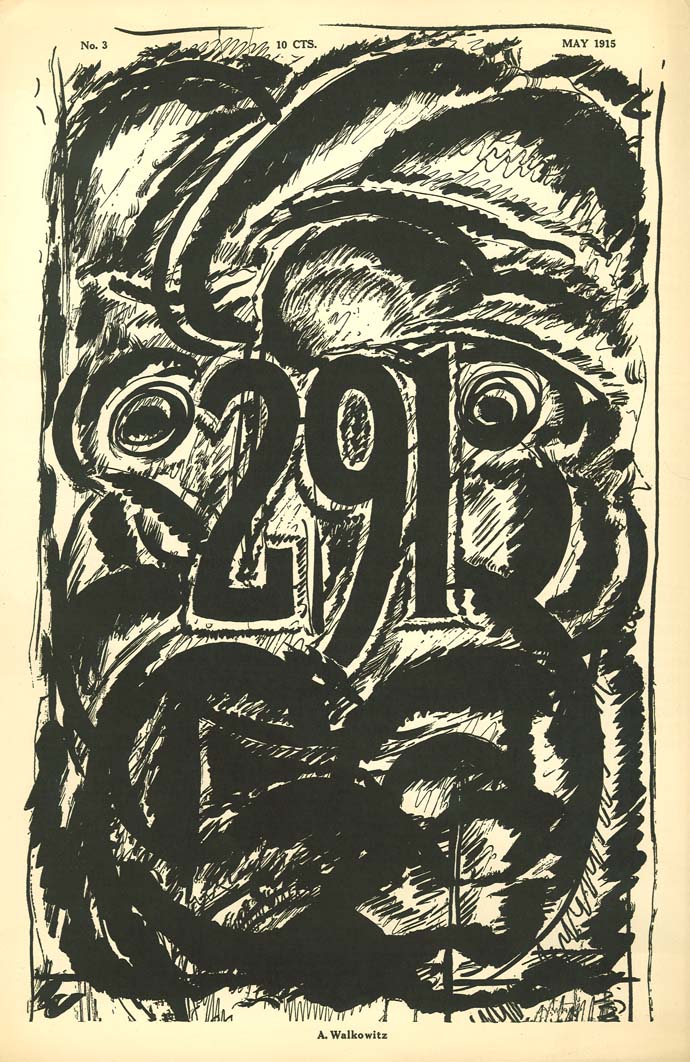
We could, as many do, situate the beginnings of Dada in the previous century, in Alfred Jarry’s bizarre 1896 play Ubu Roi or Erik Satie’s minimalist late 19th century Gymnopedies. We might also refer to an arts magazine in New York that preceded Tristan Tzara’s Dada and Ball’s single issue Cabaret Voltaire. Edited by famed photographer and art promoter Alfred Stieglitz, the journal 291 ran for 12 issues between 1915 and 1916 and is known, writes Dada-Companion.com, as “the first expression of the dada esthetic in the United States; proto-dada, actually, dada avant la lettre, before dada had started in Zürich in 1916.” Along with the University of Iowa, Ubuweb hosts the entire 12-issue print run, “a financial fiasco” in its day, “failing to sell more than eight subscriptions on vellum and a hundred on ordinary paper…. In the end Stieglitz sold the entire backstock to a ragpicker for $5.80.”
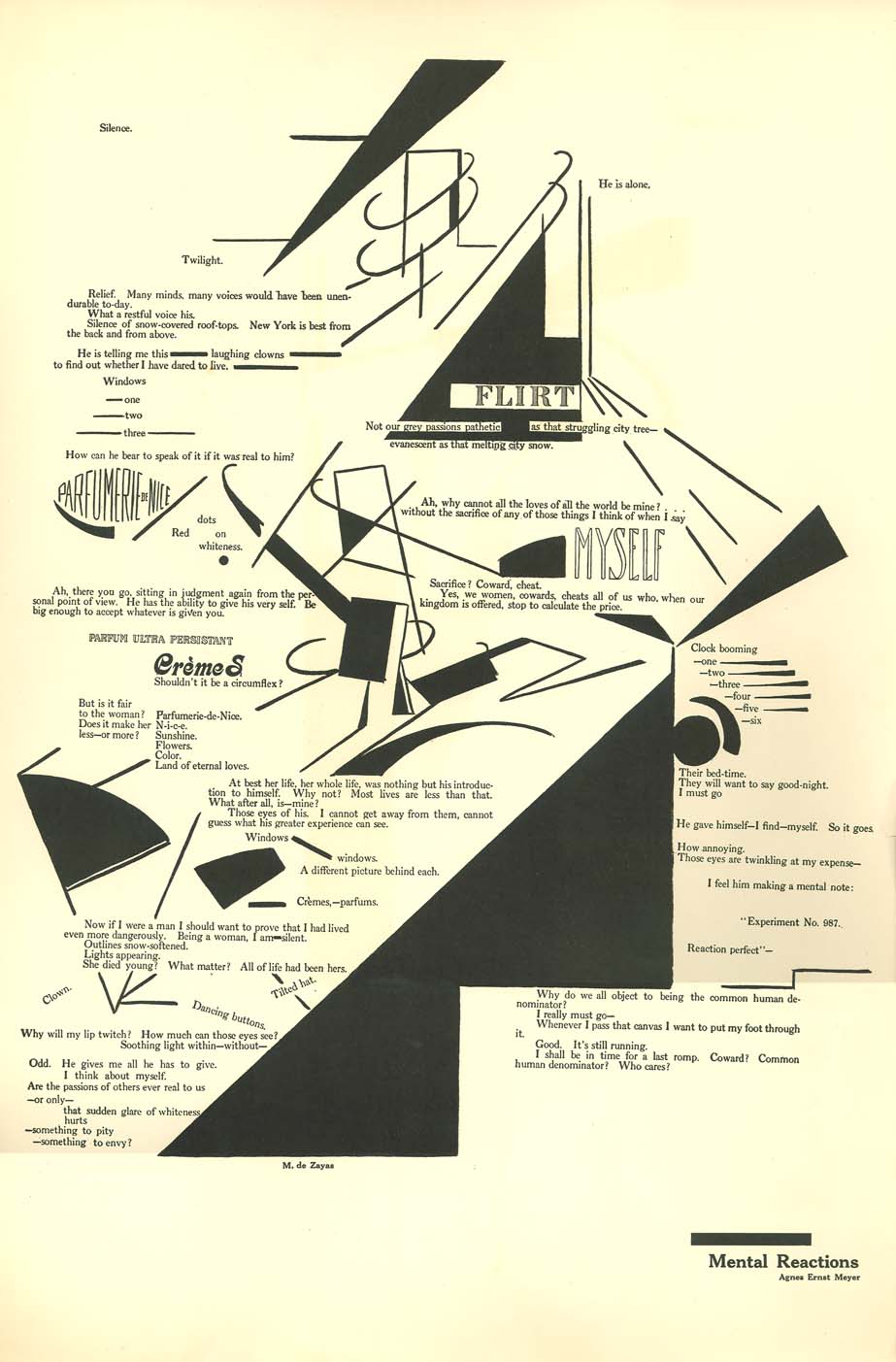
Despite this inglorious end, 291 is notable not only for its proto-dada status—and for featuring the work of modernists like Georges Braque, Guillaume Apollinaire, and later Dada and Surrealist artist Francis Picabia; the magazine also “occupies an interesting position among the journals of modernist art” as “the first magazine to style itself as a work of art in its own right.” You can get a sense of its artistry in the covers you see here, and download every issue of the magazine at Ubuweb or at the University of Iowa’s International Dada Archive. You’ll also see the magazine’s unusual format—from odd little topical items of the sort you’d find in a local newspaper to fascinating visual poetry like “Mental Reactions,” below, by Agnes Ernst Meyer. What we can’t get from the digital copies, unfortunately, is the full sense of 291’s “dramatic form” in its “gigantic folio format.”
The modernist journal “took its original inspiration from Apollinaire’s Soirées de Paris,” a journal founded in 1912 by the French poet and critic and his friends, “emphasizing caligrammatic texts and an abstracted kind of satirical drawing.” And though 291 may have had a very limited reach during its material existence, its influence continued into the era of Dada when Francis Picabia styled his own journal, 391, after Steiglitz’s publication. “Published 1917–1924 in Barcelona, New York, Zürich, and Paris in nineteen issues,” writes Booktryst, 391 helped Picabia distribute his own take on Dada, until he denounced the movement in 1921 and “issued a personal attack against [Surrealist Andre Breton] in the final issue.” The University of Iowa also hosts digital versions of all 19 issues of Picabia’s 391, which you can view and download here.
You don’t have to, like, stretch your brain or anything to rattle off a list of Keith Richards’ influences. If you’ve ever heard a Rolling Stones song, you’ve heard him pull out his Muddy Waters and Chuck Berry riffs, and he’s never been shy about supporting and naming his idols. He’s played with Waters, Berry, and many more blues and early rock and roll greats, and after borrowing heavily from them, the Stones gave back by promoting and touring with the artists who provided the raw material for their sound.
Then there’s the 2002 compilation The Devil’s Music, culled from Richards’ personal favorite collection of blues, soul, and R&B classics, and featuring big names like Robert Johnson, Little Richard, Bob Marley, Albert King, and Lead Belly, and more obscure artists like Amos Milburn, and Jackie Brenston. You may also recall last year’s Under the Influence, a Netflix documentary by 20 Feet From Stardom director Morgan Neville, in which Richards namechecks dozens of influential musicians—from his mum’s love of Sarah Vaughan, Ella Fitzgerald, and Billie Holiday, to his and Jagger’s youthful adoration of Waters and Berry, to his rock star hangouts with Willie Dixon and Howlin’ Wolf.
Point is, Keith Richards loves to talk about the music he loves. A big part of the Stones’ appeal—at least in their 60s/early 70s prime—was that they were such eager fans of the musicians they emulated. Yes, Jagger’s phony country drawls and blues howls could be a little embarrassing, his chicken dance a little less than soulful. But the earnestness with which the young Englishmen pursued their Americana ideals is infectious, and Richards has spread his love of U.S. roots music through every medium, including his 2010 memoir Life, a wickedly ironic title—given Richards’ No. 1 position on the “rock stars most-likely-to-die list,” writes Michiko Kakutani, “and the one life form (besides the cockroach) capable of surviving nuclear war.”
It’s also a very poignant title, given Richards’ single-minded pursuit of a life governed by music he’s loved as passionately, or more so, as the women in his life. Richards, Kakutani writes, dedicated himself “like a monk to mastering the blues.” Of this calling, he writes, “you were supposed to spend all your waking hours studying Jimmy Reed, Muddy Waters, Little Walter, Howlin’ Wolf, Robert Johnson. That was your gig. Every other moment taken away from it was a sin.” In the course of the book, Richards mentions over 200 artists, songs, and recordings that directly inspired him early or later in life, and one enterprising reader has compiled them all, in order of appearance, in the Spotify playlist above.
You’ll find here no surprises, but if you’re a Stones fan, it’s hard to imagine you wouldn’t put this one on and listen to it straight through without skipping a single track. When it comes to blues, soul, reggae, country, and rock and roll, Keith Richards has impeccable taste. Scattered amidst the Aaron Neville, Etta James, Gram Parsons, Elvis, Wilson Pickett, etc. are plenty of classic Stones recordings that feel right at home next to their influences and peers.
With the exception of reggae artists like Jimmy Cliff and Sly & Robbie, most of the tracks are from U.S. or U.S.-inspired artists (Tom Jones, Cliff Richard). Again, no surprises. Not everyone Richards appropriated has appreciated the homage (Chuck Berry long held a grudge), but were it not for his fandom and apprenticeship, it’s possible a great many blues records would have gone unsold, and some artists may have faded into obscurity. Thanks to playlists like these, they can live on in a digital age that doesn’t always do so well at acknowledging or remembering its history.
Jeff Buckley released just one studio album, Grace, before the emerging star died unexpectedly in May, 1997, drowning while swimming in the waters flowing from the Mississippi River. He was only 30 years old.
Given his painfully short discography, fans will delight in the newly-dropped album, You and I, which features, among other things, previously-unreleased Buckley covers of songs originally recorded by Bob Dylan (“Just Like a Woman”); Sly & the Family Stone (“Everyday People”); Led Zeppelin (“Night Flight”) and more. The album is now streaming on Spotify.
Starved for some more Buckley music? Then you’ll also want to check out this new interactive website which lets you browse/stream every album in Buckley’s varied vinyl record collection. Miles Davis, Billie Holiday, Siouxsie and the Banshees, Van Morrison, the Stones, Dylan, Bowie, Coltrane and The Clash–they’re all part of the collection. The video above shows you how to take full advantage of the new site. Enjoy.
If you would like to support the mission of Open Culture, consider making a donation to our site. It’s hard to rely 100% on ads, and your contributions will help us continue providing the best free cultural and educational materials to learners everywhere. You can contribute through PayPal, Patreon, and Venmo (@openculture). Thanks!
The mind of Kurt Vonnegut, like the protagonist of his best-known novel Slaughterhouse-Five, must have got “unstuck in time” somewhere along the line. How else could he have managed to write his distinctive brand of satirical but sincere fiction, hyper-aware of past, present, and future all at once? It must have made him a promising contributor indeed for Volkswagen’s 1988 Time magazine ad campaign, when the company “approached a number of notable thinkers and asked them to write a letter to the future — some words of advice to those living in 2088, to be precise.”
The beloved writer’s letter to the “Ladies & Gentlemen of A.D. 2088” begins as follows:
It has been suggested that you might welcome words of wisdom from the past, and that several of us in the twentieth century should send you some. Do you know this advice from Polonius in Shakespeare’s Hamlet: ‘This above all: to thine own self be true’? Or what about these instructions from St. John the Divine: ‘Fear God, and give glory to Him; for the hour of His judgment has come’? The best advice from my own era for you or for just about anybody anytime, I guess, is a prayer first used by alcoholics who hoped to never take a drink again: ‘God grant me the serenity to accept the things I cannot change, courage to change the things I can, and wisdom to know the difference.’
Our century hasn’t been as free with words of wisdom as some others, I think, because we were the first to get reliable information about the human situation: how many of us there were, how much food we could raise or gather, how fast we were reproducing, what made us sick, what made us die, how much damage we were doing to the air and water and topsoil on which most life forms depended, how violent and heartless nature can be, and on and on. Who could wax wise with so much bad news pouring in?
For me, the most paralyzing news was that Nature was no conservationist. It needed no help from us in taking the planet apart and putting it back together some different way, not necessarily improving it from the viewpoint of living things. It set fire to forests with lightning bolts. It paved vast tracts of arable land with lava, which could no more support life than big-city parking lots. It had in the past sent glaciers down from the North Pole to grind up major portions of Asia, Europe, and North America. Nor was there any reason to think that it wouldn’t do that again someday. At this very moment it is turning African farms to deserts, and can be expected to heave up tidal waves or shower down white-hot boulders from outer space at any time. It has not only exterminated exquisitely evolved species in a twinkling, but drained oceans and drowned continents as well. If people think Nature is their friend, then they sure don’t need an enemy.
You can read the whole thing at Letters of Note, where Vonnegut goes on to give his own interpretation of humanity’s perspective at the time, when “we were seeing ourselves as a new sort of glacier, warm-blooded and clever, unstoppable, about to gobble up everything and then make love — and then double in size again.” He puts the question to his future-inhabiting readers directly: “Is it possible that we aimed rockets with hydrogen bomb warheads at each other, all set to go, in order to take our minds off the deeper problem—how cruelly Nature can be expected to treat us, Nature being Nature, in the by-and-by?”
Finally, Vonnegut issues seven commandments — as much directed to readers of the late 20th century as to readers of the late 21st, or indeed to those of the early 21st in which you read this now — intended to help humanity avert what he sees as the utter catastrophe looming ahead:
Reduce and stabilize your population.
Stop poisoning the air, the water, and the topsoil.
Stop preparing for war and start dealing with your real problems.
Teach your kids, and yourselves, too, while you’re at it, how to inhabit a small planet without helping to kill it.
Stop thinking science can fix anything if you give it a trillion dollars.
Stop thinking your grandchildren will be OK no matter how wasteful or destructive you may be, since they can go to a nice new planet on a spaceship. That is really mean, and stupid.
And so on. Or else.
Volkswagen had asked him to look one hundred years into the future. As of this writing, 2088 lies less than 75 years ahead, and how many of us would agree that we’ve heeded most or even any of his prescriptions? Then again, Vonnegut grants that pessimism may have got the better of him; perhaps the future will bring with it a utopia after all, one where “nobody will have to leave home to go to work or school, or even stop watching television. Everybody will sit around all day punching the keys of computer terminals connected to everything there is, and sip orange drink through straws like the astronauts,” a comically dystopian utopia, and not an entirely un-prescient one — a Vonnegutian vision indeed.
I was surprised there’s an actual, medical name for it: pareidolia, defined by Merriam-Webster as “the tendency to perceive a specific, often meaningful, image in a random or ambiguous visual pattern.”
Thomas Lamadieu, the artist whose work is showcased above, has a different, but not wholly unrelated condition.
Most of us prefer to contemplate the heavens in a bucolic setting. Lamadieu’s art compels him to look upwards from a more urban landscape. The tops of the buildings hemming him in supply with irregularly shaped frames, which he captures using a fish eye lens. Later, he fills them in with Microsoft Paint drawings, which frequently feature a bearded man whose t‑shirt is striped in sky blue. Negative space, not Crayola, supplies the color here.
Think of it as street art in the sky.
Not every day can be a brilliant azure, but it hardly matters when even Lamadieu’s grayest views exhibit a determined playfulness. It takes a very unique sort of eye to tease a pink nippled, stripe-limbed bunny from a steely UK sky.
Like many street artists, he takes a global approach, traveling the world in search of giant unclaimed canvases. His portfolio contains vistas originally captured in Hong Kong, South Korea, Germany, Spain, Austria, Canada, Belgium, and the United States, as well as his native France.
“The bearded man in my images stands for the sky itself,” he told The Independent, adding that his is a wholly secular vision.
If you have any entrepreneurial aspirations, you’ve likely heard of Y Combinator (YC), an accelerator based in Silicon Valley that’s been called “the world’s most powerful start-up incubator” (Fast Company) or “a spawning ground for emerging tech giants” (Fortune). Twice a year, YC carefully selects a batch of start-ups, gives them $120,000 of seed funding each (in exchange for some equity), and then helps nurture the fledgling ventures to the next stage of development. YC hosts dinners where prominent entrepreneurs come to speak and offer advice. They hold “Demo Days,” where the start-ups can pitch their concepts and products to investors, and they have “Office Hours,” where budding entrepreneurs can work through problems with the seasoned entrepreneurs who run YC. Then, with a little luck, these new start-ups will experience the same success as previous YC companies, Dropbox and Airbnb.
Given Y Combinator’s mission, it makes perfect sense that YC has ties with Stanford University, another institution that has hatched giant tech companies–Google, Cisco, Yahoo and more. Back in 2014, Sam Altman (the president of Y Combinator) put together a course at Stanford called “How to Start a Start-Up,” which essentially offers students an introduction to the key lessons taught to YC companies. Altman presents the first two lectures. Then some of the biggest names in Silicon Valley take over. Dustin Moskovitz (Facebook co-founder), Peter Thiel (PayPal co-founder), Marc Andreessen (Netscape creator/general partner of Andreessen Horowitz), Marissa Mayer (Yahoo CEO, prominent Googler), Reid Hoffman (LinkedIn co-founder), Ron Conway (Silicon Valley super angel), Paul Graham (YC founder)–they all make an appearance in the course.
If you would like to support the mission of Open Culture, consider making a donation to our site. It’s hard to rely 100% on ads, and your contributions will help us continue providing the best free cultural and educational materials to learners everywhere. You can contribute through PayPal, Patreon, and Venmo (@openculture). Thanks!
Over on iTunes, you can find a short course (8 lectures in total) on the age-old mystery: How did Hannibal and his elephants cross the Alps during the Second Punic War? The course was presented by archeologist Patrick Hunt in the Continuing Studies program at Stanford University, back in 2007. Here’s the description for the course:
Hannibal is a name that evoked fear among the ancient Romans for decades. His courage, cunning and intrepid march across the dangerous Alps in 218 BCE with his army and war elephants make for some of the most exciting passages found in ancient historical texts written by Polybius, Livy, and Appian. And they continue to inspire historians and archaeologists today. The mystery of his exact route is still a topic of debate, one that has consumed Patrick Hunt (Director of Stanford’s Alpine Archaeology Project) for more than a decade. This course examines Hannibal’s childhood and his young soldierly exploits in Spain. Then it follows him over the Pyrenees and into Gaul, the Alps, Italy, and beyond, examining his victories over the Romans, his brilliance as a military strategist, and his legacy after the Punic Wars. Along the way, students will learn about archaeologists’ efforts to retrace Hannibal’s journey through the Alps and the cutting-edge methods that they are using. Hunt has been on foot over every major Alpine pass and has now determined the most probable sites where archaeological evidence can be found to help solve the mystery.
If you live in the San Francisco Bay Are, you’ll definitely want to check out the courses offered by Stanford Continuing Studies (where I also happen to work). The program also regularly offers online courses, for students living anywhere on this planet.
If you would like to support the mission of Open Culture, consider making a donation to our site. It’s hard to rely 100% on ads, and your contributions will help us continue providing the best free cultural and educational materials to learners everywhere. You can contribute through PayPal, Patreon, and Venmo (@openculture). Thanks!
We're hoping to rely on loyal readers, rather than erratic ads. Please click the Donate button and support Open Culture. You can use Paypal, Venmo, Patreon, even Crypto! We thank you!
Open Culture scours the web for the best educational media. We find the free courses and audio books you need, the language lessons & educational videos you want, and plenty of enlightenment in between.