Peter Sellers Covers the Beatles’ “A Hard Day’s Night,” “She Loves You” & “Help!”

In the ear­ly six­ties, Peter Sell­ers, one of the great­est com­ic actors of his gen­er­a­tion, met per­haps the great­est musi­cians of the age, the Bea­t­les, through their mutu­al pro­duc­er George Mar­tin. The par­tic­u­lar­ly British sen­si­bil­i­ties of the band and the actor—slapstick and word­play, accent and cos­tume changes—had sur­pris­ing­ly broad appeal in the six­ties, and a com­mon his­to­ry in their mutu­al admi­ra­tion of Eng­lish come­di­an and writer Spike Mil­li­gan.

Sell­ers rose to promi­nence on the Mil­li­gan-cre­at­ed BBC radio pro­gram The Goon Show, which the Bea­t­les cit­ed as a major influ­ence on their work. Their con­stant pat­ter in inter­views, films, even rehearsals, their ten­den­cy to break into music hall song and dance, comes right out of Sell­ers in a way (see, for exam­ple, the great com­ic actor in a rare inter­view here), but was also very much an expres­sion of their own extro­vert­ed per­son­al­i­ties. It stands to rea­son then that Sell­ers and the Bea­t­les, as we wrote in an ear­li­er post, “became fast friends.”

And as the Bea­t­les had paid trib­ute to Sell­ers’ com­e­dy, he would return the favor, cov­er­ing three of their most pop­u­lar songs as only he could. At the top of the post, see Sell­ers do a spo­ken word ver­sion of “A Hard Day’s Night” as Lawrence Olivier’s Richard III. And above and below, he gives us sev­er­al ren­di­tions of “She Loves You,” in sev­er­al dif­fer­ent accents, “in the voice of Dr. Strangelove, again with cock­ney and upper-crusty accents, and final­ly with an Irish twist. The record­ings were all released posthu­mous­ly between 1981 and 1983 on albums no longer in cir­cu­la­tion.”

There are many more Beatles/Sellers con­nec­tions. Before tap­ing his “Hard Day’s Night” skit for Grana­da tele­vi­sion spe­cial “The Music of Lennon & McCart­ney,” Sell­ers had pre­sent­ed the band with a Gram­my for the song, which won “Best Per­for­mance of a Vocal Group” in 1965. “Inci­den­tal­ly,” writes Mersey Beat’s Bill Har­ry, “the [Gram­my] pre­sen­ta­tion was made on the stu­dio set of ‘Help!’ and, inter­est­ing­ly, Sell­ers had orig­i­nal­ly been offered the script of ‘Help!’ (Obvi­ous­ly under a dif­fer­ent title) but turned it down.” Sell­ers and the Goon Show cast had pre­vi­ous­ly worked with Richard Lester, direc­tor of the Bea­t­les films and the John Lennon-star­ring How I Won the War.

Com­pletists out there may have also heard the record­ed con­ver­sa­tion between Sell­ers and the Bea­t­les that appears at the end of a boot­leg ver­sion of the White Album, which cir­cu­lat­ed for years under the title The Peter Sell­ers Tape. That the band and the come­di­an got along so famous­ly is no great sur­prise, nor that Sell­ers had so much fun rework­ing the rather sil­ly, and infec­tious­ly catchy, pop songs of the Bea­t­les’ ear­ly career, bring­ing to them his bat­tery of char­ac­ters and voic­es. We’ve saved what may be Sell­ers’ best Bea­t­les cov­er for last. Below, hear him—in the voice of a lec­tur­ing vic­ar and with a back­ing choir—deliver “Help!” as a 45 RPM ser­mon.

Relat­ed Con­tent:

Peter Sell­ers Presents The Com­plete Guide To Accents of The British Isles

The Bea­t­les Per­form a Fun Spoof of Shakespeare’s A Mid­sum­mer Night’s Dream (1964)

John Cleese, Ringo Starr and Peter Sell­ers Trash Price­less Art (1969)

John Lennon’s Appear­ances in How I Won the War, the Absur­dist 1967 Film

Josh Jones is a writer and musi­cian based in Durham, NC. Fol­low him at @jdmagness

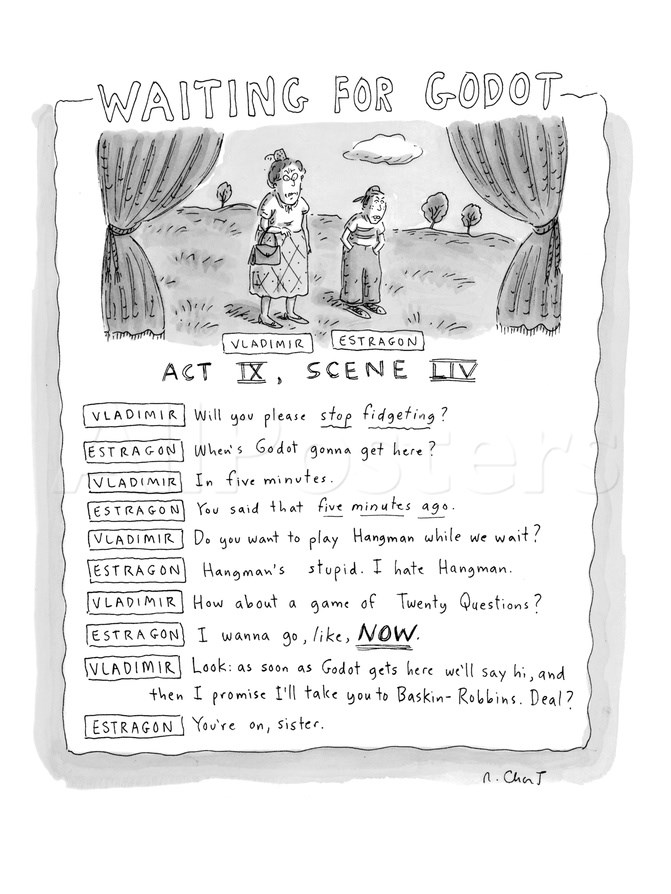
Comics Inspired by Waiting For Godot, Featuring Tintin, Roz Chast, and Beavis & Butthead

Godot Comics

Is Samuel Beck­et­t’s Wait­ing for Godot fun­ny?

Yes. It’s a com­e­dy about life’s tragedies, great and small.

Are car­toons inspired by Wait­ing for Godot fun­ny?

…most­ly not. Espe­cial­ly when they’re set in wait­ing rooms (or air­port arrivals areas).

Godot’s a hard trope for a car­toon­ist on the prowl for some­thing fresh. Dogs, psy­chi­a­trists, cast­aways on desert islands are more elas­tic sub­jects, uni­ver­sal, but capa­ble of being spun any num­ber of ways.

To wring a com­ic wor­thy of The New York­er out of Godot, you prob­a­bly have to be an actu­al New York­er car­toon­ist, like Roz Chast, whose instant­ly rec­og­niz­able work can be seen above.

Oth­er New York­er car­toon­ists who’ve tak­en a crack include Dan­ny Shana­hanJack Ziegler and Ben­jamin Schwartz.

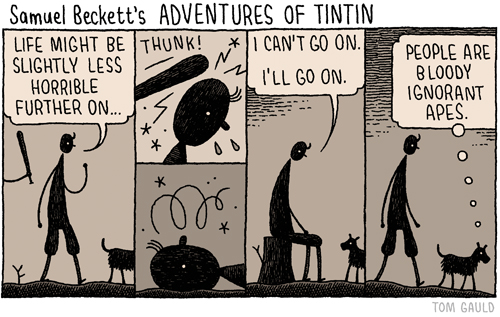
Not to imply that New York­er car­toon­ists are the only source for inspired Godot-inspired comics– the late, great Hergé, cre­ator of Tintin made one.

Godot Comics 5

(Oh wait, that’s not Hergé, it’s Tom Gauld who illus­trates the Guardian’s Sat­ur­day Review let­ters page, scor­ing major points by relo­cat­ing the ter­mi­nal­ly upbeat boy detec­tive so out­side his com­fort zone that even Snowy is a neg­a­tive image.)

godot 7

Car­toon­ist Richard Thomp­son sum­moned Godot for a strip with­in a strip install­ment of his pop­u­lar syn­di­cat­ed Cul de Sac. (Click the image above to view it in a larg­er for­mat.) Will read­ers get the ref­er­ence? Alice, his preschool-aged hero­ine, seems to, astute­ly echo­ing crit­ic Vivian Mercier’s assess­ment of Godot as a play where “noth­ing happens…twice”.

beavis beckett

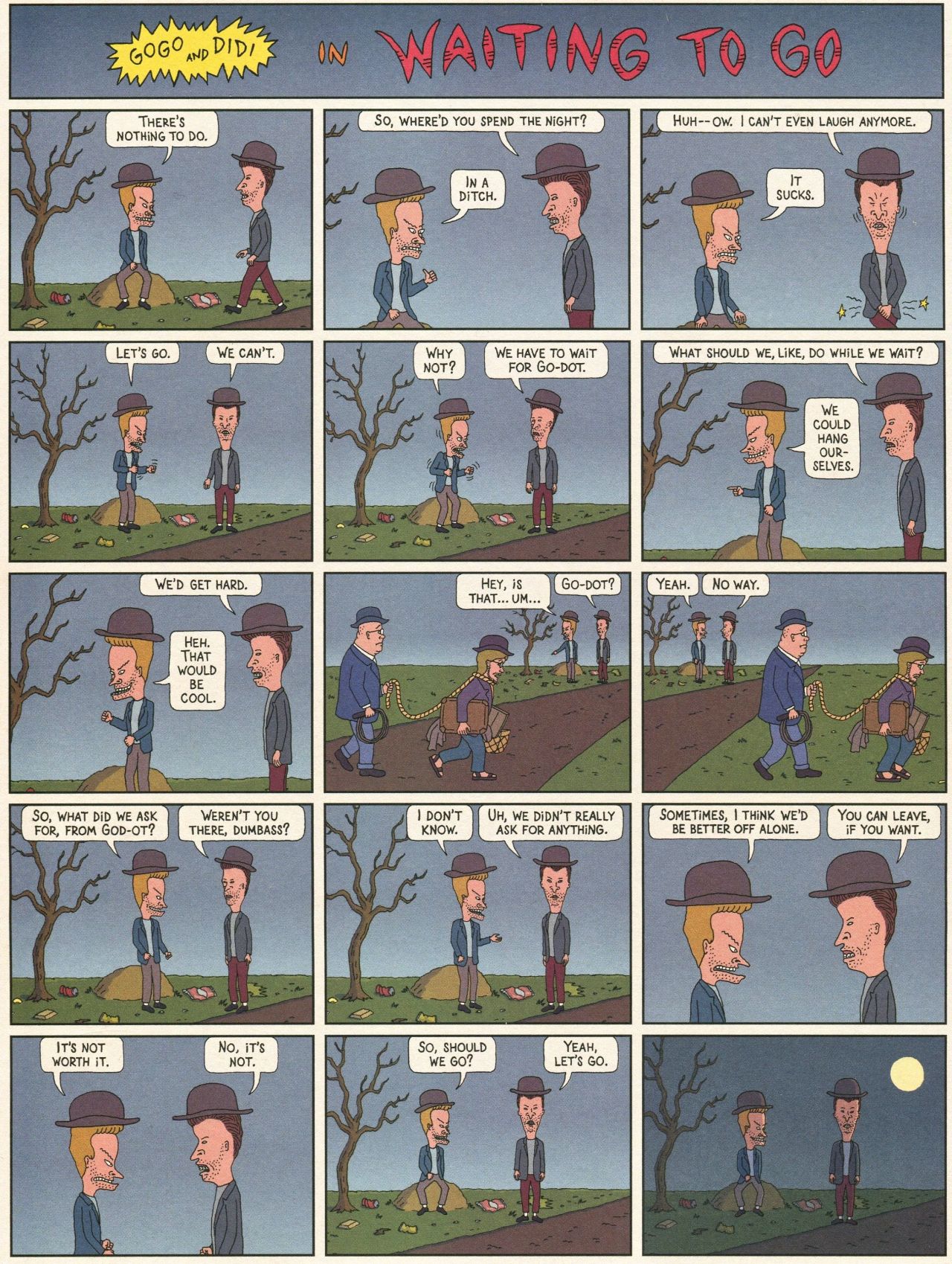
I reserve my high­est praise for the inspired cast­ing of Beav­is and Butthead in R. Siko­ryak’s “Wait­ing to Go.”  (.) Here we find a Vladimir and Estragon who tru­ly embody the final lines of Nor­man Mail­er’s noto­ri­ous “A Pub­lic Notice on Wait­ing for Godot”:

Man’s nature, man’s dig­ni­ty, is that he acts, lives, loves, and final­ly destroys him­self seek­ing to pen­e­trate the mys­tery of exis­tence, and unless we par­take in some way, as some part of this human explo­ration… then we are no more than the pimps of soci­ety and the betray­ers of our Self.

Relat­ed Con­tent:

Samuel Beck­ett Directs His Absur­dist Play Wait­ing for Godot (1985)

Samuel Beck­ett Draws Doo­dles of Char­lie Chap­lin, James Joyce & Hats

Watch the Open­ing Cred­its of an Imag­i­nary 70s Cop Show Star­ring Samuel Beck­ett

- Ayun Hal­l­i­day is an author, illus­tra­tor, and Chief Pri­ma­tol­o­gist of the East Vil­lage Inky zine. Fol­low her @AyunHalliday

Monty Python and the Holy Grail Re-Imagined as an Epic, Mainstream Hollywood Film

The orig­i­nal 1975 trail­er for Mon­ty Python and the Holy Grail (below) start­ed to make some big claims for itself. It opens, with the nar­ra­tor declar­ing:

Once in a life­time there comes a motion pic­ture which changes the whole his­to­ry of motion pic­tures. A pic­ture so stun­ning in its effect, so vast in its impact that it pro­found­ly affects the lives of all who see it.

But then comes the self-effac­ing punch­line deliv­ered by anoth­er nar­ra­tor in Japan­ese:

One such film is Kuro­sawa’s “The Sev­en Samu­rai.” Anoth­er was “Ivan the Ter­ri­ble.” Then there are more run-of-the mill films like “Her­bie Rides Again,” “La Notte” and “Mon­ty Python and the Holy Grail.”

… So, if you’re an intel­lec­tu­al midget and you feel like gig­gling, you could do worse than see Mon­ty Python and the Holy Grail.

Clas­sic Python!

Now, if want a Python trail­er that takes itself seri­ous­ly, look no fur­ther than the clip above. Cre­at­ed last year, this trail­er re-imag­ines Mon­ty Python and the Holy Grail as a main­stream Hol­ly­wood film. No wit. All cheese. If you dig the con­cept, you can see sim­i­lar rework­ings of Stan­ley Kubrick films here.

Relat­ed Con­tent:

Mon­ty Python’s Best Phi­los­o­phy Sketch­es

Mon­ty Python and the Holy Grail­Cen­sor­ship Let­ter: We Want to Retain “Fart in Your Gen­er­al Direc­tion”

Ter­ry Gilliam Reveals the Secrets of Mon­ty Python Ani­ma­tions: A 1974 How-To Guide

by | Permalink | Make a Comment ( 3 ) |

Watch Twin Beaks, Sesame Street’s Parody of David Lynch’s Iconic TV Show (1990)

Who killed Lau­ra Palmer?

If the answer comes unbid­den to your lips, you’re no doubt old enough to have spent much of 1990 glued to Twin Peaks, cult direc­tor David Lynch’s supreme­ly creepy series. (Note: US-based view­ers can watch the show for free on Hulu.)

The name prob­a­bly won’t mean much to those who entered the noughties with a wob­bly tod­dle, and why would it?  Mur­der vic­tim Palmer may have dri­ven the orig­i­nal series, but she did­n’t rank so much as a men­tion in Sesame Street’s 1991 par­o­dy, Twin Beaks, above.

The Mup­pets also steered clear of Sher­i­lyn Fenn’s teen vix­en cher­ry stem trick

No Lynchi­an dream sequences

No one armed men

No scary owls

What teth­ers this G‑rated kid­die ver­sion to the orig­i­nal, you may ask?

Hint: it car­ries a log.

Of course! The log lady is a sta­ple of Twin Peaks par­o­dies, show­ing up every­where from a Sat­ur­day Night Live skit star­ring Twin Peaks’ Spe­cial Agent Dale Coop­er (Kyle MacLach­lan) to a 2.5 minute Lego homage that man­ages to pre­serve the sex, the vio­lence, and seem­ing­ly all of the char­ac­ters.

The Cook­ie Monster’s Spe­cial Agent Cook­ie does eat some “darn” fine pie, but ulti­mate­ly, his fix­a­tion on why the town was named “Twin Beaks” is far less com­pelling than his take on Mon­ster­piece Theatre’s host Alis­tair Cooke.

Mas­ter­piece Theatre’s icon­ic pre­sen­ter has proved even more irre­sistible to par­o­dists than the Log Lady.

(In Sesame Street’s case, it worked. There are 35 more Mon­ster­pieces, includ­ing num­ber-cen­tric spoofs of The 400 Blows and (gulp) The Post­man Always Rings Twice.)

Relat­ed Con­tent:

Mon­ster­piece The­ater Presents Wait­ing for Elmo, Calls BS on Samuel Beck­ett

Watch Jazzy Spies: 1969 Psy­che­del­ic Sesame Street Ani­ma­tion, Fea­tur­ing Grace Slick, Teach­es Kids to Count

Watch The Sur­re­al 1960s Films and Com­mer­cials of Jim Hen­son

Ayun Hal­l­i­day is an author, illus­tra­tor, and Chief Pri­ma­tol­o­gist of the East Vil­lage Inky zine. Fol­low her @AyunHalliday

An Animated Louis CK on How the Colonists Came to America and Screwed It All Up (NSFW)

I sus­pect par­ents of school-aged chil­dren will find much to relate to in the Lord’s frus­tra­tion with mankind, above, whether or not they’re prone to vent­ing in come­di­an Louis CK’s patent­ed NSFW lan­guage.

Who among us has not turned our back for a few moments, only to dis­cov­er upon our return the house in sham­bles, the nutri­tious snack we set out passed over in favor of junk.

(“Just eat the shit on the floor! I left shit all over the floor! Fuckin’ corn and wheat and shit, grind it up and make some bread—what are you doing!?”)

It’s no won­der ani­ma­tors are drawn to CK. His dis­tinc­tive voice and impec­ca­ble tim­ing have earned him a star­ring role as a talk­ing dog in a CGI fea­ture to be released in 2016. Pri­or to strik­ing it big with the series Louie, he was a fre­quent vis­i­tor on “Dr” Jonathan Katz’s couch. His over-the-top standup spiels pro­vide the unau­tho­rized flash ani­ma­tor with an embar­rass­ment of rich­es.

Cana­di­an film stu­dent John Roney, whose YouTube chan­nel boasts spoofs of Game of Thrones and the Mag­ic School­bus, keeps his visu­als under­stat­ed, min­ing CK’s 2011 per­for­mance at New York City’s Bea­con The­ater for the 2‑dimensional realm.

It could have been so much gross­er.

Turn down the sound and Roney’s adap­ta­tion could be high qual­i­ty children’s pro­gram­ming, the kind most of us god­like par­ents even­tu­al­ly accept as a nec­es­sary evil. Well, maybe not the part where those Aztec kids bowl Louis’ head down the pyra­mids (right above)…though they, like Roney’s oth­er mild­ly observed human and ani­mal char­ac­ters, add to the fun­ny. Here’s the orig­i­nal clip from the Bea­con The­ater show:

Relat­ed Con­tent:

The Sur­re­al Short Films of Louis C.K., 1993–1999

Louis CK Crash­es Zach Gal­i­fi­anakis & Brad Pitt’s Very Awk­ward Inter­view

Jer­ry Sein­feld and Louis CK in Small Cars and Big Yachts, Get­ting Cof­fee

Ayun Hal­l­i­day is an author, home­school­er, and Chief Pri­ma­tol­o­gist of the East Vil­lage Inky zine. Fol­low her @AyunHalliday

John Cleese Explores the Health Benefits of Laughter

If you live in a big city like Los Ange­les or San Fran­cis­co, you’ll dis­cov­er that there are just a bewil­der­ing vari­ety of yoga styles out there — there’s Ash­tan­ga Yoga if you want a real work out, there’s Yin Yoga if you want to chill out and there’s Bikram Hot Yoga if you want heat stroke. Add to this list Laugh­ter Yoga. Yes, Laugh­ter Yoga.

For a seg­ment of the 2001 BBC series The Human Face, John Cleese, a man who knows some­thing about laugh­ter, ven­tured to Mum­bai, India to see what Laugh­ter Yoga is all about. He inter­views the man behind it all, Dr. Madan Kataria, who argues that laugh­ter is bril­liant at low­er­ing stress and improv­ing the immune sys­tem. And best of all, you don’t even need mats or unflat­ter­ing pants to do it. You just need a group of like-mind­ed peo­ple and a will­ing­ness to look sil­ly. In the video, which you can see above, Cleese yuks it up with a group of Mum­bai locals.

“We all know what a good laugh feels like,” he tells the cam­era. “But what struck me was how easy it was to get start­ed. When you have a lot of warm, friend­ly, fun­ny faces com­ing at you, you respond very naturally…I’m struck by how laugh­ter con­nects you to peo­ple. It’s almost impos­si­ble to main­tain any kind of dis­tance or any sense of social hier­ar­chy when you’re just howl­ing with laugh­ter. Laugh­ter is a force for democ­ra­cy”

Appar­ent­ly, you don’t even have to be in an espe­cial­ly jol­ly mood to reap the health ben­e­fits of Laugh­ter Yoga. Forced laugh­ter tricks the body into releas­ing endor­phins too. In Laugh­ter Yoga, as with life, the mot­to is “fake it til you make it.”

So if you are inter­est­ed in laugh­ing like a mad­man in the pri­va­cy of your own home, Dr. Kataria has an instruc­tion­al video for you, which you can see right above. There are a sur­pris­ing num­ber of laugh­ing exer­cis­es avail­able — from the milk­shake move, where you pan­tomime guz­zling a drink, to the argu­ment laugh­ter, where you wag a fin­ger, to the Visa laugh­ter where you pre­tend to laugh through the tears as you open your cred­it card state­ment. So go ahead and try it. You’ll feel bet­ter.

Relat­ed Con­tent:

Yoga in an X‑Ray Machine

John Cleese’s Phi­los­o­phy of Cre­ativ­i­ty: Cre­at­ing Oases for Child­like Play

Son­ny Rollins Describes How 50 Years of Prac­tic­ing Yoga Made Him a Bet­ter Musi­cian

Free Guid­ed Med­i­ta­tions From UCLA: Boost Your Aware­ness & Ease Your Stress

Jonathan Crow is a Los Ange­les-based writer and film­mak­er whose work has appeared in Yahoo!, The Hol­ly­wood Reporter, and oth­er pub­li­ca­tions. You can fol­low him at @jonccrow. And check out his blog Veep­to­pus, fea­tur­ing lots of pic­tures of bad­gers and even more pic­tures of vice pres­i­dents with octo­pus­es on their heads.  The Veep­to­pus store is here.

Enter the Church of the SubGenius, the Parody Religion Backed by R. Crumb, David Byrne & Other Alt-Icons

You may not know much about the Church of the Sub­Ge­nius, but you’ve def­i­nite­ly seen its prophet. The inten­sive­ly groomed, Ward Cleaveresque J. R. “Bob” Dobbs (below) began as a hum­ble piece of 1950s clip art and went on to become “a way of life to mil­lions… yet half of them don’t even know it.” Or so claims the sweep­ing, absur­di­ty-laced, son­i­cal­ly (and per­haps intel­lec­tu­al­ly) twist­ed nar­ra­tion of Arise! The Sub­Ge­nius, an “instruc­tion­al bar­rage video” put out by the Church in 1992 as the most potent dis­til­la­tion of its reli­gion-sat­i­riz­ing sen­si­bil­i­ty.

Arise-Church-SubGenius

The obses­sion with world­wide con­spir­a­cies, the impor­tance grant­ed to vora­cious con­sump­tion and “remix­ing” of pop cul­ture (vis­i­ble every­where in Arise!), the hard­line oppo­si­tion to work, the all-impor­tant and nev­er-defined qual­i­ty of “Slack,” the askew escha­tol­ogy: how much of the Church of the Sub­ge­nius’ doc­trine has remained mere par­o­dy reli­gion, and how much, since its found­ing in the late 1970s, have its “followers”—a group that includes such alt-icons as David Byrne, Robert Crumb, and Mark Mothersbaugh—come to con­sid­er as good as the real thing?

But what­ev­er legit­i­ma­cy this sur­pris­ing­ly long-run­ning post­mod­ern joke has attained, we can also view it, like all reli­gions, as a cul­tur­al move­ment. This approach rais­es its own ques­tions: how, exact­ly, did Dobbs’ pipe-clench­ing, father­ly yet sin­is­ter vis­age become one of the most rec­og­niz­able sub­cul­tur­al emblems of the 1980s and 1990s? You may nev­er learn the answer, just as you may nev­er get a han­dle on the entire­ty of the Church’s ever more labyrinthine and aggres­sive­ly pre­pos­ter­ous mythol­o­gy, but you’ll cer­tain­ly find it all strange­ly com­pelling in the attempt.

And even if Arise! The Sub­Ge­nius does­n’t recruit you into the Church of the Sub­Ge­nius’ ranks, you’ve got to respect what they’ve pre­dict­ed: not the end of the world, as much as they talk about it, but our cur­rent­ly thriv­ing 21st-cen­tu­ry cul­ture of media appro­pri­a­tion, recon­tex­tu­al­iza­tion, and absur­di­fi­ca­tion. If ever there were a reli­gion for the Youtube era, here it is. And if you find noth­ing nov­el in its char­ac­ter­is­tic ambiva­lence about what counts as seri­ous and what does­n’t, maybe the Church of the Sub­Ge­nius’ teach­ings have pen­e­trat­ed even deep­er into the zeit­geist than all those “Bob” stick­ers made us sus­pect.

via Net­work Awe­some

Relat­ed Con­tent:

Watch 8 Clas­sic Cult Films for Free: Night of the Liv­ing Dead, Plan 9 from Out­er Space & More

When William S. Bur­roughs Joined Sci­en­tol­ogy (and His 1971 Book Denounc­ing It)

Mon­ty Python’s Life of Bri­an: Reli­gious Satire, Polit­i­cal Satire, or Blas­phe­my?

Col­in Mar­shall hosts and pro­duces Note­book on Cities and Cul­ture as well as the video series The City in Cin­e­ma and writes essays on cities, lan­guage, Asia, and men’s style. He’s at work on a book about Los Ange­les, A Los Ange­les Primer. Fol­low him on Twit­ter at @colinmarshall or on Face­book.

Stephen Hawking Sings Monty Python’s “Galaxy Song”: Hear the Newly-Released Single

The “Galaxy Song” first appeared in the 1983 film Mon­ty Python’s The Mean­ing of Life, and it has been revived in lat­er years — on Mon­ty Python albums, and in Mon­ty Python stage plays. Now the song orig­i­nal­ly writ­ten by Eric Idle has been re-record­ed, this time with the lyrics sung by the world-famous physi­cist Stephen Hawk­ing. The lyrics include a lot of astro­nom­i­cal facts, some now con­sid­ered out­dat­ed by schol­ars. But that does­n’t take the fun out of the record­ing.

The song will be avail­able for down­load on iTunes. (If you live in the UK, find it here.) And it will also be released as a 7″ sin­gle. But you can stream it online for free above. Enjoy.

If you would like to sign up for Open Culture’s free email newslet­ter, please find it here. It’s a great way to see our new posts, all bun­dled in one email, each day.

If you would like to sup­port the mis­sion of Open Cul­ture, con­sid­er mak­ing a dona­tion to our site. It’s hard to rely 100% on ads, and your con­tri­bu­tions will help us con­tin­ue pro­vid­ing the best free cul­tur­al and edu­ca­tion­al mate­ri­als to learn­ers every­where. You can con­tribute through Pay­Pal, Patre­on, and Ven­mo (@openculture). Thanks!

Relat­ed Con­tent:

Mon­ty Python’s Best Phi­los­o­phy Sketch­es

Ter­ry Gilliam Reveals the Secrets of Mon­ty Python Ani­ma­tions: A 1974 How-To Guide

John Cleese’s Phi­los­o­phy of Cre­ativ­i­ty: Cre­at­ing Oases for Child­like Play

Stephen Hawking’s Big Ideas Explained with Sim­ple Ani­ma­tion

by | Permalink | Make a Comment ( 2 ) |

« Go BackMore in this category... »
Quantcast