What Happens When a Cheap Ikea Print Gets Presented as Fine Art in a Museum

The enti­ty to whom Dutch group, Life­hunters, attrib­ut­es the muse­um qual­i­ty art­work in the video prank above doesn’t exist. The “famous” Swedish artist’s han­dle –IKE Andrews –is but a puck­ish ref­er­ence to IKEA, the pur­vey­or of the 10€ print (oh snap, it’s not even an orig­i­nal!) var­i­ous unnamed “art experts” are asked to eval­u­ate, hav­ing been led to believe it’s some­thing rare and won­der­ful. IKE Andrews’ fel­low fic­tion­al enti­ty, Borat, would be grat­i­fied by how read­i­ly these experts accept pre­sen­ter Boris Lange’s sug­ges­tions as to the val­ue of this work.

So how bad is this “paint­ing”? Wal­ter Keane bad? Mar­garet Keane bad? Is it a Velvis? A sad clown? The sort of crum­my land­scape artist Wayne White might snap up in a thrift store?

Only if you think IKEA achieved glob­al dom­i­nance by choos­ing designs, pat­terns, and images in order for snot­ty hip­sters to buy them iron­i­cal­ly…

As sev­er­al YouTube, Twit­ter, and blog com­menters have men­tioned, the print itself is pret­ty cool.

It’s a media fren­zy, but inter­est­ing­ly, the artist is not com­ing for­ward to her­ald his or her role in the hoax.

Make that artists. Turns out IKE Andrews is a pair of Swiss street artists, Chris­t­ian Rebec­chi and Pablo Tog­ni, who col­lab­o­rate as NEVERCREW.

They have a fas­ci­na­tion with cross sec­tions. As their web­site some­what murk­i­ly explains [all sic]:

These mod­els, as such, from time to time actu­al­ly con­tain more or less exten­sive real­i­ties, rep­re­sent­ed as autonomous sys­tems of which the real­i­ty of the view­er becomes a part. This then the rap­port becomes the very sub­ject, main­ly high­light­ed as the rela­tion­ship between man and nature (between human being and its nature), but auto­mat­i­cal­ly extend­ed to a vision of total and inevitable rela­tion­ship between every­thing, between every part, where it is only the point of view, the posi­tion with­in a sys­tem, to define a selec­tion.

IKEA stream­lines the artists’ phi­los­o­phy for the mass­es thus­ly:

We call the theme “liv­ing struc­tures” and we like to see them as mod­els of liv­ing sys­tems. We would like our art to gen­er­ate inter­est and curios­i­ty, and the view­er to become a part of the mech­a­nism with his or her thoughts, per­spec­tive and emo­tions.

never-crew-message-in-a-bottle


Philosophy’s all well and good, but what’s it actu­al­ly look like, this “Mes­sage in a Bot­tle”?

Well, it seems to me to be a bot­tle, implau­si­bly halved length­wise to reveal a bunch of steam­punk stuff bal­anced atop robot spi­der legs, form­ing a cage around an ancient-look­ing whale. Also, a cloud rain­ing yel­low liq­uid, or pos­si­bly light. (Hope­ful­ly the lat­ter). Oh! And it appears to have been paint­ed on a brown paper bag.

I can think of plen­ty of peo­ple who’d not only like it, but find mean­ing in it, as the experts do. The only dif­fer­ence is the experts do so on cam­era, a fact not all of them are will­ing to laugh at, when host Lange informs them they’ve been punked.

The artists aren’t the only ones play­ing it cool. The inter­net may be explod­ing, but so far, nei­ther IKEA, nor the Nether­lands’ Arn­hem Muse­um, where the prank was staged, have made men­tion of this busi­ness.

via Hyper­al­ler­gic

Relat­ed Con­tent:

F for Fake: Orson Welles’ Short Film & Trail­er That Was Nev­er Released in Amer­i­ca

The Great Dr. Fox Lec­ture: A Vin­tage Aca­d­e­m­ic Hoax (1970)

How the “Paul McCart­ney is Dead” Hoax Start­ed at an Amer­i­can Col­lege News­pa­per and Went Viral (1969)

Ayun Hal­l­i­day is an author, illus­tra­tor, and moth­er of a teen film­mak­er whose best known work was shot guer­ril­la style in a Red Hook, Brook­lyn Ikea. Fol­low her @AyunHalliday

Watch Meryl Streep Have Fun with Accents: Bronx, Polish, Irish, Australian, Yiddish & More

Meryl Streep, fre­quent­ly hailed as one of our Great­est Liv­ing Actress­es — she claims there’s no such thing — com­mands a near-ency­clo­pe­dic mas­tery of accents.

Oth­ers may pre­pare for their roles by work­ing with a dialect coach or lis­ten­ing to tapes of native speak­ers, but Streep push­es to the lim­it, as indi­cat­ed in the con­ver­sa­tion with author Andre Dubus III, below.

She not only learned Pol­ish in order to play a trou­bled Holo­caust sur­vivor in Sophie’s Choice, she thought deeply about the way gen­der roles and peri­od inform vocal pre­sen­ta­tion.

Clear­ly a lot of effort goes into the per­for­mances that leave British crit­ics cheer­ing Streep as she sails above play­ing fields lit­tered with Amer­i­can actors who dared attempt Eng­lish accents.

Her com­mit­ment to her craft is inad­ver­tent­ly to blame for pop­u­lar­iz­ing the phrase “dingo’s got my baby.”

How refresh­ing that this ver­sa­tile and accom­plished actor is not pre­cious about her skills. She game­ly trot­ted them out for the come­di­an Ellen DeGeneres’ par­lor game, above. Looks like fun, pro­vid­ed one’s not an intro­vert. Each play­er draws a card labelled with an accent, sticks it to the brim of a sil­ly hat, then tried to guess the accent, based on her partner’s impromp­tu per­for­mance.

“Brook­lyn?” Streep gig­gles when the Louisiana-born DeGeneres has a go at Boston.

Her stab at the Bronx shows off her improv chops far bet­ter than the most recent stunt DeGeneres roped her into.

(For what it’s worth, Ben Affleck also excelled at this game. The late Robin Williams was less con­vinc­ing, but char­ac­ter­is­ti­cal­ly irre­press­ible, even when called upon to imper­son­ate speak­ers of oth­er races.)

- Ayun Hal­l­i­day is an author, illus­tra­tor, and low bud­get the­ater impre­sario. Fol­low her @AyunHalliday

77 Exercises: A Workout Video For Fans of the Talking Heads

Turns out you can burn some good calo­ries when you’re Burn­ing Down the House. Enjoy a fun clip from Fun­ny or Die, and some oth­er great Talk­ing Heads mate­r­i­al from our archive below.

via @stevesilberman

Relat­ed Con­tent:

David Byrne: How Archi­tec­ture Helped Music Evolve

Hear the Ear­li­est Known Talk­ing Heads Record­ings (1975)

Talk­ing Heads’ “This Must Be the Place (Naive Melody)” Per­formed on Tra­di­tion­al Chi­nese Instru­ments

Talk­ing Heads Play CBGB, the New York Club that Shaped Their Sound (1975)

Live in Rome, 1980: The Talk­ing Heads Con­cert Film You Haven’t Seen

A Gallery of Mad Magazine’s Rollicking Fake Advertisements from the 1960s

Mad-Edsel

I can well remem­ber the first time I read Mad Mag­a­zine. I was prob­a­bly around Bart Simpson’s age, but nowhere near his degree of wiseass-ness. I found the humor of the adult world most­ly mys­ti­fy­ing and also pret­ty tame, giv­en my rather shel­tered exis­tence. It was my dis­cov­ery of Mad—stacks and stacks of old Mads, to be pre­cise, in the rec room of a fam­i­ly acquaintance—that cracked the shell, one of those for­ma­tive loss-of-inno­cence moments that are ulti­mate­ly edi­fy­ing. At the time, I couldn’t tell sophis­ti­cat­ed satire from puerile par­o­dy, and the aver­age issue of Mad was no Gulliver’s Trav­els. Nonethe­less, its glee­ful skew­er­ing of the Amer­i­can civ­il reli­gion of pol­i­tics, celebri­ty, pro­fes­sion­al sports, com­merce, and mid­dle class com­fort hooked me instant­ly, and taught me about the val­ue of freethought before I’d ever heard the name Jonathan Swift.

Found­ed as a com­ic book by edi­tor Har­vey Kurtz­man and pub­lish­er William Gaines in 1952, Mad and its gap-toothed mas­cot Alfred E. New­man (still active today!) pio­neered pop­ulist satire and inspired many less­er imi­ta­tors. One dis­tinc­tive fea­ture of the mag­a­zine for almost its entire exis­tence was its abil­i­ty to run with­out adver­tis­ing, allow­ing it to tear apart mate­ri­al­ist cul­ture with­out fear of bit­ing the hands that fed it. Instead, for decades, the mag­a­zine ran fake spoof ads like those you see here. At the top, for exam­ple, see a 1963 ad for the “1963 ¾ Edsel,” an update of the “1963 ½ models—which made all ’63 mod­els obso­lete.” The text goes on to state frankly, “we’re tak­ing the first steps toward “Planned Month­ly Obsolescence—when every car own­er will be shamed into trad­ing in his old June ’64 car for a brand new shiny July ’64 mod­el.” Apple, take note.

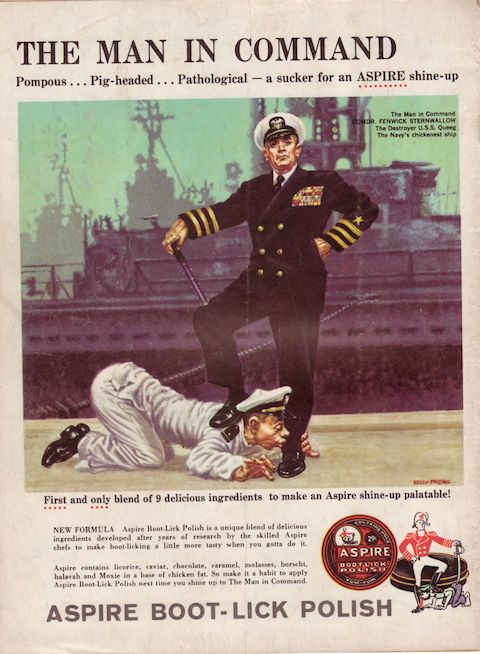
Mad-Bootlicking

In the 1960 spoof ad above, mil­i­tary cul­ture gets a send-up with “Aspire Boot-Lick Pol­ish,” made for “The Man in Com­mand: Pompous… Pig-head­ed… Patho­log­i­cal.” The fla­vored boot polish—“licorice, caviar, choco­late, caramel, molasses, borscht, halavah, and Mox­ie in a base of chick­en fat”—is said to make “boot-lick­ing a lit­tle more tasty when you got­ta do it.” A clever inset links the U.S. chain of com­mand with pre­vi­ous empires, show­ing a car­toon Euro­pean naval offi­cer of cen­turies past get­ting his boots licked by a sub­or­di­nate sailor.

Mad-Hitler Cigarettes

Just above, the dis­turb­ing 1969 fake ad for “Ceme­tery Filler Cig­a­rettes” pre­dates the tobac­co tri­als of the 1990s by decades. Long pro­mot­ed for their health ben­e­fits, calm­ing effects, sophis­ti­ca­tion, and taste—as in that mem­o­rable first episode of Mad Men—cig­a­rettes are exposed for the mass killers they are by none oth­er than “Adolph Hitler”. (Anoth­er 1970 fake ad for “Win­som Cig­a­rettes” uses an actu­al ceme­tery to sim­i­lar effect.)

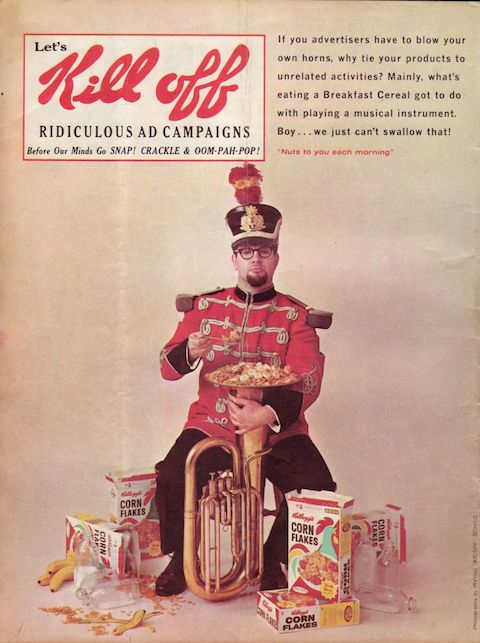
Mad-Kill Off

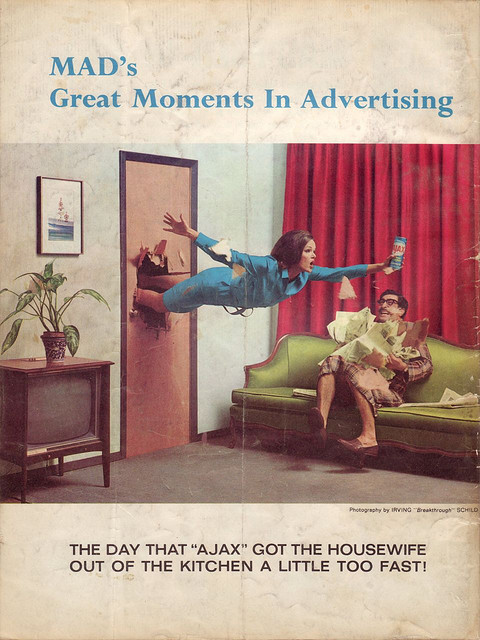
While cig­a­rette com­pa­nies were a fre­quent tar­get of Mad’s fake ads, just as often they took on the inani­ty of the entire ad indus­try itself, as in the above 1965 meta-ad for “Let’s Kill Off Ridicu­lous Ad Cam­paigns.” The text reads, “If you adver­tis­ers have to blow your own horns, why tie your prod­ucts to unre­lat­ed activ­i­ties? Main­ly, what’s eat­ing a Break­fast Cere­al got to do with play­ing a musi­cal instru­ment? Boy… we just can’t swal­low that!” Anoth­er reg­u­lar fea­ture was “Mad’s Great Moments in Adver­tis­ing,” a kind of high­light bloop­er reel of ads gone wrong. The exam­ple below, also from 1965, spoofs the promis­es of clean­ing prod­uct ads to make the lives of house­wives eas­i­er with a prod­uct that works just a lit­tle too well.

Mad-Great Moments

All of these fake Mad ads come from a Flickr account com­piled by user “Jas­par­do.” See many more of them there, and for even more of the magazine’s illus­tri­ous past, check out this Fla­vor­wire gallery of “The 10 Great­est Mad Mag­a­zine Cov­ers.”

via Metafil­ter

Relat­ed Con­tent:

Men In Com­mer­cials Being Jerks About Cof­fee: A Mashup of 1950s & 1960s TV Ads

Before Mad Men: Famil­iar and For­got­ten Ads from 1950s to 1980s Now Online

Eisen­how­er Answers Amer­i­ca: The First Polit­i­cal Adver­tise­ments on Amer­i­can TV (1952)

Josh Jones is a writer and musi­cian based in Durham, NC. Fol­low him at @jdmagness

Joni Mitchell’s Application for a Tenure Track Philosophy Position

joni philosophy

Image by Asy­lum Records (Bill­board page 2) [Pub­lic domain], via Wiki­me­dia Com­mons

Michael Stipe has a teach­ing gig at NYU. Lyn­da Bar­ry has one at UW-Madi­son. Sun Ra gave a clas­sic lec­ture at UC-Berke­ley. So why can’t we imag­ine Joni Mitchell land­ing a job at a uni­ver­si­ty too? That’s what Jedidi­ah Ander­son did, when he wrote a satir­i­cal piece over at McSweeney’s called “Joni Mitchell Applies for a Tenure Track Phi­los­o­phy Posi­tion.” It begins:

Dear Search Com­mit­tee:

I am apply­ing for the posi­tion of Assis­tant Pro­fes­sor in Phi­los­o­phy. I am an advanced doc­tor­al can­di­date in Phi­los­o­phy (with minors in Urban Stud­ies and Eng­lish), and expect to defend my dis­ser­ta­tion in May, 2015.

My dis­ser­ta­tion, Both Sides Now applies a bilat­er­al, hylo­mor­phic analy­sis to the phe­nom­e­non that is described by the sig­ni­fi­er “clouds.” Hav­ing been con­sti­tut­ed in West­ern dis­course both pos­i­tive­ly as “rows and flows of angel hair,” “ice cream cas­tles in the air,” “feath­er canyons every­where,” and neg­a­tive­ly as objects that exist sole­ly to obscure the sun, express rain and snow, and hin­der the achieve­ment of var­i­ous goals, we can con­clude that after the appli­ca­tion of this bilat­er­al, hylo­mor­phic analy­sis that due to these con­tra­dic­to­ry “up” and “down” epis­te­molo­gies of cloud tropes, the real­i­ty of clouds is some­how still under­stud­ied, hav­ing been ignored in favor of their Pla­ton­ic form/sign, and that we real­ly don’t “know” clouds at all.

You can read the rest of her “appli­ca­tion” here and then spend the evening dream­ing about tak­ing Joni’s class­es on Pla­to, Exis­ten­tial­ism, and Urban Devel­op­ment. I know I will.

You can find more great Joni Mitchell mate­r­i­al below.

Relat­ed Con­tent:

Vin­tage Video of Joni Mitchell Per­form­ing in 1965 — Before She Was Even Named Joni Mitchell

James Tay­lor and Joni Mitchell, Live and Togeth­er (1970)

The Music, Art, and Life of Joni Mitchell Pre­sent­ed in a Superb 2003 Doc­u­men­tary

Free Online Phi­los­o­phy Cours­es

Watch Between Time and Timbuktu, an Obscure TV Gem Based on the Work of Kurt Vonnegut

Just won­der­ing, who among us knows how to sing the zip code of Boston’s pub­lic tele­vi­sion sta­tion, WGBH-TV?

If you war­bled “02134” with­out hes­i­ta­tion, you prob­a­bly grew up watch­ing a beloved children’s tele­vi­sion show of the 70s.

It turns out Zoom wasn’t the only cool pro­gram WGBH hatched in 1972. On March 13, just a cou­ple of months after Zoom’s debut, the sta­tion aired Between Time and Tim­buk­tu, a 90-minute spe­cial inspired by the work of Kurt Von­negut.

The script was writ­ten by David Odell, who lat­er won an Emmy for The Mup­pet Show, but Von­negut advised, pinch­ing char­ac­ters and scenes from such favorites as Cat’s Cra­dle, Sirens of Titan, and “Har­ri­son Berg­eron.”

Von­negut also wrote the intro­duc­tion to the pub­lished script, a paper­back quick­ie enhanced by pro­duc­tion stills and pho­tos tak­en by Vonnegut’s wife, Jill Kre­mentz. It was as good a forum as any for him to announce his retire­ment from film, which he cit­ed as a medi­um “too clank­ing and real” for his com­fort.

The show itself is like­ly to cause nos­tal­gia for television’s free­wheel­ing, Mon­ty Python era.

Though 1972 wasn’t an entire­ly sil­ly peri­od, if you’ll recall. The Viet­nam War was rag­ing, with Wal­ter Cronkite hold­ing down the CBS Evening News desk.

Between Time and Tim­buk­tu cap­i­tal­izes on the vet­er­an broad­cast­er’s ubiq­ui­ty by cast­ing come­di­an Ray Gould­ing of Bob and Ray fame, as an appro­pri­ate­ly grave Wal­ter Gesund­heit. Bob joined him at the news desk as a fic­ti­tious for­mer astro­naut. Von­negut was appre­cia­tive of their efforts, stat­ing that Amer­i­can come­di­ans had prob­a­bly done more to shape his think­ing than any oth­er writer.

Also look for William Hick­ey, who played Prizzi’s Honor’s genial, aged mafia don, in the lead role of Stony Stevenson—now there’s a peri­od char­ac­ter name! If you’ll remem­ber, Stony is also the first civil­ian in space, at least accord­ing to the Sirens of Titan.

via The Air­ship

Relat­ed Con­tent:

Kurt Von­negut Urges Young Peo­ple to Make Art and “Make Your Soul Grow”

Kurt Von­negut: Where Do I Get My Ideas From? My Dis­gust with Civ­i­liza­tion

Kurt Von­negut Explains “How to Write With Style”

Ayun Hal­l­i­day is an author, home­school­er, and Chief Pri­ma­tol­o­gist of the East Vil­lage Inky zine. Fol­low her @AyunHalliday

Watch Artist Shepard Fairey Pretend to Work in an Art Supply Store

Atten­tion sulky art school stu­dents! Next time you’re stock­ing up on pre-smashed TVs, baby doll parts, riot cop sten­cils and man­nequins, be sure to say hel­lo to Shep­ard Fairey.

The artist is cur­rent­ly sport­ing a provoca­tive T‑shirt of his own design and pos­ing as an employ­ee of Shock­ing Art Sup­ply and Craft.

D’oh! We’ve been punked again!

Fairey’s real, but the store, a bright­ly lit empo­ri­um cater­ing to those seek­ing to make sub­ver­sive state­ments with their art, is the inven­tion of Fred Armisen and Car­rie Brownstein’s Port­landia. (The full episode aired last week on IFC.)

Armisen and Brown­stein ham things up in ill-fit­ting wigs as Gigi and Phil, char­ac­ters pre­vi­ous­ly known for run­ning a com­pa­ny that pro­vid­ed bad art for cof­fee shop walls.

Mean­while, Fairey wins laughs by leav­ing the com­e­dy to the come­di­ans. Though I wouldn’t be sur­prised to learn that Shock­ing Art Sup­ply employ­ee Shep­ard F is an admir­er of Hen­ry Rollins. You can read all sorts of things into a per­for­mance that dead­pan.

The seg­ment was filmed in a Port­land store where Fairey remem­bered pur­chas­ing art sup­plies a few years back. As he notes on his web­site:

I’m no actor, but this part, along with maybe “jad­ed art stu­dent” or “jad­ed skate shop employ­ee,” are the clos­est I’ll ever get to method act­ing.


- Ayun Hal­l­i­day is an author whose last sting in Port­land involved mak­ing final edits to the Zinester’s Guide to NYC in a bro­ken down vin­tage camper infest­ed with fly­ing ants. Fol­low her @AyunHalliday


Start Your Day with Werner Herzog Inspirational Posters

herzog inspiration 2

Wern­er Her­zog is the wild man of cin­e­ma. His movies are stark and ele­men­tal and ecsta­t­ic and are usu­al­ly about a crazed dream­er who strug­gles to achieve an impos­si­ble task in the face of a chaot­ic, indif­fer­ent uni­verse. Think Aguirre, Wrath of God, about a con­quis­ta­dor who goes crazy while adrift along an Ama­zon­ian riv­er. Think Stroszek, about a Ger­man grifter who goes men­tal in the for­bid­ding land­scape of Wis­con­sin while strug­gling to find the Amer­i­can dream. That film famous­ly, inex­plic­a­bly, ends with shots of a danc­ing chick­en.

herzog inspiration 1

The ecsta­t­ic truths seen in his movies are reflect­ed in the man him­self. At the age of 14, Her­zog struck out from his native Ger­many for Alba­nia and then Sudan. In 1972, he once walked from Munich to Paris to vis­it an ail­ing friend. In 1977, he shot footage at the lip of a vol­cano at the brink of erup­tion. He’s a film­mak­er who seems to go out of his way to choose loca­tions that are remote and dif­fi­cult — Antarc­ti­ca, the Sahara and the Ama­zon­ian rain for­est — and his shoots always seem to be bedev­iled by intrigue and cat­a­stro­phe. His first fea­ture was near­ly derailed because of a coup d’état. While shoot­ing Fata Mor­gana in Cameroon, he was mis­tak­en for a want­ed crim­i­nal and thrown in jail. Once dur­ing a TV inter­view in the hills of Los Ange­les, he was shot by a ran­dom crazy per­son. Watch it here.

“A BBC tele­vi­sion crew came to see me in Lau­rel Canyon,” as he recount­ed for The New York­er. “They want­ed to inter­view me for the British pre­mière of ‘Griz­zly Man.’ I didn’t want them to film right out­side my house, so we went up to Sky­line Dri­ve. In the mid­dle of the inter­view, I was shot with a rifle by some­one stand­ing on his bal­cony. I seem to attract the clin­i­cal­ly insane.”

herzog inspiration 3

Instead of stop­ping the inter­view, run­ning for pro­tec­tion and per­haps going to the hos­pi­tal, Her­zog just con­tin­ued with the inter­view say­ing sim­ply, “It was not a sig­nif­i­cant bul­let. I am not afraid.”

Herzog’s improb­a­ble pen­chant for dis­as­ter, his col­lab­o­ra­tion with the bril­liant, but bat­shit crazy, Klaus Kin­s­ki, and of course, his sin­gu­lar, uncom­pro­mis­ing work have turned him into almost a myth­ic fig­ure in some cir­cles. But it’s these mad, macho dec­la­ra­tions like those above that have real­ly fed the cult of Her­zog.

herzog inspiration 4

Recent­ly, some unknown genius turned some of Herzog’s more extreme quo­ta­tions into inspi­ra­tional posters. Lines like “Civ­i­liza­tion is like a thin lay­er of ice upon a deep ocean of chaos and dark­ness” are placed along side a shot of a glass of white wine and a sun­set.

So gaze upon them. Absorb the pearls of wis­dom. Find cold com­fort in their bleak, nihilist pro­nounce­ments. They make fine addi­tions to any cubi­cle.

See the full gallery here.

via Coudal

Relat­ed Con­tent:

Wern­er Her­zog Picks His 5 Top Films

Wern­er Her­zog Offers 24 Pieces of Film­mak­ing & Life Advice

Wern­er Her­zog Los­es a Bet to Errol Mor­ris, and Eats His Shoe (Lit­er­al­ly)

Jonathan Crow is a Los Ange­les-based writer and film­mak­er whose work has appeared in Yahoo!, The Hol­ly­wood Reporter, and oth­er pub­li­ca­tions. You can fol­low him at @jonccrow. And check out his blog Veep­to­pus, fea­tur­ing lots of pic­tures of bad­gers and even more pic­tures of vice pres­i­dents with octo­pus­es on their heads.  The Veep­to­pus store is here.

« Go BackMore in this category... »
Quantcast