More sad news. J.D. Salinger, who brought us The Catcher in the Rye, has died at 91. Here’s the initial news release.
Boy, when you’re dead, they really fix you up. I hope to hell when I do die somebody has sense enough to just dump me in the river or something. Anything except sticking me in a goddam cemetery. People coming and putting a bunch of flowers on your stomach on Sunday, and all that crap. Who wants flowers when you’re dead? Nobody. ~J.D. Salinger, The Catcher in the Rye, Chapter 20
Russ Roberts, the George Mason University economist and host of EconTalk (iTunes – RSS Feed – Web Site) recently teamed up with John Papola, a television exec, to produce “Fear the Boom and Bust.” It’s a rap song/video with intellectual substance that follows this premise:
John Maynard Keynes and F. A. Hayek, two of the great economists of the 20th century, come back to life to attend an economics conference on the economic crisis. Before the conference begins, and at the insistence of Lord Keynes, they go out for a night on the town and sing about why there’s a boom and bust cycle in modern economies and good reason to fear it.
This clip is now added to our YouTube favorites. You can get the full lyrics, story and free download of the song in high quality MP3 and AAC files at: http://www.econstories.tv
Sad news. Howard Zinn, the American historian best known for his book, A People’s History of the United States, died today of a heart attack at the age of 87. The Boston Herald has more on his life and passing here. If you’re familiar with Zinn’s biography, you’ll know that he served in World War II and later took a strong position against the Vietnam War. So, perhaps fittingly, we feature Zinn talking above about wars and the role governments play in manufacturing them…
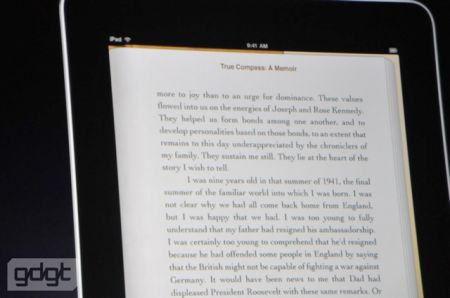
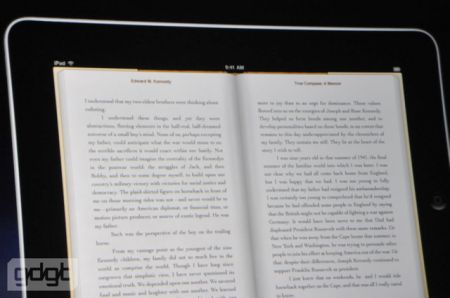
Welcome the new Kindle competitor. Above, you’ll find some of the first pictures showing the ebook capabilities of Apple’s new iPad. We should have more thoughts on the iPad coming later today. Pictures come via gdgt.com, which has been providing excellent live coverage of the Apple event.
Working with the BBC, Neil MacGregor, the Director of the British Museum, has launched a downright smart project. A History of the World in 100Objects uses important pieces from the museum’s collections to recount the long history of humanity. Throughout the year, the serialized radio program will air 100 episodes, each averaging 15 minutes, and they will cover two million years of human innovation and artistic creation. Below, I’ve included a recent episode that revisits the Olduvai hand axe, a tool invented some 1.2 million years ago that proved vital to human evolution and our migration out of Africa. You can access the full series in audio via iTunes, RSS Feed, as well as other formats found here. A big thanks to Stephen in the UK for flagging this production for us.
The Chinese language has tens of thousands of characters, and many have considered it nearly impossible to fit these characters onto a single workable typewriter. But that hasn’t stopped inventors from trying … and, to a certain degree, succeeding. Stanford historian Thomas Mullaney is now writing the first history of the Chinese typewriter, and he has found evidence for numerous patents and prototypes that incorporate the most commonly used characters. In addition to making a political impact in China, these machines have also potentially influenced innovations in modern computing. You can read more about Mullaney’s work on Stanford’s Human Experience website, and also watch him discuss his work in this YouTube clip.
Public confidence in the U.S. House and Senate is at an all-time low, and, after last week’s Supreme Court decision, it’s bound to sink even lower. On January 19th (the day before the decision), Harvard law professor Lawrence Lessig returned to Stanford and highlighted the degree to which “institutional corruption” — in the form of lobbyists and corporate influence — pervades Congress, dictates legislation, and brings large sums of money to campaigns and, yes, even representatives’ personal bank accounts. (Roughly 50% of U.S. Senators become lobbyists, working for industries they once assisted politically, and earn substantial incomes.) The talk, accompanied by a rapid fire PowerPoint presentation, runs a solid hour and details various instances in which lobbyists have shaped unfathomably bad legislation. Happily, the talk also ends with Lessig outlining possible solutions. Policy changes can offer some answers. But, a lot of it comes down to this: getting the passive privileged to rein in a corrupted elite.
Note: To see Lessig’s immediate response to the SCOTUS decision, look here.
We're hoping to rely on loyal readers, rather than erratic ads. Please click the Donate button and support Open Culture. You can use Paypal, Venmo, Patreon, even Crypto! We thank you!
Open Culture scours the web for the best educational media. We find the free courses and audio books you need, the language lessons & educational videos you want, and plenty of enlightenment in between.