Take the Coen Brothers’ 1998 cult film, The Big Lebowski, and put it in Shakespearean verse, and what do you get? Two Gentlemen of Lebowski as written by Adam Bertocci. It begins:
In wayfarer’s worlds out west was once a man,
A man I come not to bury, but to praise.
His name was Geoffrey Lebowski called, yet
Not called, excepting by his kin.
That which we call a knave by any other name
Might bowl just as sweet. Lebowski, then,
Did call himself ‘the Knave’, a name that I,
Your humble chorus, would not self-apply
In homelands mine; but, then, this Knave was one
From whom sense was a burden to extract,
And of the arid vale in which he dwelt,
Also dislike in sensibility;
Mayhap the very search for sense reveals
The reason that it striketh me as most
Int’resting, yea, inspiring me to odes.
TED recently took its show to India, and one of the more interesting presentations featured neuroscientist Vilayanur Ramachandran (UCSD) explaining how mirror neurons, a recently discovered system in the brain, “allow us to learn complex social behaviors, some of which formed the foundations of human civilization,” and also helped us evolve as a species. Good stuff. You can find more TED India Talks here.
Last year, Stanford University gave iPhone owners around the world a boost when it released a free iPhone App Development course (find it on iTunes). Millions have since downloaded the lectures, and many new iPhone apps have been created as a result. (Partly thanks to this course, we developed our own Free iPhone App that gives you mobile access to our educational media collections — free audio books, free university courses, free language lessons, etc. Get our app here.)
This week, Stanford has started rolling out a new App Development course (get it in video on iTunes), one adapted to the new iPhone operating system that Apple released last summer. Two lectures have been released so far. More will get rolled out on a weekly basis. Please note, these courses also appear in our collection of Computer Science Courses, a subset of our larger collection of Free Courses from leading universities.
In this clip from Richard Dawkins’ YouTube Channel, philosopher A.C. Grayling offers an argument for why intelligent design should’t be taught alongside evolution in the classroom. Some will agree with his position, and some won’t. And probably few will have no opinion. If you have reactions to Grayling’s argument, please state them civilly and intelligently in the comments below.
Every year, The Edge.org poses a thought-provoking question to 150+ engaging thinkers, and the answers never disappoint. This year, they throw out the question: How is the Internet Changing the Way You Think? In this collection, you will find answers by George Dyson, Clay Shirky, Tim O’Reilly, Marissa Mayer, Richard Dawkins and many more. Below, I’ve included an excerpt from Nassim Taleb (author of The Black Swan), who has a less sanguine outlook on how the internet is changing our world. He writes:
I used to think that the problem of information is that it turns homo sapiensinto fools — we gain disproportionately in confidence, particularly in domains where information is wrapped in a high degree of noise (say, epidemiology, genetics, economics, etc.). So we end up thinking that we know more than we do, which, in economic life, causes foolish risk taking. When I started trading, I went on a news diet and I saw things with more clarity. I also saw how people built too many theories based on sterile news, the fooled by randomness effect. But things are a lot worse. Now I think that, in addition, the supply and spread of information turns the world into Extremistan (a world I describe as one in which random variables are dominated by extremes, with Black Swans playing a large role in them). The Internet, by spreading information, causes an increase in interdependence, the exacerbation of fads (bestsellers like Harry Potter and runs on the banks become planetary). Such world is more “complex”, more moody, much less predictable.
So consider the explosive situation: more information (particularly thanks to the Internet) causes more confidence and illusions of knowledge while degrading predictability.
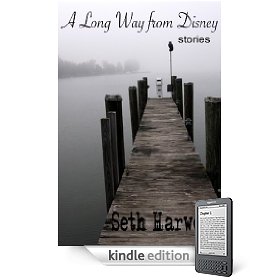
As some of you already know, back on December 27th, I released a sample of my first short story collection A Long Way from Disney on Amazon’s Kindle store and used social media strategies to market it. I did this for various reasons, but mainly because, as I’ve said here on OC before, I believe authors need to take on the role of scientists and experiment with what’s possible in today’s publishing world. (If you’re interested in how I publicized this, see my recent posts at AuthorBootCamp.com.)
From a scientific point of view, the experiment was a great success. I learned a great deal, which I’ll discuss below. I sold a lot of books (at $.99 each)–around 350 in the first week–and I got my name and stories in front of a lot of new people. I also heard from a number of them who read the book right away and really loved it! For you authors out there, I hope you can relate: Getting positive feedback on your work from total strangers is about the best feedback there is.
[For those of you keeping score at home, those sales put $260 into Amazon’s pocket and $140 into mine. Not too shabby, I think, but also not the split an author might hope for.]
Okay, without any further delay: Here are the Results (what I’ve learned) from Experiment 1:
1) Timing can be essential. I positioned myself to hit the Kindle store just after Xmas, thinking that with many newly gifted Kindles out there, a lot more Kindle ebooks would be selling and that I could cash in on this rush. I was correct in this prediction (Amazon sold more ebooks than paper copies over Christmas), but what I didn’t predict was how much harder this made it to reach the Top 100 Kindle bestseller list, a goal I had set for myself. I wanted to hit the Top 100 because it would give the book additional exposure and stimulate more buying from newbie Kindle owners looking for quick, cheap content. (more…)
For the past two years, Stanford has been rolling out a series of courses (collectively called Modern Physics: The Theoretical Minimum) that gives you a baseline knowledge for thinking intelligently about modern physics. The sequence, which moves from Isaac Newton, to Albert Einstein’s work on the general and special theories of relativity, to black holes and string theory, comes out of Stanford’s Continuing Studies program. And the courses are all taught by Leonard Susskind, an important physicist who has engaged in a long running “Black Hole War” with Stephen Hawking. The final course, Statistical Mechanics, has now been posted on YouTube. The rest of the courses can be accessed immediately below. (The courses also appear in our list of Free Online Physics Courses, a subset of our collection, 1,700 Free Online Courses from Top Universities.) Six courses. Roughly 120 hours of content. A comprehensive tour of modern physics. All in video. All free. Beat that.
We're hoping to rely on loyal readers, rather than erratic ads. Please click the Donate button and support Open Culture. You can use Paypal, Venmo, Patreon, even Crypto! We thank you!
Open Culture scours the web for the best educational media. We find the free courses and audio books you need, the language lessons & educational videos you want, and plenty of enlightenment in between.