And now for something completely delicious: a rare gem from the Monty Python vault called Away From it All, featuring John Cleese as Nigel Farquhar-Bennett, a voice-over artist badly in need of a holiday.
The 13-minute film is a parody of the mind-numbing travelogues they used to show in movie theaters. It was produced in 1979 and screened in British and Australian theaters as a warm-up for Monty Python’s Life of Brian.
The narration was written by Cleese, who Michael Palin once said was born with a silver tongue in his mouth. “John loves words,” writes Palin in The Very Best of Monty Python, “especially ‘nebulous’, ‘trenchant’ and ‘orthodontic’. Though most children’s first word is ‘mama’, John’s was ‘elision’. ‘Mama’ was third, after ‘hydraulics’.” Enjoy.
This doesn’t need much in the way of an introduction, except to say that two photographers, Simon Iannelli & Johannes Berger, caught Marina Kanno and Giacomo Bevilaqua, both from the Staatsballett Berlin, performing several jumps, each captured in slow motion at 1000 frames per second. And it’s all set to Radiohead’s “Everything In Its Right Place.” Enjoy that (h/t Kottke) and also …
In our enlightened times, film directing has become a reasonably open profession, admitting men, women, and — given the plummeting cost of production equipment — children alike. But imagine how it would’ve been in 1949, when the English-born actress Ida Lupino took the reins of Not Wanted from the project’s ailing director Elmer Clifton. This wouldn’t have seemed normal at the time, and it would’ve seemed even less normal that she went on to direct six more pictures. Her fifth, 1953’s The Hitch-hiker, even entered the tradition of noir, one rarely associated with female writers or directors. Femmes fatales, sure — these stories could scarcely exist without them — but women behind the camera?
To add a layer of irony on top of the unlikeliness, The Hitch-hiker does away with any trace of overt womanly presence. By the time we get to know the film’s hapless protagonists, a couple of buddies who look and act like fresh-cut slabs of all-American blandness, they’ve already told their wives they’re off to a fishing trip, and they’ll get back when they get back.
Bearing straight south down the open road, no sooner do they reach Mexico than they pick up a hitchhiker. By the time they come to understand that this black-clad, lumpy-featured fellow has killed before, may well kill again, and intends to mount a ceaseless campaign of psychological manipulation in order to get a ride to his freedom, we understand why hitchhiking has gone out of style. You can find out how things turn out for them by watching the whole thing, free on YouTube.
Lupino’s film doesn’t just remove the women from the noir formula; it leaves aside most of the darkness implicit in the genre’s very name. Apart from a few tense nighttime scenes and a climactic chase through an after-hours shipyard, the bulk of The Hitch-hiker’s action takes place under a harsh Mexican sun that bleaches out nearly everything but the jagged shadows cast by unearthly rock formations along the empty road. Though actually shot on the eastern slopes of the Sierra Nevada mountains, the movie takes its foreign setting seriously, offering several relatively extended sequences and exchanges conducted entirely in untranslated Spanish. By the standards of midcentury American genre film, this nearly counts as an act of radical artistic experimentation. Yes, The Hitch-hiker plays a bit broadly today and leans on a few tropes that must have seemed creaky even in 1953, but it remains an unusual enough entry in noir history to merit attention — and not just because of the sex of the director.
This weekend, an estimated 20,000 agnostics, atheists and ardent secularists gathered on the National Mall in rainy Washington DC. They were attending the first Reason Rally, an event intended to “unify, energize, and embolden secular people nationwide, while dispelling the negative opinions held by so much of American society… and having a damn good time doing it!” Lawrence Krauss, Michael Shermer, Eddie Izzard — they all spoke to the crowd. And then came Richard Dawkins, the high priest of reason, the author of The Selfish Gene, who spent decades teaching evolutionary biology at Oxford. In the middle of his 16 minute talk, he tells the audience, “We’re here to stand up for reason, to stand up for science, to stand up for logic, to stand up for the beauty of reality, and the beauty of the fact that we can understand reality.” I’m with you Richard on that. But then comes the scorn we’re now so accustomed to (“I don’t despise religious people; I despise what they stand for.”), and my guess is that changing perceptions of agnostics, atheists and secularists will need to wait for another day.
A music scholar made an astounding discovery recently while going through the personal belongings from the attic of a recently deceased church musician and band leader in the Lech Valley of the Austrian Tyrol.
Combing through the dead man’s collection of old music manuscripts, Hildegard Herrmann-Schneider of the Institute for Tyrolean Music Research noticed a hand-written book with the date “1780” on the cover. On pages 12 to 14 she found an unidentified sonata movement with the tempo mark “allegro molto,” Italian for “very quickly.” On the upper right-hand side of page 12 was written “Del Signore Giovane Wolfgango Mozart,” or “The young Wolfgango Mozart.”
“Wolfgango” was a name Mozart’s father, Leopold, called him when he was a boy. Looking further into the manuscript, Herrmann-Schneider found several pieces that were already known to have been written by Leopold Mozart. Those compositions were respectfully marked “Signore Mozart,” or “Lord Mozart.”
Although the writing was clearly not in the hand of either the elder or the younger Mozart, the meticulousness of the transcriptions, along with the accuracy of every verifiable detail throughout the 160-page book, led Herrmann-Schneider to suspect that the composition by “The Young Wolfgango Mozart” was an authentic, previously unknown piece.
On the back of the manuscript was the copyist’s name: Johannes Reiserer. After an extensive investigation, Herrmann-Schneider was able to learn that Reiserer was born in 1765 and had gone to gymnasium, or high school, in Salzburg, where he was a member of the cathedral choir from 1778 to 1780. That would have placed him in close proximity to Leopold Mozart. “Researchers have thus concluded,” writes The History Blog, “that Johannes Reiserer used the notebook to copy compositions as part of a rigorous program of music instruction by Kapellhaus music masters, perhaps Leopold himself.”
Based on the style and the level of accomplishment in the piece, now known as the “Allegro Molto in C Major,” researchers place the date of composition at around 1767, when Mozart was 11 years old. A press release from the Institute for Tyrolean Music Research describes the piece:
Mozart frequently selected a C‑major key, and the Allegro molto has a sonata form with a length of 84 measures. Its ambitus is tailored to the clavichord. The Allegro molto could be a first major attempt by Wolfgang Amadé to assert himself in the area of the sonata form. This is suggested by the relatively high level of compositional technique.…Throughout the Allegro molto, thematic formation, compositional setting and harmony have a number of components that are found repeated in other Mozart piano works. Hardly a compositional detail points to a contradiction with the general characteristics of Mozart’s comsummate musical composition. According to current scholarly knowledge, it must therefore be regarded as an authentic sonata movement by Wolfgang Amadeus Mozart.
Austrian musician Florian Birsak, who specializes in playing early keyboard instruments, gave the premier performance of the piece on Mozart’s own fortepiano last Friday at the Mozart family home in Salzburg, which is now a museum of the Salzburg Mozarteum Foundation. You can watch a video, above, which was recorded sometime earlier in the same place and on the same instrument. You can also read a PDF of the score, and download Birsak’s recording at iTunes.
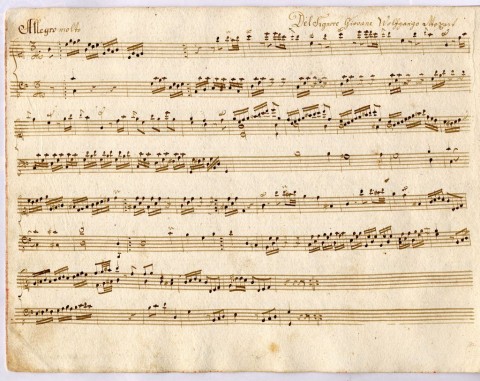
The first page of Mozart’s Allegro Molto in C Major (above) from the 1780 notebook. Credit: Salzburg Mozarteum Foundation.
Looking to dig a little deeper into what’s happening out there in the cosmos? Then you might want to spend some time with the courses listed in the Astronomy section of our Free Courses collection.
Astrobiology and Space Exploration – iTunes – YouTube – Lynn Rotschild, Stanford
Astronomy 101 – iTunes – Web Site – Scott Miller, Mercedes Richards & Stephen Redman, Penn State
Exploring Black Holes: General Relativity & Astrophysics –YouTube – iTunes Video — Web Site – Edmund Bertschinger, MIT
Today is the birthday of Robert Frost, who once said that a poem cannot be worried into being, but rather, “Like a piece of ice on a hot stove the poem must ride on its own melting.” Those words are from Frost’s 1939 essay, “The Figure a Poem Makes,” which includes the famous passage:
The figure a poem makes. It begins in delight and ends in wisdom. The figure is the same as for love. No one can really hold that the ecstasy should be static and stand still in one place. It begins in delight, it inclines to the impulse, it assumes direction with the first line laid down, it runs a course of lucky events, and ends in a clarification of life–not necessarily a great clarification, such as sects and cults are founded on, but in a momentary stay against confusion.
To celebrate the 138th anniversary of the poet’s birth, we bring you rare footage of Frost reciting his classic poem, “Stopping by Woods on a Snowy Evening.” You can also listen to a four-part recording (below) of Frost reading a selection of his poems in 1956, courtesy of Harper Audio.
Robert Frost Reading, Part One: “The Road Not Taken,” “The Pasture,” “Mowing,” “Birches,” “After Apple-Picking,” and “The Tuft of Flowers.”
Robert Frost Reading, Part Three: “Mending Wall,” “One More Brevity,” “Departmental,” “A Considerable Speck,” and “Why Wait for Science.”
Robert Frost Reading, Part Four: “Etherealizing,” “Provide, Provide,” “One Step Backward Taken,” “Choose Something Like a Star,” “Happiness Makes Up in Height,” and “Reluctance.”
The first time I saw Billy Collins speak, he appeared at my college convocation, toward the end of his years as United States Poet Laureate. Now, the second time I’ve seen Billy Collins speak, he appears giving this TEDTalk, “Everyday Moments, Caught in Time,” in which he makes fun of his own tendency to mention his years as United States Poet Laureate. But he mostly uses his fifteen minutes onstage in Long Beach in front of TED’s swooping cameras to talk about how the Sundance Channel animated five of his poems. A booster of poetry “off the shelf” and into public places — subways, billboards, cereal boxes — he figured that even such an “unnatural and unnecessary” merger could further the cause of eluding humanity’s “anti-poetry deflector shields that were installed in high school.”
Collins also notes that the idea for the project stirred the embers of his “cartoon junkie” childhood, when Bugs Bunny was his muse. Stylistically, however, the producers at the Sundance Channel kept quite far indeed from the Merrie Melodies. These animated poems opt instead for an aesthetic that takes pieces of visual reality and repurposes them in ways we don’t expect: look at the real arm slithering across the pages in the first poem, the tangible-looking dolls and doll environments of the second poem, or the drifting photographic cutouts of the third. Not to get too grand about it, but isn’t this what poetry itself is supposed to do? Don’t the words themselves also cut out fragments of actual existence and position them, recontextualize them, and move them around in ways that surprise us? The substance of these shorts — fountain pens, figurines, car keys, paper boats, matchsticks, mice — may seem like the last word in mundanity, but perceived through the differently “real” lenses of Collins’ poetry and this unusual animation, they inspire curiosity again.
We're hoping to rely on loyal readers, rather than erratic ads. Please click the Donate button and support Open Culture. You can use Paypal, Venmo, Patreon, even Crypto! We thank you!
Open Culture scours the web for the best educational media. We find the free courses and audio books you need, the language lessons & educational videos you want, and plenty of enlightenment in between.