Remember Jeff Harris? He’s the photographer who has documented every day of his life with a self-portrait since 1999. Now meet Madeline Schichtel, a young production assistant living in LA. She recorded her daily life in 2011 with a Canon Powershot, then edited each day down to a meaningful one-second shot, creating the video montage “This is What Madeline Did.” Wired writer Steve Silberman (aka @SteveSilberman) found the video unexpectedly charming, and we have to agree. “All My Friends,” by LCD Soundsystem, serves as the soundtrack for this endearing little film.
190 Thinkers Answer the Question: “What is Your Favorite Deep, Elegant, or Beautiful Explanation?”

It’s a new year, which means it’s time for the Edge.org to pose its annual question to some of the world’s finest minds. The 2012 edition asks the question, “What is Your Favorite Deep, Elegant, or Beautiful Explanation?” And the replies — 190 in total — feature thoughts by Sherry Turkle, Robert Sapolsky, Steven Pinker, and Daniel Dennett, plus the ones excerpted below. If you’re willing to venture down the rabbit hole, you can access the complete collection of responses here.
Where did we come from? I find the explanation that we were made in stars [that we are all stardust] to be deep, elegant, and beautiful. This explanation says that every atom in each of our bodies was built up out of smaller particles produced in the furnaces of long-gone stars. We are the byproducts of nuclear fusion. The intense pressures and temperatures of these giant stoves thickened collapsing clouds of tiny elemental bits into heavier bits, which once fused, were blown out into space as the furnace died. The heaviest atoms in our bones may have required more than one cycle in the star furnaces to fatten up. Uncountable numbers of built-up atoms congealed into a planet, and a strange disequilibrium called life swept up a subset of those atoms into our mortal shells. We are all collected stardust. And by a most elegant and remarkable transformation, our starstuff is capable of looking into the night sky to perceive other stars shining. They seem remote and distant, but we are really very close to them no matter how many lightyears away. All that we see of each other was born in a star. How beautiful is that?
Kevin Kelly, Wired co-founderhere and don’t miss Susskind’s complete physics lectures here].
Leonard Susskind, Physics Professor, Stanford.
[T]here is one elegant and deep statement (which, alas, is not quite an “explanation”) … that I find very useful as well as beautifully simple.
I refer to the well-known lines Lord Acton wrote in a letter from Naples in 1887 to the effect that: “Power tends to corrupt, and absolute power corrupts absolutely.” At least one philosopher of science has written that on this sentence an entire science of human beings could be built.
I find that the sentence offers the basis for explaining how a failed painter like Adolph Hitler and a failed seminarian like Joseph Stalin could end up with the blood of millions on their hands; or how the Chinese emperors, the Roman popes, or the French aristocracy failed to resist the allure of power. When a religion or ideology becomes dominant, the lack of controls will result in widening spirals of license leading to degradation and corruption. [More here].
Mihaly Csikszentmihalyi; Psychologist
You can dive into the full collection at Edge.org. The photo above was taken by Marco Bellucci.
200,000 Martin Luther King Papers Go Online
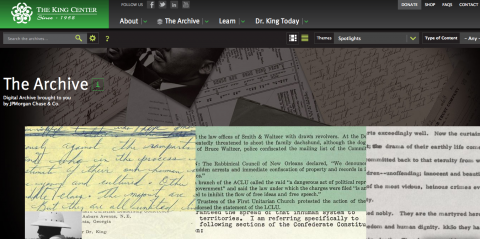
What better way to celebrate the birthday of Martin Luther King, Jr.? Today, the King Center has made available online 200,000 papers belonging to the civil rights leader — the first step to bringing more than one million documents to the web. The documents give you a good glimpse of Dr. King’s role as a scholar, father, pastor and catalyst for change. And, among the papers, you will find “speeches, telegrams, scribbled notes, patient admonitions and urgent pleas.” Notable documents worth visiting include King’s 1964 Nobel Prize Acceptance Lecture, his Eulogy for the Four Girls Murdered in Birmingham (1963), a draft of his world-changing “I Have a Dream” speech, and much more.
Underwritten by JPMorgan Chase, the archive lets you navigate through documents by theme and by type of document. Or you can simply use a dedicated search engine. Once you find a document of interest, you can zoom into the content. But, I am not seeing a way to scroll up and down the enlarged pages — something that seriously limits your ability to read any given text. If I’m missing something please let me know in the comments below …
Related Content:
MLK’s Soaring “I Have a Dream” Speech, 1963
MLK’s Haunting “I’ve Been to the Mountaintop” Speech, 1968
100 Years in 10 Minutes: A Quick Video History of the Past Century
When you write history, you’re always confronted with the question: what facts and events will make it into your historical account, and which ones will be left out? When it comes to this viral video produced by Donolinio Studio, what makes the cut? Europe. America. Men. And a long list of downers: war, depravation, natural disaster, a‑bombs, social crisis, financial crisis, genocide and assassination, all set to a dramatic soundtrack by Hans Zimmer. What gets left out? Anything that seemingly makes life worth living and, with some minor exceptions, human achievement. And, yes, Africa and Latin America too — except for the first World Cup tournament played in Uruguay. (Note: we’re pretty sure that English isn’t the first language of the filmmakers. Hence the spelling errors in the captions.)
Speaking of human achievement and historical omissions, we’d like to pay tribute to Martin Luther King Jr. on his birthday by highlighting two of MLK’s memorable speeches — his soaring “I Have a Dream” speech presented in August 1963, and then fast forward to his prescient “I’ve Been to the Mountaintop” speech, delivered just the day before he was assassinated in April 1968.
To dig deeper into the past, don’t miss the history courses (42 in total) in our collection of 400 Free Courses Online.
Johnny Depp Reads Letters from Hunter S. Thompson (NSFW)
Back in 1998, Hunter S. Thompson’s most famous piece of Gonzo journalism, Fear and Loathing in Las Vegas, was brought to the silver screen, with Johnny Depp playing a lead role. From this point forward, Depp and Thompson became fast friends. Indeed, Depp would end up paying for Thompson’s elaborate funeral, which involved shooting the writer’s ashes out of a cannon to the tune of Norman Greenbaum’s Spirit in the Sky and Bob Dylan’s Mr. Tambourine Man.
Above we feature Johnny reading aloud some letters he received from Hunter. The letters are very Thompson-esque, which means, among things, they’re NOT SAFE for work! Part 2 can be found here, and Part 3 here.
Related Content:
Hunter S. Thompson Interviews Keith Richards
Hunter S. Thompson Gets Confronted by the Hell’s Angels
Johnny Depp Narrates New Keith Richards Autobiography (and How to Snag a Free Copy)
Hunter S. Thompson’s The Rum Diary: a ‘Warped Casablanca’
The Page Turner: A Fabulous Rube Goldberg Machine for Readers
Last week, The New York Times profiled Joseph Herscher, a 26-year-old kinetic artist who hails from New Zealand and now develops intentionally “absurd” and “useless” Rube Goldberg machines in his Brooklyn apartment. His latest contraption, called “The Page Turner,” just gets better as it rolls along. Perhaps the best part comes towards the end when Herscher’s pet hamster, Chester, makes a cameo appearance. Enjoy…
Follow us on Facebook, Twitter, Google Plus and LinkedIn and share intelligent media with your friends. Or better yet, sign up for our daily email and get a daily dose of Open Culture in your inbox.
Robert DeNiro, Woody Allen and Others in the Post 9/11 “New York Miracle” TV Commercials
In the immediate aftermath of the September 11, 2001 terrorist attacks, when New York and much of the world were still in a state of shock, a group of top-flight actors, directors and other creative workers donated their time and talents for a special project to lure tourists back to the Big Apple. The “New York Miracle” ads were unveiled only two months after the tragedy, and featured stars like Robert DeNiro, Woody Allen, Ben Stiller and Billy Crystal. The commercials were as much a boost to the city’s morale as they were an invitation to tourists. At the end of each segment, Mayor Rudy Giuliani intones: “The New York Miracle. Be a part of it.”
The video above offers a look back at all nine ads. They appear in the following order:
- “Deli,” starring Ben Stiller and Kevin Bacon.
- “Turkey,” starring Robert DeNiro and Billy Crystal; directed by Barry Levinson.
- “Theatre,” starring Barbara Walters; directed by Bryan Buckley.
- “Skating,” starring Woody Allen; directed by Joe Pytka.
- “Yankee Stadium,” starring Henry Kissinger; directed by Joe Pytka.
- “Philharmonic,” starring Yogi Berra; directed by Joe Pytka.
- “New York Giants Kicker,” starring Vanessa Williams.
- “Marathon,” starring Al Roker.
- “Santa,” starring Christopher Walken.
via @webacion
Countries and Coastlines: A Dramatic View of Earth from Outer Space
We’ve shown you What a Hurricane Looks Like From Outer Space and NASA’s 7 Minute Tour of the Earth from Space (in HD). Now comes new high resolution footage from the International Space Station that gives you a dramatic view of coastlines and countries around the world. Produced by Space Rip, this clip will give you an extraordinary view of England, France, Italy, Egypt, Algeria, Tunisia, Greece, the island of Crete, Taiwan, South Korea, Japan, the United States, Mexico, Ecuador, Peru, Chile, Argentina, and Cuba. Find this video housed in our collection of 125 Great Science Videos. If you love space travel, astronomy, physics, neuroscience or technology, then you will definitely want to spend time rummaging through the collection.
Follow us on Facebook, Twitter and now Google Plus and we’ll deliver intelligent media right to your virtual doorstep.
Support Us
We're hoping to rely on loyal readers, rather than erratic ads. Please click the Donate button and support Open Culture. You can use Paypal, Venmo, Patreon, even Crypto! We thank you!

About Us

Open Culture scours the web for the best educational media. We find the free courses and audio books you need, the language lessons & educational videos you want, and plenty of enlightenment in between.
Advertise With Us

