Creative Uses of the Fax Machine: From Iggy Pop’s Bile to Stephen Hawking’s Snark

Iggy fax

Unlike the type­writer, the low­ly fax machine nev­er pulled itself out of the hive-like exis­tence of util­i­tar­i­an office machines and into lit­er­ary celebri­ty. With their bland, func­tion­al styling, fax machines will not have their impend­ing obso­les­cence capped with muse­um exhi­bi­tions. And as lit­tle more than con­duits for wonky, unglam­orous com­mu­niqués, fax machines rarely con­duct a piece of text that inspires peo­ple to savor, and want to save, the words, as with per­son­al let­ters. While we often fea­ture his­toric cor­re­spon­dence of a time before email from one of our favorite sites, Let­ters of Note, the ris­i­ble, pro­found, and shock­ing sen­ti­ments expressed by famous fig­ures when they think that no one’s look­ing rarely make it into office mem­o­ran­da.

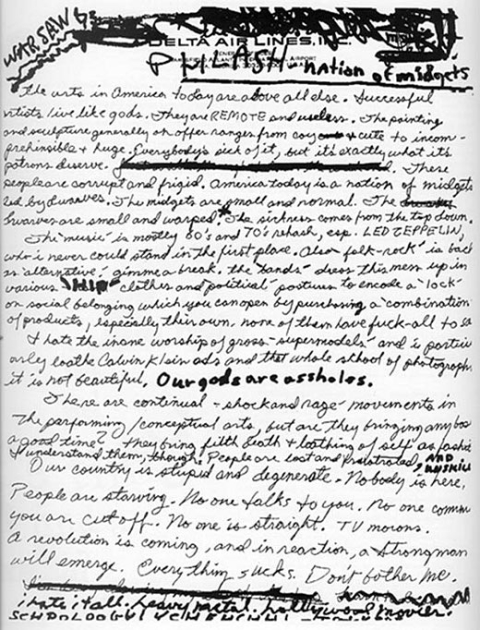
How­ev­er, inspired by our recent post on Mark Twain’s type­writer, a read­er alert­ed us to a Let­ters of Note sub­genre of sorts, “fax­es of note.” These odd­ball mes­sages defy the worka­day con­ven­tions of the fax. Take, for exam­ple, the fax above sent by Iggy Pop to Plazm mag­a­zine writer Joshua Berg­er as an adden­dum to a 1995 inter­view. Scrawled with his fevered thoughts, on Delta Air­lines sta­tion­ary, Pop’s fax amounts to what Let­ters of Note calls “a rant so rich with quotable lines, it’s amaz­ing he was able to con­tain it all on a sin­gle sheet.”

You can click here for a full tran­script of Iggy’s take on Amer­i­can cul­tur­al deca­dence, but here are just a few high­lights from his faxed get-off-my-lawn moment: Pop—on tour in Europe at the time—calls his home coun­try “a nation of midgets,” and decries the ‘90s rehash of ‘60s and ’70s music (“none of them have fuck-all to say”); he rails against the Calvin Klein aes­thet­ic, adding “our gods are ass­holes” (maybe some pro­fes­sion­al jeal­ousy here—Pop more or less invent­ed hero­in chic). Final­ly, he signs off with some cranky ono­matopoeia: “i hate it all. heavy met­al. hol­ly­wood movies. SCHPOLOOGY! YeHE­HCHH!” This is archival-wor­thy vit­ri­ol, for sure.

Hawking fax

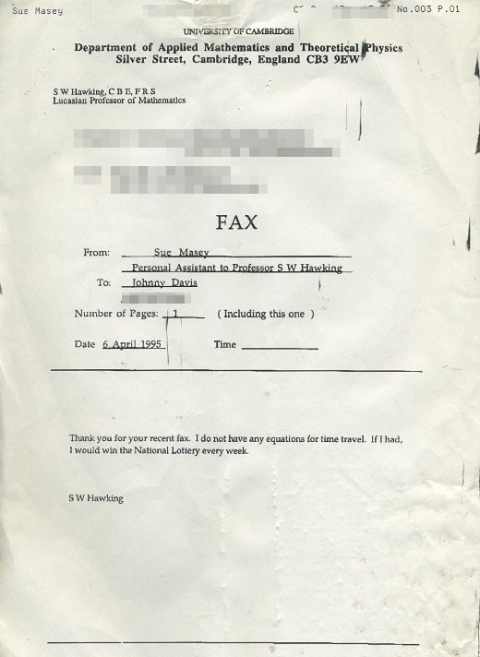
Anoth­er fax of note uses the medi­um to oppo­site effect; Stephen Hawking’s fax (above), also from 1995, responds to a request from erst­while British music and fash­ion mag­a­zine The Face for the for­mu­la for time trav­el. Hawk­ing replies, via his per­son­al assis­tant, “Thank you for your recent fax. I do not have any equa­tions for time trav­el. If I had, I would win the Nation­al Lot­tery every week.”  Unlike Iggy’s explo­sion of hand­writ­ten bile, Hawking’s mis­sive retains all the for­mal prop­er­ties of the fax—appropriate insti­tu­tion­al let­ter­head, “from” and “to” lines, etc—which makes his pithy retort all the more incon­gru­ous.

While the 1980s and ’90s were boom times for fax trans­mis­sions, the machine actu­al­ly dates back to 1843, when it was patent­ed by Scot­tish inven­tor Alexan­der Bain. As ear­ly as 1902, fax tech­nol­o­gy allowed pho­tographs to be sent over tele­phone lines. And yes, as every frus­trat­ed admin­is­tra­tive assis­tant knows too well, the hum­ble fax machine is still in use in offices around the world, trans­mit­ting blear­ing­ly bor­ing mes­sages, as well as the occa­sion­al flash of indi­vid­u­al­i­ty. For more on famous fax­es, see this help­ful info­graph­ic from our read­er.

H/T @jaclynlambert

Relat­ed Con­tent:

From The Stooges to Iggy Pop: 1986 Doc­u­men­tary Charts the Rise of Punk’s God­fa­ther

Sev­en Ques­tions for Stephen Hawk­ing: What Would He Ask Albert Ein­stein & More

David Bowie’s First Amer­i­can Fan Let­ter And His Evolv­ing Views of the U.S. (1967–1997)

Josh Jones is a writer, edi­tor, and musi­cian based in Wash­ing­ton, DC. Fol­low him @jdmagness

The Art and Science of Beer

Charles Bam­forth is the Anheuser-Busch Endowed Pro­fes­sor of Malt­ing and Brew­ing Sci­ences at UC Davis, which means he knows a few things about mak­ing beer. He can get into some nit­ty-grit­ty top­ics, like the enzy­mol­o­gy of the brew­ing process, foam sta­bil­i­ty, and the psy­chophysics of beer per­cep­tion. But that’s not what he’s doing here. In the clip above, the “Pope of Foam,” as Bam­forth is oth­er­wise known, gives you a quick overview of the beer-mak­ing process, describ­ing every­thing from grind­ing the malt, to boil­ing the wort, to bot­tling with glass ver­sus cans. Final­ly, the Pope gives you a hot tip: how to pick the fresh­est pint when you’re at a pub.

If you want to go deep­er into Bam­forth’s world, you can read his 2009 book: Beer: Tap into the Art and Sci­ence of Brew­ing. Or don’t miss this pre­vi­ous post where a Uni­ver­si­ty of Not­ting­ham sci­en­tist explains The Physics of Guin­ness Beer.

via Devour

Relat­ed Con­tent:

Wim Wen­ders Cre­ates Ads to Sell Beer (Stel­la Artois), Pas­ta (Bar­il­la), and More Beer (Car­ling)

How to Open a Wine Bot­tle with Your Shoe for the DIY Con­nois­seur

The Physics of Cof­fee Rings Final­ly Explained

Tom Waits, Playing the Down-and-Out Barfly, Appears in Classic 1978 TV Performance

Musi­cal­ly, Tom Waits has come a long way since the 1970s. Absorb­ing a range of influ­ences, Waits has rein­vent­ed him­self sev­er­al times over to become one of the most influ­en­tial writ­ers and per­form­ers of our time.

Along the way he has also made his mark as a char­ac­ter actor. But “par­al­lel career” would be the wrong phrase to describe Wait­s’s film and tele­vi­sion work, for his music and act­ing have always inter­sect­ed. Nev­er was this more appar­ent than in the 1970s, when Waits cul­ti­vat­ed the per­sona of a down-and-out barfly with the soul of a Beat poet.

That ear­ly phase of Wait­s’s career is pre­served in this high­ly the­atri­cal 54-minute tele­vi­sion per­for­mance. It was record­ed on Decem­ber 5, 1978 at the Uni­ver­si­ty of Texas for a March 24, 1979 broad­cast of Austin City Lim­its. The pro­gram was lat­er released on DVD as Bur­ma Shave. Waits is joined by Her­bert Hard­esty on trum­pet and tenor sax­o­phone, Arthur Richards on gui­tar, Greg Cohen on bass, and Big John Thomassie on drums. Here’s the set list:

  1. Sum­mer­time Blues
  2. Bur­ma Shave
  3. Annie’s Back in Town
  4. I Wish I Was in New Orleans
  5. Ain’t Gonna Rain
  6. Bul­lets
  7. On the Nick­el
  8. Romeo is Bleed­ing
  9. Silent Night
  10. Christ­mas Card from a Hook­er in Min­neapo­lis
  11. Small Change
  12. Hey Big Spender
  13. Small Change

Relat­ed con­tent:

Tom Waits Makes Com­ic Appear­ance on Fer­n­wood Tonight (1977)

Tom Wait­s’s Clas­sic Appear­ance on Aus­tralian TV, 1979

Tom Waits and Kei­th Richard Sing Sea Song ‘Shenan­doah’ for New Pirate-Themed CD

Font Based on Sigmund Freud’s Handwriting Coming Courtesy of Successful Kickstarter Campaign

Doc­tor, what does it mean if you dream of cre­at­ing a font of Freud’s hand­writ­ing?

This is exact­ly what Ger­man typog­ra­ph­er Har­ald Geisler has in mind, and, in the spir­it of self-actu­al­iza­tion, he’s fund­ing the project on Kick­starter. His charis­ma is such that he’s already raised over eight times the orig­i­nal $1500 goal that will allow him to trav­el to Vien­na, where he will cre­ate the type­face in a bor­rowed apart­ment with­in walk­ing dis­tance from Freud’s for­mer home at Berggasse 19. That address is now home to the Sig­mund Freud Muse­um, where the roman­ti­cal­ly-mind­ed Geisler plans to vis­it the hard copies of the eight let­ters from which his alpha­bet will be assem­bled.

Don’t let the pro­jec­t’s ful­ly-in-the-black sta­tus keep you from vis­it­ing its fundrais­ing page. In addi­tion to being an inad­ver­tent tuto­r­i­al on the ele­ments of a top-notch Kick­starter cam­paign, it also pro­vides some inter­est­ing infor­ma­tion with regard to pen­man­ship, font cre­ation, and the dif­fer­ence between Kur­rent, the Ger­man-style script Freud learned as a school­boy, and the Latin-style cur­sive that was stan­dard among his North Amer­i­can patients.

Geisler says it cracks him up to imag­ine some­one jot­ting a note to his or her shrink in Freud’s hand­writ­ing. Per­haps those of us not cur­rent­ly under the care of a psy­chi­a­try pro­fes­sion­al could use it to write our moth­ers.

Relat­ed Con­tent:

Sig­mund Freud Speaks: The Only Known Record­ing of His Voice, 1938

Jean-Paul Sartre Writes a Script for John Huston’s Film on Freud (1958)

Sig­mund Freud’s Home Movies: A Rare Glimpse of His Pri­vate Life

Ayun Hal­l­i­day has nev­er regret­ted her child­ish deci­sion to ape her moth­er’s high­ly idio­syn­crat­ic hand.

Drones Over America!: Two Animated Satires of Misguided American Policy

Drones over Amer­i­ca –they’re a high tech assault on Amer­i­can con­sti­tu­tion­al rights, and they deserve to be met with a mod­ern form of dis­sent, some­thing more than a cranky op-ed in the pages of The New York Times. In this case, ani­mat­ed satire feels just about right. Enter Drew Christie, who cre­at­ed a satir­i­cal “Op-Doc” for the Times that mocks plans to use drones to police Amer­i­ca. Christie hails from Seat­tle, whose police force recent­ly announced it would adopt an aer­i­al drone pro­gram. When the plan was lat­er scut­tled, K.G.B. agents every­where were very upset. Who could blame them, see­ing that we were so close to achiev­ing our brave new world?

If Mr. K.G.B. feels a lit­tle too severe, then why not have a lit­tle fun with Mr. Blasty? He’s adorable, a bar­rel of laughs, but he pulls no punch­es. “While you’re all sud­den­ly won­der­ing about me and my drone friends blow­ing you to bits in Bowl­ing Green, I’ve been busy abroad for years killing thou­sands!…” “Don’t wor­ry, they’re usu­al­ly just for­eign­ers though. But whether they’re for­eign­ers or cit­i­zens– first comes fire­pow­er [blam], then comes legalese! And if the legalese does­n’t work, there’s always “state secrets” where nobody knows noth­in’–.” The more the admin­is­tra­tions the change, the more they stay the same.

Frank Zappa Reads NSFW Passage From William Burroughs’ Naked Lunch (1978)

You may strug­gle to find two more icon­o­clas­tic coun­ter­cul­tur­al fig­ures than William S. Bur­roughs and Frank Zap­pa. The well-known names con­ceal often less well-known and at times inac­ces­si­ble or down­right infu­ri­at­ing work and per­son­al­i­ties. Despite their some­times too-easy asso­ci­a­tion with the move­ments they helped birth, nei­ther Bur­roughs nor Zap­pa fits com­fort­ably with free-wheel­ing Beat sen­si­bil­i­ties or flow­ery Cal­i­for­nia hip­pie cul­ture. They were both sim­ply too con­trary, cul­ti­vat­ed or, at times, too weird and anti­so­cial for that.

But these con­found­ing ten­den­cies make both artists peren­ni­al­ly inter­est­ing. Despite their differences—in medi­um, age, and background—both share at least two sig­nif­i­cant traits: a wry, blas­phe­mous sense of humor and descent from fam­i­lies inte­gral to U.S. tech­no­crat­ic suprema­cy: Bur­roughs the grand­son of the inven­tor of the adding machine and Zap­pa the son of a chemist and math­e­mati­cian who helped make chem­i­cal weapons. Maybe it’s his­tor­i­cal irony that the Bur­roughs and Zap­pa fam­i­lies pro­duced such errant off­spring, maybe it’s a dialec­ti­cal inevitabil­i­ty. But it’s cer­tain­ly fit­ting that the two come togeth­er in the audio above, where Zap­pa reads a par­tic­u­lar­ly fun­ny and pro­fane pas­sage from Bur­roughs’ most famous nov­el Naked Lunch.

The occa­sion of this read­ing was the Nova Con­ven­tion in 1978, three days and nights of read­ings, pan­el dis­cus­sions, film screen­ings, and per­for­mances that, The New York Times wrote at the time, “sought to grap­ple with some of the impli­ca­tions of the writ­ing” of Bur­roughs. In addi­tion to Bur­roughs and Zap­pa, the con­ven­tion fea­tured such notable coun­ter­cul­tur­al names as Ter­ry South­ern, Pat­ti Smith, Philip Glass, Brion Gysin, John Cage, Tim­o­thy Leary, and Robert Anton Wil­son. A good bit of the hap­pen­ing (includ­ing the audio above) was record­ed for pos­ter­i­ty and released as a dou­ble-LP by Giorno Poet­ry Sys­tems.

Relat­ed Con­tent:

Beat Writer William S. Bur­roughs Spreads Coun­ter­cul­ture Cool on Nike Sneak­ers, 1994

William S. Bur­roughs Shows You How to Make “Shot­gun Art”

Frank Zap­pa Debates Cen­sor­ship on CNN’s Cross­fire (1986)

Josh Jones is a writer, edi­tor, and musi­cian based in Wash­ing­ton, DC. Fol­low him @jdmagness

Philip K. Dick Previews Blade Runner: “The Impact of the Film is Going to be Overwhelming” (1981)

PKD Blade Runner

Click the image to view larg­er ver­sion

Last week we fea­tured stu­dio-exec­u­tive notes on Blade Run­ner. “This movie gets worse every screen­ing,” they said. “Dead­ly dull,”  they said. “More tits,” they said. These remarks now offer some­thing in the way of irony and enter­tain­ment, but they only give even the most avid Blade Run­ner enthu­si­ast so much to think about. For a more inter­est­ing reac­tion, and cer­tain­ly a more artic­u­late one, we should turn to Philip K. Dick, the pro­lif­ic writer of psy­cho­log­i­cal­ly inven­tive sci­ence fic­tion whose Do Androids Dream of Elec­tric Sheep? pro­vid­ed Blade Run­ner’s source mate­r­i­al. Dick, alas, would not live to see the film open in the­aters, much less ascend to the top of the canon of sci-fi cin­e­ma decades lat­er, but he did get a good look, before mov­ing on to oth­er realms, at the script and some of the footage. With just those, he man­aged to out­guess every­one — audi­ences, crit­ics, and espe­cial­ly stu­dio exec­u­tives — about the film’s fate.

“This indeed is not sci­ence fic­tion,” Dick wrote in a let­ter avail­able on his offi­cial site. “It is not fan­ta­sy; it is exact­ly what [star] Har­ri­son [Ford] said: futur­ism. The impact of Blade Run­ner is sim­ply going to be over­whelm­ing, both on the pub­lic and on cre­ative peo­ple — and, I believe, on sci­ence fic­tion as a field. [ … ] Noth­ing we have done, indi­vid­u­al­ly or col­lec­tive­ly, match­es Blade Run­ner. This is not escapism; it is super real­ism, so grit­ty and detailed and authen­tic and god­dam con­vinc­ing that, well, after the seg­ment I found my nor­mal present-day ‘real­i­ty’ pal­lid by com­par­i­son.” 32 years on, many of us fre­quent Blade Run­ner-watch­ers feel just the same way, and Dick wrote that after catch­ing noth­ing more than a seg­ment about the pic­ture on the news. “It was my own inte­ri­or world,” he lat­er told inter­view John Boon­stra. “They caught it per­fect­ly.” And, at this point, all of our inte­ri­or worlds look a lit­tle more Blade Run­ner-esque.

H/T to Mar­i­anne for the lead on the PKD let­ter.

Relat­ed Con­tent:

Blade Run­ner: The Pil­lar of Sci-Fi Cin­e­ma that Siskel, Ebert, and Stu­dio Execs Orig­i­nal­ly Hat­ed

The Mak­ing of Blade Run­ner

The Blade Run­ner Sketch­book: The Orig­i­nal Art of Syd Mead and Rid­ley Scott Online

Col­in Mar­shall hosts and pro­duces Note­book on Cities and Cul­ture and writes essays on lit­er­a­ture, film, cities, Asia, and aes­thet­ics. He’s at work on a book about Los Ange­lesA Los Ange­les Primer. Fol­low him on Twit­ter at @colinmarshall.

Dan Ariely’s MOOC, “A Beginner’s Guide to Irrational Behavior,” Starts Monday

Back in Novem­ber we gave you a heads up on A Begin­ner’s Guide to Irra­tional Behav­ior, a MOOC being cre­at­ed by Dan Ariely. If you’re a fre­quent vis­i­tor to our site, you know that Ariely is a pro­fes­sor of psy­chol­o­gy and behav­ioral eco­nom­ics at Duke Uni­ver­si­ty, who has pre­vi­ous­ly explained by why well-inten­tioned peo­ple lie, and why CEOs repeat­ed­ly get out­sized bonus­es that have no basis in ratio­nal­i­ty. Ariely’s six-week course final­ly begins tomor­row (Mon­day the 25th), so, before you miss the boat, reserve your free seat today.

A Begin­ner’s Guide to Irra­tional Behav­ior now appears on our  list of 300 Free MOOCs from Great Uni­ver­si­ties.

by | Permalink | Make a Comment ( 5 ) |

« Go BackMore in this category... »
Quantcast