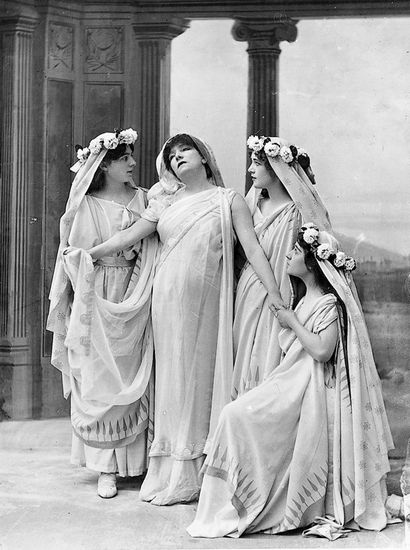
The French actress Sarah Bernhardt is often remembered as the first international superstar. Her hypnotic presence and flamboyant personality are legendary. “She could contrive thrill after thrill,” wrote Lytton Strachey of Bernhardt’s acting ability, “she could seize and tear the nerves of her audience, she could touch, she could terrify, to the top of her astonishing bent.” Bernhardt died before the age of talking movies, notes her biographer Robert Gottlieb, “yet she remains the most famous actress the world has ever known.”
How good was she? Listen below, and you can begin to form your own opinion. The recording was made in February of 1910, when Bernhardt and her troupe were touring America. To tap into the emerging phonographic record market, Bernhardt stopped by Thomas Edison’s laboratory in West Orange, New Jersey, to cut some wax cylinders. For one recording, she chose a scene from Jean Racine’s 1677 tragedy Phèdre, which is based on Euripides’ Hippolytus and Seneca’s Phaedra. Bernhardt plays the title role opposite an unknown actor in the highly dramatic Act II Scene V, in which Phèdre declares her love for Hypolyte, her stepson:
Unfortunately, the video image moves in a distracting way. So perhaps the best way to enjoy the audio is to forget the image and read along with Bernhardt. A full transcript follows the jump:
The history of religion(s) is a fascinating subject, one that should be covered, in my humble opinion, as an integral part of every liberal arts education. But the history of atheism—of disbelief—is a subject that only emerges piecemeal, in oppositional contexts, especially in the wake of recent fundamentalist uprisings in the past decade or so. We covered one such history recently, the 2004 BBC series Atheism: A Rough History of Disbelief, made by director Jonathan Miller and featuring such high-profile thinkers as Richard Dawkins, Daniel Dennett, Arthur Miller, and physicist Steven Weinberg.
Miller’s series originally included much more material than he could air, and so the BBC agreed to let him produce the outtake interviews as a separate program called The Atheism Tapes. It’s a series in six parts, featuring interviews with English philosopher Colin McGinn, Weinberg, Miller, Dawkins, Dennett, and British theologian Denys Turner. At the top, watch Miller’s intro to The Atheism Tapes and his interview with Colin McGinn. It’s an interesting angle—Miller gets to quiz McGinn on “what it means to be a skeptical English philosopher in such a seemingly religious country as the United States.” Many readers may sympathize with McGinn’s difficulty in communicating his unbelief to those who find the concept totally alien.
Directly above, watch Daniel Dennett (after the intro) discuss the relationship between atheism and Darwin’s revolutionary theory. Miller is a wonderful interviewer—sympathetic, probing, informed, humorous, humanist. He is the perfect person to bring all these figures together and get their various takes on modern unbelief, because despite his own professions, Miller really cares about these big metaphysical questions, and his passion and curiosity are shared by all of his interviewees. In the introduction to his interview with playwright Arthur Miller (below), Jonathan Miller makes the provocative claim that Christianity believes “there’s something peculiar about the Jews that makes them peculiarly susceptible to profane disbelief.” Watch Arthur Miller’s response below.
One would hope that all manner of people—believers, atheists, and the non-committal—would come away from The Atheism Tapes with at least a healthy respect for the integrity of philosophical and scientific inquiry and doubt. See the full series on YouTube here. Or purchase your copy on Amazon here.
“Football is a whole skill to itself. A whole world. A whole universe to itself. Me love it because you have to be skillful to play it! Freedom! Football is freedom.”
Bob Marley spoke those lines in 1979, two years before his life was cut short by melanoma, revealing his passion for the world’s game, or what we call “soccer” here in America. Casual fans might not know this, but Marley followed Brazilian football closely, revered Pele, made the sport part of his daily routine, and when he traveled to Rio de Janeiro in 1980, he took part in a now legendary match on musician Chico Buarque’s private pitch. Team A consisted of Marley, Junior Marvin (member of the Wailers), Paulo César Caju (member of the Brazil 1970 squad), Toquinho (Brazilian musician), Chico Buarque and Jacob Miller (lead singer of Inner Circle). Team B featured Alceu Valença (Brazilian musician), Chicão (member of Jorge Ben’s band) and four staff members from Island Records, recalls Russ Slater in Sounds and Colours. The short clip above shows Marley scoring a goal, despite being well into his battle with melanoma.
If you would like to sign up for Open Culture’s free email newsletter, please find it here. It’s a great way to see our new posts, all bundled in one email, each day.
If you would like to support the mission of Open Culture, consider making a donation to our site. It’s hard to rely 100% on ads, and your contributions will help us continue providing the best free cultural and educational materials to learners everywhere. You can contribute through PayPal, Patreon, and Venmo (@openculture). Thanks!
Second City has given us many great improv comedy sketches and comedians over the decades … and now comic videos on YouTube too. From this video collection comes the “Too Philosophical Pop Song,” whose opening lines resemble the hackneyed lyrics of so many contemporary pop tunes.
We’ve got to be young while we live, and live while we are young.
We’ve got to live for tonight because tomorrow won’t come.
We’ve all heard these existential clichés before, right? But then, the “Too Philosophical Pop Song” gets, well, too philosophical, swerving darkly of course.
We have to party like we’ll never see tomorrow, thereby destroying the intrinsic value of this moment and ourselves.
The certainty of death invalidates our actions tonight.
We’re thrown into this universe with no purpose, compelled to fabricate meaning.
There is no good, there is no right, and our morals are crafted out of reason.
Makes it a little hard to get your groove on … unless you’re a UVA grad student or one of those heady guys at PartiallyExaminedLife. Don’t miss their podcast.
Let’s take a little break from our fast-moving world and watch one of the world’s oldest and slowest-moving experiments in action. Begun in October 1944 at Trinity College Dublin’s School of Physics, the Tar Drop experiment has attempted to measure the viscosity of pitch tar, a polymer that seems solid at room temperature. The goal of the experiment? To demonstrate that pitch tar actually flows and to capture a drop falling from a funnel — something that happens about once a decade. Above, you can watch a timelapse video of all the exciting action. It marks the first time a pitch drop has ever been captured on film.
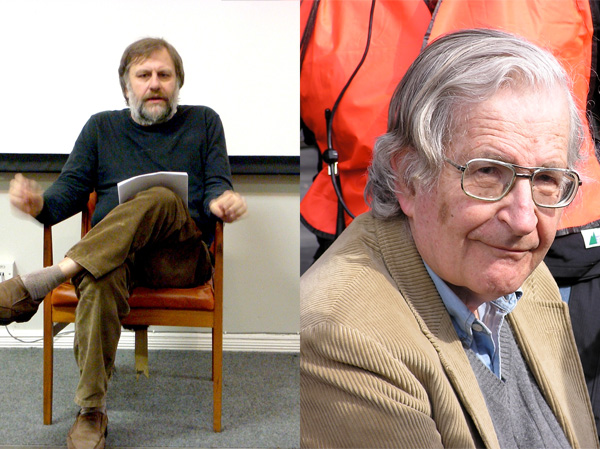
The rift between the two high-profile intellectuals began, as you may recall, when Chomsky criticized Žižek and other continental philosophers for essentially talking nonsense — for cloaking trivialities in fancy language and using the scientific-sounding term “theory” to describe propositions that could never be tested empirically. Žižek lashed back, saying of Chomsky, “I don’t think I know a guy who was so often empirically wrong.” He went on to criticize Chomsky’s controversial early position on American assessments of the Khmer Rouge atrocities in Cambodia. (To read Žižek’s comments, click here to open the earlier post in a new window.) In response yesterday, Chomsky said he had received numerous requests to comment on our post:
I had read it, with some interest, hoping to learn something from it, and given the title, to find some errors that should be corrected — of course they exist in virtually anything that reaches print, even technical scholarly monographs, as one can see by reading reviews in professional journals. And when I find them or am informed about them I correct them.
But not here. Žižek finds nothing, literally nothing, that is empirically wrong. That’s hardly a surprise. Anyone who claims to find empirical errors, and is minimally serious, will at the very least provide a few particles of evidence — some quotes, references, at least something. But there is nothing here — which, I’m afraid, doesn’t surprise me either. I’ve come across instances of Žižek’s concept of empirical fact and reasoned argument.
Chomsky goes on to recount an instance when he says Žižek misattributed a “racist comment on Obama” to Chomsky, only to explain it away later and say that he had discussed the issue with Chomsky on the telephone. “Of course,” writes Chomsky, “sheer fantasy.” Chomsky then moves on to Žižek’s comments reported by Open Culture, which he says are typical of Žižek’s methods. “According to him,” writes Chomsky, “I claim that ‘we don’t need any critique of ideology’ — that is, we don’t need what I’ve devoted enormous efforts to for many years. His evidence? He heard that from some people who talked to me. Sheer fantasy again, but another indication of his concept of empirical fact and rational discussion.”
Chomsky devotes the rest of his article to defending his work with Edward Herman on the Khmer Rouge atrocities. He claims that no factual errors have been found in their work on the subject, and he draws attention to a passage in their book After the Cataclysm, quoted last week by Open Culture reader Poyâ Pâkzâd, in which they write, “our primary concern here is not to establish the facts with regard to postwar Indochina, but rather to investigate their refraction through the prism of Western ideology, a very different task.”
Anyone calling themselves even casual Bill Murray fans — and we here at Open Culture have taken it well beyond casualness — will by now have read a number of articles on how the actor, comedian, and early Saturday Night Live alumnus has reinvented himself in the 21st century. Though he still acts and makes us laugh more than ever in so doing, he picks his projects more carefully, tends to work with creators possessed of particular visions (Wes Anderson comes to mind), and at times apparently lives his life like a form of self-satirizing performance art, popping up now and then in the least expected places amongst the least expected people. Fans of Murray’s from his Caddyshack, Stripes, and Ghostbusters days certainly wouldn’t expect to see him, for instance, at a poetry reading, much less onstage, much less reading seriously.
And yet here we have three examples, captured live, of Bill Murray’s poetry-reading acumen. Up top, you can watch him read former Poet Laureate of the United States Billy Collins’ “Forgetfulness” at the 16th Annual Poets House Walk Across the Brooklyn Bridge. Just above, at the same event, Murray reads “Brush Up Your Shakespeare” by songwriter Cole Porter from the lyrics of Porter’s musical Kiss Me, Kate. Below, at the Poets House Walk dinner, he reads “What We Miss” by Sarah Manguso. We’ll add those three to the list of voices Murray’s performances have done justice — a list that includes such illustrious figures real and imagined as Wallace Stevens, Emily Dickinson, and Drs. Peter Venkman and Hunter S. Thompson.
Stick to what you know goes the conventional wisdom. Author Richard Wright won acclaim documenting the African-American experience in the 30’s and 40’s. Literary standing in the bag, he could have explored any number of avenues through his writing, or chosen to delve deeper into the rich territory from which his career had been mined.
Or, you know, he could’ve starred in a 1951 film adaptation of Native Son, his best selling Book of the Month Club selection.
Which only really counts as sticking with what one knows when one has the acting chops to back it up —something the 40 year old Wright, playing a character 20 years younger than himself, did not. It doesn’t help that the period dialogue sounds stilted to modern ears, and Buenos Aires makes a bizarre geographic substitute for the original’s Chicago location. In the age of the digital connection, his turn in the little seen production assumed train wreck status.
A cursory online search reveals a long line of amateur critics busting on Wright’s ultimately ill-advised celluloid foray. Let us come at things from a slightly adjusted angle. Most of us have seen, if not been, an imaginative child at play, whispering invented lines for favorite dolls and action figures’ spur of the moment scenarios.
Couldn’t we hold that that is what Wright is up to here? He may not be the most convincing handling of a prop gun, but he still bests your average 7‑year-old believer. Those willing to overlook an untrained actor’s less-than-Oscar interpretation-caliber might be rewarded with insight…
We're hoping to rely on loyal readers, rather than erratic ads. Please click the Donate button and support Open Culture. You can use Paypal, Venmo, Patreon, even Crypto! We thank you!
Open Culture scours the web for the best educational media. We find the free courses and audio books you need, the language lessons & educational videos you want, and plenty of enlightenment in between.