What if that screen you’re peering at was something akin to a one-way mirror? There’s a definite aspect of dressing room horror, viewing artist Robbie Cooper’sImmersion project, a video collection of the alternately grotesque and dull expressions appearing on people’s faces as they play video games and watch YouTube. (The viewer is never privy to what’s showing on the subjects’ screens, but one suspects it’s likely less rarified than a short animation inspired by physicist Richard Feynman’s remarks on a flower or filmmaker Miranda July’s lyrical advice to the procrastination-prone). But before we denounce the mostly underaged participants’ dead eyes and slack jaws—an effect made more disturbing by the soundtrack’s high incidence of gunfire—perhaps we should turn the web cam on ourselves.
That’s exactly what Cooper is hoping will happen, as he prepares to expand the project’s scope to include people of all ages and nationalities. “Babies being born right now arrive in a landscape where computers, smartphones, the internet, and social media already exist,” he explains, “While the oldest generation alive today can remember a time before TV was a fixture of our living room.”
To widen the net, Cooper is turning to crowd sourcing. Whether someone who knowingly trains the camera on him or herself can achieve the previous participants zoo-like lack of inhibition remains to be seen, but the Kickstarter campaign to fund this next phase lays things out on a grand scale. The plan is for the public to contribute via uploads and a social media aggregator. More excitingly, they’re encouraged to seize the reins by creating a series of instructions and prompts for those coming later to follow.
Let us hope this will lead to a more heartening variety of expressions, as well as the book, documentary, and interactive exhibits Cooper envisions.
Before you do anything else, click on the image above and then move little slider (along the bottom of the image) from left to right. Now watch the universe fly by, going from macro to micro. Pretty cool, no? Now read on:
This dynamic infographic comes to us via Number Sleuth, who describes their wonderful creation as follows:
This interactive infographic accurately illustrates the scale of over 100 items within the observable universe ranging from galaxies to insects, nebulae and stars to molecules and atoms. Numerous hot points along the zoom slider allow for direct access to planets, animals, the hydrogen atom and more. As you scroll, a handy dial spins to show you your present magnification level.
While other sites have tried to magnify the universe, no one else has done so with real photographs and 3D renderings.…We hope you have a blast magnifying the universe, know that each time you zoom in a depth, you’re magnifying the universe 10x … and every time you zoom out, the bigger objects are 1/10th of their prior size. If you zoom from the biggest object, The Observable Universe, all the way down to the hydrogen atom’s proton nucleus, you will have zoomed in over 100,000,000,000,000,000,000,000,000,000,000,000,000,000x! Unbelievable isn’t it? Our universe really is immensely massive and surprisingly small.
If you’re familiar with the work of Ray and Charles Eames, this infographic will almost certainly remind you of Powers of Ten, the Eames’ 1977 film. That’s something we’re going to talk about more on Monday. For more info on how to use Magnifying the Universe, please see the instructions here.
Even if you cultivate only a casual appreciation for philosophy, you’ll have realized that professional opinions differ about Ludwig Wittgenstein, and starkly. Philosophers don’t just argue about his work; they also seem to argue about his attitude, his conduct, his very person. Above, you can hear Betrand Russell, a somewhat less controversial philosophical personage, briefly give his impressions of the lad who would write the Tractatus Logico-Philosophicus. (Find a copy in our Free eBooks collection.) You see, before landing in the philosophy track—or, in any case, his own crooked version of the philosophy track—Wittgenstein studied aerodynamics at England’s University of Manchester. An assignment in propeller design got him fascinated with mathematics, which led him to philosophy at Cambridge. There, in 1912 and 1913, he studied under Russell.
“He was queer, and his notions seemed to me odd,” Russell says, surely using queer in its archaic sense. (Though others do apply; in 1993, Derek Jarman made a gay-themed biographical film about the philosopher.) “For a whole term, I could not make up my mind whether he was a man of genius or merely an eccentric.” But at the end of this term, the young Wittgenstein brought to his instructor a pressing question: “Will you please tell me whether I am a complete idiot or not? If I am a complete idiot, I shall become an aeronaut; but, if not, I shall become a philosopher.” Russell issued a challenge to write about a philosophical subject over the school break, and Wittgenstein handed him the result as soon as the next term began. “After reading only one sentence,” recalls Russell, “I said to him, “No, you must not become an aeronaut.” And he didn’t.” One imagines his unrealized career in aeronautics wouldn’t have given us quite so much to debate.
Colin Marshall hosts and produces Notebook on Cities and Culture and writes essays on literature, film, cities, Asia, and aesthetics. He’s at work on a book about Los Angeles, A Los Angeles Primer. Follow him on Twitter at @colinmarshall.
Today we’ve gathered together a group of postcards from six of the most famous writers of the 20th century. (Please click the images to see them in a larger format.) Some of the cards are about business, others friendship. We found them all fascinating to glance through.
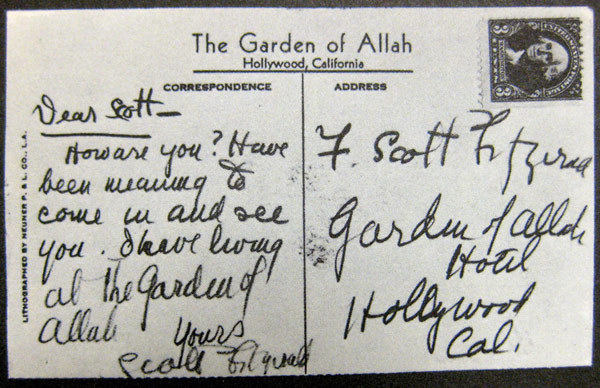
Perhaps the most curious and amusing of the cards is the whimsical note F. Scott Fitzgerald wrote to himself. (See above.) Fitzgerald was working as a screenwriter in Hollywood during the late 1930s and stayed for awhile at the fabled Garden of Allah (now a parking lot just down Sunset Boulevard from the Chateau Marmont), where a number of film and literary luminaries once lived, including Errol Flynn, Greta Garbo, the Marx Brothers, Dorothy Parker and Robert Benchley. Little is known about Fitzgerald’s postcard to himself, but alcohol is generally assumed to have been involved. The undated card was stamped, but never mailed. In F. Scott Fitzgerald: A Life in Letters, editor Matthew J. Bruccoli guesses that it was written in the summer of 1937.
Jack Kerouac to Malcolm Cowley, 1956:
In 1956, Viking Press editor Malcolm Cowley was a believer in Jack Kerouac’s talent but was putting off the publication of On the Road. In March of that year Cowley had cautioned the Beat writer about going too far with automatic writing. “Automatic writing is fine for a start,” Cowley said in a letter to Kerouac, “but it has to be revised and put into shape or people will quite properly refuse to read it–and what you need now is to be read, not to be exhibited as a sort of natural phenomenon like [the] Old Faithful geyser that sends up a jet of steam and mud every hour on the hour.” Kerouac was apparently stung by the last line, because on July 3 of that year he sent a postcard (above) with a picture of Yellowstone National Park on it, expressing extreme impatience with Cowley’s foot-dragging. “If you don’t send me a contract with an advance (or some kind of option) by October first, on On the Road, I am going to withdraw the manuscript from Viking and sell it elsewhere. Than have it demeaned I’d rather it were never published.” A year later Viking published the novel.
James Joyce to Elkin Mathews, 1908:
In 1908, James Joyce was four years into his self-imposed exile from Ireland. He was living in the Austro-Hungarian port city of Trieste (now part of Italy) and teaching at the Berlitz School while trying to get his book of short stories, Dubliners, into print. One publisher had already accepted the book, but the printer had refused to produce it for fear of being prosecuted on obscenity charges. On January 24, 1908 Joyce sent the postcard above to the London publisher Charles Elkin Mathews, who had been holding onto the manuscript for several months, requesting a decision. Mathews turned it down. Six more years of headaches followed for Joyce (with one publisher actually printing 1,000 copies of the book only to change his mind and burn them all) before Dubliners was finally printed in 1914 by Grant Richards Ltd.
Franz Kafka et al. to Kurt Wolff, 1913:
Franz Kafka is often pictured as a solitary figure, brooding alone in his room. The postcard above is evidence of Kafka’s social side. It was sent on March 25, 1913 from Charlottenburg, a district of Berlin, where Kafka was meeting with a group of fellow authors who shared the same publisher. The writers decided to send a group postcard to their publisher Kurt Wolff. Kafka writes “Best greetings from a plenary session of authors of your house. Otto Pick, Albert Ehrenstein, Carl Ehrenstein. Dear Herr Wolff: Pay no attention to what Werfel tells you! He does not know a word of the story. As soon as I have a clean copy made, I will of course be glad to send it to you. Sincerely, F. Kafka.” At the bottom, in another hand, is written “Cordial greetings from Paul Zech,” and on the front of the postcard is a drawing by Else Lasker-Schuler with the name “Abigail Basileus III” next to it. The “Werfel” Kafka refers to is the Austrian-Bohemian writer Franz Werfel, who had told Wolff about Kafka’s unpublished novella, The Metamorphosis. Wolff had expressed interest in seeing “the bug story.” He published it two years later, in 1915.
Ernest Hemingway to Gertrude Stein, 1924:
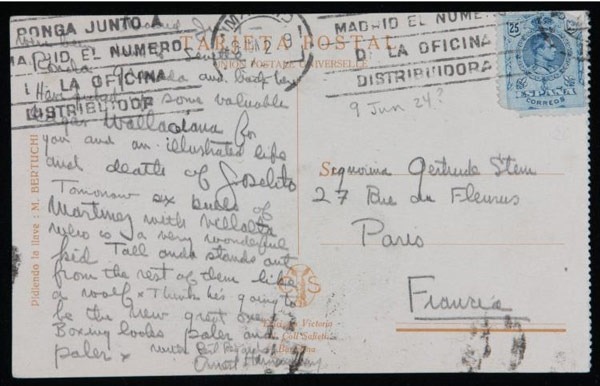
In the summer of 1924, Ernest Hemingway traveled in Spain to attend bullfights. On June 9 he sent a postcard from Madrid to his mentor and fellow bullfighting fan Gertrude Stein. Hemingway was eager to fill Stein in on the latest developments. “Tomorrow,” he writes, “six bulls of Martinez with Villalta, who is a very wonderful kid. Tall and stands out from the rest of them like a wolf. Think he’s going to be the next great one.” Hemingway’s accumulated knowledge of Spain and bullfighting would figure into his breakthrough novel of 1926, The Sun Also Rises. Another postcard from Hemingway to Stein and Alice B. Toklas appears here.
Kurt Vonnegut to David Breithaupt, 2006:
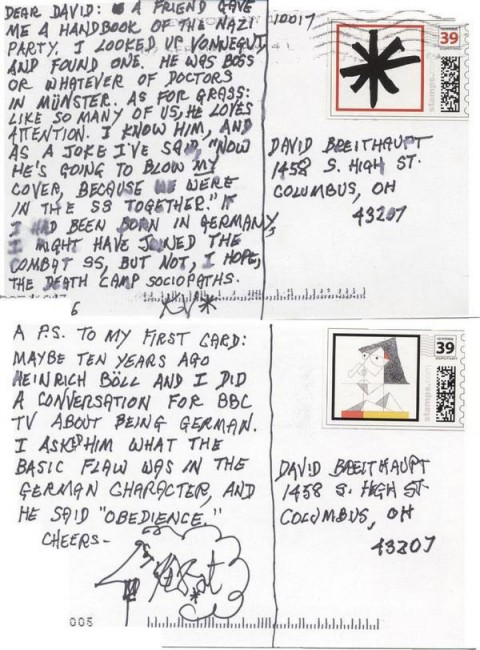
In the last two decades of his life, Kurt Vonnegut corresponded with a young man named David Breithaupt, whom he had met through Allen Ginsberg. (Breithaupt had worked part-time as an archivist for Ginsberg in the early 1980s.) In a 2007 interview with The Nervous Breakdown, Breithaupt was asked why Vonnegut took the time to exchange letters with him. “This has mystified me over the years,” said Breithaupt, “but part of the reason may have been because Kurt and I were both midwesterners. I grew up in central Ohio and he was a Hoosier next door. We both had Germanic backgrounds and we were often sending sightings of the other’s family names to each other. In fact our last correspondence was about Gunter Grass and his out-of-the-closet Nazi announcement.” Grass had stunned the literary world in the summer of 2006 by admitting that he was drafted into the Waffen SS when he was a teenager. “As for Grass,” says Vonnegut in a September, 2006 postcard shown above: “He loves attention. I know him, and as a joke I’ve said ‘Now he’s going to blow my cover, because we were in the SS together.’ If I had been born in Germany, I might have joined the combat SS, but not, I hope, the death camp sociopaths.”
What advantage, I recently asked a trilingual writer, could you possibly find in using such an improvised, confusing, irregular patchwork of a language as English? She replied that this very improvisation, irregularity, and even confusion comes from the vast freedom of expression (and of invention of new expressions) that English offers over other European tongues. This goes even more so for American English, the variant with whose combination of carefully shaded nuances and smashing colloquialisms David Foster Wallace so dazzled his readers. Like many writers, Wallace also taught writing, but those of us not lucky enough to receive his direct instruction can still behold his teaching materials, archived online at the University of Texas at Austin’s Harry Ransom Center.
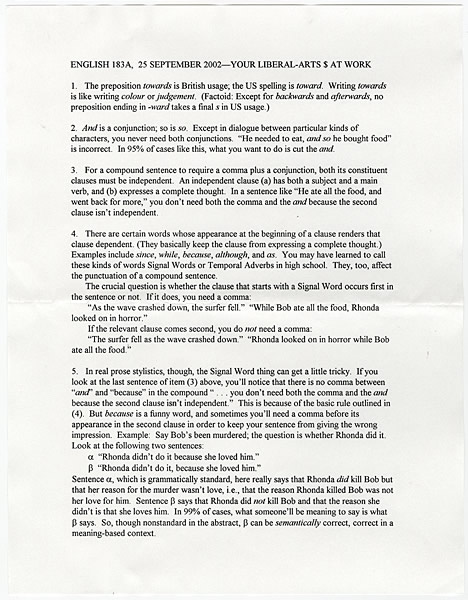
See, for instance, Wallace’s handout on five common usage mistakes, from his Fall 2002 section of English 183A at Pomona College (an advanced fiction writing class, taught last Spring by Jonathan Lethem). “The preposition towards is British usage; the US spelling is toward.” Fair enough. “And is a conjunction; so is so,” he continues. “Except in dialogue between particular kinds of characters, you never need both conjunctions.” Handy to know! Then, things get more technical: “For a compound sentence to require a comma plus a conjunction, both its constituent clauses must be independent.” As Wallace goes deeper, I feel even more sympathy for those who learn English as a second language, as I did when I read “Tense Present,” his Harper’s review of Bryan A. Garner’s A Dictionary of Modern American Usage. If the hardcore grammar talk tires you, feel free to peruse the Ransom Center’s other artifacts of Wallace’s time in the classroom—which we covered in a post last week—such as his syllabus for English 102: Literary Analysis, his guidelines for papers, and the marginalia in his copy of Carrie.
Colin Marshall hosts and produces Notebook on Cities and Culture and writes essays on literature, film, cities, Asia, and aesthetics. He’s at work on a book about Los Angeles, A Los Angeles Primer. Follow him on Twitter at @colinmarshall.
Jamaica Kincaid is out with her first novel in ten years, See Now Then, but she hasn’t been idle, steadily publishing non-fiction and essays in the span between 2002’s Mr. Potter and now. Kincaid is a many-faceted woman: Antiguan native, contented Vermont gardener, improbable literary success story, fierce critic of European colonialism. She is also, most likely, one of the most anthologized writers of the past few decades. Anyone who’s taken a writing or intro lit class recently has no doubt read her short story (or prose-poem) “Girl.”
With Kincaid in the news for her new book, the New Yorker’s Page-Turner blog caught up with one of her admirers, Haitian-American author and fellow New Yorker columnist Edwidge Danticat and asked her to read two of Kincaid’s classic stories, “Girl” and “Wingless,” published in the New Yorker in 1978 and ’79, for their fiction podcast. Danticat gladly obliged (hear the audio above), but not before briefly discussing her relationship to Kincaid and her work.
Last year, we posted on a song archive of novelist and anthropologist Zora Neale Hurston, who, it turns out, was also quite a singer. As she traveled through the American South and the Caribbean doing field research in the 1930s and ‘40s, Hurston collected and interpreted several folk songs and stories, sometimes working with folklorists Stetson Kennedy and Alan Lomax. Hurston dropped off the map for a few decades before a revival of her work in the 1970s caused literary scholars and historians to re-evaluate her place in American letters. One recent evaluation of her work and life, the 2008 PBS American Masters documentary Jump at the Sun, profiles the writer in all her independence, contrariness, and vigor. Unfortunately, the full documentary is not online, but you can order a copy of the award-winning film on DVD from California Newsreel or Amazon.
In the short clip above from Jump at the Sun, you can see footage Hurston shot herself, over which she sings, in her crystal clear alto, a bawdy old-time country blues song called “Uncle Bud.” Hurston called “Uncle Bud” a “jook song,” not the kind of thing sung around (or by) respectable ladies. The song comes from experiences with the infamous Chief Transfer Agent for the Texas prison system, “Uncle Bud” Russell, whose dreaded wagon, “Black Betty,” was possibly the reference for a work song immortalized by Lead belly, no stranger to Texas prisons (Russell also gets a name-check in Lead Belly’s “Midnight Special”).
Russell earned his notoriety, delivering 115,000 men and women to prison, including Clyde Barrow in 1930. The prison song, with equally profane, but slightly different lyrics, appeared on a 1960 album called The Unexpurgated Folk Songs of Men, compiled by Texas musicologist and folklorist Mack McCormick, and Texas bluesman Lightnin’ Hopkins had his own narrative of the lawman in “Bud Russell Blues.”
After Hurston’s brief rendition above, we see a photo montage of the author, smiling broadly, never without a rakishly cocked hat. Partly because of the work of folklorists and lovers of Americana like McCormick and Hurston, songs like “Uncle Bud” stayed in the lexicon of popular music, transmitted from obscure folk renditions to the blues and weaving together working-class black and white blues and folk traditions that were often never very far apart to begin with. Those worlds come together in Zydeco legend Boozoo Chavis’ take on “Uncle Bud,” but my favorite version by far is the lyrically cleaned-up, harmonica-driven stomper by Sonny Terry and Brownie McGhee, recorded in 1956 (below).
On Tuesday night, the San Francisco-Oakland Bay Bridge outshined The Golden Gate Bridge for the first time in 75 years. That happened when artist Leo Villareal flipped a switch and illuminated 25,000 lights, turning the 1.8‑mile expanse into the world’s largest L.E.D. light sculpture. According to The New York Times, the privately-funded project, estimated to cost $8 million, “has become a darling of moneyed Silicon Valley types.” And, it’s not hard to see why. As Villareal explains in the video above, “The Bay Lights” installation runs on custom-designed software (written in C) that captures the kinetic activity around the bridge and then uses the data to sequence the lights, creating patterns that never occur twice. You can visit the installation through 2015. Learn more here.
We're hoping to rely on loyal readers, rather than erratic ads. Please click the Donate button and support Open Culture. You can use Paypal, Venmo, Patreon, even Crypto! We thank you!
Open Culture scours the web for the best educational media. We find the free courses and audio books you need, the language lessons & educational videos you want, and plenty of enlightenment in between.
.JPG?itok=hMaQO1FM)
.jpg)
.jpg)