To eat bacon sandwiches? Or not to eat bacon sandwiches? That’s a question tackled by David Spiegelhalter, who holds the title, “Winton Professor for the Public Understanding of Risk” at Cambridge University. Sometimes they just call him “Professor Risk” for short.
In his academic work, Spiegelhalter looks at risk and uncertainty every day, seeing how they affect the lives of individuals and society. You’d figure that this might make him more cautious than the rest of us. But that’s not how it turns out. After analyzing all of the data, Spiegelhalter comes to this conclusion: some calculated risks are worth it. They have minimal downside and make life worth living. Or, looked at a little differently, sometimes “one of the biggest risks [in life] is being too cautious.”
If you would like to support the mission of Open Culture, consider making a donation to our site. It’s hard to rely 100% on ads, and your contributions will help us continue providing the best free cultural and educational materials to learners everywhere. You can contribute through PayPal, Patreon, and Venmo (@openculture). Thanks!
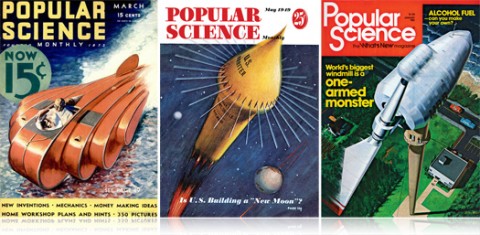
Popular Scienceis the fifth oldest continuously-published monthly magazine—a long way of saying that the magazine has done a fine job of maintaining a niche in a crazily fast-paced industry. Founded in 1872 by science writer Edward Youmans to reach an audience of educated laypeople, Popular Science today combines reviews of the latest gadgets with stories about innovation in design and science. It’s an organized mishmash of news about “the future now,” liberally defined. A recent issue included stories about the military’s use of 3‑D printing and an astrophysicist who questions whether Shakespeare wrote the entire Folio.
With that kind of breadth, the magazine’s archives cover just about everything. And it’s easy to browse through back issues, dating all the way back to 1872, since the magazine teamed up with Google to put a searchable archive on the web. The earliest issues, like this one from February 1920, feature color covers that bring to mind science fiction with a fascination for the imagined future.
One of the cool things about the magazine is its equal attention to new and old technology. Search for “scissors” and you will find this 1964 article about the mechanics of sharpening your own scissors. The archive also offers another search tool that returns results in a visual word frequency grid, which is especially cool if you click the “animate” button. Any social historians out there able to explain why the word “scissor” would appear so often in the mid-20th century?
Interestingly, although the word “internet” dates back to the 1960s, the word didn’t appear in the magazine’s pages until 1989.
Period advertisements are included, which adds to the fun. This issue from September, 1944 includes a house-advertisement on the table of contents page calling for all collectors of back issues to consider surrendering them for the war cause. “There’s a war going on and this is no time for sentiment,” the ad urges. “Grit your teeth and dig out those stacks of back numbers. Then turn them over to your local paper salvage drive!” Enter the archive here.
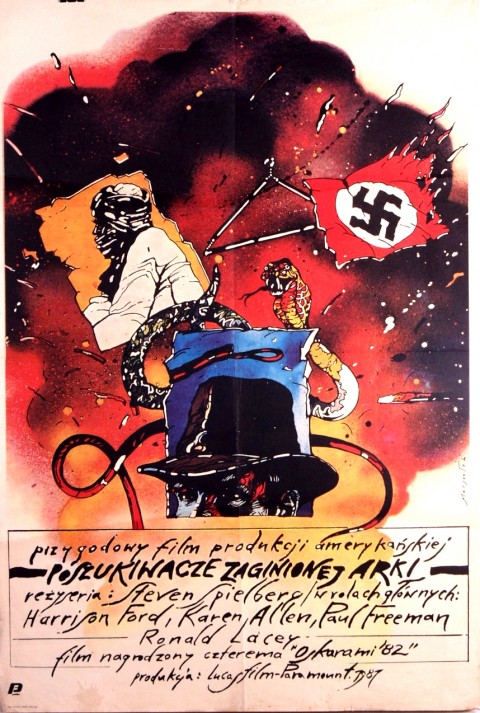
We do not, alas, live in the golden age of American movie poster design. Some United States independent films (and especially their Criterion Collection DVD releases, if they get them) still fly under the banner of striking imagery designed by daring artists and graphic designers, but for mainstream Hollywood pictures, the thrill has definitely gone. Even when their most iconic posters of decades past showcase admirable craftsmanship, they often lack a certain artistic zing. Every Indiana Jones fan, for instance, has a special place in their heart for Raiders of the Lost Ark’s classic poster, but even the sternest Indy purist would have to admit that one of the film’s Polish posters, shown above, immediately communicates something the original, near-photorealistic image doesn’t. You can see another Polish rendition of Raiders, one that conveys even more fully the unexpected intensity of Harrison Ford’s all-American hero archaeologist, in this collection fifty Polish film posters from wellmedicated.
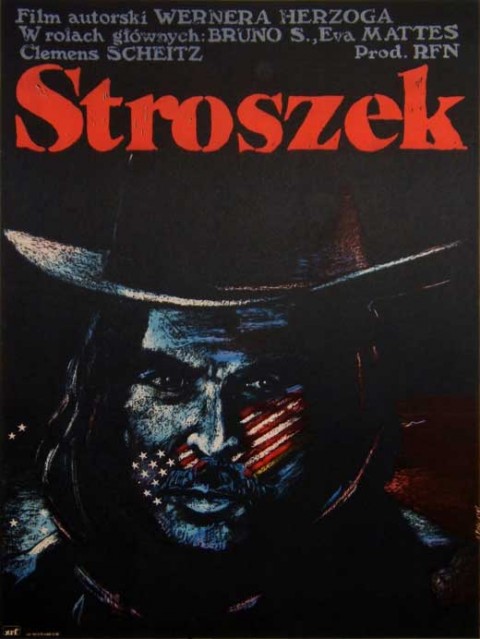
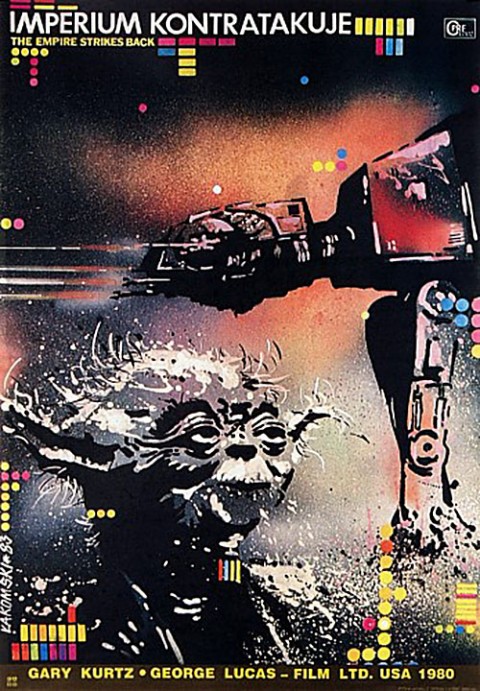
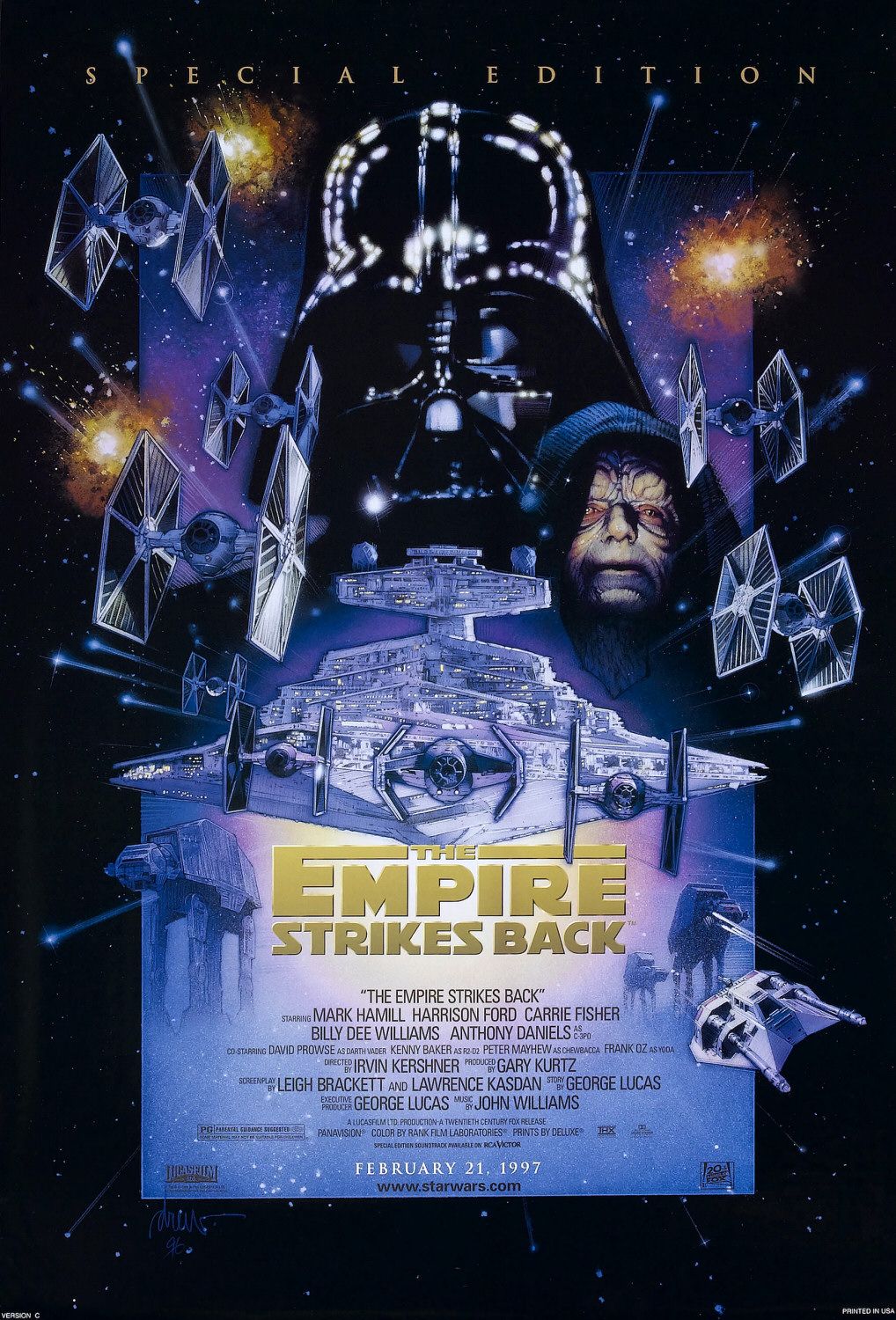
Followers of many varieties of visual art, especially animation, know that Poland has a rich visual tradition indeed. Executed by the hand of a Polish artist, ideas that would seem nonsensical or ridiculous anywhere else in the world suddenly make sense. Just above we have the Polish poster advertising Stroszek by Werner Herzog, whose movies, based on his own inexplicable but somehow satisfying ideas of “ecstatic truth,” perhaps merit Polish posters more than anyone else’s. Just below, we see what Polish viewers saw when they lined up to buy tickets for Star Wars’ sequel The Empire Strikes Back. Maybe it strikes you as heresy to accept anything but Drew Struzan’s hardy, Darth Vader-centric, explosion-laden original, but this one urges me to think about the entirety of Star Wars’ project in a whole new — or at least newly askew — way. The other country which has long led the way with interesting homegrown posters for American movies? Ghana.
“Al otro, a Borges, es a quien le ocurren las cosas,” begins the very short story “Borges y yo”. That translates to “It’s to the other man, to Borges, that things happen” in English. The tale’s author, Jorge Luis Borges, lived his life between English and his native Spanish, just as he lived between his public and private personas. No surprise, then, that his writing generates so much energy from matters of identity, language, and thought, and thus makes you want to learn more about the mind behind it. Here at Open Culture, we particularly enjoy doing our learning through Arena, the BBC’s intellectually omnivorous and artistically liberated television documentary series. The 1983 broadcast above, takes as its subject the imaginative Argentine master of the short story. The show has always done well by what we might call cult writers (see also its episode on the no less imaginative Philip K. Dick), and the cult of Borges now seems broader and more enthusiastic than ever. If you count yourself as a member, this episode “Borges and I” makes for required viewing.
Sitting down with Arena, the elderly Borges speaks without hesitation on his relationship to language, his discovery of his own limitations as a writer, the regimes that have ruled his homeland, his professional life spent at libraries (including his time as director of Argentina’s Biblioteca Nacional), and his accelerating blindness. We see scenes of life in Borges’ beloved Buenos Aires. We see the writer stepping carefully through the city streets, cane in one hand, feeling the buildings with the other. We see, perhaps most fascinatingly of all, dramatized passages of Borges’ most famous stories: “Funes the Memorious”, about a peasant condemned to remember everything perfectly, losing his ability to generalize, and thus to think; “The Circular Ruins”, about a man attempting to dream another human being into existence, detail by minute detail; “Death and the Compass”, about a detective who either accidentally or deliberately walks straight into a villain’s elaborate, tetragrammaton-based trap. Borges’ fans tend to think of his stories as thoroughly wrapped up in, and inseparable from, the text that constitute them, but some of these segments convince me that, as movies, they wouldn’t turn out half-bad.
Last month, David Bowie released The Next Day, his first new album in a decade. That’s a long time to go without an album — long enough that fans could perhaps use a refresher, a reminder of why they should splurge for the new material. So, in conjunction with the release of The Next Day, Bowiehas opened the vaults and put online a wonderful set of videos recorded during his golden years. It’s a visual and aural treat. Today, I’ve pulled together my personal favorites, all from the 1970s. That’s how I roll. But, if you’re an 80s Bowie fan, there’s something there for you too. Fashion, Ashes to Ashes, China Girl, a duet with Mick Jagger recorded for Live Aid in 85 — they’re all included in the collection of 36 videos.
Now watch a few of these clips — we’re starting you off above with “Life on Mars?” — and then ask yourself: Are you ready to download The Next Day?
So much has been written about hand-written letters, mostly lamenting their death. What else can be added about the beautiful vulnerability of handwriting and the satisfying feel of paper stationary and envelopes, not to mention the miracle of letter delivery? Think of all those heartsick soldiers in wars old and modern receiving an actual letter from home, thousands of miles away.
The only news about letter writing is that we continue to discover its value. Just recently Cambridge University published some 1,200 letters exchanged between Charles Darwin and his closest friend, the botanist Joseph Dalton Hooker. The letters span 40 years of Darwin’s working life, from 1843 to his death in 1882, and join the other letters in the Darwin Correspondence Project.
There is so much to appreciate about these letters. Call it 19th century bromance, if you must, but the correspondence between Darwin and Hooker touched on nearly every subject, scientific and personal. Darwin wrote Hooker for his help negotiating with publishers, for his opinion about whether seeds from islands without four-legged animals are ever hook-shaped, and for his support after his 6‑year-old daughter Maria died.
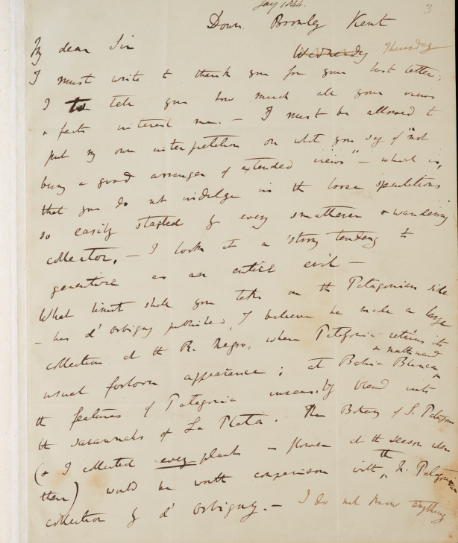
From a scientific point of view the most important letter may be the one Darwin wrote Hooker on January 11, 1844. Writing from his home, Down House in Kent, Darwin fires questions at Hooker about seeds, seashells and Arctic species—his mind obviously a blur of activity—and then describes that his work has taken a “presumptuous” turn. After years of research and collecting specimens, he was beginning to form an idea that “species are not (it is like confessing a murder) immutable.”
Fifteen years later Darwin published On the Origin of Species. (Find it on our Free Audio Books and Free eBooks collections.)
In his letters to Hooker, himself a great botanist and explorer, Darwin works out and worries over his ideas. In one letter he expresses impatience with all other existing explanations for the geographical distribution of plants.
The Correspondence Project has archived more than 7,500 of Darwin’s letters altogether, including the mail he sent home while at sea aboard The Beagle. Darwin was 22 when he joined a team to chart the coast of South America, a trip that was planned for two years but which stretched into five. After a bout of seasickness, Darwin wrote home to his father.
A quick aside to those who long for the days of long letters and who believe that our IQs drop a point with each text: Take note of Darwin’s liberal use of ampersands, numerals and quaint 19th century contractions (sh’d for should, etc.). IMHO, these are all just Victorian shortcuts to speed up the process of handwriting when the mind can work so much more quickly.
Kate Rix writes about education and digital media. Visit her website: .
Here’s a weird one: weirdo Doors frontman Jim Morrison, native of Florida, the weirdest state in the Union (well, it is!), stars in a promo film for Florida State University. Morrison’s character gets a bummer of a letter informing him that he has been rejected from FSU, and later meets with an administrator who gives him the lowdown. Of course, as one YouTube commenter quips, “when one door closes, The Doors open” (heh). So, fine, Morrison didn’t need Florida State—he lived fast, died young, and left the most famous grave in history.
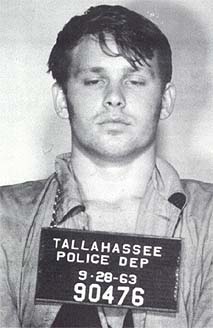
But as his fans know, the well-read Morrison was no intellectual slouch; he started the Doors while studying film at UCLA, to which he’d transferred from Florida State, where he enrolled in 1962. In addition to getting cast in the promo above, while at FSU Morrison got arrested for a school prank (see his ’63 mugshot at left), made some short films, and did his share of carousing. One fellow student, Gerry McClain, remembers Morrison from his FSU days in an interview with the site American Legends:
He hung around with a bohemian crowd: people who liked to wear pants with holes in them. Jim posed as a model for the art department, and they would all sell blood to the Red Cross to get a few bucks. Once, I saw Jim go around the college coffee shop eating scraps off tables. I felt he–and the others–were living an image–the starving young artist.
But Morrison wasn’t exactly a starving artist. He was, in fact, the son of Rear Admiral George Stephen Morrison, commander of the U.S. Naval forces in the incident that sparked the Vietnam War. Weird, right? Watch the elder Morrison and Jim’s sister Anne in interview remembrances of Jim in the video below.
We recently posted a rare audio recording of Albert Einstein reading his essay, “The Common Language of Science.” Today we have a similarly rare treat: filmed excerpts from a speech on individual liberty that Einstein gave shortly after the Nazis rose to power and he became a refugee from his native Germany. Without freedom for the individual, Einstein said, “life to a self-respecting man is not worth living.”
Einstein delivered the speech on October 3, 1933 at the Royal Albert Hall in London. As it turned out, the speech was something of a farewell address to his native continent. Four days later Einstein boarded a ship to America and never returned to Europe. The speech was organized by the Academic Assistance Council (now the Council for Assisting Refugee Academics) and other aid groups to help the hundreds of German intellectuals, many of them Jews, who were fired from their university jobs by the Nazis.
Although the Albert Hall now has a maximum allowed capacity of 5,544, according to historical accounts more than 10,000 people crowded into the old hall to hear Einstein, who warned of a coming catastrophe in Europe that would rival the Great War. “Today,” he said, “the questions which concern us are: How can we save mankind and its spiritual acquisitions of which we are the heirs? How can we save Europe from a new disaster?” Einstein reminded the audience to keep clearly in mind what is ultimately at stake: individual liberty. The speech was later published in a different form in Einstein’s book, Out of My Later Years, and you can open a PDF transcript of the original by clicking here. The film clip is cut into four short excerpts. In heavily accented English, Einstein says:
I am glad that you have me given the opportunity of expressing to you here my deep sense of gratitude as a man, as a good European, and as a Jew.
It cannot be my task today to act as a judge of the conduct of a nation which for many years has considered me as her own.
We are concerned not merely with the technical problem of securing and maintaining peace, but also with the important task of education and enlightenment.
Without such freedom there would have been no Shakespeare, no Goethe, no Newton, no Faraday, no Pasteur, and no Lister.
We're hoping to rely on loyal readers, rather than erratic ads. Please click the Donate button and support Open Culture. You can use Paypal, Venmo, Patreon, even Crypto! We thank you!
Open Culture scours the web for the best educational media. We find the free courses and audio books you need, the language lessons & educational videos you want, and plenty of enlightenment in between.