It’s often remembered as the day the Sixties died. On December 6, 1969, the Rolling Stones and a group of West Coast bands put on a free concert at the Altamont Raceway near San Francisco. The concert was billed as “Woodstock West,” but instead of being another gathering of peace, love and music, it was more like a bad trip.
The event was hastily put together by the Stones to celebrate the end of their American tour, their first with guitarist Mick Taylor. The stage at the venue was unusually low and was situated at the bottom of a hill. To keep the audience of 300,000 people from engulfing the stage, someone had the bright idea of enlisting the Hells Angels motorcycle gang to form a security cordon around the stage in exchange for (essentially) all the beer they could drink.
As the concert descended into chaos, the Hells Angels beat people with pool cues and motorcycle chains. A guitarist and singer for the Jefferson Airplane, Marty Balin, was knocked unconscious. When a man in the audience brandished a pistol during an altercation while the Stones were onstage, he was stabbed and beaten to death by members of the gang.
The whole sorry episode is captured in Gimme Shelter, the classic documentary by the brothers Albert and David Maysles and Charlotte Zwerin. The film was released in 1970 and can be seen above in its entirety. Gimme Shelter contains elements of a typical rock and roll documentary, with footage of the Stones on the road and playing a concert at Madison Square Garden in New York. But the main focus is Altamont. The Maysles brothers hired a large team of cameramen for the event, including filmmaker Robert Elfstrom, Magnum photographer Elliott Erwitt and a young George Lucas.
Gimme Shelter is a fascinating record of the Sixties counterculture as it was falling apart. The last third of the picture is painful to watch but difficult to turn away from. The hubris and naiveté of the time are captured in a scene before the event, when Mick Jagger tells a group of reporters what Altamont is all about: “It’s creating a sort of microcosmic society, which sets an example to the rest of America as to how one can behave in large gatherings.”
Pope John Paul II had a mixed legacy. Some good, some bad. But whatever your take on him, you have to give him this — the Pontiff could swing a good bat. Visiting California in 1987, the 67 year-old Pope headed to the batting cages and started lining singles and doubles, maybe even a few triples. As the video proceeds, we discover that the switch-hitting Pope had previously honed his batting skills in the Vatican Softball League. The clip concludes with the gracious hosts giving the Pope the royal treatment, treating him to a nice 1980s-style energy drink in a styrofoam cup. Pretty posh. h/t Metafilter
Follow us on Facebook, Twitter and now Google Plus and share intelligent media with your friends! They’ll thank you for it.
It seems like not a week goes by without The New York Times writing a gushing profile about Coursera. It’s hard to believe, but back during another day, there was another darling of the open education movement. And his name was Walter Lewin. In a 2007 profile, the same New York Times called him “an international Internet guru” and highlighted his wildly popular physics courses recorded at MIT. Those courses — find them in our collection of Free Online Physics Courses, part of our collection of 825 Free Online Courses — were widely distributed through YouTube and iTunes. Now the MOOCs have come along, and Lewin isn’t letting himself get swept to the side. On February 18, Lewin and his MIT colleagues will launch a new course on edX called Electricity and Magnetism. Drawing on Lewin’s famous lecture series, Electricity and Magnetism will run 17 weeks, requiring students to put in about 9–12 hours per week. You can reserve your free seat in the course today and watch Lewin do what he does best.
Above you’ll find find a clip from Wired In, a television show produced in the early eighties meant to orient viewers in the midst of that heady era of technological innovation. Alas, the program never aired; only a demo reel and some raw footage survive. But those remains feature no less a comedic luminary than Bill Murray, who even 32 years ago must have been quite a catch for a pilot like this. Though not known for his tech savvy, he has built a reputation for making anything sound hilarious by virtue of his persona alone. This skill he applies to a parody of the everyman’s anti-technology diatribe, as commonly heard then as it is today — or as it no doubt was 32 years before the shoot, or will be 32 years from now. “Who thinks up all this high-tech stuff anyway?” Murray demands. “They start with the digital watches. Tells you the time in numbers, the exact time to the second. 3:12 and 42 seconds. Who needs to know that stuff? I don’t!”
Keep watching, and that Wired In clip heads to Las Vegas to demonstrate for us the wonder of solid-state cartridge software for the Texas Instruments Home Computer. But if you’d rather marvel at more of Murray’s particular kind of craft, watch the full seven minutes of rant takes above. His riffs, seemingly scripted as well as improvised, of varying moods and pitched at varying energy levels, take him from those digital watches to automated car factories to R2-D2 to talking dashboards to the one idea he does like, robots that ride alongside you in your car’s passenger’s seat. “You know what?” he concludes, “They’ll never do it — because it makes too much sense.” The makers of Wired In clearly had a presciently sardonic attitude about the coming waves of tech-related anxiety; the pilot also includes a jab at the notion of video game addiction from “Pac-Man freak” Lily Tomlin.
Colin Marshall hosts and produces Notebook on Cities and Cultureand writes essays on literature, film, cities, Asia, and aesthetics. He’s at work on a book about Los Angeles, A Los Angeles Primer. Follow him on Twitter at @colinmarshall.
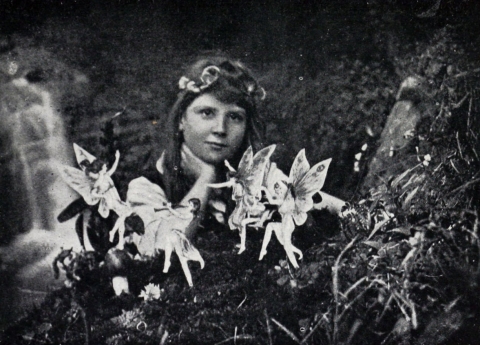
In a previous post, we brought you what is likely the only appearance on film of Sir Arthur Conan Doyle—an interview in which he talks of Sherlock Holmes and spiritualism. Although Conan Doyle created one of the most hardnosed rational characters in literature, the author himself later became converted to a variety of supernatural beliefs, and he was taken in by a few hoaxes. One such famous hoax was the case of the so-called “Cottingley Fairies.” As you can see from the photo above (from 1917), the case involved what Conan Doyle believed was photographic evidence of the existence of fairies, documented by two young Yorkshire girls, Elsie Wright and her cousin Frances Griffiths (the girl in the photo above). According to The Haunted Museum, the story of Doyle’s involvement goes something like this:
In 1920, Conan Doyle received a letter from a Spiritualist friend, Felicia Scatcherd, who informed of some photographs which proved the existence of fairies in Yorkshire. Conan Doyle asked his friend Edward Gardner to go down and investigate and Gardner soon found himself in the possession of several photos which showed very small female figures with transparent wings. The photographers had been two young girls, Elsie Wright and her cousin, Frances Griffiths. They claimed they had seen the fairies on an earlier occasion and had gone back with a camera and photographed them. They had been taken in July and September 1917, near the Yorkshire village of Cottingley.
The two cousins claimed to have seen the fairies around the “beck” (a local term for “stream”) on an almost daily basis. At the time, they claimed to have no intention of seeking fame or notoriety. Elsie had borrowed her father’s camera on a host Saturday in July 1917 to take pictures of Frances and the beck fairies.
Elsie’s father, a skeptic, filed the photos away as a joke, but her mother, Polly Wright, believed, and brought the images to Gardner (there were only two at first, not “several”), who circulated them through the British spiritualist community. When Conan Doyle saw them in 1920, he gave each girl a camera and commissioned them to take more. They produced three additional prints. The online Museum of Hoaxesdetails each of the five photos from the two sessions with text from Edward Gardner’s 1945 Theosophical Society publication The Cottingley Photographs and Their Sequel.
These photos swayed thousands over the course of the century, but arch-skeptic James Randi seemingly debunked them for good when he pointed out that the fairies were ringers for figures in the 1915 children’s book Princess Mary’s Gift Book, and that the prints show discrepancies in exposure times that clearly point to deliberate manipulation. The two women, Elsie and Frances, finally confessed in the early 1980s, fifty years after Conan Doyle’s involvement, that they had faked the photos with paper cutouts. Watch Randi and Elsie Wright discuss the trickery above.
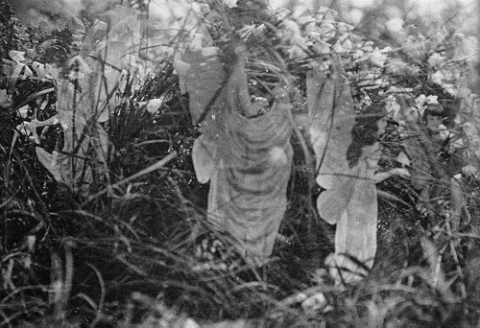
The daughter and granddaughter of Griffiths possess the original prints and one of Conan Doyle’s cameras. Both once believed that the fairies were real, but as the host explains, they were not simply credulous fools. Throughout much of the twentieth century, people looked at the camera as a scientific instrument, unaware of the ease with which images could be manipulated and staged. But even as Frances admitted to the fakery of the first four photos, she insisted that number five was genuine. Everyone on the show agrees, including the host. Certainly Conan Doyle and his friend Edward Gardner thought so. In the latter’s description of #5, he wrote:
This is especially remarkable as it contains a feature quite unknown to the girls. The sheath or cocoon appearing in the middle of the grasses had not been seen by them before, and they had no idea what it was. Fairy observers of Scotland and the New Forest, however, were familiar with it and described it as a magnetic bath, woven very quickly by the fairies and used after dull weather, in the autumn especially. The interior seems to be magnetised in some manner that stimulates and pleases.
I must say, I remain seriously unconvinced. Even if I were inclined to believe in fairies, photo number five looks as phony to me as numbers one through four. But the Antiques Roadshow appearance does add a fun new layer to the story and an air of mystery I can’t help but find intriguing, as Conan Doyle did in 1920, if only for the historical angle of the three generations of Griffiths who held onto the legend and the artifacts. Oh, and the appraisal for the five original photos and Arthur Conan Doyle’s camera? Twenty-five to thirty-thousand pounds—not too shabby for an adolescent prank.
Josh Jones is a freelance writer, editor, and musician based in Washington, DC. Follow him @jdmagness
What is entering the public domain in the United States? Nothing. Once again, we will have nothing to celebrate this January 1st. Not a single published work is entering the public domain this year. Or next year. In fact, in the United States, no publication will enter the public domain until 2019. Even more shockingly, the Supreme Court ruled in 2012 that Congress can take back works from the public domain. Could Shakespeare, Plato, or Mozart be pulled back into copyright? The Supreme Court gave no reason to think that they could not be.
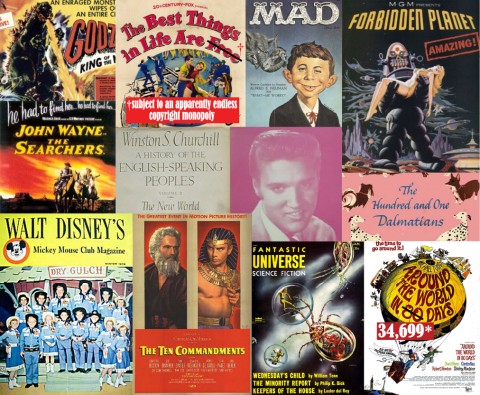
The Center then goes on to enumerate the works that would have entered the commons had we lived under the copyright laws that prevailed until 1978. Under those laws, “thousands of works from 1956 would be entering the public domain. They range from the films The Best Things in Life Are Free, Around the World in 80 Days, Forbidden Planet, and The Man Who Knew Too Much, to the Phillip K. Dick’s The Minority Report and Eugene O’Neill’s Long Day’s Journey into Night, to seminal articles on artificial intelligence.” Have a look at some of the others, several of which appear in the mosaic above.
Ask a photographer from the century that just passed to name his or her favorite film, and the answer, very often, will be Kodachrome.
The crisp emulsion, beautifully saturated colors and archival stability of Kodachrome made it a sentimental favorite among photographers long after other, more practical color films had all but pushed it out of the marketplace. The problem was, the very qualities that made the film special stemmed from a highly cumbersome technical process. Kodachrome was a “non-substantive” film, meaning the dye couplers were not built into the emulsion, as they are in other color films, but had to be added during development. The process was complex, and few labs could afford to offer it. Even before the digital revolution, Kodachrome was an endangered species.
So while it came as an emotional shock to many photographers, it was no real surprise when the Eastman Kodak Company announced in 2009 that it was halting production of Kodachrome. One of the photographers who had long-since moved on to digital imaging but who was saddened by the demise of Kodachrome was Steve McCurry, an award-winning photojournalist for National Geographic who is best known for his haunting 1984 image (shot on Kodachrome) of a 12-year-old Afghan refugee girl with piercing green eyes. When McCurry heard the news, he arranged to obtain the very last roll of Kodachrome to come off the assembly line at the Kodak plant in Rochester, New York. The challenge, then, was this: What do you do with the last 36 exposures of a legendary film?
The half-hour documentary above from National Geographic tells the story of that roll and how McCurry used it. The filmmakers followed the photographer on an odyssey that began at the factory in Rochester and ended at a laboratory (the last Kodachrome lab open) in a small town in Kansas. Over the course of about six weeks, from late May to early July, 2010, McCurry traveled halfway around the world to make those final 36 exposures. The resulting photographs iclude street scenes in New York and Kansas, portraits of a movie star (Robert De Niro) in New York, intellectuals and ethnic tribesmen in India, colleagues in Turkey and New York, and one of himself. It’s a remarkable take. Although a few of the shots appear spontaneous, most are the result of careful planning. McCurry donated all 36 slides to the George Eastman House International Museum of Photography and Film, but you can see almost all of the photos online at the Vanity Fair Web site. As McCurry tells the magazine:
I’ve been shooting digital for years, but I don’t think you can make a better photograph under certain conditions than you can with Kodachrome. If you have good light and you’re at a fairly high shutter speed, it’s going to be a brilliant color photograph. It had a great color palette. It wasn’t too garish. Some films are like you’re on a drug or something. Velvia made everything so saturated and wildly over-the-top, too electric. Kodachrome had more poetry in it, a softness, an elegance. With digital photography, you gain many benefits [but] you have to put in post-production. [With Kodachrome] you take it out of the box and the pictures are already brilliant.
Ornithologists and bird watchers rejoice. After a dozen years, The Cornell Lab of Ornithology’s Macaulay Library has fully digitized its nearly 150,000 audio recordings (a total running time of 7,513 hours), representing close to 9,000 different species, such as the very unsettling-sounding Barred Owl (above). While the collection also includes the sounds of whales, elephants, frogs, primates, and other animals, the primary emphasis here is on birds (it is a Lab of Ornithology, after all), and there is an incredible range of calls. Cornell recommends some of the highlights below:
Earliest recording: Cornell Lab founder Arthur Allen was a pioneer in sound recording. On a spring day in 1929 he recorded this Song Sparrow sounding much as they do today
Most likely to be mistaken for aliens arriving: Birds-of-paradise make some amazing sounds – here’s the UFO-sound of a Curl-crested Manucode in New Guinea
Whether you’re an enthusiastic birder, practicing scientist, or sound-sample hunter, you’ll find something to blow your mind at the extensive collections of the Macaulay Library. Both amateur and professional naturalists, for example, can acquire, visualize, measure, and analyze animal sounds with a free version of the Cornell Lab’s proprietary interactive sound analysis software, Raven.
And admirers of the astonishing variety and beauty of the bird-of-paradise should stay tuned for the Bird-of-Paradise Project website, launching this month. Sign up to receive an email when the full site launches. Meanwhile, watch the project’s spellbinding trailer below.
We're hoping to rely on loyal readers, rather than erratic ads. Please click the Donate button and support Open Culture. You can use Paypal, Venmo, Patreon, even Crypto! We thank you!
Open Culture scours the web for the best educational media. We find the free courses and audio books you need, the language lessons & educational videos you want, and plenty of enlightenment in between.