Founded by Rick Prelinger in 1983, The Prelinger Archives have amassed thousands of “ephemeral” films — advertising, educational, industrial, and amateur films of “historic significance” that haven’t been collected elsewhere. We’ve featured some gems from the Archive in months past. Remember How to Spot a Communist (1955) or Have I Told You Lately I Love You (1958)?
Among other things, the archive features some 2,000 public domain films, which people are free to remix and mashup however they like. Some time ago, Shaun Clayton got into the spirit, took a series of 1950’s and 60’s-era coffee commercials from the Archives (like the one below), and “edited them down to just the moments when the guys were the biggest jerks to their wives about coffee.” The point of the exercise, I’d like to think, wasn’t just to show men being jerks for the sake of it, but to throw into stark relief the disturbing attitudes coursing through American advertising and culture during that era. And nothing accomplishes that better than mashing up the scenes, placing them side by side, showing them one after another. It gives a clear historical reality to views we’ve seen treated artistically in shows like Mad Men.
Just for the record, I make my own coffee.
If you would like to sign up for Open Culture’s free email newsletter, please find it here. It’s a great way to see our new posts, all bundled in one email, each day.
If you would like to support the mission of Open Culture, consider making a donation to our site. It’s hard to rely 100% on ads, and your contributions will help us continue providing the best free cultural and educational materials to learners everywhere. You can contribute through PayPal, Patreon, and Venmo (@openculture). Thanks!
Here’s a challenge: for every book recommended to you by Amazon, pick one from the site Neglected Books. No fancy algorithms here, just old-fashioned serendipity, and you’re unlikely to see much overlap. You will be rewarded with book after fascinating book that has slipped through the usual marketing channels and fallen into obscurity. Most of the authors come recommended by well-known names, making them writers’ writers—people whose writerly difficulty or peculiar subject matter can narrow their readership.
This is not entirely a fair assessment, and in many cases, the work that achieves literary notoriety does so by chance, not mass appeal, but it is undoubtedly the case that certain kinds of writers write for certain kinds of readers. The literary editor Malcolm Cowley, helming The New Republic in 1934, thought so, and lamented a system that prevented books from reaching their intended readers. In a call to “America’s leading novelists and critics,” Cowley asked for lists of such books—and in perhaps a retroactive vindication of the listicle—published them in two articles, “Good Books That Almost Nobody Has Read” and “More About Neglected Books.” Neglected Books, the website, quotes Cowley’s announcement:
Each year… a few good books get lost in the shuffle. It may not be the fault of the publisher, the critic, the bookseller, it may not be anybody’s fault except that of the general system by which too many books are distributed with an enormous lot of ballyhoo to not enough readers. Most of the good books are favorably reviewed, yet the fact remains that many of them never reach the people who would like and profit by them, the people for whom they are written.
Cowley asked his targets to suggest “two or three or four” names and “a few sentences identifying them.” He got lists from about a dozen writers, including lions like F. Scott Fitzgerald, John Dos Passos, Sinclair Lewis, Thornton Wilder and critic Edmund Wilson, who gets a mention in both Fitzgerald’s and Dos Passos’ lists. (Fitzgerald also offered three other titles Miss Lonelyhearts by Nathanael West; Sing Before Breakfast by Vincent McHugh and Through the Wheat by Thomas Boyd.) Dos Passos, unlike most of the men, names a few women writers, including Agnes Smedley, now revealed to have been a triple agent for the Soviets, the Chinese, and Indian nationalists, “one of the most prolific female spies of the 20th century.” Dos Passos’ commentary on her autobiography Daughter of Earth—which he misremembers as Woman of Earth—is mostly understated: “An uneven but impressive I suppose autobiographical narrative of a young woman’s life in a Western mining camp and in New York.”
Libertarian journalist Susan La Follette, one of the few women writers surveyed, offers only one suggestion, Ilya Ilf and Evgeny Petrov’s 1931 comedic Russian novel The Golden Calf. The description alone in this L.A. Times review of a 2010 translation has me thinking this may indeed be an overlooked masterwork of totalitarian satire. La Follette said as much three years after its publication, writing of her disappointment, “I take this quite personally, because so few people even know about it that I rarely find anyone who can laugh over it with me.”
While The New Republic is well-known as a left-of-center publication, the meaning of the American Left in the thirties was much more inclusive, even of avowed Marxists like The New Masses editor Isidor Schneider, who names Imperialism, and The State and Revolution by Lenin and Leninism by Joseph Stalin. Next to the irony of naming two books that thousands have been coerced to read, Schneider contrarily names the The Poems of Gerard Manley Hopkins, from the aesthetically radical, but earnestly religiously conservative Irish Jesuit poet. (The latter two suggestions did not make publication since Schneider’s list was already quite long.)
As interesting as the lists themselves is the selection of responses to the second article. William Saroyan writes in to recommend Grace Stone Coates’ Black Cherry as the “finest prose you ever saw.” And legendary publisher Alfred A. Knopf writes with a lengthy and detailed explanation of the books listed that he published. Of one book named, Franz Kafka’s The Castle, Knopf writes, “The Castle is one of my really inglorious failures. It is, as Conrad Aiken says, a masterpiece. But in the original edition it sold only 715 copies, and since January 3, 1933, we have been offering it at the reasonable price of $1 and only 120 copies have been purchased.”
Perhaps the most famous of all literary recluses, despite herself, Emily Dickinson left a posthumously discovered cache of poetry that did not receive a proper scholarly treatment until the publication of The Poems of Emily Dickinson by Thomas H. Johnson in 1955, which made available Dickinson’s complete body of 1,775 poems in their intended state of punctuation and capitalization. For the first time, readers outside the small Dickinson family circle could read the work she circulated privately in so-called “fascicles” as well as the hundreds of poems no one had seen during her lifetime. There is some question over whether Dickinson wished to publish for a wider audience. She shared her work only with family and friends, some of whom published ten of her poems in newspapers between 1850 and 1866, most likely without her knowledge or consent. Many urged Dickinson to publish. Author Helen Hunt Jackson wrote to her: “You are a great poet—and it is a wrong to the day you live in, that you will not sing aloud.” Nevertheless, Dickinson “hesitated,” an important word in her lexicon, expressive of her profound agnostic doubts about the value of fame, success, and immortality.
Possibly due to the lack of scholarly interest before Johnson’s collection, Dickinson’s trove of manuscript drafts has remained scattered across several archives, sending researchers hoofing it to several institutions to view the poet’s handiwork. As of today, that will no longer be necessary with the inauguration of the online Emily Dickinson Archive, “an open-access website for the manuscripts of Emily Dickinson” that brings together thousands of manuscripts held by Harvard, Amherst, the Boston Public Library, the Library of Congress, and four other collections. Though nothing can substitute for the almost mystical feeling of being in the physical presence of a favorite author’s artifacts, the site is an enormous boon to scholars and lay readers alike, since it is open to anyone, unlike most special collections in university libraries (although browsing the thousands of handwritten images can be exhausting unless one knows what to look for).
As The New York Times describes it, the archives’ creation led to some dissention among participating institutions. For the past year, Amherst has maintained an online database of their Dickinson collection (including the manuscript of “The way Hope builds his house,” above). Harvard has been more reluctant to make its manuscripts available. Nevertheless, the project’s general editor, Leslie M. Morris, says that the aim of the archive “was to downplay the issue of ownership and focus on Emily Dickinson and her manuscripts.” No behind the scenes wrangling seems to have interfered with the website’s ease of use. Readers can search the text of manuscript images or browse images by library collection, first line, date, recipient (of letters), or edition. The site also includes a “Lexicon,” with definitions of the poet’s favorite words from her own dictionary, Webster’s 1844 American Dictionary of the English Language, and users can also search for poems by word. All in all it’s an impressive project made all the more so by its free availability.
Worth a quick note: The New York Review of Books has posted an intriguing interview with Supreme Court Justice Stephen Breyer, who reflects on an important moment in his intellectual life — reading Marcel Proust’s À la recherche du temps perdu (In Search of Lost Time) for the very first time … in French. Decades ago, while “working as a legal intern at an American law firm in Paris,” Breyer needed to improve his French. Reading through all seven volumes of Proust’s monumental work seemed like a good way to do it. 3,500 pages and 1.5 million words later, Breyer finished. And then he re-read them again. The first volume of the long novel,Swann’s Way, was published 100 years ago, in 1913. Asked why he still cherishes Proust’s work so much, Breyer had this to say:
It’s all there in Proust—all mankind! Not only all the different character types, but also every emotion, every imaginable situation. Proust is a universal author: he can touch anyone, for different reasons; each of us can find some piece of himself in Proust, at different ages.… What is most extraordinary about Proust is his ability to capture the subtlest nuances of human emotions, the slightest variations of the mind and the soul. To me, Proust is the Shakespeare of the inner world.
You can read the full interview at NYRB, which gets into to some fascinating questions, like Why is literature crucial to a democracy? and Does reading the US Constitution having anything in common with reading a great literary work?
In 1948, Jack Kerouac first started talking about a “Beat Generation,” by which he meant a “swinging group of new American men intent on joy.” Ten years later, the term, now commonplace in America’s lexicon, was getting co-opted by the mainstream media, and not for the better. “Beat” had become a shorthand for “crime, delinquency, immorality, amorality” and more. In 1958, Kerouac delivered a speech at Hunter College where he tried to restore the true principles of the beat movement and sweep aside the fabricated misconceptions. You can listen to a 7 minute excerpt of that speech below, or hear the full speech here:
The next year, Playboy explicitly asked Kerouac to elaborate on the Hunter College speech. He agreed and gave them “The Origins of the Beat Generation,” which, too, you can read online: Page 1 — Page 2 — Page 3 — Page 4.
By ’59, Allen Ginsberg, the poet laureate of the Beats, knew there was little use in trying to reappropriate the term from the magazines and marketers. When asked to define the word, he effectively refused to play the game. But famed anthropologist Margaret Mead, a more neutral outside observer, was willing to take a shot. Listen below, or hear a slightly longer audio clip here:
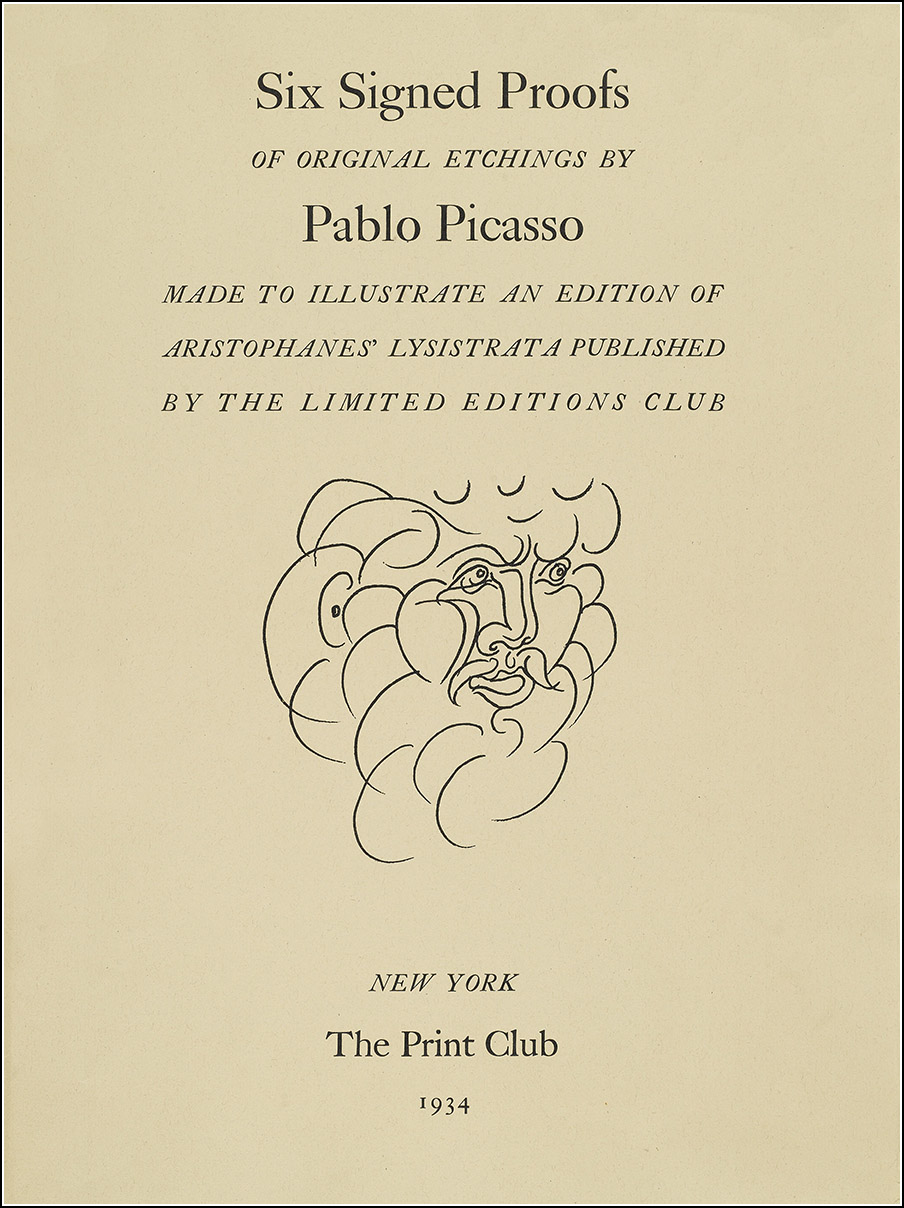
In the mid-1930s, some beautiful, high-quality books were published by a company called Limited Editions Club, which, according to Antiques Roadshow appraiser Ken Sanders, was “famous for re-issuing classics of literature and commissioning contemporary living artists to illustrate 1500-copy signed limited editions.” One of those books—the 1934 Pablo Picasso-illustrated edition of Aristophanes’ Lysistrata—is, next to Henri Matisse’s 1935 edition of Joyce’s Ulysses, one of “the most sought after and desirable limited editions on the market today.”
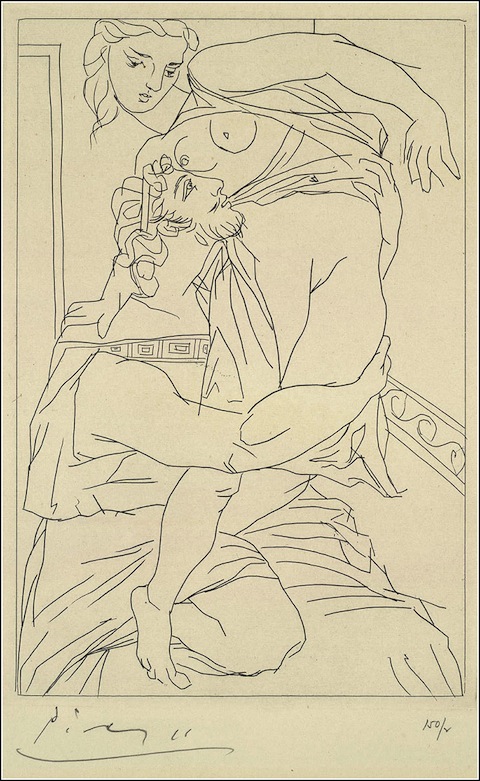
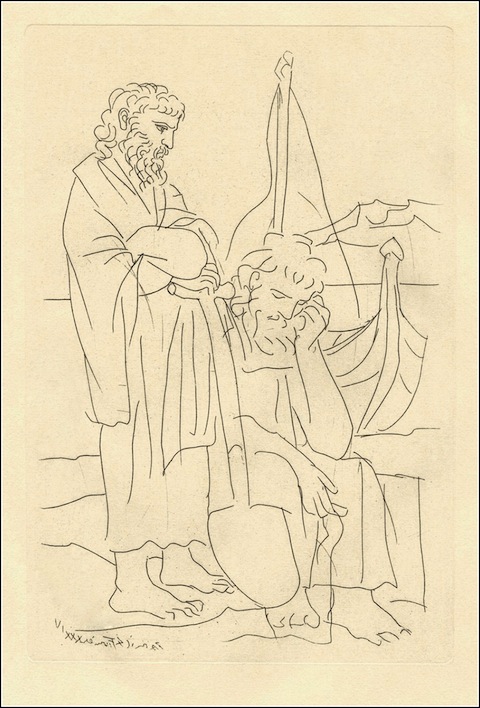
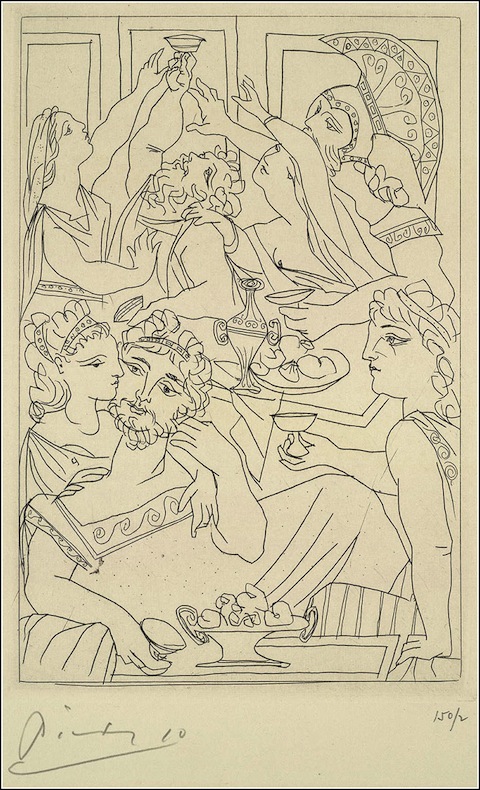
The book’s rarity, of course, renders it more valuable on the market than a mass-produced object, but whether it was worth $5,000 or $50, I think I’d hold onto my copy if I had one (here’s one for $12,000 if you’re buying). While Aubrey Beardsley’s 1896 illustrations do full and stylish justice to the satirical Greek comedy’s bawdy nature, Picasso’s drawings render several scenes as tender, softly sensual tableaux. The almost childlike simplicity of these illustrations of a play about female power and the limits of patriarchy do not seem like the work of a rumored misogynist, but then again, neither do any of Picasso’s other domestic scenes in this spare, rounded style of his.
In Aristophanes’ play, the women of Greece refuse their husbands sex until the men agree to end the Peloponnesian War. The play makes much of the men’s mounting sexual frustration, with several humorous gestures toward its physical manifestations. Beardsley’s drawings offend Victorian eyes by making these scenes into exaggerated nudist farce. Picasso’s modernist sketches all but ignore the overt sexuality of the play, picturing two lovers (2nd from top) almost in the posture of mother and child, the pent up men (image above) as dejected and downcast gentle souls, and the reunion of the sexes (below) as a highly stylized, none too erotic, feast. These images are three of six signed proofs featured on the blog Book Graphics. See their site to view all six illustrations.
What did Banksy’s month-long show, “Better Out than In,” bring today? Why nothing other than a miniature version of The Great Sphinx of Giza. According to the street artist’s web site, the 22nd installment in the exhibition is a “1/36 scale replica of the great Sphinx of Giza made from smashed cinderblocks.” And it comes with the warning, “You’re advised not to drink the replica Arab spring water.”
The Blank on Blank “Lost Interview” series continues to roll along. Today, they’ve released an animated video based on a July, 1993 interview with Nirvana frontman Kurt Cobain. Recorded less than a year before his death, the interviewer, Jon Savage, finds Cobain feeling relatively optimistic, upbeat, better than he’d felt in years. The interview touches on many things, but, if there’s a common theme, it’s identity — Cobain’s Irishness, his questions about his sexuality as a younger man, his views on women and sexism, his sense of being an outsider throughout his childhood, and how punk music saved him from all of that. Previous Blank on Blank videos have revived interviews from Ray Charles, Janis Joplin, David Foster Wallace, Jim Morrison & Dave Brubeck. For footage of Kurt Cobain back in the day, see some of the choice material below.
We're hoping to rely on loyal readers, rather than erratic ads. Please click the Donate button and support Open Culture. You can use Paypal, Venmo, Patreon, even Crypto! We thank you!
Open Culture scours the web for the best educational media. We find the free courses and audio books you need, the language lessons & educational videos you want, and plenty of enlightenment in between.