“Tintin addicts are a mixed bunch,” writes New Yorker critic Anthony Lane, profiling the beloved plus fours-clad, quiff-topped adventurer and thereby revealing himself as one of the afflicted. “Steven Spielberg and Peter Jackson [have] a three-picture deal to bring Tintin to the big screen. I once heard Hugh Grant declare on a radio program that if he could take only one book to a desert island it would be King Ottokar’s Sceptre (1939). [ … ] General de Gaulle declared that Tintin was his only international rival — he was envious, perhaps, not just of Tintin’s fame but of the defiantly positive attitude that he came to represent.” Despite coming from America, one of the few countries never to have taken wholeheartedly to the character, I too have read and re-read the 23 full-length comic books (or as we call them nowadays, graphic novels) in which he stars, and I too envy his qualities, especially the useful amorphousness of his identity: neither man nor boy; neither traditional nor modern; presumably Belgian, though for practical purposes stateless and apolitical; ostensibly a reporter, but no apparent need ever to file a story.
The late Harry Thompson surely ranks as a top Tintin addict. A radio and television producer, comedy writer, novelist, and creator of Have I Got News for You, he also greatly advanced the widespread avocation of English-language Tintinology with his book Tintin: Hergé and his Creation, published in 1991. Three years later, he would star in this episode of London Weekend Television’s documentary series Opening Shot on Tintin and his creator (part one at the top, click for two and three). His analysis swiftly assures any adult reader just how and why they should go about picking up and appreciating the truly painstaking craftsmanship of these comics they so relished in their youth. The broadcast also features commentary from Tintin’s English translators and, through archival footage, from Georges “Hergé” Remi himself (seen drawing Tintin just above, and his companion Captain Haddock below). Finally, we hear from more typical Tintin readers in man-on-the-street interviews — or rather, precocious-British-child-in-the-bookstore interviews: “My favorite character is Snowy, because he says really rude things.” “My favorite book is Tintin in America, because I like red Indians.” How many of these kids, nearly two decades on, can have resisted the siren song of Tintinology themselves?
In early 1990 Steve Jobs granted a very rare interview to the makers of a PBS NOVA miniseries called The Machine that Changed the World.
The producers of the series had a tough time getting Jobs to talk with them. They had already interviewed Bill Gates, Steve Wozniak and most of the other founding fathers of the personal computing revolution, but the reclusive Jobs brushed off all requests. “As we started the series,” writes Nancy Linde at the NOVA Web site, “we were warned time and time again. ‘You ‘ll never get Steve Jobs on camera.’ ” After multiple requests, Jobs finally replied with a terse “No, thank you.” Linde continues:
But we had an ace up our sleeve by the name of Robert Noyce. A legend in the computer world as the co-inventor of the microchip and co-founder of Intel, Bob Noyce was a strong supporter of The Machine That Changed the World and served on our advisory board. Like most in Silicon Valley, Steve Jobs revered Bob Noyce, and a one-paragraph letter from Noyce changed Jobs’ “no” into a “yes,” giving our series one of a limited number of interviews Steve Jobs gave in his short lifetime.
At the time of the interview, Jobs was 35 years old and about midway through his 11-year exile from Apple. He was working with NeXT, the computer company he founded after being pushed out of Apple in 1985. In keeping with the theme of the miniseries, the interview deals mostly with the big picture. Jobs talks about the role of the computer in human life, and about the emergence and evolution of personal computing. He tells the story of how he and his early friend Wozniak (referred to in the interview as “Woz”) turned a hobby into a business and developed the Apple I and Apple II computers. He very briefly touches on the first two drivers of the personal computing revolution — spreadsheets and desktop publishing — before talking at length about the revolution that was yet to come: networked computing. The World Wide Web had barely been created in 1990, and Jobs is fairly prescient in his predictions of how the linking of computers would change the world.
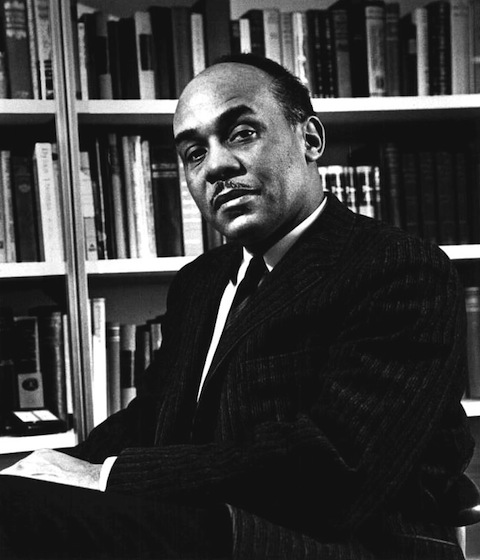
We’re smack in the middle of Banned Books Week, and one particular case of book-banning has received a lot of attention lately, that of Ralph Ellison’s classic 1952 novel Invisible Man, which was censored by the Randolph County, NC school board last week. In response to one parent’s complaint, the board assessed the book, found it a “hard read,” and voted 5–2 to remove it from the high school libraries (prompting the novel’s publisher to give copies away for free to students). One board member stated that he “didn’t find any literary value” in Ellison’s novel, a judgment that may have raised the eyebrows of the National Book Award judges who awarded Ellison the honor in 1953, not to mention the 200 authors and critics who in 1965 voted the novel “the most distinguished single work published in the last twenty years.”
After widespread public outcry, the Randolph County reversed the decision in a special session yesterday. In light of the book’s newfound notoriety after this story, we thought we’d revisit a Paris Review interview Ellison gave in 1954. The interviewers press Ellison on what they see as some of the novel’s weaknesses, but describe Ellison’s masterwork as “crackling, brilliant, sometimes wild, but always controlled.” Below are some highlights from this rich conversation. This interview would not likely sway those shamefully unlettered school board members, but fans of Ellison and those just discovering his work will find much here of merit. Ellison, also an insightful literary critic and essayist, discusses at length his intentions, influences, and theories of literature.
On his literary influences:
Ellison, who says he “became interested in writing through incessant reading,” cites a number of high modernist writers as direct influences on his work. T.S. Eliot’s The Waste Land piqued his interest in 1935, and in the midst of the Depression, while he and his brother “hunted and sold game for a living” in Dayton OH, Ellison “practiced writing and studied Joyce, Dostoyevsky, Stein, and Hemingway.” He especially liked Hemingway for the latter’s authenticity.
I read him to learn his sentence structure and how to organize a story. I guess many young writers were doing this, but I also used his description of hunting when I went into the fields the next day. I had been hunting since I was eleven, but no one had broken down the process of wing-shooting for me, and it was from reading Hemingway that I learned to lead a bird. When he describes something in print, believe him; believe him even when he describes the process of art in terms of baseball or boxing; he’s been there.
On literature as protest
Ellison began Invisible Man in 1945, before the Civil Rights movement got going. He drew much of his sense of the novel as a form of social protest from literary sources, claiming that he recognized “no dichotomy between art and protest.”
Dostoyevsky’s Notes from Underground is, among other things, a protest against the limitations of nineteenth-century rationalism; Don Quixote, Man’s Fate, Oedipus Rex, The Trial—all these embody protest, even against the limitation of human life itself. If social protest is antithetical to art, what then shall we make of Goya, Dickens, and Twain?
All novels are about certain minorities: the individual is a minority. The universal in the novel—and isn’t that what we’re all clamoring for these days?—is reached only through the depiction of the specific man in a specific circumstance.
On the role of myth and folklore in literature:
Ellison adapts a tremendous amount of black American folklore in Invisible Man, from folk tales to the blues, to give the novel much of its voice and structure. His use of folk forms springs from his sense that “Negro folklore, evolving within a larger culture which regarded it as inferior, was an especially courageous expression” as well as his reading of ritual in the modernist masters he admired. Of the use of folklore and myth, Ellison says,
The use of ritual is equally a vital part of the creative process. I learned a few things from Eliot, Joyce and Hemingway, but not how to adapt them. When I started writing, I knew that in both “The Waste Land” and Ulysses, ancient myth and ritual were used to give form and significance to the material; but it took me a few years to realize that the myths and rites which we find functioning in our everyday lives could be used in the same way. … People rationalize what they shun or are incapable of dealing with; these superstitions and their rationalizations become ritual as they govern behavior. The rituals become social forms, and it is one of the functions of the artist to recognize them and raise them to the level of art.
On the moral and social function of literature:
Ellison has quite a lot to say in the interview about what he sees as the moral duty of the novelist to address social problems, which he relates to a nineteenth century tradition (referencing another famously banned book, Huckleberry Finn). Ellison faults the contemporary literature of his day for abandoning this moral dimension, and he makes it clear that his intention is to see the social problems he depicts as great moral questions that American literature should address.
One function of serious literature is to deal with the moral core of a given society. Well, in the United States the Negro and his status have always stood for that moral concern. He symbolizes among other things the human and social possibility of equality. This is the moral question raised in our two great nineteenth-century novels, Moby-Dick and Huckleberry Finn. The very center of Twain’s book revolves finally around the boy’s relations with Nigger Jim and the question of what Huck should do about getting Jim free after the two scoundrels had sold him. There is a magic here worth conjuring, and that reaches to the very nerve of the American consciousness—so why should I abandon it? …Perhaps the discomfort about protest in books by Negro authors comes because since the nineteenth century, American literature has avoided profound moral searching. It was too painful and besides there were specific problems of language and form to which the writers could address themselves. They did wonderful things, but perhaps they left the real problems untouched.
Back in 1983, the BBC aired Fun to Imagine, a television series hosted by Richard Feynman that used physics to explain how the everyday world works. Here, in language that makes sense to anyone with a basic grounding in science, the Nobel Prize-winning physicist answered questions like, Why can’t tennis balls bounce forever? What are we really seeing when we look in the mirror? And, as shown above, why are rubber bands stretchy? The clip comes from Fun to Imagine, and thanks to this dedicated BBC website, you can watch online all six videos in the series, each running about 12 minutes. (If you have any difficulty viewing them at the BBC, simply watch the all-in-one video below.) But beware, Feynman’s enthusiasm for science is contagious. So watch the clips at your own risk, and be prepared to start playing with bouncy, stretchy things during your free time, hopefully with a big smile on your face.
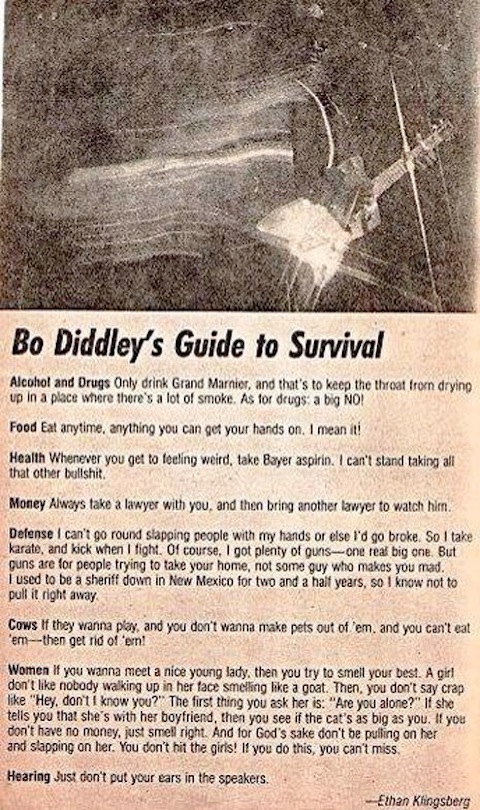
Some people think Chuck Berry invented rock and roll. Chuck Berry sure thinks so. But I say it was Bo Diddley. At least Diddley invented the rock and roll I love—throbbing, dirty, hypnotic, hovering in some space between the blues, gospel and African rhythms but also with its feet firmly planted on any industrial city streetcorner. Bo Diddley invented irony in rock (his first band was called “The Hipsters”). Bo Diddley never pandered to the teenybopper crowd (though he did go commercial in the 80s). Even his biggest hits have about them an otherworldly air of echo‑y weirdness, with their signature beat and one-note drone. Also something vaguely sleazy and maybe a little sinister, essential elements of rock and roll worthy of the name.
So, as a man who made his own rhythm, his own tones, his own studio, and his own guitar—who was so much his own man that one of his best known songs is named after him—it stands to reason that he would also make his own set of rules for surviving the music business. Called “Bo Diddley’s Guide to Survival,” the list covers all the bases: drugs and booze (“NO!”), food (“anything you can get your hands on”), health, money, defense, cows, women, and hearing. What more is there, really?
The list, clearly part of a magazine feature, has circulated on the internet for some time, but no one has managed to track down the source. It’s probably genuine, though; it sounds like the perfect mix of the down-to-earth and far-out funny that was Bo Diddley. I’m particularly intrigued by his very specific defense techniques (Elvis obviously took notes). It is true, by the way, that Diddley once served as a sheriff in New Mexico, a fact that adds so much to the mystique. Where “Defense” and “Women” get lengthy (and respectful) treatments, his succinct take on “Hearing” is as practical as it gets.
See the original list at the top and read the full transcript below. As you do, listen to the timeless weirdness of “Bo Diddley” above. There’s nothing else like it.
Alcohol and Drugs Only drink Grand Marnier, and that’s to keep the throat from drying up in a place where there’s a lot of smoke. As for drugs: a big NO!
Food Eat anytime, anything you can get your hands on. I mean it!
Health Whenever you get to feeling weird, take Bayer aspirin. I can’t stand taking all that other bullshit.
Money Always take a lawyer with you, and then bring another lawyer to watch him.
Defense I can’t go around slapping people with my hands or else I’d go broke. So I take karate, and kick when I fight. Of course, I got plenty of guns — one real big one. But guns are for people trying to take your home, not some guy who makes you mad. I used to be a sheriff down in New Mexico for two and a half years, so I know not to pull it right away.
Cows If they wanna play, and you don’t wanna make pets out of ‘em, and you can’t eat ‘em — then get rid of ‘em!
Women If you wanna meet a nice young lady, then you try to smell your best. A girl don’t like nobody walking up in her face smelling like a goat. Then, you don’t say crap like “Hey, don’t I know you?” The first thing you ask her is: “Are you alone?” If she tells you that she’s with her boyfriend, then you see if the cat’s as big as you. If you don’t have no money, just smell right. And for God’s sake don’t be pulling on her and slapping on her. You don’t hit the girls! If you do this, you can’t miss.
Hearing Just don’t put your ears in the speakers.
From the mid-1940s to the mid-1970s, Coronet Instructional Media, that formidable factory of classroom educational films, taught America’s schoolchildren how to study, how to land a job, how to perform their societal and filial duties, how to bathe. Certain generations no doubt retain vivid memories, fond or otherwise, of such 16-millimeter standbys as Good Eating Habits, Joan Avoids a Cold, Are You Popular?and Communism. In 1949, Coronet came up with a short subject rather closer to the eternal interests of the teenager: Dating: Do’s and Don’ts. This twelve-minute film, directed Gilbert Altschul with the assistance of Reuben Hill, Research Professor of Family Life at the University of North Carolina, navigates the garden of forking paths formed by all the choices, from ideally gentleman-like to potentially disastrous, that confront young Woody on his very first date.
Who, for instance, should Woody ask to join him at Central High’s Hi-Teen Carnival? “Whose company would you enjoy?” asks the voice-of-midcentury-authority narrator.” “Well, one thing you can consider is looks. Woody thought of Janice, and how good-looking she was. He really had to rate to date somebody like her.” Still: “It’s too bad Janice always acts so superior and bored. She’d make a fellow feel awkward and inferior.” Perhaps the more grounded Betty? “And yet, it just doesn’t seem as if she’d be much fun. What about Anne? She knows how to have a good time.” Even 64 years on, I daresay fellows would still do well to cleave to the Annes of the world. But given how far the pendulum of sexual politics has swung since Coronet’s heyday, other pieces of of Dating: Do’s and Don’ts advice seems more quaint than current. For a more modern perspective, see also How to Be a “Mr. Good-Date,” a Looney Tunes parody starring Bugs Bunny as the hopeful suitor Reggie Gerandevu and Elmer Fudd as the protective homeowner of whom he runs afoul.
Earlier this month, we highlighted The 10 Greatest Films of All Time According to 846 Film Critics. Featuring films by Hitchcock, Kubrick, Welles and Fellini, this master list came together in 2012 when Sight & Sound(the cinema journal of the British Film Institute) asked contemporary critics and directors to name their 12 favorite movies. Nearly 900 cinephiles responded, and, from those submissions, a meta list of 10 was culled.
So how about something similar for books, you ask? For that, we can look back to 2007, when J. Peder Zane, the book editor of the Raleigh News & Observer, asked 125 top writers to name their favorite books — writers like Norman Mailer, Annie Proulx, Stephen King, Jonathan Franzen, Claire Messud, and Michael Chabon. The lists were all compiled in an edited collection, The Top Ten: Writers Pick Their Favorite Books, and then prefaced by one uber list, “The Top Top Ten.”
Zane explained the methodology behind the uber list as follows: “The participants could pick any work, by any writer, by any time period.… After awarding ten points to each first-place pick, nine to second-place picks, and so on, the results were tabulated to create the Top Top Ten List — the very best of the best.”
The short list appears below, along with links to electronic versions of the works (and traditional published editions). There’s one notable exception, Vladimir Nabokov’s Lolita. We couldn’t provide that electronic text, but we do have something special — an audio recording of Nabokov reading a chapter from his controversial 1955 novel.
The texts listed below are permanently housed in our collection of Free eBooks, along with many other classics. In many cases, you’ll find audio versions of the same works in our ever-growing collection of Free Audio Books. If you have questions about how to load files onto your Kindle, please see this related instructional video.
Got an issue with any of the selections? Tell us all about it in the comments section below.
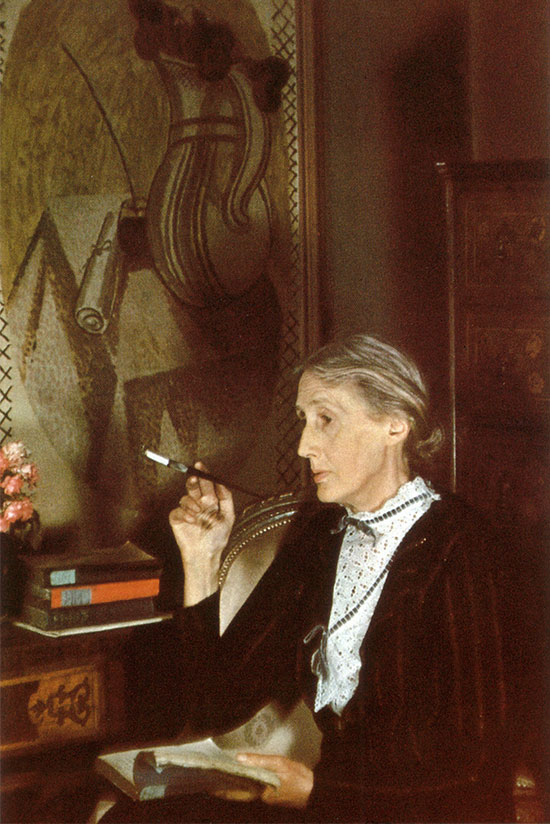
“Gisèle Freund, the German-born photographer who died in 2000 at 91, is both famous and not famous enough,” writes Katherine Knorr in the New York Times. “She was sometimes chagrined to be best known for some of her portraits,” whose luminary subjects included artists, film stars, and writers. At the top, we have Freund’s 1938 shot of James Joyce with his grandson in Paris. Just below, her photograph of a pensive Walter Benjamin from that same year. At the bottom, her 1939 portrait of a smoking Virginia Woolf. (French novelist, theorist and, Minister for Cultural Affairs André Malraux also sported a cigarette in his 1935 portrait by Freund, an image which made it to a postage stamp in 1996, though with his smoke carefully removed.) Former President Jacques Chirac publicly praised Freund’s ability to “reveal the essence of beings through their expressions.” In Woolf’s case, Freund produced the being in question’s first-ever color portrait.
“[Freund] was an early adapter to color, in 1938, and her first exhibition was in fact a projection of color portraits given in Monnier’s book shop,” Knorr writes. She goes on to describe another exhibition, in 2011, that “similarly projects the portraits within its mock bookshop, turning the show into a guessing game since some of those photographed have enormously famous faces,” while others “are a lot of French intellectuals that most young French people today would not recognize.” While we naturally assume that you, as an Open Culture reader, recognize a fair few more French intellectuals than the average gallery-goer, we can’t help but focus on the fact that so many of the writers of whom Freund’s eye saw the definitive images — not just Joyce, Benjamin, and Woolf, but Beckett, Eliot, Hesse, the list goes on — became the defining writers of their era. Freund herself had just one question: “Explain to me why writers want to be photographed like stars,” she wrote, “and the latter like writers.”
We're hoping to rely on loyal readers, rather than erratic ads. Please click the Donate button and support Open Culture. You can use Paypal, Venmo, Patreon, even Crypto! We thank you!
Open Culture scours the web for the best educational media. We find the free courses and audio books you need, the language lessons & educational videos you want, and plenty of enlightenment in between.