You want a gentle introduction to statistics, and maybe those Khan Academy videos aren’t quite working out for you. Well, here’s another approach: statistics explained with modern dance. That’s the novel approach explored by Lucy Irving (Middlesex University) and Andy Field (University of Sussex), who produced four short films demonstrating different statistical concepts through dance. The films touch on Correlation, Frequency Distributions, Sampling and Standard Error, and Variance. Speaking about the project, Irving explained: “We worked with the choreographer and experimented with the dancers to find ways of communicating the concepts. Our hope is that, as well as being fun and educational, the films will demystify and take some of the fear out of statistics. Students often report that ‘the stats’ are the most difficult part of their psychology degree and these the films aim to challenge this by demonstrating that thinking about them in new ways may make them easier to comprehend.” You can follow Lucy on Twitter at @statsdancer.
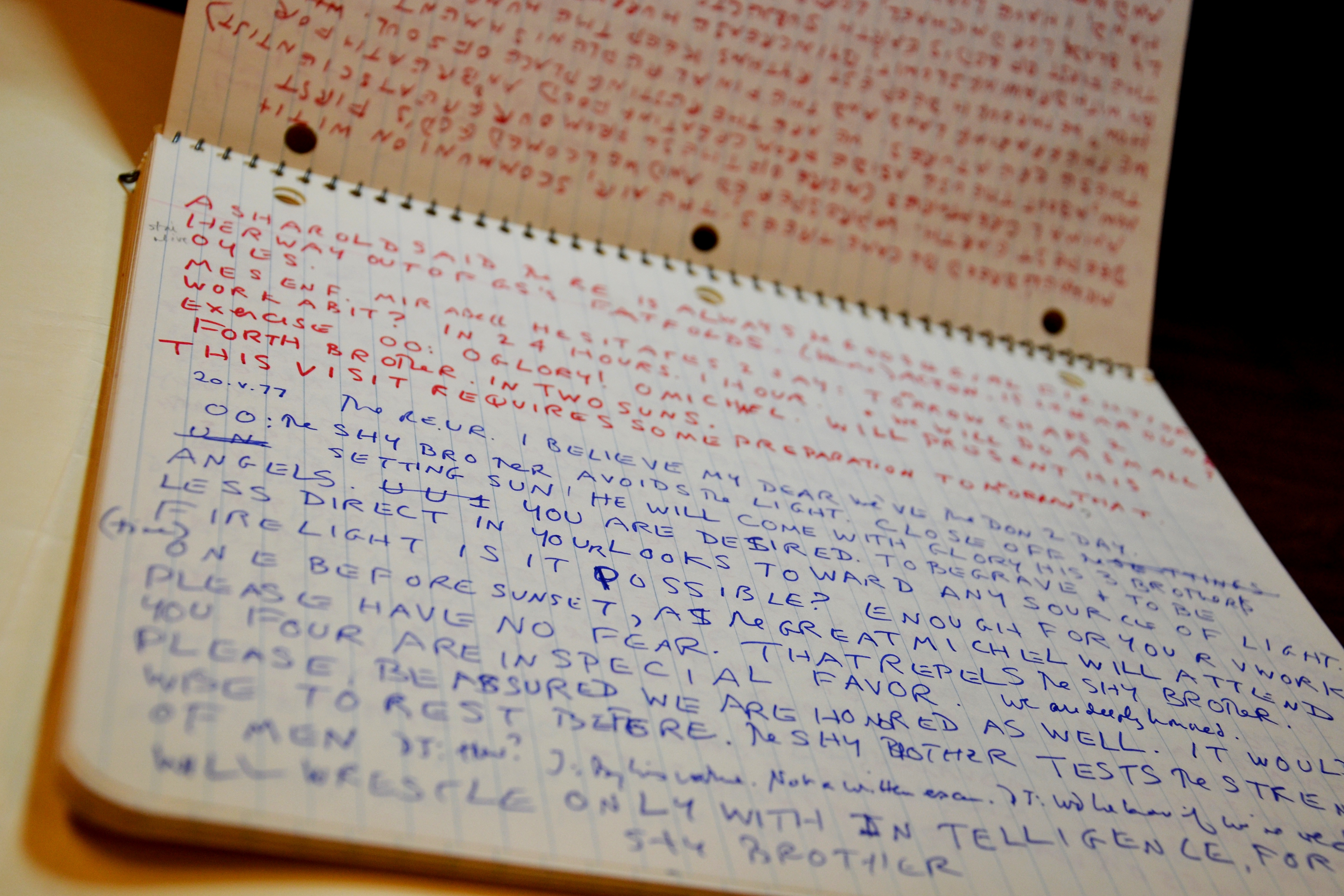
The Ouija-inspired poetry of Pulitzer Prize-winning poet James Merrill (1926–1995) comes alive in a newly launched digital archive from Washington University in St. Louis. Visitors to the site can explore notebook after notebook bearing Merrill’s handwritten notes in all caps—colorful transcripts from his “Thousand and One Evenings Spent/ With [partner] David Jackson at the Ouija Board/ In Touch with Ephraim Our Familiar Spirit.” Merrill, the son of Charles E. Merrill, cofounder of the Merrill Lynch investment firm, was considered one of the most significant American poets of his generation.
The occult was central to all of Merrill’s later work, including “The Book of Ephraim,” which is the current focus of the James Merrill Digital Archive. Merrill’s complex and highly unusual creative process is evident in the materials presented, all of them drawn from the extensive James Merrill Papers housed in the university’s Special Collections.
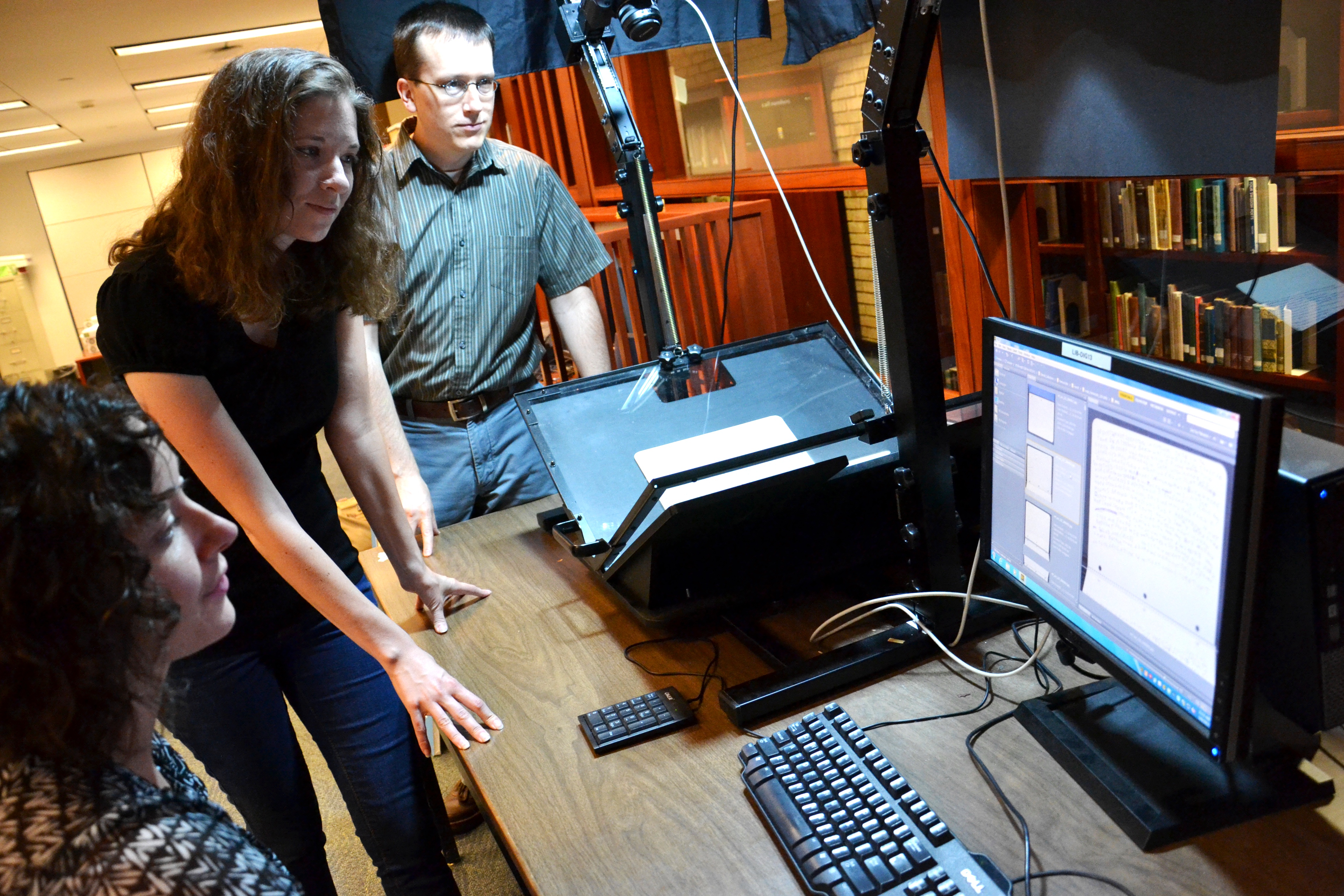
In a description on the site, project collaborator and graduate student Annelise Duerden (pictured at center below) points out that “the opening to ‘The Book of Ephraim’ clamors for a medium ‘that would reach / The widest public in the shortest time,’ and we hope that digital archiving can provide such an entrance to Merrill’s work, and to the richness of the process behind his finished poem.”
Duerden, herself an active poet, says she was impressed by Merrill’s “imaginative force” and “relentless energy for revision” while helping build the archive this past summer along with staff from Washington University Libraries and the Humanities Digital Workshop.
“Merrill originally imagined constructing his story of Ephraim in the form of a novel,” she says. “He planned to write it for some time, began work on it, then lost the pages in a taxi, and gave up on the idea of the novel of Ephraim, instead writing it in poetic form. In a Ouija session, Ephraim later claimed credit for losing the novel.”
“The Book of Ephraim” was first published in Merrill’s book Divine Comedies in 1976 and later as the first installment of his apocalyptic epic The Changing Light at Sandover, one of the longest poems in any language and featuring voices ranging from the then-recently deceased poet W. H. Auden to the Archangel Michael.
Goodreads, that social network for the bookish, recently posted on its blog the results of a survey taken among its 20 million members with the melancholy title “The Psychology of Abandonment.” Complete with infographic, the survey gives us, among other things, a list of the “Top Five Abandoned Classics.” James Joyce’s Ulysses is third on the list, and I’m not at all surprised to find it there. One must know Ulysses, it seems, to merit consideration as a culturally literate person. But Ulysses, perhaps more than any work of modern literature, can easily discourage. It presents us with a landscape so psychologically complex, so dense with literary and historical allusion and contemporary cultural reference, that I cannot say I would have known what to do with it had I not read it under the auspices of an august Irish Joyce scholar and with Don Gifford’s guidebook Ulysses Annotated ready at hand. I had nowhere near the breadth and depth of reading Joyce seems to assume of his ideal reader. Few people do.
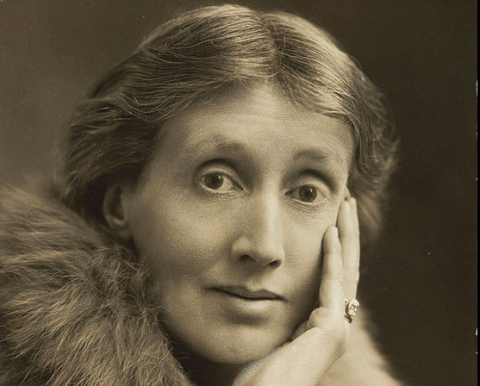
Two of Joyce’s contemporaries, however, had such a grasp of literature and language: T.S. Eliot and Virginia Woolf. And the two had quite a lot to say about the book, much of it to each other. Eliot recommended Joyce’s novel to Woolf, and very soon after its 1922 publication, she purchased her own copy. At the time, Woolf was hard at work on her story “Mrs. Dalloway on Bond Street,” which would eventually grow into her next novel, Mrs. Dalloway. She was also immersed in Proust’s epic Remembrance of Things Past, just beginning the second volume. According to Dartmouth’s James Heffernan, Woolf “chafes at the thought of Ulysses,” writing haughtily:
Oh what a bore about Joyce! Just as I was devoting myself to Proust—Now I must put aside Proust—and what I suspect is that Joyce is one of those undelivered geniuses, whom one can’t neglect, or silence their groans, but must help them out, at considerable pains to oneself.
Heffernan chronicles Woolf’s reading of Ulysses, which she documented in her diary in a “withering assessment” as the work of “a self-taught working man… egotistic, insistent, raw, striking, & ultimately nauseating.” “When one can have cooked flesh,” she writes, “why have the raw?”
This private critical opinion Woolf recorded after reading only 200 pages of the novel. Heffernan makes the case that she read no more thereafter. Though she claimed to have “finished Ulysses,” he takes her to mean she had finished with the book, putting it aside like those bewildered, bored, or exasperated Goodreads members. Nevertheless, Woolf could not shake Joyce. She continued to write about him, to Eliot and herself. “Never did any book so bore me,” she would write, and many more very disparaging remarks about her brilliant contemporary.
Over and again she savaged Joyce in her diaries; so much so that it seems to Heffernan and Woolf scholar Suzette Henke that hers is a case of protesting too much against an author whom, Henke alleges, was her “artistic ‘double,’ a male ally in the modernist battle for psychological realism.” This may indeed be so. In the midst of her characterizations of Joyce as uncouth, boring, “underbred” and worse, she admits in her diary that what she attempted in her fiction was “probably being better done by Mr. Joyce.” While hardly any reader of Ulysses—among those who finish it and those who don’t—can say they are attempting something near what he accomplished, we might all find some solace in knowing that a reader as sharp as Virginia Woolf found his modernist masterpiece either so boring or so intimidating that even she may not have been able to finish it.
Do we have a more energetic commentator on popular culture than Slavoj Žižek, the Slovenian philosophy professor who has risen to the role the Chronicle of Higher Education calls “the Elvis of cultural theory”? In the 2006 essay film The Pervert’s Guide to Cinema, Žižek offered psychoanalytic readings of such pictures as The Red Shoes, Alien, and The Matrix. (See him take on Vertigo in a clip featured here before.) Now he returns with a sequel, The Pervert’s Guide to Ideology. At the top, you can see him expound upon the role of ideology in They Live, John Carpenter’s 1988 science-fiction semi-comedy in which wrestler “Rowdy” Roddy Piper happens upon a pair of sunglasses that, when worn, reveal a host of sinister alien commandments behind advertising and the media. “These glasses function like critique-of-ideology glasses,” Žižek asserts.“We live, so we are told, in a post-ideological society. We are addressed by social authority not as subjects who should do their duty, but subjects of pleasures: ‘Realize your true potential,’ ‘Be yourself,’ ‘Lead a satisfying life.’ When you put the glasses on, you see dictatorship in democracy.”
Just above, Žižek looks into the ideology of The Dark Knight, Christopher Nolan’s second Batman movie. “Who is Joker?” he asks. “Which is the lie he is opposing? The truly disturbing thing about The Dark Knight is that it elevates a lie into a general social principle: the principle of organization of our social, political life, as if our societies can remain stable, can function, only if based on a lie, as if the truth — and this telling the truth is embodied in Joker — means destruction.” Last year at the Toronto International Film festival, Žižek participated in an on-stage conversation about the project (introduction, part one, two), “explaining” in his inimitably roundabout fashion some of the thinking behind these cinematic cultural analyses. The Pervert’s Guide to Ideology also uses other big-name movies like Taxi Driver, Titanic, West Side Story (and Jaws, some of which you can see him comment briefly upon in the trailer) as jumping off points for extended monologues on the unseen forces that he finds shape our beliefs and behavior. Unseen, of course, unless you’ve got those superpowered sunglasses — or unless, even more unconventionally, you’ve got a mind like Slavoj Žižek’s.
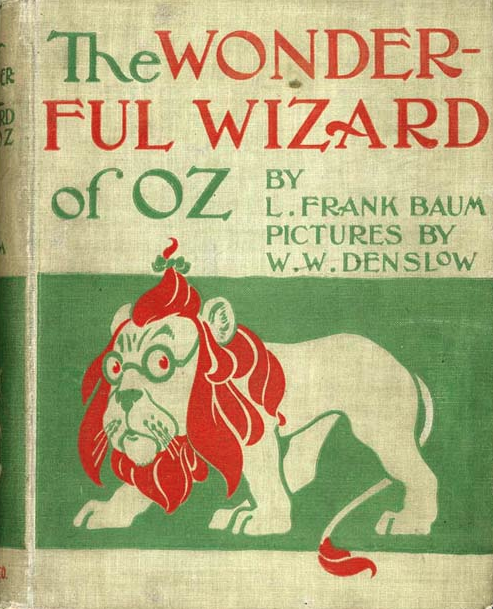
The classic Wizard of Oz series was written by L. Frank Baum between 1900 and 1920. There are 14 volumes in total, starting with the most well-known book, The Wonderful Wizard of Oz. Below we’ve gathered every volume in the series, in both text and audio formats. If you have questions about how to load files onto your Kindle, please see this instructional video. You can find early film adaptations of The Wizard of Oz in our collection of Free Movies Online. Plus elsewhere on our site we have the complete Chronicles of Narnia(in audio)by CS Lewis, another enduring children’s classic.
Note: If you want to read online a first edition copy of The Wonderful Wizard of Oz, you can do so thanks to The Library of Congress. Click here: Page Turner -PDF
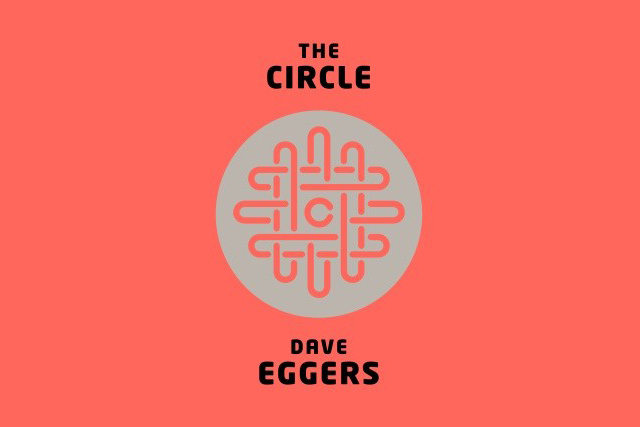
Dave Eggers, author of A Heartbreaking Work of Staggering Genius, has a new book coming out in early October, The Circle, a novel about “a young woman who goes to work at an omnipotent technology company and gets sucked into a corporate culture that knows no distinction between work and life, public and private.” Breaking with tradition, The New York Times has placed the novel’s cover on the cover of its own Sunday Magazine. It has also printed a lengthy excerpt from the book. Read it online here, or listen right below (or on iTunes) to a reading of the excerpt by actor Don Graham. It runs 46 minutes.
One of the defining moments in Elvis Costello’s career happened on December 17, 1977, when he appeared on Saturday Night Live. Costello was 23 years old. His debut album, My Aim Is True, had just come out in America a month earlier. When the Sex Pistols were unable to appear on the show as planned (see their last live concert here), Costello and his recently formed band, the Attractions, got their big break.
They were supposed to play his single “Less Than Zero,” a catchy tune about a loathsome politician in England. But only a few bars into the song, Costello put a stop to it. “I’m sorry, ladies and gentlemen,” he said, “but there’s no reason to do this song here.”
At that point he and the band launched into “Radio Radio,” a song that takes a jab at corporate-controlled broadcasting. Saturday Night Live producer Lorne Michaels was furious. According to some reports, he raised his middle finger at Costello and kept it up until the unapproved song was over. Costello was banned from the show for nearly 12 years. You can learn more about the incident by watching this video from the Daily Guru:
The rift between Costello and Michaels eventually healed, and Costello was invited to appear again on Saturday Night Live in the spring of 1989. Ten years after that, on SNL’s 25th anniversary show, Costello went on the show again and parodied his notorious 1977 appearance by bursting onstage while the Beastie Boys were playing “Sabotage” and ordering them to stop. He and the Boys then launched into a raucous version of “Radio Radio”:
In an interview this month with Details magazine, Costello talks a little about the 1977 incident. “They’ve run that clip forever,” he says, “and every time anybody does anything outrageous on that show, I get name-checked. But I was copying Jimi Hendrix. Hendrix had done the same thing on the Lulu Show, when he went into an unscheduled number. I remember seeing it and going, ‘What the hell’s going on?’ ” To see for yourself what Costello is talking about, visit our post, Jimi Hendrix Wreaks Havoc on the Lulu Show, Gets Banned From BBC.
Their conversation has been resurrected as a four minute animation for PBS Digital Studios’ Blank on Blank series. The cartoon Janis bears a close resemblance to Gloria Steinem, an uncomfortable fit once the topic turns from her sadness at critical rejection to the sisterhood’s alleged withholding of affection.
Smith hits his subject with some leading questions that smack of the myriad ways Women’s Lib was distorted by even the liberal media of the time: “It seems to bother a lot of Women’s Lib people that you’re so upfront sexually,” he muses.
No need to take that one at anything less than face value…
Joplin allowed herself to be led, tossing off several statements that animator Patrick Smith faithfully illustrates. (In my opinion the wounded female drummers rock far more than pregnancy and vacuums, his shorthand for “settling.” )
When later, Joplin timidly asks if “all that $#*% I said about chicks” sounded bad, Smith reassures her that no, she said what she wanted to say. Perhaps he got what he wanted her to say.
As commenter heyitsmoiobserved on YouTube, “It’s always bothered me when people ask successful women to comment on how some other women don’t like them. I’ve yet to hear a successful man to be asked why other men don’t like him, even though there’s sure to be plenty. Women seem to constantly be put in this defensive position where they can’t answer the question without making it sound like all women are jealous beasts who can’t handle that some woman made it, and that’s simply not true.”
If you’re left feeling vaguely queasy, I suggest “Stiletto Power,” Blank on Blank’s take on Larry Grobel’s 1994 interview with Farrah Fawcett. Grobel’s approach seemed to have been one of turn on the tape recorder and then get out of the way. Mission accomplished. The resulting monologue is as ferocious as it is funny.
We're hoping to rely on loyal readers, rather than erratic ads. Please click the Donate button and support Open Culture. You can use Paypal, Venmo, Patreon, even Crypto! We thank you!
Open Culture scours the web for the best educational media. We find the free courses and audio books you need, the language lessons & educational videos you want, and plenty of enlightenment in between.