Even readers not particularly well versed in science fiction know Philip K. Dick as the author of the stories that would become such cinematic visions of a troubled future as Blade Runner, Total Recall, Minority Report, and A Scanner Darkly. Dick’s fans know him better through his 44 novels, 121 short stories, and other writings not quite categorizable as one thing or the other. All came as the products of a creatively hyperactive mind, and one subject to more than its fair share of disturbances from amphetamines, hallucinogens, unconventional beliefs, and what those who write about Dick’s work tend to call paranoia (either justified or unjustified, depending on whom you ask). But Dick, who passed in 1982, channeled this constant churn of visions, theories, convictions, and fears into books like The Man in the High Castle, Do Androids Dream of Electric Sheep?, Ubik, and VALIS, some of the most unusual works of literature ever to carry the label of science fiction — works that, indeed, transcend the whole genre.
But what must it have felt like to live with the guy? The Penultimate Truth About Philip K. Dick (named after his 1964 novel of humanity tricked into living in underground warrens) seeks out the writer’s friends, colleagues, collaborators, stepdaughter, therapist, and wives (three of them, anyway), assembling a portrait of the man who could create so many textual worlds at once so off-kilter and so tapped into our real worries and obsessions. Each of these interviewees regards differently Dick’s dedication to the pursuits of both literary achievement and psychonautical adventure, his complicated conception of the true nature of reality, his at times unpredictable behavior, and his penchant for encounters with the divine. Director Emeliano Larre and writer Patricio Vega’s 2007 documentary reveals one of the most fascinating personalities in late 20th-century letters, though, as any professor of literature will tell you, we ultimately have to return to the work itself. Fortunately, Dick’s personality ensured that we have a great deal of it, all of it unsettling but greatly entertaining. Readers taken note. You can Download 14 Great Sci-Fi Stories by Philip K. Dick as Free Audio Books and Free eBooks.
Kierkegaard apparently did his best writing standing up, as did Charles Dickens, Winston Churchill, Vladimir Nabokov and Virginia Woolf. Also put Ernest Hemingway in the standing desk club too.
In 1954, George Plimpton interviewed Hemingway for the literary journal he co-founded the year before, The Paris Review. The interview came prefaced with a description of the novelist’s writing studio in Cuba:
Ernest Hemingway writes in the bedroom of his house in the Havana suburb of San Francisco de Paula. He has a special workroom prepared for him in a square tower at the southwest corner of the house, but prefers to work in his bedroom, climbing to the tower room only when “characters” drive him up there…
The room is divided into two alcoves by a pair of chest-high bookcases that stand out into the room at right angles from opposite walls.…
It is on the top of one of these cluttered bookcases—the one against the wall by the east window and three feet or so from his bed—that Hemingway has his “work desk”—a square foot of cramped area hemmed in by books on one side and on the other by a newspaper-covered heap of papers, manuscripts, and pamphlets. There is just enough space left on top of the bookcase for a typewriter, surmounted by a wooden reading board, five or six pencils, and a chunk of copper ore to weight down papers when the wind blows in from the east window.
A working habit he has had from the beginning, Hemingway stands when he writes. He stands in a pair of his oversized loafers on the worn skin of a lesser kudu—the typewriter and the reading board chest-high opposite him.
Popular Science, a magazine with roots much older than the Paris Review, first began writing about the virtues of standing desks for writers back in 1883. By 1967, they were explaining how to fashion a desk with simple supplies instead of forking over $800 for a commercial model — a hefty sum in the 60s, let alone now. Plywood, saw, hammer, nails, glue, varnish — that’s all you need to build a DIY stand-up desk. Or, as Papa Hemingway did, you could simply throw your writing machine on the nearest bookcase and get going. As for how to write the great American novel, I’m not sure that Popular Science offers much help. But maybe some advice from Hemingway himself will steer you in the right direction. See Seven Tips From Ernest Hemingway on How to Write Fiction.
If you would like to sign up for Open Culture’s free email newsletter, please find it here. It’s a great way to see our new posts, all bundled in one email, each day.
If you would like to support the mission of Open Culture, consider making a donation to our site. It’s hard to rely 100% on ads, and your contributions will help us continue providing the best free cultural and educational materials to learners everywhere. You can contribute through PayPal, Patreon, and Venmo (@openculture). Thanks!
put a Carnegie Hall orchestra in the middle of New York City and placed an empty podium in front of the musicians with a sign that read, “Conduct Us.” Random New Yorkers who accepted the challenge were given the opportunity to conduct this world-class orchestra. The orchestra responded to the conductors, altering their tempo and performance accordingly.
Improv Everywhere is “a New York City-based prank collective that causes scenes of chaos and joy in public places. Created in August of 2001 by Charlie Todd, the organization “has executed over 100 missions involving tens of thousands of undercover agents.” Find more of their “work” on YouTube.
Follow Open Culture on Facebook and Twitter and share intelligent media with your friends. Or better yet, sign up for our daily email and get a daily dose of Open Culture in your inbox. And if you want to make sure that our posts definitely appear in your Facebook newsfeed, just follow these simple steps.
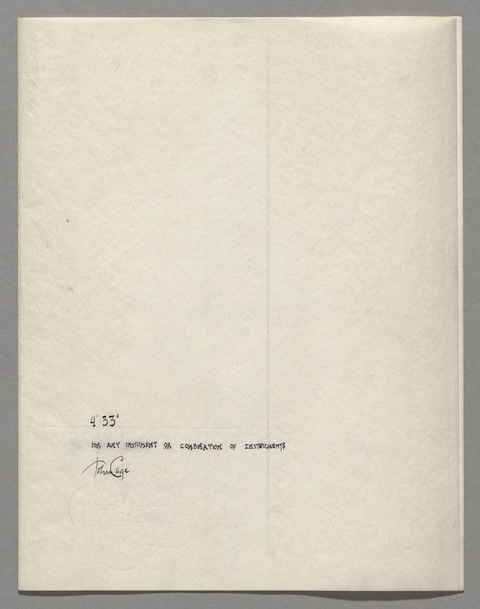
In most of the performances of John Cage’s famously silent composition 4’33”, the performer sits in front of what appears to be sheet music (as in the performance below). The audience, generally prepared for what will follow, namely nothing, may sometimes wonder what could be printed on those pages. Probably also nothing? Now we have a chance to see what Cage envisioned on the page as he composed this piece. Starting on October of this month, New York’s Museum of Modern Art will exhibit Cage’s 1952 score “4’33” (In Proportional Notation).” You can see the first page above.
As you might imagine, subsequent pages (viewable here) look nothing like a typical score, but they are not blank, nor do they contain blank staves; instead they are traversed by carefully hand-drawn vertical lines that seem to denote the units of time as units of space. In fact, this is exactly what Cage did (hence proportional notation). On the fourth page of the score, Cage writes the following formula: “1 page=7 inches=56 seconds.” Artist Irwin Kremen, to whom Cage dedicated the piece, has this to say about the unusual score:
In this score, John made exact, rather than relative, duration, the only musical characteristic. In effect, real time is here the fundamental dimension of music, its very ground. And where time is primary, change, process itself, defines the nature of things. That aptly describes the silent piece — an unfixed flux of sound through time, a flux from performance to performance.
Interpreters of Cage have frequently taken his “silent” piece as a playful bit of conceptual performance art. For example, philosopher Julian Dodd emphatically declares that 4’33” is not music, a distinction he takes to mean that it is instead analytical, “a work about music…,” that it is “a witty, profound work… of conceptual art.” Thinking of Cage’s piece as a kind of meta-analysis of music seems to miss the point, however. Kremen and many others, including Cage himself, call this notion into question. In the interview below, for example, Cage does make an important distinction between “music” and “sound.” He favors the latter for its chance, impersonal qualities, but also, importantly, because it is neither analytical nor emotional. Sound, says Cage, does not critique, interpret, or elaborate—it does not “talk.” It simply is. But the distinction between music and not-music soon collapses, and Cage cites Emmanuel Kant in saying that music “doesn’t have to mean anything,” any more than the chance occurrences of sound.
Cage’s rejection of meaning in music may have played out in a rejection of traditional forms, but it seems mistaken to think of 4’33” as a high concept joke or intellectual exercise. Perhaps it makes more sense to think of the piece as a Zen exercise, carefully designed to awaken what Suzuki Roshi called “the true dragon.” In a 1968 lecture, the Zen master tells the following story:
In China there was a man named Seko, who loved dragons. All his scrolls were dragons, he designed his house like a dragon-house, and he had many pictures of dragons. So the real dragon thought, “If I appear in his house, he will be very pleased.” So one day the real dragon appeared in his room and Seko was very scared of it. He almost drew his sword and killed the real dragon. The dragon cried, “Oh my!” and hurriedly escaped from Seko’s room. Dogen Zenji says, “Don’t be like that.”
The subject of Suzuki’s lecture is zazen, or Zen meditation, a practice that very much influenced Cage through his study of another Zen interpreter, D.T. Suzuki. Instead of practicing zazen, however, Cage practiced what he called his “proper discipline.” He describes this himself in a quotation from a biography by Kay Larsen:
[R]ather than taking the path that is prescribed in the formal practice of Zen Buddhism itself, namely, sitting cross-legged and breathing and such things, I decided that my proper discipline was the one to which I was already committed, namely, the making of music. And that I would do it with a means that was as strict as sitting cross-legged, namely, the use of chance operations, and the shifting of my responsibility from the making of choices to that of asking questions.
Cage, who loved Zen parables and was himself a storyteller, would appreciate Suzuki Roshi’s telling of Zenji’s true dragon story. While much of his compositional work seems to skirt the edges of music, focusing on the negative space around it, for Cage, this space is no less important that what we think of as music. As Suzuki interprets the story: “For people who cannot be satisfied with some form or color, the true dragon is an imaginary animal which does not exist. For them something which does not take some particular form or color is not a true being. But for Buddhists, reality can be understood in two ways: with form and color, and without form and color.” Read against this backdrop, Cage’s “silent” piece is as much a way of understanding reality—as much a true being—as a musical composition expressly designed produce specific formal effects. And while his published collection of lectures and writings is titled Silence, as Cage himself said of 4’33”, in a remark that provides the title for the MoMA’s exhibit, “there will never be silence.” In the absence of formalized music, 4′33″ asks us to hear the true dragon of sound.
One of the sad facts of human psychology is that knowledge can be used for evil just as easily as it can be used for good. If the human race had never figured out how to use fire, for example, we wouldn’t have to worry about those pesky arsonists.
If some people are willing to use the fruits of knowledge to hurt people, should we stop acquiring knowledge? It sounds absurd, but that’s a question that is often asked, though it’s invariably couched in different language.
When Richard Dawkins, the evolutionary biologist and outspoken atheist, made an appearance on The Daily Show last week to promote his new memoir, host Jon Stewart asked: “Do you believe that the end of our civilization will be through religious strife or scientific advancement?” The answer, Dawkins said, is probably both. “Science provides, in the form of technology, weapons which hitherto have been available only to reasonably responsible governments,” said Dawkins, and those weapons “are likely to become available to nutcases who believe that their god requires them to wreak havoc and destruction.”
The conversation then moves beyond religious fanaticism. “Science is the most powerful way to do whatever it is you want to do,” said Dawkins, “and if you want to do good, it’s the most powerful way of doing good. If you want to do evil, it’s the most powerful way to do something evil.”
Dawkins’s last statement echoes the words of Albert Einstein, who warned that the scientific method is only a means to an end, and that the welfare of humanity depends ultimately on shared goals. You can hear Einstein make his point by visiting our post, “Listen as Albert Einstein Reads ‘The Common Language of Science’ (1941)”.
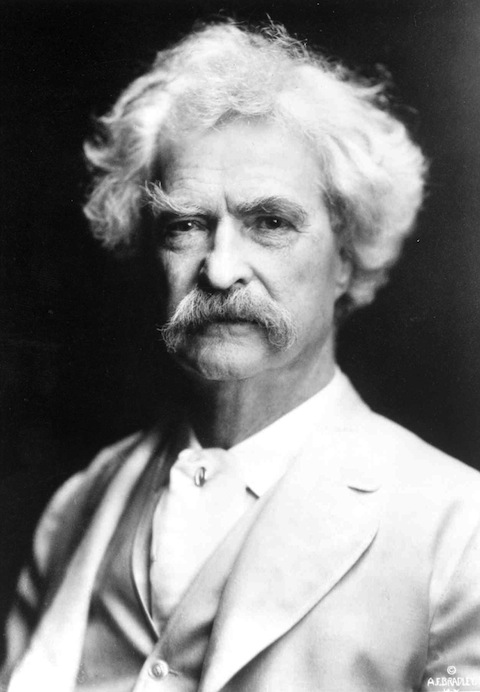
Every American has appreciated at least a little bit of the oeuvre of late-19th- and early-20th-century humorist Samuel Clemens, better known as Mark Twain. Some only manage to get through the chapters of The Adventures of Huckleberry Finn their English classes test them on, but even those give them the inkling that they hold before them the work of a writer worth reading. Others go as far as to become enthusiasts of all things Twain, but perhaps stop just short of reading his “Advice to Little Girls,” a brief piece that offers the following points of counsel to the young ladies of 1865:
Good little girls ought not to make mouths at their teachers for every trifling offense. This retaliation should only be resorted to under peculiarly aggravated circumstances.
If you have nothing but a rag-doll stuffed with sawdust, while one of your more fortunate little playmates has a costly China one, you should treat her with a show of kindness nevertheless. And you ought not to attempt to make a forcible swap with her unless your conscience would justify you in it, and you know you are able to do it.
You ought never to take your little brother’s “chewing-gum” away from him by main force; it is better to rope him in with the promise of the first two dollars and a half you find floating down the river on a grindstone. In the artless simplicity natural to this time of life, he will regard it as a perfectly fair transaction. In all ages of the world this eminently plausible fiction has lured the obtuse infant to financial ruin and disaster.
If at any time you find it necessary to correct your brother, do not correct him with mud—never, on any account, throw mud at him, because it will spoil his clothes. It is better to scald him a little, for then you obtain desirable results. You secure his immediate attention to the lessons you are inculcating, and at the same time your hot water will have a tendency to move impurities from his person, and possibly the skin, in spots.
If your mother tells you to do a thing, it is wrong to reply that you won’t. It is better and more becoming to intimate that you will do as she bids you, and then afterward act quietly in the matter according to the dictates of your best judgment.
You should ever bear in mind that it is to your kind parents that you are indebted for your food, and for the privilege of staying home from school when you let on that you are sick. Therefore you ought to respect their little prejudices, and humor their little whims, and put up with their little foibles until they get to crowding you too much.
Good little girls always show marked deference for the aged. You ought never to “sass” old people unless they “sass” you first.
“American children’s literature in those days was mostly didactic,” writes children’s-book author and illustrator Vladimir Radunsky in a post at the New York Review of Books. It was often addressed to some imaginary reader, an ideal girl or boy, who, “upon reading the story, would immediately adopt its heroes as role models. Twain did not squat down to be heard and understood by children, but asked them to stand on their tiptoes — to absorb the kind of language and humor suitable for adults.” And Twain also understood that, humor, at the height of the craft, limits itself to no one audience in particular. Just as anyone, even today, can enjoy Huckleberry Finn — anyone, that is, without a teacher looking over their shoulder — “Advice to Little Girls” plays, like everything Twain wrote, to both girls and boys, to both the little and the big, at once irresistibly entertaining and viciously satirizing the whole of what he called “the damned human race.”
Then again, Twain also knew, as any master humorist does, that nothing funny ever benefited from too much explanation. We’ll thus leave you with a link to Project Gutenberg’s collection of 216 free e‑books of his work, among which a bit of time spent should turn any one of us into enthusiasts of all things Twain.
“David Bowie Is,” the extensive retrospective exhibit of the artist and his fabulous costumes, hit Toronto last Friday (see our post from earlier today), and as many people have reported, in addition to those costumes—and photos, instruments, set designs, lyric sheets, etc.—the show includes a list of Bowie’s favorite books. Described as a “voracious reader” by curator Geoffrey Marsh, Bowie’s top 100 book list spans decades, from Richard Wright’s raw 1945 memoir Black Boy to Susan Jacoby’s 2008 analysis of U.S. anti-intellectualism in The Age of American Unreason.
Bowie’s always had a complicated relationship with the U.S., but his list shows a lot of love to American writers, from the aforementioned to Truman Capote, Hubert Selby, Jr., Saul Bellow, Junot Diaz, Jack Kerouac and many more. He’s also very fond of fellow Brits George Orwell, Ian McEwan, and Julian Barnes and loves Mishima and Bulgakov. You can read the full list below or over at Open Book Toronto, who urges you to “grab one of these titles and settle in to read — and just think, somewhere, at some point, David Bowie (or, to be more accurate, the man behind David Bowie, David Jones) was doing the exact same thing.” If that sort of thing inspires you to pick up a good book, go for it. You could also peruse the list, then puzzle over the literate Bowie’s lyrics to “I Can’t Read.” You can also explore a new related book–Bowie’s Bookshelf:The Hundred Books that Changed David Bowie’s Life.
If you would like to sign up for Open Culture’s free email newsletter, please find it here. It’s a great way to see our new posts, all bundled in one email, each day.
If you would like to support the mission of Open Culture, consider making a donation to our site. It’s hard to rely 100% on ads, and your contributions will help us continue providing the best free cultural and educational materials to learners everywhere. You can contribute through PayPal, Patreon, and Venmo (@openculture). Thanks!
On September 21, Pete Seeger performed the Woody Guthrie classic, “This Land is Your Land,” at Farm Aid while being joined on stage by John Mellencamp, Willie Nelson, Dave Matthews and Neil Young. “Friends,” he told the audience, “at 94, I don’t have much of a voice left. But here’s a song I think you know, and if you sing it, why, we’ll make a good sound.” And that’s just what the singer and audience did. Seeger, who still has his wits about him, even improvised a bit and added a new verse, “New York was made to be frack free!” Bless him.
For some vintage Seeger, don’t miss this film featuring the folk legend when he was only 27 years old. Released in 1946, To Hear Your Banjo Play is an engaging 16-minute introduction to American folk music, written and narrated by Alan Lomax.
We're hoping to rely on loyal readers, rather than erratic ads. Please click the Donate button and support Open Culture. You can use Paypal, Venmo, Patreon, even Crypto! We thank you!
Open Culture scours the web for the best educational media. We find the free courses and audio books you need, the language lessons & educational videos you want, and plenty of enlightenment in between.