In this fun new video from CDZA, guitarist Mark Sidney Johnson takes us on an entertaining romp through more than fifty years of the rock guitar solo, from Chuck Berry to John Mayer.
Along the way Johnson rips through a succession of famous riffs and solos by Keith Richards, Jimi Hendrix, Carlos Santana, Jimmy Page, Eric Clapton, Mark Knopfler, Randy Rhoads, Eddie Van Halen, Slash … and those are only a few from the first half of the video.
Johnson is an English multi-instrumentalist and songwriter based in New York. He works regularly as a session guitarist and plays with The Brit Pack as well as the experimental music video group CDZA, short for Collective Cadenza. For more examples of their offbeat and innovative work, visit the CDZA Web site.
Many things have happened on the internet this week, among them some get off my lawn outrage at a $375 Urban Outfitters leather jacket designed to replicate the homemade swag every punk rock kid once draped over their shoulders. Then there’s the Justin Bieber/Black Flag mash-up t‑shirt that “ruined punk forever.” I may have spent some formative years immersed in ersatz punk and hardcore culture, but no matter how old and cranky I may be compared to the target market of this merchandise, I just can’t bring myself to get bothered. No one has said it better than Dave Berman: “punk rock died when the first kid said / ‘punk’s not dead, punk’s not dead.’”
The strident desire of some to cling to a punk rock ethos can be amusing since the movement’s most famous figureheads, the Sex Pistols, crashed and burned a little over three years after forming and one year after introducing their mascot, Sid Vicious. The band’s creative destruction often seems like the most viable expression of punk. It burns itself out on its own energy. Everything else you can say about it is just more Malcolm McLaren marketing.
Or, put differently, maybe the only discussion worth having about punk rock is archival. It came, it went, get over it—but oh, what a glorious comet trail left by the likes of Johnny Rotten! And we have evidence of the tail end on film. Above, you can see the Pistols very last performance at San Francisco’s Winterland Ballroom in January of 1978.
The film opens with text excusing some quality control issues: “The footage contained in this video is rare archive material and irreplaceable. The publishers feel that the quality of the content… far outweighs any minor… shortcomings of sound and vision.” Then we’re off to the races, introduced by a pair of announcers, male and female, like an Olympic event. Despite the disclaimer, this is decent film and audio, and definitely “quality content.” Brilliant, in fact (Sid actually plays!), and an excellent argument for why this band needed no future. A YouTube commenter helpfully breaks down the video into the tracklist below. Great stuff.
01:45 — God Save The Queen , 05:56 — I Wanna Be Me , 10:04 — Seventeen , 12:27 — New York , 15:54 — EMI , 19:38 — Belsen Was Gas , 21:50 — Bodies , 25:50 — Holidays In The Sun , 31:17 — Liar , 35:40 — No Feelings , 38:55 — Problems , 43:26 — Pretty Vacant, 46:57 — Anarchy In The UK , 52:43 — No Fun
There’s nothing funny about the ravages of highly addictive narcotics or gangland turf wars. Nevertheless, Vince Gilligan’s riveting hit Breaking Bad managed to start on a (yes, darkly) comic note that still sounds occasionally as the show hurtles toward its fateful conclusion this Sunday. (Conan O’Brien has had a lot of fun with these moments in parodies of the show’s characters’ quirks and its sometimes-gruesome desert absurdities.)
What anchors the show, even when it veers into gallows humor, is its sense of authenticity. Despite Breaking Bad’s theatrical—almost Shakespearean—plotting, Gilligan and his writers have taken care to build a very believable scaffolding behind every outrageous set piece, even when it comes to the science of perfectionistic chemistry teacher Walter White’s super high-quality crystal methamphetamine. In order to get the science right, Gilligan approached Donna Nelson, Professor of Organic Chemistry at the University of Oklahoma.
Nelson doesn’t only consult on the nature of illicit chemical compounds; she has also provided the show’s writers with insights into the motivations and methods of chemists and teachers. As Nelson says, “to us who are educated in science, whenever we see science presented inaccurately, it’s like fingernails on a blackboard. It just drives us crazy, and we can’t stay immersed in the show.” As a Breaking Bad fan who is, I’ll be honest, largely chemistry-illiterate, I’d still credit some of my immersion to how real the science feels, a by-product, surely, of how genuine it is. Watch Professor Nelson in the video above, produced by the American Chemical Society, explain how the show created its illusions with the stuff of 100% real science.
Well, okay, it’s maybe more like 96%. As you might have suspected, the signature powder blue color of Walter’s product is pure dramatic invention.
Had he lived during the Inquisition, Thomas Jefferson would have been burned at the stake. His ideas about Jesus and Christianity were far from orthodox. A product of the Enlightenment, Jefferson believed that everything, including religion, should be examined in the light of reason.
When Jefferson examined the Gospels he came away with a strongly divided opinion. “I find many passages of fine imagination, correct morality, and of the most lovely benevolence,” he wrote in an 1820 letter to William Short, “and others again of so much ignorance, so much absurdity, so much untruth, charlatanism, and imposture, as to pronounce it impossible that such contradictions should have proceeded from the same being.”
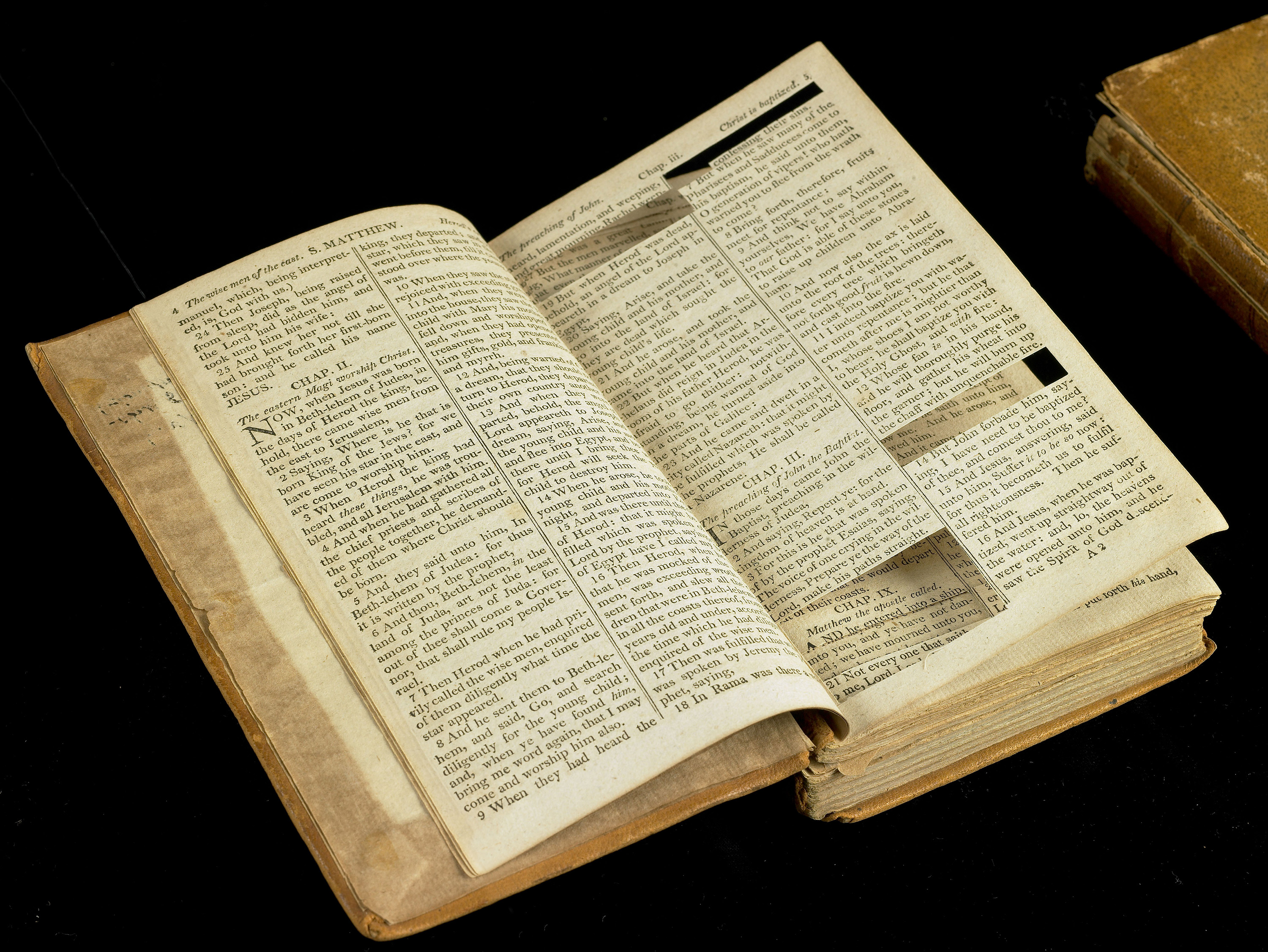
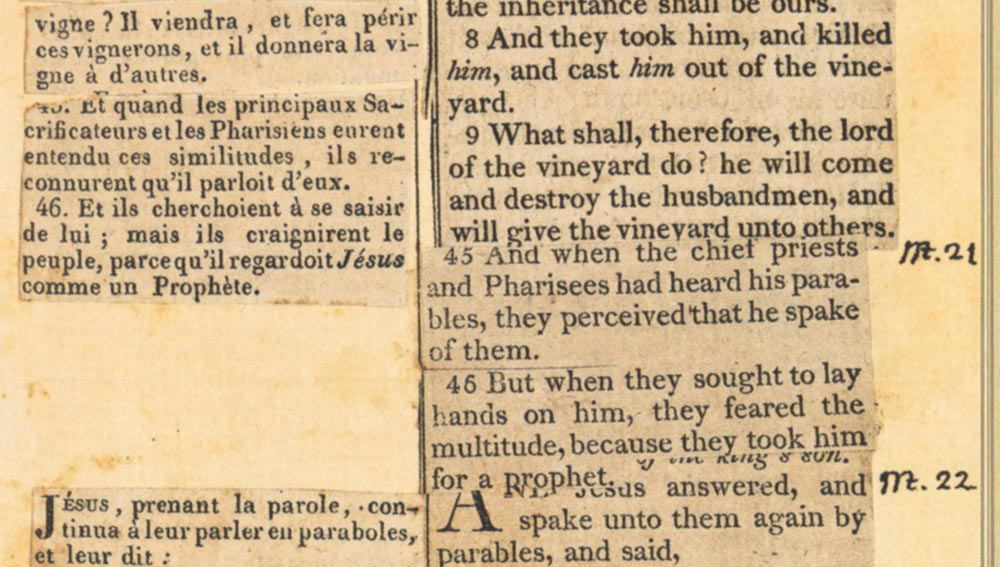
As early as 1804, when he was still president, Jefferson began separating “the diamond from the dunghill,” as he later put it, to assemble his own version of the Bible. He continued the project in earnest during his later years at Monticello, poring over various editions in Greek, Latin, French and King James English. He clipped the passages he thought were genuine teachings of Jesus and pasted them, in the four languages side by side, onto pages.
In 1820 — six years before his death at the age of 83 — Jefferson produced a leather-bound, 84-page volume titled The Life and Morals of Jesus of Nazareth, Extracted Textually From the Gospels in Greek, Latin, French & English. Jefferson eliminated everything in the Bible concerning miracles. He ended the Gospel story with the execution and burial of Jesus, omitting the resurrection. The retained passages, Jefferson explained in an 1813 letter to John Adams, contain “the most sublime and benevolent code of morals which has ever been offered to man.”
Today marks the 77th anniversary of Jim Henson’s birth. To celebrate the puppeteer, filmmaker, and Muppet inventor’s life and career, we offer here three of his early short works. Most of us know only certain high-profile pieces of Henson’s oeuvre: The Muppet Show, the Muppet movies, Sesame Street, or perhaps such pictures now much attended on the camp revival circuit as Labyrinth and The Dark Crystal. But even by the Muppet Show’s 1974 debut, Henson (1936–1990) had already put in decades developing his distinctive aesthetic of puppets and puppetry. We’ve previously featured the uncharacteristically violent commercials he produced for Wilkins Coffee between 1957 and 1961 and Limbo, the Organized Mind, his seventies trip of a Johnny Carson segment. But unless you count yourself as a serious Henson, fan, you probably haven’t yet seen the likes of Memories, The Paperwork Explosion,and Ripples. Creating each of these shorts, the young Henson collaborated with pianist, jazz composer, and sound engineer Raymond Scott, now remembered as a pioneer in modern electronic music.
The particular sound of Scott, no stranger to scoring cartoons (we’ve by now heard it in everything from Looney Tunes to Ren and Stimpy to The Simpsons), also suited the sorts of visions Henson realized for his various projects of the sixties. Memories, which plunges into a man’s mind as he remembers (with narration by Henson himself) one particularly pleasant afternoon nearly ruined by a headache, appeared in 1967 as a continuation of Henson’s commercial career; the pain reliever Bufferin, you see, literally saved the day. That same year, the commercial (and in form, almost mini-documentary) The Paperwork Explosion illustrates the time- space‑, and labor-saving advantages of IBM’s then-new word-processing system, the MT/ST. Ripples Henson and Scott put together for Montreal’s Expo 1967. It takes place, like Memories and Limbo, inside human consciousness: an architect (Sesame Street writer-producer Jon Stone) drops a sugar cube in his coffee, and its ripples trigger a memory of throwing pebbles into a pond, which itself sends ripples through a host of his other potential thoughts. You’ve got to watch to understand how Henson and Scott pulled this off; conveniently, they only take one minute to do it.
Born 117 years ago today in St. Paul, Minnesota, F. Scott Fitzgerald, that somewhat louche denizen—some might say inventor—of the “Jazz Age,” has been immortalized as the tender young man we see above: Princeton dropout, writer of The Great Gatsby, boozy companion to beautiful Southern belle flapper Zelda Sayre. Amidst all the glamorization of his best and worst qualities, it’s easy to forget that Fitzgerald was also the father of a daughter, Frances Scott Fitzgerald, who went on to have her own successful career as a writer. Unlike the children of some of Fitzgerald’s contemporaries, Frances thrived, which must be some testament to her father’s parenting (and to Zelda’s as well, though she allegedly hoped, like Daisy Buchanan, that her daughter would become a “beautiful little fool”).
We get more than a hint of Fitzgerald’s fatherly character in a wonderful little letter that he sent to her in August of 1933, when Frances was away at summer camp. Fitzgerald, renowned for his extremes, counsels an almost Epicurean middle way—distilling, perhaps, hard lessons learned during his decline in the thirties (which he wrote of candidly in “The Crack Up”). He concludes with a list of things for his daughter to worry and not worry about. It’s a very touching missive that I look forward to sharing with my daughter some day. I’ll have my own advice and silly in-jokes for her, but Fitzgerald provides a very wise literary supplement. Below is the full letter, published in the New York Times in 1958. The typos, we might assume, are all sic, given Fitzgerald’s penchant for such errors:
AUGUST 8, 1933 LA PAIX RODGERS’ FORGE TOWSON, MATYLAND
DEAR PIE:
I feel very strongly about you doing duty. Would you give me a little more documentation about your reading in French? I am glad you are happy– but I never believe much in happiness. I never believe in misery either. Those are things you see on the stage or the screen or the printed page, they never really happen to you in life.
All I believe in in life is the rewards for virtue (according to your talents) and the punishments for not fulfilling your duties, which are doubly costly. If there is such a volume in the camp library, will you ask Mrs. Tyson to let you look up a sonnet of Shakespeare’s in which the line occurs Lilies that fester smell far worse than weeds…
I think of you, and always pleasantly, but I am going to take the White Cat out and beat his bottom hard, six times for every time you are impertinent. Do you react to that?…
Half-wit, I will conclude. Things to worry about:
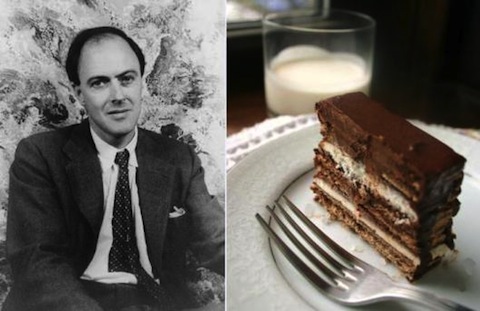
It comes as no surprise that Roald Dahl, author of Charlie and the Chocolate Factory, possessed a sweet tooth. Having dazzled young readers with visions of Cavity-Filling Caramels, Everlasting Gobstoppers, and snozzberry-flavored wallpaper, Dahl’s candy of choice was the more pedestrian Kit-Kat bar. In addition to savoring one daily (a luxury little Charlie Bucket could but dream of, prior to winning that most golden of tickets) he invented a frozen confection called “Kit-Kat Pudding.”
The original recipe is, appropriately, simple enough for a child to make. Stack as many Kit-Kats as you like into a tower, using whipped cream for mortar, then shove the entire thing into the freezer, and leave it there until solid.
Book publicist and self-described literary fangirl Nicole Villeneuve does him one better on Paper and Salt, a food blog devoted to the recipes of iconic authors. Her re-imagined and renamed Frozen Homemade Kit-Kat Cakeadds bittersweet chocolate ganache, replacing Dahl’s beloved candy bars with high quality wafer cookies. It remains a pretty straight-forward preparation, not quite as decadent as the Marquis de Sade’s Molten Chocolate Espresso Cake with Pomegranate, but surely more to Dahl’s liking than Jane Austen’s Brown Butter Bread Pudding Tarts would have been. (The author once wrote that he preferred his chocolate straight.)
Villeneuve spices her entry with historical context and anecdotes regarding early 20th-century candy marketing, Dahl’s hatred of the Cadbury Crème Egg, and his dog’s hankering for Smarties. Details such as these make Paper and Salt, which features plenty of savories to go with the sweet, a delicious read even for non-cooks.
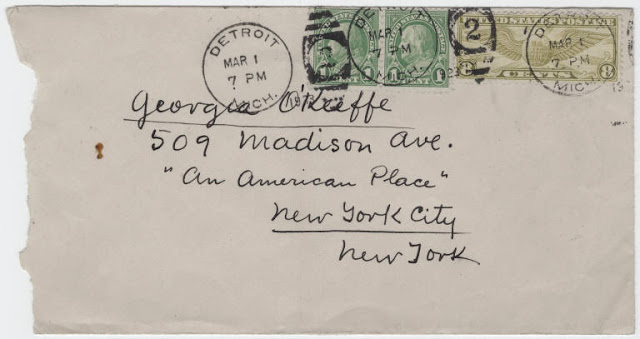
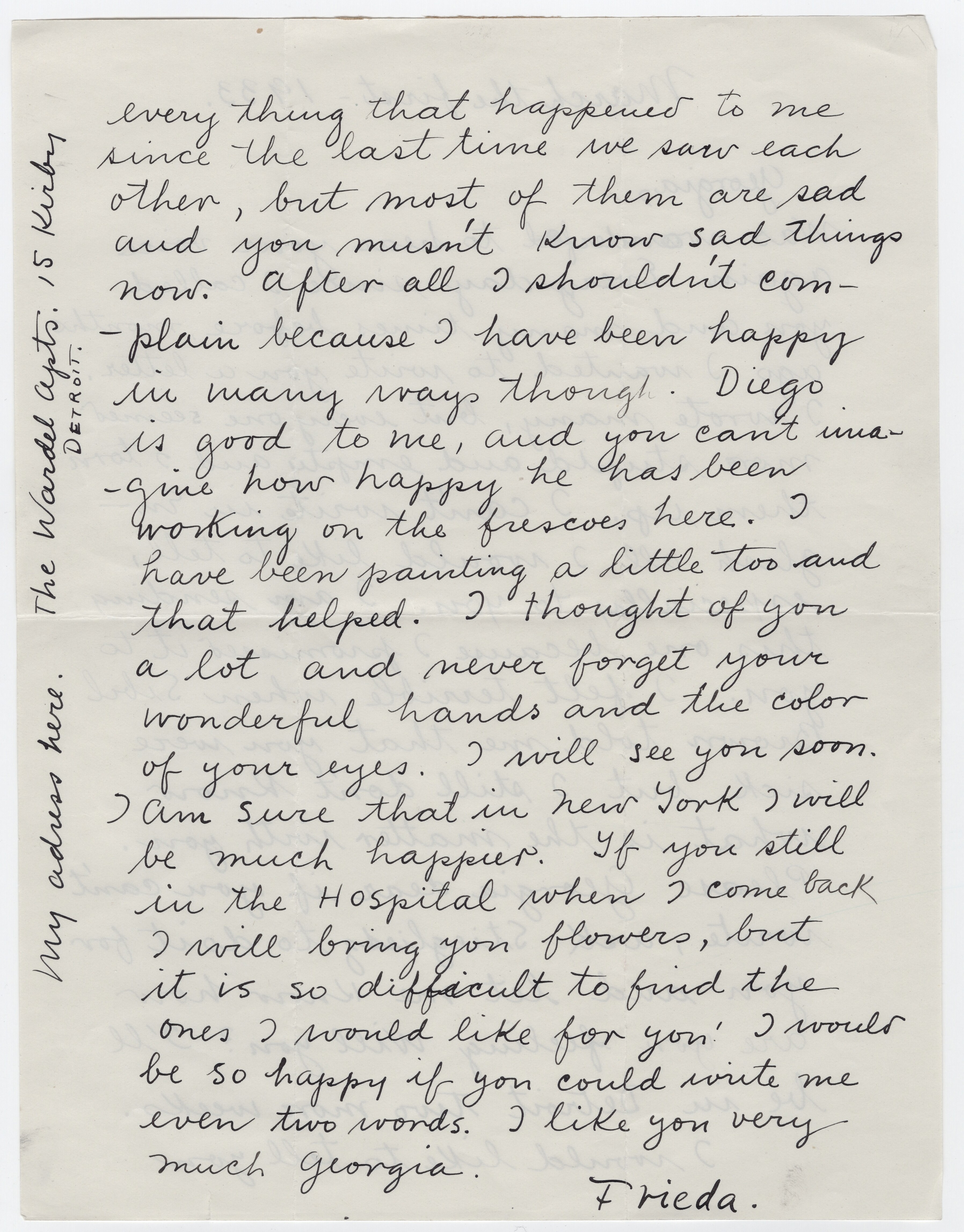
Important twentieth-century painters, as every student of art history learns, didn’t tend to sail smoothly through existence. Those even a little interested in famed Mexican self-portraitist Frida Kahlo have heard much about the travails both romantic and physical she endured in her short life. But in this lesser-known instance, another artist suffered, and Kahlo offered the solace. Available to view from Yale’s Beinecke Rare Book & Manuscript Library, we have here a letter Kahlo sent to Georgia O’Keeffe, painter of blossoms and southwest American landscapes (and more besides), on March 1st, 1933. At that time, O’Keeffe, who the year before had struggled and failed to complete a mural project for Radio City Music Hall on time, lived through the aftermath of a nervous breakdown which had hospitalized her (diagnosis: “psychoneurosis”), sent her to no less remote a locale than Bermuda to recuperate, and prevented her from painting again until 1934.
Was wonderful to hear your voice again. Every day since I called you and many times before months ago I wanted to write you a letter. I wrote you many, but every one seemed more stupid and empty and I torn them up. I can’t write in English all that I would like to tell, especially to you. I am sending this one because I promised it to you. I felt terrible when Sybil Brown told me that you were sick but I still don’t know what is the matter with you. Please Georgia dear if you can’t write, ask Stieglitz to do it for you and let me know how are you feeling will you ? I’ll be in Detroit two more weeks. I would like to tell you every thing that happened to me since the last time we saw each other, but most of them are sad and you mustn’t know sad things now. After all I shouldn’t complain because I have been happy in many ways though. Diego is good to me, and you can’t imagine how happy he has been working on the frescoes here. I have been painting a little too and that helped. I thought of you a lot and never forget your wonderful hands and the color of your eyes. I will see you soon. I am sure that in New York I will be much happier. If you still in the hospital when I come back I will bring you flowers, but it is so difficult to find the ones I would like for you. I would be so happy if you could write me even two words. I like you very much Georgia.
Frieda
“Clearly Kahlo hoped for a deeper friendship, or perhaps more, with O’Keeffe, when she and Diego went to New York a few weeks later,” writes Sharyn Rohlfsen Udall in Carr, O’Keeffe, Kahlo: Places of Their Own. “From there, she wrote to a friend on 11 April (by which time O’Keeffe had gone to Bermuda to convalesce) that because of O’Keeffe’s illness there had been no lovemaking between them that time. A boastful exaggeration of their closeness? Knowing Kahlo’s predilection for sexual hyperbole, this seems likely.”
We're hoping to rely on loyal readers, rather than erratic ads. Please click the Donate button and support Open Culture. You can use Paypal, Venmo, Patreon, even Crypto! We thank you!
Open Culture scours the web for the best educational media. We find the free courses and audio books you need, the language lessons & educational videos you want, and plenty of enlightenment in between.