Here’s an update to our original 2011 post: The social theorist and geographer David Harvey has produced a free online course where he gives a close reading of Karl Marx’s Capital (1867). Often considered to be Marx’s masterpiece, Capital is where he elaborated a critique of capitalism and laid the groundwork for an ideology that took the 20th century by storm. Harvey has taught courses on Capital for over 40 years, both in universities (Johns Hopkins and CUNY) and in the community as well. Now his 26 lecture course is freely available on the web. You can watch the first lecture above. (It’s preceded by an introductory, six-minute interview.) The rest of the lectures can be accessed via Harvey’s web site, YouTube, iTunes, and the Economics section of our collection of Free Online Courses.
Marking a new phase of the project, Professor Harvey is now looking for volunteers to help translate his lectures into 36 languages. If you speak English and languages like Urdu, Arabic or Italian (just to list a few), you can start helping with translations here.
Also note that Harvey published A Companion to Marx’s Capitalin 2010. It’s something you’ll want read along with the lectures.
“Breaking Bad is the first story to truly commit the full spectrum of New Mexico to film,” writes Rachel Syme in a New Yorker post on the critically acclaimed AMC series’ use of and effect on her home state. “The grandiose vistas, the soaring altitudes, the banal office complexes, the Kokopellis and Kachina dolls, the seamy warehouses, the marshmallow clouds. The show seems to root itself deeper in the landscape with every new montage. It has become our newest monument.” With the concluding season of the exploits of chemistry-teacher-turned-methamphetamine-dealer Walter White debuting this Sunday, Breaking Bad fans have no doubt steeled themselves for a televisual plunge back into its very own Albuquerque, which “still looks like the Wild West, a scorched, hazy, lawless place where rugged individualism might just tip over into criminal behavior at any moment,” an interpretation Syme deems “not wholly inaccurate.”
To assist you in your own re-entry into Breaking Bad’s thoroughly amoral but unstoppably compelling reality, we’ve rounded up a few audition tapes which let you witness the early formation of three of the show’s characters. Everyone talks about Bryan Cranston’s starring performance as Walter, and given his grounded execution of a near-novelistic arc of improbable transformation, rightly so. But what about his wife and eventual money launderer Skyler, as portrayed by Anna Gunn? Or her brother-in-law Hank, the gung-ho DEA agent played by Dean Norris? Or Aaron Paul as Jesse, Walter’s former student and current partner in crime? In a series so highly praised for the writing of its characters, you don’t want to think about just one. Or maybe your memories of them have grown dim, in which case you’ll want to spend eight minutes with this recap of the previous seasons before you settle down for the final one.
Today, we bring the two together, in two versions of Smith reading Ginsberg’s “Footnote to Howl,” the orgiastic coda to his 1955 epic. This makes so much sense I wonder why we haven’t featured it before, and yet, here we are. In the first rendition, above, from 2012, Smith is backed by Philip Glass, her own Incredible Band, and some saffron-clad Tibetan monks. The ensemble convened in honor of a visit by the Dalai Lama.
There are doubtless dozens of stories to tell about Ginsberg and Smith. My favorite is their first chance meeting in 1969:
It’s November 1969 and Ms. Smith is trying to buy a cheese sandwich at the Horn & Hardart Automat on West 23rd Street in Manhattan. When she finds herself a dime short, Ginsberg approaches her and asks if he can help. He offers her the extra 10 cents and also treats her to a cup of coffee. The two are talking about Walt Whitman when Ginsberg suddenly leans forward and asks if she’s a girl.
“Is that a problem?” she asks.
He laughs and says: “I’m sorry. I took you for a very pretty boy.”
“Well, does this mean I return the sandwich?”
“No, enjoy it. It was my mistake.”
Holy that sandwich! Watch Smith above in Florence, Italy forty years later, chanting a cappella from “Footnote to Howl” while the audience claps, and howls, along. It’s decidedly rough footage, taken with a handheld camera (cell phone?) from the crowd, but the audio is good, and it’s stirring stuff despite, or because of, the raw quality.
(Shots of muscular, heavily tattooed gang-bangers glowering, fighting, smoking pot, and enjoying super-hot twice-weekly conjugal visits)
“In a hellish, overstuffed maximum security prison in Peru…”
(Close up of Vin Diesel or Vin Diesel-type wiping away a tear as he bids goodbye to a neatly dressed, bespectacled teenage girl)
“One man will do whatever it takes to win the respect of his daughter…”
(Cut to Vin in a colorful, coordinated outfit, leading hundreds of fellow inmates in an aerobics class as they attempt to break a Guinness World Record)
No doubt it would be godawful. That’s not to say convicted kidnapper Alejandro Nuñez del Arco’s story isn’t inspiring in the original.
Colonel Tomas Garay, who greenlighted del Arco’s Full Body aerobics class back in November, is pleased by the changes in attitude he’s noticed at Lurigancho, “a branch of hell” where drugs, alcohol, and violence were previously the norm. Although the sport, a cardiovascular workout combining dance, boxing, and Tae Bo was invented by a Peruvian man, macho inmates were standoffish at first. A mere eight attended del Arco’s first class. By June 14, the date he attempted to best the Philippines’ Cebu Prison’s world record for the most people dancing behind bars, at least 1179 of his fellow inmates were raging with dance fever. Talk about transformative effects…
Hopefully not coming soon to a theater near you, unless it’s as an expansion of the five-minute documentary above.
She is 14 years old, and apparently French. Not much else is known about this precocious young guitarist who goes by the name “Tina S” on her YouTube channel.
Tina became an Internet sensation in late May, when she posted an astonishing cover version of “Eruption,” from Van Halen’s debut album. Eddie Van Halen’s son Wolfgang was so impressed he tweeted, “I need to meet this girl!!!”
Writing as “@Tina_Guitare,” the young musician replied, “I need to meet you too! Haha :))” Talk show host Ellen DeGeneres also went on Twitter and said, “This girl is incredible. If you know where she is, I want her on my show immediately.” There was no reply to that one — at least not on Twitter.
If you would like to support the mission of Open Culture, consider making a donation to our site. It’s hard to rely 100% on ads, and your contributions will help us continue providing the best free cultural and educational materials to learners everywhere. You can contribute through PayPal, Patreon, and Venmo (@openculture). Thanks!
I recently read an article in which a music critic argued for Bob Dylan’s 1970 double album Self Portrait as his best. This provoked so much derision and outrage in the comments that I almost felt sorry for the author. But this is not unusual. Rolling Stone’s Greil Marcus opened his review of the record with a surly “What is this shit?” Dylan himself explained in a 1984 interview with the magazine that the record was intentionally bad, a “screw you” to his less discerning fans. And why not? Bob Dylan can do whatever he wants.
Well, the album The Onion’s AV Club calls “almost universally loathed” is being reissued in a four-disc set that includes outtakes and bootlegs, as well as alternates and demo takes from Nashville Skyline and 1970’s New Morning. You’ll find the full tracklist of what will be released on August 27 as Another Self Portraithere. (The album itself can be pre-ordered here.) For a preview, watch the video above of “Pretty Saro,” an 18th century English folk tune Dylan recorded for Self Portrait but never released. As with Marcus’ review and Dylan’s explanatory interview, this comes to us via the stalwart Rolling Stone.
Filmmaker Jennifer Lebeau made the video, which consists of carefully selected photos from the Farm Security Administration and which Lebeau says “literally goes from women on farms with wagons to Rosie the Riveter.” It’s a cool concept and a beautiful song. Might it persuade you to re-evaluate Self Portrait? If you never loathed it but defended it, does this outtake enhance your appreciation of its genius? Maybe you’re in need of a refresher on the confused, amused, and infuriated reactions that this record generates. If so, you may wish to visit this site for “24 minutes of footage of people talking about Bob Dylan’s puzzling” 1970 album.
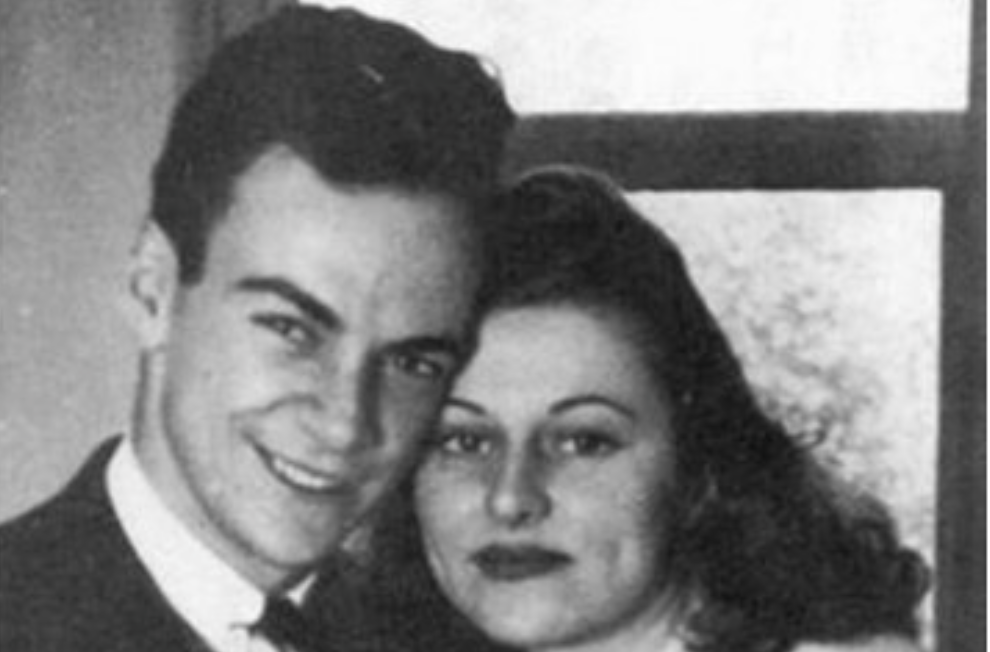
In June 1945, the 27-year-old physicist Richard Feynman lost his wife, Arline Feynman, to tuberculosis. Only 25 years old, she was Richard’s high-school sweetheart. And yet she was much more. As Lawrence Krauss writes in 2012 biography on Feynman:
Richard and Arline were soul mates. They were not clones of each other, but symbiotic opposites — each completed the other. Arline admired Richard’s obvious scientific brilliance, and Richard clearly adored the fact that she loved and understood things he could barely appreciate at the time. But what they shared, most of all, was a love of life and a spirit of adventure.
I know how much you like to hear that — but I don’t only write it because you like it — I write it because it makes me warm all over inside to write it to you.
It is such a terribly long time since I last wrote to you — almost two years but I know you’ll excuse me because you understand how I am, stubborn and realistic; and I thought there was no sense to writing.
But now I know my darling wife that it is right to do what I have delayed in doing, and that I have done so much in the past. I want to tell you I love you. I want to love you. I always will love you.
I find it hard to understand in my mind what it means to love you after you are dead — but I still want to comfort and take care of you — and I want you to love me and care for me. I want to have problems to discuss with you — I want to do little projects with you. I never thought until just now that we can do that. What should we do. We started to learn to make clothes together — or learn Chinese — or getting a movie projector. Can’t I do something now? No. I am alone without you and you were the “idea-woman” and general instigator of all our wild adventures.
When you were sick you worried because you could not give me something that you wanted to and thought I needed. You needn’t have worried. Just as I told you then there was no real need because I loved you in so many ways so much. And now it is clearly even more true — you can give me nothing now yet I love you so that you stand in my way of loving anyone else — but I want you to stand there. You, dead, are so much better than anyone else alive.
I know you will assure me that I am foolish and that you want me to have full happiness and don’t want to be in my way. I’ll bet you are surprised that I don’t even have a girlfriend (except you, sweetheart) after two years. But you can’t help it, darling, nor can I — I don’t understand it, for I have met many girls and very nice ones and I don’t want to remain alone — but in two or three meetings they all seem ashes. You only are left to me. You are real.
My darling wife, I do adore you.
I love my wife. My wife is dead.
Rich.
PS Please excuse my not mailing this — but I don’t know your new address.
We all thrilled to Johannes Vermeer painting his best-known portrait as dramatized in Peter Webber’s 2003 film Girl with a Pearl Earring. But for every heightened, scintillating feature film built around a well-known artist, there exists — or should exist, anyway — a documentary that examines the work itself in greater detail. For such a counterpart to the aforementioned Colin Firth/Scarlett Johansson vehicle, I nominate Joe Krakora’s 2001 Vermeer: Master of Light, a rich look at the paintings of the well-known visual chronicler of seventeenth-century middle-class Dutch life, whose use of color could reach pretty formidable heights of scintillation itself. Providing its narration, we have a certain Meryl Streep.
Click each image for a larger version
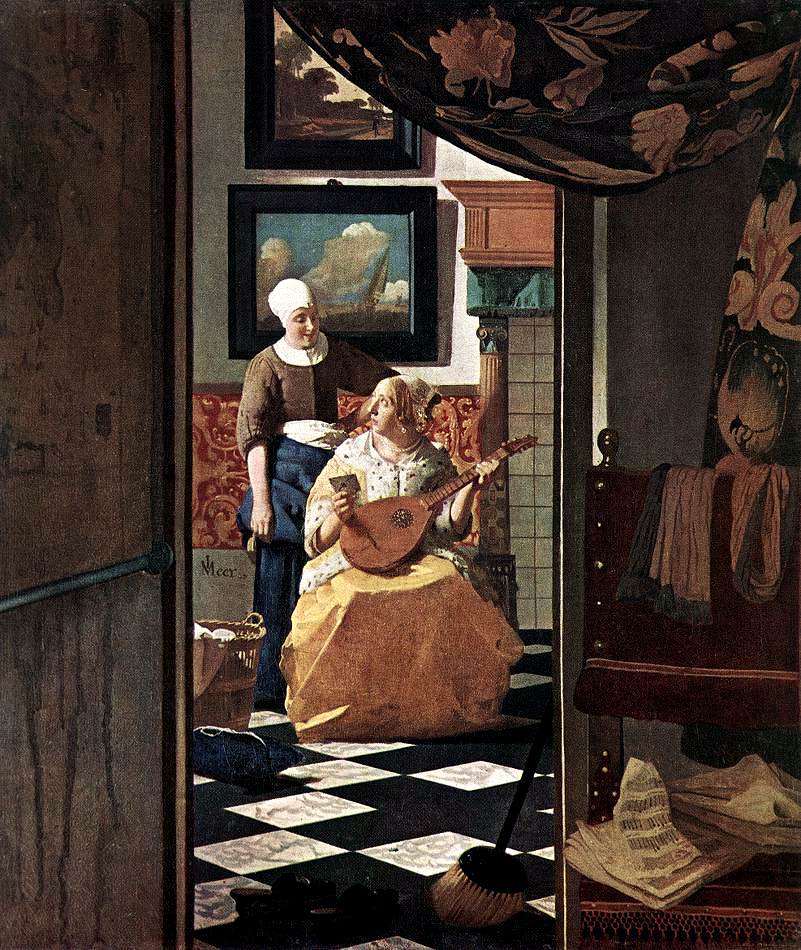
Streep’s words and those of the documentary’s expert interviewees must of necessity focus on Vermeer’s actual paintings, since we know little of the painter’s life. And we don’t even have very many paintings to talk about: living from 1632 to 1672, Vermeer turned out fewer than 40 canvases. But what canvases: Master of Light goes into detail on his particular mastery not only of light and color, but of textures, perspectives, and seemingly minor but nonetheless painstaking touches. We do, however, offer a viewing tip: unless you particularly enjoy shots of light through windows, you may want to begin the video at 5:22 or so. The analysis of Vermeer takes its time coming, but when it begins, it offers a wealth of surprising detail — just as do the paintings themselves. But don’t believe me; find out for yourself by viewing fifteen of them up close at the Google Art Project, including Lady at the Virginal with a Gentleman just above, or, below, The Love Letter.
We're hoping to rely on loyal readers, rather than erratic ads. Please click the Donate button and support Open Culture. You can use Paypal, Venmo, Patreon, even Crypto! We thank you!
Open Culture scours the web for the best educational media. We find the free courses and audio books you need, the language lessons & educational videos you want, and plenty of enlightenment in between.