Thanks to the efforts of Scott Bradlee’s Postmodern Jukebox and singer Miche Braden, the world now knows how heavy metal rockers, Guns N’ Roses sound with their knees rouged up and their stockings down.
Their New Orleans jazz take on 1987’s “Sweet Child O’ Mine” replaces the preening rock god sensitivity of the original with a sort of mature, female swagger harkening all the way back Bessie Smith. (Braden’s stage credits include turns as Billie Holiday, Valaida Snow, and Ma Rainey.)
The backup musicians get in on the fun, too, retooling Slash’s guitar solo as a horn-driven cakewalk. I know which party I’d rather hit!
Over the years, “Sweet Child O’ Mine” has proved a remarkably study workhorse, withstanding attempts to make it over as electronica, a Gregorian Chant and Brazilian prog rock. Or how about this version played on the Guzheng, an ancient Chinese instrument. Postmodern Jukebox’s entry into this stakes is not without gimmick, but it’s a winning one.
If you would like to support the mission of Open Culture, consider making a donation to our site. It’s hard to rely 100% on ads, and your contributions will help us continue providing the best free cultural and educational materials to learners everywhere. You can contribute through PayPal, Patreon, and Venmo (@openculture). Thanks!
Tezuka Osamu (1928–1989) is known as “the God of manga” in Japan. He created classics for both children and adults in every genre – from horror to romance to action. The sheer amount of work produced in Osamu’s relatively short life is staggering; some estimates have it that he drew over 150,000 pages of comics.
While focusing just on manga would have been enough for most mortals, Osamu was also a trailblazer in animation. He created Astro-Boy, the hugely popular character that spawned comic books, TV shows, video games and a couple of movies. The visual style of Osamu’s animated work — Astro-Boy and others — proved to be very influential. Those trademark giant eyes on anime characters come straight from Osamu (who in turn was influenced by Walt Disney and Max Fleischer).
Osamu relentlessly challenged the limits of what manga and anime could do. He’s credited with making the first ever X‑Rated animated feature film, Cleopatra, Queen of Sex(1970) — imagine Disney doing that. He also made a series of experimental animated shorts, which showcase not only Osamu’s creativity and range but also his philosophy, which was heavily influenced by Buddhism.
His 1962 work Tale of Street Corner is a surprisingly moving short about the day-to-day life of a city street corner as seen through the eyes of some anthropomorphized mice and sentient street posters.
And if you want get a sense of Osamu’s versatility, check out his 1966 movie Pictures at an Exhibition. The work is an omnibus film featuring ten smaller shorts, all set to Mussorgsky’s famous suite. Osamu recreated each short in a completely different style from the others.
His 1984 short, Jumping is a technical tour-de-force told with admirable simplicity. Seen from a first person point of view, the movie is about a young child who is jumping down a country road. As each jump gets higher and longer, the camera passes through cities, fields and oceans and eventually into a warzone. The sharp-eyed viewer will see R2D2 and C‑3PO make a surprise cameo at around the 2:57 marker.
And finally, here is an interview with the master himself as he talks about making these movies. And you can see all 13 of the animated shorts here.
Jonathan Crow is a Los Angeles-based writer and filmmaker whose work has appeared in Yahoo!, The Hollywood Reporter, and other publications. You can follow him at @jonccrow.
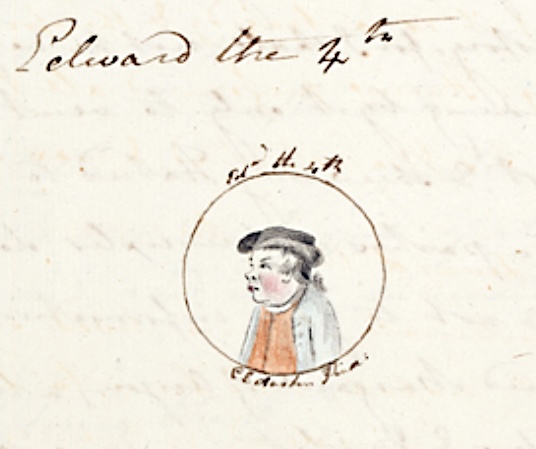
Austen was, by and large, a homeschooled and autodidactic child. Although she had taken part in some formal schooling between the ages of 7 and 10, illness and the family’s lack of means dictated that she had to rely on her father’s extensive library for an education. By the time she was fifteen, Austen had evidently gathered sufficient material to fuel her writing, and had completed a history of England, beginning with Henry IV (1367–1413), and ending with Charles I (1600–1649). Above, you can see one of the book’s many illustrations drawn by Jane’s elder sister, Cassandra, depicting Edward IV, of whom Austen writes, “This Monarch was famous only for his Beauty & his Courage, of which the Picture we have here given of him, & his undaunted Behaviour in marrying one Woman while he was engaged to another, are sufficient proofs.” In spite of its brevity — the book numbers only 36 handwritten pages — Austen’s juvenilia shows unmistakable signs of her distinct satirical voice. The volume is, in fact, a parody of the stuffy claims of objectivity found in 18th century grade school history textbooks, like Oliver Goldsmith’sThe History of England from the Earliest Times to the Death of George II. Rather than follow suit, Austen skips trivialities such as key dates and events, noting to her readers in the introduction to a section on Henry VIII,
“It would be an affront to my Readers were I to suppose that they were not as well acquainted with the particulars of the King’s reign as I am myself. It will therefore be saving them the task of reading again what they have read before, & myself the trouble of writing what I do not perfectly recollect, by giving only a slight sketch of the principal Events which marked his reign”
I had the sense that Austin relished writing such humorous prose as much as I enjoyed reading it. Unconstrained by the formalities of her medium, she takes to referencing Shakespeare and giving voice to her numerous opinions. Take, for example, her entries on Henry V and Henry VI:
Henry the 5th
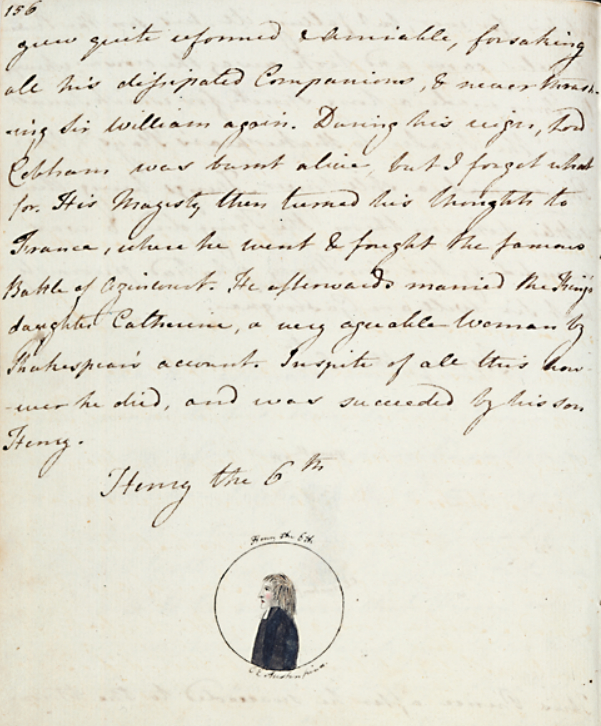
This Prince after he succeeded to the throne grew quite reformed and amiable, forsaking all his dissipated Companions, & never thrashing Sir William again. During his reign, Lord Cobham was burnt alive, but I forget what for. His Majesty then turned his thoughts to France, where he went & fought the famous Battle of Agincourt. He afterwards married the King’s daughter Catherine, a very agreeable Woman by Shakespear’s account. Inspite of all this however, he died, and was succeeded by his son Henry.
Henry the 6th
I cannot say much for this Monarch’s sense. Nor would I if I could, for he was a Lancastrian. I suppose you know all about the Wars between him & the Duke of York who was of the right side; if you do not, you had better read some other History, for I shall not be very diffuse in this, meaning by it only to vent my Spleen against, & shew my Hatred to all those people whose parties or principles do not suit with mine, & not to give information. This King married Margaret of Anjou, a Woman whose distresses & misfortunes were so great as almost to make me who hate her, pity her. It was in this reign that Joan of Arc lived & made such a row among the English. They should not have burnt her — but they did.
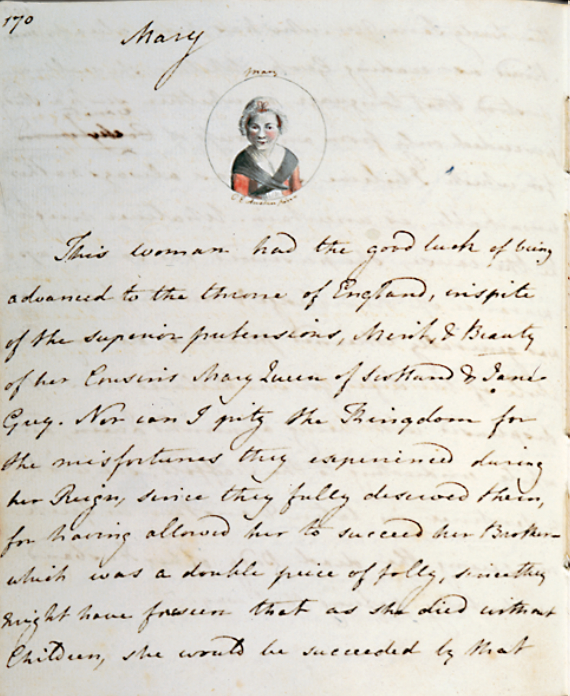
The whole book, including the above pages on Queens Mary and Elizabeth, may be viewed at the British library’s website.
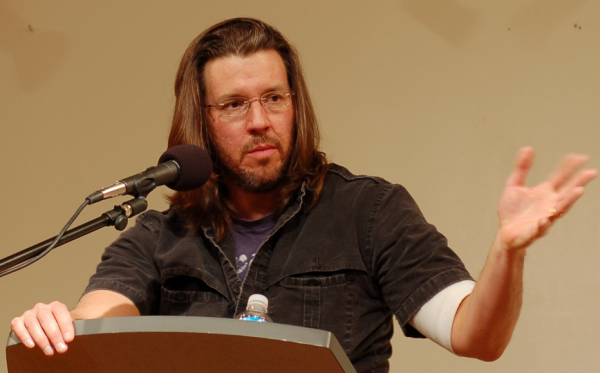
Like many David Foster Wallace fans, I bought a copy of J. Peder Zane’s The Top Ten (previously featured here), a compilation of various famous writers’ top-ten-books lists, expressly for DFW’s contribution. Like most of those David Foster Wallace fans, I felt more than a little surprised when I turned to his page and found out which ten books he’d chosen. Here, as quoted in the Christian Science Monitor, we have the Infinite Jest author and widely recognized (if reluctant) “high-brow” literary figure’s top ten list:
Thrillers, killers, and a dose of Christianity to top it off; I didn’t blame Zane when he asked, “Is he serious? Beats me. To be honest, I don’t know what Wallace was thinking. But I do think there’s a certain integrity to his list.” Wallace himself seemed to read assiduously all over the map — or, more to the point, all up and down the scale of critical respectability. Rattling off “the stuff that’s sort of rung my cherries” to Salon’s Laura Miller in 1996, for a contrast, he named, among other worthy reads, Socrates’ funeral oration, John Donne, “Keats’ shorter stuff,” Schopenhauer, William James’ Varieties of Religious Experience, Wittgenstein’s Tractatus, Joyce’s Portrait of the Artist as a Young Man, Hemingway’s In Our Time, Don DeLillo, A.S. Byatt, Cynthia Ozick, Donald Barthelme, Moby-Dick, and The Great Gatsby. (You can find many of these texts in our Free eBooks collection.)
That, some Wallace readers may think, sounds more like it. But those who’ve paid close attention to Wallace’s language — that often breathlessly but hopelessly imitated mixture of high-caliber vocabulary, casually spoken rhythm, deceptively sharp-edged perception, shrugging presentation, and deliberate solecism — know how fully he simultaneously embodied both “high” and “low” English writing. Just look at the Literary Analysis syllabus from his days teaching at Illinois State University, which demands students read not just The Silence of the Lambs but another Thomas Harris novel, Black Sunday, as well as more C.S. Lewis (in this case The Lion, the Witch, and the Wardrobe) and Stephen King (Carrie). Lest you doubt his commitment to the serious reading of popular fiction, note the presence of Jackie Collins’ Rock Star. In the classroom and in life, Wallace must truly have believed that there exists no low fiction; just low ways of reading fiction.
Looking for free, professionally-read audio books from Audible.com? Here’s a great, no-strings-attached deal. If you start a 30 day free trial with Audible.com, you can download two free audio books of your choice. Get more details on the offer here.
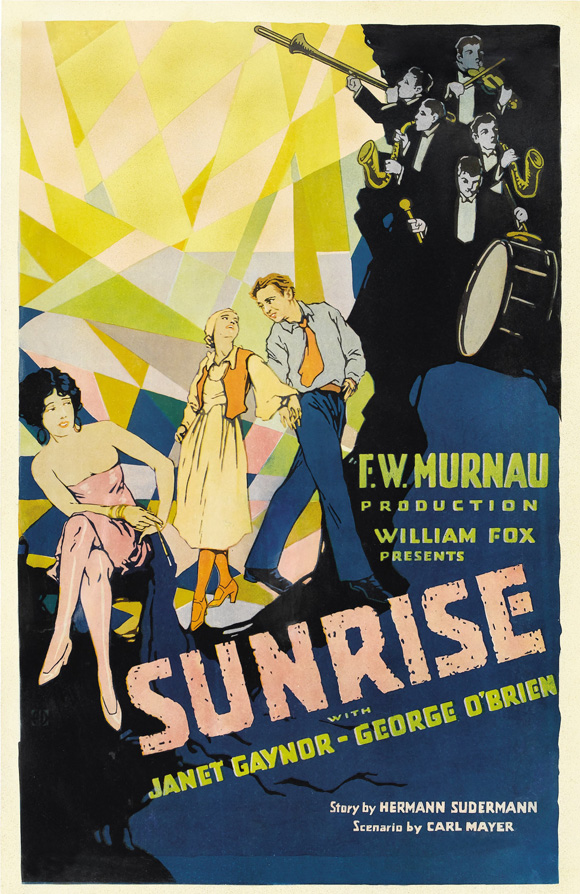
German director F.W. Murnau’s silent masterpiece Sunrise: A Song of Two Humans(1927) is a rare example of a foreign auteur who managed to keep his vision in the face of the Hollywood machine.
Prior to this movie, F. W. Murnau was arguably the most important film director of his time. He directed a string of German Expressionist works that were as bleak and brooding as they were technically brilliant. Murnau’s eerily, hallucinatory Nosferatu(1922) redefined the horror movie. The spectacularly depressing Der Letzte Mann (1924) featured a roving camera, double-exposure and forced perspective to brilliantly evoke the shame, humiliation and (in one tour-de-force sequence) drunkenness of a proud doorman demoted to a washroom attendant. And his adaptation of Faust (1926) was the most lavish, expensive movie Germany had ever produced at the time.
Enter William Fox, a Jewish-Hungarian immigrant who founded the Fox Film Corporation. Though his studio was moderately successful producing Tom Mix serials, he aspired to something greater; he aspired to art. Fox convinced Murnau to make the jump to Hollywood, in part by agreeing to build a $200,000 set for the movie — an astronomical sum in those days.
Sunrise opens with a series of title cards that announce just what this movie is about:
This song of the man and his wife is of no place and every place; you might hear it anywhere at any time. For wherever the sun rises and sets in the city’s turmoil or under the open sky on the farm, life is much the same; sometimes bitter, sometimes sweet.
Murnau and his screenwriter Carl Meyer (who also wrote Der Letzte Mann) made the plotline so simple, so universal that the characters don’t even have names.
A struggling farmer is smitten with a femme fatale from the city. She inveigles him to drown his young wife and run off to the city with her. But when it comes time to do the deed, he realizes that he can’t do it. When the wife flees from him, he follows her into the city, apologizing profusely. Eventually, he and his remarkably forgiving wife reconcile and rekindle their love for one other. The story is so elemental that it could be a fairy tale.
Yet Murnau’s ability to spin absolutely dazzling images — using technology perfected in Germany – is what makes Sunrise so memorable. At one point in the movie, the camera seemingly floats over a crowd in an amusement park; at another the lovers walk down a city street that, without a cut, transforms into a flowering meadow. Compared to his Hollywood contemporaries – D.W. Griffith for example – Murnau’s movie seems vital, modern, and surprisingly poignant.
Though the movie earned a few Oscars – including one for Best Unique and Artistic Production and one for Best Actress for Janet Gaynor — Sunrise suffered the fate of many cinematic masterpieces: It flopped. Yet over the years, its critical reputation has only grown. In 2012, it was named the 5th best movie of all time by Sight and Sound magazine just ahead of 2001: A Space Odyssey. Unlike Kubrick’s sci-fi saga, however, you can watch Sunrise for free on Archive.org. Check it out. Also find the classic on our list of Great Silent Films, part of our larger collection, 4,000+ Free Movies Online: Great Classics, Indies, Noir, Westerns, Documentaries & More.
Jonathan Crow is a Los Angeles-based writer and filmmaker whose work has appeared in Yahoo!, The Hollywood Reporter, and other publications. You can follow him at @jonccrow.
I’ve always been jealous of friends who studied history in college. They’ve got a working knowledge of the causes of wars, economic crises, political upheavals, and any other trivia question-worthy events. Thankfully, whatever I’d like to learn is merely a click away: we’ve got over 800 free online courses (including 67 free history courses) listed on Open Culture at the time of writing, and educational institutions continue to upload new lectures every week. Most of the lectures, however, last from 30 minutes to an hour, requiring users to cordon off a block of time for study. Want something shorter? Enter the 15 Minute History podcast, currently the fourth most popular podcast on iTunesU.
The result of the University of Texas at Austin’s Hemispheres and Not Even Past public outreach efforts, the 15 Minute Historypodcast focuses on key subjects in world history and U.S. history. Although the podcastis tailored to Texas teachers and students, emphasizing the state’s K‑12 curriculum, it also happens to be a treasure trove of free content for anyone interested in history. The short podcasts, which last some 15 minutes on average, cover everything from Russia’s October 1917 Revolution, to the Ottoman Empire, to the global context of the American Revolution. Each episode is led by one of three UT Austin academics, who discuss the topic at hand with another university professor or graduate student. Conveniently, on the 15 Minute History web site, the podcasts are accompanied by a carefully formatted transcript, plus additional reading materials for those who find themselves curious about a particular topic.
Interested readers can find the whole podcast series on iTunes, or on the web.
Ilia Blinderman is a Montreal-based culture and science writer. Follow him at @iliablinderman.
For a sport obsessed with statistical averages, baseball seems to thrive like no other on outrageous anecdotes and singular characters. One of those characters, pitcher Dock Ellis, had a drug-fueled run in the 70s with the Pittsburgh Pirates, claiming that he almost never pitched a game sober, including several National League East Championships and a 1971 World Series win. The drugs eventually became too much and he got help, but they gave Ellis his career best anecdote, the story he tells in the short film above, “Dock Ellis and the LSD No-No.” It’s animated by James Blagdon from an interview Ellis gave to Donnell Alexander and Neille Ilel that aired on NPR in March of 2008.
In June 1970, Ellis took a day off, dropped acid at the airport and, “high as a Georgia pine,” checked into a friend’s girlfriend’s house to enjoy the rest of his trip. He woke up two days later, still tripping, went to the stadium, took some stimulants—which “over 90% of the league was using,” he says—and got to work, pitching a no-hitter against the San Diego Padres. “I didn’t see the hitters,” Ellis says, “all I could tell was whether they were on the right side or left side.” Above, his colorful narration gets a full compliment of sound effects and day-glo exclamations. (We also see allusions to Ellis’ other storied antics, like appearing on the mound in curlers and beaning opposing players with fastballs.) “It was easier,” he says, “to pitch with the LSD because I was used to medicating myself.” In this instance at least, the meds were magic.
The short film premiered at Sundance and film festivals worldwide in 2010, and the Dock Ellis legend has only grown since. The same interview become part of Beyond Ellis D, a “multimedia book” for iPads developed in 2012 by Donnell Alexander and animated by Heidi Perry. (See Part 1, “Superfly Spitball,” above.) In an essay for Deadspin, Alexander laments that Ellis—an outspoken critic of racism in baseball—has been largely reduced to the LSD no-hitter, which he calls “a short take on a big life.” While it’s a hell of a good story, Alexander also sees Ellis “on a continuum with Jackie Robinson” (who advised him to tone it down), “a black ballplayer straddling the reserve-clause era and the arrival of free agency, a man who brought many of the old ways with him into baseball’s new, Day-Glo epoch.” Ellis—who died in 2008 of liver failure at age 63 after years as a drug counselor—certainly lived up to the hype. His wild life and career get a full treatment in the documentary No No, which just screened at Sundance this past month. Watch the film’s trailer below.
Despite his respected facility with the English language, Argentine master craftsman of short fiction Jorge Luis Borges did his best work in his native Spanish. Though we remember prolific interviewer and even more prolific writer William F. Buckley for his formidable command of English above all else, he didn’t even learn it as his first language, starting in on his English education at age seven, having already learned Spanish (not to mention French).
This must have placed him well to appreciate Borges’ writing, and indeed, in his introduction to their Firing Line conversation above, Buckley cites Borges’ reputation as the greatest, most influential writer then alive. “We met in Buenos Aires, in 1977, during the military junta days,” Buckley recalls of the taping in a Paris Review interview. “He seemed astonishingly frail, but he spoke without a pause.”
Buckley goes on to provide many choice quotes from Borges’ answers to questions about his sight (“When you are blind, time flows in a different way. It flows, let’s say, on an easy slope”), his love of American writers like Emerson and Melville, his languages (“Of course, my Latin is very rusty. But still, as I once wrote, to have forgotten Latin is already, in itself, a gift”), and where he finds beauty and art (“A man may say a very fine thing, not being aware of it. I am hearing fine sentences all the time from the man in the street, for example. From anybody”), and how he taught (“I tried to teach my students not literature—that can’t be taught—but the love of literature”). For more on that last, see also “The Daggers of Jorge Luis Borges,” a piece on the new book Professor Borges: A Course on EnglishLiterature, by Michael Greenberg in the New York Review of Books.
We're hoping to rely on loyal readers, rather than erratic ads. Please click the Donate button and support Open Culture. You can use Paypal, Venmo, Patreon, even Crypto! We thank you!
Open Culture scours the web for the best educational media. We find the free courses and audio books you need, the language lessons & educational videos you want, and plenty of enlightenment in between.