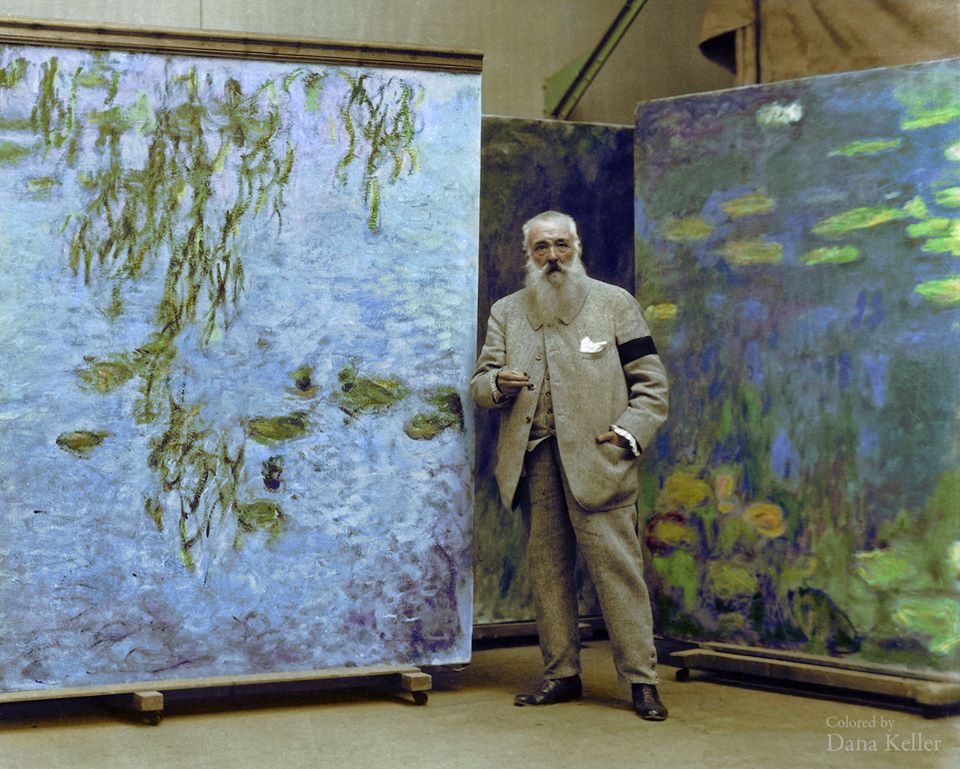
On the History in Color Facebook page, artist Dana Keller presents a series of colorized historical photographs, helping to “remove that barrier between the past and our modern eyes, drawing us a little bit closer to the reality in which the photo was taken.” In the example above, we see impressionist painterClaude Monet standing next to paintings from his famous Water Lilies series. Given what he did with color in his paintings, it seems only fitting that we should see the man himself in color.
If you would like to support the mission of Open Culture, consider making a donation to our site. It’s hard to rely 100% on ads, and your contributions will help us continue providing the best free cultural and educational materials to learners everywhere. You can contribute through PayPal, Patreon, and Venmo (@openculture). Thanks!
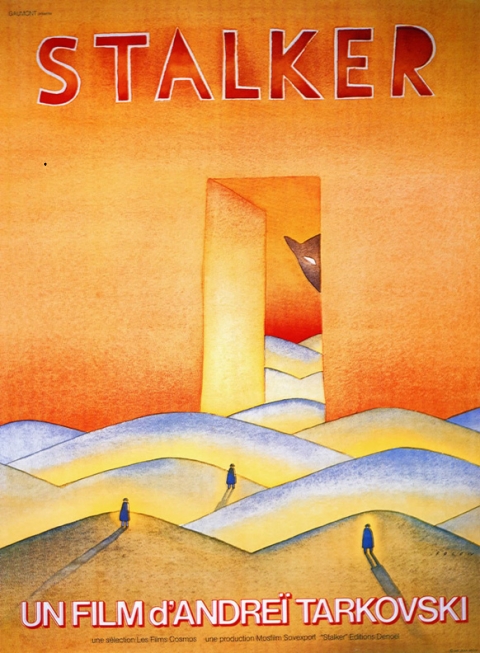
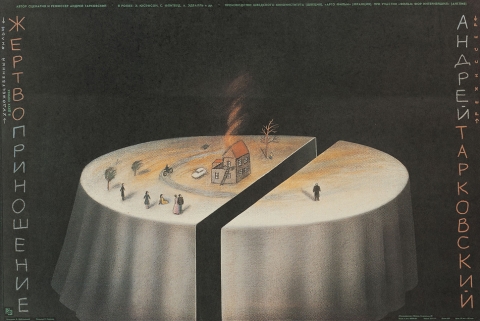
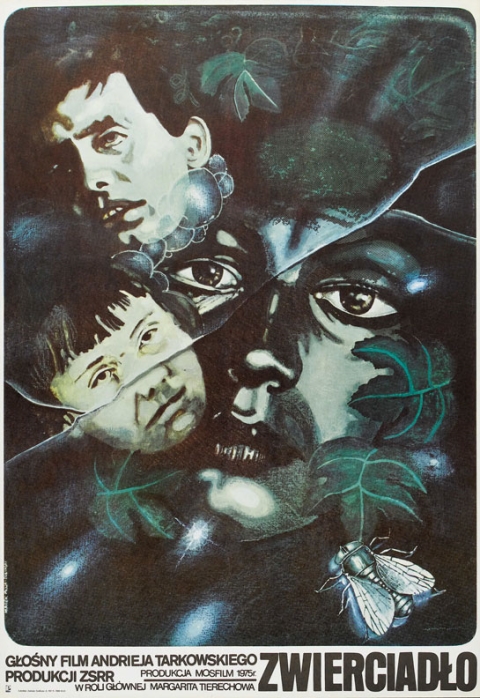
Nearly thirty years after his death, Andrei Tarkovsky (many of whose films you can watch free online) continues to win devoted fans by what some describe as his still-unparalleled mastery of aesthetics. Not only do all his pictures — and especially his later works like Solaris, Mirror, and Stalker — present images of the deepest richness in a manner of the highest refinement, but in so doing they come out looking and feeling like no other films created before or since. So many cinephiles claim that one can identify their favorite director’s work by only a single shot, but for Tarkovsky this boast actually seems to hold true (especially in the case of the nine-minute candle-carrying shot from Nostalghia). When we talk about Tarkovsky, we talk about aesthetics, whether we talk about his films, his Polaroid photos, or his posters.
Not that Tarkovsky’s perfectionism had him exercising total control over the one-sheets that advertise his films, nor did he actually command every visual detail of every frame of the films themselves. I would submit, however, that all who worked in the orbit of a Tarkovsky production, from cinematographers to set builders, right down to the graphic designers, entered his thoroughly realized and affecting aesthetic reality. “Tarkovsky is one filmmaker for whom I’d gladly have posters that simply feature gorgeous images from his films (of which there are an unlimited supply)” writes Adrian Curry at MUBI, “but there are so many terrific illustrated posters that I thought I’d just feature my favorite for each film.” His selections include the French one for Stalker, the Polish one for Mirror(because you can never ignore Polish movie poster design), and the Russian one for The Sacrifice. It pays Tarkovsky one of the highest possible compliments: he created not only beauty, but works that inspire others to create beauty.
A collection of the international movie posters for each of Tarkovsky’s major films can be found at Nostalghia.com.
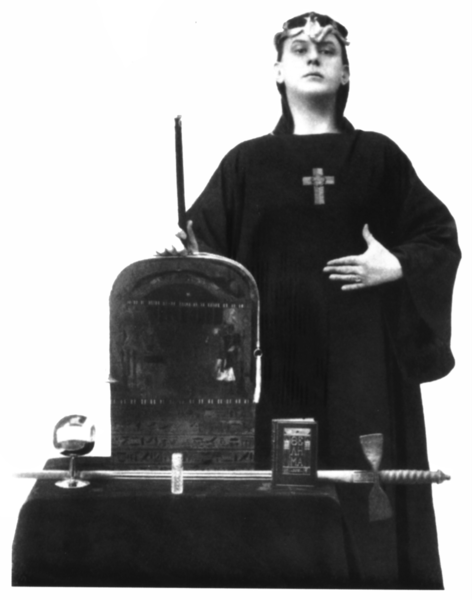
Perhaps no one single person has had such widespread influence on the countercultural turns of the 20th century as Cambridge-educated occultist and inventor of the religion of Thelema, Aleister Crowley. And according to Crowley, he isn’t finished yet. “1000 years from now,” Crowley once wrote, “the world will be sitting in the sunset of Crowlianity.” The self-aggrandizing Crowley called himself “the Great Beast 666” and many other tongue-in-cheek apocalyptic titles. The British press dubbed him “The Wickedest Man in the World,” also the title of the above documentary, one of a four-part BBC 4 series on famously sinister figures called “Masters of Darkness.” Crowley is perhaps most famous for his dictum “Do what thou wilt,” which, taken out of its context, seems to be a philosophy of absolute, unfettered libertinism.
It’s no surprise that the particular treatment of Crowley’s life above adopts the tabloid description of the magician. The documentary—with its ominous music and visual effects reminiscent of American Horror Story’s jarring opening credits—takes the sensationalistic tone of true crime TV mixed with the dim lighting and hand-held camerawork of paranormal, post-Blair Witch entertainments. And it may indeed take some liberties with Crowley’s biography. When we’re told by the voice-over that Crowley was a “black magician, drug fiend, sex addict, and traitor to the British people,” we are not disposed to meet a very likable character. Crowley would not wish to be remembered as one anyway. But despite his pronounced disdain for all social conventions and pieties, his story is much more complicated and interesting than the cardboard cutout villain this description suggests.
Born Edward Alexander Crowley in 1875 to wealthy British Plymouth Brethren brewers, Crowley very early set about replacing the religion of his family and his culture with a variety of extreme endeavors, from mountaineering to sex magic and all manner of practices derived from a synthesis of Eastern religions and ancient and modern demonology. The results were mixed. All but the most adept find most of his occult writing incomprehensible (though it’s laced with wit and some profundity). His raunchy, hysterical poetry is frequently amusing. Most people found his overbearing personality unbearable, and he squandered his wealth and lived much of life penniless. But his biography is inarguably fascinating—creepy but also heroic in a Faustian way—and his presence is nearly everywhere inescapable. Crowley traveled the world conducting magical rituals, writing textbooks on magic (or “Magick” in his parlance), founding esoteric orders, and interacting with some of the most significant artists and occult thinkers of his time.
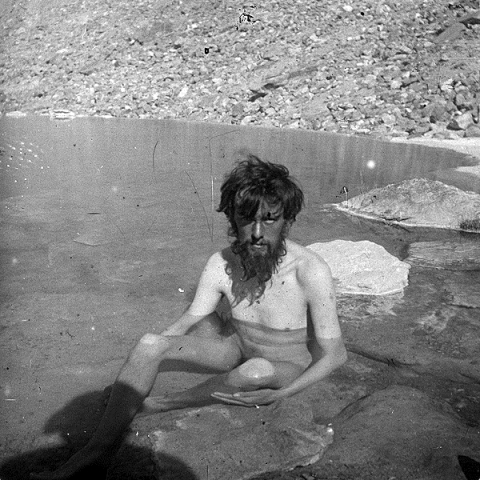
As a mountaineer, Crowley co-lead the first British expedition to K2 in 1902 (the photo above shows him during the trek). As a poet, he published some of the most scandalous verse yet printed, under the name George Archibald Bishop in 1898. During his brief sojourn in the occult society Hermetic Order of the Golden Dawn, he exerted some influence on William Butler Yeats, if only through their mutual antipathy (Crowley may have inspired the “rough beast” of Yeats’ “The Second Coming”). He’s indirectly connected to the development of the jet propulsion system—through his American protégée, rocket scientist Jack Parsons—and of Scientology, through Parsons’ partner in magic (and later betrayer), L. Ron Hubbard.
Though accused of betraying the British during the First World War, it appears he actually worked as a double agent, and he had many ties in the British intelligence community. Crowley rubbed elbows with Aldous Huxley, Alfred Adler, Roald Dahl, and Ian Fleming. After his death in 1947, his life and thought played a role in the work of William S. Burroughs, The Beatles, Led Zeppelin, the Rolling Stones, David Bowie, Ozzy Osbourne, Robert Anton Wilson, Timothy Leary, Genesis P‑Orridge, and countless others. Crowley pops up in Hemingway’s A Movable Feast and he has inspired a number of literary characters, in for example Somerset Maugham’s The Magician and Christopher Isherwood’s A Visit to Anselm Oakes.
So who was Aleister Crowley? A sexually liberated genius, a spoiled, egomaniacal dilettante, a campy charlatan, a skeptical trickster, a cruel and abusive manipulator, a racist misogynist, a Nietzschean superman and “icon of rebellion” as the narrator of his story above calls him? Some part of all these, perhaps. A 1915 Vanity Fair profile put it well: “a legend has been built up around his name. He is a myth. No other man has so many strange tales told of him.”
As with all such notorious, larger-than-life figures, who Crowley was depends on whom you ask. The evangelical Christians I was raised among whispered his name in horror or pronounced it with a sneer as a staunch and particularly insidious enemy of the faith. Various New Age groups utter his name in reverence or mention it as a matter of course, as physicists reference Newton or Einstein. In some countercultural circles, Crowley is a hip signifier, like Che Guevara, but not much more. Dig into almost any modern occult or neo-pagan system of thought, from Theosophy to Wicca, and you’ll find Crowley’s name and ideas. Whether one’s interest in “The Great Beast” is of the prurient variety, as in the investigation above, or of a more serious or academic bent, his legacy offers a bountiful plenty of bizarre, repulsive, intriguing, and completely absurd vignettes that can beggar belief and compel one to learn more about the enigmatic, pan-sexual black magician and self-appointed Antichrist.
Along with its whimsical, hand-drawn covers and its surprisingly readable articles on unlikely subjects, like nickel-mining, The New Yorker magazine is known for its cartoons – single panel doodles that can be either wry commentaries on our culture or, as a famous Seinfeld episode pointed out, utterly inscrutable.
Translating the cartoons to television seems a task doomed to failure but Seth Meyers, the newly-installed host of Late Night, managed successfully to do just that. The show’s “theater group-in-residence, the late night players” reenacted some of the magazine’s more famous recent cartoons. Many of the magazine’s most enduring cartoon set ups are represented – a bar, a wedding reception and, of course, a deserted island.
Providing deadpan commentary on the performances is The New Yorker’s editor-in-chief David Remnick. When selecting cartoons for the magazine, he notes, the primary criteria is that they “should be funny.” Check it out above.
Jonathan Crow is a Los Angeles-based writer and filmmaker whose work has appeared in Yahoo!, The Hollywood Reporter, and other publications. You can follow him at @jonccrow.
What do a dancer, a chess player, a visual artist, a trumpeter, an architect, and a cab driver have in common? In the case of the dancer, the chess player, the visual artist, the trumpeter, the architect, and the cab driver profiled in trained molecular biologist and neuroscientist and The Rough Guide to the Brain author Barry J. Gibb’s abNormal above, they share… well, abnormality, in some sense or another. This half-hour documentary, which Gibb made in consultation with psychologist and neuroimaging researcher Chris Frith, “points a microscope at human behaviour, asking viewers to question their perceptions of others and even of themselves.” An ambitious mandate, especially when you consider its central question: we know what we mean when we think of someone else as abnormal, but what do all these other people — people whom we might indeed find abnormal, for good, ill, or both — consider abnormal? Do they consider themselves abnormal? And how do we define normality, let alone abnormality, in the first place?
A tangled question, bordering on nonsense, but science can, as usual, clarify a few things. abNormal finds answers, or at least the appropriate questions, in the workings of the human brain. It comes as an early offering from Mosaic, a new site from the Wellcome Trust “dedicated to exploring the science of life” by telling “stories with real depth about the ideas, trends and people that drive contemporary life sciences,” all published as Creative Commons-licensed content. In this case, a set of human stories — the frustrated IT worker who ditched the office job to become a London cabbie, the Thai painter who makes large-form works with three-dimensional nipples, the breakdancer bent on recreating and improving on 1982 with his body alone — converge to elucidate a deeper scientific narrative about our brains, our environments, and the forms our lives take today.
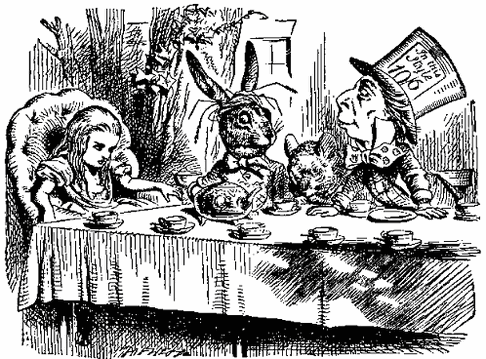
Many of us came across our favorite book serendipitously. No surprise: it’s easiest to be completely blown away by a work of art or literature when you approach it without any pre-existing expectations. For BoingBoing’s Cory Doctorow, that book was Lewis Carroll’sAlice In Wonderland. Doctorow, now a prominent author, journalist, and technology activist, first came across Carroll’s tale of a young girl who falls down a rabbit hole in 1978:
“In 1978, I walked into my Crestview Public School grade two classroom in Willowdale, a suburb of Toronto, and, on the spur of the moment, took Alice in Wonderland off the shelf. My teacher was Bev Pannikkar, who had the amazing empathy and good sense to let me be after I hunkered down behind the low bookshelf and started reading. I spent the entire day back there, reading. I never stopped.
If you’re looking for a version with a few more bells and whistles with regards to production value, we’ve included a 1996 audio version of the book, below. This one is narrated by Susan Jameson and James Saxon, two actors and veteran audiobook readers, who do a wonderful job of injecting the story’s tongue-in-cheek humor into the recording.
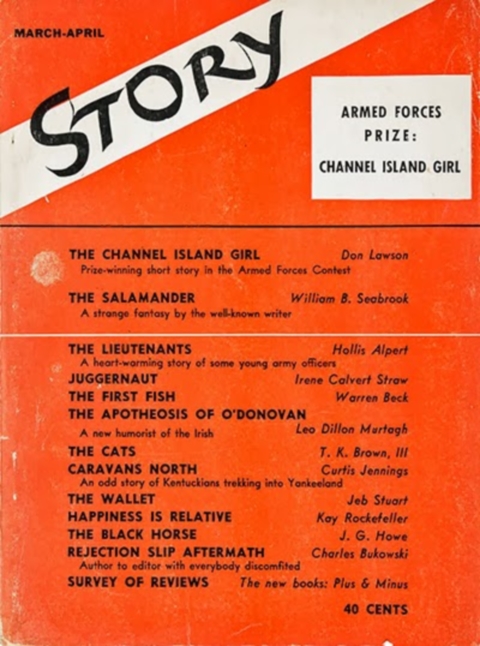
“Everyone’s got to start somewhere,” a banal platitude that expresses a truism worth repeating: wherever you are, you’ve got to get started. If you’re John Updike (who would have been 82 years old yesterday), you start where so many other accomplished figures have, the Harvard Lampoon. If you’re Charles Bukowski… believe it or not, you actually start in an equally renowned publication. Bukowski’s first fiction appeared in Story, a magazine that helped launch the careers of Cheever, Salinger, Saroyan, Carson McCullers and Richard Wright.
But if you’re Charles Bukowski, you come out swinging. Your first published work in 1944 is a nonsense story written as an eff you to the editor, Whit Burnett. You feature Mr. Burnett as a character, along with a cat who shakes hands (sort of), a prostitute named Millie, a few card-playing drunks, an imperious “short story instructress,” and a mysterious “bleary-eyed tramp.” Oh, and you open the story by quoting verbatim one of Burnett’s rejection letters:
Dear Mr. Bukowski:
Again, this is a conglomeration of extremely good stuff and other stuff so full of idolized prostitutes, morning-after vomiting scenes, misanthropy, praise for suicide etc. that it is not quite for a magazine of any circulation at all. This is, however, pretty much the saga of a certain type of person and in it I think you’ve done an honest job. Possibly we will print you sometime but I don’t know exactly when. That depends on you.
Sincerely yours,
Whit Burnett
I won’t spoil it for you—you must read (or listen to below) “Aftermath of a Lengthy Rejection Slip” for yourself—but the letter sets up a typically Bukowskian punchline: wry and sarcastic and wistful and lyrical all at once.
Bukowski was 24 and had only been writing for two years by this time. He later recalled being very unhappy with the publication. For one, writes Booktryst, “it had been buried in the End Pages section of the magazine as, Bukowski felt, a curiosity rather than a serious piece of writing.” However, Bukowski had already sent Story dozens of what he considered serious pieces of writing before penning “Aftermath,” which he admits he tamed for the sake of Burnett’s sensibilities. In an interview near the end of his life, Bukowski remembered submitting to the magazine “a couple of short stories a week for maybe a year and half. The story they finally accepted was mild in comparison to the others. I mean in terms of content and style and gamble and exploration and all that.”
Bukowski may have been bitter, but his first publication, and last submission to Story, might deserve credit for inspiring a lifetime of boozy material: looking back, he recalls that after the perceived slight, he “drank and became one of the best drinkers anywhere, which takes some talent also.” Everybody’s got to start somewhere.
Booktryst has more to the story, as well as several images of the rare 1944 Bukowski issue of Story. Above, in two parts, listen to the story in the wonderfully dry baritone of Tom O’Bedlam, whom you may already know from our previous posts on Bukowski’s poems “Nirvana” and “So You Want to Be a Writer?”
For his latest essay, Kogonada takes on perhaps film’s most famous formalist working today – Wes Anderson. As you can see from the video above, Anderson loves to compose his shots with perfect symmetry. From his breakout hit Rushmore,to his stop-motion animated movie The Fantastic Mr. Fox, to his most recent movie The Grand Budapest Hotel, Anderson consistently organizes the elements in his frame so that the most important thing is smack in the middle.
Directors are taught in film school to avoid symmetry as it feels stagey. An asymmetrically framed shot has a natural visual dynamism to it. It also makes for a more seamless edit to the next shot, especially if that shot is another asymmetrically framed shot. But if you’ve watched anything by Anderson, you know that seeming stagey has never been one of his concerns. Instead, Anderson has developed his own quirky, immediately identifiable visual style.
When critics complained about Ozu’s proclivity for essentially making the same movie over and over again, he famously responded by saying, “I only know how to make tofu. I can make fried tofu, boiled tofu, stuffed tofu. Cutlets and other fancy stuff, that’s for other directors.” Anderson would probably not consider himself a tofu maker, but he would most likely appreciate Ozu’s sentiment.
Check out another Kogonada essay below about Anderson’s tendency for composing shots from directly overhead.
We're hoping to rely on loyal readers, rather than erratic ads. Please click the Donate button and support Open Culture. You can use Paypal, Venmo, Patreon, even Crypto! We thank you!
Open Culture scours the web for the best educational media. We find the free courses and audio books you need, the language lessons & educational videos you want, and plenty of enlightenment in between.