Michael Palin’s Tour of the Best Loved Monty Python Sketch Locations

In 1999, trav­el pre­sen­ter and found­ing mem­ber of Mon­ty Python, Michael Palin, led view­ers on a tour of Python­land, a col­lec­tion of unre­mark­able Lon­don loca­tions where some of the com­e­dy troupe’s most famous sketch­es were filmed.

Unlike fel­low Python Ter­ry Jones, the pleas­ant woman who responds to Pal­in’s knock at 94 Thor­pe­bank Road is not expect­ing a new gas cook­er, though judg­ing from the way she is dressed, she is await­ing a tele­vi­sion crew. Hav­ing spent sev­er­al decades lis­ten­ing to boys (and then men) inces­sant­ly recit­ing their fave Python bits, it’s a tri­fle hard for me to believe that any­one could claim zero knowl­edge of the show’s exis­tence. Maybe things are dif­fer­ent here in the States…

For­tu­nate­ly for the tele­vi­sion audi­ence, old Joe, next door at no. 92, does remem­ber the show’s takeover of the neigh­bor­hood, includ­ing John Cleese’s sil­ly walk out of no. 107, back when it was a shop.

The star betrays his age at the West Lon­don home that was the set­ting of the Seduced Milk­man skit. Palin is less shocked that the scant­i­ly clad Don­na Read­ing has been replaced by a dis­in­ter­est­ed young bloke in an apron than that the small size of the room served as a hold­ing pen for the punch­line’s five oth­er way­ward milk­men. Me too. I can’t imag­ine a 21st-cen­tu­ry crew agree­ing to lug their equip­ment up a flight of stairs, let alone shoot in a room that’s no big­ger than it appears to be on film.

Palin also swings by Ted­ding­ton Lock to demon­strate his fabled Fish Slap­ping Dance with a uni­formed atten­dant and no fish. At the end of every call, Palin presents the cur­rent occu­pant with a fac­sim­i­le Eng­lish Her­itage plaque. (More than ten years lat­er, Palin toast­ed the instal­la­tion of a fake blue plaque hon­or­ing his late col­league Gra­ham Chap­man at the lat­ter’s favorite pub.)

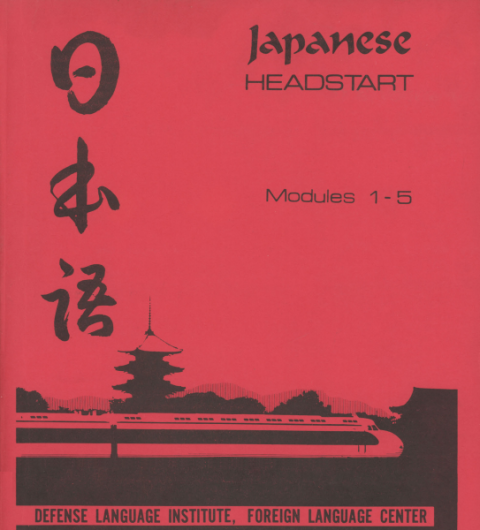
If you’re a Python pil­grim look­ing to make a day of it, here are a few more spots that will round things up to an even dozen. The no-longer-in-print Japan­ese guide­book that Palin relies on in the videos is some­thing of a grail, but only to those who speak Japan­ese.

Relat­ed Con­tent:

Mon­ty Python’s Best Phi­los­o­phy Sketch­es

Watch All of Ter­ry Gilliam’s Mon­ty Python Ani­ma­tions in a Row

Watch Mon­ty Python’s “Sum­ma­rize Proust Com­pe­ti­tion” on the 100th Anniver­sary of Swann’s Way

Ayun Hal­l­i­day is a Brook­lyn-based author, per­former, direc­tor and the Chief Pri­ma­tol­o­gist of the East Vil­lage Inky zine. Fol­low her@AyunHalliday

Isolated Drum Tracks From Six of Rock’s Greatest: Bonham, Moon, Peart, Copeland, Grohl & Starr

“Drums, eh,” says Kei­th Richards in answer to a fan ques­tion on the sub­ject. “With­out it you’re kin­da nowhere.” He’s got a point. An ace drum­mer can be the spine, mus­cle, and even soul of a great band. Pound­ing, swing­ing, and smash­ing away behind showy gui­tarists and flam­boy­ant front­men, drum­mers some­times have prob­lems being seen, but nev­er heard. But while John Bon­ham or Kei­th Moon nev­er got lost in the mix, it’s a rare thing to hear them out of it. The pro­lif­er­a­tion of rock band video games and iso­lat­ed tracks post­ed to Youtube allow us to lis­ten to the nuances of drum grooves we may feel we know by heart, such as Bonham’s dri­ving beat behind Led Zeppelin’s “Whole Lot­ta Love.”

In a pre­vi­ous post, we brought you a rough mix of the song and Jim­my Page describ­ing its cre­ation. Page want­ed Bonham’s drum track to “real­ly stand out, so that every stick stroke sound­ed clear and you could real­ly feel them.” It cer­tain­ly does that. The drum track above is all about feel­ing. As a result of the record­ing tech­niques of the time, writes producer/engineer Bob­by Owin­s­ki, drum tracks tend­ed to sound “like a sin­gle instru­ment,” since they were record­ed with only two or three mics cap­tur­ing the space around the kit, rather than the sound of indi­vid­ual pieces. “Still,” Owin­s­ki writes of this track, “there’s plen­ty of pow­er in [Bonham’s] kick and snare, because he played them hard!” In addi­tion to his pow­er, Bon­ham is known for his laid-back groove, due to his ten­den­cy for play­ing slight­ly behind the beat, a qual­i­ty Youtube drum instruc­tor Ter­ry Keat­ing of Bon­zoleum ascribes to “tem­pera­ment.”

Bonham’s style con­sist­ed main­ly of cre­ative uses of triplets, so much so that McSweeny’s had a good laugh about his con­stant use a sim­i­lar pat­tern. One of my favorite drummers—crankiest man in rock Gin­ger Baker—also dis­par­ages Bonham’s play­ing, as well as that of anoth­er alco­holic drum star, Kei­th Moon. But Gin­ger Bak­er doesn’t tend to like any­one, and Moon’s play­ing, while maybe not vir­tu­osic or espe­cial­ly dis­ci­plined, was, like his per­sona, insane. Drum Mag­a­zine describes Moon’s style as “trib­al, prim­i­tive, and impul­sive, with him often stomp­ing the bass drums and pound­ing his wall of toms like a mad­man” (clear­ly Moon inspired the Mup­pets’ Ani­mal). Moon’s many kits often con­sist­ed of dou­ble bass drums and dou­ble rows of toms, and he played them as hard as pos­si­ble almost all the time. Hear him above thrash­ing with aban­don through “Won’t Get Fooled Again.”


Seem­ing­ly miles away from the mad­ness of Kei­th Moon, Rush’s Neil Peart is a high­ly tech­ni­cal drum­mer with impec­ca­ble on-the-beat tim­ing and a drum set­up that has grown so exten­sive and com­pli­cat­ed over the years that he almost dis­ap­pears into its depths. Peart’s play­ing com­bines the pow­er and sta­mi­na of Bon­ham with com­plex pat­terns whose rhyth­mic dynam­ics shift sub­tly sev­er­al times through­out each song. Check out the iso­lat­ed drum track for “Tom Sawyer” above as a clas­sic exam­ple of Peart’s tech­nique and you may see why he’s classed as one of the all-time best rock drum­mers (though I wouldn’t class him as one of rock’s great­est lyri­cists).

Although I’m an admir­er of Neil Peart’s drum­ming, I can’t say I’m much of a Rush fan. Police drum­mer Stew­art Copeland feels the same. In an inter­view with Music Radar, he jokes about “pull[ing] Neil’s chain at every pos­si­ble oppor­tu­ni­ty” for the self-indul­gent excess of drum solos (though Copeland game­ly played one dur­ing David Letterman’s “Drum Solo Week” in 2011). Copeland talks about “a time when bands like Rush were the epit­o­me of what The Police were the­o­ret­i­cal­ly against, which was an overem­pha­sis on musi­cal­i­ty.” Nonethe­less, Copeland is one of the most musi­cal of drum­mers, mak­ing use of odd time sig­na­tures and polyrhyth­mic syn­co­pa­tion to cre­ate a thor­ough­ly unique and instant­ly rec­og­niz­able style (which has even inspired neu­ro­science stud­ies). The drum track above comes from “Next to You,” a song on the band’s debut album, dur­ing their decid­ed­ly anti-Rush phase. While the song itself is uptem­po punk rock, Copeland’s Gene Kru­pa-like drum­ming, heard in iso­la­tion, presages the unusu­al quirks to come as the band stretched out into jazz and reg­gae ter­ri­to­ry.

The sheer num­ber of bands Foo Fight­ers front­man and for­mer Nir­vana drum­mer Dave Grohl has drummed for is impres­sive, and a tes­ta­ment to his machine-like speed and tim­ing. Drum­mer and Port­landia star Fred Armisen may be Grohl’s biggest fan. “Every drum part he does is a mas­ter­piece,” says Armisen, “He’s nev­er just heavy for heavy’s sake or rock for rock’s sake—it’s all so musi­cal, with an incred­i­ble sense of dynam­ics. Every gen­er­a­tion has their drum­ming guy, and Dave is ours.” Even Kurt Cobain, nev­er one to over­praise, once called Grohl “the best drum­mer in the world.” Maybe a bit of hyper­bole, but Grohl’s damned good, even at his most straight­for­ward, as above in his pound­ing drum­beat for “Smells Like Teen Spir­it.” Grohl’s pow­er­house play­ing isn’t the most ver­sa­tile. He had some trou­ble adjust­ing to qui­eter envi­rons, and Cobain near­ly banned him from the band’s leg­endary “Unplugged” per­for­mance for his too-aggres­sive play­ing in rehearsals. Nonethe­less, when it comes to punk, hard­core, and seri­ous rock, Grohl’s the man.


I can’t resist end­ing with the iso­lat­ed track of what maybe be my all-time favorite drum part, Ringo Starr’s wild­ly funky busi­ness at the end of “Straw­ber­ry Fields For­ev­er.” Some of the drums here are over­dubbed, with sev­er­al dif­fer­ent per­cus­sion parts blend­ed with Starr’s full-kit freak out. Starr has tak­en a lot of com­plete­ly unde­served flak for his sup­posed lim­i­ta­tions as a drum­mer, but as Samuel Belkin writes at The Exam­in­er, “his lat­ter day drum pat­terns are […] often sophis­ti­cat­ed, and always idio­syn­crat­ic […] nobody has ever been able to sound quite like Ringo.” Ulti­mate­ly, in my book, what dis­tin­guish­es a tru­ly great drum­mer from thou­sands of tech­ni­cal­ly pro­fi­cient play­ers is a qual­i­ty no one can teach or emu­late: Per­son­al­i­ty.

Relat­ed Con­tent:

7 Female Bass Play­ers Who Helped Shape Mod­ern Music: Kim Gor­don, Tina Wey­mouth, Kim Deal & More

Lis­ten to The John Bon­ham Sto­ry, a Radio Show Host­ed by Dave Grohl

Kei­th Moon’s Final Per­for­mance with The Who (1978)

Hear the Iso­lat­ed Vocal Tracks for The Bea­t­les’ Cli­mac­tic 16-Minute Med­ley on Abbey Road

Josh Jones is a writer and musi­cian based in Durham, NC. Fol­low him at @jdmagness.

Stanley Kubrick Talks Cinema, Chess, ESP, Vietnam & His Cat in Interviews with Michel Ciment (1975–1987)

Cinephiles cer­tain­ly know the name of Stan­ley Kubrick, and die-hard cinephiles just as cer­tain­ly know the name of Michel Ciment, the French crit­ic behind cel­e­brat­ed vol­umes on such auteurs as Elia Kazan, Joseph Losey, John Boor­man, Theo Angelopou­los, Fritz Lang, and, yes Kubrick him­self. Ciment has placed the direc­tor’s work, which includes the likes of Dr. Strangelove2001: A Space Odyssey, and A Clock­work Orange, “among the most impor­tant con­tri­bu­tions to world cin­e­ma in the twen­ti­eth cen­tu­ry.” In an attempt to do jus­tice to the mind of his sub­ject while writ­ing Kubrick, he put in no small amount of time with the man him­self. At the top of the post, you can hear an assem­blage of mate­r­i­al from a five-part inter­view between Ciment and Kubrick orig­i­nal­ly aired on the French radio pro­gram A voix nue, itself pieced togeth­er from a series of con­ver­sa­tions between crit­ic and direc­tor record­ed between 1975 and 1987. So we ulti­mate­ly have here, as the per­son who put the clip on Youtube notes, “a recon­struct­ed hour of Kubrick talk­ing about cin­e­ma, chess, ESP, art, writ­ing, Viet­nam, his cat, the 18th cen­tu­ry, and even Fear and Desire.”

But with this fas­ci­nat­ing mate­r­i­al comes a caveat: “As the inter­views were broad­cast for French audi­ences, a French voice-over was added through­out the entire audio in post-edit. This meant that you’d hear Kubrick talk for about three or four sec­onds and then have a trans­la­tor jump in and repeat what he said in French at a loud­er vol­ume. Usu­al­ly the trans­la­tor would step in and cut off the first or last words that Kubrick was say­ing, or some­times just talk over the top of him.” The result, with the French most­ly excised and the Eng­lish remains stitched into a solid­ly Kubrick­ian hour, does make for “a very demand­ing and irri­tat­ing way to lis­ten to the inter­views” which “involves a lot of con­cen­tra­tion to fil­ter out the inter­preter and keep piec­ing togeth­er the flow of what Kubrick says.” Yet he does say plen­ty worth hear­ing, espe­cial­ly for those already famil­iar with his fil­mog­ra­phy. But if this audio does indeed wear down your patience, feel free to check out one of the less tax­ing ways to get a dose of Kubrick and Ciment: for exam­ple, the three con­ver­sa­tions on Bar­ry Lyn­donThe Shin­ing, and A Clock­work Orange so con­ve­nient­ly tran­scribed — in Eng­lish! — at The Kubrick Site. You can also lis­ten to Stan­ley Kubrick’s 1965 Inter­view with The New York­er here.

Relat­ed Con­tent:

Fear and Desire: Stan­ley Kubrick’s First and Least-Seen Fea­ture Film (1953)

Stan­ley Kubrick’s Daugh­ter Shares Pho­tos of Her­self Grow­ing Up on Her Father’s Film Sets

Stan­ley Kubrick’s List of Top 10 Films (The First and Only List He Ever Cre­at­ed)

Col­in Mar­shall hosts and pro­duces Note­book on Cities and Cul­ture and writes essays on cities, lan­guage, Asia, and men’s style. He’s at work on a book about Los Ange­les, A Los Ange­les Primer. Fol­low him on Twit­ter at @colinmarshall or on Face­book.

Archive of 5,000 Images Document the History of San Francisco and the Vehicles That Put It in Motion

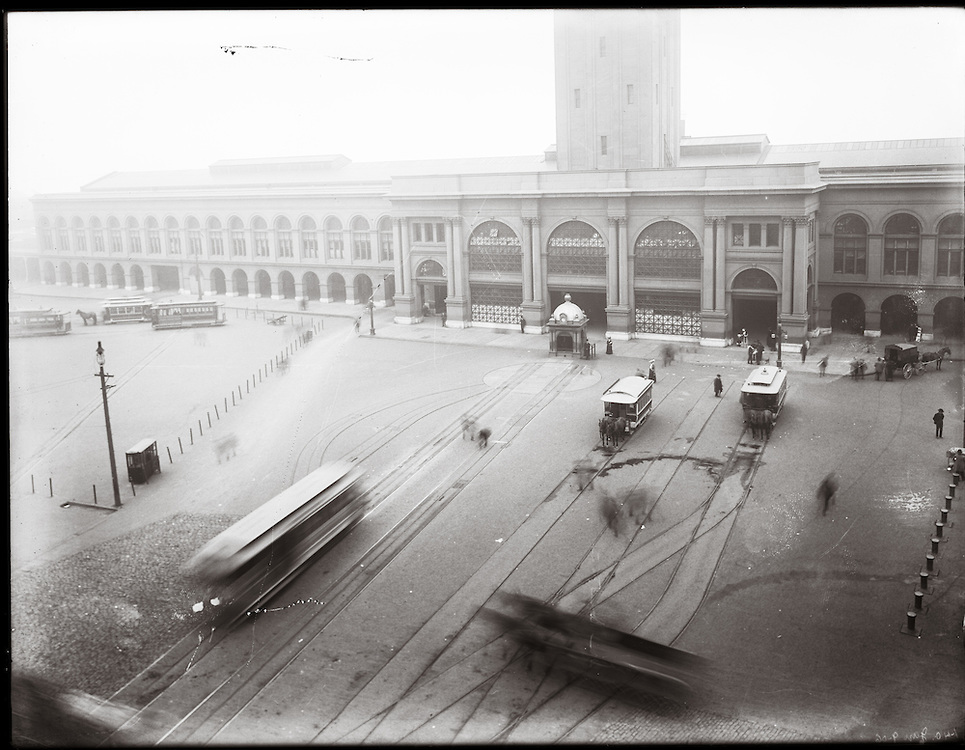
Ferry Showing Present Track Layout

Tak­en at the fog-shroud­ed Fer­ry Build­ing in San Fran­cis­co in Jan­u­ary 1906, just months before a mas­sive earth­quake lev­eled the up-and-com­ing city, the strik­ing image above comes from The San Fran­cis­co Munic­i­pal Trans­porta­tion Agency Pho­to­graph­ic Archive, an archive that pro­vides a “visu­al his­to­ry of the city’s pub­lic trans­porta­tion his­to­ry dat­ing back to the ear­ly 20th Cen­tu­ry.”

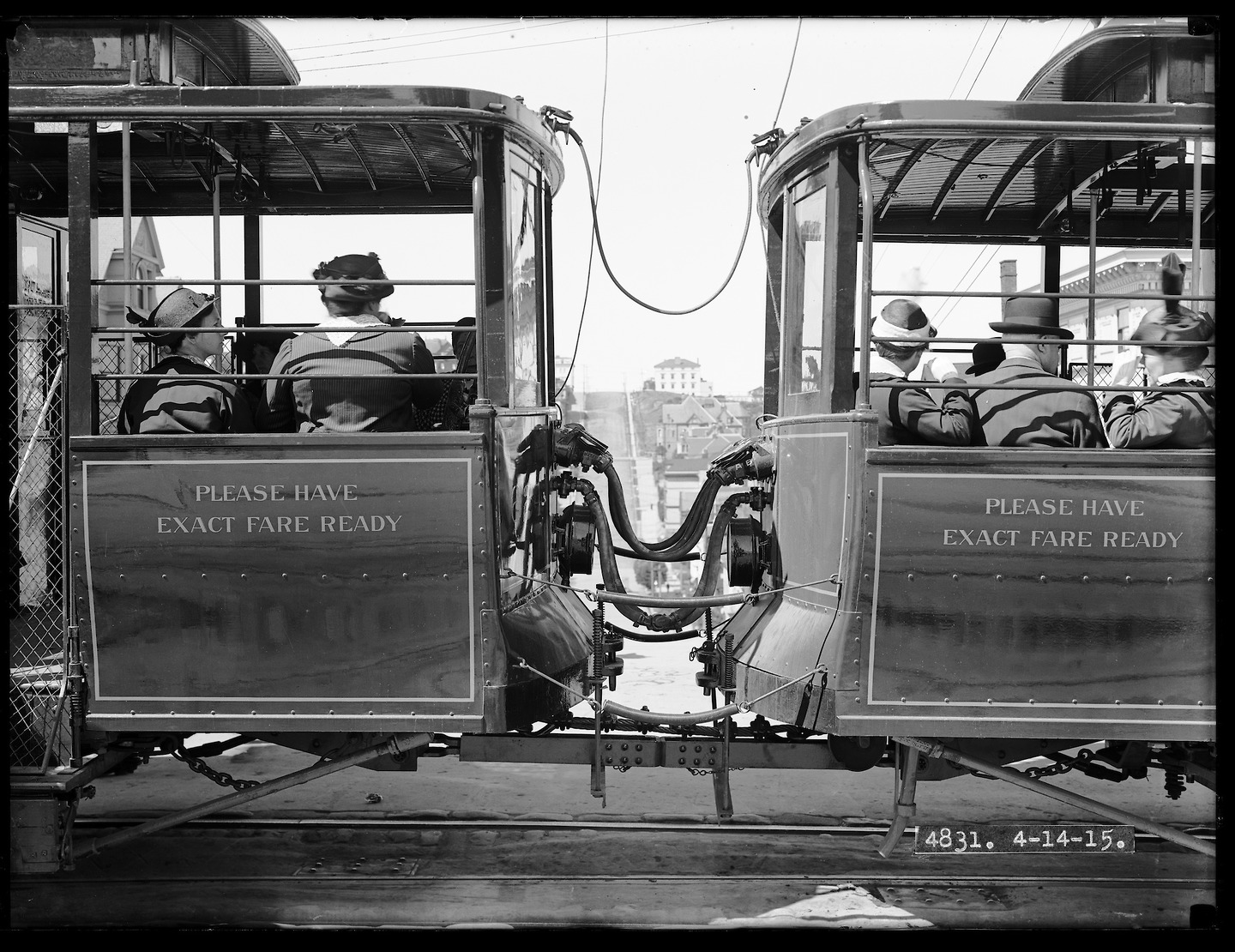
FIllmore Hill Cars Air Coupling

Fea­tur­ing a col­lec­tion of glass plate, nitrate and acetate neg­a­tives, the liv­ing archive tells “the sto­ry of San Fran­cis­co, its tran­si­tion from a stretch of sand dunes to an inter­na­tion­al­ly acclaimed city, it’s rise from the rub­ble of the dev­as­tat­ing earth­quake of 1906 and the vital role pub­lic trans­porta­tion played and con­tin­ues to play in revi­tal­iz­ing the city.” The archive con­tains near­ly 5,000 images, all neat­ly divid­ed into 14 col­lec­tions. You can enter the archive and start perus­ing here.

via Metafil­ter

Relat­ed Con­tent:

The 1906 San Fran­cis­co Earth­quake: Before and After

Design­er Mas­si­mo Vignel­li Revis­its and Defends His Icon­ic 1972 New York City Sub­way Map

Vin­tage Video: A New York City Sub­way Train Trav­els From 14th St. to 42nd Street (1905)

Famous Writers’ Report Cards: Ernest Hemingway, William Faulkner, Norman Mailer, E.E. Cummings & Anne Sexton

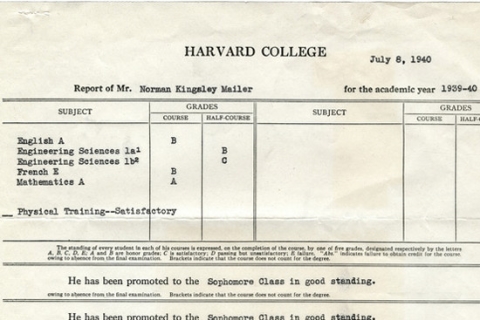
MailerReportCard

“It’s not about the grade,” I’d say to per­turbed stu­dents ask­ing me to change theirs: “it’s about what you learned.” No one will care what you got in first-year Eng­lish Com­po­si­tion; they’ll care if you can write a sen­tence, a para­graph, a pro­fes­sion­al, ele­gant, or mov­ing text. All of this is true, and yet (of course I nev­er told them this) I still remem­ber every grade I earned in every class I took in high school, col­lege, and grad­u­ate school. Obses­sive? Maybe. But it’s also symp­to­matic of that same com­pul­sion that dri­ves stu­dents to try, by any means, to get pro­fes­sors to bump their grades up at the end of the semester—fear of the “per­ma­nent record.” Like Sein­feld’s Elaine, strug­gling to expunge a black mark from her med­ical chart, we all fear the reams of documents—or archives of data—that cat­a­logue our every mis­step, stum­ble, fail­ure or faux pas.

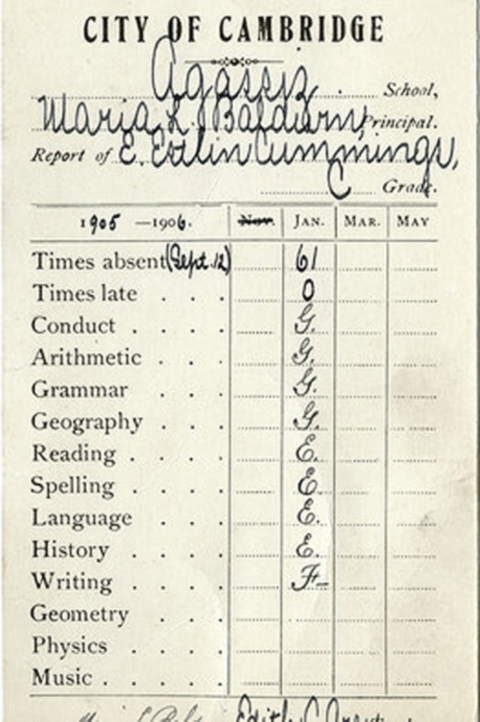
CummingsReportCard

In many cas­es, this anx­i­ety is jus­ti­fi­able, but as you can see here, the occa­sion­al bad mark didn’t stop famed writ­ers Nor­man Mail­er or E.E. Cum­mings from achiev­ing lit­er­ary great­ness, even if those grades remain, in ink, on record today. See Mailer’s first-year Har­vard Col­lege report card at the top of the post, aca­d­e­m­ic year 1939–40. The bear­ish nov­el­ist did well, but for the C in his sec­ond semes­ter of Engi­neer­ing Sci­ence. Just above, we have Cum­mings’ report card from what is like­ly his fifth grade year giv­en his age of 11 at the time. The 1905-06 grad­ing sys­tem looks for­eign to us now, but the C that Cum­mings received that year prob­a­bly did not put him at the top of the class. Nor, I’m sure, did his 61 absences.

HemingwayReportCard

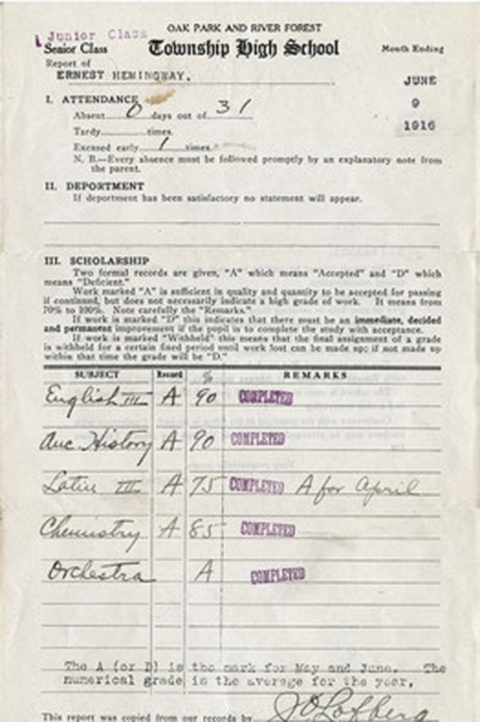
Ernest Hem­ing­way, on the oth­er hand, had lit­tle rea­son to hide the high school report card above, but if you look close­ly, you’ll see that the col­umn of straight A’s does not mean what we might think. The Oak Park and Riv­er For­est Town­ship High School only gave two let­ter grades, A for “Accept­ed” and D for “Defi­cient.” Still, Hemingway’s numer­i­cal per­cent­ages show his schol­ar­ly apti­tude, though his 75 in Latin may have haunt­ed him.

FaulknerReportCard

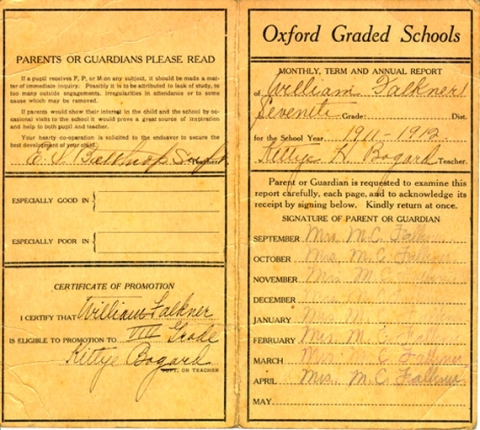
Hemingway’s mod­ernist con­tem­po­rary William Faulkn­er, you may know, strug­gled in school after the fourth grade, and even­tu­al­ly dropped out of high school after the 11th (though his father’s job at Ole Miss meant he could enroll there for the three semes­ters he attend­ed). The sev­enth grade report card above does not show us his grades, and Faulkner’s teacher neglect­ed to fill in the “Espe­cial­ly Good In” and “Espe­cial­ly Poor In” box­es. Nev­er­the­less, Faulkn­er (then William Falkn­er), did well enough to move up, and his moth­er signed off on each month of the term but the last.

SextonReportCard

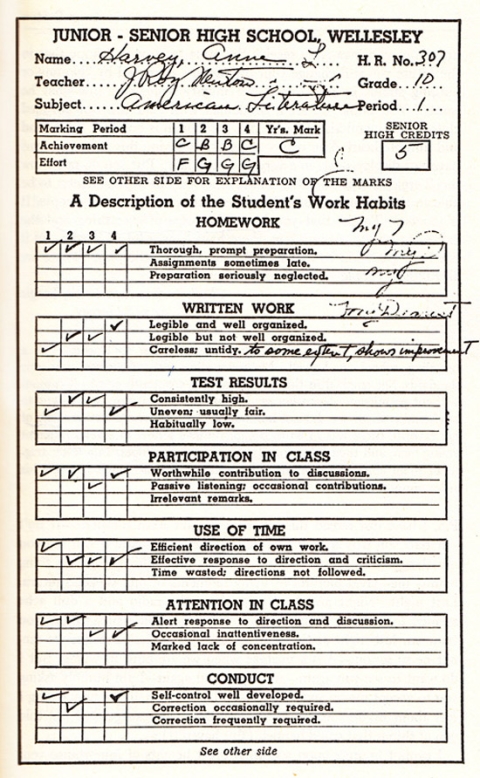
Final­ly we bring you the report card of Anne Sex­tonnée Harvey—for a 10th grade Amer­i­can Lit­er­a­ture class at the Junior-Senior High School in Welles­ley, Mass­a­chu­setts, from which Sylvia Plath also grad­u­at­ed. As you can see, Sex­ton received a C in the class, with an F for effort in the first quar­ter. Accord­ing to Beth Hinch­liffe—a Welles­ley native who con­duct­ed one of Sexton’s final interviews—the poet remem­bered the grade. She also remem­bered her teenage self as “ ‘a pim­ply, boy-crazy thing’ who was obsessed with flirt­ing.”

Most of these report cards come from col­lec­tions at the Uni­ver­si­ty of Texas’ Har­ry Ran­som Cen­ter, a trove of his­tor­i­cal and lit­er­ary doc­u­ments that, unlike some oth­er archives, I’m very glad keeps per­ma­nent records. Anne Sex­ton’s report card comes to us via the always infor­ma­tion-rich Brain Pick­ings.

via The Wall Street Jour­nal

Relat­ed Con­tent:

Ernest Hem­ing­way Cre­ates a Read­ing List for a Young Writer, 1934

The Art of William Faulkn­er: Draw­ings from 1916–1925

Two Child­hood Draw­ings from Poet E.E. Cum­mings Show the Young Artist’s Play­ful Seri­ous­ness

Anne Sex­ton, Con­fes­sion­al Poet, Reads “Want­i­ng to Die” in Omi­nous 1966 Video

How Famous Writ­ers — From J.K. Rowl­ing to William Faulkn­er — Visu­al­ly Out­lined Their Nov­els

Josh Jones is a writer and musi­cian based in Durham, NC. Fol­low him at @jdmagness.

Salvador Dalí & Walt Disney’s Destino: See the Collaborative Film, Original Storyboards & Ink Drawings

Unlike­ly col­lab­o­ra­tions in pop music abound: Run DMC and Aero­smith? It works! U2 and Luciano Pavarot­ti? Why not? Robert Plant and Ali­son Krauss? Sure! Any­one and Ker­mit the Frog? Yes. They don’t always work out, but the attempts, whether kismet or train­wreck, tend to reveal a great deal about the part­ners’ strengths and weak­ness­es. Unlike­ly col­lab­o­ra­tions in fea­ture film are some­what rar­er, though not for lack of wish­ing. I would guess the high finan­cial stakes have some­thing to do with this, as well as the sheer num­ber of peo­ple required for the aver­age pro­duc­tion. One par­tic­u­lar­ly salient exam­ple of an osten­si­ble mis­match in ani­mat­ed movies—a planned co-cre­ation by sur­re­al­ist Sal­vador Dalí and pop­ulist Walt Disney—offers a fas­ci­nat­ing look at how the two artists’ careers could have tak­en very dif­fer­ent cre­ative direc­tions. The col­lab­o­ra­tion may also have fall­en vic­tim to a film indus­try whose eco­nom­ics dis­cour­age exper­i­men­tal duets.

We’ve pre­vi­ous­ly fea­tured the ani­mat­ed short— Des­ti­no—at the top of the post. The 6 and a half minute film shows us what Dalí and Disney’s planned project might have looked like. Recre­at­ed from 17 sec­onds of orig­i­nal ani­ma­tion and sto­ry­boards drawn by Dalí and released in 2003 by Disney’s nephew Roy, Des­ti­no gives us an almost per­fect sym­bio­sis of the two cre­ators’ sen­si­bil­i­ties, with Walt Disney’s Fan­ta­sia-like flights smooth­ly ani­mat­ing Dalí’s flu­id dream imagery. Accord­ing to Chris Pal­lant, author of Demys­ti­fy­ing Dis­ney, work between the two on the orig­i­nal project also moved smooth­ly, with lit­tle fric­tion between the two artists. Meet­ing in 1945, Dalí and Dis­ney “quick­ly devel­oped an indus­tri­ous work­ing rela­tion­ship” and “ease of col­lab­o­ra­tion.” Pal­lant writes that “Disney’s desire for absolute cre­ative con­trol changed, and, for the first time, the ani­ma­tors work­ing with­in the stu­dio felt the influ­ence of oth­er artis­tic forces.” I imag­ine it might prove dif­fi­cult, if not impos­si­ble, to micro­man­age Sal­vador Dalí. In any case, the fruit­ful rela­tion­ship pro­duced results:

Des­ti­no reached a rel­a­tive­ly advanced stage before being aban­doned. By mid-1946 the Dis­ney- Dalí col­lab­o­ra­tion encom­passed approx­i­mate­ly ’80 pen-and-ink sketch­es’ and numer­ous ‘sto­ry­boards, draw­ings and paint­ings that were cre­at­ed over nine months in 1945 and 1946.’

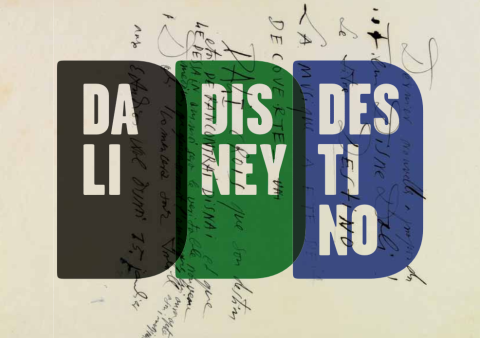
Roy E. Dis­ney dis­cov­ered Dalí’s Des­ti­no art­work in the late 90s, lead­ing to his short re-cre­ation of what might have been. Above, you can flip through a slideshow of twelve of those draw­ings and sto­ry­boards, cour­tesy of Park West Gallery, who rep­re­sent the work. The Des­ti­no mate­ri­als went on dis­play at the Draw­ings Room in Figueres, Spain. The exhi­bi­tion fea­tured “1 oil paint­ing, 1 water­colour, 15 prepara­to­ry drawings—10 of which are unpublished—and 9 pho­tographs of Dalí in the cre­ative process of this mate­r­i­al, of the Dis­ney cou­ple in Port Lli­gat in 1957, and the Dalí cou­ple in Bur­bank.” You can see many of those pho­tographs in the exhibit’s pam­phlet (in pdf here, in Span­ish and Eng­lish; cov­er image below), which offers a detailed descrip­tion of the orig­i­nal project, includ­ing its nar­ra­tive con­cept, a “love sto­ry” between a dancer and “base­ball-play­er-cum-god Cronos” meant to rep­re­sent “the impor­tance of time as we wait for des­tiny to act on our lives.”

DaliDisneyexhibit

Inspired by a Mex­i­can song by Arman­do Dominguez, Des­ti­no, on its face, seems like a very strange choice for Dis­ney, who gen­er­al­ly traf­ficked in more rec­og­niz­able (and Euro­pean) folk-tale sources. And yet, the exhi­bi­tion pam­phlet asserts, the co-pro­duc­tion made a great deal of sense for Dalí, “if we con­sid­er that one Dalin­ian con­stant is his bring­ing togeth­er of the elit­ist artis­tic idea and mass cul­ture (and vice ver­sa) […]. Des­ti­no becomes a unique artis­tic prod­uct in which Dalin­ian expres­sive­ness is com­bined with Disney’s fan­ta­sy and sonor­i­ty, mak­ing it a film in which Dalí’s images take on move­ment and Disney’s fig­ures become ‘Dalinised.’ ”

And yet, while both Dalí and Dis­ney worked excit­ed­ly on the project, it was ulti­mate­ly not to be, at least until almost six­ty years lat­er. Des­ti­no would have been part of a “pack­age film,” like Fan­ta­sia, a com­pi­la­tion of short vignettes. John Hench, a Dis­ney artist who worked on the project with Dalí, spec­u­lat­ed that the com­pa­ny “fore­saw the end” of such fea­tures. Pal­lant, how­ev­er, goes fur­ther in spec­u­lat­ing the film “would have resem­bled a poten­tial box-office bomb” for Dis­ney, who remarked lat­er that is was “no fault of Dalí’s that the project… was not completed—it was sim­ply a case of pol­i­cy changes in our dis­tri­b­u­tion plans.”

This cryp­tic remark, writes Pal­lant, alludes to Disney’s plans to focus his cre­ative ener­gy on “safe” fea­ture-length projects “to strength­en the company’s posi­tion with­in the film indus­try.” While such a deci­sion might have made good busi­ness sense, it prob­a­bly doomed many more Des­ti­no-like ideas that might have made the Walt Dis­ney com­pa­ny a very dif­fer­ent enti­ty indeed. One can only imag­ine what the stu­dio might have become had Dis­ney opt­ed to pur­sue exper­i­ments like this instead of tak­ing the more prof­itable route. Of course, giv­en the mar­ket pres­sures on the movie indus­try, it’s also pos­si­ble the stu­dio might not have sur­vived at all.

Relat­ed Con­tent:

Des­ti­no: The Sal­vador Dalí – Dis­ney Col­lab­o­ra­tion 57 Years in the Mak­ing

Impres­sions of Upper Mon­go­lia : Sal­vador Dalí’s Last Film About a Search for a Giant Hal­lu­cino­genic Mush­room

Alfred Hitch­cock Recalls Work­ing with Sal­vador Dali on Spell­bound

Josh Jones is a writer and musi­cian based in Durham, NC. Fol­low him at @jdmagness.

John Lennon Illustrates Two of His Books with Playful Drawings (1964–1965)

LennonVicar

Upon his trag­ic ear­ly death at 40, John Lennon left behind a body of work few pop­u­lar artists could hope to equal. And that’s only the pub­lished stuff. As we point­ed out in a recent post on his home demos, the for­mer Bea­t­le also left hun­dreds of hours of tape record­ings for his fans to sift through, and, as if that weren’t enough, Sotheby’s recent­ly auc­tioned off a store­house of orig­i­nal man­u­scripts and auto­graphed draw­ings for two books Lennon wrote in the mid-six­ties, In His Own Write (1964) and A Spaniard in the Works (1965), a Sher­lock Holmes par­o­dy.

LennonParty

Lennon’s play­ful sense of humor and sur­re­al imag­i­na­tion shine through the sto­ries and poems in both books, as does his more moody broody side. If any­thing, Lennon’s word­play and out-there line draw­ings close­ly resem­ble the work of Shel Sil­ver­stein, who was prob­a­bly not an influ­ence but cer­tain­ly a kin­dred spir­it. Sotheby’s spe­cial­ist Gabriel Heaton cites as Lennon’s influ­ence “the non­sense tra­di­tion of Eng­lish lit­er­a­ture,” and indeed Lewis Car­roll comes to mind when read­ing his work. See, for exam­ple, “About The Awful,” his author’s state­ment for In His Own Write:

I was bored on the 9th of Octover 1940 when, I believe, the Nas­ties were still boom­ing us led by Madolf Heatlump (who only had one). Any­way they did­n’t get me. I attend­ed to vari­cous schools in Lid­dy­pol. And still did­n’t pass — much to my Aun­ties sup­plies. As a mem­ber of the most pub­li­fied Bea­t­les my (P, G, and R’s) records might seem fun­nier to some of you than this book, but as far as I’m con­ceived this cor­rec­tion of short writ­ty is the most won­der­foul larf I’ve every ready.
God help and breed you all.

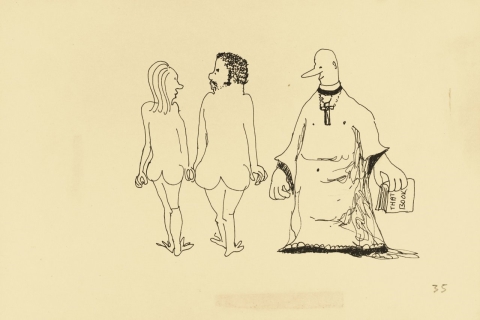
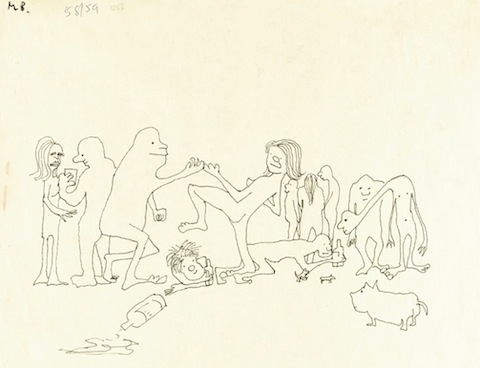
And then there’s the art­work. At the top, see an unti­tled ink draw­ing of a vic­ar leer­ing at a nude cou­ple (and hold­ing in his hand “That Book”). The draw­ing above shows a clique of naked partiers, with the cap­tion “Puff­ing and glob­ber­ing they drugged they­selves ram­pling or danc­ing with wild abdomen, stub­bing in wild pos­tumes amon­st them­selves…”

LennonBelonely

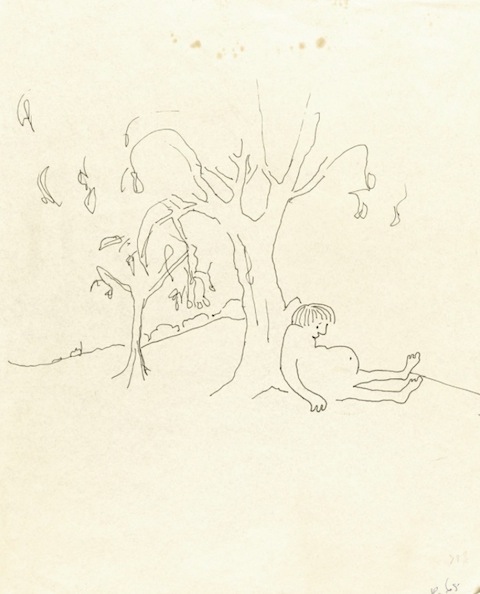
Recall­ing the art­work in Silverstein’s The Giv­ing Tree, direct­ly above we have a sim­ple illus­tra­tion for a poem called “I Sat Belone­ly,” cap­tioned with the poem’s first two lines: “I Sat Belone­ly Down a Tree, Hum­bled Fat and Small” (read the full poem here).

LennonFlies

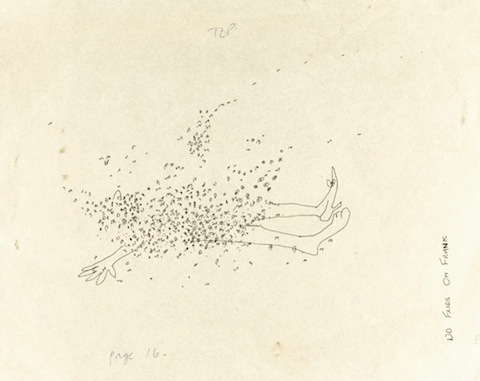
Anoth­er Sil­ver­stein­ian draw­ing is titled “A Lot of Flies on His Wife” from a short sto­ry called “No Flies on Frank,” whose title char­ac­ter speaks in an argot right out of James Joyce: “I carn’t not believe this incred­i­ble fact of truth about my very body which has not gained fat since moth­er begat me at child­burn. Yea, though I wart through the valet of thy shad­owy hut I will feed no nor­man. What grate qualm­sy hath tak­en me thus into such a fat­ty hard­buck­le.”

LennonGuitar

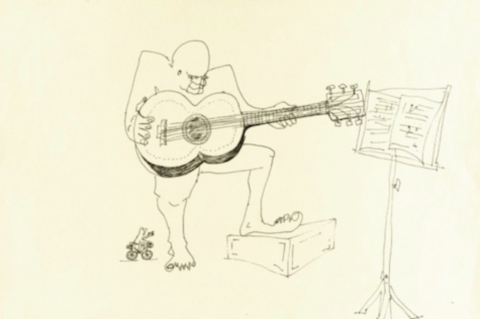
Just above, Lennon sketch­es a Picas­so-like four-eyed gui­tarist in this unti­tled draw­ing (notice the tiny cyclist at his feet)—estimated by Sotheby’s between $15,000 and $25,000. The eighty nine lots that went up for auc­tion includ­ed many oth­er draw­ings (see more here) and some hand­writ­ten notes from Paul McCart­ney. All told, the sale net­ted close to $3 mil­lion, though for Lennon devo­tees, these arti­facts are price­less. .

via The Dai­ly Beast

Relat­ed Con­tent:

Hear John Lennon Sing Home Demo Ver­sions of “She Said, She Said,” “Straw­ber­ry Fields For­ev­er,” and “Don’t Let Me Down”

John Lennon Plays Bas­ket­ball with Miles Davis and Hangs Out with Allen Gins­berg & Friends

The Last Time Lennon & McCart­ney Played Togeth­er Cap­tured in the Boot­leg A Toot And a Snore in ’74

Josh Jones is a writer and musi­cian based in Durham, NC. Fol­low him at @jdmagness.

Sound Effects Genius Michael Winslow Performs the Sounds of 32 Typewriters (1898–1983)

“When forced to leave my house for an extend­ed peri­od of time, I take my type­writer with me,” once wrote essay­ist-humorist David Sedaris. “Togeth­er we endure the wretched­ness of pass­ing through the X‑ray scan­ner. The lap­tops roll mer­ri­ly down the belt, while I’m instruct­ed to stand aside and open my bag. To me it seems like a nor­mal enough thing to be car­ry­ing, but the typewriter’s declin­ing pop­u­lar­i­ty arous­es sus­pi­cion and I wind up elic­it­ing the sort of reac­tion one might expect when trav­el­ing with a can­non. ‘It’s a type­writer,’ I say. ‘You use it to write angry let­ters to air­port secu­ri­ty.’ ” But Sedaris, one of the last high-pro­file hold-outs against elec­tron­ic word pro­cess­ing, wrote those words almost fif­teen years ago — even before air­port secu­ri­ty real­ly cracked down in our post‑9/11 real­i­ty. Sure­ly he has since picked up and pre­sum­ably learned to use a com­put­er. We now find our­selves in an age when type­writer usage has tran­scend­ed the sta­tus of an act of nos­tal­gia and attained the sta­tus of an act of rebel­lion; if you insist on using a clas­sic old Under­wood Rem­ing­ton, or an Invic­ta, or a Con­ti­nen­tal Stan­dard, or Olympia Moni­ka Deluxe, well, you must real­ly have a state­ment to make.

Yet I dare­say that for all their mechan­i­cal heft, free­dom from inter­net-borne dis­trac­tion, and thor­ough­ly ana­log aes­thet­ic appeal, type­writ­ers bring with them a num­ber of bur­dens. We have their dif­fi­cul­ty in clear­ing TSA lines, yes, but also their thirst for phys­i­cal ink and paper (“I can always look at my loaded wastepa­per bas­ket and tell myself that if I failed,” said Sedaris, “at least I took a few trees down with me”), and their noise — oh my, their noise. You can hear the vary­ing sounds of 32 mod­els belong­ing to many suc­ces­sive type­writer gen­er­a­tions in the video at the top of the post. They don’t come as straight record­ings, but as sounds repro­duced by mouth to per­fec­tion by that one-in-a-mil­lion mim­ic Michael Winslow, best known from the Police Acad­e­my movies as Sergeant Larvell “Motor Mouth” Jones. “The His­to­ry of the Type­writer Recit­ed by Michael Winslow” orig­i­nat­ed in the mind of Span­ish artist Igna­cio Uri­arte, who, accord­ing to Frieze“has employed stan­dard office sup­plies such as Biros, high­lighters and jot­ters,” not to men­tion “the ubiq­ui­tous spread­sheet tool Microsoft Excel, per­haps soon fac­ing its own obso­les­cence.” This pro­duc­tion “telling­ly cul­mi­nates with the sounds of a machine from 1983, the year before the arrival of the first home com­put­er with a graph­i­cal inter­face.” Which leads one to won­der: can Winslow do hard dri­ve nois­es?

We’ll def­i­nite­ly add “The His­to­ry of the Type­writer Recit­ed by Michael Winslow” to our col­lec­tion, 4,000+ Free Movies Online: Great Clas­sics, Indies, Noir, West­erns, Doc­u­men­taries & More.

via Kot­tke

Relat­ed Con­tent:

The Endur­ing Ana­log Under­world of Gramer­cy Type­writer

Woody Allen’s Type­writer, Scis­sors and Sta­pler: The Great Film­mak­er Shows Us How He Writes

Dis­cov­er Friedrich Nietzsche’s Curi­ous Type­writer, the “Malling-Hansen Writ­ing Ball”

Mark Twain Wrote the First Book Ever Writ­ten With a Type­writer

Dis­rup­tive Tech­nol­o­gy: Stu­dent Brings Type­writer to Class

Col­in Mar­shall hosts and pro­duces Note­book on Cities and Cul­ture and writes essays on cities, lan­guage, Asia, and men’s style. He’s at work on a book about Los Ange­les, A Los Ange­les Primer. Fol­low him on Twit­ter at @colinmarshall or on Face­book.

« Go BackMore in this category... »
Quantcast