David Brooks’ List of “Really Good Books”

david brooks books

In the pages of The New York Times, David Brooks reeled off a list of Real­ly Good Books. He pref­aces the list with this: “Peo­ple are always ask­ing me what my favorite books are. I’ve held off list­ing them because it seems self-indul­gent. But, with sum­mer almost here, I thought I might spend a cou­ple columns rec­om­mend­ing eight books that have been piv­otal in my life.” [He actu­al­ly rec­om­mends more than 8 in the end.] Some of the books will help you think about liv­ing a life of “civ­i­lized ambi­tion.” Oth­ers will nur­ture your inner spir­it. And still oth­ers will help you think more intel­li­gent­ly about writ­ing and pol­i­tics. Along the way, he adds a quick caveat about what these books “can’t do.” “They can’t carve your con­vic­tions about the world. Only life can do that — only rela­tion­ships, strug­gle, love, play and work. Books can give you vocab­u­lar­ies and frame­works to help you under­stand and decide, but life pro­vides exact­ly the edu­ca­tion you need.”

The list was pub­lished in two parts: Part 1 and Part 2. In each install­ment, Brooks explains why he select­ed each work. Where pos­si­ble, we have pro­vid­ed links to texts avail­able online. You can also find them list­ed in our col­lec­tion, 800 Free eBooks for iPad, Kin­dle & Oth­er Devices.

1. A Col­lec­tion of Essays by George Orwell

2. Anna Karen­i­na by Leo Tol­stoy

3. “Ratio­nal­ism in Pol­i­tics” by Michael Oakeshott

4. All the King’s Men by Robert Penn War­ren

5. The Pelo­pon­nesian War by Thucy­dides

6. The Con­fes­sions by St. Augus­tine

7. The Lone­ly Man of Faith by Joseph Soloveitchik

8. Man’s Search for Mean­ing by Vik­tor Fran­kl (see Fran­kl talk about that great search here.)

9. Mid­dle­march by George Eliot

10. End­less Love by Scott Spencer

Relat­ed Con­tent:

David Bowie’s Top 100 Books

Stephen King Cre­ates a List of 96 Books for Aspir­ing Writ­ers to Read

Neil deGrasse Tyson Lists 8 (Free) Books Every Intel­li­gent Per­son Should Read

by | Permalink | Make a Comment ( 7 ) |

Dimension X: The 1950s SciFi Radio Show That Dramatized Stories by Asimov, Bradbury, Vonnegut & More

dimension x

Enthu­si­asts of Amer­i­can radio dra­ma usu­al­ly place the for­m’s “Gold­en Age” as begin­ning in the 1920s and end­ing, almost at the stroke of tele­vi­sion’s mass adop­tion, in the 1950s. NBC’s Dimen­sion X, which ran in 1950 and 1951, came some­what late to the game, but it did more than its part to give “old time radio” a strong last decade — indeed, per­haps its strongest. Oth­er famous “seri­ous” sci­ence-fic­tion pro­grams had aired in the 20s, 30s, and 40s, but Dimen­sion X made its mark by adapt­ing short sto­ries by acknowl­edged mas­ters of the craft: Isaac Asi­mov, Ray Brad­bury, Robert Hein­lein, and even a non-genre-bound lit­er­ary mind like Kurt Von­negut. All of these world-cre­ators knew well the val­ue of imag­i­na­tion, and radio, in its way, stood then and remains today the most evoca­tive, imag­i­na­tion-dri­ven medi­um of them all. At the Inter­net Archive (cer­tain­ly a more con­ve­nient old time radio source than the boot­leg cas­sette tapes I used to have to buy) you can down­load all of Dimen­son X’s “adven­tures in time and space, tran­scribed in future tense.”

If you don’t know where in this spec­u­la­tive field of time and space to begin, we’ve high­light­ed a few Dimen­sion X episodes drawn from works of the most notable authors. June 10, 1950’s “The Green Hills of Earth”, based upon the Robert Hein­lein sto­ry of the same name, relates the life of “Noisy” Rhys­ling, a blind space-age trou­ba­dour who real­izes he must pay trib­ute to the plan­et he long ago left behind. The very next week’s “There Will Come Soft Rains”, one of Ray Brad­bury’s many works adapt­ed for the show, describes the apoc­a­lypse through the process­es of the self-main­tain­ing high-tech mir­a­cle house. June 17, 1951’s “Peb­ble in the Sky” takes its theme from the epony­mous Isaac Asi­mov nov­el that thrusts a 20th-cen­tu­ry every­man into a com­plex future of a galac­tic empire, a radioac­tive Earth, and manda­to­ry euthana­sia at age six­ty. And in Feb­ru­ary 11, 1950’s “Report on the Barn­house Effect”, only the show’s third broad­cast, we hear the tes­ti­mo­ny of a tele­ki­net­ic — one who, giv­en that Kurt Von­negut wrote the orig­i­nal sto­ry, it won’t sur­prise you to hear the gov­ern­ment imme­di­ate­ly (and hap­less­ly) tries to weaponize.

“The Green Hills of Earth” (Robert Hein­lein)

“There Will Come Soft Rains” (Ray Brad­bury)

“Peb­ble in the Sky” (Isaac Asi­mov)

“Report on the Barn­house Effect” (Kurt Von­negut)

Relat­ed con­tent:

Orson Welles Vin­tage Radio: The War of the Worlds That Pet­ri­fied a Nation

The Rel­a­tiv­i­ty Series Fea­tures 24 Free Plays About Great Sci­en­tists and Sci­en­tif­ic Endeav­ors

Isaac Asimov’s Sci­ence Fic­tion Clas­sic, The Foun­da­tion Tril­o­gy, Dra­ma­tized for Radio (1973)

Col­in Mar­shall hosts and pro­duces Note­book on Cities and Cul­ture and writes essays on cities, lan­guage, Asia, and men’s style. He’s at work on a book about Los Ange­les, A Los Ange­les Primer. Fol­low him on Twit­ter at @colinmarshall or on Face­book.

Botticelli’s 92 Surviving Illustrations of Dante’s Divine Comedy (1481)


Every true Renais­sance man need­ed a wealthy patron, and many Ital­ian artist-inven­tor-schol­ar-poets found theirs in Loren­zo de’Medici, scion of a Flo­ren­tine dynasty and him­self a schol­ar and poet. Loren­zo either spon­sored direct­ly or helped secure com­mis­sions for such 15th cen­tu­ry art stars as Michelan­ge­lo Buonaroti and Leonar­do da Vin­ci.

Among Lorenzo’s many artist friends was a painter who most­ly dis­ap­peared from his­to­ry until the late nine­teenth cen­tu­ry, when the redis­cov­ery of his Pri­mav­era and Birth of Venus made him one of the most pop­u­lar of Renais­sance artists. I’m refer­ring of course, to San­dro Bot­ti­cel­li, por­traitist of Loren­zo de’Medici, his father, and grand­fa­ther and also, it turns out, illus­tra­tor of Dante Alighieri’s Divine Com­e­dy.

In 1550, the so-called “father of art his­to­ry” Gior­gio Vasari record­ed that “since Bot­ti­cel­li was a learned man, he wrote a com­men­tary on part of Dan­te’s poem, and after illus­trat­ing the Infer­no, he print­ed the work.”  The painter also made a por­trait of Dante, Vasari tells us, and drew sketch­es for engrav­ings in the first Flo­ren­tine edi­tion of The Divine Com­e­dy in 1481.

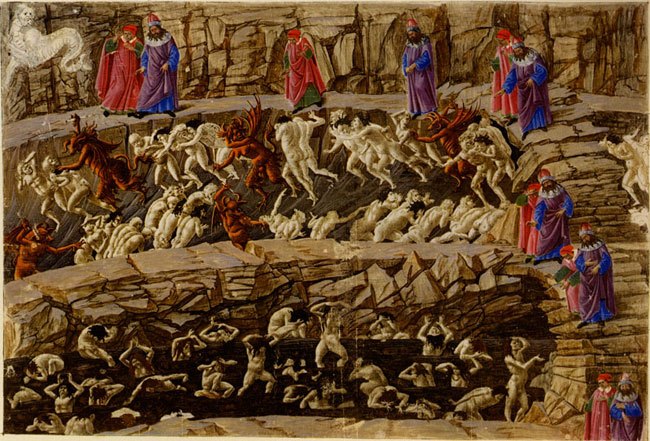
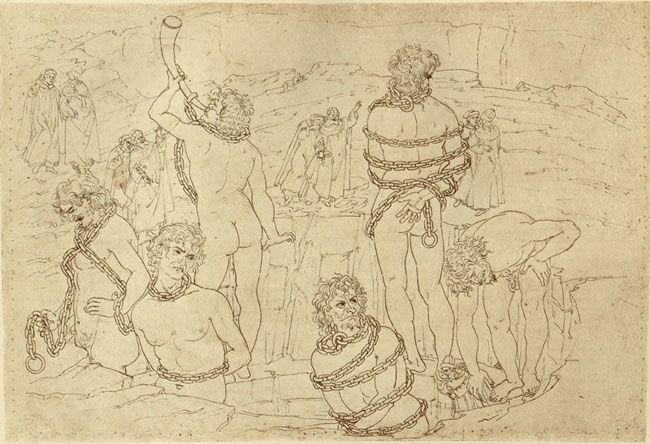
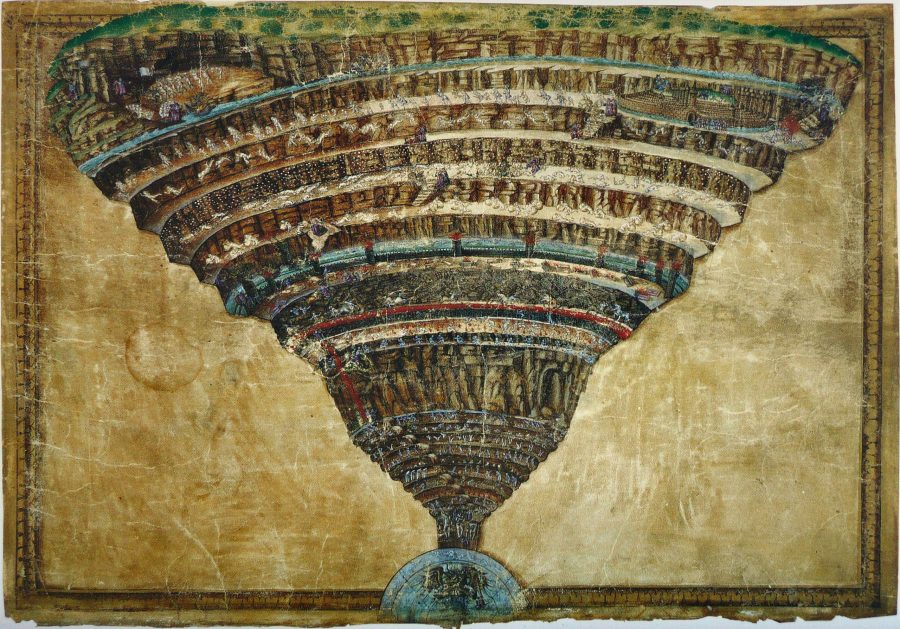
It seems, how­ev­er, that Botticelli’s inter­est in Dante went much fur­ther than even Vasari knew. Some­time late in his career—after he had already achieved local renown in Florence—Botticelli promised his patron Loren­zo an illus­trat­ed Divine Com­e­dy on sheep­skin with a sep­a­rate image for each Can­to, some­thing no artist had yet attempt­ed. 92 of those illus­tra­tions sur­vive, in var­i­ous stages of com­ple­tion, such as the two above, “Pan­der­ers, Flat­ter­ers” (top–the only draw­ing in col­or) and “Giants” (above), both from the Infer­no.

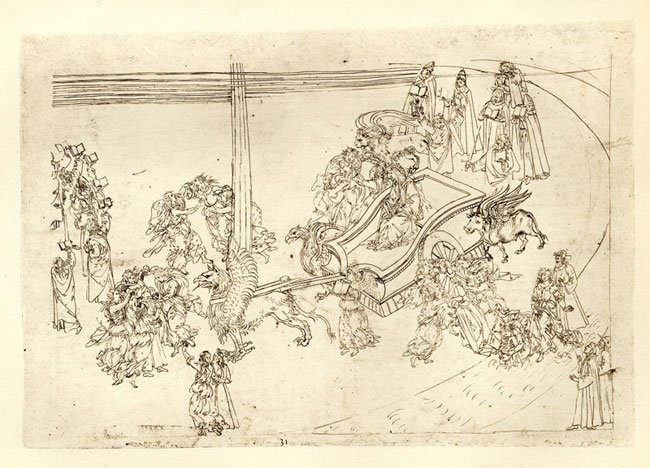
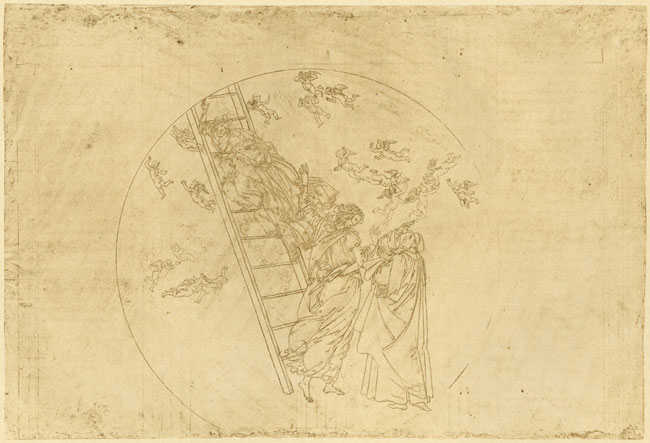
These are two of the most ful­ly real­ized of the col­lec­tion. Accord­ing to art his­to­ri­an Jonathan K. Nel­son, “Bot­ti­cel­li com­plet­ed the out­line draw­ings for near­ly all the can­tos, but only added col­ors for a few. The artist shows his ‘learn­ing’ and artis­tic skill by rep­re­sent­ing each of the three realms each in a dis­tinc­tive way.” Many of Botticelli’s draw­ings for the Pur­ga­to­rio and Par­adiso sur­vive as well, but—like the books themselves—these are increas­ing­ly less detailed (and arguably less inter­est­ing). See “Dan­te’s Con­fes­sion” from the Pur­ga­to­rio above, his “Map of Hell” at the top, “Jacob’s Lad­der” from the Par­adiso below, and the remain­ing 88 illus­tra­tions at World of Dante.

Relat­ed Con­tent:

Gus­tave Doré’s Dra­mat­ic Illus­tra­tions of Dante’s Divine Com­e­dy

Alber­to Martini’s Haunt­ing Illus­tra­tions of Dante’s Divine Com­e­dy (1901–1944)

Sal­vador Dalí’s 100 Illus­tra­tions of Dante’s The Divine Com­e­dy

Josh Jones is a writer and musi­cian based in Durham, NC. Fol­low him at @jdmagness.

20-Year-Old Louis CK Performs Stand Up (1987)

Ever been tak­en aback by a vin­tage pho­to of a Face­book friend? “Look how young he was! An infant!” If you’re a mem­ber of come­di­an Louis CK’s gen­er­a­tion, it’s like­ly that at some point, the per­son in the pho­to was you.

Louis mod­el 1987, above, is close to unrec­og­niz­able, with a full head of red hair and a trim bel­ly. His joke-based rou­tine isn’t howl­ing­ly fun­ny, but nei­ther is it shame­ful. He’s con­fi­dent, at his ease with the audi­ence, but the life expe­ri­ence that would inform his lat­er work was not yet a thing.

A few years fur­ther along, above, one can see that com­ic per­sona com­ing into focus. The sad sack phys­i­cal­i­ty that gives it weight came lat­er. Suf­fice to say, that hair­brush joke is no longer a present tense propo­si­tion.

What struck me were the famil­iar back walls of those lit­tle com­e­dy club stages. Louis has been work­ing those crum­my lit­tle stages for such a long time. No won­der he’s on famil­iar terms with the door guys at the Com­e­dy Cel­lar, the club he’s most often shown fre­quent­ing in his char­ac­ter-dri­ven, self-pro­duced, large­ly auto­bi­o­graph­i­cal TV show.

As he gen­er­ous­ly advised an 18-year-old aspi­rant on the Google news­group “alt.comedy.standup”:

Go on stage as often as pos­si­ble.  Any stage any­where.  Don’t lis­ten to any­one about any­thing.  Just keep get­ting up there and try to be fun­ny, hon­est and orig­i­nal.

Know that it’s not going to be easy.  Know that it’s going to take a long time to be good or great. Don’t focus on the career climb­ing.  Focus on the get­ting fun­nier.  The sec­ond you are bitch­ing about what anoth­er com­ic is get­ting you are going in the com­plete­ly wrong direc­tion.  No one is get­ting your gig or your mon­ey.

Keep in mind that you are in for a looooong haul of ups and downs and noth­ing and some­thing.  It takes at least 15 years, usu­al­ly more, to make a great com­ic.  Most flame out before they get there.

And yes, be polite and cour­te­ous to every sin­gle per­son you deal with. Not because that will make you a bet­ter come­di­an, but because you’re sup­posed to do that.

- Ayun Hal­l­i­day is the author of sev­en books, includ­ing No Touch Mon­key! And Oth­er Trav­el Lessons Learned Too Late. Fol­low her @AyunHalliday

Relat­ed Con­tent:

The Sur­re­al Short Films of Louis C.K., 1993–1999

Sein­feld, Louis C.K., Chris Rock, and Ricky Ger­vais Dis­sect the Craft of Com­e­dy (NSFW)

How the Great George Car­lin Showed Louis CK the Way to Suc­cess (NSFW)

The Only Known Recordings of C.S. Lewis (1944–1948)

When we come to know the work of nov­el­ist and schol­ar C.S. Lewis, we usu­al­ly do it through a tex­tu­al medi­um — specif­i­cal­ly in child­hood, through that thrilling writ­ten arti­fact known as The Lion, the Witch, and the Wardrobe. Often this leads us into the rest of his sev­en-vol­ume Chron­i­cles of Nar­nia series (find a free audio ver­sion here), and those most deeply intrigued by the world­view that shaped that high-fan­ta­sy world may find them­selves even­tu­al­ly read­ing even Lewis’ Chris­t­ian apolo­get­ics, of which 1952’s well-known Mere Chris­tian­i­ty came as only the first. That book drew its con­tent from a series of the­o­log­i­cal lec­tures Lewis gave on BBC radio between 1942 and 1944, dur­ing the Sec­ond World War. Lit­tle mate­r­i­al from these talks sur­vives — in fact, we have pre­cious few min­utes of his voice on tape in any con­text, and noth­ings at all of him on film — but you can hear about fif­teen min­utes of it in the clips above and below.

These excerpts come from “The New Men”, the last episode of Lewis’series Beyond Per­son­al­i­ty orig­i­nal­ly broad­cast on March 21, 1944, and an intro­duc­tion to The Great Divorce, his the­o­log­i­cal nov­el writ­ten in response to William Blake’s The Mar­riage of Heav­en and Hell. “If I’ve writ­ten of their divorce,” Lewis says, “this is not because I think myself a fit antag­o­nist for so great a genius, nor even because I feel at all sure that I knew what he meant.” The state­ment exem­pli­fies the clar­i­ty and humil­i­ty with which he always wrote, even when essen­tial­ly trum­pet­ing the ben­e­fits of his own faith. Giv­en the off-putting­ly com­bat­ive tenor of most high-pro­file reli­gious argu­ments made today, both for and against, the remains of Lewis’ broad­casts remind us how much we could use more thinkers like him today — in any form of media.

Relat­ed con­tent:

C.S. Lewis’ Pre­scient 1937 Review of The Hob­bit by J.R.R. Tolkien: It “May Well Prove a Clas­sic”

Watch Hand-Drawn Ani­ma­tions of 7 Sto­ries & Essays by C.S. Lewis

Free Audio: Down­load the Com­plete Chron­i­cles of Nar­nia by C.S. Lewis

Col­in Mar­shall hosts and pro­duces Note­book on Cities and Cul­ture and writes essays on cities, lan­guage, Asia, and men’s style. He’s at work on a book about Los Ange­les, A Los Ange­les Primer. Fol­low him on Twit­ter at @colinmarshall or on Face­book.

David Gilmour & David Bowie Sing “Comfortably Numb” Live (2006)

David Bowie and David Gilmour singing “Com­fort­ably Numb” togeth­er? Yes, thank you. Filmed at the Roy­al Albert Hall, the clip above shows the two per­form­ing at the end of Gilmour’s 2006 Euro­pean solo tour in sup­port of his solo album On an Island. Dur­ing two oth­er nights in the same venue, Gilmour was joined by David Cros­by, Gra­ham Nash, and Robert Wyatt, and the footage saw release as a DVD titled Remem­ber That Night: “It goes with­out say­ing,” writes All­mu­sic of the disc, “that it is stun­ning, both visu­al­ly and aural­ly; how could any Pink Floyd-relat­ed project fail to be? […] but it is Gilmour’s show, and no star can out­shine him.” Maybe, but Bowie’s pret­ty riv­et­ing singing what may be the most spell­bind­ing of Gilmour and Roger Waters’ col­lab­o­ra­tions on Pink Floyd’s The Wall.

Gilmour played sev­er­al Floyd clas­sics dur­ing the Roy­al Albert Hall stint. Gilmour and band play Pink Floyd’s “Breathe,” “Time,” and “Shine on You Crazy Dia­mond” in addi­tion to songs from On an Island, “a most­ly laid-back, utter­ly ele­gant Eng­lish record,” writes Thom Jurek. Laid-back and ele­gant might also describe the stage show—its star and his guests some­what less ani­mat­ed than in their heyday—but Gilmour’s solos soar, and the light show, true to form, is a dra­mat­ic com­ple­ment to an equal­ly dra­mat­ic set in which clas­sic Floyd seems to mix seam­less­ly with the first col­lec­tion of orig­i­nal songs Gilmour had released in 22 years.

If you would like to sign up for Open Culture’s free email newslet­ter, please find it here. It’s a great way to see our new posts, all bun­dled in one email, each day.

If you would like to sup­port the mis­sion of Open Cul­ture, con­sid­er mak­ing a dona­tion to our site. It’s hard to rely 100% on ads, and your con­tri­bu­tions will help us con­tin­ue pro­vid­ing the best free cul­tur­al and edu­ca­tion­al mate­ri­als to learn­ers every­where. You can con­tribute through Pay­Pal, Patre­on, and Ven­mo (@openculture). Thanks!

Relat­ed Con­tent:

Pink Floyd Plays With Their Brand New Singer & Gui­tarist David Gilmour on French TV (1968)

Watch Doc­u­men­taries on the Mak­ing of Pink Floyd’s Dark Side of the Moon and Wish You Were Here

Watch Pink Floyd Play Live in the Ruins of Pom­peii (1972)

Josh Jones is a writer and musi­cian based in Durham, NC. Fol­low him at @jdmagness.

In 1964, Arthur C. Clarke Predicts the Internet, 3D Printers and Trained Monkey Servants

“If by some mir­a­cle some prophet could describe the future exact­ly as it was going to take place, his pre­dic­tions would sound so absurd, so far-fetched that every­one would laugh him to scorn.”

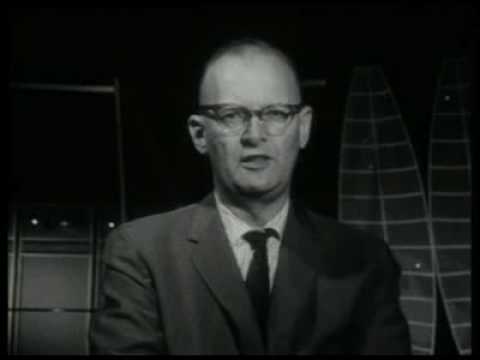
That was Sir Arthur C. Clarke, sci­ence fic­tion author best known for 2001: A Space Odyssey, describ­ing the inher­ent fol­ly of pre­dict­ing the future in a 1964 BBC doc­u­men­tary. Of course, he then goes on to do exact­ly that – with remark­able, unnerv­ing accu­ra­cy. Part one of the doc­u­men­tary is above. Part two is below.

The piece opens with a gener­ic nar­ra­tion that describes a dio­ra­ma of future soci­ety at the GM pavil­ion at the 1964 World Fair. Per­haps because it was a more inno­cent time or maybe because it was spon­sored by an automak­er, this vision of the future is touch­ing­ly obliv­i­ous to any­thing relat­ed to cli­mate change. Machines with laser guns will clear jun­gles in hours flat and peo­ple will live in domed com­mu­ni­ties on the ice caps. (Ice caps in the future. Hilar­i­ous.)

Then the reedy, bespec­ta­cled author appears and starts to describe how he thinks the world in fifty years (i.e. 2014) will look. And this is where the movie starts to feel uncan­ny. He talks about how the advance­ment of tran­sis­tors and satel­lites will rad­i­cal­ly alter our under­stand­ing of phys­i­cal space.

These things will make pos­si­ble a world in which we can be in instant con­tact wher­ev­er we may be. Where we can con­tact our friends any­where on earth, even if we don’t know their actu­al phys­i­cal loca­tion. It will be pos­si­ble in that age, pos­si­bly 50 years from now, for a man to con­duct his busi­ness from Tahi­ti or Bali just as well as he could from Lon­don.

For the record, I’m writ­ing this post in a cof­fee shop in Los Ange­les, hun­dreds of miles from the mas­sive Open Cul­ture head­quar­ters in Palo Alto, but I could just as eas­i­ly be writ­ing this on a beach in Sri Lan­ka or a hotel room in Dubrovnik. Clarke sounds here less like some pie-in-the-sky futur­ist than an aspi­ra­tional lifestyle guru like Tim Fer­ris.

Clarke then describes how med­i­cine might change. “One day, we might have brain sur­geons in Edin­burgh oper­at­ing on patients in New Zealand.” The long-dis­tance vir­tu­al surgery first was pio­neered back in 2001 and it con­tin­ues to improve as inter­net speeds increase.

And he pre­dicts that at some point sci­ence will invent a “repli­cat­ing device” that would cre­ate an exact copy of any­thing. That sounds an awful lot like a 3D print­er. Clarke warns that this inven­tion might cause mas­sive soci­etal dis­rup­tion. “Con­front­ed by such a device, our present soci­ety would prob­a­bly sink into a kind of glut­to­nous bar­barism. Since every­one would want unlim­it­ed quan­ti­ties of every­thing.” In oth­er words, 3D print­ers might turn the world into Black Fri­day at Wal­mart.

Some of his oth­er ideas are just weird. Clarke pro­pos­es to tame and train armies of chim­panzees to cook, clean and do society’s grunt work. “We can cer­tain­ly solve our ser­vant prob­lem with the help of the mon­key king­dom. “ Plan­et of the Apes wouldn’t come out for anoth­er four years so Clarke could be for­giv­en for not real­iz­ing that that is one ter­ri­ble idea. On the oth­er hand, it’s hard to see how hir­ing mon­keys could pos­si­bly make the cus­tomer ser­vice at Time Warn­er Cable any worse than it already is.

Relat­ed Con­tent:

Arthur C. Clarke Nar­rates Film on Mandelbrot’s Frac­tals; David Gilmour Pro­vides the Sound­track

Isaac Asi­mov Pre­dicts in 1964 What the World Will Look Like Today — in 2014

Free Sci­ence Fic­tion Clas­sics on the Web: Hux­ley, Orwell, Asi­mov, Gaiman & Beyond

Jonathan Crow is a Los Ange­les-based writer and film­mak­er whose work has appeared in Yahoo!, The Hol­ly­wood Reporter, and oth­er pub­li­ca­tions. You can fol­low him at @jonccrow.


Cartoonist Lynda Barry Reveals the Best Way to Memorize Poetry

Car­toon­ist and Patron Saint of Hon­or­ing the Cre­ative Impulse, Lyn­da Bar­ry, believes that the secret to under­stand­ing poet­ry is to com­mit it to mem­o­ry. Effort­less recall is key. Get that poem lodged inside your brain as if it were a Top 40 hit of your youth.

That’s all well and good, but is there a secret to mem­o­riz­ing poet­ry?

Accord­ing to Bar­ry (or Pro­fes­sor Chew­bac­ca, as she is known to stu­dents in her Mak­ing Comics course at the Uni­ver­si­ty of Wis­con­sin), the secret to mem­o­riz­ing poet­ry is to set it to music.

The work of Emi­ly Dick­in­son, a Bar­ry favorite, is par­tic­u­lar­ly well suit­ed to this tac­tic, as this Inter­net-sourced “hill­bil­ly ren­di­tion” of “I Felt a Funer­al in My Brain” proves.

As Bar­ry demon­strates, above, the Belle of Amherst also lends her­self well to “The Girl from Ipane­ma” and a cer­tain move­ment of Gersh­win’s “Rhap­sody in Blue”.

It does the soul good to see poet­ry offer­ing this lady the sort of joy­ful release her dog expe­ri­ences, rolling around in a dead squir­rel.

Per­haps you, too, are in need of such an out­let. Odds are, we all are. Bar­ry, who traces her pas­sion for poet­ry to the 1974 anthol­o­gy Mad Sad & Glad: Poems from Scholas­tic Cre­ative Writ­ing Awards, claims that the best poems deal with our dark­est feel­ings. Dick­in­son, she posits, wrote what she did to stay alive, a the­o­ry she sup­ports with a hilar­i­ous imper­son­ation of Dick­in­son’s per­ceived hand­writ­ing ver­sus Dick­in­son’s actu­al hand­writ­ing.

Dick­in­son wrote vol­umes, but as Bar­ry points out, she also wrote short. Look at how many there are to choose from, were you to chal­lenge your­self to learn one by heart today. (Don’t think about it. Just do it. What­ev­er hap­pens, it’s sure to be a more grat­i­fy­ing expe­ri­ence than lis­ten­ing to the female robot charged with recit­ing “A Day! Help! Help! Anoth­er Day!” here.)

- Ayun Hal­l­i­day believes that Lyn­da Bar­ry has enough milk of human kind­ness & funk pow­er supreme to be the Patron Saint of Every­thing. Fol­low her @AyunHalliday

Relat­ed Con­tent

Join Car­toon­ist Lyn­da Bar­ry for a Uni­ver­si­ty-Lev­el Course on Doo­dling and Neu­ro­science

The Sec­ond Known Pho­to of Emi­ly Dick­in­son Emerges

Bill Mur­ray Reads Poet­ry at a Con­struc­tion Site

« Go BackMore in this category... »
Quantcast