If the answer comes unbidden to your lips, you’re no doubt old enough to have spent much of 1990 glued to Twin Peaks, cult director David Lynch’s supremely creepy series. (Note: US-based viewers can watch the show for free on Hulu.)
The name probably won’t mean much to those who entered the noughties with a wobbly toddle, and why would it? Murder victim Palmer may have driven the original series, but she didn’t rank so much as a mention inSesame Street’s 1991 parody, Twin Beaks, above.
Of course! The log lady is a staple of Twin Peaks parodies, showing up everywhere from a Saturday Night Live skit starring Twin Peaks’ Special Agent Dale Cooper (Kyle MacLachlan) to a 2.5 minute Lego homage that manages to preserve the sex, the violence, and seemingly all of the characters.
The Cookie Monster’s Special Agent Cookie does eat some “darn” fine pie, but ultimately, his fixation on why the town was named “Twin Beaks” is far less compelling than his take on Monsterpiece Theatre’s host Alistair Cooke.
Rummage through our collection of 1700 Free Online Courses, and you’ll find many recently-recorded courses from great universities, covering topics like “How Hannibal Crossed the Alps,” “Existentialism in Literature & Film,” and “Introduction to Computer Coding.” But you’ll also find on our list of Free Online Courses some vintage lectures recorded during generations past.
California is wine country, and the place to study wine there is UC Davis. As for Professor Amerine, he was widely considered “the father of American wine,” an influential scientist who taught generations of winemakers and students how to evaluate wine according to appearance, flavor and aroma. As he lectures on Californian, Italian, and French wines, you can almost see the US coming into its own as a respectable wine-drinking, wine-producing nation.
If you would like to support the mission of Open Culture, consider making a donation to our site. It’s hard to rely 100% on ads, and your contributions will help us continue providing the best free cultural and educational materials to learners everywhere. You can contribute through PayPal, Patreon, and Venmo (@openculture). Thanks!
“All the Things You Could Be by Now If Sigmund Freud’s Wife Was Your Mother” appeared on Charles Mingus Presents Charles Mingus (1961). And it begins with this cryptic, hard-to-decipher dedication to mothers everywhere:
And now, ladies and gentleman, you have been such a wonderful audience. We have a special treat in store for you. This is a composition dedicated to all mothers. And it’s titled “All The Things You Could Be By Now If Sigmund Freud’s Wife Was Your Mother.” Which means if Sigmund Freud’s wife was your mother, all the things you could be by now. Which means nothing, you got it? Thank you.
Or was that a cryptic, hard-to-decipher non-dedication to mothers everywhere? With Mingus, you never can tell.
Rounding out Mingus’ quartet is Ted Curson on trumpet, Eric Dolphy on alto saxophone and bass clarinet, and Dannie Richmond on drums.
As the protests in Baltimore unfolded, Prince sat at his keyboard at Paisley Park’s soundstage in Minnesota and started penning a peaceful protest song, which just hit the web this morning. Click play and ponder the lyrics below. Then get the backstory on the writing of “Baltimore” at MyFoxTwinCities.
BALTIMORE
lyrics by Prince
NPG RECORDS, copyright 2015
NOBODY GOT IN NOBODY’S WAY
SO EYE GUESS U COULD SAY
IT WAS A GOOD DAY
AT LEAST A LITTLE BETTER THAN THE DAY IN BALTIMORE
DOES ANYBODY HEAR US PRAY?
4 MICHAEL BROWN OR FREDDIE GRAY PEACE IS MORE THAN THE ABSENCE OF WAR
ABSENCE OF WAR
R WE GONNA C ANOTHER BLOODY DAY?
WE’RE TIRED OF CRYIN’ & PEOPLE DYIN’
LET’S TAKE ALL THE GUNS AWAY
ABSENCE OF WAR- U AND ME
MAYBE WE CAN FINALLY SAY
ENUFF IS ENUFF IT’S TIME 4 LOVE
IT’S TIME 2 HEAR,
IT’S TIME 2 HEAR
THE GUITAR PLAY! (guitar solo)
If you would like to support the mission of Open Culture, consider making a donation to our site. It’s hard to rely 100% on ads, and your contributions will help us continue providing the best free cultural and educational materials to learners everywhere. You can contribute through PayPal, Patreon, and Venmo (@openculture). Thanks!
In 2013, we featured Daniel Crawford, an undergrad at the University of Minnesota, playing “A Song of Our Warming Planet” on his cello. The song, produced in collaboration with geography professor Scott St. George, was created using a method called “data sonification,” which converts global temperature records into a series of musical notes. (More on that here.)
Now, two years later, we have a brand new video by Crawford and St. George. This one is a composition for a string quartet called “Planetary Bands, Warming World,” and it’s based on temperature data gathered over time by NASA’s Goddard Institute for Space Studies. As Crawford explains in the video, “Each instrument represents a specific part of the Northern Hemisphere. The cello matches the temperature of the equatorial zone. The viola tracks the mid latitudes. The two violins separately follow temperatures in the high latitudes and in the arctic.” Each note’s pitch “is tuned to the average annual temperature in each region, so low notes represent cold years and high notes represent warm years.” As you listen, keep in mind one observation made by Prof. St. George says. “Listening to the violin climb almost the entire range of the instrument is incredibly effective at illustrating the magnitude of change — particularly in the Arctic which has warmed more than any other part of the planet.” The time period covered here moves from 1880 to present.
Like many people of my generation, I got my first electric guitar as a teenage birthday gift, took a few lessons and learned a few chords, and immediately started a band that bashed out angry punk rock at breakneck speeds. Some of my favorite bands made it seem accessible, and I didn’t have much patience for real musical training on the instrument anyway. Though I’d played brass and strings in school, the guitar had an entirely different mojo. It stood alone, even in a group—primal, wild, and uncomplicated; as Radiohead once observed, anyone can play it.
Well, anyone can play it badly. There wasn’t necessarily anything wrong with the way I learned—it was great fun. But as my musical tastes broadened, so did my desire to play different styles, and years of playing with little formal training meant I had to un- and re-learn a lot of technique, no easy feat without access to a good teacher. Private instruction, however, can be costly and good teachers difficult to come by. Pre-Youtube, that is. These days, anyone can learn to play guitar, from scratch, the right (fun) way, and the wrong (also fun) way, with great teachers, innumerable online mini-tutorials, and some very thorough beginner lessons.
We’ve highlighted a few celebrity lessons here and there, and as far as they go, they’re great ways to pick up some tricks from your favorite musicians. But while people like Paul McCartney and Brian May don’t have a whole lot of time on their hands to make free guitar videos, a number of high quality teachers do, at least as promotional tools for paying gigs. At the top of the post, an instructor named Ravi presents the first ten lessons of his 21-day beginner course, offered on Truefire, an online guitar course service featuring for-pay lessons from such greats as Frank Vignola, David Grissom, and Dweezil Zappa.
This hour-long video functions in and of itself as a complete introductory course that’ll definitely get you started on the instrument. To further help you get the basics down, you can spend hours working through the other free videos here, a “quick start” series offered by Guitarlessons.com and taught by an instructor named Nate Savage. These short videos take you from rudiments like “How to Strum on a Guitar” and “8 Guitar Chords You Must Know” to the slightly more sophisticated but still beginner-worthy “Dominant 7th Blues Chords.” You’ll learn scales and power chords, the bricks and mortar of lead and rhythm playing. You’ll even get a corrective like “7 Mistakes Guitar Players Make,” if, like me, you learned a few things the wrong way, on purpose or otherwise.
Of course mistakes are a necessary part of learning, and often the keys to innovation, so don’t be afraid to make ‘em. But with so much quality, free guitar instruction online, you can also learn techniques that will set you up for success in a variety of different styles. Above, you can watch JustinGuitar’s much-praised videos, which will give you a multipart introduction to playing blues guitar. The key, as with any skill, is practice.
And per the suggestion of our editor, we’re also giving a mention to Guitar Jamz, which features tons of instructional videos that will show you how to play classic songs. In fact, you can find a playlist of 182 easy acoustic songs for beginners right above.
As another, very patient instructor—the host of series “Metal Method”—explains, “learning guitar doesn’t need to be complicated. You don’t need to understand how an internal combustion engine works to drive a car, and you don’t need to understand complex music theory to become an incredible guitarist.” So get to work, guitarists out there, beginners and lifelong students. And please share with us your favorite free online guitar resources in the comments.
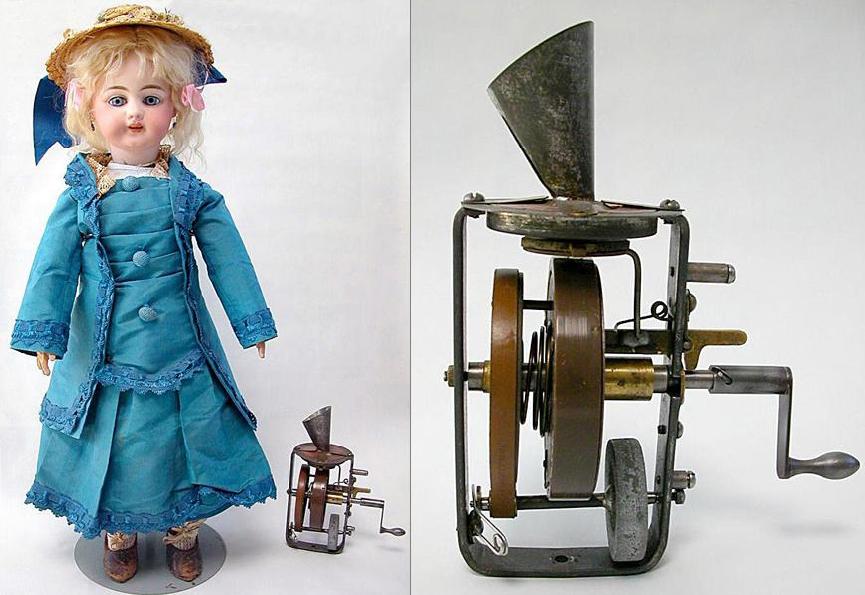
When studying history’s most famous creators, we must never forget that they always produced failures as well as successes, and often failures as impressive as their successes. Take Thomas Edison, widely regarded as the great American inventor for his work on the light bulb, the movie camera, and the phonograph. We all know about those achievements, all of which shaped technologies which went on to near-universal use, but have you heard of Edison’s still-pioneering but rather less well-known work in the field of talking dolls?
Many of us in the past few generations grew up with talking dolls of one kind or another. But had we been children in 1890, we might have grown up with the very first talking dolls, for which Edison designed an internal mechanism that played one of several wax cylinders pre-recorded with various child-oriented songs, prayers, and nursery rhymes. Or rather, we might have grown up with them if we came from wealthy families: they cost between $10 and $20 in 1890 dollars, or up to $526 in today’s dollars.
And even at that price, Edison’s talking dolls provided not just the lowest of lo-fi listening experiences, but resoundingly creepy ones at that. “The public reacted as one does when confronted with a grandmother’s massive doll collection: You averted your eyes in fear,” writes PBS’ Joshua Barajas. “After six weeks into production, the dolls were deemed too scary and pulled from the market, the New York Times reported.”
But now, thanks to optical audio-scanning technology unimaginable in Edison’s day, we can hear the dolls’ renditions of “Twinkle, Twinkle, Little Star,” “Hickory, Dickory, Dock,” and — most eerily of all — “Now I Lay Me Down to Sleep” just as the children of 1890 would have heard them. But even this seriously wrongheaded-seeming product paved the way for not just the less disturbing Furbys and Teddy Ruxpins of more recent childhoods, but, given its unprecedented use of auto recordings made for entertainment purposes, the entire record industry — and, of course, the minor but robust subgenre of talking-doll horror movies.
The Henson Rarities site on YouTube keeps giving and giving. Not only has it given us access to some of Jim Henson’s earliest (and delightfully violent) commercials, but it has discovered this: a pilot of The Orson Welles Show from 1979. The show was never aired, and you might be able to discern why from checking it out.
It’s the height of ‘70s excess with wide collars, polyester shirts, various forms of pre-show indulgences, and it’s all underlit like a nightclub, not a talk show set. Orson Welles doesn’t interview his first guest Burt Reynolds, but instead immediately throws the questions to the audience, turning the first half of the show into an ur-Actors Studio episode. (An eagle eyed YouTube commentator points out a young–but unverified–Joe Dante in the audience.) And the entire show has the feeling of very, very rough footage saved by editing and heaping on tablespoons of canned laughter.
Eventually Welles introduces “a little company of cloth headed comedians” that was already in its third season of the Muppet Show and about to premiere its first movie. (That first Muppet Movie, by the way, features Welles near the end as a movie executive.)
Welles, who calls himself a magician more often than a director in this episode, no doubt loves the magic behind the Muppets. Even when the lights are fully upon Henson and his frog puppet, we never question that Kermit is not real. In the 50th minute, Welles introduces both Henson (“picture Rasputin as an Eagle Scout” says the director) and Frank Oz (“A man who truly fits his name.”)
The show peters out with a magic trick, an appearance by Angie Dickinson (more tricks!) and a final Welles monolog, who reads Jenny Kissed Me by James Leigh Hunt. Like the poem, there’s a shadow of maudlin mortality hanging over all of Welles’ lines throughout the show. Six years later Welles would pass away with his final movie unfinished, still waiting for the cash that he hoped programs like The Orson Welles Show would bring.
Ted Mills is a freelance writer on the arts who currently hosts the FunkZone Podcast. You can also follow him on Twitter at @tedmills, read his other arts writing at tedmills.com and/or watch his films here.
We're hoping to rely on loyal readers, rather than erratic ads. Please click the Donate button and support Open Culture. You can use Paypal, Venmo, Patreon, even Crypto! We thank you!
Open Culture scours the web for the best educational media. We find the free courses and audio books you need, the language lessons & educational videos you want, and plenty of enlightenment in between.