Cult Films by Kubrick, Tarantino & Wes Anderson Re-imagined as 8‑Bit Video Games

Now clos­ing in on 50 episodes, David Dut­ton’s 8‑Bit Cin­e­ma series for Cine­Flix cel­e­brates and cri­tiques the increas­ing video game qual­i­ties of action films. Or maybe it’s a nos­tal­gic do-over of a child­hood spent watch­ing great films turned into ter­ri­ble games and your favorite games turned into ter­ri­ble films. 8‑Bit Cin­e­ma imag­ines pop­u­lar and clas­sic movies turned into NES-era con­sole games, with the movie’s plot imag­ined as a “per­fect run,” as gamers call it.

Their ver­sion of Guardians of the Galaxy (watch it here) quotes Mega­man, Capcom’s 1987 hit game that is still spawn­ing sequels, and con­fines its action to a plat­form shoot­er, which, in a way, describes James Gunn’s film. (But dig that 8‑bit ver­sion of “The Pina Cola­da Song,” man!). The film adapts too well to a video game, and that may be its prob­lem.

Things get more inter­est­ing when Dutton’s cre­ative team tack­les films in the cult canon. One of their favorites, Pulp Fic­tion com­bines sev­er­al game gen­res: Dance Dance Rev­o­lu­tion for the Jack Rab­bit Slim sequence, side scrollers for the gun (and samu­rai sword)-heavy action, and more. But what 8‑Bit Cin­e­ma had to do was straight­en out Tarantino’s non-lin­ear nar­ra­tive, allow­ing the “play­er” to change char­ac­ters from Vince to Butch after their unfor­tu­nate meet­ing, and ditch all that won­der­ful dia­log. This 2 1/2 minute ver­sion quotes plen­ty of rare video games, just like Taran­ti­no quotes movies.

The Shin­ing is one of two Kubrick films the team has attempt­ed, the oth­er one being A Clock­work Orange. The Shin­ing one works bet­ter as Kubrick’s exam­i­na­tions of domes­tic vio­lence are ren­dered even ici­er (no pun intend­ed) through typ­i­cal vio­lent game­play, and tense con­fronta­tions between Jack and Wendy are reduced to emo­tion­less exchanges. The video ref­er­ences 1987’s Mani­ac Man­sion, appro­pri­ate­ly enough, which itself was a trib­ute to hor­ror movie clich­es.

Wes Anderson’s ship set from The Life Aquat­ic with Steve Zis­sou was designed much like a plat­form game, so the 8‑Bit Cin­e­ma team had an eas­i­er job with this one, and threw in ref­er­ences to Met­al Gear Sol­id to boot. Judg­ing from the com­ments, the 8‑Bit death of Ned still man­ages to pull the ol’ heart­strings, but the nar­ra­tive remains just as inscrutable.

The take­away here might be this: The bet­ter the film, the less it can con­form to the sim­plis­tic plots, puz­zle play, and point-scor­ing vio­lence that make video games fun to play. And while video games are undoubt­ed­ly a form of art, there’s a large gulf between them and cin­e­ma.

Cur­rent­ly Dutton’s crew man­ages one 8‑Bit Cin­e­ma short a month. For a behind-the-scenes look at what it takes to put three min­utes of nos­tal­gic bliss togeth­er, check this out:

Ted Mills is a free­lance writer on the arts who cur­rent­ly hosts the FunkZone Pod­cast. You can also fol­low him on Twit­ter at @tedmills and/or watch his films here.

Relat­ed Con­tent:

8‑Bit Phi­los­o­phy: Pla­to, Sartre, Der­ri­da & Oth­er Thinkers Explained With Vin­tage Video Games

The Inter­net Arcade Lets You Play 900 Vin­tage Video Games in Your Web Brows­er (Free)

Andrei Tarkovsky’s Mas­ter­piece Stalk­er Gets Adapt­ed into a Video Game

George Orwell Creates a Who’s Who List of “Crypto” Communists for British Intelligence Forces (1949)

George-Orwell-001

Jour­nal­ist and nov­el­ist Eric Blair, known for all of his pro­fes­sion­al life by the pen name George Orwell, staunch­ly iden­ti­fied him­self as a demo­c­ra­t­ic social­ist. For exam­ple, in his slim 1946 pub­li­ca­tion Why I Write, he declared, “Every line of seri­ous work I have writ­ten since 1936 has been writ­ten, direct­ly or indi­rect­ly, against total­i­tar­i­an­ism and for demo­c­ra­t­ic social­ism as I under­stand it.” Despite the wide­spread blur­ring of lines these days between social­ism and communism—whether through igno­rance or delib­er­ate misleading—the dis­tinc­tion was not lost on Orwell. Though he sup­port­ed an equi­table dis­tri­b­u­tion of wealth and pub­lic insti­tu­tions for the com­mon good, he fierce­ly opposed Sovi­et com­mu­nism as anti-demo­c­ra­t­ic and oppres­sive. As Orwell biog­ra­ph­er John Newsinger writes, one “cru­cial dimen­sion to Orwell’s social­ism was his recog­ni­tion that the Sovi­et Union was not social­ist. Unlike many on the left, instead of aban­don­ing social­ism once he dis­cov­ered the full hor­ror of Stal­in­ist rule in the Sovi­et Union, Orwell aban­doned the Sovi­et Union and instead remained a social­ist.”

Of course, Orwell’s anti-com­mu­nist sen­ti­ments are famil­iar to every stu­dent who has read Ani­mal Farm. Less well known is the degree to which he con­tributed to anti-com­mu­nist pro­pa­gan­da, even cor­re­spond­ing with British secret ser­vices and keep­ing a black­list of writ­ers he deemed either “cryp­tos” (secret com­mu­nists), “fel­low trav­ellers” (com­mu­nist sym­pa­thiz­ers), or out­right mem­bers of the Com­mu­nist Par­ty. Orwell’s involve­ment with the Infor­ma­tion Research Depart­ment (IRD), a pro­pa­gan­da unit formed in 1948 under the UK’s For­eign Office to com­bat Stal­in­ism at home and abroad has received a good deal of atten­tion in the past few decades, in part because of the dis­cov­ery in 2003 of a pri­vate note­book con­tain­ing his orig­i­nal list. Even before this rev­e­la­tion, biog­ra­phers and his­to­ri­ans had known about the list, which Orwell includ­ed, in part, in a let­ter to his love inter­est Celia Kir­wan, who worked for the IRD, with the instruc­tions that she keep it secret due to its “libelous” nature. Orwell intend­ed that the writ­ers on the list not be asked to work for the IRD because, in his esti­ma­tion, they were peo­ple who could not be trust­ed.

Reac­tions to Orwell’s list have been very mixed. When the sto­ry first broke in the late nineties, Orwell’s long­time friend Michael Foot said he found the list “amaz­ing” and out of char­ac­ter. One of the peo­ple named, Nor­man Macken­zie, ascribed the list to Orwell’s ill­ness, say­ing that the writer was “los­ing his grip on him­self” in 1949 dur­ing his final strug­gle with the tuber­cu­lo­sis that killed him that year. Orwell biog­ra­ph­er Bernard Crick defend­ed his actions, writ­ing, “He did it because he thought the Com­mu­nist Par­ty was a total­i­tar­i­an men­ace. He wasn’t denounc­ing these peo­ple as sub­ver­sives. He was denounc­ing them as unsuit­able for counter-intel­li­gence oper­a­tion.” On the oth­er hand, late left­ist fire­brand jour­nal­ist Alexan­der Cock­burn con­demned Orwell as a “snitch” and thought the list was evi­dence of Orwell’s big­otry, giv­en his sus­pi­cion of Paul Robe­son as “anti-white” and his denounc­ing of oth­ers due to their rumored homo­sex­u­al­i­ty or Jew­ish back­ground. He makes a com­pelling case. What­ev­er Orwell’s moti­va­tions, the effect on the named indi­vid­u­als’ pro­fes­sion­al and polit­i­cal lives was mild, to say the least. This was hard­ly a McCarthyite witch-hunt. Nonethe­less, it’s a lit­tle hard for admir­ers of Orwell not to wince at this col­lab­o­ra­tion with the state secret ser­vice.

Below, see the list he sub­mit­ted to Kir­wan in his let­ter. Fur­ther down is a list of names, includ­ing those of Orson Welles and Kather­ine Hep­burn, that appeared in his note­book but not on the list he gave to the IRD.

Writ­ers and jour­nal­ists

Aca­d­e­mics and sci­en­tists

Actors

Labour MPs

Oth­ers

Peo­ple named in Orwell’s note­book, but not appear­ing on the final IRD list:

Relat­ed Con­tent:

George Orwell Explains in a Reveal­ing 1944 Let­ter Why He’d Write 1984

George Orwell Reviews Mein Kampf (1940)

George Orwell’s Five Great­est Essays (as Select­ed by Pulitzer-Prize Win­ning Colum­nist Michael Hiltzik)

Josh Jones is a writer and musi­cian based in Durham, NC. Fol­low him at @jdmagness

A Racy Philosophy Lesson on Kant’s Aesthetics by Alain de Botton’s “School of Life”

For the past two decades, Alain de Bot­ton has refined his knack for pop­u­lar­iz­ing philo­soph­i­cal and lit­er­ary ideas. In 1997, he pub­lished his best­seller, How Proust Can Change Your Life. Next came his six-part video series, A Guide to Hap­pi­nesswhere de Bot­ton showed how thinkers like Mon­taigne, Seneca and Schopen­hauer can help you grap­ple with time­less ques­tions — like deal­ing with anger, man­ag­ing your love life, or main­tain­ing your self-esteem. And, by 2008, we find Alain open­ing The School of Life, a Lon­don-based oper­a­tion that has as its tagline “good ideas for every­day life.”

The School of Life offers class­es, pub­lish­es books, makes films, and now pro­duces YouTube videos, some of which we’ve fea­tured here before. The School’s lat­est release won’t go unno­ticed. A three minute les­son on Kan­t’s aes­thet­ics, the video fea­tures an eroti­cized teacher talk­ing quick­ly and author­i­ta­tive­ly in Ger­man about dif­fi­cult aspects relat­ing to Kan­t’s phi­los­o­phy. Things get meta pret­ty quick­ly, and soon the dis­tract­ing cam­era work starts mak­ing Kan­t’s very point about the nature of the sub­jec­tive. The charged imagery is not, in oth­er words, entire­ly gra­tu­itous — but it’s cer­tain­ly pret­ty uncon­ven­tion­al, and whether it’s effec­tive, I guess that’s up for debate. Next, up Niet­zsche, we’re told.

If you would like some deep­er intro­duc­tions to Kan­t’s phi­los­o­phy, please see our list of 130 Free Online Phi­los­o­phy Cours­es. Kan­t’s Cri­tique of Judg­ment appears in our col­lec­tion, 135 Free Phi­los­o­phy eBooks.

Relat­ed Con­tent:

The Dai­ly Habits of High­ly Pro­duc­tive Philoso­phers: Niet­zsche, Marx & Immanuel Kant

Alain de Botton’s School of Life Presents Ani­mat­ed Intro­duc­tions to Hei­deg­ger, The Sto­ics & Epi­cu­rus

How Mar­tin Luther King, Jr. Used Hegel, Kant & Niet­zsche to Over­turn Seg­re­ga­tion in Amer­i­ca


The Story of John Coltrane’s A Love Supreme, Released 50 Years Ago This Month

What can I add to the cho­rus of voic­es in praise of John Coltrane’s A Love Supreme? Record­ed in Decem­ber of 1964 and released fifty years ago this month, the album has gone on to achieve cult status—literally inspir­ing a church found­ed in Coltrane’s name—as one of the finest works of jazz or any oth­er form of music. It cement­ed Coltrane’s name in the pan­theon of great com­posers, and re-invent­ed reli­gious music for a sec­u­lar age. Com­posed as a hymn of praise and grat­i­tude, “the bizarre suite of four move­ments,” wrote NPR’s Arun Rath last year, “com­mu­ni­cat­ed a pro­found spir­i­tu­al and philo­soph­i­cal mes­sage.” That mes­sage is artic­u­lat­ed explic­it­ly by Coltrane in the album’s lin­er notes as “a hum­ble offer­ing to Him,” the deity he expe­ri­enced in a 1957 “spir­i­tu­al awak­en­ing” that “lead me to a rich­er, fuller, more pro­duc­tive life.”

These phras­es speak the lan­guage of recov­ery, and Coltrane found God through a pro­gram of recov­ery from hero­in addic­tion. Like so many who have embraced faith after addic­tion, Coltrane’s devo­tion was ardent, but nei­ther dog­mat­ic nor judg­men­tal. He “refused to com­mit to a sin­gle reli­gion,” writes Rath, “His idea of God couldn’t be con­tained by any doc­trine. But with his sax­o­phone, and with his band, he could preach.” That he did, reli­gious­ly, no pun intend­ed. Before the record­ing of A Love Supreme, Coltrane’s clas­sic quartet—including drum­mer Elvin Jones, pianist McCoy Tyn­er, and bassist Jim­my Garrison—toured the U.S. for four years. As the BBC doc­u­men­tary above informs us, “The group’s appetite for per­for­mance was fero­cious.” They played “two gigs a day, six nights a week, tak­ing only short breaks in the stu­dio to record mate­r­i­al for more than fif­teen increas­ing­ly crit­i­cal­ly acclaimed albums.”

By the time the group record­ed A Love Supreme, they had devel­oped “an amaz­ing unspo­ken com­mu­ni­ca­tion.” Tyn­er recalled the album as “a cul­mi­na­tion and nat­ur­al exten­sion of chem­istry honed through years of play­ing togeth­er live.” (Despite all that, they would only per­form the suite of songs live once, in Antibes, France, result­ing in a live album and some frag­men­tary film of the event.) Nar­rat­ed by Jez Nel­son, the 2004 radio doc­u­men­tary (up top) presents inter­views with Tyn­er, Jones, mod­ernist com­pos­er Steve Reich, Coltrane’s wife Alice, and oth­ers, in-between pas­sages of Coltrane’s music, includ­ing his major break­out hit record­ing of “My Favorite Things.”

Among the many trib­utes to the album’s inspir­ing, tran­scen­dent genius, Coltrane schol­ar Ash­ley Kahn offers a very down-to-earth assess­ment of A Love Supreme’s impor­tance: “[Coltrane] was not a prodi­gy. He was some­one who worked very, very, very hard at his craft, and he showed us, and he shows musi­cians still, that it is pos­si­ble.” Whether we attribute Coltrane’s achieve­ments to divine inspi­ra­tion, incred­i­bly hard work, or some com­bi­na­tion of the two, the proof of his devo­tion stands the test of fifty years, and fifty years from now, I sus­pect we’ll say much the same.

Relat­ed Con­tent:

John Coltrane’s Hand­writ­ten Out­line for His Mas­ter­piece A Love Supreme

John Coltrane Per­forms A Love Supreme and Oth­er Clas­sics in Antibes (July 1965)

Dis­cov­er the Church of St. John Coltrane, Found­ed on the Divine Music of A Love Supreme

Josh Jones is a writer and musi­cian based in Durham, NC. Fol­low him at @jdmagness

The Musical Career of David Bowie in One Minute … and One Continuous Take

We like to keep things suc­cinct around here. So behold the many ch-ch-changes of David Bowie, filmed in one minute, and in one con­tin­u­ous take. And when you’re done, check out 50 Years of Chang­ing David Bowie Hair Styles in One Ani­mat­ed GIF. More Bowie mate­r­i­al from the OC archive awaits you below.

Relat­ed Con­tent:

David Bowie’s Top 100 Books

A 17-Year-Old David Bowie Defends “Long-Haired Men” in His First TV Inter­view (1964)

David Bowie Releas­es Vin­tage Videos of His Great­est Hits from the 1970s and 1980s

David Bowie Sings ‘I Got You Babe’ with Mar­i­anne Faith­full in His Last Per­for­mance As Zig­gy Star­dust

Wes Anderson Likes the Color Red (and Yellow)

Red seems to be a mag­net for angry bulls and great direc­tors. After all, it’s the col­or that seems to stand out more than any oth­er. Yasu­jiro Ozu, for one, made the jump to col­or movies very reluc­tant­ly late in his career and prompt­ly became obsessed with the col­or red. His pro­duc­tion team kept a box on set of small red house­hold things – a match­box, an umbrel­la, a teaket­tle — which he used to place in the back­ground of just about every shot. Jean-Luc Godard famous­ly bathed Brigitte Bardot’s back­side in red light for his first col­or film Con­tempt. When crit­ics com­plained that his fea­ture, Pier­rot le Fou, was too bloody, he quipped, “It’s not blood, it’s red.” And from HAL 9000’s unfor­giv­ing elec­tron­ic eye in 2001 to the buck­ets of blood pour­ing out of the ele­va­tor from hell in The Shin­ing, Stan­ley Kubrick built some of his most mem­o­rable scenes around the col­or red.

Edi­tor and design­er Rishi Kane­r­ia, who seems to be mak­ing a career out of point­ing out the col­or choic­es of auteurs, has just released a video called “Red & Yel­low: A Wes Ander­son Super­cut” that square­ly places Wes Ander­son among the ranks of cinema’s great crim­son-lov­ing styl­ists – from Ben Stiller’s sweats in The Roy­al Tenen­baums to the lux­u­ri­ous car­pets of his lat­est effort The Grand Budapest Hotel. As you might gath­er from the title of Kaneria’s short, Ander­son is also a fan of the col­or yel­low too. You can watch the video above. And you can watch Kaneria’s look into Kubrick’s use of red below.

Relat­ed Con­tent:

What’s the Big Deal About Wes Anderson’s The Grand Budapest Hotel? Matt Zoller Seitz’s Video Essay Explains

The Per­fect Sym­me­try of Wes Anderson’s Movies

A Glimpse Into How Wes Ander­son Cre­ative­ly Remixes/Recycles Scenes in His Dif­fer­ent Films

Watch Wes Anderson’s Charm­ing New Short Film, Castel­lo Cav­al­can­ti, Star­ring Jason Schwartz­man

Wes Anderson’s First Short Film: The Black-and-White, Jazz-Scored Bot­tle Rock­et (1992)

Jonathan Crow is a Los Ange­les-based writer and film­mak­er whose work has appeared in Yahoo!, The Hol­ly­wood Reporter, and oth­er pub­li­ca­tions. You can fol­low him at @jonccrow. And check out his blog Veep­to­pus, fea­tur­ing lots of pic­tures of bad­gers and even more pic­tures of vice pres­i­dents with octo­pus­es on their heads.  The Veep­to­pus store is here.

Glorious Early 20th-Century Japanese Ads for Beer, Smokes & Sake (1902–1954)

drink_smoke_10

Ear­li­er this month, we fea­tured adver­tise­ments from Japan’s pre­war Art Deco gold­en age, a peri­od that shows off one facet of the coun­try’s rich graph­ic his­to­ry. While all forms of Japan­ese design remain com­pelling today, any time or place would be hard pressed to com­pete with the world of Japan’s pre-war print adver­tis­ing. It has, espe­cial­ly for the mod­ern West­ern­er, not just a visu­al nov­el­ty but a com­mer­cial nov­el­ty as well: as often as not, sur­viv­ing exam­ples glo­ri­fy now-restrict­ed addic­tive sub­stances like alco­hol and tobac­co.

drink_smoke_4

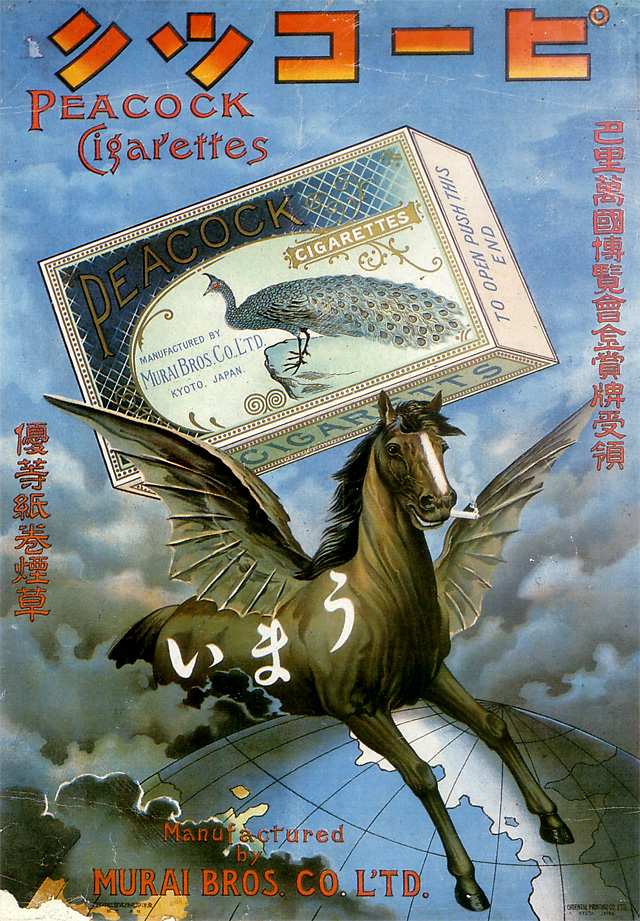
At Pink Ten­ta­cle (a com­plete­ly safe-for-work page, believe it or not), you can find a roundup of Japan­ese print adver­tise­ments for prod­ucts that tap into just such vices. Japan opened up to the world in a big way in the mid-to-late 19th cen­tu­ry, and the coun­try’s accep­tance (and sub­se­quent Japan­i­fi­ca­tion) of all things for­eign kept chug­ging along right up until the Sec­ond World War. At the top, we have an appeal­ing exam­ple of this inter­na­tion­al­ism at work in the ser­vice of Saku­ra Beer in the late 1920s. The 1902 ad just above depicts not just the globe but a smok­ing Pega­sus astride it in the name of Pea­cock cig­a­rettes.

drink_smoke_21

When the tone of Japan­ese life got mil­i­taris­tic in the 1930s, so did the tone of Japan­ese ads. The 1937 poster just above pro­claims “Defense for Coun­try, Tobac­co for Soci­ety,” a mes­sage brought to you by the South Kyoto Tobac­co Sell­ers’ Union. Below, the kind of Japan­ese maid­en pre­war graph­ic design always ren­dered so well appears in a dif­fer­ent, more out­ward­ly patri­ot­ic, and much more naval form.

drink_smoke_17

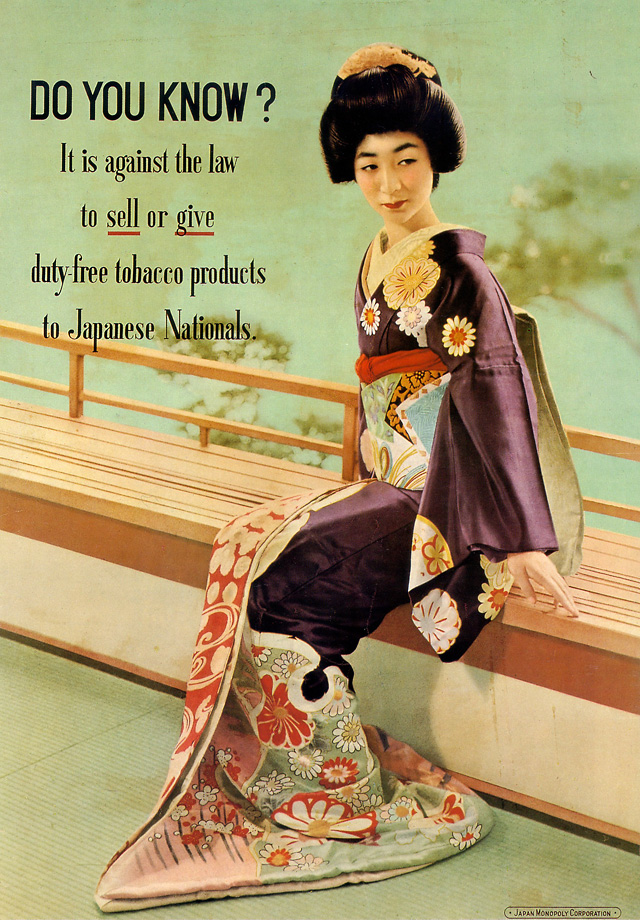
It goes with­out say­ing that most of these ads’ design­ers geared them toward the eyes of the Japan­ese — most, but not all. After the war, dur­ing the Unit­ed States’ occu­pa­tion of the coun­try, there appeared print announce­ments in this same styl­is­tic vein urg­ing GIs and oth­er Amer­i­can mil­i­tary per­son­nel to keep on their best com­mer­cial behav­ior. Take, for instance, these words the straight­for­ward­ly named Japan Monop­oly Cor­po­ra­tion placed beside this arche­typ­i­cal­ly court­ly but unchar­ac­ter­is­ti­cal­ly stern tra­di­tion­al lady in 1954:

drink_smoke_25

A valiant effort, but from the sto­ries I’ve heard of the occu­pa­tion, no amount of graph­ic design could’ve shut down that par­tic­u­lar black mar­ket. And final­ly, no look back at vin­tage Japan­ese ads would be com­plete with­out includ­ing one adver­tise­ment for sake. The ad below is for Zuigan sake, cre­at­ed in 1934.

drink_smoke_18

Relat­ed Con­tent:

Adver­tise­ments from Japan’s Gold­en Age of Art Deco

Hand-Col­ored Pho­tographs of 19th Cen­tu­ry Japan

Two Short Films on Cof­fee and Cig­a­rettes from Jim Jar­musch & Paul Thomas Ander­son

Col­in Mar­shall hosts and pro­duces Note­book on Cities and Cul­ture as well as the video series The City in Cin­e­ma and writes essays on cities, lan­guage, Asia, and men’s style. He’s at work on a book about Los Ange­les, A Los Ange­les Primer. Fol­low him on Twit­ter at @colinmarshall or on Face­book.

Kids Orchestra Plays Ozzy Osbourne’s “Crazy Train” and Zeppelin’s “Kashmir”

The Louisville Leop­ard Per­cus­sion­ists — they’re a per­form­ing ensem­ble made up of 60 stu­dents, all between the ages of 7 and 14, from schools around the Louisville, Ken­tucky area. Each musi­cian plays sev­er­al instru­ments, such as the marim­bas, xylo­phone, vibra­phone, drum set, tim­bales, con­gas, bon­gos and piano. And they can rock with the best of them. Per­haps you’ve seen a viral video of the young per­cus­sion­ists play­ing Led Zep­pelin’s “Kash­mir,” which Jim­my Page called “too good not to share” on his Face­book page.

If your inner 16-year-old is ask­ing “what about Ozzy?,” well then, we’ve got you cov­ered. Above you can watch The Fab­u­lous Leop­ard Per­cus­sion­ists rehears­ing a ver­sion of Ozzy Osbourne’s “Crazy Train,” the heavy met­al clas­sic from 1980. Found­ed in 1993 by the ele­men­tary school teacher Diane Downs, the ensem­ble has cer­tain­ly explored oth­er musi­cal forms too. Here, you can see them per­form Chick Core­a’s “Spain” and Ben­ny Good­man’s “Sing Sing Sing” at the Inter­na­tion­al Asso­ci­a­tion of Jazz Edu­ca­tors’ con­cert in New York City. And Latin-inspired ver­sions of Low Rider/Oye Como Va. Not a bad way to start your day, I must say.

Fol­low us on Face­book, Twit­ter and Google Plus and share intel­li­gent media with your friends. Or bet­ter yet, sign up for our dai­ly email and get a dai­ly dose of Open Cul­ture in your inbox.

Relat­ed Con­tent:

Ele­men­tary School Kids Sing David Bowie’s “Space Odd­i­ty” & Oth­er Rock Hits: A Cult Clas­sic Record­ed in 1976

Mr. Rogers Intro­duces Kids to Exper­i­men­tal Elec­tron­ic Music by Bruce Haack & Esther Nel­son (1968)

Thomas Dol­by Explains How a Syn­the­siz­er Works on a Jim Hen­son Kids Show (1989)

by | Permalink | Make a Comment ( 4 ) |

« Go BackMore in this category... »
Quantcast