Agnès Varda claimed to have seen fewer than ten movies before she made her first film at age 25. At the time, she had some pretty naïve ideas about film. “I thought if I added sound to photographs, that would be cinema,” she recalled. She learned the essence of filmmaking and, by all accounts, learned it well. The resulting film, La Pointe-Courte (1954), a self-financed documentary-fiction hybrid, is considered one of the forerunners of the French New Wave.
Fast forward a few years. Varda is shooting her follow up feature Cleo from 5 to 7. The film would prove to be her breakout hit and a classic of the New Wave alongside the likes of 400 Blows and Breathless.
The film, which unspools almost in real time, is about a beautiful young singer who waits anxiously for the results of a medical test. We watch her as she talks with well-meaning friends, finds comfort with a stranger, and even takes some time to watch a movie. In the wrong hands, the story has the potential for being an unleavened exercise in existential angst. But, as she later proved in subsequent movies, she was never one to let things get too dark. The movie that the heroine watches is a silent comedy – one that Varda shot herself.
Les Fiancés Du Pont Macdonaldcenters on a Buster Keatonsque dandy in a flat straw hat who waves good-bye to his doll-like girlfriend. Yet when he dons a pair of sunglasses, everything goes wrong. He witnesses his beloved getting injured in an accident only to be hauled off by a hearse. When he takes off the glasses to wipe away the tears, he realizes that he saw it all wrong. The glasses make everything seem metaphorically dark. No wonder the movie’s subtitle is “Beware of Dark Glasses.” You can watch it above.
Les Fiancés is interesting not just because of Varda’s spot on pastiche of silent movies but also because of its cast. None other than Jean-Luc Godard plays the dandy. His wife Anna Karina plays the girl, of course. Generally, Godard’s onscreen appearances run the gamut from being sober and aloof to being hectoring and indignant. It’s fun to watch him ham it up.
Jean-Luc Godard Gives a Dramatic Reading of Hannah Arendt’s “On the Nature of Totalitarianism”
Jonathan Crow is a Los Angeles-based writer and filmmaker whose work has appeared in Yahoo!, The Hollywood Reporter, and other publications. You can follow him at @jonccrow. And check out his blog Veeptopus, featuring lots of pictures of badgers and even more pictures of vice presidents with octopuses on their heads. The Veeptopus store is here.
A century later, on another continent, Hegel’s thought influenced the course of a very different struggle. And while the historical conditions of mid-nineteenth century Europe and mid-twentieth century America present entirely different sets of specific concerns, the same general observation applies: the time and place of such radical thinkers as Malcolm X, Angela Davis, Huey Newton and a host of other activists presented “peculiarly auspicious” circumstances for revolutionary social philosophy.
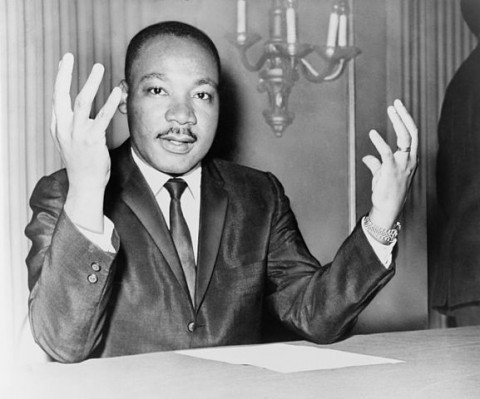
But while these figures appear today as the vanguard of radical black thought, Martin Luther King, Jr., the most widely celebrated of Civil Rights leaders, “is often conflated with neoliberal multiculturalism,” writes Critical Theory, his program associated with “the failure of the civil rights movement to dismantle the ongoing systemic white supremacy of the status quo.” And yet, King’s movement not only succeeded in ending legal segregation and hastening the passing of the Civil Rights Act; it also provided direction for nearly every nonviolent social movement from his day to ours. King’s legacy is not only that of an inspiring organizer and orator, but also of a radical thinker who engaged critically with philosophy and social theory and brought it to bear on his activism.
We are generally well aware of King’s debt to Gandhi and the Satyagraha movement that won Indian independence in 1947, yet we know little of his debt to the same thinker who inspired Marx and his contemporaries—G.W.F. Hegel. As philosopher and “Ethicist for Hire” Nolen Gertz has recently demonstrated on his blog, King was highly influenced by Hegelianism, as much as, or perhaps even more so, than he was by Gandhi’s movement. Marx may have turned Hegel’s system on its head, but King, writes Gertz, “fought White America… by turning the ideas of dead white men against the oppressive practices of living white men.”
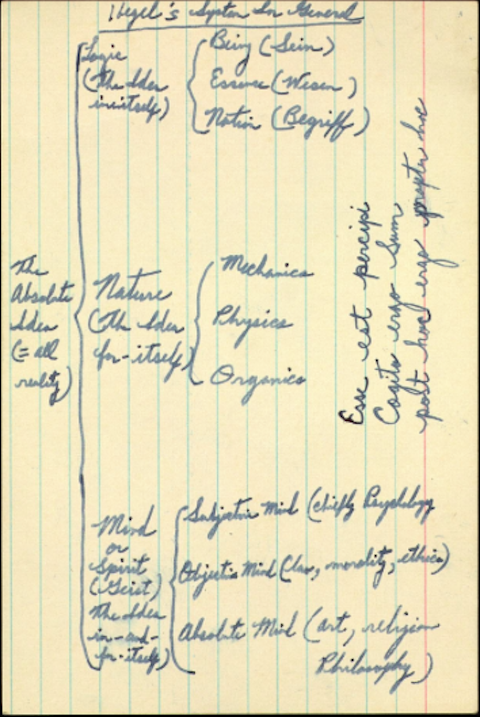
King read and wrote on Hegel as a graduate student at Boston University and Harvard in the mid-50s, where he studied theology and the history of philosophy and religion. He took a yearlong seminar on Hegel with his advisor at BU, Edgar Brightman (see King’s diagram notes of Hegel’s system above), and found a great deal to admire in the “dead white” philosopher’s logical system, as well as a good deal to critique. The two-semester class, King wrote in his autobiography, was “both rewarding and stimulating”:
Although the course was mainly a study of Hegel’s monumental work, Phenomenology of Mind, I spent my spare time reading his Philosophy of History and Philosophy of Right. There were points in Hegel’s philosophy that I strongly disagreed with. For instance, his absolute idealism was rationally unsound to me because it tended to swallow up the many in the one. But there were other aspects of his thinking that I found stimulating. His contention that “truth is the whole” led me to a philosophical method of rational coherence. His analysis of the dialectical process, in spite of its shortcomings, helped me to see that growth comes through struggle.
While King may have disagreed with Hegel’s idealism, he found support for his own philosophy of nonviolence in Hegel’s dialectical method, a mode of analysis that seems particularly well suited to socially revolutionary thought. In Stride Toward Freedom, King wrote,
The third way open to oppressed people in their quest for freedom is the way of nonviolent resistance. Like the synthesis in Hegelian philosophy, the principle of nonviolent resistance seeks to reconcile the truths of two opposites—acquiescence and violence—while avoiding the extremes and immoralities of both.
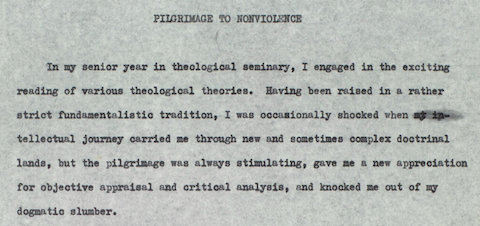
King’s critical appraisal of Hegel extended to other radical philosophical thinkers as well, including Kant, Spinoza, Kierkegaard, Marx, and Nietzsche. Gertz offers many samples of the budding civil rights leader’s notes on various thinkers and philosophies, including the first paragraph of an essay entitled “Pilgrimage to Nonviolence” (below), in which King confesses that his encounter with Existentialism often “shocked” him, especially since he had “been raised in a rather strict fundamentalist tradition.” And yet, he writes—in an allusion to Kant’s reaction to David Hume—he acquired “a new appreciation for objective appraisal and critical analysis” that “knocked me out of my dogmatic slumber.”
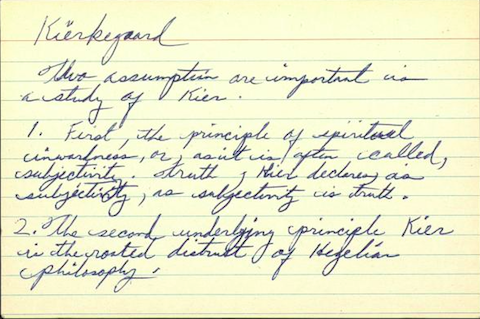
In the essay, King writes, “I became convinced that existentialism, in spite of the fact that it had become all too fashionable, had grasped certain basic truths about man.” He seems particularly drawn to Kierkegaard (see his notes on the philosopher below). Yet it is Hegel who seems most responsible for awakening his philosophical curiosity. As King scholar John Ansbro discovered, King “stated in a January 19, 1956 interview with The Montgomery Adviser that Hegel was his favorite philosopher.” Later that year, King gave an address to the First Annual Institute on Nonviolence and Social Change in which he used Hegelian terms to characterize the Civil Rights struggle: “Long ago, the Greek philosopher Heraclitus argued that justice emerges from the strife of opposites, and Hegel, in modern philosophy, preached a doctrine of growth through struggle.”
Independent scholar Ralph Dumain has further catalogued King’s many approving references to Hegel, including a paper he wrote entitled “An Exposition of the First Triad of Categories of the Hegelian Logic—Being, Non-Being, Becoming,” the “last of six essays that King wrote” for his two-semester course on the philosopher. King also approached Hegel by way of an earlier Civil Rights leader—W.E.B. Dubois, who read the German philosopher while studying with prominent social scientists in Berlin, and who applied Hegelian logic to his own analysis of racial consciousness and struggle in America.
Interestingly, what neither King nor Dubois remarked on is the fact that Hegel was likely himself inspired by black revolutionaries. The Haitian Revolution, argues scholar Susan Buck-Morss, gave Hegel the impetus for his analysis of power and his “metaphor of the ‘struggle to death’ between the master and slave, which for Hegel provided the key to the unfolding of freedom in world history.” While Hegel’s thought is a philosophical thread that winds through the work of radical thinkers throughout the nineteenth and twentieth centuries, his own philosophy may not have taken the direction it did without the revolutionary struggles against oppression waged by former slaves in the New World centuries before King led his nonviolent war on the oppressive system of segregation in the United States.
Note: It looks like the 92nd St Y took the reading off of its Youtube channel for unknown reasons. However you can stream it here.
Haruki Murakami doesn’t make many public appearances, but when he does, his fans savor them. This recording of a reading he gave at New York’s 92nd Street Y back in 1998 (stream it here) counts as a treasured piece of material among English-speaking Murakamists, especially those who love his eighth novel, The Wind-Up Bird Chronicle. When asked to read from that book, the author explains here, he usually reads from chapter one, “but I’m tired of reading the same thing over and over, so I’m going to read chapter three today.” And that’s what he does after giving some background on the book, its 29-year-old protagonist Toru Okada, and his own thoughts on how it feels to be 29.
The Wind-Up Bird Chronicle, published in three parts in Japan in 1994 and 1995 and in its entirety in English in 1997, began a new chapter in the writer’s career. You could tell by its size alone: the page count rose to 600 in the English-language edition, whereas none of his previous novels had clocked in above 400. Thematically, too, Murakami’s mission had clearly broadened: where its predecessors concern themselves primarily with Western pop culture, disappearing girls, twentysomething languor, and mysterious animal-men, The Wind-Up Bird Chronicle takes on Japanese history, especially the country’s ill-advised wartime colonial venture in Manchuria.
As a result, the book finally earned Murakami some respect — albeit respect he’d never directly sought — from his homeland’s long-disdainful literary establishment. Despite having held its place since the time of this reading as Murakami’s “important” book, and one many readers name as their favorite, it might not offer the easiest point of entry into his work. When I asked Wang Chung lead singer Jack Hues about a Murakami reference in the band’s song “City of Light,” he told me he put it there after reading The Wind-Up Bird Chronicle on his daughter’s recommendation and not liking it very much. I suggested he try Norwegian Wood instead.
Note: You can download a complete audio version of The Wind-Up Bird Chronicle if you take part in one of the free trials offered by our partners Audible.com and/or Audiobooks.com. Click on the respective links to get more information.
Back in July of last year, we brought you a transcription and a couple of audio interpretations of the oldest known song in the world, discovered in the ancient Syrian city of Ugarit and dating back to the 14th century B.C.E.. Likely performed on an instrument resembling an ancient lyre, the so-called “Hurrian Cult Song” or “Hurrian Hymn No. 6” sounds otherworldly to our ears, although modern-day musicologists can only guess at the song’s tempo and rhythm.
When we reach even further back in time, long before the advent of systems of writing, we are completely at a loss as to the forms of music prehistoric humans might have preferred. But we do know that music was likely a part of their everyday lives, as it is ours, and we have some sound evidence for the kinds of instruments they played. In 2008, archeologists discovered fragments of flutes carved from vulture and mammoth bones at a Stone Age cave site in southern Germany called Hohle Fels. These instruments date back 42,000 to 43,000 years and may supplant earlier findings of flutes at a nearby site dating back 35,000 years.
Image via the The Archaeology News Network
The flutes are meticulously crafted, reports National Geographic, particularly the mammoth bone flute, which would have been “especially challenging to make.” At the time of their discovery, researchers speculated that the flutes “may have been one of the cultural accomplishments that gave the first European modern-human (Homo sapiens) settlers an advantage over their now extinct Neanderthal-human (Homo neanderthalis) cousins.” But as with so much of our knowledge about Neanderthals, including new evidence of interbreeding with Homo Sapiens, these conclusions may have to be revised.
It is perhaps possible that the much-underestimated Neanderthals made their own flutes. Or so a 1995 discovery of a flute made from a cave bear femur might suggest. Found by archeologist Ivan Turk in a Neanderthal campsite at Divje Babe in northwestern Slovenia, this instrument (above) is estimated to be over 43,000 years old and perhaps as much as 80,000 years old. According to musicologist Bob Fink, the flute’s four finger holes match four notes of a diatonic (Do, Re, Mi…) scale. “Unless we deny it is a flute at all,” Fink argues, the notes of the flute “are inescapably diatonic and will sound like a near-perfect fit within ANY kind of standard diatonic scale, modern or antique.” To demonstrate the point, the curator of the Slovenian National Museum had a clay replica of the flute made. You can hear it played at the top of the post by Slovenian musician Ljuben Dimkaroski.
The prehistoric instrument does indeed produce the whole and half tones of the diatonic scale, so completely, in fact, that Dimkaroski is able to play fragments of several compositions by Beethoven, Verdi, Ravel, Dvořák, and others, as well as some free improvisations “mocking animal voices.” The video’s Youtube page explains his choice of music as “a potpourri of fragments from compositions of various authors,” selected “to show the capabilities of the instrument, tonal range, staccato, legato, glissando….” (Dimkaroski claims to have figured out how to play the instrument in a dream.) Although archeologists have hotly disputed whether or not the flute is actually the work of Neanderthals, as Turk suggested, should it be so, the finding would contradict claims that the close human relatives “left no firm evidence of having been musical.” But whatever its origin, it seems certainly to be a hominid artifact—not the work of predators—and a key to unlocking the prehistory of musical expression.
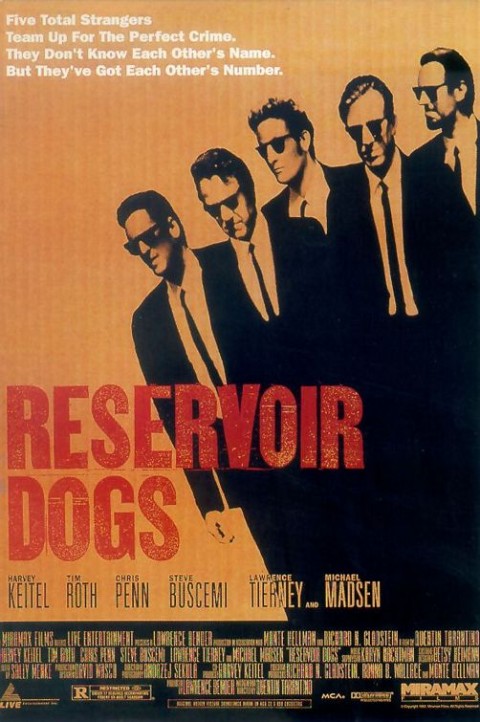
While watching Interstellar and hating it, designer Nick Barclay came up with a project for himself — taking the posters of famous films and reimagining them with a minimalist design that uses only circles. Above, you can see his clever take on Tarantino’s Reservoir Dogs. It’s a far cry, to be sure, from the original movie poster found below.
Over at My Modern Met, you’ll find other minimalist designs for The Matrix, The Lord of the Rings, Bram Stoker’s Dracula, Forrest Gump, Harry Potter, Pulp Fiction, Trainspotting, 101 Dalmations, Léon: The Professional, The Deer Hunter, Total Recall, Monsters Inc., and, of course, 2001: A Space Odyssey.
Raising Arizona;The Big Lebowski;O Brother, Where Art Thou? — Joel and Ethan Coen have made more than a few movies not just widely beloved, but also widely thought of as eccentric. One thus wouldn’t imagine their sensibility translating well to advertising, that means of occasional support for many an uncompromising auteur. But just as the Coen brothers have brought Hollywood at least partially over to their way of creating, they’ve also, on several occasions, bent the form of the commercial to their advantage.
And even if you keep up with the Coen brothers’ short film work, you may never have seen the spot below, which originally aired during the 2002 Super Bowl. Working for H&R Block, they use perhaps the least promising setting imaginable, a slow-moving tax law lecture, to create a dystopian vision not a million miles from the one Ridley Scott used to introduce the Apple Macintosh eighteen Super Bowls before.
It’s a truism to say that Hollywood is a boy’s club but Dr. Stacy L. Smith of the University of Southern California put this saying into stark, empirical terms: a mere 4.4% of the top 100 box-office releases in the USA were directed by women. That’s it. It’s a percentage that should be used to describe the amount of cream in whole milk, not half the human race.
The truth is that the film industry in general, not just Hollywood, is dominated by men. In books on cinema and classes on film history, female directors frequently get overlooked.
The Gleaners & I (2000) – Agnes Varda
A fascinating meditation on art, aging and foraging off leftovers of others. Varda turns the act of hunting for potatoes into a political act. You can watch the first four minutes of the film above.
The Apple (1998) – Samira Makhmalbaf
The daughter of Mohsen Makhmalbaf, one of the true trailblazers of the Iranian new wave, Samira proved to be a cinematic talent in her own right with this movie that blurs the line between documentary and narrative.
Wendy and Lucy (2008) – Kelly Reichardt
A woman at the margins of society whose life utterly comes apart after her car breaks down. Riechardt’s direction is slow, quiet and ultimately devastating.
The Pervert’s Guide to Cinema (2006) – Sophie Fiennes
Slavoj Zizek, the reigning rock star/comedian of the cultural theory world, riffs on some of the greatest films ever made.
American Psycho (2000) – Mary Harron
Perhaps the best portrait out there on the mindset of the 1%. You’ll never listen to Huey Lewis and the News in the same way.
Jonathan Crow is a Los Angeles-based writer and filmmaker whose work has appeared in Yahoo!, The Hollywood Reporter, and other publications. You can follow him at @jonccrow. And check out his blog Veeptopus, featuring lots of pictures of badgers and even more pictures of vice presidents with octopuses on their heads. The Veeptopus store is here.
We all know that Michelangelo sculpted in marble. What’s less well known is that he worked in bronze too. The historical record shows that Michelangelo once made a David in bronze for a French aristocrat, and a bronze statue of Pope Julius II. But the David disappeared during the French Revolution, and the Julius was later melted down for military purposes in Italy. For years, scholars thought that Michelangelo’s bronze creations were all irretrievably lost to history. And then came the big discovery.
A team of international experts (from Cambridge, the Rijksmuseum and the University of Warwick) recently gathered evidence suggesting that two bronze male nudes “are early works by Michelangelo, made just after he completed the marble David and as he was about to embark on the Sistine Chapel ceiling,” reports a Cambridge blog post. Although the statues aren’t signed by Michelangelo, *****@****ac.uk”>Prof Paul Joannides (Emeritus Professor of Art History at Cambridge) “connected them to a drawing by one of Michelangelo’s apprentices now in the Musée Fabre, Montpellier, France,” and it turns out that the drawing contains figures that closely resemble the statues. What’s more, Cambridge reports, the “bronzes were compared with other works by Michelangelo and found to be very similar in style and anatomy to his works of 1500–1510.” The Cambridge video above gives you a further introduction to this important discovery.
We're hoping to rely on loyal readers, rather than erratic ads. Please click the Donate button and support Open Culture. You can use Paypal, Venmo, Patreon, even Crypto! We thank you!
Open Culture scours the web for the best educational media. We find the free courses and audio books you need, the language lessons & educational videos you want, and plenty of enlightenment in between.