This week, Blank on Blank wraps up its series “The Experimenters,” with an episode animating a conversation between Carl Sagan and Studs Terkel–two figures we’ve highlighted on our site many times before. But never have we brought them together. So here they are.
Recorded in October, 1985, as part of Terkel’s long-running Chicago radio show (find an archive of complete episodes here), the conversation touched on some the big questions you might expect: the compatibility between science and religion; the probability we’ll encounter extraterrestrials if given enough time; and more. You can hear more outtakes from their conversation here:
Other episodes in “The Experimenters” series feature:
Thanks to the tireless efforts of archaeologists, we have a pretty clear idea of what much of the ancient world looked like, at least as far as the clothes people wore and the structures in and around which they spent their days. But we seldom imagine these lives among the ruins-before-they-became-ruins in color, despite having read in the history books that some ancient builders and artists created a colorful world indeed, especially when a special architectural occasion like an Egyptian temple called for it.
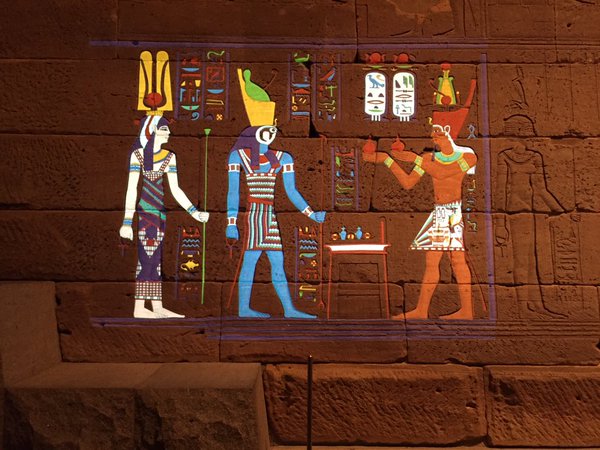
But Egyptologists know that this temple, like many others of the ancient world, was painted with vivid colors and patterns. In ‘Color the Temple,’ a marriage of research and projection-mapping technology, visitors to the Met can now glimpse what the Temple of Dendur may have looked like in its original, polychromatic form more than 2,000 years ago.”
While the ravages of time haven’t destroyed the various scenes carved into the temple’s walls, they’ve long made it next to impossible for scholars to get an idea of what colors their creators painted them. Originally located on the banks of the Nile, the temple endured century after century of flooding (by the 1920s, almost nine months out of the year) which thoroughly washed away the surface of the images. But after some serious historical research, including the consultation of a 1906 survey by Egyptologist Aylward M. Blackman and the Napoleonic Description de l’Egypte, the Met’s team has come up with a pretty plausible idea of what the scene on the temple’s south wall, in which Emperor Caesar Augustus in Pharaoh garb presents wine to the deities Hathor and Horus, looked like in full color.
But it would hardly do to buy a few buckets from Sherwin-Williams and simply fill the wall in. Instead, the Met has used a much more advanced technology called digital projection mapping (also known, more Wired-ly, as “spatial augmented reality”) to restore the Temple of Dendur’s colors with light. You can get a sense of the result in the twovideos at the top of the post, shot during the Color the Temple exhibition which ran through March 19.
For a closer look into the process, have a look at the video just above, created by Maria Paula Saba, who worked on the project. As you can see, the use of light rather than paint allows for the possibility of a variety of different color schemes, all of them quite possibly what the ancient Egyptians saw when they passed by, all of them fitting right in to the details and contours the ancient Egyptian artists put there — a thrill impossible to overstate for those of us who grew up with ancient-Egypt coloring books.
Every story has its architecture, its joints and crossbeams, ornaments and deep structure. The boundaries and scope of a story, its built environment, can determine the kind of story it is, tragedy, comedy, or otherwise. And every story also, it appears, generates a network—a web of weak and strong connections, hubs, and nodes.
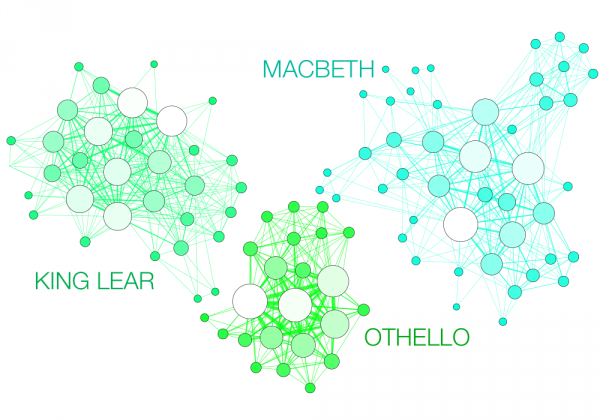
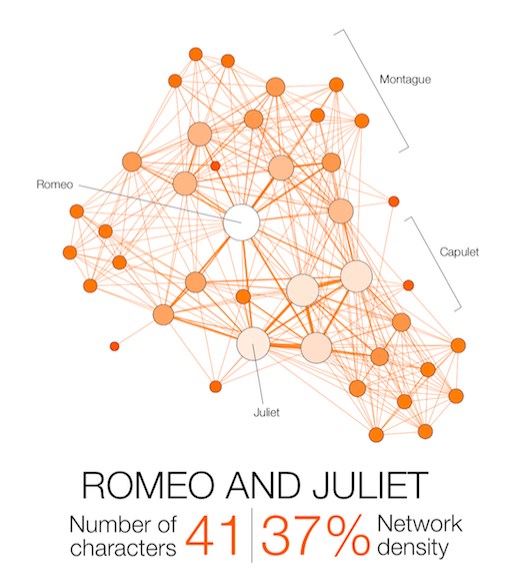
Take Shakespeare’s tragedies. We would expect their networks of characters to be dense, what with all those plays’ intrigues and feasts. And they are, according to digital humanities, data visualization, and network analysis scholar Martin Grandjean, who created the charts you see here: “network visualization[s] in which each character is represented by a node connected with the characters that appear in the same scenes.”
The result speaks for itself: the longest tragedy (Hamlet) is not the most structurally complex and is less dense than King Lear, Titus Andronicus or Othello. Some plays reveal clearly the groups that shape the drama: Montague and Capulets in Romeo and Juliet, Trojans and Greeks in Troilus and Cressida, the triumvirs parties and Egyptians in Antony and Cleopatra, the Volscians and the Romans in Coriolanus or the conspirators in Julius Caesar.
Grandjean’s visualizations show us how varied the density of these plays is. While Macbeth has 46 characters, it only achieves 25% network density. King Lear, with 33 characters, reaches 45%.
Hamlet’s density score nearly matches its number of characters, while Titus Andronicus’ density number exceeds its character number, as does that of Othello by over twice as much. Why is this? Grandjean doesn’t tell us. These data maps only provide an answer to the question of whether “Shakespeare’s tragedies” are “all structured in the same way.”
But does Grandjean’s “result speak for itself,” as he claims? Though he helps us visualize the way characters cluster around each other, most obviously in Romeo and Juliet, above, it’s not clear what a “density” score does for our understanding of the drama’s intent and purposes. With the exception of the most prominent few characters, the graphics only show various plays’ personae as nameless shaded circles, whereas Shakespeare’s skill was to turn most of those characters, even the most minor, into antitypes and anomalies. Perhaps as important as how they are connected is the question of who they are when they connect.
Recently, a Metafilter user asked the question: which books do you reread again and again, and why— whether for “comfort, difficulty, humour, identification, whatever”? It got me thinking about a few of the ways I’ve discovered such books.
Writing an essay or book about a novel is one good way to find out how well it holds up under multiple readings. You stare at plot holes, implausible character development, inconsistent chronologies, and other literary flaws (or maybe features) for weeks, months, sometimes even years. And you also live with the language that first seduced you, the characters who drew you in, the images, places, atmospheres you can’t forget….
But reading alone can mean that blind spots never get addressed. We hold to our biases, positive and negative, despite ourselves. Another great way to test the durability of work of fiction is to teach it for years, or otherwise read it in a group of engaged people, who will see what you don’t, can’t, or won’t, and help better your appreciation (or deepen your dislike).
Having spent many years doing both of these things as a student and teacher, there are a few books that survived semester after semester, and still sit prominently on my shelves, where at any time I can pull them down, open them up, and be immediately absorbed. Then there are books I read when younger, and which seemed so mysterious, so possessed of an almost religious significance, I returned to them again and again—looking for the most enchanted sentences.
If I had to narrow down to a short list the books I consistently reread, those books would come out of all three experiences above, and they would include, in no necessary order—
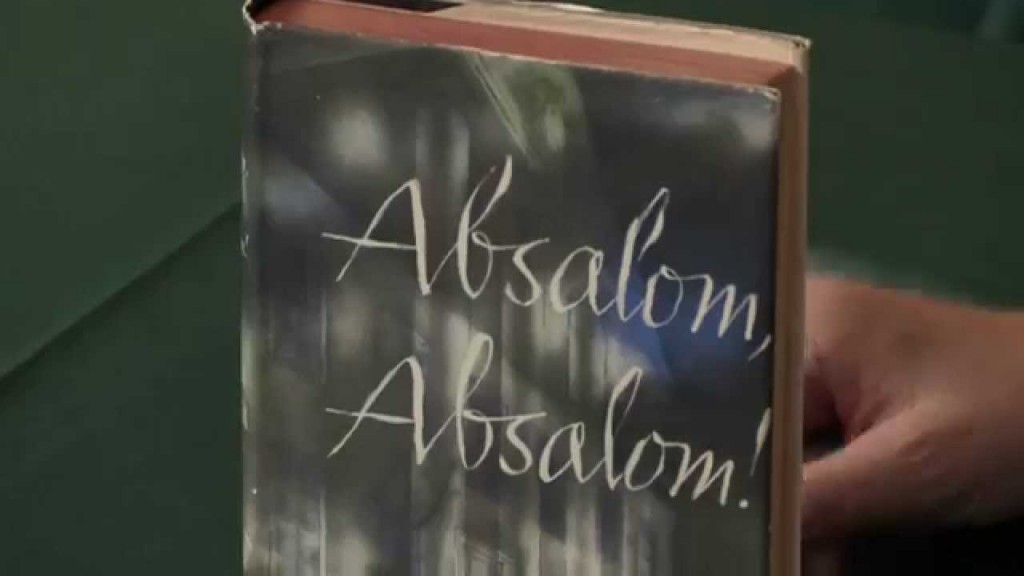
Absalom, Absalom!, by William Faulkner: I’ve written several essays on this novel, over the course of several years, and I love it as much or more as when I first picked it up. It’s a book that becomes both more grim and more darkly humorous as time goes on; its vertiginous narrative strategy creates an inexhaustible number of ways to see the story.
Wuthering Heights, by Emily Bronte: I read this novel as a child and understood almost nothing about it but the ghostly setting of “wiley, windy moors” (as Kate Bush described it) and the furious emotional intensity of Heathcliff and Catherine. These elements kept me coming back to discover just how much Bronte—like Faulkner—encircles her reader in a cyclone of possibility; multiple stories, told from multiple characters, times, and places, swirl around, never settling on what we most want in real life but never get there either—simple answers.
Song of Solomon, by Toni Morrison: Morrison’s novel extracts from the 20th century African American experience a tale of profound individual struggle, as characters in her fictional family fight to define themselves against social inequities and to transcend oppressive identities. Their failures to do so are just as poignant as their successes, and characters like Pilate and Milkman achieve an almost archetypal significance through the course of the novel. Morrison creates modern myth.
The Yiddish Policeman’s Union, by Michael Chabon. I taught this novel for years because it seemed like, and was, a great way to introduce students to the complications of plot, the joys of speculative fiction, and the empathetic imagining of other people and cultures that the novel can enable. I can think of many ways some critics might find Chabon’s book politically “problematic,” but my consistent enjoyment of its wild-eyed story has never diminished since I first picked up the book and read it straight through in a couple of days, fully convinced by its fictional world.
Labyrinths, by Jorge Luis Borges. The Argentinian writer’s best-known collection of stories and essays requires patient rereading. My first encounter with the book early in college provoked amazement, but little comprehension. I still can’t say that I understand Borges, but every time I reread him, I seem to discover some new alcove, and sometimes a whole other room, filled with inscrutable, mysterious treasures.
This list is not in any way comprehensive, but it covers a few of the books that have stayed with me, each of them for well over a decade, and a few of the reasons why. What books do you reread, and why? What is it about them that keeps you returning, and how did you discover these books? While I stuck with fiction above, I could also make a list of philosophical books, as well as poetry. Feel free to include such books in the comments section below as well.
Last month, Canada lost one of its important filmmakers, Colin Low. Over a career spanning six decades, Low worked on over 200 productions at the National Film Board of Canada. He won countless awards, including two Short Film Palme d’Or awards at the Cannes Film Festival. His work inspired other soon-to-be-influential filmmakers, like Ken Burns and Stanley Kubrick. And he helped pioneer the giant-screen IMAX format.
Above you can watch City Out of Time, Low’s short tribute to Venice. The 1959 film, writes the National Film Board of Canada, “depicts Venice in all its splendor. In the tradition of Venetian painter Canaletto, the film captures the great Italian city’s elusive beauty and fabled landscapes, where spired churches and turreted palaces soar into a blue Mediterranean sky.” The film also features a narration by a young William Shatner, then only 28 years old, whose voice sounds nothing like the one we’d hear several years later in Star Trek, never mind those unforgettable spoken-word albums he started releasing in the late 1960s.
The second film on the page is Low’s 1952 animation, The Romance of Transportation in Canada, which won a Short Film Palme d’Or at the Cannes Film Festival.
In the time it’s taken me to grow out of my wayward 90s youth and into mostly solid citizen adulthood, cultural memories of that decade have crystalized around a few genres that have seen some renewal of late. I’m more than pleased to find current musicians reviving shoegaze, 90s electronica, and neo-soul. And with so many artists who peaked twenty or so years ago still releasing records or getting back together for impressive reunions, it often seems like the music I grew up with never left, even if a whole raft of stars I couldn’t pick out of a lineup have emerged in the meantime.
And yet, though the veneration of 90s music has become a thing in recent years, the perspective of it by people perhaps not even born when the decade ended tends to be somewhat limited. Perhaps all of us forget how strange and eclectic 90s music was. Even at the time, pop and alternative cultures were almost instantly reduced in films, compilation albums, and more-or-less every show on MTV. It was an era when subcultures were quickly commodified, sanitized, and sold back to us in theaters and on record shelves.
To remind ourselves of just how wide-ranging the 90s were, we might turn to the expansive “giant 90s alt/indie/etc” playlist here, compiled by Aroon Korvna (born in 1982, but precociously “musically conscious” during the decade). The journey begins with the nasal chamber pop of They Might Be Giants’ “Birdhouse in Your Soul”—a classic of DIY dork-rock—and ends with Jay Z’s “Big Pimpin,” a song heralding the triumph of radio-ready rap and club hits over the decades’ many quirky rock and hip-hop guises.
Hear the playlist in three parts: Part I (1990–94) and II (1995–96) above; Part III (1997–99) below. (If you need Spotify’s software, download it here.) Along the way, we run into forgotten songs by under-the-radar bands like The Dwarves, Red House Painters, Guided By Voices, The Beta Band, and The Microphones; leftfield choices from one-hit wonders like Ned’s Atomic Dustbin and Information Society; the first stirrings from now-superstars like Daft Punk and Jack White; and cuts from just about every other artist on college or alternative radio throughout the decade.
“The inspiration for this playlist,” writes Korvna, “came from seeing one too many of those nostalgia-bait pieces aimed at my cohort: ‘You totally forgot about these 20 amazing hits from the 90’s.… After the 6th or 7th of these articles all listing off the same obvious things, you start to think you really have heard everything from the 90s. But we all know that’s not true.”
By doing a bit of internet research to fill gaps in memory, Korvna compiled “a mix of things everyone is familiar with, and more obscure artifacts, the sorts of songs you might have only been familiar with if you were, say, listening to college rock in 1991.”
If the 90s is to you an unknown country, you’ll find that this three-part Spotify playlist offers a comprehensive walk-through of the decades’ diverse musical culture—and it doesn’t just play the hits. If you’re a gentleman or lady of a certain age, it will refresh a few memories, make you smile and wince with nostalgia, and perhaps fill you with indignation over all the songs you think need to be on there but aren’t.
Feel free to leave your suggestions in the comments—or to make your own 90s playlist. And while you’re at it, you might want to take a look at Flavorwire’s surprising list of “105 ‘90s Alternative Bands that Still Exist.”
You’ll find many a bold claim on Wikipedia, even on the page for Bert Haanstra’s Glass, a 1958 short documentary on glassmaking in the Netherlands, which, as of this writing, mentions that the film “is often acclaimed to be the perfect short documentary.” Just the sort of thing you’d want to take with a grain of salt, right? But if you watch Glass itself, which won the 1959 Academy Award for Documentary Short Subject, you might find yourself joining in on that supposed chorus of acclaim.
Prashant Parvatneni at The Essential Mystery calls Glass “at once a passionate celebration of human labour and craftsmanship and a biting critique of the mechanistic mass-production of objects. On the very surface this documentary can appear as a demonstrative film keenly elucidating the very basic processes that go into the making of handmade glassware and juxtaposing it with the process of bottle-making in a mechanised factory.
Yet this very juxtaposition coupled with a Haanstra’s strong stylistic intervention takes the film into a polemical space.” Taking a slightly different tone, Colossal’s Christopher Jobson highlights the jazz of the traditional half, and the “whimsical score of more synthesized music” in the modern half. “Also,” he adds, “there’s a ton of great smoking!”
Jobson doesn’t mention that these guys also somehow manage to keep smoking even while blowing glass — an impressive feat indeed, and just one of the impressive qualities on display in Glass’ brief runtime. Eventually, the footage turns back from the factory to the workshop, and soon it begins oscillating between the two, cutting to the jazzy rhythm and even making the machines and workmen into musical instruments of a kind. The Dutch glassmaking industry has surely changed in the past half-century, but students of Dutch film can’t ignore the work of Haanstra, who in addition to this and other documentaries short and long, directed features including Fanfare, still one of the most popular films in the Netherlands ever. But as any film historian might suspect — and here comes another bold claim — Glass will outlive them all.
If you asked me to name the best representative of rock and roll as a boy’s club, KISS would be high on my list. Despite their commitment to a gender-bending glam style, Frontmen Gene Simmons and Paul Stanley’s chest hair rugs, wagging tongues, and studded codpieces are exaggerated examples of seventies virility—a rock era known for progressive music, but not progressive gender politics.
If you asked me to name a musician who had challenged and defied gender stereotypes in rock and roll, Carol Kaye— bassist and member of L.A.’s top flight session musicians the Wrecking Crew—would be high on my list. Kaye and her crew helped create the sound of Phil Spector records, the Beach Boys, the Mamas and the Papas, and so many other classic sixties artists.
Kaye never particularly saw herself as a pioneer or pathbreaker, but her smooth, unpretentious professionalism carried her through a career most musicians, male and female, would envy, even if she never stood in the spotlight herself. Her attitude, approach, and playing are pretty much the opposite of the bombastic, mercenary Simmons, who has on more than one occasion weathered charges of sexism in his pursuit of bigger, louder, dumber music and more tawdry reality TV.
In the short clip above, the two legends meet, and Kaye sits Simmons down and shows him how it’s done.
She has taught hundreds of students to imitate, though never duplicate, her chops, and earned the clout to take Simmons to school (though she seems surprised to be doing so); Kaye largely helped invent the sound of rock bass and elevated the instrument from a supporting player to an indispensable lead one as well.
We're hoping to rely on loyal readers, rather than erratic ads. Please click the Donate button and support Open Culture. You can use Paypal, Venmo, Patreon, even Crypto! We thank you!
Open Culture scours the web for the best educational media. We find the free courses and audio books you need, the language lessons & educational videos you want, and plenty of enlightenment in between.
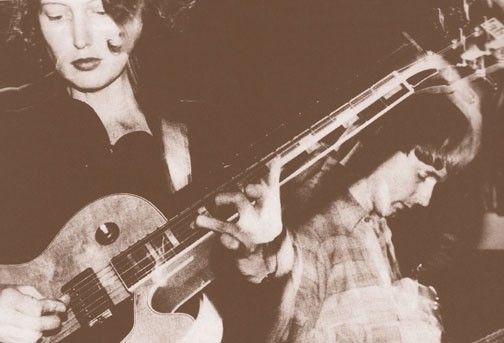 In the time it’s taken me to grow out of my wayward 90s youth and into mostly solid citizen adulthood, cultural memories of that decade have crystalized around a few genres that have seen some renewal of late. I’m more than pleased to find current musicians reviving shoegaze, 90s electronica, and neo-soul. And with so many artists who peaked twenty or so years ago still releasing records or getting back together for impressive reunions, it often seems like the music I grew up with never left, even if a whole raft of stars I couldn’t pick out of a lineup have emerged in the meantime.


