Earlier this week, we let you know about the animation software used by Hayao Miyazaki’s Studio Ghibli coming out in an open source version free to download. While this makes available to you a piece of the technology used in the service of such masterpieces as Princess Mononoke, Spirited Away, and The Tale of Princess Kaguya, it won’t, alas, get you any closer to possessing the artistic skills of the Ghibli team. To attain those, you’ve just got to engage in the same long, cyclical process of observation, replication, and refinement that you would when mastering anything.
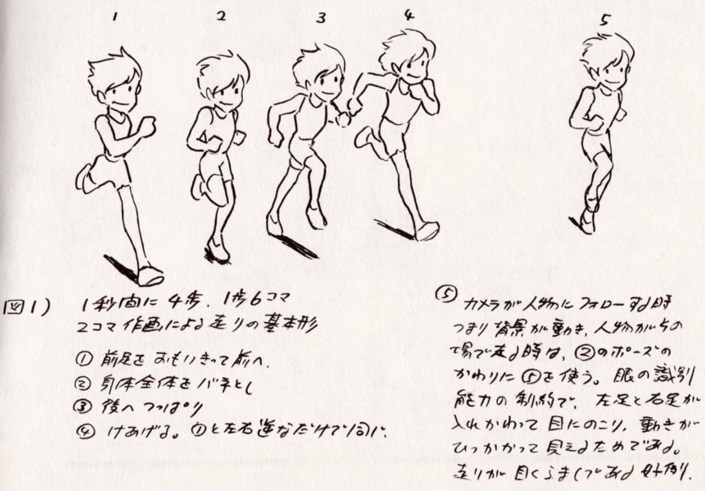
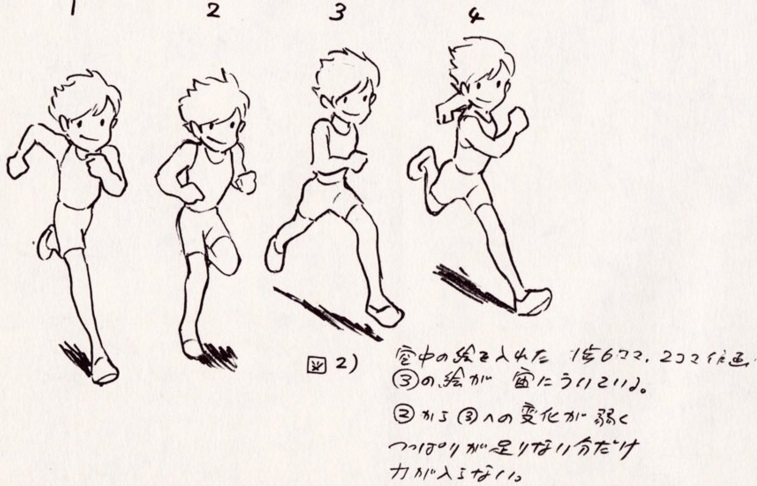
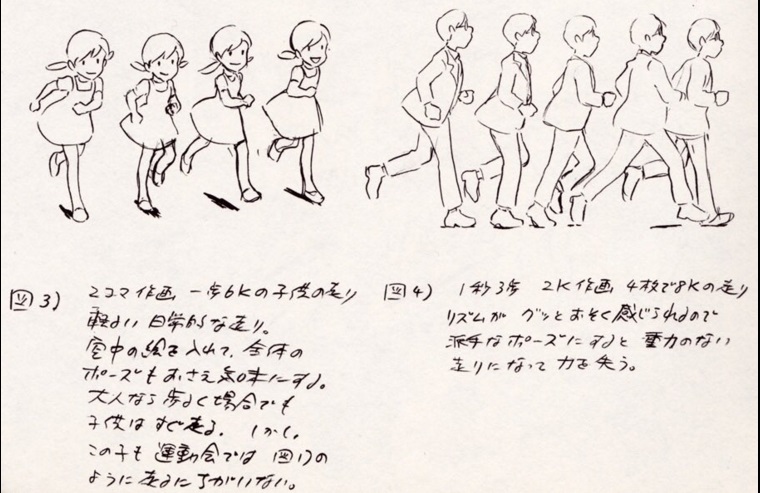
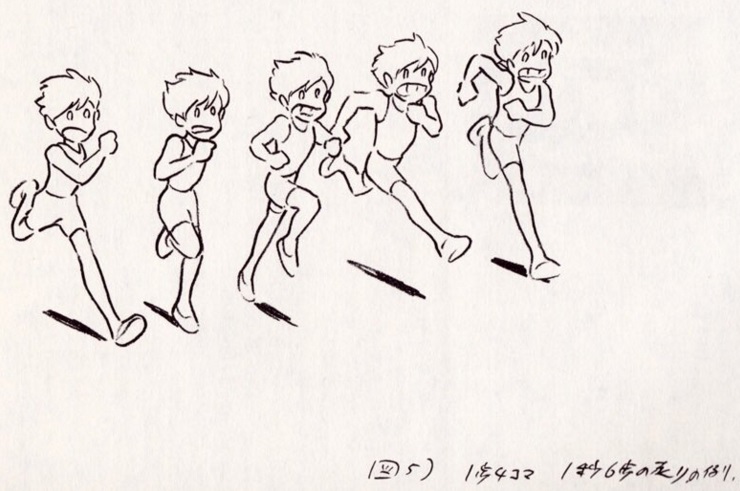
Luckily, Miyazaki has provided plenty of examples to work with, and even, now and again in his long career, broken down his techniques for all to understand. Here we have four of his sketches, originally published in a 1980 issue of Animation Magazine (月刊アニメーション), which provide visual explanations of how to animate a character running — not an uncommon task, one imagines, for the Ghibli animators in charge of what the Creators Project calls “the constant running Miyazaki’s films are known for.” If you’ve ever tried to animate running yourself, you’ll know that what might at first seem like a simple, everyday physical action requires a great deal of subtlety to get right.
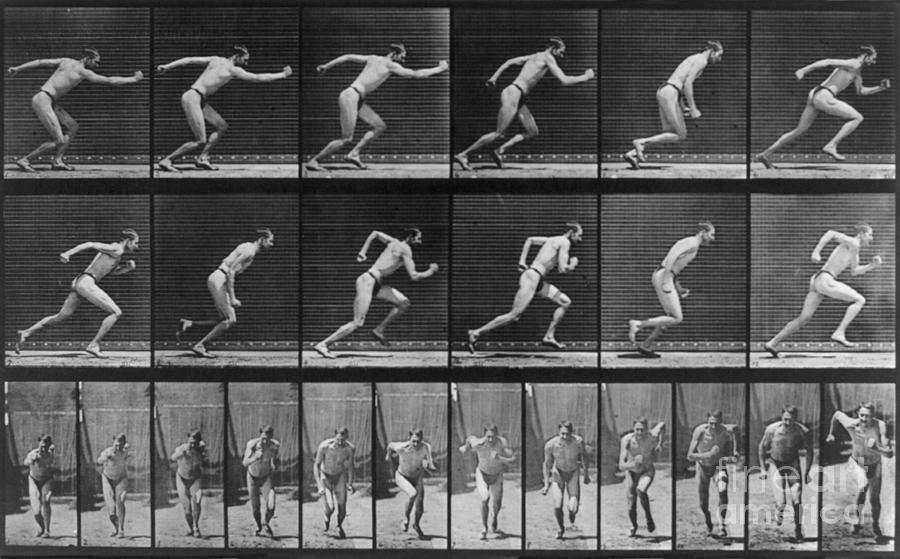
The early motion photographer Eadweard Muybridge gave the world a sense of this when he captured the mechanics of both men and horses running back in the 1880s, but to take those real-world observations and render them convincingly in animation — much less with the characteristic Ghibli smoothness — takes things to another level altogether. “Only Miyazaki man,” said animator LeSean Thomas when he tweeted these images. “Such effortless lines and silhouettes. Years of hard work & learning on display in these sketches!”
To those who wish to follow Miyazaki’s method of animating running in order to go on to making the kind of lavish cinematic stories he and his collaborators have, best of luck; to those who’d rather not put in the decades, well, you can still learn his method of making instant ramen.
Every decade, when the British Film Institute (BFI) announces the outcome of its Sight & Sound Poll of the Greatest Films of All Time, cinephiles listen; no less a serious movie person than Roger Ebert called it, among the countless polls of great movies, “the only one most serious movie people take seriously.” When the BFI conducts the poll, it divides those polled into two groups: one for critics like Ebert, and one for directors like, say, Quentin Tarantino, whose thorough knowledge of cinema and absolute seriousness as a movie person almost makes him a critic as well, albeit one who does his criticism in the form of movies.
In the 2002 poll, Tarantino named these as the greatest films of all time:
You can watch two of Tarantino’s 2002 picks, the formally experimental caper comedy Hi Diddle Diddle as well as His Girl Friday, the capstone of the screwball comedy subgenre, for free online. Once you’ve enjoyed the both of them, why not have a look at Tarantino’s selections a decade on, for the 2012 Sight & Sound directors poll, to compare and contrast, with the new titles bolded:
Tarantino’s 2012 selections reveal a clear increase in appreciation, or at least willingness to vote his appreciation, for high-profile pictures of the 1970s — Apocalypse Now, Jaws, Taxi Driver, The Bad News Bears — a decade whose cinema to which the director has made no lack of homage. We’ll have to wait six more years, until the 2022 poll, to get a full sense of how Tarantino’s idea of the canon has changed. Will the grim, satirical, and lurid films of the 70s consume most of his list by then? Will he favor a different era of film history entirely? I’d only put money on one thing for sure about the preference of this filmmaker who loves dialogue even more than violence: His Girl Friday isn’t going anywhere.
The auto industry continues to take steps forward, sometimes big, sometimes small. They’re tinkering with electric and driverless cars, and they’re finding ways to improve the safety of everyday vehicles already on the road. How much incremental progress have we made? Just watch the video produced by the Insurance Institute for Highway Safety. A 2009 Chevy Malibu crashes into a colossal 1959 Chevy Bel Air at 40 miles per hour. And despite its “Safety-Girder” cruciform frame (a safety innovation Chevy developed during the 1950s) the bigger Bel Air didn’t fare well at all. The same applies to the dummy inside.
Here’s how the Institute described what happened to the Bel Air to The New York Times:
This car had no seat belts or air bags. Dummy movement wasn’t well controlled, and there was far too much upward and rearward movement of the steering wheel. The dummy’s head struck the steering wheel rim and hub and then the roof and unpadded metal instrument panel to the left of the steering wheel.
During rebound, the dummy’s head remained in contact with the roof and slid rearward and somewhat inward. The windshield was completely dislodged from the car and the driver door opened during the crash, both presenting a risk of ejection. In addition, the front bench seat was torn away from the floor on the driver side.
The Bel Air got a “Poor” rating in every safety category; the Malibu a “Good.”
Although a lot of America seems stuck in reverse, car design is one area where we’re moving forward, hopefully with even better days to come.
I am privileged to have grown up in a house filled with books. I don’t remember learning to read; I simply recall books—those that felt beneath me, those that seemed forever beyond comprehension. No one taught me how to read—by which I mean no one told me what to attend to in books, what to ignore; what to love, what to scorn. The shelves in my home, school, and local library were a wilderness, and I was left to carve my own paths through their thickets.
That all changed when I got to college, then graduate school, where I found various critical movements, literary theories, and philosophical schools, and was compelled to choose between their methods, politics, and prohibitions. Reading became a strenuous activity, a heavy intellectual exercise in which I felt those critics and theorists always looking over my shoulder. Those who have done intensive study in the humanities may sympathize: Afterward, I had to relearn how to read without an agenda.
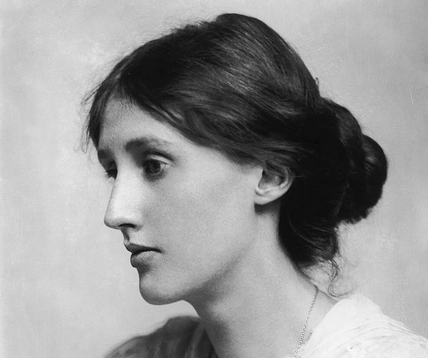
Such is the kind of unfettered reading Virginia Woolf recommends in an essay titled “How Should One Read a Book?”, published in a series called The Common Reader—a title, in fact, of two collections, the first published in 1925, the second in 1932. Woolf wrote these essays for lay readers, not scholars, and many were previously published in venues like The Nation, Vogue, and The Yale Review. In them, Woolf’s informal investigations of writers like Jonathan Swift, Daniel Defoe, Christina Rossetti, and Thomas Hardy—writes a 1925 New York Times review—do not “put the author in the attitude of a defender or an expositor of certain trends in literature.”
“How Should One Read a Book?” appears at the end of the second series of The Common Reader. The essay “cautions,” writes Maria Popova, “against bringing baggage and pre-conceived notions to your reading” and abjures a formal, critical approach:
After all, what laws can be laid down about books? The battle of Waterloo was certainly fought on a certain day; but is Hamlet a better play than Lear? Nobody can say. Each must decide that question for himself. To admit authorities, however heavily furred and gowned, into our libraries and let them tell us how to read, what to read, what value to place upon what we read, is to destroy the spirit of freedom which is the breath of those sanctuaries. Everywhere else we may be bound by laws and conventions — there we have none.
Though herself a more than able scholar and critic, Woolf does not recommend that her readers become so. “The only advice,” she writes, “that one person can give another about reading is to take no advice, to follow your instincts, to use your own reason, to come to your own conclusions.” That said, however, she feels “at liberty to put forward a few ideas and suggestions” that we are free to take or leave. She offers her guidelines to aid enjoyment, not stifle it, and to help us sort and sift the “multitudinous chaos” we encounter when confronted with genres, periods, and styles of every type.
“Where,” Woolf asks, “are we to begin?” Below, in brief, find a few of her “ideas and suggestions,” offered with all of the careful caveats above:
“Since books have classes—fiction, biography, poetry—we should separate them and take from each what it is right that each should give us.”
Most commonly we come to books with blurred and divided minds, asking of fiction that it shall be true, of poetry that it shall be false, of biography that it shall be flattering, of history that it shall enforce our own prejudices. If we could banish all such preconceptions when we read, that would be an admirable beginning. Do not dictate to your author; try to become him. Be his fellow-worker and accomplice. If you hang back, and reserve and criticise at first, you are preventing yourself from getting the fullest possible value from what you read.
“Perhaps the quickest way to understand the elements of what a novelist is doing is not to read, but to write; to make your own experiment with the dangers and difficulties of words.”
Recall, then, some event that has left a distinct impression on you — how at the corner of the street, perhaps, you passed two people talking. A tree shook; an electric light danced; the tone of the talk was comic, but also tragic; a whole vision, an entire conception, seemed contained in that moment…. When you attempt to reconstruct it in words, you will find that it breaks into a thousand conflicting impressions…. Then turn from your blurred and littered pages to the opening pages of some great novelist — Defoe, Jane Austen, Hardy. Now you will be better able to appreciate their mastery.
“We can read [biographies and memoirs] with another aim, not to throw light on literature, not to become familiar with famous people, but to refresh and exercise our own creative powers.”
The greater part of any library is nothing but the record of… fleeting moments in the lives of men, women, and donkeys. Every literature, as it grows old, has its rubbish-heap, its record of vanished moments and forgotten lives told in faltering and feeble accents that have perished. But if you give yourself up to the delight of rubbish-reading you will be surprised, indeed you will be overcome, by the relics of human life that have been cast out to moulder. It may be one letter — but what a vision it gives! It may be a few sentences — but what vistas they suggest!
Read the entirety of Woolf’s essay here to learn her nuanced view of reading. She concludes her essay with another gentle swipe at literary criticism and recommends humility in the company of literature:
If to read a book as it should be read calls for the rarest qualities of imagination, insight, and judgment, you may perhaps conclude that literature is a very complex art and that it is unlikely that we shall be able, even after a lifetime of reading, to make any valuable contribution to its criticism. We must remain readers.
Clearly Woolf did not think of reading as a passive activity, but rather one in which we engage our own imaginations and literary abilities, such as they are. But if we are not to criticize, not draw firm conclusions, morals, life lessons, or philosophies from the books we read, of what use is reading to us?
Woolf answers the question with some questions of her own: “Are there not some pursuits that we practice because they are good in themselves, and some pleasures that are final? And is not this among them?”
Earlier this month, the world got news of the death of a man whose name many of us had never heard but whose act of innovation shaped what we do every day. “When historians of the future study the ways information technology affected people’s lives in the late 20th century,” said his Economist obituary, “they will surely recognise e‑mail as one of the most profound. Today, about 2.5m e‑mails are sent every second. The first e‑mail of all, though” — to be precise, “the first message between terminals attached to separate CPUs, albeit that these two computers stood side-by-side in the same room” — “was sent 45 years ago by Ray Tomlinson.”
Fifteen years after that quietly history-making transmission, e‑mail had evolved to the point that it had become a subject in the news. This 1984 segment of the Thames Television computer show Database shows how one early-adopting couple, Pat and Julian Green of north London, communicate with the world by connecting their computer to, of all things, the telephone line. “It’s simple, really,” says Julian, unplugging a British Telecom cable from one socket and plugging it into a modem, plugging a different wire from the modem into the first socket, switching on the modem, and then hand-dialing the number of a “main computer” — with his rotary phone. “Extremely simple,” he reiterates.
What can they do on Micronet, their service provider, once connected? They might read the news, have a look at “reviews of the software that’s currently available” and even download some of it, or use the feature that Pat (in addition to her use of the computer for “keeping household records, such as what I have in the freezer, and people’s telephone numbers and addresses,” as well as “a word processor for my letters, which always come out perfect now”) describes as most exciting of all: “the mailbox where I write to other people.” We see how she can use this new electronic mail to ask her doctor to refill a prescription, and even to send a message to the Database studio.
All this must have intrigued the viewers of the day, who, if they had their own computers at the ready, could even “download” software straight from the broadcast by recording the tone that plays over the show’s end credits. (As long as their computers were BBC Micros, that is, at least in this particular episode.) The past 32 years have seen enthusiasm for new technology spread all across the world, turning us all, in some sense, into Pat and Julian Greens. Today we marvel at all what we can do with our smartphones, devices that would’ve seemed magical in 1984, but in three decades from now, even our current technological lives will surely look quainter than anything in the Database archives.
“Now is the winter of our discontent….” If you know nothing else of Shakespeare’s Richard III, you’ll know this famous opening line, and it’s likely many of us know it through Laurence Olivier’s performance of Richard as a “melodramatic baddie” in the famous 1955 film. If not, take a look at the clip below to familiarize yourself with Olivier’s distinctive mannerisms and speech. The reference may largely be lost these days, but in 1965, at the very height of The Beatles’ fame, Olivier’s performance was still fresh in the minds of the TV viewing public. And the mercurial English comedian Peter Sellers put it to good use in a Beatles-tribute variety program called The Music of Lennon and McCartney that aired in the UK. In the clip above, Sellers recites the lyrics to “A Hard Day’s Night” in character as Olivier’s dandyish Richard.
Unsurprisingly, Sellers and the Beatles had hit it off right away when they were introduced by George Martin, and as we showed you in a recent post, the comedian milked their lyrics for more material, reading “She Loves You,” in a variety of accents. Sellers’ rendition of “A Hard Day’s Night” was hardly the first Shakespearean turn for the band.
The previous year, they appeared in another variety television special called Around the Beatles, “produced concurrently,” writes Dangerous Minds, “while A Hard Day’s Night was being shot.” (Around the Beatles was directed by producer and manager Jack Good, a “Shakespeare fan,” who also, it turns out, convinced rockabilly star Gene Vincent to dress up like Richard III.) In this earlier program, the band—always good sports about this kind of thing—dressed up in Shakespearean garb and staged a raucous performance of a scene from A Midsummer Night’s Dream.
If I had my way, more academics would care about teaching beyond the walls of the academy. They’d teach to a broader public and consider ways to make their material more engaging, if not inspiring, to new audiences. You can find examples out there of teachers who are doing it right. The heirs of Carl Sagan–Brian Greene, Neil deGrasse Tyson, and Bill Nye–know how to light a spark and make their material come alive on TV and YouTube. How they do this is not exactly a mystery, not after M.I.T. posted online a course called “Becoming the Next Bill Nye: Writing and Hosting the Educational Show.”
Taught at M.I.T. over a month-long period, Becoming the Next Bill Nye was designed to teach students video production techniques that would help them “to engagingly convey [their] passions for science, technology, engineering, and/or math.” By the end of the course, they’d know how to script and host a 5‑minute YouTube show.
After the cult success of HBO’s gritty Baltimore crime drama, The Wire, the obsessiveness of the show’s fanbase became a running joke. Devoted Wire-lovers browbeat friends, family, and coworkers with the show’s many virtues. Wire fans became emotionally attached not only to the show’s characters, but also to the actors who played them. Though I managed to shun Wire evangelists for a time, I too finally became a convert after its six-year run ended in 2008. Like many a fan I was thrilled to see actors Michael K. Williams and Michael B. Jordan land juicy post-Wire roles (and saddened to see some of the show’s other fine actors seem to disappear from view).
And, like many a fan, I also wanted to know these actors’ backstories. What had they been up to before The Wire? We get one answer to that question above, in the adaptation of Zora Neale Hurston’s 1933 short story “The Gilded Six-Bits.” In the starring role, you’ll recognize The Wire’s (eventually) reformed ex-con Dennis “Cutty” Wise, or Chad Coleman, in his first starring role. Playing opposite him you’ll be happy to see your favorite wiseass, philandering, cigar-chomping detective, Bunk Moreland, or Wendell Pierce, who has landed many juicy roles of his own, both pre- and post-Wire. (Here, playing a wiseass, cigar-chomping womanizer.) Adapted and directed by author and filmmaker Booker T. Mattison, the short film debuted on Showtime in 2001.
The story is an early example of Hurston’s genius, written four years before the publication of her breakout novel Their Eyes Were Watching God and two years before her groundbreaking study of African-American folklore, Mules and Men. Published in the influential literary magazine Story—which also served as an important venue for writers like J.D. Salinger and Richard Wright—“The Gilded Six-Bits” so impressed the magazine’s editor that he asked Hurston if she had a novel in progress. She didn’t, but told him she did, and immediately began work on Jonah’s Gourd Vine, published the following year. A story of infidelity and reconciliation, “The Gilded Six-Bits” features characters and a setting familiar to Hurston readers—ordinary African-Americans caught up in the travails of rural life in the Jim Crow South. But as in all of her work, the seeming simplicity of her characters and language slowly reveal complicated truths about the nature of language, marriage, sexuality, and money. And few could bring her characters to life better than your favorite Wire actors.
We're hoping to rely on loyal readers, rather than erratic ads. Please click the Donate button and support Open Culture. You can use Paypal, Venmo, Patreon, even Crypto! We thank you!
Open Culture scours the web for the best educational media. We find the free courses and audio books you need, the language lessons & educational videos you want, and plenty of enlightenment in between.