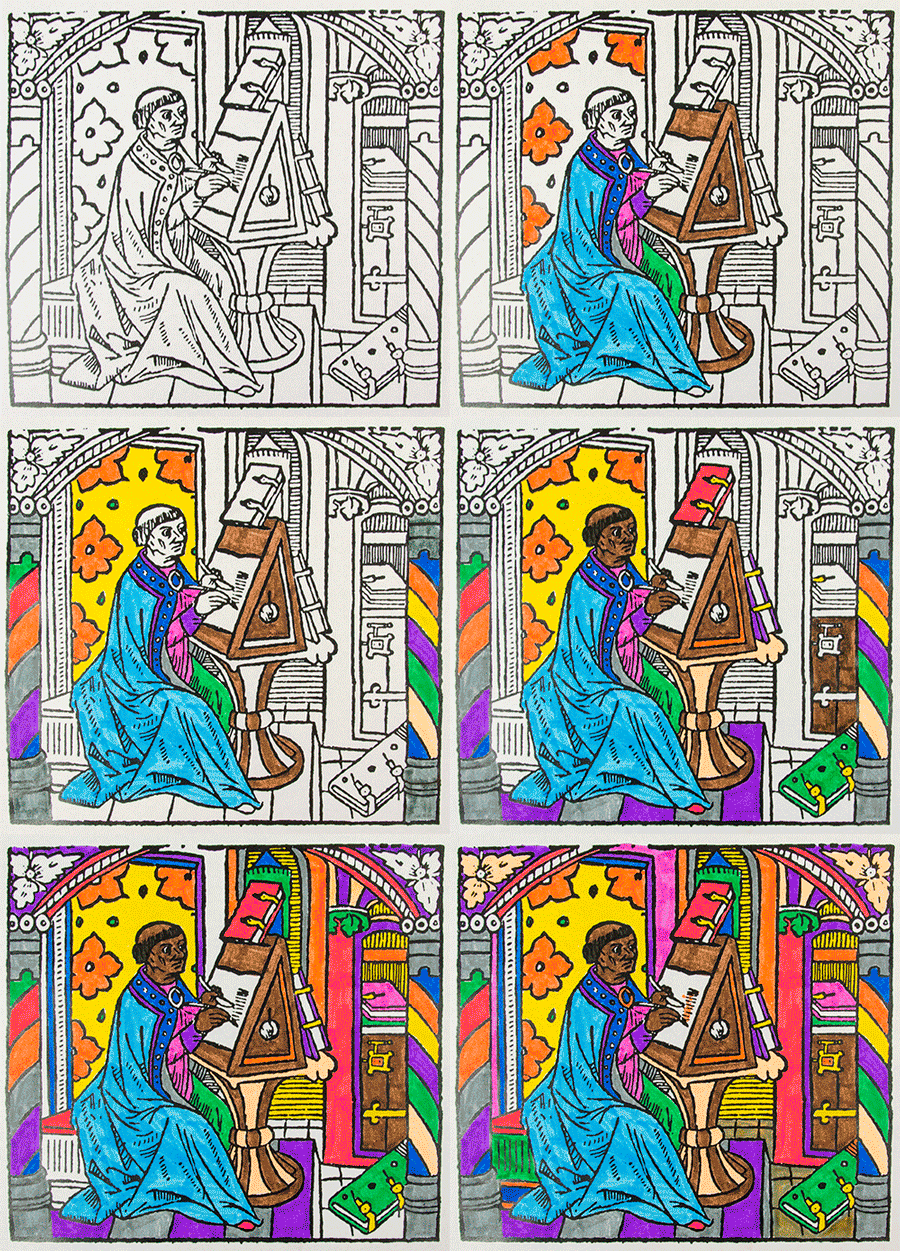
You can now take part in the 2018 edition of #ColorOurCollections–a campaign where museums, libraries and other cultural institutions make available free coloring books, letting you color artwork from their collections and then share it on Twitter and other social media platforms. When sharing, use the hashtag #ColorOurCollections.
If you would like to support the mission of Open Culture, consider making a donation to our site. It’s hard to rely 100% on ads, and your contributions will help us continue providing the best free cultural and educational materials to learners everywhere. You can contribute through PayPal, Patreon, and Venmo (@openculture). Thanks!
The non-existence, or non-importance, of the self has for millennia been an uncontroversial proposition in Eastern thought. But Western thinkers have tended to embrace the concept of the isolated self as, if not sufficient, at least necessary for a coherent account of human life. Yet there are many ways to describe what it means to have a self—an ego, an individual identity. Is the self a product of culture, history, and economy? Is it a collection of subjective experiences to which no one else has access? Is it constituted only in relation to other selves, or in relation to an ultimate, unchanging, all-powerful Self?
For the Existentialists, the self can be a prison, a trap, and a source of great anxiety. Heidegger called selfhood a condition of being “thrown into the world.” By the time we realize where and what we are, according to restrictive categories of historical thought and language, we are already there, inescapably bound to our conditions, forced to perform roles for which we never auditioned. Jean-Paul Sartre took this notion of “thrownness” and gave it his own neurotic stamp. We are indeed tossed into existences against our will, but the real condemnation, he thought, is that once we arrive, we have to make choices. We are doomed to the task of creating ourselves, no matter how limited the options, and there is no possibility of opting out. Even not making choices is a choice.
This extreme kind of free will, as Stephen Fry explains in the short, animated video above, stems from the problem of human nature—there isn’t any. “According to Sartre, there is no design for a human being,” says Fry, or in Sartre’s famous phrase, “existence precedes essence.” There is only the absurdity of arriving in a world with no plan, no God, no universal codes or fixed standards of value: just a dizzying array of decisions to make. And yet, rather than making life trivial, the absurd condition described by Sartre lends substantial weight to all of our choices, for in making them, he claimed, we are not only creating ourselves, but deciding what a human being should be.
Illusions of certainty and necessity obscure the contingent nature of existential choice, both the true inheritance and the unremitting burden of every individual. What we become in life is up to us, Sartre thought, a proposition that causes us a good deal of anguish, since we cannot know the outcome of our choices nor understand the world in which we make them beyond our limited capacity. And yet, we must act, Sartre thought, “as if everyone is watching me.” This is not a pleasing thought, even if, for many, the idea might actually lead to more careful, sober, and deliberative decision-making—that is, when it doesn’t lead to paralyzing dread.
“Video,” as we now say on the internet, “or it didn’t happen,” articulating a principle to which the ever-forward-thinking National Aeronautics and Space Administration (NASA) has adhered for about 70 years now, starting with film in the time before the invention of video itself. Even setting aside the wonders of voyaging into outer space, NASA has done a few things right here on Earth that you wouldn’t believe unless you saw them with your own eyes. And now you easily can, thanks to the agency’s commitment to making the fruits of its research available to all on its YouTube Channel. Take for example this recently-uploaded collection of 400 historic flight videos.
Here we have just a sampling of the hundreds of videos available to all: the M2-F1, a prototype wingless aircraft, towed across a lakebed by a modified 1963 Pontiac Catalina convertible; a mid-1960s test of the Lunar Lander Research Vehicle, also known as the “flying bedstead,” that will surely remind long-memoried gamers of their many quarters lost to Atari’s Lunar Lander; a spin taken in the Mojave Desert, forty years later, by the Mars Exploration Rover; and, most explosively of all, a “controlled impact demonstration” of a Boeing 720 airliner full of crash-test dummies meant to test out a new type of “anti-misting kerosene” as well as a variety of other innovations designed to increase crash survivability.
These historic test videos were all shot back when the Armstrong Flight Research Center (re-named in 2014 for Neil Armstrong, whose legacy stands as a testament to the cumulative effectiveness of all these NASA tests) was known as the Hugh L. Dryden Flight Research Center: you can watch the 418 clips just from that era on this playlist.
Rest assured that the experimentation continues and that NASA still pushes the boundaries of aviation right here on Earth, a project continuously documented in the channel’s newest videos. As astonishing as we may find mankind’s forays up into the sky and beyond so far, the aviation engineer’s imagination, it seems, has only just gotten started.
Based in Seoul, Colin Marshall writes and broadcasts on cities and culture. His projects include the book The Stateless City: a Walk through 21st-Century Los Angeles and the video series The City in Cinema. Follow him on Twitter at @colinmarshall or on Facebook.
For some time now, certain fans of Queen have sought the elusive answer to the question “what made Freddie Mercury such an incredible singer?” That he was an incredible singer—one of the greatest in terms of vocal range, emotive power, stage presence, songwriting, etc.—is hardly a fact in dispute. Or it shouldn’t be. You don’t need to love Queen’s music to acknowledge its brilliance, and marvel at its frontman’s seemingly superhuman power and stamina. The explanations for it are multiple and have become far more sophisticated in recent years.
Scientific research has examined the possible physiological structure of Mercury’s vocal chords, and concluded that he was able to vibrate several vocal folds at once, creating subharmonics and a vibrato faster than that of any other singer. It’s a compelling theory, albeit a little gross. Who wants to listen to “Somebody to Love”’s glorious, swooping soulful verses and Broadway showstopper choruses and picture vibrating vocal folds? Mercury was a showman, not a singing machine—and his unique inflections derived not only from biology but also—argues Rudi Dolezal, director of Freddie Mercury: The Untold Story—from culture.
Mercury’s formative experiences as a child in Zanzibar and India, and the “culture shock” of his move to London as a teenager, may have contributed to his expansive vocal prowess: “it was multiculturalism that was combined in Freddie Mercury,” says Dolezal, suggesting that Mercury’s voice went places no one else’s did in part because he combined the strengths of Eastern and Western music. Maybe. Mercury grew up emulating English and American artists like Cliff Richard and Little Richard, but one of his biggest influences was Bollywood superstar Lata Mangeshkar.
Mercury himself had his own unusual theory, believing that his distinctive overbite somehow played a part in his singing ability, which is why he never had his teeth straightened despite a lifetime of self-consciousness about them. Maybe the most honest fan answer to the question might be, “who cares?” Just enjoy it—over-analysis of the parts takes away from the experience of Queen’s bombastic theatrical whole. That’s fair enough, I suppose, but if there’s any voice worth obsessing over it’s Mercury’s.
If you’re still in doubt about why, listen to the isolated vocal track at the top for “Somebody to Love” from start to finish. You’ll hear a singer who sounds capable of doing pretty much anything that it’s possible to do with the human voice except sing off-key. Yes, of course, it’s impressive in context, with the band’s vocal harmonies lifting Mercury’s voice like a great pair of wings. Take them away, however, and strip away all of the song’s instrumentation, and Mercury’s vocal seems to soar even higher. I’d kind of like to know how he did that.
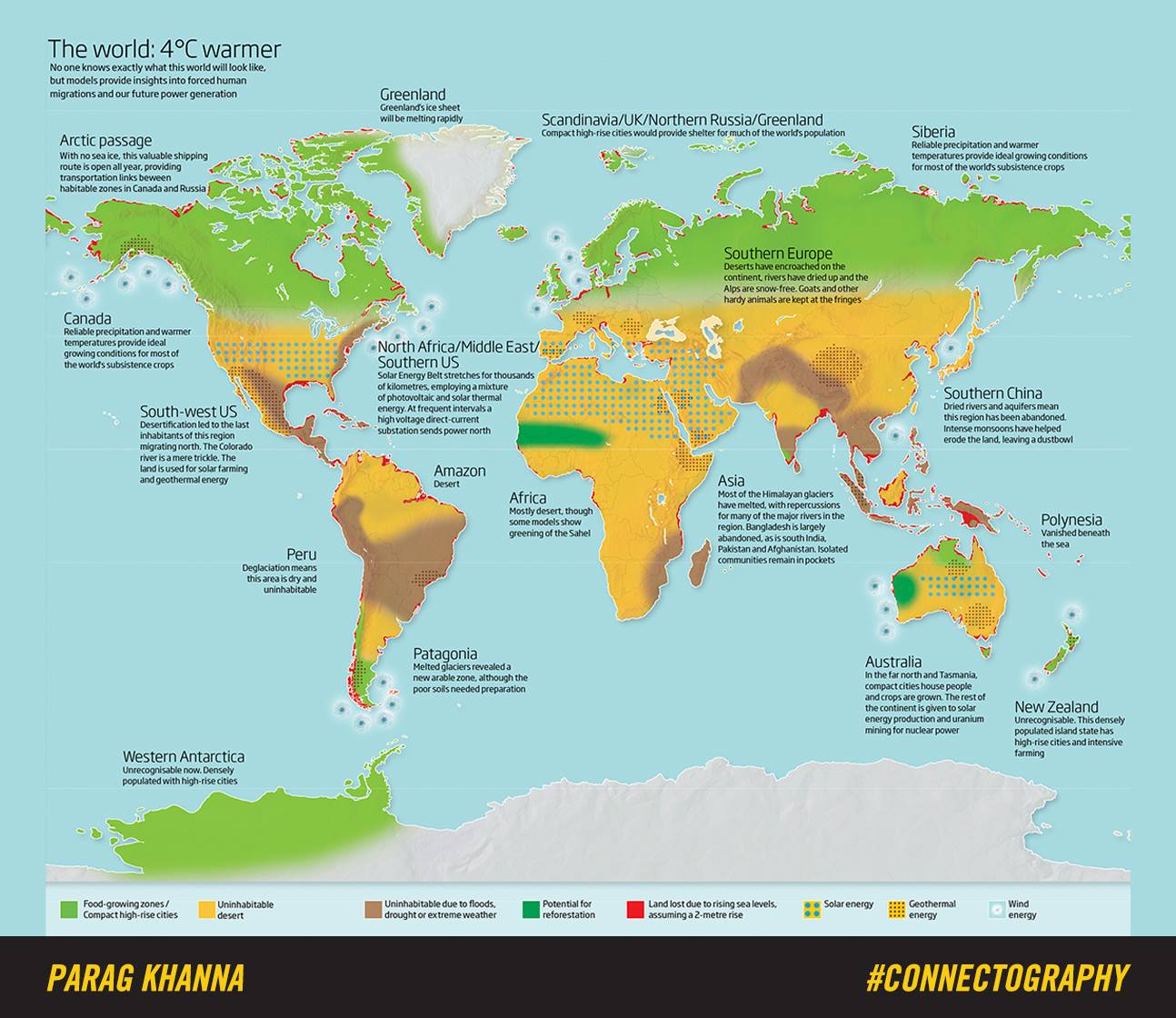
Humanity faces few larger questions than what, exactly, to do about climate change — and, in a sense larger still, what climate change even means. We’ve all heard a variety of different future scenarios laid out, each of them based on different data. But data can only make so much of an impact unless translated into a form with which the imagination can readily engage: a visual form, for instance, and few visual forms come more tried and true than the map.
And so “leading global strategist, world traveler, and best-selling author” Parag Khanna has created the map you see above (view in a larger format here), which shows us the state of our world when it gets just four degrees celsius warmer. “Micronesia is gone – sunk beneath the waves,” writes Big Think’s Frank Jacobs in an examination of Khanna’s map. “Pakistan and South India have been abandoned. And Europe is slowly turning into a desert.”
But “there is also good news: Western Antarctica is no longer icy and uninhabitable. Smart cities thrive in newly green and pleasant lands. And Northern Canada, Scandinavia, and Siberia produce bountiful harvests to feed the hundreds of millions of climate refugees who now call those regions home.”
Not quite as apocalyptic a climate-change vision as some, to be sure, but it still offers plenty of considerations to trouble us. Lands in light green, according to the map’s color scheme, will remain or turn into “food-growing zones” and “compact high-rise cities.” Yellow indicates “uninhabitable desert,” brown areas “uninhabitable due to floods, drought, or extreme weather.” In dark green appear lands with “potential for reforestation,” and in red those places that rising sea levels have rendered utterly lost.
Those last include the edges of many countries in Asia (and all of Polynesia), as well as the area where the southeast of the United States meets the northeast of Mexico and the north and south coasts of South America. But if you’ve ever wanted to live in Antarctica, you won’t have to move into a research base: within a couple of decades, according to Khanna’s data, that most mysterious continent could become unrecognizable and “densely populated with high-rise cities,” presumably with their own hipster quarters. But where best to grow the ingredients for its avocado toast?
Based in Seoul, Colin Marshall writes and broadcasts on cities and culture. His projects include the book The Stateless City: a Walk through 21st-Century Los Angeles and the video series The City in Cinema. Follow him on Twitter at @colinmarshall or on Facebook.
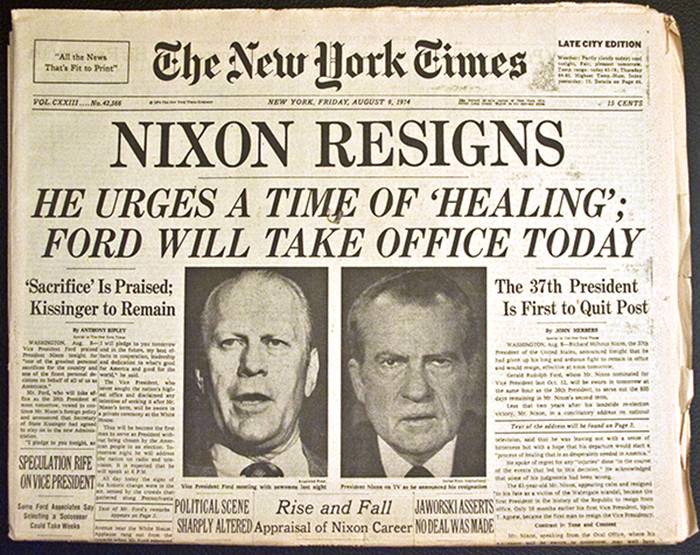
A crime was committed during a presidential campaign. Then came a cover up and other skullduggery. Finally, there was a resignation. Nope, we’re not talking about the trajectory of the Mueller investigation. We’re talking about Watergate–the subject of Slow Burn, a new, eight-episode podcast miniseries from Slate.
Available on iTunes, the web, and other podcast players, Slow Burnzeroes in on the questions: “What did it feel like to live through the scandal that brought down a president? What was that strange, wild ride like?” Below, you can read the introductory words from the podcast’s host, Leon Neyfakh. And then stream the first episode called “Martha,” as in Martha Mitchell, wife of John Mitchell, the Attorney General of the United States under President Nixon.
One day at the end of April 1973, Richard Nixon stood on a porch at Camp David and told John Ehrlichman he wanted to die. Nixon had summoned Ehrlichman, his long-serving domestic policy adviser, to tell him he was being fired from the White House.
Nixon had been dreading the conversation, but he knew it had to be done. The Department of Justice had recently informed the president that Ehrlichman could be facing criminal charges. Nixon felt the walls closing in.
Later, Nixon would tell the journalist David Frost how he gave his old friend the news: “I said, ‘You know, John, when I went to bed last night … I hoped—I almost prayed—I wouldn’t wake up this morning.’ ” According to Ehrlichman, the president then began to sob. It would be 15 months before he resigned from office.
So, that’s how Richard Nixon felt as the Watergate story went from a curious burglary to a national obsession. What was it like for everyone else? That’s the animating question behind my new eight-episode podcast series for Slate, Slow Burn.
Episode 1: Martha
If you would like to support the mission of Open Culture, consider making a donation to our site. It’s hard to rely 100% on ads, and your contributions will help us continue providing the best free cultural and educational materials to learners everywhere. You can contribute through PayPal, Patreon, and Venmo (@openculture). Thanks!
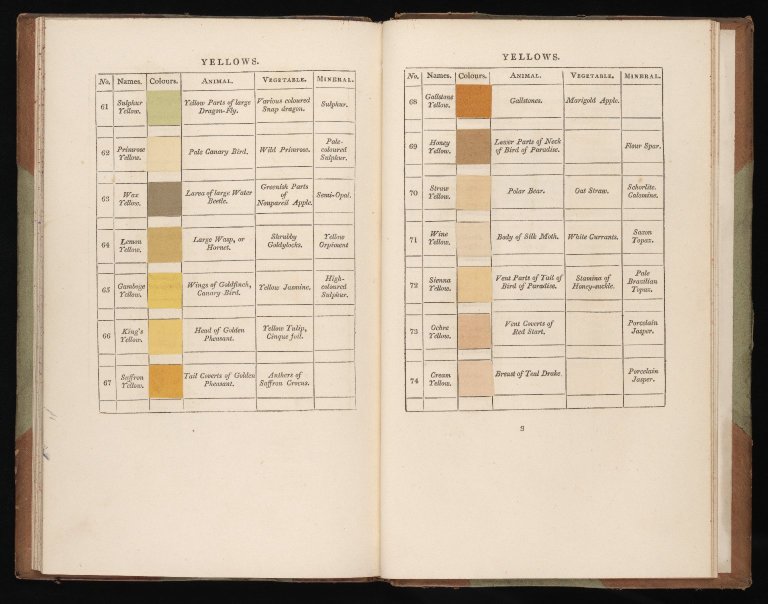
Before Pantone invented “a universal color language” or big box hardware stores arose with proprietary displays of colorfully-named paints—over a century before, in fact—a German mineralogist named Abraham Gottlob Werner invented a color system, as detailed and thorough a guide as an artist might need. But rather than only cater to the needs of painters, designers, and manufacturers, Werner’s Nomenclature of Colours also served the needs of scientists. “Charles Darwin even used the guide,” writes This is Colossal, “during his voyage to the Madeira, Canary, and Cape Verde islands on the H.M.S. Beagle.”
Werner’s is one of many such “color dictionaries” from the 19th century, “designed to give people around the world a common vocabulary,” writes Daniel Lewis at Smithsonian, “to describe the colors of everything from rocks and flowers to stars, birds, and postage stamps.” These guides appealed especially to naturalists.
Indeed, the book began—before Scottish painter Patrick Syme updated the system in English, with swatches of example colors—as a naturalist’s guide to the colors of the world, naming them according to Werner’s poetic fancy. “Without an image for reference,” the original text “provided immense handwritten detail describing where each specific shade could be found on an animal, plant, or mineral. Many of Werner’s unique color names still exist in common usage, though they’ve detached from his scheme ages ago.
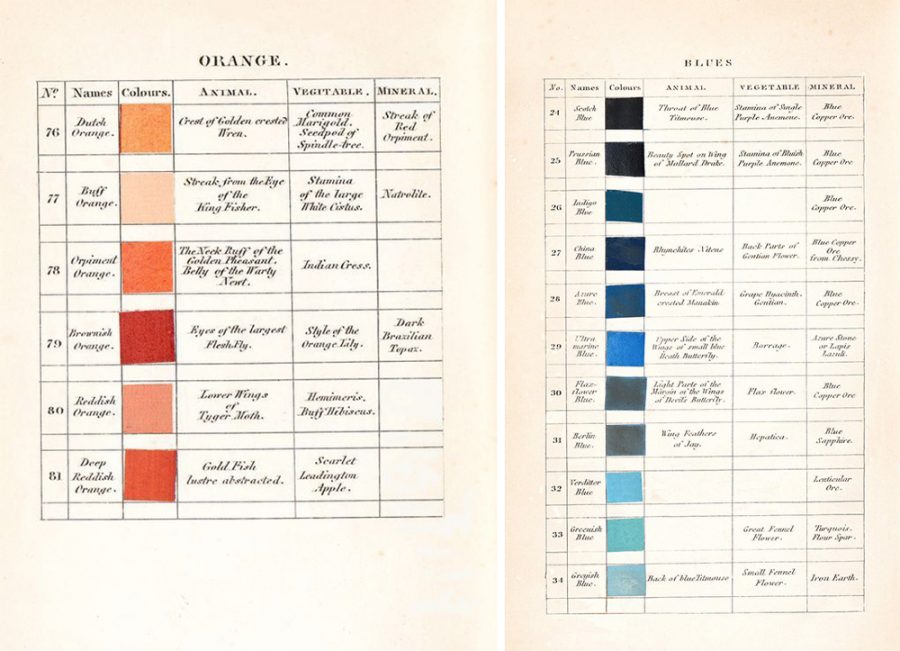
Prussian Blue, for instance, which can be located “in the beauty spot of a mallard’s wing, on the stamina of a bluish-purple anemone, or in a piece of blue copper ore.” Other examples, notes Fast Company’s Kelsey Campbell-Dollaghan, include “’Skimmed Milk White,’” or no. 7… found in ‘the white of the human eye’ or in opals,” and no. 67, or “’Wax Yellow’… found in the larvae of large Water Beetles or the greenish parts of a Nonpareil Apple.” It would have been Syme’s 1814 guide that Darwin consulted, as did scientists, naturalists, and artists for two centuries afterward, either as a taxonomic color reference or as an admirable historic artifact—a painstaking description of the colors of the world, or those encountered by two 18th and 19th century European observers, in an era before photographic reproduction created its own set of standards.
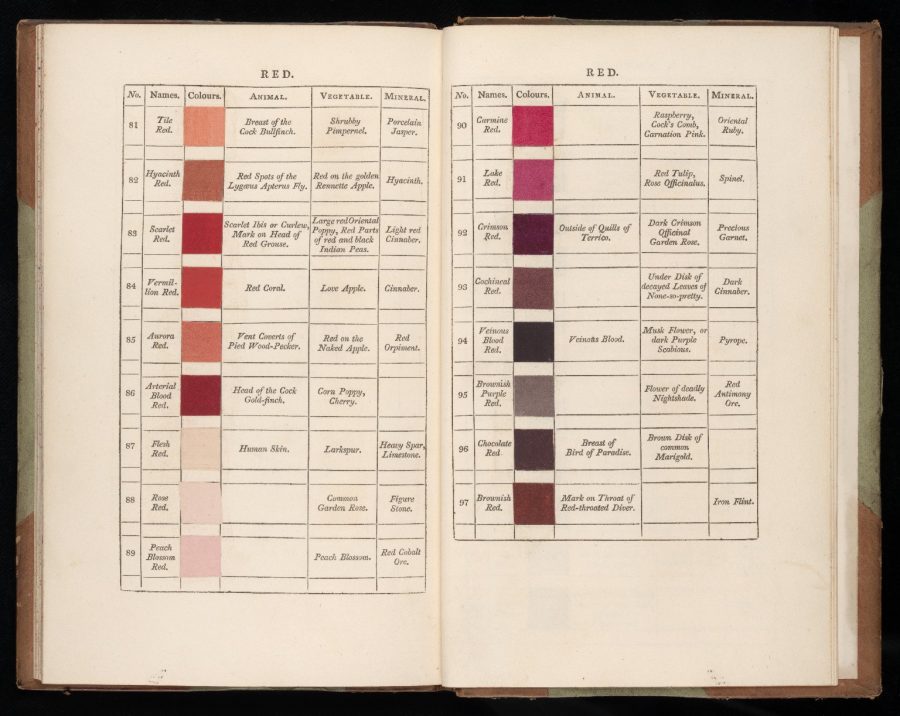
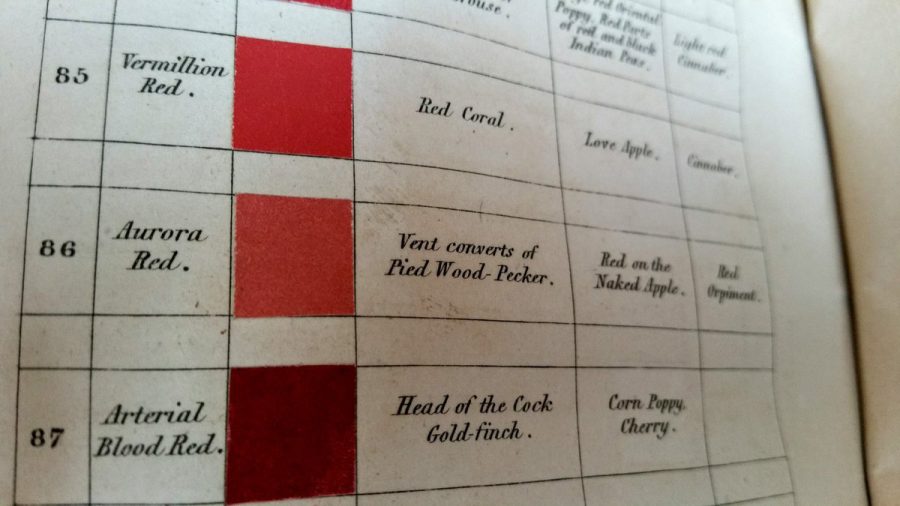
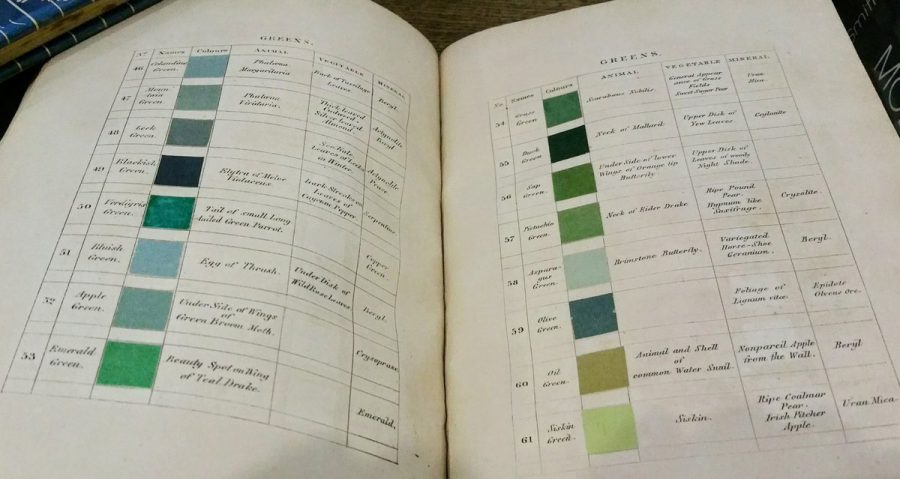
The book is now being republished in an affordable pocket-size edition by Smithsonian Books, who note that the Edinburgh flower painter Syme, in his illustrations of Werner’s nomenclature, “used the actual minerals described by Werner to create the color charts.” This degree of fidelity to the source extends to Syme’s use of tables to neatly organize Werner’s precise descriptions. Next to each color’s number, name, and swatch, are columns with its location on various animals, vegetables and minerals. “Orpiment Orange,” named after a mineral, though none is listed in its column, will be found, Werner tells us, on the “neck ruff of the golden pheasant” or “belly of the warty newt.” Should you have trouble tracking these down, surely you’ve got some “Indian cress” around?
While its references may not be those your typical industrial designer or graphic artist is likely to find helpful, Werner’s Nomenclature of Colours will still find a treasured place in the collections of designers and visual artists of all kinds, as well as historians, writers, poets, and the scientific inheritors of 19th century naturalism, as a “charming artifact from the golden age of natural history and global exploration.” Flip through a scanned version of the 1821 second edition just above, including Werner’s introduction and careful lists of color properties, or read it in a larger format at the Internet Archive. The new edition is now available for purchase here.
Be not inhospitable to strangers, lest they be angels in disguise.
More than a few visitors to Paris’ fabled Shakespeare & Company bookshop assume that the quote they see painted over an archway is attributable to Yeats or Shakespeare.
In fact, its author was George Whitman, the store’s late owner, a grand “hobo adventurer” in his 20s who made such an impression that he spent the rest of his life welcoming travelers and encouraging young writers, who flocked to the shop. A great many became Tumbleweeds, the nickname given to those who traded a few hours of volunteer work and a pledge to read a book a day in return for spartan accommodation in the store itself.
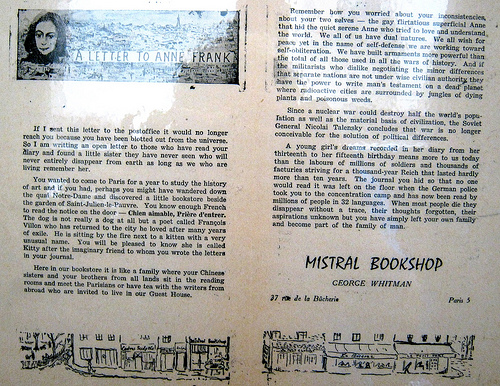
In light of this generosity, Whitman’s 1960 letter to Anne Frank (1929–1945) is all the more moving.
One wonders what inspired him to write it. It’s a not an uncommon impulse, but usually the authors are students close to the same age as Anne was at the time of her death.
Perhaps it was an interaction with a Tumbleweed.
He refrained from mentioning his own service in World War II, possibly because he was posted to a remote weather station in Greenland. Unlike other American veterans, he hadn’t witnessed with his own eyes the sort of hell she endured. If he had, he might not have been able to address her with such initial lightness of tone.
One can’t help but think how delighted the rambunctious young teen would have been by his sense of humor, his descriptions of his bohemian booklovers’ paradise—then called Le Mistral—and references to his dog, François Villon, and cat, Kitty, named in honor of Anne’s pet name for her diary.
His profound observations on the impermanence of life and the politics of war continue to resonate deeply with those who read the letter as its intended recipients’ proxies:
Le Mistral
37 rue de la Bûcherie
Dear Anne Frank,
If I sent this letter to the post office it would no longer reach you because you have been blotted out from the universe. So I am writing an open letter to those who have read your diary and found a little sister they have never seen who will never entirely disappear from earth as long as we who are living remember her.
You wanted to come to Paris for a year to study the history of art and if you had, perhaps you might have wandered down the quai Notre-Dame and discovered a little bookstore beside the garden of Saint-Julien-le-Pauvre. You know enough French to read the notice on the door—Chien aimable, Priere d’entrer. The dog is not really a dog at all but a poet called Francois Villon who has returned to the city he loved after many years of exile. He is sitting by the fire next to a kitten with a very unusual name. You will be pleased to know she is called Kitty after the imaginary friend to whom you wrote the letters in your journal.
Here in our bookstore it is like a family where your Chinese sisters and your brothers from all lands sit in the reading rooms and meet the Parisians or have tea with the writers from abroad who are invited to live in our Guest House.
Remember how you worried about your inconsistencies, about your two selves—the gay flirtatious superficial Anne that hid the quiet serene Anne who tried to love and understand the world. We all of us have dual natures. We all wish for peace, yet in the name of self-defense we are working toward self-obliteration. We have built armaments more powerful than the total of all those used in all the wars in history. And if the militarists who dislike negotiating the minor differences that separate nations are not under the wise civilian authority they have the power to write man’s testament on a dead planet where radioactive cities are surrounded by jungles of dying plants and poisonous weeds.
Since a nuclear could destroy half the world’s population as well as the material basis of civilization, the Soviet General Nikolai Talensky concludes that war is no longer conceivable for the solution of political differences.
A young girl’s dreams recorded in her diary from her thirteenth to her fifteenth birthday means more to us today than the labors of millions of soldiers and thousands of factories striving for a thousand-year Reich that lasted hardly more than ten years. The journal you hid so that no one would read it was left on the floor when the German police took you to the concentration camp and has now been read by millions of people in 32 languages. When most people die they disappear without a trace, their thoughts forgotten, their aspirations unknown, but you have simply left your own family and become part of the family of man.
We're hoping to rely on loyal readers, rather than erratic ads. Please click the Donate button and support Open Culture. You can use Paypal, Venmo, Patreon, even Crypto! We thank you!
Open Culture scours the web for the best educational media. We find the free courses and audio books you need, the language lessons & educational videos you want, and plenty of enlightenment in between.