What do you want to do with your life? It’s a good question to ask any time. But particularly as you watch the very short film, “In The Fall,” by the inimitable Steve Cutts.
Enjoy. Reflect. Maybe make a change for the better.
If you would like to support the mission of Open Culture, consider making a donation to our site. It’s hard to rely 100% on ads, and your contributions will help us continue providing the best free cultural and educational materials to learners everywhere. You can contribute through PayPal, Patreon, and Venmo (@openculture). Thanks!
Everyone should learn to write well, I used to tell students in Composition classes, and I believed it. To write well, in a certain sense, is to become a better thinker. But writing differs from writing, perhaps, in the same way that walking the dog differs from hiking the Appalachian trail. There are levels of difficulty. How badly do you need to say something that no one else can—or wants to—say? How badly do you need to push this thing you’ve said into the world?
These are separate questions. Some writers really do write for themselves, some write for money, though they might also write for free. Some write as a means to other ends, and some require, at all times, an audience. It may be a sexual compulsion or an animal reflex or the only way to get one’s mind right. Or some combination of the above. As a Jesuit scholar I once knew would say, “I’ve never met a motive that wasn’t mixed.” Given the difficulty of discerning why anyone does anything, there could be as many mixed motives as there are writers.
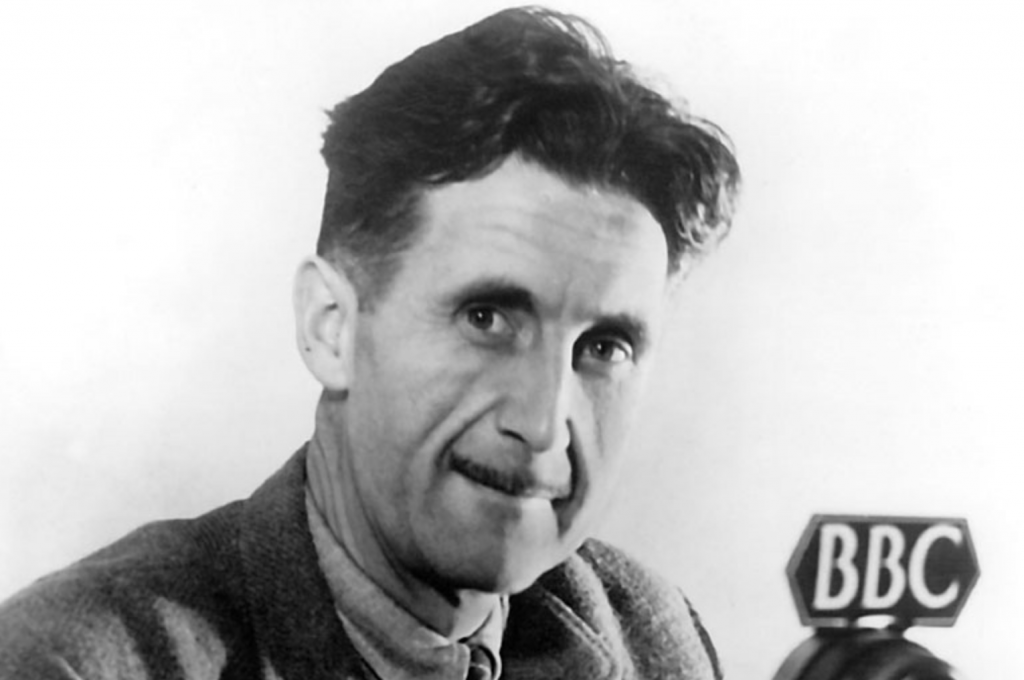
That said, I tend to think that every writer who reads George Orwell’s essay “Why I Write” sees themselves in some part of his description of his early life. “I was somewhat lonely,” he tells us, “and I soon developed disagreeable mannerisms which made me unpopular throughout my schooldays. I had the lonely child’s habit of making up stories and holding conversations with imaginary persons, and I think from the start my literary ambitions were mixed up with the feeling of being isolated and undervalued.”
Maybe everyone has such feelings, but again it is a question of degree. Given Orwell’s keen understanding of the writer’s mind from the inside out, and his diligent pursuit of his work through the most trying times, we might be inclined to give him a hearing when he claims, “there are four great motives for writing, at any rate for writing prose.” Orwell allows that these motives will be mixed, existing “in different degrees in every writer, and in any one writer the proportions will vary from time to time, according to the atmosphere in which he is living.”
But no one whom we might call a writer, Orwell suggests, writes solely for utility or money. The rewards are too peculiarly psychological, as are the pains. And the pleasures too otherworldly and practically useless. Orwell begins with one of those psychological compensations, fame, then proceeds to pleasure, then to duty to posterity and, finally, to persuasion; the four reasons, he says:
(i) Sheer egoism. Desire to seem clever, to be talked about, to be remembered after death, to get your own back on the grown-ups who snubbed you in childhood, etc., etc. It is humbug to pretend this is not a motive, and a strong one. Writers share this characteristic with scientists, artists, politicians, lawyers, soldiers, successful businessmen — in short, with the whole top crust of humanity. The great mass of human beings are not acutely selfish. After the age of about thirty they almost abandon the sense of being individuals at all — and live chiefly for others, or are simply smothered under drudgery. But there is also the minority of gifted, willful people who are determined to live their own lives to the end, and writers belong in this class. Serious writers, I should say, are on the whole more vain and self-centered than journalists, though less interested in money.
(ii) Aesthetic enthusiasm. Perception of beauty in the external world, or, on the other hand, in words and their right arrangement. Pleasure in the impact of one sound on another, in the firmness of good prose or the rhythm of a good story. Desire to share an experience which one feels is valuable and ought not to be missed. The aesthetic motive is very feeble in a lot of writers, but even a pamphleteer or writer of textbooks will have pet words and phrases which appeal to him for non-utilitarian reasons; or he may feel strongly about typography, width of margins, etc. Above the level of a railway guide, no book is quite free from aesthetic considerations.
(iii) Historical impulse. Desire to see things as they are, to find out true facts and store them up for the use of posterity.
(iv) Political purpose. — Using the word ‘political’ in the widest possible sense. Desire to push the world in a certain direction, to alter other peoples’ idea of the kind of society that they should strive after. Once again, no book is genuinely free from political bias. The opinion that art should have nothing to do with politics is itself a political attitude.
Surely, someone will suggest others, but it may be that other reasons would still fall into these categories. Neither are these motives consonant, “they must war with one another,” Orwell writes, and readers tend to egg the conflict on, declaring historical memoirs as products of pure egotism or turning their noses up at overly “political” novels.
Surprisingly, Orwell reveals that he might have done the same, had not circumstances forced his hand. “In a peaceful age I might have written ornate or merely descriptive books, and might have remained almost unaware of my political loyalties,” he says. But who lives in a peaceful age? In any case, we might wonder if he is being completely honest. “What I have most wanted to do throughout the past ten years is to make political writing into an art. My starting point is always a feeling of partisanship, a sense of injustice.”
Orwell admits that his task “is not easy,” and he offers unsparing examples of times when his writing has moved too far toward one end of the spectrum on which he situates himself. What is instructive about his framework for understanding his motivations, however, is that he has the tools to self-correct. Such self-knowledge can serve anyone in good stead. For the writer, who is compelled to reveal themselves over and over, it may be essential.
It takes no small amount of inquiry, from no few angles, to truly understand a form of art. This goes even more so for forms of art with which most of us in the 21st century have little direct experience. Take, for example, the illuminated manuscript: its history stretches back to the fifth century and it has arguably shaped all the forms of visual-textual storytelling we enjoy today, yet surely not one of a million of us understands how the artisans that made them did it.
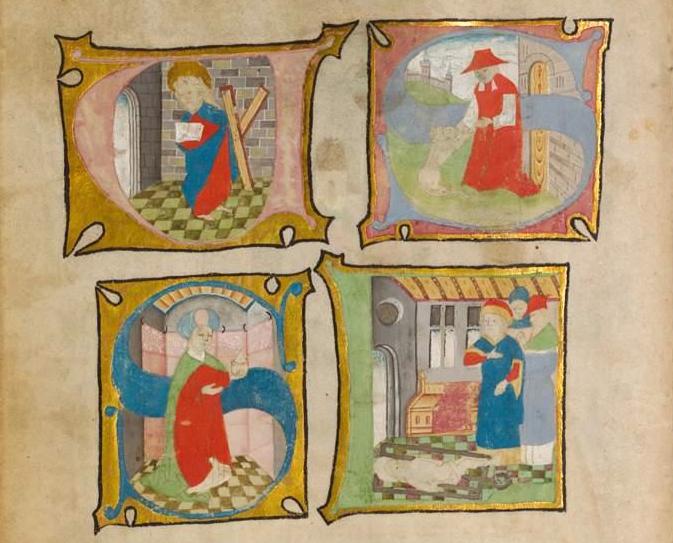
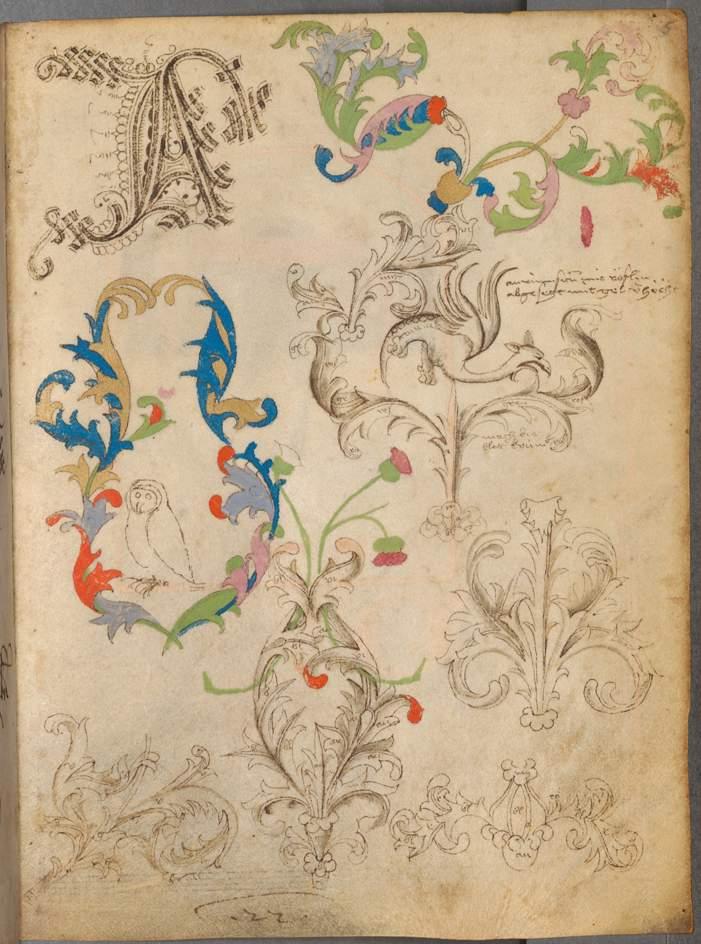
The Public Domain Review did their bit to correct this when they posted the illuminated sketchbook of Stephan Schriber, a series of pages dating from 1494 in which “ideas and layouts for illuminated manuscripts were tried out and skills developed” by the author, a monk in the southwest of Germany. “The monk-artist produced this sketchbook at the tail end of the 1,000-year age of illuminated manuscripts,” write’s Slate’s Rebecca Onion, “a type of book production that was to die out as the Renaissance moved forward and the printing press took over.”
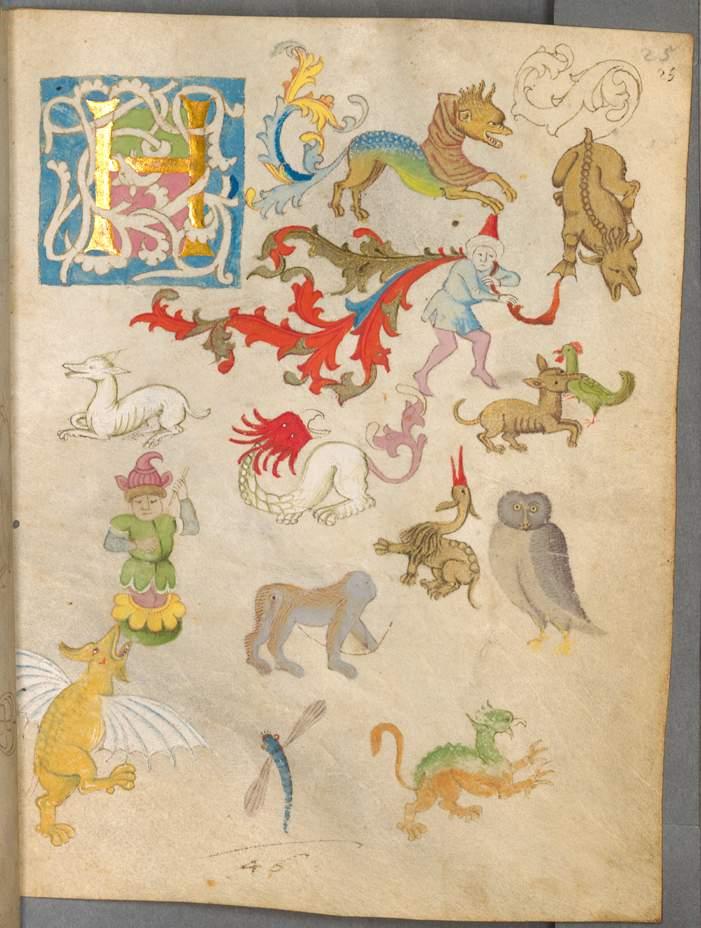
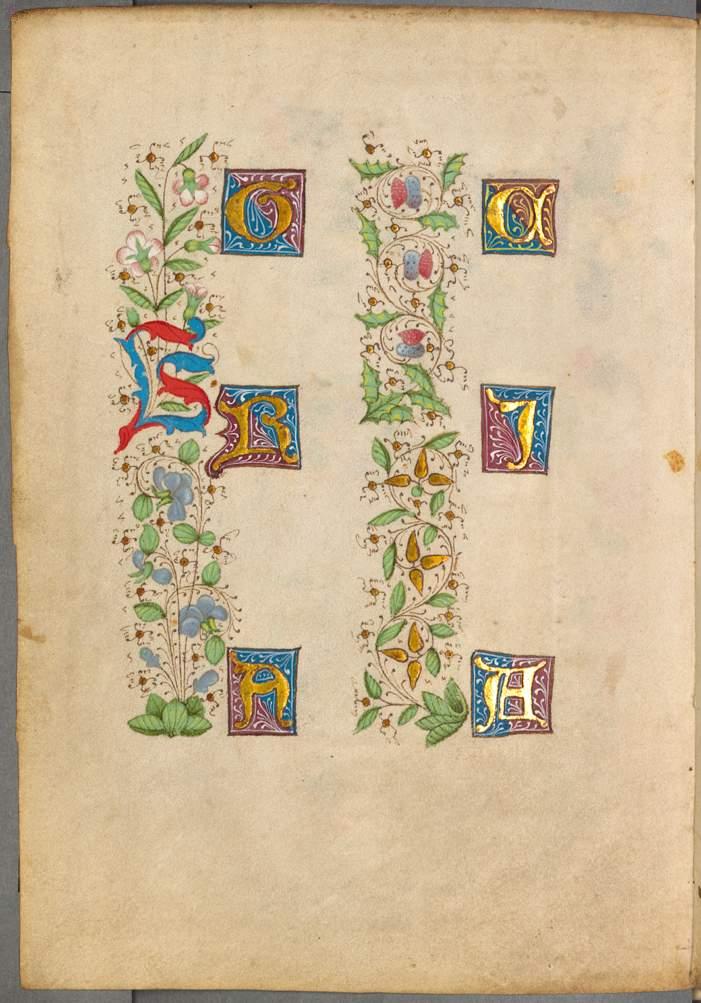
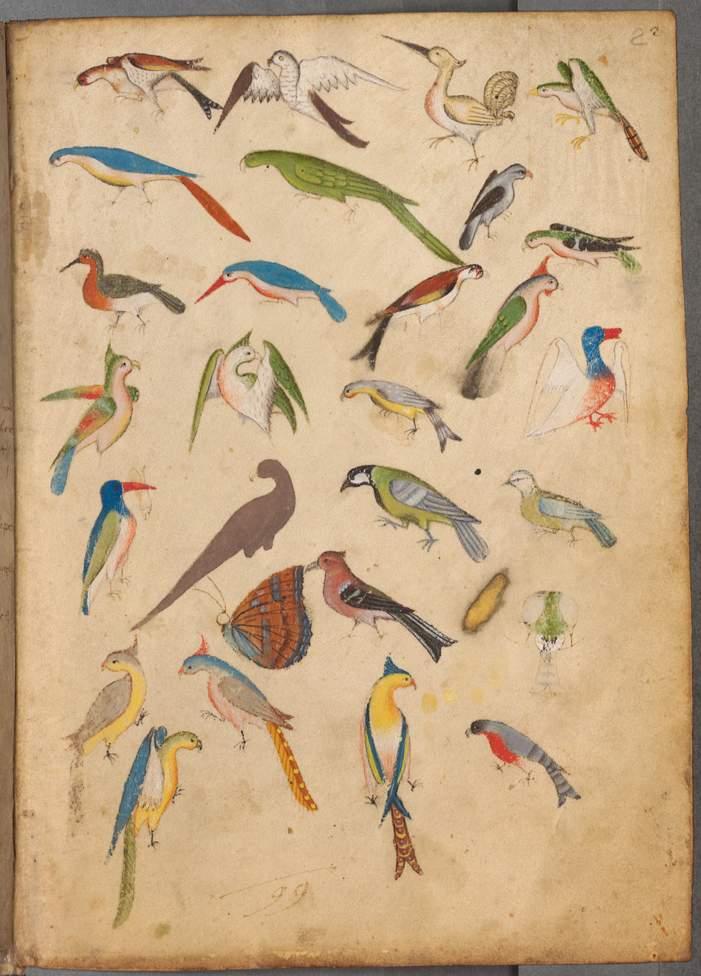
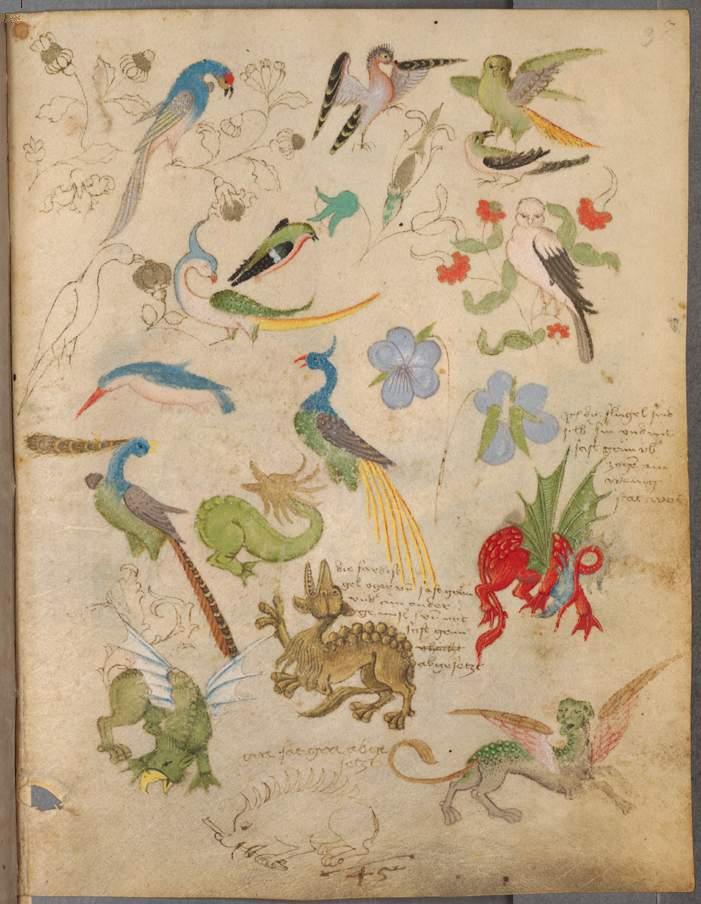
As printed books began to displace illuminated manuscripts, the production of the latter went commercial, no longer produced only by the hands of individual monks. But some of those monks, like Schriber, kept up their dedication to the craft: “These pages show an artist trying out animal motifs, practicing curlicued embellishments, and drafting beautiful presentations of the capital letters that would begin a section, page, or paragraph.”
BibliOdyssey points out that the book, “dedicated to Count Eberhard (Eberhard the bearded, later first Duke) of Württemberg,” appears to be “a manual of templates and/or a practice book containing partially completed sketches, painted and calligraphy initals, stylised floral decorative motifs, plant foliage tendrils, fantastic beast border drolleries” — yes, a real term from the field of illuminated manuscripts — “together with some gold and silver illumination work.”
You can browse more images from Schriber’s sketchbook at this Flickr account, or you can have a look at each and every page at the Munich DigitiZation Center. The images repay close study not just for their own beauty, but for what their seemingly deliberate incompleteness reveals about how a master of manuscript illuminations would go about composing their art. Even the creation of a form whose heyday passed more than half a millennium ago has something to teach us today.
Based in Seoul, Colin Marshall writes and broadcasts on cities and culture. His projects include the book The Stateless City: a Walk through 21st-Century Los Angeles and the video series The City in Cinema. Follow him on Twitter at @colinmarshall or on Facebook.
Photographer Nan Goldin’s celebrated series The Ballad of Sexual Dependency would likely have sent portraitist Julia Margaret Cameron reeling for her smelling salts, but the century that divides these two photographers’ active periods is less of a barrier than one might assume.
As Goldin notes in the above episode of the Metropolitan Museum of Art’s online series, The Artist Project, both made a habit of photographing people with whom they were intimately acquainted. (Cameron’s subjects included Virginia Woolf’s mother and Alice Liddell, the inspiration for Lewis Carroll’s Alice in Wonderland.)
The trust between artist and subject is evident in both of their work.
And both were roundly criticized for their lack of technical prowess, though that didn’t stop either of them from pursuing their visions, in focus or not.
John Baldessari, who chafes at the “Conceptualist” label, has been a fan of Social Realist/Abstract Expressionist Philip Guston since high school, when he would tear images of early works from his parents’ Life magazines.
His admiration for Gustin’s nightmarish Stationary Figure reveals a major difference in attitude from museum goers sneering that their kids could have painted such a work. Baldessari sees both the big picture—the idea of death as a sort of cosmic joke—and the sophisticated brushwork.
Cartoonist Roz Chast chose to focus on Italian Renaissance painting in her episode, savoring those teeming canvases’ creators’ imperfect command of perspective and three dimensionality.
The maximalist approach helps her believe that what she’s looking at is “real,” even as she grants herself the freedom to interpret the narrative in the manner she finds most amusing, playfully suggesting that a UFO is responsible for The Conversion of Saint Paul.
Over at The Intercept, Josh Begley, a data visualization artist, has posted a video entitled “Field of Vision — Concussion Protocol.” By way of introduction, he writes:
Since the season started, there have been more than 280 concussions in the NFL. That is an average of 12 concussions per week. Though it claims to take head injuries very seriously, the National Football League holds this data relatively close. It releases yearly statistics, but those numbers are published in aggregate, making it difficult to glean specific insights.
I have been tracking these injuries all season. Using a variety of methods, including reviewing daily injury reports from NFL.com, I have created what I believe is the most complete dataset of individual concussions sustained during the 2017–2018 season.
The resulting film, “Concussion Protocol,” is a visual record of every concussion in the NFL this year.
He goes on to add: “This film does not make an argument for ending football. Rather, it invites a set of questions… When we watch American football, what are we seeing?” Or, really, what are we missing? It’s only by “cutting together these scenes of injury — moments of impact, of intimacy, of trauma — and reversing them,” that we “see some of this violence anew” and underscore the sheer brutality of the game.
When Miles Davis attended a White House dinner in 1987, he was asked what he had done to deserve to be there. No modest man, Davis, he responded “Well, I’ve changed music five or six times.”
Is it bragging when it’s absolutely true? In this recent Spotify playlist, Steve Henry takes on the Miles Davis discography in roughly a chronological order, a stunning 569 songs and 65 hours of music. That makes that, what, over 90 tracks per revolution in music?
Technically, Davis’ first recorded appearance was as a member of Charlie Parker’s quintet in 1944, and his first as a leader was a 1946 78rpm recording of “Milestones” on the Savoy label. But this playlist starts with the 1951 Prestige album The New Sounds (which later made up the first side of Conception). By this time, Davis had taken the jaunty bebop of mentor and idol Parker and helped create a more relaxed style, a “cool” jazz that would come to dominate the 1950s. Privately he swung between extremes: a health nut who got into boxing, or a heroin addict and hustler/pimp, and he would oscillate between health and illness for the rest of his life.
During the 1950s however, he also created some of his most stunning classics, first for Prestige and Blue Note, where he developed the style to be known as “hard bop; then for Columbia, a label relationship that would result in some of his most revolutionary music. (Note: to get out of his Prestige contract that wanted four more albums out of him, Davis and his Quintet booked two session dates and recorded four albums worth of material, the Cookin’Relaxin’Workin’ and Steamin’ albums that in no way sounds like an obligation.)
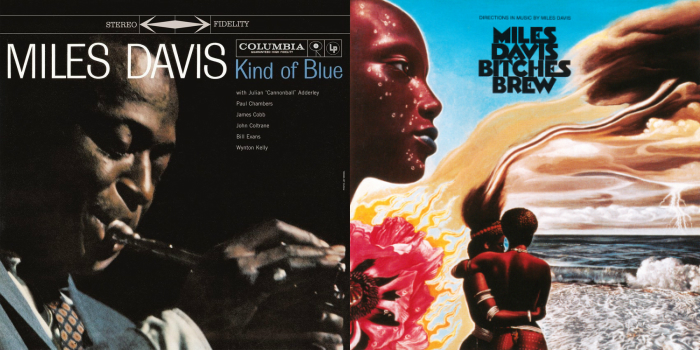
At Columbia, Davis made history with 1959’s Kind of Blue, considered by many as one of the greatest jazz albums of all time, along with his collaborations with arranger Gil Evans (Sketches of Spain, Porgy and Bess, Miles Ahead). After a lull in the mid-‘60s where the music press expected either a resurgence or a tragic end, Davis returned with second quintet (Wayne Shorter, Herbie Hancock, Ron Carter, Tony Williams) for another run of albums in his then “time, no changes” free jazz style, including Miles Smiles, Sorcerer, and Filles de Kilimanjaro.
But none of those prepared anybody for the giant leap beyond jazz itself into proto-ambient with In a Silent Way and the menacing misterioso-funk of Bitches Brew of 1970. Davis had watched rock and funk go from teenager pop music at the beginning of the decade to literally changing the world. He responded by creating one of the densest, weirdest albums which both owed some of its sound to rock and at the same time refuted almost everything about the genre (as well as the history of jazz). He was 44 years old.
His band members went on to shape jazz in the ‘70s: Wayne Shorter and Joe Zawinul formed Weather Report; John McLaughlin formed the Mahavishnu Orchestra; Herbie Hancock, although already established as a solo artist, brought forth the Headhunters album; Chick Corea helped form Return to Forever.
As for Davis, he delved deeper into funk and fusion with a series of albums, including On the Corner, that would go unappreciated at the time, but are now seen as influential in the world of hip hop and beyond. By the ‘80s, after a few years where he just disappeared into reclusion, he returned with some final albums that are all over the map: covering pop hits by Cyndi Lauper and Michael Jackson much in the same way that Coltrane covered The Sound of Music; experimental soundtracks; and experimenting with loops, sequencers, beats, and hip hop. Having struggled with illness and addiction all his life, he passed away at 65 years old in 1991, leaving behind this stunning discography, still offering up surprises to those looking to explore his legacy.
Ted Mills is a freelance writer on the arts who currently hosts the artist interview-based FunkZone Podcast and is the producer of KCRW’s Curious Coast. You can also follow him on Twitter at @tedmills, read his other arts writing at tedmills.com and/or watch his films here.
It says something about the human brain that we so often see the shape of human faces in inanimate things — and that we feel such amusement and even delight about it when we do. If you don’t believe it, just ask the 618,000 followers of the Twitter account Faces in Things, which posts images of nothing else. Or go to Chichibu, Japan, two hours northwest of Tokyo, where you’ll find the Chinsekikan, a small museum that has collected over 1,700 “curious rocks,” all 100 percent organically formed, about a thousand of which resemble human faces, sometimes even famous ones.
“The museum’s founder, who passed away in 2010, collected rocks for over fifty years,” writes Kotaku’s Brian Ashcraft. “Initially, he was drawn to rare rocks, but that evolved into collecting, well, strange rocks — especially unaltered rocks that naturally resemble celebrities, religious figures, movie characters, and more.
These days, the founder’s daughter keeps the museum running, and it has been featured on popular, nationwide Japanese TV programs.” It has also, more recently, become a subject of CNN’s internet video series Great Big Story, which highlights interesting people and places all around the world.
The Chinsekikan stands in walking distance of a local river rich with rocks, where we see the museum’s proprietor Yoshiko Hayama performing one of her routine searches for wee faces staring back at her. “To find rocks, we walk step-by-step,” she says. “If we walk too fast, we won’t find them.” She explains that a proper jinmenseki, or face-shaped stone, needs at least eyes and a mouth, reasonably well-aligned, with a nose being a rare bonus. Only decades of adherence to these standards, and hunting with such deliberateness, can yield such prize specimens as a rock that looks like Elvis Presley, a rock that looks (vaguely) like Johnny Depp, and a rock that looks like Donald Trump — though that one does benefit from what looks like a pile of thread on top, of a color best described as not found in nature.
Based in Seoul, Colin Marshall writes and broadcasts on cities and culture. His projects include the book The Stateless City: a Walk through 21st-Century Los Angeles and the video series The City in Cinema. Follow him on Twitter at @colinmarshall or on Facebook.
Back in 2011, in Tokyo, 167 musicians performed some classic Beethoven with the “Matryomin,” a new-fangled instrument that lodges a theremin inside a matryoshka. A matryoshka, of course, is one of those Russian nested dolls where you find wooden dolls of decreasing size placed one inside the other. As for the theremin, it’s a century-old electronic musical instrument that requires no physical contact from the player. You can watch its inventor, Leon Theremin, give it a demo in the vintage video below. Or via these links you can see the Matryomin Ensemble performing versions of Amazing Grace and Memory of Russia. Enjoy.
Note: An earlier version of this post appeared on Open Culture in July, 2013. It’s like the Olympics. It comes back once every four years.
If you would like to support the mission of Open Culture, consider making a donation to our site. It’s hard to rely 100% on ads, and your contributions will help us continue providing the best free cultural and educational materials to learners everywhere. You can contribute through PayPal, Patreon, and Venmo (@openculture). Thanks!
We're hoping to rely on loyal readers, rather than erratic ads. Please click the Donate button and support Open Culture. You can use Paypal, Venmo, Patreon, even Crypto! We thank you!
Open Culture scours the web for the best educational media. We find the free courses and audio books you need, the language lessons & educational videos you want, and plenty of enlightenment in between.