The Art of Letterlocking: The Elaborate Folding Techniques That Ensured the Privacy of Handwritten Letters Centuries Ago

Occa­sion­al­ly and with dimin­ish­ing fre­quen­cy, we still lament the lost art of let­ter-writ­ing, most­ly because of the degra­da­tion of the prose style we use to com­mu­ni­cate with one anoth­er. But writ­ing let­ters, in its long hey­day, involved much more than putting words on paper: there were choic­es to be made about the pen, the ink, the stamp, the enve­lope, and before the enve­lope, the let­ter­lock­ing tech­nique. Though recent­ly coined, the term let­ter­lock­ing describes an old and var­ied prac­tice, that of using one or sev­er­al of a suite of phys­i­cal meth­ods to ensure that nobody reads your let­ter but its intend­ed recip­i­ent — and if some­one else does read it, to show that they have.

“To seal a mod­ern-day enve­lope (on the off chance you’re seal­ing an enve­lope at all), it takes a lick or two, at most,” writes Atlas Obscu­ra’s Abi­gail Cain. Not so for the likes of Mary Queen of Scots or Machi­avel­li: “In those days, let­ters were fold­ed in such a way that they served as their own enve­lope. Depend­ing on your desired lev­el of secu­ri­ty, you might opt for the sim­ple, tri­an­gu­lar fold and tuck; if you were par­tic­u­lar­ly ambi­tious, you might attempt the dag­ger-trap, a heav­i­ly boo­by-trapped tech­nique dis­guised as anoth­er, less secure, type of lock.”

Begin­ning with “the spread of flex­i­ble, fold­able paper in the 13th cen­tu­ry” and end­ing around “the inven­tion of the mass-pro­duced enve­lope in the 19th cen­tu­ry,” let­ter­lock­ing “fits into a 10,000-year his­to­ry of doc­u­ment secu­ri­ty — one that begins with clay tablets in Mesopotamia and extends all the way to today’s pass­words and two-step authen­ti­ca­tion.”

We know about let­ter­lock­ing today thanks in large part to the efforts of Jana Dambro­gio, Thomas F. Peter­son Con­ser­va­tor at MIT Libraries. Accord­ing to MIT News’ Heather Den­ny, Dambro­gio first got into let­ter­lock­ing (and far enough into it to come up with that term her­self) “as a fel­low at the Vat­i­can Secret Archives,” pre­vi­ous­ly fea­tured here on Open Cul­ture. “In the Vatican’s col­lec­tion she dis­cov­ered paper let­ters from the 15th and 16th cen­turies with unusu­al slits and sliced-off cor­ners. Curi­ous if the marks were part of the orig­i­nal let­ter, she dis­cov­ered that they were indi­ca­tions the let­ters had orig­i­nal­ly been locked with a slice of paper stabbed through a slit, and closed with a wax seal.”

She and her col­lab­o­ra­tor Daniel Starza Smith have spent years try­ing to recon­struct the many vari­a­tions on that basic method used by let­ter-writ­ers of old, and you can see one of them, which Mary Queen of Scots used to lock her final let­ter before her exe­cu­tion, in the video at the top of the post.

Though we in the age of round-the-world, round-the-clock instant mes­sag­ing — an age when even e‑mail feels increas­ing­ly quaint — may find this impres­sive­ly elab­o­rate, we won’t have even begun to grasp the sheer vari­ety of let­ter­lock­ing expe­ri­ence until we explore the let­ter­lock­ing Youtube chan­nel. Its videos include demon­stra­tions of tech­niques his­tor­i­cal­ly used in Eng­landItaly, Amer­i­caEast Asia, and else­where, some of them prac­ticed by nota­bles both real and imag­ined. Tempt­ing though it is to imag­ine a direct dig­i­tal-secu­ri­ty equiv­a­lent of all this today, human­i­ty seems to have changed since the era of let­ter­lock­ing: as the apho­rist Aaron Haspel put it, “We can have pri­va­cy or we can have con­ve­nience, and we choose con­ve­nience, every time.”

via Atlas Obscu­ra

Relat­ed Con­tent:

Lewis Carroll’s 8 Still-Rel­e­vant Rules For Let­ter-Writ­ing

6,000 Let­ters by Mar­cel Proust to Be Dig­i­tized & Put Online

Jane Austen Writes a Let­ter to Her Sis­ter While Hung Over: “I Believe I Drank Too Much Wine Last Night”

How to Jump­start Your Cre­ative Process with William S. Bur­roughs’ Cut-Up Tech­nique

How the Mys­ter­ies of the Vat­i­can Secret Archives Are Being Revealed by Arti­fi­cial Intel­li­gence

Based in Seoul, Col­in Mar­shall writes and broad­casts on cities, lan­guage, and cul­ture. His projects include the book The State­less City: a Walk through 21st-Cen­tu­ry Los Ange­les and the video series The City in Cin­e­ma. Fol­low him on Twit­ter at @colinmarshall or on Face­book.

How Glenn Gould’s Eccentricities Became Essential to His Playing & Personal Style: From Humming Aloud While Playing to Performing with His Childhood Piano Chair

The cul­tur­al law that we must indulge, or at least tol­er­ate, the quirks of genius has much less force these days than it once did. Noto­ri­ous­ly per­fec­tion­is­tic Stan­ley Kubrick’s fabled fits of ver­bal abuse, for exam­ple, might skirt a line with actors and audi­ences now, though it’s hard to argue with the results of his process. Many oth­er exam­ples of artists’ bad behav­ior need no fur­ther men­tion, they are now so well-known and right­ly reviled. When it comes to anoth­er leg­en­dar­i­ly demand­ing auteur, Glenn Gould was as devot­ed to his art, and as dogged­ly idio­syn­crat­ic, as it gets.

But the case of Gould presents us with a very dif­fer­ent pic­ture than that of the artist who lash­es out at or abus­es those around him. His eccen­tric­i­ties con­sist­ed main­ly of her­met­ic habits, odd attach­ments, and a ten­den­cy to hum and sing loud­ly while he played Bach, Mozart, Schoen­berg, or any num­ber of oth­er clas­si­cal com­posers whose work he re-inter­pret­ed. While Leonard Bern­stein praised Gould as a “think­ing per­former” (one with whom Bern­stein sharply dis­agreed), he was also a par­tic­u­lar­ly noisy per­former, a fact that bedev­iled record­ing engi­neers.

As music crit­ic Tim Page says in the inter­view clip at the top, the habit of hum­ming also trou­bled Gould, who saw it as a lia­bil­i­ty but could not play at his best with­out doing it. “I would say that Glenn was in sort of an ecsta­t­ic trans­port,” dur­ing a lot of his per­for­mances. “When you look at him, he’s almost auto-erot­ic…. He is clear­ly hav­ing a major and pro­found reac­tion to it as he is also mak­ing it hap­pen.” The trait man­i­fest­ed “from the begin­ning” of Gould’s life, his father Bert once said. “When you’d expect a child to cry, Glenn would always hum.” (He may or may not have had Asperger’s syn­drome.)

“On the warm sum­mer day of the first record­ing ses­sion” of his first record­ing of Bach’s Gold­berg Vari­a­tions, writes Edward Roth­stein at The New York Times:

He arrived at the record­ing stu­dio wear­ing a win­ter coat, a beret, a muf­fler and gloves. He car­ried a batch of tow­els, bot­tles of spring water, sev­er­al vari­eties of pills and a 14-inch high piano chair to sit on. He soaked his arms in hot water for 20 min­utes, took sev­er­al med­ica­tions, adjust­ed each leg of his chair, and pro­ceed­ed to play, loud­ly hum­ming and singing along. After a week, he had pro­duced one of the most remark­able per­for­mances of Bach’s Gold­berg Vari­a­tions on record.

See a young Gould fur­ther up play J.S. Bach’s Par­ti­ta #2, loud­ly hum­ming and singing expres­sive­ly as though it were an opera. Anoth­er of Gould’s incur­able quirks also threat­ened to be a detri­ment to his per­for­mances, espe­cial­ly after he renounced per­form­ing live and retreat­ed per­ma­nent­ly to the stu­dio. Gould insist­ed on per­form­ing for over 21 years on a “chair that has become an object of rev­er­ence for Gould devo­tees,” explains the pod­cast Lud­wig van Toron­to. Gould was “obsessed” with the chair and “wouldn’t per­form on any­thing else.”

In the video above, you can see Gould defend the diminu­tive chair—built by his father for his child­hood practice—telling a TV pre­sen­ter, “I’ve nev­er giv­en any con­cert in any­thing else.” The chair, he says, is “a mem­ber of the fam­i­ly! It is a boon com­pan­ion, with­out which I do not func­tion, I can­not oper­ate.”

Along with his exact­ly spec­i­fied height for the piano, over which he hov­ered with his chin just inch­es from the mid­dle C, a rug under his feet, and a very warm stu­dio, which he often sat in wear­ing win­ter clothes, Gould’s chair is one of the most dis­tinc­tive of his odd­i­ties. The chair is “one of the most famous musi­cal objects in the his­to­ry of clas­si­cal music,” Kate Shap­ero writes at Gould inter­view site Unheard Notes. But it caused con­sid­er­able con­ster­na­tion in the stu­dio.

Now resid­ing in a glass case at the Nation­al Library of Cana­da, Gould’s chair is so dilap­i­dat­ed that “the only thing that kept it from falling apart,” says Lud­wig van Toron­to, “is some duct tape, screws, and piano wire.” Even before it acquired the noisy hard­ware of the met­al brack­ets hold­ing up its two front legs, Gould’s ani­mat­ed play­ing made the chair rock and creak in dis­tract­ing ways. But while Gould’s unin­ten­tion­al accom­pa­ni­ments turn some peo­ple off, his true fans, and they are mul­ti­tude, either find his vocal­iza­tions charm­ing or com­plete­ly tune them out. (They dis­ap­pear when he begins per­form­ing above.)

Gould’s “singing authen­ti­cates and human­izes his per­for­mances,” com­pos­er Luke Dahn argues. “It reveals a per­former so entire­ly absorbed in the music’s moment and reminds us that this is a per­for­mance, even if with­in the con­fines of the stu­dio.” His unusu­al qual­i­ties “dis­tin­guish his record­ings from those of count­less note-per­fect record­ings avail­able today that take on a fab­ri­cat­ed, ster­ile, and even robot­ic qual­i­ty. (Is per­fec­tion ever very inter­est­ing?)” Like the great­est musi­cal innovators—John Coltrane espe­cial­ly comes to mind—Gould has wide appeal both inside his genre cir­cles and far out­side them.

“I can put him on for hours,” says not­ed Gould devo­tee John Waters, “he’s like nobody else. He was the ulti­mate original—a real out­sider. And he had a great style, the hats and the gloves and so on.” What­ev­er the ori­gins of Gould’s quirks, and what­ev­er his mis­giv­ings about them, Gould lovers per­ceive them not as flaws to be over­looked or tol­er­at­ed but essen­tial qual­i­ties of his pas­sion and utter­ly unique per­son­al style. See him “say some­thing orig­i­nal” about Beethoven above, then deliv­er a tremen­dous per­for­mance, most­ly hum free but total­ly enthralling, of Beethoven’s Piano Sonata No. 17 in D Minor—a piece whose nick­name cap­tures Gould’s musi­cal effect: “The Tem­pest.”

Relat­ed Con­tent:

Glenn Gould Plays Bach on His U.S. TV Debut … After Leonard Bern­stein Explains What Makes His Play­ing So Great (1960)

Hear the Famous­ly Con­tro­ver­sial Con­cert Where Leonard Bern­stein Intro­duces Glenn Gould & His Idio­syn­crat­ic Per­for­mance of Brahms’ First Piano Con­cer­to (1962)

Lis­ten to Glenn Gould’s Shock­ing­ly Exper­i­men­tal Radio Doc­u­men­tary, The Idea of North (1967)

Josh Jones is a writer and musi­cian based in Durham, NC. Fol­low him at @jdmagness

The Journal of Controversial Ideas, Co-Founded by Philosopher Peter Singer, Will Publish & Defend Pseudonymous Articles, Regardless of the Backlash

Pho­to of Peter Singer by Mat Vick­ers, via Wiki­me­dia Com­mons

Aus­tralian bioethi­cist Peter Singer has made head­lines as few philoso­phers do with claims about the moral sta­tus of ani­mals and the “Singer solu­tion to world pover­ty,” and with far more con­tro­ver­sial posi­tions on abor­tion and dis­abil­i­ty. Many of his claims have placed him out­side the pale for stu­dents at Prince­ton, his cur­rent employ­er, where he has faced protests and calls for his ter­mi­na­tion. “I favor the abil­i­ty to put new ideas out there for dis­cus­sion,” he has said in response to what he views as a hos­tile aca­d­e­m­ic cli­mate, “and I see an atmos­phere in which some peo­ple may be inti­mat­ed from doing that.”

For those who, like him, make con­tro­ver­sial argu­ments such as those for euth­a­niz­ing “defec­tive infants,” for exam­ple, as he wrote about in his 1979 Prac­ti­cal Ethics, Singer has decid­ed to launch a new venue, The Jour­nal of Con­tro­ver­sial Ideas. As The Chron­i­cle of High­er Edu­ca­tion reports, the jour­nal aims to be “an annu­al, peer-reviewed, open-access pub­li­ca­tion that will print wor­thy papers, and stand behind them, regard­less of the back­lash.” The idea, says Singer, “is to estab­lish a jour­nal where it’s clear from the name and object that con­tro­ver­sial ideas are wel­come.”

Is it true that “con­tro­ver­sial ideas” have been denied a hear­ing else­where in acad­e­mia? The wide­ly-cov­ered tac­tics of “no-plat­form­ing” prac­ticed by some cam­pus activists have cre­at­ed the impres­sion that cen­sor­ship or illib­er­al­ism in col­leges and uni­ver­si­ties has become an epi­dem­ic prob­lem. No so, argues Princeton’s Eddie Glaude, Jr., who points out that fig­ures who have been dis­in­vit­ed to speak at cer­tain insti­tu­tions have been wel­comed on dozens of oth­er cam­pus­es “with­out it becom­ing a nation­al spec­ta­cle.” Sen­sa­tion­al­ized cam­pus protests are “not the norm,” as many would have us believe, he writes.

But the ques­tion Singer and his co-founders pose isn’t whether con­tro­ver­sial ideas get aired in debates or lec­ture forums, but whether schol­ars have been cen­sored, or have cen­sored them­selves, in the spe­cial­ized forums of their fields, the aca­d­e­m­ic jour­nals. Singer’s co-founder/ed­i­tor Jeff McMa­han, pro­fes­sor of moral phi­los­o­phy at Oxford, believes so, as he told the BBC in a Radio 4 doc­u­men­tary called “Uni­ver­si­ty Unchal­lenged.” The new jour­nal, said McMa­han, “would enable peo­ple whose ideas might get them in trou­ble either with the left or with the right or with their own uni­ver­si­ty admin­is­tra­tion, to pub­lish under a pseu­do­nym.”

Those who feel cer­tain posi­tions might put their career in jeop­ardy will have cov­er, but McMa­han declares that “the screen­ing pro­ce­dure” for pub­li­ca­tion “will be as rig­or­ous as those for oth­er aca­d­e­m­ic jour­nals. The lev­el of qual­i­ty will be main­tained.” Some skep­ti­cism may be war­rant­ed giv­en the journal’s intent to pub­lish work from every dis­ci­pline. The edi­tors of spe­cial­ist jour­nals bring net­works of review­ers and spe­cial­ized knowl­edge them­selves to the usu­al vet­ting process. In this case, the core found­ing team are all philoso­phers: Singer, McMa­han, and Francesca Min­er­va, post­doc­tor­al fel­low at the Uni­ver­si­ty of Ghent.

One might rea­son­ably ask how that process can be “as rig­or­ous” on this whole­sale scale. Though the BBC reports that there will be an “intel­lec­tu­al­ly diverse inter­na­tion­al edi­to­r­i­al board,” board mem­bers are rarely very involved in the edi­to­r­i­al oper­a­tions of an aca­d­e­m­ic jour­nal. Justin Wein­berg at Dai­ly Nous has some oth­er ques­tions, includ­ing whether the degree, or exis­tence, of aca­d­e­m­ic cen­sor­ship even war­rants the journal’s cre­ation. “No evi­dence was cit­ed,” he writes “to sup­port the claim that ‘a cul­ture of fear and self-cen­sor­ship’ is pre­vent­ing arti­cles that would pass a review process” from see­ing pub­li­ca­tion.

Fur­ther­more, Wein­berg says, the journal’s puta­tive founders have giv­en no argu­ment “to allay what seems to be a rea­son­able con­cern that the cre­ation of such a jour­nal will fos­ter more of a ‘cul­ture of fear and self-cen­sor­ship’ com­pared to oth­er options, or that it plays into and rein­forces exper­tise-under­min­ing mis­con­cep­tions about acad­e­mia bandied about in pop­u­lar media that may have neg­a­tive effects…. Giv­en that the found­ing team is com­prised of peo­ple not­ed for views that empha­size empir­i­cal facts and con­se­quences, one might rea­son­ably hope for a pub­lic dis­cus­sion of such evi­dence and argu­ments.”

Should schol­ars pub­lish pseu­do­ny­mous­ly in peer-reviewed jour­nals? Shouldn’t they be will­ing to defend their ideas on the mer­its with­out hid­ing their iden­ti­ty? Is such sub­terfuge real­ly nec­es­sary? “Right now,” McMa­han asserts, “in cur­rent con­di­tions some­thing like this is need­ed…. I think all of us will be very hap­py if, and when, the need for such a jour­nal dis­ap­pears, and the soon­er the bet­ter.” Giv­en that the journal’s co-founders paint such a broad­ly dire pic­ture of the state of acad­e­mia, it’s rea­son­able to ask for more than anec­do­tal evi­dence of their claims. A few high-pro­file inci­dents do not prove a wide­spread cul­ture of repres­sion.

It is also “fair to won­der,” writes Annabelle Tim­sit at Quartz, “whether the board of a jour­nal ded­i­cat­ed to free speech might have a bias toward pub­lish­ing par­tic­u­lar­ly con­tro­ver­sial ideas in the inter­est of free­dom of thought” over the inter­ests of good schol­ar­ship and sound eth­i­cal prac­tice.

via Dai­ly Nous

Relat­ed Con­tent:

A New Aca­d­e­m­ic Hoax–Complete with Fake Arti­cles Pub­lished in Aca­d­e­m­ic Journals–Ventures to Show the “Cor­rup­tion” of Cul­tur­al Stud­ies

What Are the Most Influ­en­tial Books Writ­ten by Schol­ars in the Last 20 Years?: Lead­ing Aca­d­e­mics Pick “The New Canon”

The 20 Most Influ­en­tial Aca­d­e­m­ic Books of All Time: No Spoil­ers

Josh Jones is a writer and musi­cian based in Durham, NC. Fol­low him at @jdmagness

A Map of the U.S. Created Out of 1,000 Song Titles That Reference Cities, States, Landmarks & More

Accord­ing to Leonard Cohen, song­writ­ing is a lone­ly busi­ness, but there’s noth­ing for it, he sings in “Tow­er of Song,” when you’re “born with the gift of a gold­en voice” and when “twen­ty-sev­en angels from the Great Beyond” tie you to a table and make you write. Just where is Cohen’s tow­er? Maybe Mon­tre­al, his home­town, or his adopt­ed city of L.A.? He doesn’t tell us, though we do know Hank Williams lives 100 floors above, so there’s a good chance that it’s not a place on earth.

Cohen the poet had a gift for mak­ing meta­phys­i­cal trips seem per­fect­ly nat­ur­al, but most song­writ­ers, lone­ly or oth­er­wise, rely on more real­ist con­ven­tions of nar­ra­tive sto­ry­telling, includ­ing spe­cif­ic set­tings, whether men­tioned in pass­ing or form­ing a cen­tral theme.

Songs like “Lit­tle Old Lady from Pasade­na,” “Rock­away Beach,” “Don’t Go Back to Rockville,” or “Straight Out­ta Comp­ton” helped put their respec­tive locales on the map.

Design house Dorothy has tak­en that phrase lit­er­al­ly, cre­at­ing a map of the U.S. “made up entire­ly from the titles of over 1,000 songs” that “ref­er­ence states, cities, rivers, moun­tains and land­marks.” In the playlist below, you can lis­ten to the country’s geog­ra­phy, as sung by Lynyrd Skynyrd, David Bowie, R.E.M., Pink Floyd, George Strait, Kings of Leon, Jay Z,  John­ny Cash, Miles Davis, Joan Baez, and hun­dreds more artists who have lit­tle in com­mon oth­er than their use of a U.S. city, state, land­mark, nat­ur­al for­ma­tion, etc. as an anchor for their lyrics.

Like Homer’s Ili­ad, which maps the ancient Greek world with its copi­ous ref­er­ences to ports, cities, moun­tains, and so on, the pop canon could be used by some future civ­i­liza­tion to recon­struct the geog­ra­phy of the U.S. And if so, it might look quite a lot like this. But not only does the map sit­u­ate well-known songs about well-known places in their prop­er coor­di­nates, it also locates some­what obscure loca­tions name-checked  in songs like The Band’s “The Weight,” whose men­tion of Nazareth refers not to the Bib­li­cal town, but rather to Nazareth, Penn­syl­va­nia, home of Mar­tin Gui­tars. (The city gets anoth­er boost, though not on this map, in Mark Knopfler’s “Speed­way at Nazareth,” which refers to anoth­er local land­mark.)

“Some of our favorite song choic­es are the ones which require you to think a lit­tle hard­er about con­nec­tions,” Dorothy admits, “such as ‘Space Odd­i­ty’ (David Bowie) which sign­posts Cape Canaver­al, ‘After the Gold Rush’ (Neil Young) which ref­er­ences Sutter’s Mill, and ‘Home­com­ing’ (Kanye West) which is placed near the rapper’s home town of Chica­go.”

Perus­ing the map (zoom into a high-res ver­sion here) and playlist will doubt­less alert you to oth­er choic­es with oblique or implied ref­er­ences. In one instance, on the map of Flori­da, we see Green Day’s “Amer­i­can Idiot,” whose lyrics take on the whole nation, “under the new mania.” Dorothy finds a sin­gle address for the song’s vit­ri­ol, one sus­pi­cious­ly close to the so-called “Win­ter White House.” Some­how I doubt the band would object to this cre­ative geo­graph­i­cal inter­pre­ta­tion.

You can pur­chase your own copy of the map here.

Relat­ed Con­tent:

Behold the MusicMap: The Ulti­mate Inter­ac­tive Geneal­o­gy of Music Cre­at­ed Between 1870 and 2016

An Inter­ac­tive Map Shows Just How Many Roads Actu­al­ly Lead to Rome

A Handy, Detailed Map Shows the Home­towns of Char­ac­ters in the Ili­ad

Josh Jones is a writer and musi­cian based in Durham, NC. Fol­low him at @jdmagness

Jazz Deconstructed: What Makes John Coltrane’s “Giant Steps” So Groundbreaking and Radical?

John Coltrane bore an unusu­al bur­den. Many exper­i­men­tal artists who rad­i­cal­ly change their forms of music, and music in gen­er­al, are so out on the edge and ahead of their time they elude the public’s notice. But Coltrane was respon­si­ble for both “fur­ther­ing the cause” of free jazz and “deliv­er­ing it to an increas­ing­ly main­stream audi­ence,” as Lind­say Plan­er writes at All­mu­sic. This meant that he achieved the kind of recog­ni­tion in his short life that most musician/composers only dream of, and that his every attempt was heav­i­ly scru­ti­nized by crit­ics, a lis­ten­ing pub­lic, and record com­pa­nies not always ready for the most for­ward-think­ing of his ideas.

His immense pop­u­lar­i­ty makes Coltrane’s accom­plish­ments all the more impres­sive. While 1959 is often cit­ed as the “year that changed jazz” with a series of land­mark albums, two releas­es by Coltrane in 1960—My Favorite Things and Giant Steps—com­plete­ly rad­i­cal­ized the form, with reper­cus­sions far out­side the jazz world. In the lat­ter record­ing, writes Plan­er, Coltrane was “in essence, begin­ning to rewrite the jazz canon with mate­r­i­al that would be cen­tered on solos—the 180-degree antithe­sis of the art form up to that point. These arrange­ments would cre­ate a place for the solo to become infi­nite­ly more com­pelling,” cul­mi­nat­ing “in a fre­net­ic per­for­mance style that not­ed jazz jour­nal­ist Ira Gitler dubbed ‘sheets of sound.’”

The saxophonist’s “poly­ton­al tor­rents” upend the “cor­dial solos that had begun decay­ing… the genre, turn­ing it into the equiv­a­lent of easy lis­ten­ing.” There was noth­ing easy about keep­ing up with Coltrane. The title track of Giant Steps has become known for a rapid chord pro­gres­sion that cycles through three keys, built on an ear­li­er tech­nique known as the “Coltrane Changes.” Impro­vis­ing over these chords has become “a rite of pas­sage for jazz musi­cians” explains the Vox Ear­worm video above, mak­ing the tune “one of the most revered, and feared, com­po­si­tions in jazz his­to­ry.”

We can intu­it the dif­fi­cul­ty of Coltrane’s com­po­si­tions by lis­ten­ing to them, but with­out a back­ground in music the­o­ry, we won’t under­stand just what, exact­ly, makes them “so leg­endary.” Earworm’s “crash course” in the­o­ry from musi­cians Adam Neely and Brax­ton Cook demys­ti­fies Coltrane’s intim­i­dat­ing progression—so chal­leng­ing it tied up pianist Tom­my Flana­gan dur­ing his solo, and his halt­ing stabs can be heard on the record, fol­lowed by Coltrane’s aston­ish­ing­ly flu­id cas­cade of notes. “That’s messed up,” says Brax­ton, in sym­pa­thy. “I would want anoth­er shot.” What, besides the mad­den­ing­ly fast tem­po, sent Flana­gan into the weeds?

As with most music based in West­ern har­mo­ny, the song’s struc­ture can be demon­strat­ed by ref­er­ence to the cir­cle of fifths, a method of orga­niz­ing notes and scales that Coltrane made his very own. His bril­liance was in tak­ing rec­og­niz­able forms—the stan­dard II-V‑I jazz pro­gres­sion, for example—and push­ing them to their absolute lim­it.

“There are 26 chord changes in the 16-bar theme of ‘Giant Steps,’” notes Jazz­wise mag­a­zine in its his­to­ry of the album. (Watch them all fly by in the ani­mat­ed sheet music above). The pro­gres­sion “pro­vides a for­mi­da­ble chal­lenge for the impro­vi­sor with its quick­ly chang­ing key cen­tres.” Coltrane him­self, “han­dled pat­terns derived from pen­ta­ton­ic scales, trans­posed to fit each chord as it flew by, excep­tion­al­ly well.”

Keep watch­ing the Ear­worm video to find out how the “Giant Steps” pro­gres­sion is like a “musi­cal M.C. Esch­er paint­ing,” and to under­stand why Coltrane is con­sid­ered a god, or at least a saint, by so many who have followed—or strug­gled to follow—his work.

Relat­ed Con­tent:

John Coltrane Draws a Pic­ture Illus­trat­ing the Math­e­mat­ics of Music

John Coltrane’s Hand­writ­ten Out­line for His Mas­ter­piece A Love Supreme (1964)

Stream Online the Com­plete “Lost” John Coltrane Album, Both Direc­tions at Once

Josh Jones is a writer and musi­cian based in Durham, NC. Fol­low him at @jdmagness

R.I.P. Stan Lee: Take His Free Online Course “The Rise of Superheroes and Their Impact On Pop Culture”

“I grew up in an exurb where it took near­ly an hour to walk to the near­est shop, to the near­est place to eat, to the library,” remem­bers writer Adam Cadre. “And the steep hills made it an exhaust­ing walk.  That meant that until I turned six­teen, when school was not in ses­sion I was stuck at home.  This was often not a good place to be stuck. Stan Lee gave me a place to hang out.” Many oth­er for­mer chil­dren of exur­ban Amer­i­ca — as well as every­where else — did much of their grow­ing up there as well, not just in the uni­verse of Mar­vel Comics but in those of the comics and oth­er forms of cul­ture to which it gave rise or influ­enced, most of them either direct­ly or indi­rect­ly shaped by Lee, who died yes­ter­day at the age of 95.

“His crit­ics would say that for me to thank Stan Lee for cre­at­ing the Mar­vel Uni­verse shows that I’ve fall­en for his self-promotion,” Cadre con­tin­ues, “​that it was Jack Kir­by and Steve Ditko and his oth­er col­lab­o­ra­tors who sup­plied the dynam­ic, expres­sive art­work and the epic sto­ry­lines that made the Mar­vel Uni­verse so com­pelling.”

Mar­vel fans will remem­ber that Ditko, co-cre­ator with Lee of Spi­der-Man and Doc­tor Strange, died this past sum­mer. Kir­by, whose count­less achieve­ments in comics include co-cre­at­ing the Fan­tas­tic Four, the X‑Men, and the Hulk with Lee, passed away in 1994. (Kir­by’s death, as I recall, was the first I’d ever heard about on the inter­net.)

Those who take a dim­mer view of Lee’s career see him as hav­ing done lit­tle more artis­tic work than putting dia­logue into the speech bub­bles. But like no small num­ber of oth­er Mar­vel Uni­verse habitués, Cadre “didn’t read super­hero comics for the fights or the cos­tumes or the trips to Asgard and Atti­lan. I read them for fan­ta­sy that read like real­i­ty, for the inter­play of wild­ly dif­fer­ent per­son­al­i­ties — ​and for the wise­cracks.” And what made super­hero sto­ries the right deliv­ery sys­tem for that inter­play of per­son­al­i­ties and those wise­cracks? You’ll find the answer in “The Rise of Super­heroes and Their Impact On Pop Cul­ture,” an online course from the Smith­son­ian, pre­vi­ous­ly fea­tured here on Open Cul­ture and still avail­able to take at your own pace in edX’s archives, cre­at­ed and taught in part by Lee him­self. You can watch the trail­er for the course at the top of the post.

If you take the course, its pro­mo­tion­al mate­ri­als promise, you’ll learn the answers to such ques­tions as “Why did super­heroes first arise in 1938 and expe­ri­ence what we refer to as their “Gold­en Age” dur­ing World War II?,” “How have com­ic books, pub­lished week­ly since the mid-1930’s, mir­rored a chang­ing Amer­i­can soci­ety, reflect­ing our mores, slang, fads, bias­es and prej­u­dices?,” and “When and how did com­ic book art­work become accept­ed as a true Amer­i­can art form as indige­nous to this coun­try as jazz?” Whether or not you con­sid­er your­self a “true believ­er,” as Lee would have put it, there could be few bet­ter ways of hon­or­ing an Amer­i­can icon like him than dis­cov­er­ing what makes his work in super­hero comics — the field to which he ded­i­cat­ed his life, and the one which has tak­en more than its fair share of deri­sion over the decades — not just a reflec­tion of the cul­ture but a major influ­ence on it as well.

Enroll in “The Rise of Super­heroes and Their Impact On Pop Cul­ture” here.

Relat­ed Con­tent:

1,700 Free Online Cours­es from Top Uni­ver­si­ties

The Great Stan Lee Reads Edgar Allan Poe’s “The Raven”

Stan Lee Reads “The Night Before Christ­mas,” Telling the Tale of San­ta Claus, the Great­est of Super Heroes

Down­load Over 22,000 Gold­en & Sil­ver Age Com­ic Books from theCom­ic Book Plus Archive

Down­load 15,000+ Free Gold­en Age Comics from the Dig­i­tal Com­ic Muse­um

Based in Seoul, Col­in Mar­shall writes and broad­casts on cities, lan­guage, and cul­ture. His projects include the book The State­less City: a Walk through 21st-Cen­tu­ry Los Ange­les and the video series The City in Cin­e­ma. Fol­low him on Twit­ter at @colinmarshall or on Face­book.

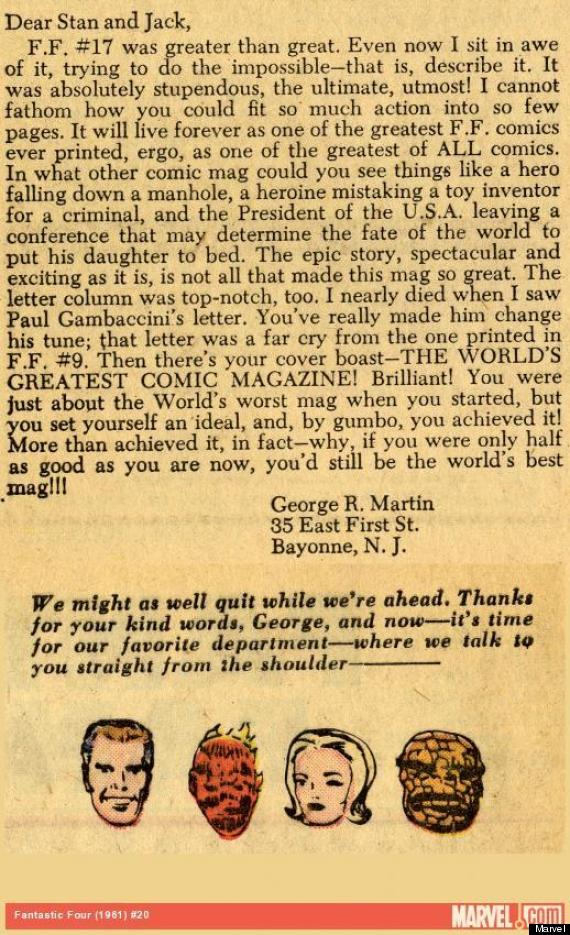
Stan Lee (RIP) Gets an Exuberant Fan Letter from 15-Year-Old George R.R. Martin, 1963

martin-LETTER

The let­ter above goes to show two things. George Ray­mond Richard Mar­tin, oth­er­wise known as George R.R. Mar­tin, or sim­ply as GRRM, had fan­ta­sy and writ­ing in his blood from a young age. Decades before he wrote his fan­ta­sy nov­el series A Song of Ice and Fire, which HBO adapt­ed into Game of Thrones, a 15-year-old George R. Mar­tin sent a fan let­ter to the now depart­ed Stan Lee and Jack Kir­by, the leg­endary cre­ators of Spi­der-Man, the Hulk, Thor, the X‑Men and the Fan­tas­tic Four (called “F.F.” in the let­ter).

When you read the note, you can imme­di­ate­ly tell that young Mar­tin was steeped in sci-fi and fan­ta­sy lit­er­a­ture. He could also string togeth­er some fair­ly com­plex sen­tences dur­ing his teenage years — sen­tences that many adults would strug­gle to write today. Above, you can watch Mar­tin read his 1963 fan let­ter note, and Stan Lee’s short reply: “We might want to quit while we’re ahead. Thanks for your kind words, George.” We’re all sure­ly glad that Lee and Kir­by kept going.

If you would like to sign up for Open Culture’s free email newslet­ter, please find it here. It’s a great way to see our new posts, all bun­dled in one email, each day.

If you would like to sup­port the mis­sion of Open Cul­ture, con­sid­er mak­ing a dona­tion to our site. It’s hard to rely 100% on ads, and your con­tri­bu­tions will help us con­tin­ue pro­vid­ing the best free cul­tur­al and edu­ca­tion­al mate­ri­als to learn­ers every­where. You can con­tribute through Pay­Pal, Patre­on, and Ven­mo (@openculture). Thanks!

Relat­ed Con­tent:

Down­load 15,000+ Free Gold­en Age Comics from the Dig­i­tal Com­ic Muse­um

The Great Stan Lee Reads Edgar Allan Poe’s “The Raven”

See Carl Sagan’s Child­hood Sketch­es of The Future of Space Trav­el

British Doctors To Prescribe Arts & Culture to Patients: “The Arts Are Essential to our Health and Wellbeing”

Pho­to by Adam Jones, via Wiki­me­dia Com­mons

The arts and human­i­ties are after­thoughts in many Amer­i­can schools, rarely giv­en pri­or­i­ty as part of a com­pre­hen­sive edu­ca­tion, though they formed the basis of one for thou­sands of years else­where. One might say some­thing sim­i­lar of pre­ven­ta­tive med­i­cine in the U.S. health­care sys­tem. It’s tempt­ing to ide­al­ize the pri­or­i­ties of oth­er wealthy coun­tries. The Japan­ese invest­ment in “for­est bathing,” for exam­ple, comes to mind, or Finnish pub­lic schools and France’s fund­ing of an Alzheimer’s vil­lage.

But every­place has its prob­lems, and no coun­try is an island, exempt from the glob­al pres­sures of cap­i­tal or hos­tile inter­fer­ence.

But if we con­sid­er such things as art, music, and dance as essential—not only to an edu­ca­tion, but to our gen­er­al well-being—we must com­mend the UK’s Health Sec­re­tary, Matt Han­cock, for his “social pre­scrib­ing” ini­tia­tive.

Han­cock wants “the country’s doc­tors to pre­scribe ther­a­peu­tic art- or hob­by-based treat­ments for ail­ments rang­ing from demen­tia to psy­chosis, lung con­di­tions and men­tal health issues,” reports Meilan Sol­ly at Smith­son­ian. The plan “could find patients enrolled in dance class­es and singing lessons, or per­haps enjoy­ing a per­son­al­ized music playlist.”

In a speech Han­cock deliv­ered on what hap­pened to be elec­tion day in the U.S., he referred to a quote from Con­fu­cius that rep­re­sents one par­tic­u­lar­ly ancient edu­ca­tion­al tra­di­tion: “Music pro­duces a kind of plea­sure, which human nature can­not do with­out.” (He also quotes the Rolling Stones’ “Sat­is­fac­tion.”) Hancock’s idea goes beyond aris­to­crat­ic tra­di­tions of old, pro­claim­ing a diet of the arts for every­one.

They’re not just a right in their own terms as the search for truth and expres­sion of the human con­di­tion. We shouldn’t only val­ue them for the role they play in bring­ing mean­ing and dig­ni­ty to our lives. We should val­ue the arts and social activ­i­ties because they’re essen­tial to our health and well­be­ing. And that’s not me as a for­mer Cul­ture Sec­re­tary say­ing it. It’s sci­en­tif­i­cal­ly proven. Access to the arts and social activ­i­ties improves people’s men­tal and phys­i­cal health.

We’ve like­ly all come across research on the tremen­dous health ben­e­fits of what Warnock calls “social activ­i­ties,” main­tain­ing friend­ships and get­ting out and about. But what does the research into art and health say? “The med­ical ben­e­fits of engag­ing with the arts are well-record­ed,” Sol­ly writes, cit­ing stud­ies of stroke sur­vivors mak­ing great strides after per­form­ing with the Roy­al Phil­har­mon­ic; dance lessons improv­ing clar­i­ty and con­cen­tra­tion among those with ear­ly psy­chosis; and those with lung con­di­tions improv­ing with singing lessons. Addi­tion­al­ly, many stud­ies have shown the emo­tion­al lift muse­um vis­its and oth­er cul­tur­al activ­i­ties of a social nature can give.

Sim­i­lar tri­als have tak­en place in Cana­da, but the UK project is “simul­ta­ne­ous­ly more com­pre­hen­sive and less fleshed-out,” aim­ing to encour­age every­thing from cook­ing class­es, play­ing bin­go, and gar­den­ing to “more cul­tur­al­ly focused ven­tures.” The pro­pos­al does not, how­ev­er, ful­ly address fund­ing or acces­si­bil­i­ty issues for the most at-risk patients. Hancock’s rhetoric also per­haps heed­less­ly pits “more pre­ven­tion and per­spi­ra­tion” against “pop­ping pills and Prozac,” a char­ac­ter­i­za­tion that seems to triv­i­al­ize drug ther­a­pies and cre­ate a false bina­ry where the two approach­es can work well hand-in-hand.

Nonethe­less, a shift away from “over-med­ical­is­ing” and toward pre­ven­ta­tive and holis­tic approach­es has the poten­tial to address not only chron­ic symp­toms of dis­ease, but the non-med­ical causes—including stress, iso­la­tion, and sadness—that con­tribute to and wors­en ill­ness. The plan may require a rig­or­ous­ly indi­vid­u­al­ized imple­men­ta­tion by physi­cians and it will “start at a dis­ad­van­tage,” with 4% cuts per year to the NHS bud­get until 2021, as Roy­al Col­lege of Nurs­ing pub­lic health expert Helen Dono­van points out.

Those chal­lenges aside, giv­en all we know about the impor­tance of emo­tion­al well-being to phys­i­cal health, it’s hard to argue with Hancock’s premise. “Access to the arts improves people’s men­tal and phys­i­cal health,” he tweet­ed dur­ing his Novem­ber 6th roll-out of the ini­tia­tive. “It makes us hap­pi­er and health­i­er.” Art is not a lux­u­ry, but a nec­es­sary ingre­di­ent in human flour­ish­ing, and yet “the arts do not tend to be thought of in med­ical terms,” writes pro­fes­sor of health human­i­ties Paul Craw­ford, though they con­sti­tute a “shad­ow health ser­vice,” bring­ing us a kind of hap­pi­ness, I’d argue with Con­fu­cius, that we sim­ply can­not find any­where else.

via The Smith­son­ian

Relat­ed Con­tent:

How the Japan­ese Prac­tice of “For­est Bathing”—Or Just Hang­ing Out in the Woods—Can Low­er Stress Lev­els and Fight Dis­ease

How Fin­land Cre­at­ed One of the Best Edu­ca­tion­al Sys­tems in the World (by Doing the Oppo­site of U.S.)

The French Vil­lage Designed to Pro­mote the Well-Being of Alzheimer’s Patients: A Visu­al Intro­duc­tion to the Pio­neer­ing Exper­i­ment

Med­i­ta­tion is Replac­ing Deten­tion in Baltimore’s Pub­lic Schools, and the Stu­dents Are Thriv­ing

On the Pow­er of Teach­ing Phi­los­o­phy in Pris­ons

Josh Jones is a writer and musi­cian based in Durham, NC. Fol­low him at @jdmagness

« Go BackMore in this category... »
Quantcast