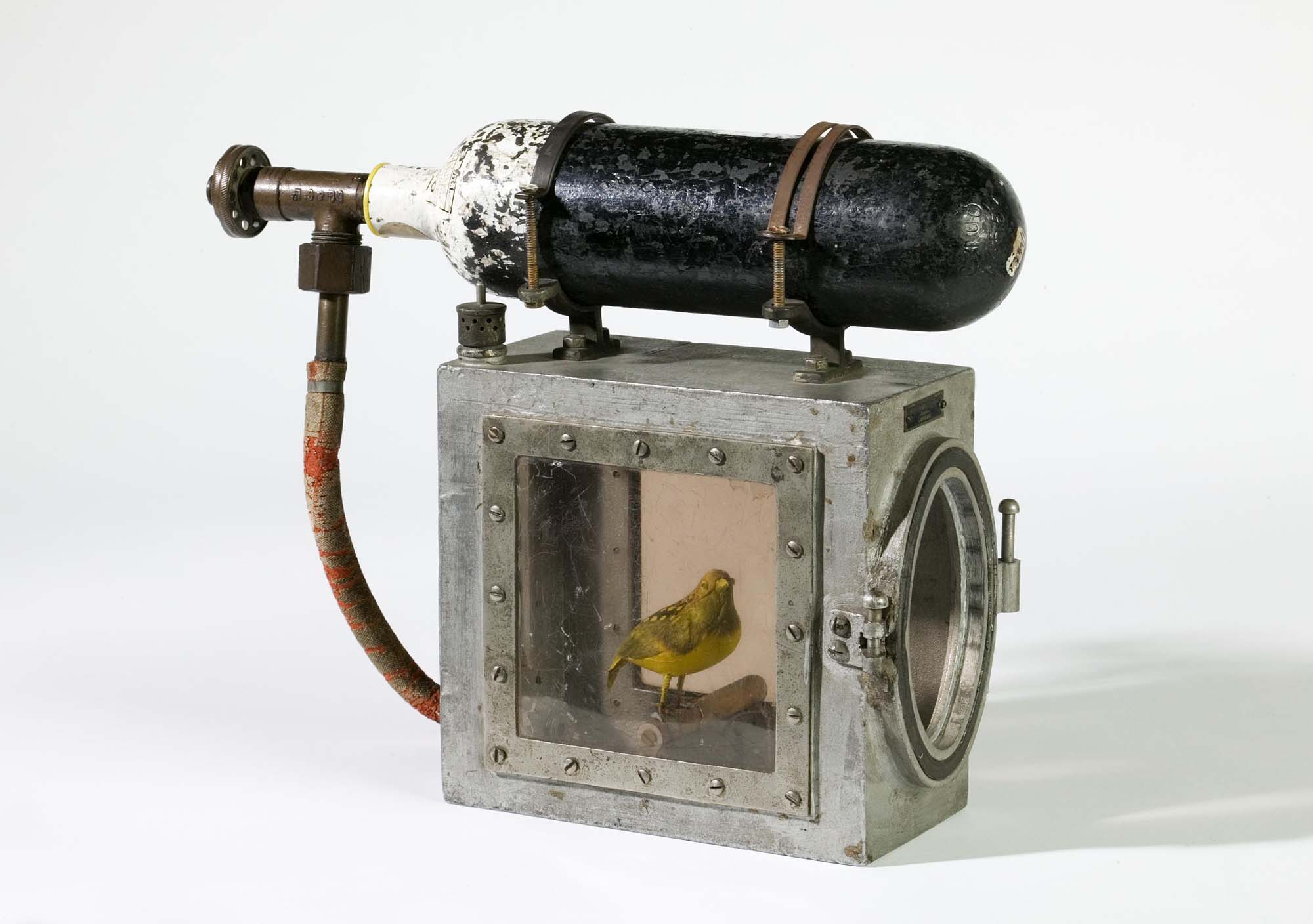
Lewis Pollard, the curator of the Museum of Science and Industry in Manchester, England, recently highlighted his favorite object in his museum’s collections–this gadget, created circa 1896, used to resuscitate canaries in coal mines.
For about a century–from the 1890s through the 1980s–British coal miners had a tradition of lowering canaries into a coal mine to detect the presence of noxious gases. As the BBC explains, the “canary is particularly sensitive to toxic gases such as carbon monoxide which is colourless, odourless and tasteless. This gas could easily form underground during a mine fire or after an explosion. Following a mine fire or explosion, mine rescuers would descend into the mine, carrying a canary in a small wooden or metal cage. Any sign of distress from the canary was a clear signal the conditions underground were unsafe and miners should be evacuated from the pit and the mineshafts made safer.”
In deciding to send canaries into the mines, inventors came up with the somewhat humane device shown above. According to Pollard, the circular door of the cage “would be kept open and had a grill to prevent the canary [from] escaping. Once the canary showed signs of carbon monoxide poisoning the door would be closed and a valve opened, allowing oxygen from the tank on top to be released and revive the canary. The miners would then be expected to evacuate the danger area.” This practice continued for almost 100 years, until canaries officially started to get replaced by technology in 1986.
F. Scott Fitzgerald started writing in earnest at Princeton University, several of whose literary and cultural societies he joined after enrolling in 1913. So much of his time did he devote to what would become his vocation that he eventually found himself on academic probation. Still, he kept on writing novels even after dropping out and joining the Army in 1917. He wrote hurriedly, with the prospect of being shipped out to the trenches hanging over his head, but that grim fate never arrived. Instead the Army transferred him to Camp Sheridan outside Montgomery, Alabama, at one of whose country clubs young Scott met a certain Zelda Sayre, the “golden girl” of Montgomery society.
With his sights set on marriage, Scott spent several years after the war trying to earn enough money to make a credible proposal. Only the publication of This Side of Paradise, his debut novel about a literarily minded student at Princeton in wartime, convinced Zelda that he could maintain the lifestyle to which she had become accustomed. Between 1921, when they married, and 1948, by which time both had died, F. Scott and Zelda Fitzgerald lived an occasionally productive, often miserable, and always intensely compelling life together. The story of this early cultural “power couple” has an important place in American literary history, and Fitzgerald enthusiasts can now use Airbnb to spend the night in the home where one of its chapters played out.
The rentable apartment occupies part of the F. Scott Fitzgerald Museum in Montgomery, an operation run out of the house in which the Fitzgeralds lived in 1931 and 1932. For the increasingly troubled Zelda, those years constituted time in between hospitalizations. She had come from the Swiss sanatorium that diagnosed her with schizophrenia. She would afterward go to Johns Hopkins Hospital in Baltimore, where she would write an early version of her only novel Save Me the Waltz, a roman à clef about the Fitzgerald marriage. For Scott’s part, the Montgomery years came in the middle of his work on Tender is the Night, the follow-up to The Great Gatsby for which critics had been waiting since that book’s publication in 1925.
“The house dates to 1910,” writes the Chicago Tribune’s Beth J. Harpaz. “The apartment is furnished in casual 20th century style: sofa, armchairs, decorative lamps, Oriental rug, and pillows embroidered with quotes from Zelda like this one: ‘Those men think I’m purely decorative and they’re fools for not knowing better.’ ” Evocative features include “a record player and jazz albums, a balcony, and flowering magnolia trees in the yard.” It may not offer the kind of space needed to throw a Gatsby-style bacchanal — to the endless relief, no doubt, of the museum staff — but at $150 per night as of this writing, travelers looking to get a little closer to these defining literary icons of the Jazz Age might still consider it a bargain. It also comes with certain modern touches that the Fitzgeralds could hardly have imagined, like wi-fi. But then, given the well-documented tendency toward distraction they already suffered, surely they were better off without it.
Based in Seoul, Colin Marshall writes and broadcasts on cities and culture. His projects include the book The Stateless City: a Walk through 21st-Century Los Angeles and the video series The City in Cinema. Follow him on Twitter at @colinmarshall or on Facebook.
But the accompanying captions set punk’s poet laureate apart. No LOLs here. It’s clear that the award-winning author of Just Kids and M Train thinks about her content, carefully crafting each post before she publishes. Each is a bite-sized reflection, a page-a-day meditation on what it means to be alive:
Ayun Halliday is an author, illustrator, theater maker and Chief Primatologist of the East Village Inky zine. Her solo show Nurse!, in which one of Shakespeare’s best loved female characters hits the lecture circuit to set the record straight premieres in June at The Tank in New York City. Follow her @AyunHalliday.
Has the world ever known a more compellingly eccentric cultural outlet than the fringes of Los Angeles television in the 1970s and 80s? For the most part a realm of false prophets, unhinged crackpots, desperate pitchmen, and Cal Worthington, its airwaves also occasionally carried the thoughts of important minds. Take, for instance, the appearances on the public-access cable programs Psychic Phenomena: The World Beyond and Quest Four: The Fourth Dimension of none other than prolific architect-theorist-inventor Buckminster Fuller. You can watch both together, and thereby get an overview of the then already octogenarian Fuller’s life and ideas in a fairly unusual context, in the videos of the Youtube playlist above.
On both programs, the first of which aired in 1979 and the second in 1983, Fuller sits across from Damien Simpson. The founder of an organization called the Universal Mind Science Church, Simpson seems to have spent his life as something of a seeker. After time in the seminary, he lived for a period in a monastery under a vow of silence.
In the years after starting his own church, he hosted new-age television and radio programs whose guest lists included, according to his bio, everyone from Elisabeth Kübler-Ross to Dennis Weaver. But Simpson clearly considered Fuller the catch to beat them all, more than once likening himself to “a kid in a candy store” as he revels in his chance to converse with the man who thought up the geodesic dome and much else besides.
Born in the 19th century, usually dressed in a suit and tie, and constantly working on the development and application of ultra-practical ideas, Fuller hardly projected the image of a 70s new-ager. Yet he and the audiences of shows like Psychic Phenomena and Quest Four shared more than a few habits of mind. Fuller, for instance, insisted on always considering the world as not a collection of nations but one whole system (one he memorably labeled “Spaceship Earth”), an example of “holistic thinking” in the truest sense. He also believed, as he spells out in these interviews, that humanity faces an existential “final examination,” a test of our collective intellect and will to determine whether we can bring about an era — quite literally, a new age — of peace. It will demand much of us, he tells Simpson and and his viewers all across Los Angeles, not least our naiveté: “Dare to be naive. That’s the only way you’ll ever learn anything.”
Based in Seoul, Colin Marshall writes and broadcasts on cities and culture. His projects include the book The Stateless City: a Walk through 21st-Century Los Angeles and the video series The City in Cinema. Follow him on Twitter at @colinmarshall or on Facebook.
In the introduction to his sweeping History of Western Philosophy, Bertrand Russell wastes no time getting to a definition of his subject. “The conceptions of life and the world which we call ‘philosophical,’” he writes in the first sentence, “are a product of two factors: one, inherited religious and ethical conceptions; the other, the sort of investigation which may be called ‘scientific,’ using the word in its broadest sense. … Philosophy, as I shall understand the word, is something intermediate between theology and science.” (Russell makes a similar argument, in slightly different terms, in the essay “Mysticism and Logic.”)
Although this distinction between broadly “theological” and broadly “scientific” thinking may not map directly onto the modern schism between “Continental” and “Analytic” philosophy, a comparison still seems highly relevant. Though some continental thinkers may not wish to admit it, their categories and modes of reasoning—or intuiting, reflecting, speculating, etc.—derive from theological thought denuded of its specific religious content or beliefs. Or as philosopher Thomas R. Wells writes at his blog The Philosopher’s Beard, the continental proceeds from a “direct concern with the human condition, its ambition, its reflexivity, its concern with the media as well as the message.”
The analytic, on the other hand, strives for “universal scope, clarity and public accountability…. It tries to systematize knowledge” and approximate scientific methods of inquiry (which also once mixed freely with the theological). Both approaches can move too close to the poles Russell identifies—can move too far away, that is, from philosophy and toward the obscure and purely mystical or the inhumanely, unreflectively rational. Perhaps one way of thinking about the history of philosophy is as a dance between this play of opposites, with each approach offering a corrective to the other’s excesses, sometimes within the same thinker’s body of work.
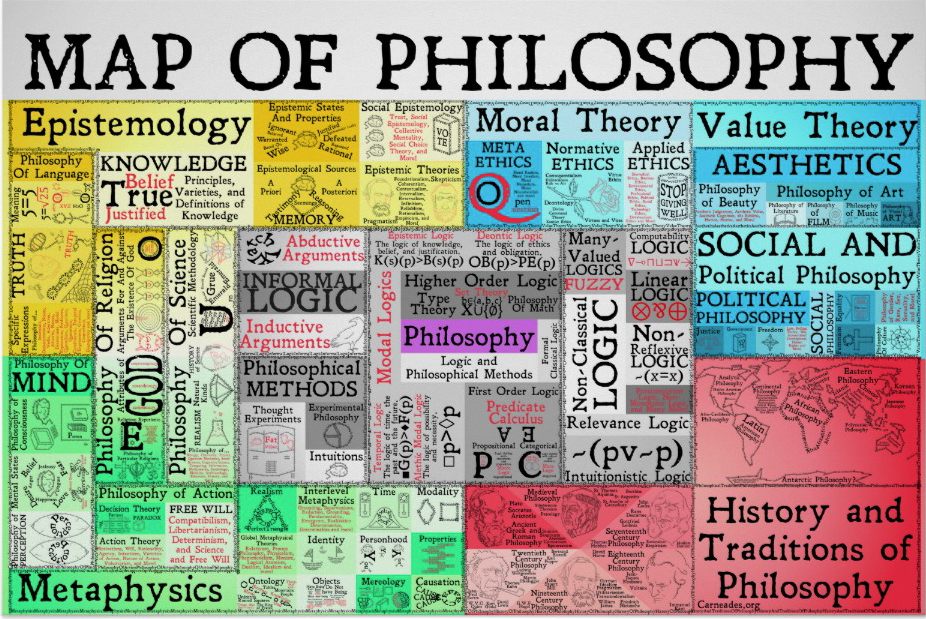
But before applying such abstractions, we should consider the ways philosophy developed as a discipline distinct from the hard sciences and theology—and from art, psychology, anthropology, physics, mathematics, linguistics, economics, etc. “Once upon a time,” notes the video at the top—a comprehensive “map of philosophy” made by Carneades.org— “Philosophy was anything you can study. Everything in the realm of study was a type of philosophy.” The breaking off of other fields into their own domains happened over the course of several hundred years. Nonetheless, “philosophy still had its fingers in all of those other pies.”
One can think philosophically about anything—philosophy can “put different disciplines on the same playing field to talk to each other.” It is, the video’s introduction declares, “the glue that holds all of academia together” (hence, the top academic degree, the Ph.D., or “doctor of philosophy”). For reasons of his own training, the video’s creator, who simply goes by the pseudonym “Carneades,” leans more heavily on the analytic side of things, neglecting or only lightly touching on much of the continental thought that flourished in the wake of Heidegger, Hegel, Nietzsche, Kierkegaard, Sartre, and others. (Further up, you can see a video focused on one specific school of moral philosophy—Consequentialism. See more such videos at the Carneades.org YouTube channel.)
Carneades admits his biases and blind spots and welcomes corrections from those better versed in other traditions. To his credit, he includes Native American, African, Latin American, Afro-Caribbean, Polynesian, Japanese, Islamic, Tibetan, and many other global philosophical traditions in his extensive map—traditions that are usually completely ignored or deemed “unphilosophical” in other such surveys. His sensitivity to global thought may have something to do with the fact that he is not based in a Western academic department, but in West Africa, where he does humanitarian work.
See a complete table of contents, with links to specific sections, for the lengthy “Map of Philosophy” just below, and an image of the full map just above (purchase a hard copy here). Carneades’ intention to bring “these ideas back to the modern agora from the Ivory Tower” is a noble one. If you agree, and find these videos informative and intellectually stimulating, you can donate to or become a patron of his efforts at the Carneades.org Patreon page.
Table of Contents:
00:00 Introduction 01:44 Logic and Philosophical Methods 02:14 Formal Classical Logic 04:55 Non-Classical Logic 06:35 Informal Logic 08:00 Philosophical Methods 10:20 The History of Philosophy 13:30 Philosophical Traditions Around the World 20:55 Aesthetics 22:35 Political Philosophy 23:34 Social Philosophy 25:00 Moral Theory & Ethics 28:08 Epistemology 30:34 Metaphysics 34:13 Philosophy of Science 37:35 Philosophy of Religion 40:17 Philosophy of Language 41:58 Philosophy of Mind 43:49 Philosophy of Action 44:57 Full Map
Most of us got hooked up to the internet in the 1990s or thereabouts, though the true early adopters did it when personal computers first blew up in the 1980s. But certain Canadian households got online even earlier, in the late 1970s, although not quite on the internet as we know it: they had Telidon, a phone line-connected videotex/teletex system that used a regular television as a display. “It is no exaggeration to say that the telecommunications marketplace in Canada was gripped by Telidon fever from late 1979 to late 1982,” writes Donald Gilles in the Canadian Journal of Communications. Fueling that fever was “hope and belief in technology – science-based technology – as an agent of change, a bringer of novelty, and enhancer of life.”
When it first came available, Telidon’s content providers included “corporations and interests such as The Bay, Encyclopedia Britannica and the Toronto Star,” writes the CBC’s Chris Hampton, but “a community of arts-minded electronics wonks, telecom prophets and other curious sorts coalesced around it, embracing it as an art medium.”
You can see some of those Telidon creators interviewed in the short Motherboard documentary at the top of the post. While businesses experimented with possibilities of banking and shopping through the system, artists pushed its boundaries even further, using its now severe-seeming technological limitations as a catalyst for visual creativity. On some months, artist Bill Perry’s Telidon magazine Computerese drew more viewers than every other provider combined.
Now, more than 30 years after its discontinuation, Telidon has attracted attention again. It turns out that its early-computer-art aesthetic has aged quite well, as seen in the examples now being pulled from the archives and Instagrammed by Toronto new-media center InterAccess. Originally founded to make Telidon development tools available to the artist community, InterAccess launched this social media project as a way of celebrating its own 35th birthday. Looking back on all the uses artists found for Telidon — everything from abstract quasi-animations to a study of perspectives on the Cold War — we can imagine how comparatively boundless the modern internet would have seemed to them. But we might also wonder what that modern internet would look like if it had a little more of their artistically and technologically adventurous spirit.
Based in Seoul, Colin Marshall writes and broadcasts on cities and culture. His projects include the book The Stateless City: a Walk through 21st-Century Los Angeles and the video series The City in Cinema. Follow him on Twitter at @colinmarshall or on Facebook.
One brisk thumping by a natural disaster, totalitarian regime, or terrorist group is more than enough to reduce an awe-inspiring heritage site to rubble.
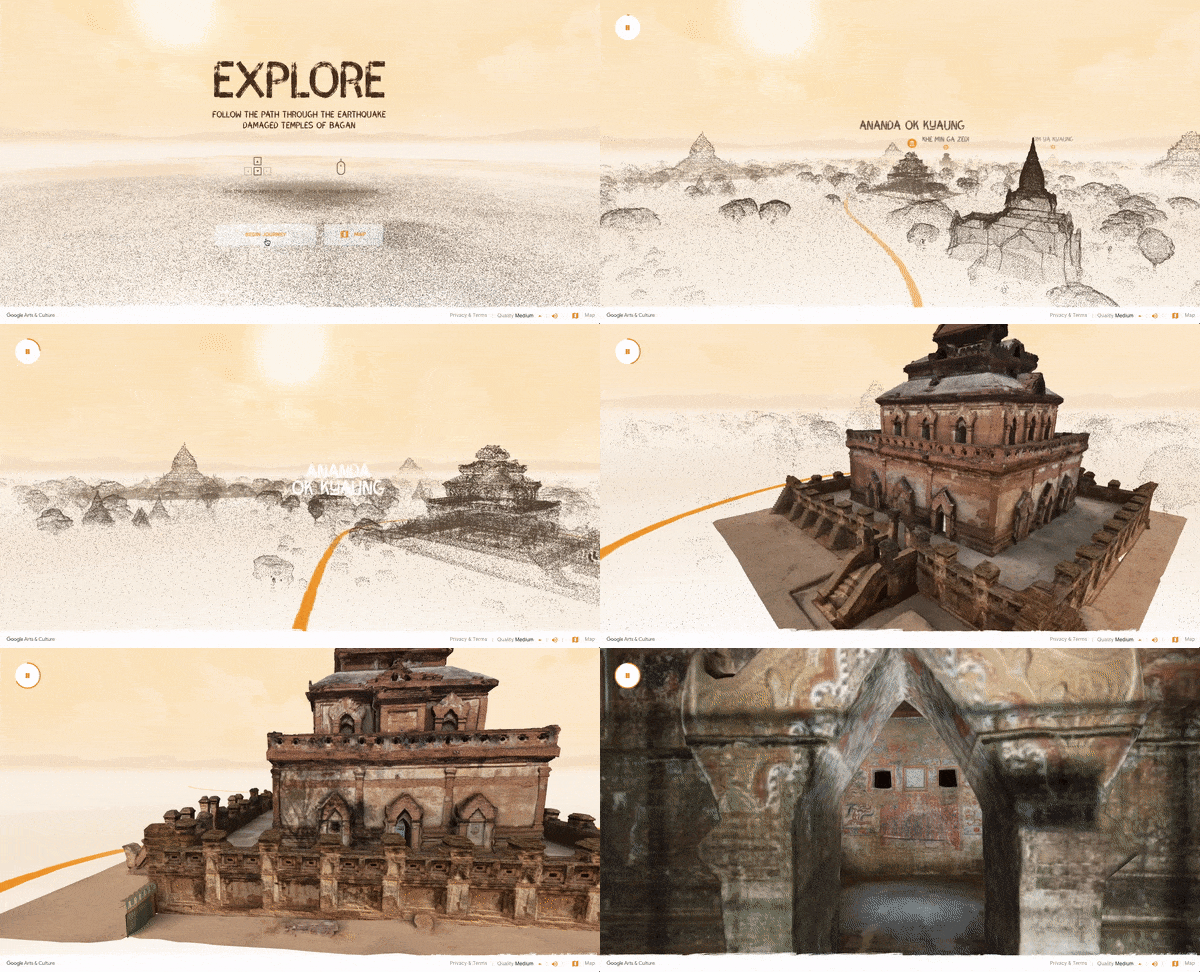
With that sad fact in mind, Google Arts & Culture has paired with CyArk, a non profit whose mission is using the latest technologies to digitally document and preserve the world’s significant cultural heritage in an easily shareable format.
The resulting project, Open Heritage, is a massive browsable collection of 3D heritage data, already the largest of its kind, and certain to increase as its creators race against the clock.
As of this writing, visitors can explore 3D models of 27 heritage sites from 18 countries.
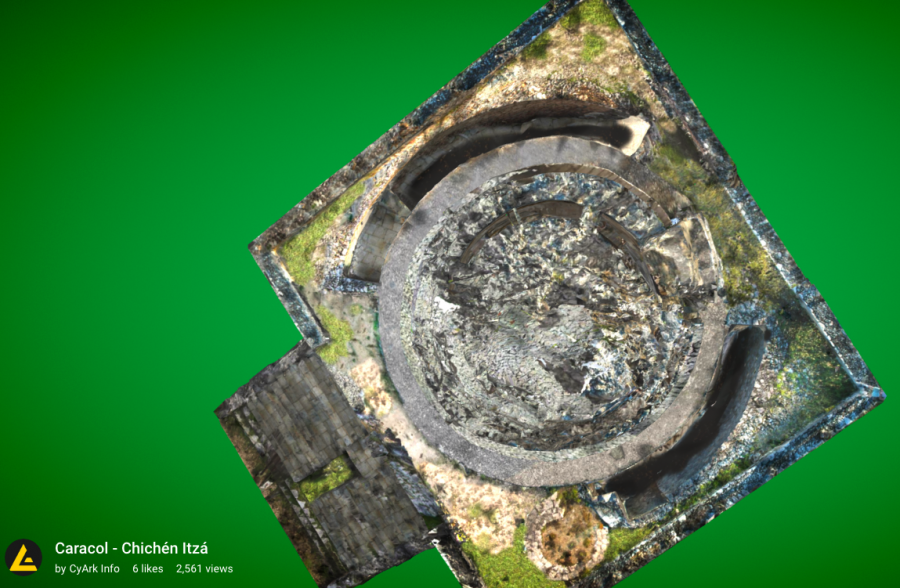
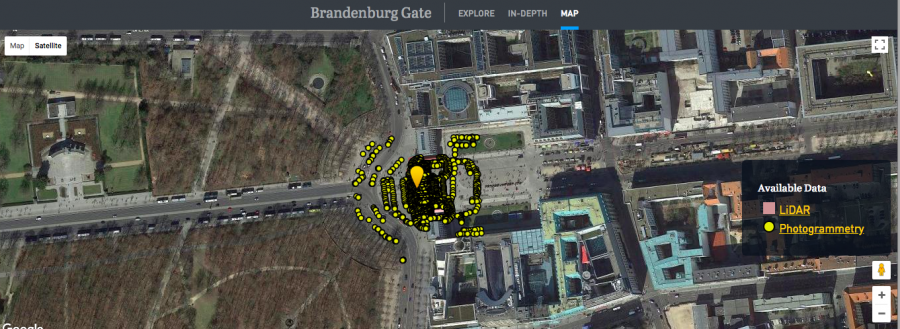
Even those of us who’ve had the good fortune to visit these sites in person have much to gain from the drone’s eye view of the Caracol observatory that’s part of Mexico’s ancient Mayan metropolis Chichén Itzá or Berlin’s iconic Brandenburg Gate.
Each model is accompanied by an expedition overview that details the site’s history and significance, as well as its location on a map. Time lapse photos help give a sense of the site’s human traffic during the time it was being documented, as well as the nature of the work CyArk does on location. Significant details are highlighted, and their symbolism discussed.
Equally important is the role these comprehensive 3D scans can play in current and future restoration efforts, by identifying areas of damage and documenting existing color and texture with down-to-the-millimeter precision.
Learn more about aerial photogrammetry, 3D laser scanning, stereoscopic 360 imagery, and other tools of the digital preservation trade here.
And stay abreast of CyArk’s work by subscribing to their free monthly newsletter here.
Ayun Halliday is an author, illustrator, theater maker and Chief Primatologist of the East Village Inky zine. Her solo show Nurse!, in which one of Shakespeare’s best loved female characters hits the lecture circuit to set the record straight premieres in June at The Tank in New York City. Follow her @AyunHalliday.
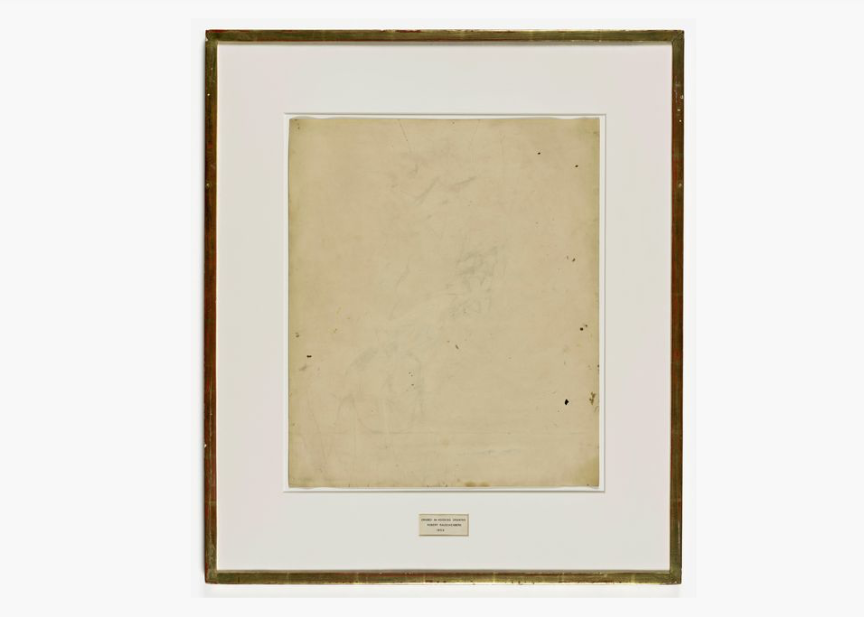
How to make a name for oneself in the art world? Every up-and-coming artist has to face that intimidating question in one way or another, but Robert Rauschenberg, now remembered as a leading light of the pop art movement, came up with a particularly memorable answer. When in 1953 he got the counterintuitive idea to make a drawing not by drawing, but by erasing, he at first tried erasing images he’d drawn himself. This brought him to the realization that not only should his erasing constitute more than half the process — “I wanted it to be the whole,” he later said — but that, to make a real artistic impact, he’d have to erase the work of someone important.
The logical choice at the time: Willem de Kooning, then already considered a master of abstract expressionism. “I bought a bottle of Jack Daniels and went up and knocked on his door, praying the whole time that he wouldn’t be home,” says Rauschenberg in the interview clip above, “but he was home.” Eventually he sold the older and more eminent artist on the idea of taking a drawing, erasing it, and turning that into art of his own, a pitch no doubt assisted by Rauschenberg and de Kooning’s already friendly relationship. (The already vast difference between their artistic styles also took the notion of artistic patricide out of the question.)
De Kooning at first resisted, but then doubled down: “I want it to be something I’ll miss,” Rauschenberg remembers him saying before picking out the sacrifice.Erased de Kooning Drawing, the result of two months of erasing and countless spent erasers, “essentially remained an underground, art world phenomenon for more than ten years after it was completed.” So writes SFMOMA curator Sarah Roberts in an essay on the piece. “Significantly, it was excluded from numerous important solo and group exhibitions in the late 1950s and early 1960s, crucial years when Rauschenberg’s reputation was becoming established internationally.”
But slowly, over the years, word spread through the art media and social scenes, and now the 27-year-old Rauschenberg’s brazen artistic act has a place among the progenitors of conceptual art. “Yes, the erasure was an act of destruction,” writes Roberts, “but as a creative gesture it was also an act of reverence or even devotion—to de Kooning, to drawing, to art history, and to the idea of taking a risk and being open to whatever comes as a result.” Though practically unknown for quite a long time, Erased de Kooning Drawing can now hardly be forgotten — which takes erasing a respected forebear’s work off the table as a means of name-making for young artists today, each of whom will have to find their own way to set off a slow-burn shock.
Based in Seoul, Colin Marshall writes and broadcasts on cities and culture. His projects include the book The Stateless City: a Walk through 21st-Century Los Angeles and the video series The City in Cinema. Follow him on Twitter at @colinmarshall or on Facebook.
We're hoping to rely on loyal readers, rather than erratic ads. Please click the Donate button and support Open Culture. You can use Paypal, Venmo, Patreon, even Crypto! We thank you!
Open Culture scours the web for the best educational media. We find the free courses and audio books you need, the language lessons & educational videos you want, and plenty of enlightenment in between.