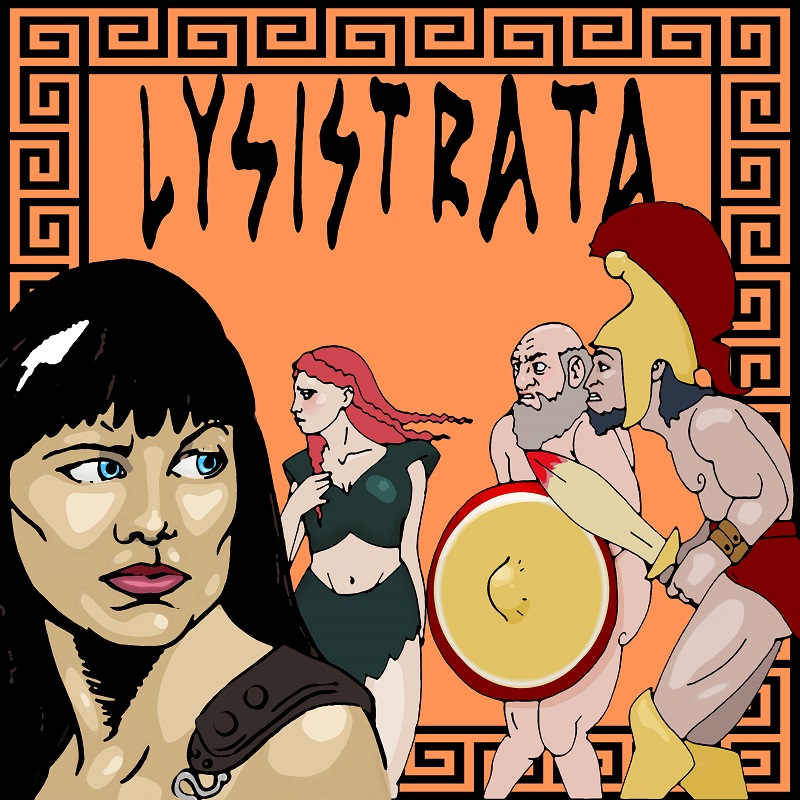
Remember Lucy, aka Xena the Warrior Princess, perhaps better known to younger folks as Ron Swanson’s (eventual) wife on Parks and Recreation? Before her career re-launched via major roles on Spartacus, Salem, and Ash vs. Evil Dead, she took some time off to study philosophy and so got involved with The Partially Examined Life Philosophy Podcast, which is coming up on its 10th birthday and has now been downloaded more than 25 million times.
She has now joined the gang for cold-read on-air performances with discussions of Sartre’s No Exit, Sophocles’s Antigone, and most recently Aristophanes’s still-funny proto-feminist comedy Lysistrata. For the discussion of this last, she was joined by fellow cast member Emily Perkins (she played the little girl on the 1990 TV version of Stephen King’s “IT”) to hash through whether this story of stopping war through a sex-strike is actually feminist or not, and how it relates to modern politics. (For another take on this, see Spike Lee’s 2015 adaptation of the story for the film Chi-Raq.)
And as a present to bring you into the New Year, she provided lead vocals on a new song by PEL host Mark Linsenmayer about the funky ways women can be put on a pedestal, projected upon, unloaded upon, and otherwise not treated as quite human despite the intention to provide affection. Stream it right below. And read the lyrics and get more information on bandcamp.com.
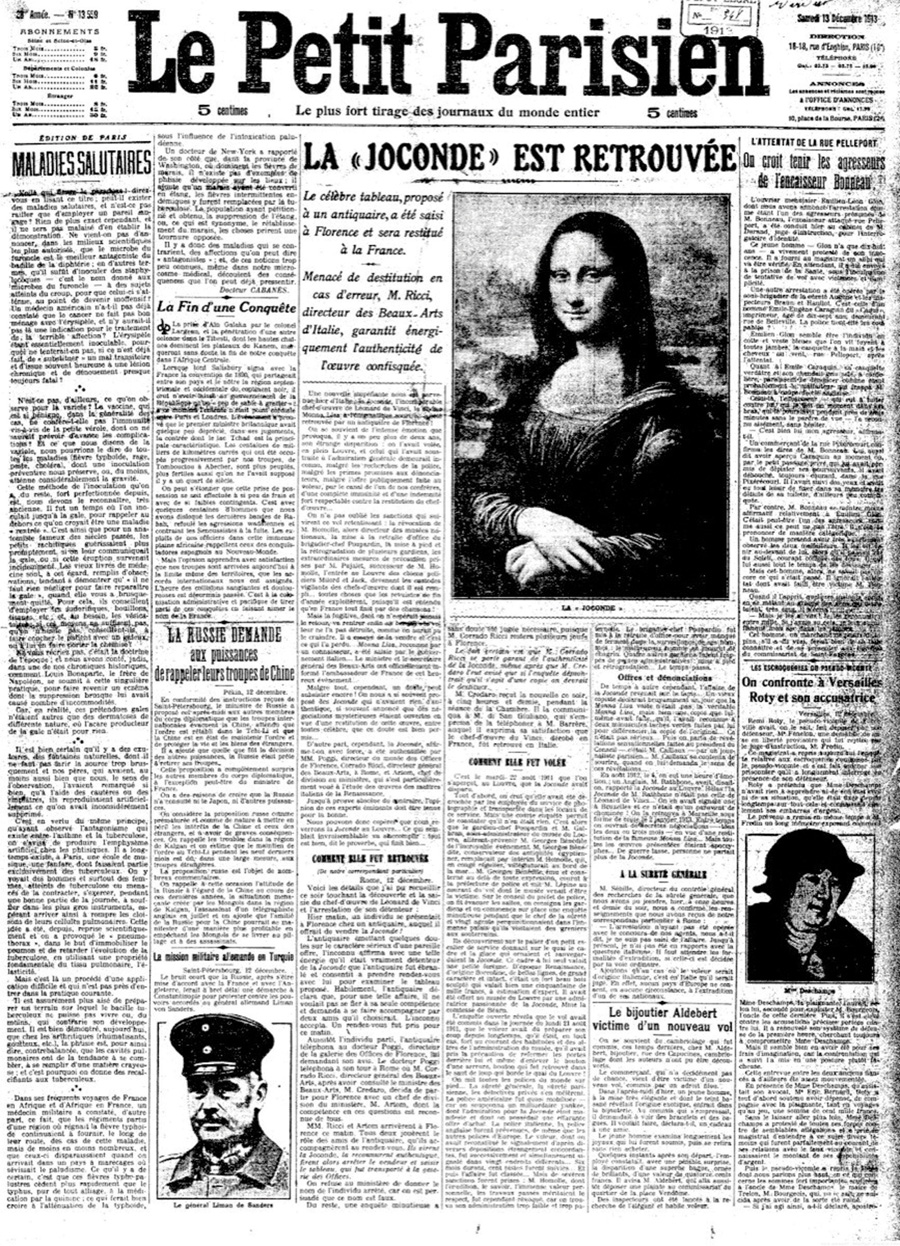
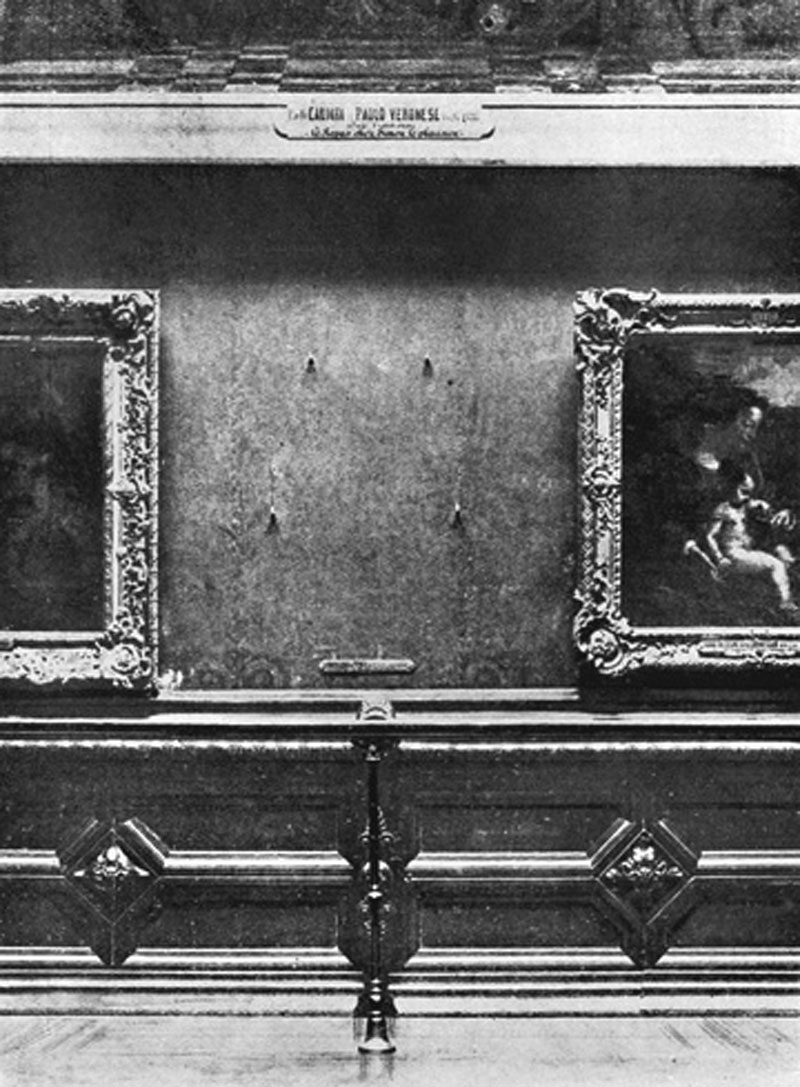
If you visit the Louvre today, you’ll notice two phenomena in particular: the omnipresence of security, and the throng of visitors obscuring the Mona Lisa. If you’d visited just over a century ago, neither would have been the case. And if you happened to visit on August 22nd, 1911, you wouldn’t have encountered Leonardo’s famed portrait at all. That morning, writes Messy Nessy, “Parisian artist Louis Béroud, famous for painting and selling his copies of famous artworks, walked into the Louvre to begin a copy of the Mona Lisa. When he arrived into the Salon Carré where the Da Vinci had been on display for the past five years, he found four iron pegs and no painting.”
Béroud “theatrically alerted the sleepy guards who fumbled around for several hours under the assumption the painting might have been borrowed for cleaning or photographing, until it was finally confirmed the Mona Lisa had been stolen.”
The immediate measures taken: “The Louvre was closed for an entire week, museum administrators lost their jobs, the French borders were closed as every ship and train was searched and a reward of 25,000 francs was announced for the painting.”
High on the list of suspects, thanks to the word of an art thief not involved in the heist named Joseph Géry Pieret: none other than Pablo Picasso and Guillaume Apollinaire. Confessing to his habit of purloining small items from the Louvre, which then took no great pains to protect the cultural assets within its walls, Pieret informed the police that he had sold a couple of small Iberian statues to a “painter-friend.” Pieret, writes Artsy’s Ian Shank, “had left a clue — a nom de plume in one of his published confessions, pulled straight from the writings of avant-garde poet Apollinaire. (As police would later discover, Pieret was in fact the writer’s former secretary.)”
As the powers that be knew, “Apollinaire was a devout member of Picasso’s modernist entourage la bande de Picasso — a group of artistic firebrands also known around town as the ‘Wild Men of Paris.’ Here, police believed, was a ring of art thieves sophisticated enough to swipe the Mona Lisa.” Though the Spanish-born painter and Italian-born poet had nothing to do with the theft of the Mona Lisa, Picasso had indeed bought those stolen sculptures from Pieret, and in a panic nearly threw them into the Seine.
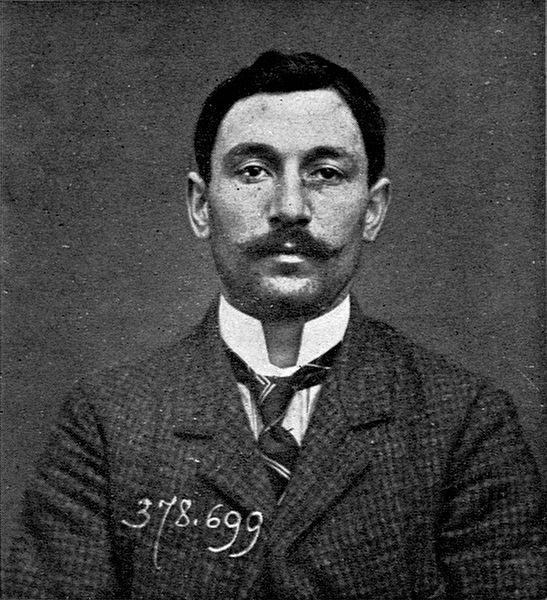
“Apollinaire confessed to everything,” writes Shank, while Picasso “wept openly in court, hysterically alleging at one point that he had never even met Apollinaire. Deluged with contradictory and nonsensical testimony the presiding Judge Henri Drioux threw out the case, ultimately dismissing both men with little more than a stern admonition.” Two years later, the identity of the real Mona Lisa thief came to light: a Louvre employee named Vincenzo Peruggia (shown right above), who had easily smuggled the canvas out and kept it in a trunk until such time — so he insisted — as he could repatriate the masterpiece to its, and his, homeland.
All this makes for an entertaining chapter in the history of art crime, but if you still believe that Picasso must have had a hand in the Mona Lisa’s disappearance, have a look at “All the Evidence That Picasso Actually Stole the Mona Lisa.” Compiled by the Huffington Post’s Sara Boboltz, the list includes such facts as “He was living in France at the time,” “He’d technically purchased stolen artworks before” — those little Iberian sculptures — and “He loved art, duh.” None could deny that last point, just as none could deny the Mona Lisa’s enduring status as something of a Holy Grail for art thieves. But what modern-day Peruggia — or Picasso, or Apollinaire, or as some theories hold, Béroud — would dare make an attempt on it now?
Based in Seoul, Colin Marshall writes and broadcasts on cities, language, and culture. His projects include the book The Stateless City: a Walk through 21st-Century Los Angeles and the video series The City in Cinema. Follow him on Twitter at @colinmarshall or on Facebook.
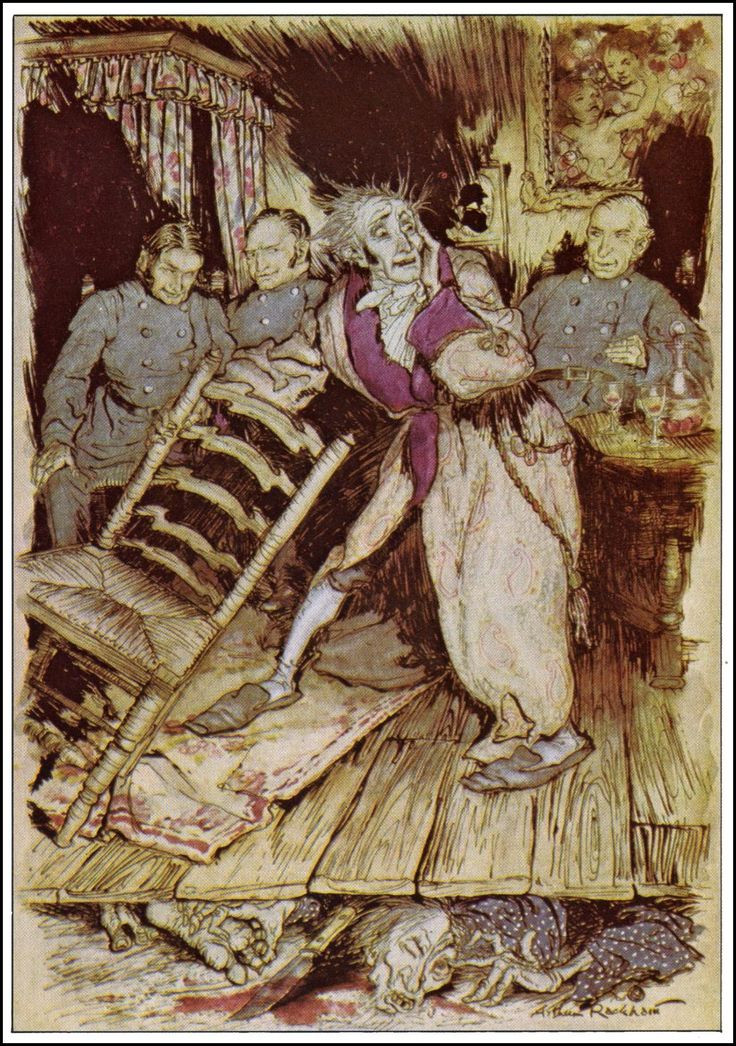
What do you see when you read the work of Edgar Allan Poe? The great age of the illustrated book is far behind us. Aside from cover designs, most modern editions of Poe’s work circulate in text-only form. That’s just fine, of course. Readers should be trusted to use their imaginations, and who can forget indelible descriptions like “The Tell-Tale Heart”’s “eye of a vulture—a pale, blue eye, with a film over it”? We need no picture book to make that image come alive.
Yet, when we first discover the many illustrated editions of Poe published in the late 19th and early 20th centuries, we might wonder how we ever did without them. A copy of Tales of Mystery and Imaginationillustrated by Arthur Rackham in 1935 (above) served as my first introduction to this rich body of work.
Known also for his editions of Peter Pan, The Wind in the Willows, Grimm’s Fairy Tales, and Alice in Wonderland, Rackham’s “signature watercolor technique” was “always in high demand,” Sadie Stein writes at The Paris Review.
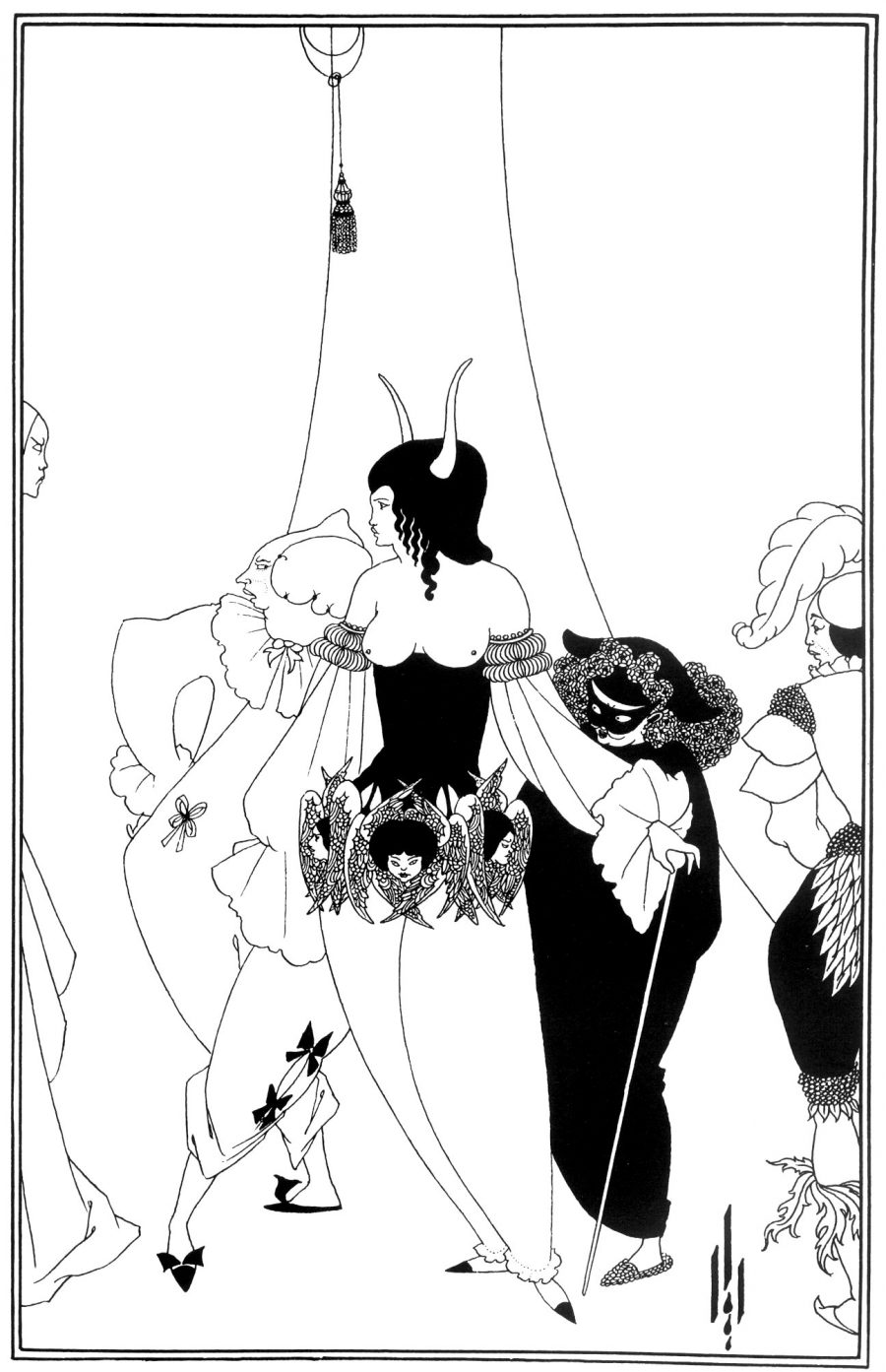
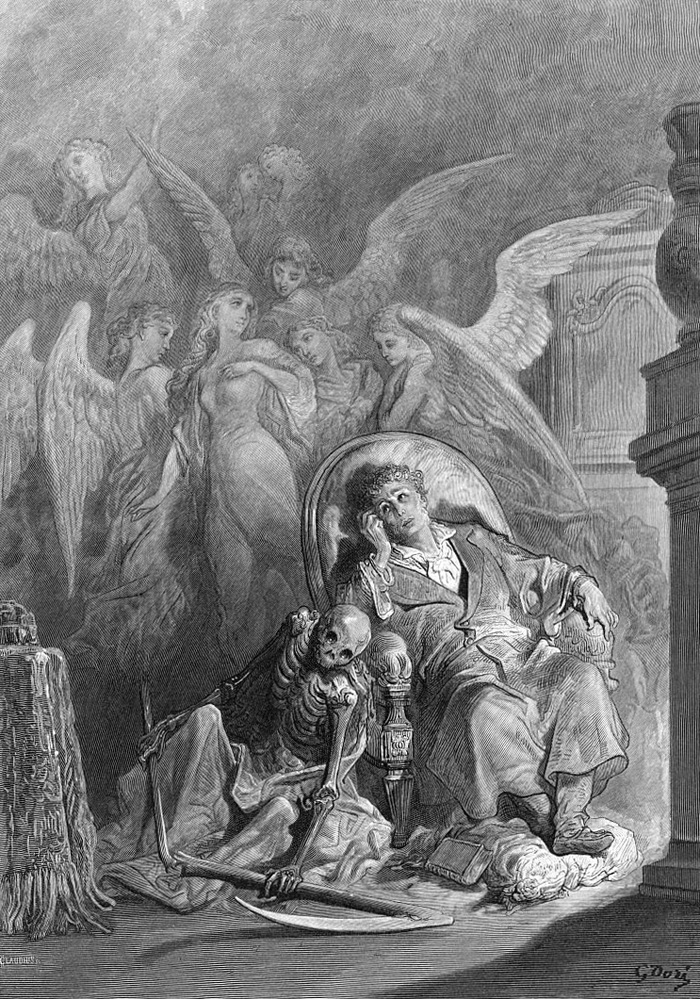
Sometime later, I came across the 1894 Symbolist illustrations of Aubrey Beardsley, and for a while, when Poe came to mind so too did Beardsley’s sensually creepy prints, influenced by Japanese woodcuts and Art Nouveau posters. His stylized take on Poe, notes Print magazine, offers “a very different aesthetic from the works of his predecessors.” Most prominent among those earlier illustrators was the hugely prolific Gustave Doré, whose classical renderings of the Divine Comedyand Don Quixotemay have few equals in a field crowded with illustrated editions of those books.
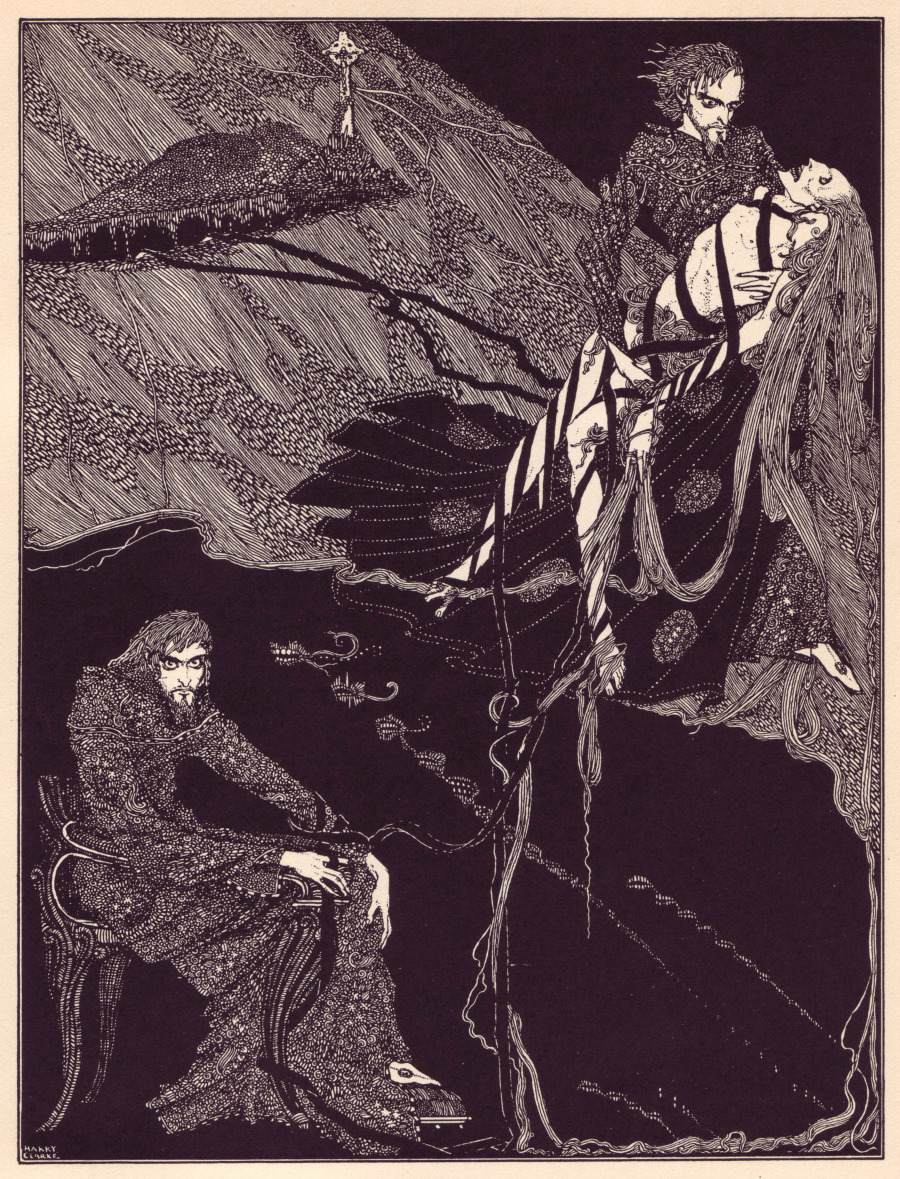
But for me, there’s something lacking, in the 26 steel engravings Doré made for an 1884 edition of Poe’s “The Raven.” They are, like all of his work, classically accomplished works of art. But unlike Beardsley, Doré seems to miss the strain of absurdism and dark humor that runs through all of Poe’s work (or at least the way I’ve read him), though it’s true that “The Raven” relies on atmosphere and suggestion for its effect, rather than torture, murder, and plague. In the later, 1923 edition of Tales of Mystery and Imagination illustrated by Irish artist Harry Clarke, we find the best qualities of Beardsley and Doré combined: finely-detailed, fully-realized scenes, suffused with gothic sensuality, symbolism, grotesque weirdness, and an almost comically exaggerated sense of dread.
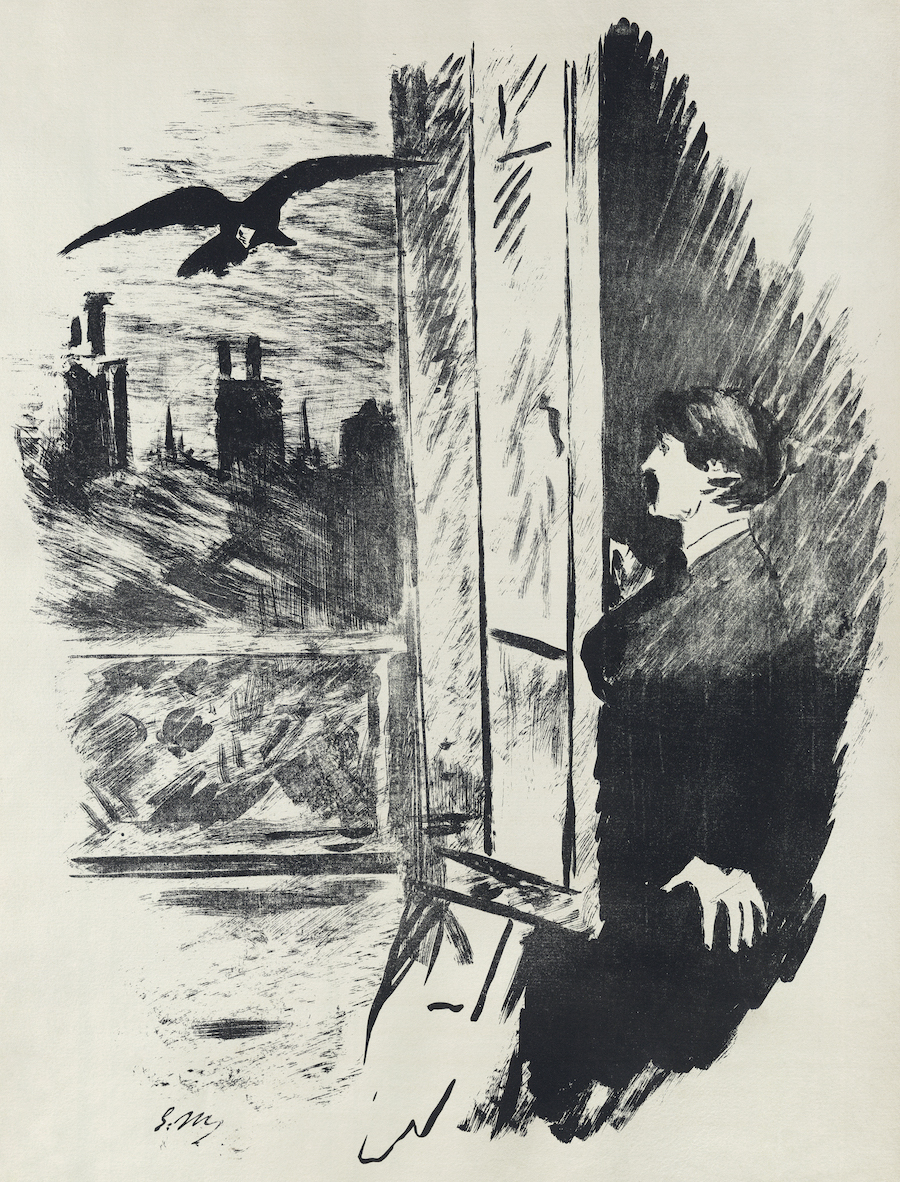
Poe significantly influenced the poetry of Charles Baudelaire and Stéphane Mallarmé, and Clarke foregrounds in his work many of the qualities those poets did—the tangling up of sex and death in images that attract and repulse at the same time. Early Impressionist master Édouard Manet also illustrated an 1875 edition of “The Raven,” translated into French by Mallarmé. Manet draws the French poet/translator as the speaker of the poem (recognizable by his pushbroom mustache).
Manet’s minimal drawings of the poem contrast starkly with Doré’s elaborate engravings. Just as readers might imagine Poe’s macabre stories in innumerable ways, so too the artists who have illustrated his work. See contemporary illustrations for “The Tell-Tale Heart,” for example, by South African artist Pencilheart Art and Brooklyn-based illustrator Daniel Horowitz, and recommend your favorite Poe artist in the comments below.
Maybe it’s too soon to divide pop music history into “Before David Bowie” and “After David Bowie,” but two years after Bowie’s death, it’s impossible to imagine pop music history without him. Yet, if there ever did come a time when future generations did not know who David Bowie is, they could do far worse than hear Gary Oldman tell the story. Luckily for them, and us, Oldman narrates the new David Bowie augmented reality app, which launches today on what would have been the legend’s 72nd birthday.
Bowie and Oldman were both born and raised in South London. They became friends in the 80s, starred together in Julian Schnabel’s 1996 film Basquiat, and collaborated on the 2013 video for “The Next Day,” in which Oldman plays a sleazy, ducktailed priest. As much the consummate changeling in his medium as Bowie, Oldman brings a fellow craftsman’s appreciation to his role as docent, without any sense of star-struckness. “I see him less as ‘David Bowie,’” he once remarked, “and more as Dave from Brixton and I’m Gary from New Cross.”
The app is based on the sensational 2013 Victoria & Albert museum exhibition David Bowie Is, which traveled the world for five years before ending at the Brooklyn Museum this past summer. Focused on “the colourful, theatrical side of Bowie,” Tim Jonze writes at The Guardian, the show drew “a staggering 2m visitors” with its stunning breadth of costumes, props, sketches, lyrics sheets, film, and photography. The digital version intends, however, not only to “recreate the experience of going to the exhibition,” but “to better it.”
Learn how “Dave from Brixton” (or Davy Jones, before a Monkee of the same name came along) made “sketches proposing outfits for his teenage band the Delta Lemons (brown waistcoats with jeans).” See how that young aspiring crooner learned to love “hikinuki—the Japanese method of quick costume change that he experimented with during his Aladdin Sane shows at Radio City Music Hall.” The exhibition brilliantly fulfilled his own wishes for his legacy. “As Bowie himself puts it,” Jonze writes, “he didn’t want to be a radio, but a colour television.”
Bowie probably would have been pleased to have his friend Gary hosting his variety show. But does the AR app match, or better, the real thing? It’s “no match for seeing the costumes in real life,” or seeing Bowie himself in the flesh. But for the millions of people who never got the chance—a category that will soon include everyone—it may currently be the best way to experience the musician/actor/writer/one-man-zeitgeist’s career in three dimensions. See a preview of the app from Rolling Stone, above, and download the AR David Bowie Is for iPhone and Android via these links. The cost is $7.99.
These days, every cinephile can name more than a few women among their favorite living filmmakers: Sofia Coppola, Ava DuVernay, Kathryn Bigelow, Jane Campion, Agnès Varda — the list goes on. But if we look farther back into cinema history, coming up with examples becomes much more difficult. There’s Ida Lupino, previously featured here on Open Culture, whose The Hitch-Hiker made her the only female director of a 1950s film noir, but before her? No name from that early era is more important than that of Lois Weber, in some estimations “the most important female director the American film industry has known.”
Or so, anyway, says Weber’s extensive Wikipedia entry, part of the relatively recent effort to rescue from obscurity her vast body of work: a filmography estimated at between 200 to 400 pictures, almost all of them considered lost. Weber’s champions emphasize not just her prolificacy but her boldness, not just technologically and aesthetically — 1913’s Suspense, for example, pioneered the split-screen technique — but socially.
Even in its infancy, she used her medium to deal with issues like poverty, drugs, capital punishment, women in the workforce, and even contraception. (In 1915’s Hypocrites, she went as far as to include the first full-frontal female nude scene in motion pictures.)
Though born in 1879, well before the advent of cinema, Weber grew up with a surprisingly suitable background to prepare her for this kind of filmmaking. Raised strongly religious, she left the family household to take up street-corner evangelism and church-oriented social activism. Early in the 20th century she moved from her native Pittsburgh to New York, where she set her sights on singing and acting. “I was convinced the theatrical profession needed a missionary,” she later explained, and having heard that “the best way to reach them was to become one of them,” she “went on the stage filled with a great desire to convert my fellowman.”
Weber’s work in the theater opened the door to opportunities in the then-nascent movie industry. By 1914, she could confidently say in an interview that “in moving pictures, I have found my life’s work. I find at once an outlet for my emotions and my ideals. I can preach to my heart’s content, and with the opportunity to write the play, act the leading role and direct the entire production, if my message fails to reach someone, I can blame only myself.” The recent restoration of several of her surviving films has made it possible for her message to reach a century she never lived to see — and to give their viewers the chance to evaluate the claims made by film historians like Anthony Slide, who puts her alongside D.W. Griffith as “American cinema’s first genuine auteur, a filmmaker involved in all aspects of production and one who utilized the motion picture to put across her own ideas and philosophies.”
Based in Seoul, Colin Marshall writes and broadcasts on cities, language, and culture. His projects include the book The Stateless City: a Walk through 21st-Century Los Angeles and the video series The City in Cinema. Follow him on Twitter at @colinmarshall or on Facebook.
“Though hardly a cinematic masterpiece,” film critic Andre Soares writes, “or even a good film,” Al Jolson’s 1927 The Jazz Singer will forever bear the distinction of “the first time in a feature film that synchronized sound and voices could be heard in musical numbers and talking segments.” What usually goes unremarked in film history is that Indian cinema was never far behind its U.S. counterpart. The country’s first feature sound film appeared just four years after The Jazz Singer. Now lost, the love story Alam Aradebuted in March of 1931 and initiated a venerable tradition with its several songs, including the first major filmi music hit.
The movie was so popular, one historian notes, “police aid had to be summoned to control the crowds.” Its director Ardeshir Irani was inspired by another early Hollywood part-talkie musical, 1929’s Show Boat, which, like his film, used the Movietone system to record sound, rather than the Vitaphone system used in The Jazz Singer. Movietone, or Fox Movietone, as it came to be known after William Fox bought the patents in 1926, was also responsible for another early film development, the sound newsreel, a technology that made its way to India almost as soon as it debuted in the U.S.
The first sound newsreel, showing footage of Charles Lindbergh’s taking off in the “Spirit of St. Louis,” debuted in 1927 in New York. In November 1929, Fox opened the first exclusive newsreel theater on Broadway, and in January of that same year, a Movietone camera captured the street scenes of Bombay (now Mumbai) that you see above, over 13 minutes of footage complete with live audio recording of bustling crowds, busy vendors and laundry workers, honking automobiles, and clip-clopping horses.
This incredible document preserves the sights and sounds of a significant Indian slice of life from 90 years ago, and shows how early the technology for making sound films arrived on the subcontinent. When Ardeshir Irani began filming his groundbreaking musical the following year, he would use exactly this same technology, shooting all of the dialogue and music live, on a closed set late at night to avoid unwanted noise like the street sounds you hear above.
Learn more of the Fox Movietone newsreel story here, and here, learn how Indian cinema began in Mumbai in 1899 when Indian photographers, writers, theater impresarios, and entrepreneurs like Irani took the new technology and used it to build a cultural empire of their own.
“I first took on The Lord of the Rings at the age of eleven or twelve,” writes The New Yorker’s Anthony Lane. “It was, and remains, not a book that you happen to read, like any other, but a book that happens to you: a chunk bitten out of your life.” The preteen years may remain the most opportune ones in which to pick up the work of J.R.R. Tolkien, but whatever the period in life at which they find their way in, most readers who make the journey through Middle-earth never really leave the place. And it hardly requires covering much more ground to get from hungering to know everything about the world of The Lord of the Rings — one rich with its own terrain, its own races, its own languages — to hungering to know how Tolkien created it.
Now the countless Lord of the Rings enthusiasts in America have their chance to behold the materials first-hand. The exhibition Tolkien: Maker of Middle-Earth, which runs from January 25th to May 12th of this year at New York’s Morgan Library and Museum, will assemble “the most extensive public display of original Tolkien material for several generations,” drawing from “the collections of the Tolkien Archive at the Bodleian Library (Oxford), Marquette University Libraries (Milwaukee), the Morgan, and private lenders.”
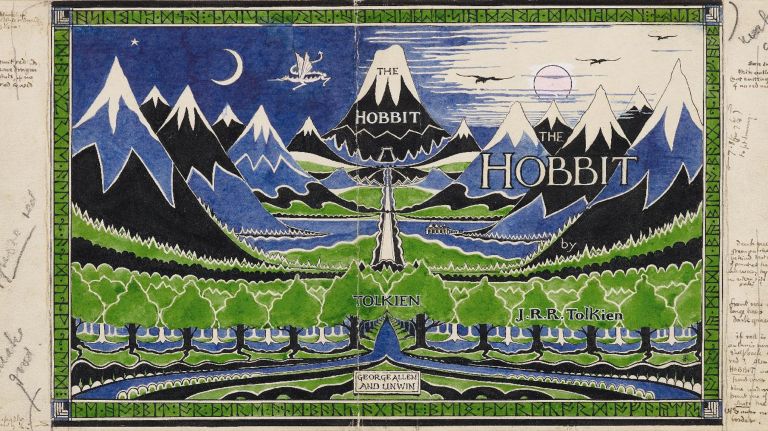
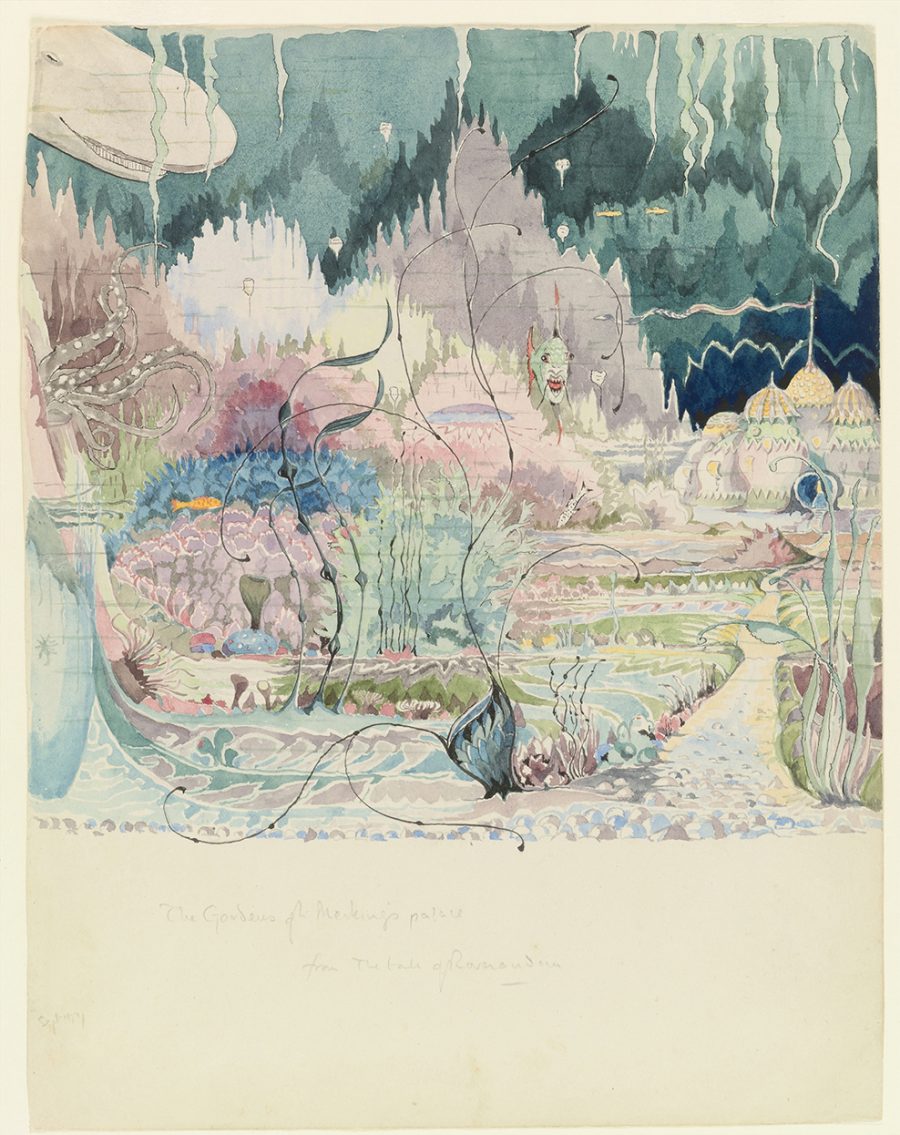
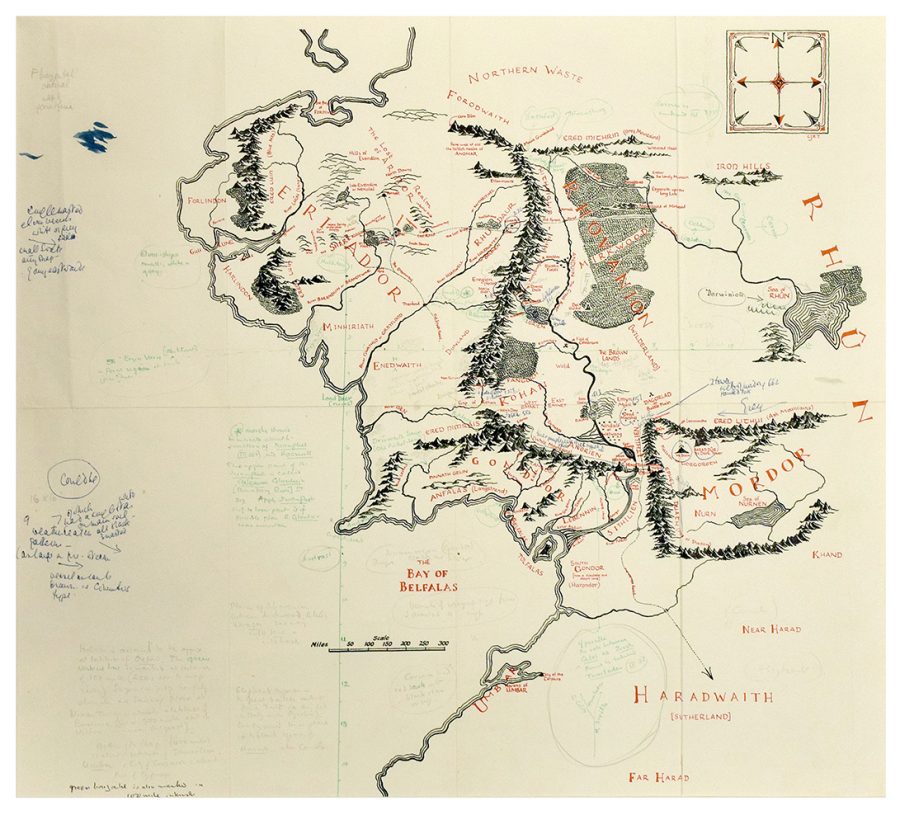
All told, it will include “family photographs and memorabilia, Tolkien’s original illustrations, maps, draft manuscripts, and designs related to The Hobbit, The Lord of the Rings, and The Silmarillion.”
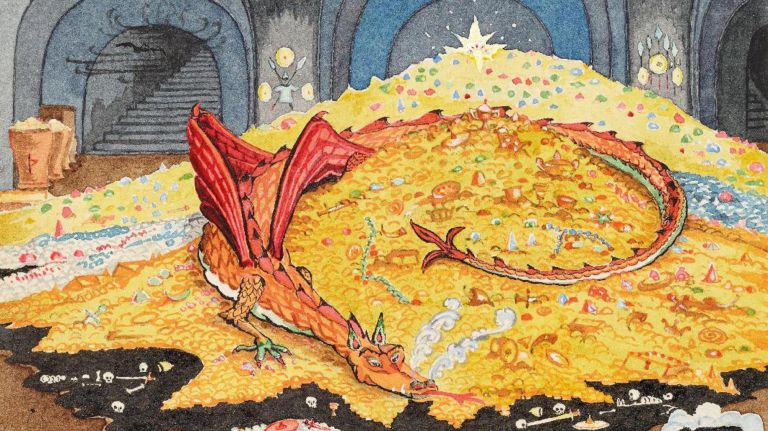
Mental Floss’ Emily Petsko also highlights the presence of “original illustrations of Smaug the dragon (from The Hobbit), Sauron’s Dark Tower of Barad-dûr (described in The Lord of the Rings and The Silmarillion), and other recognizable characters,” as well as that of Tolkien’s draft manuscripts that “provide a window into his creative process, as well as the vivid, expansive worlds he created.” You can see more of the things Tolkienian that will soon come available for public viewing at the Morgan in the exhibition’s trailer at the top of the post.
“The Lord of the Rings has remained comically divisive,” Lane writes. “It is either adored, with varying degrees of guilt, or robustly despised, often by those who have yet to open it.” But after seeing an exhibition like Tolkien: Maker of Middle-Earth, even Tolkien’s harshest critics may well find themselves persuaded to acknowledge the scale and depth of the books’ achievement, as well as the dedication and even bravery of its creator. As Lane puts it, “The Lord of the Rings may be the final stab at epic, and there is invariably something risky, if not downright risible, in a last gasp.” But “Tolkien believed that he could reproduce the epic form under modern conditions,” the fruit of that belief continues to enrapture readers of all ages more than 60 years later.
If you can’t wait for the exhibition, you might want to have a look at Wayne G. Hammond and Christina Scull’s book, J.R.R. Tolkien: Artist and Illustrator. It’s already published.
Based in Seoul, Colin Marshall writes and broadcasts on cities, language, and culture. His projects include the book The Stateless City: a Walk through 21st-Century Los Angeles and the video series The City in Cinema. Follow him on Twitter at @colinmarshall or on Facebook.
“Turkey is a geographical and cultural bridge between the east and the west,” writes Istanbul University’s Gönül Bakay. This was so long before Constantinople became Istanbul, but after the rise of the Ottoman Empire, the region took on a particular significance for Christian Europe. “The Turk” became a threatening and exotic figure in the European imagination, “shaped by a considerable body of literature, stretching from Christopher Marlowe to Thomas Carlyle.” Images of Ottoman Turkey were long drawn from a “mixture of fact, fantasy and fear.”
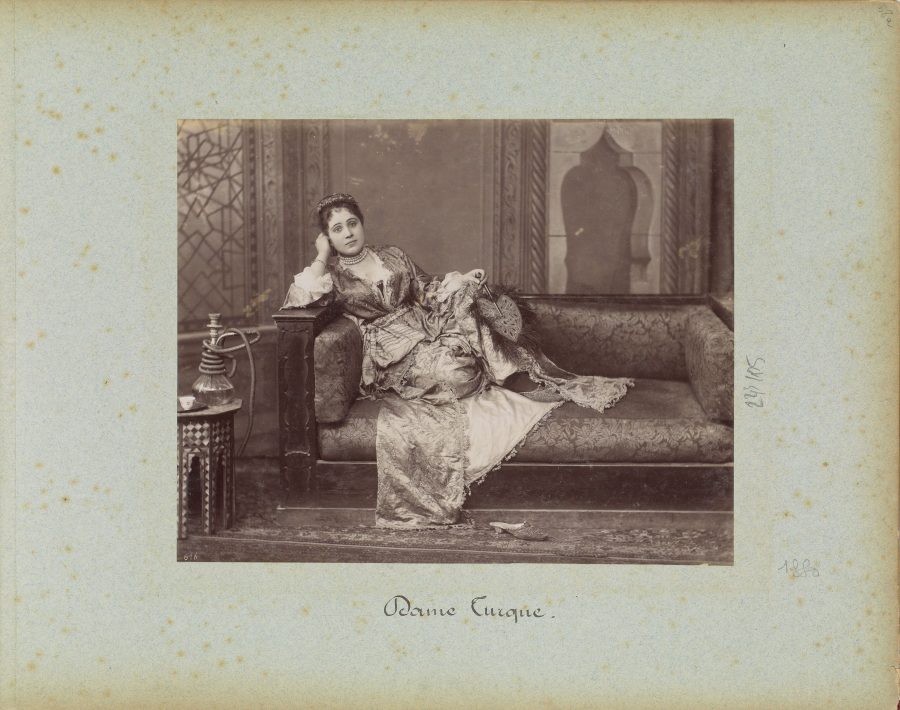
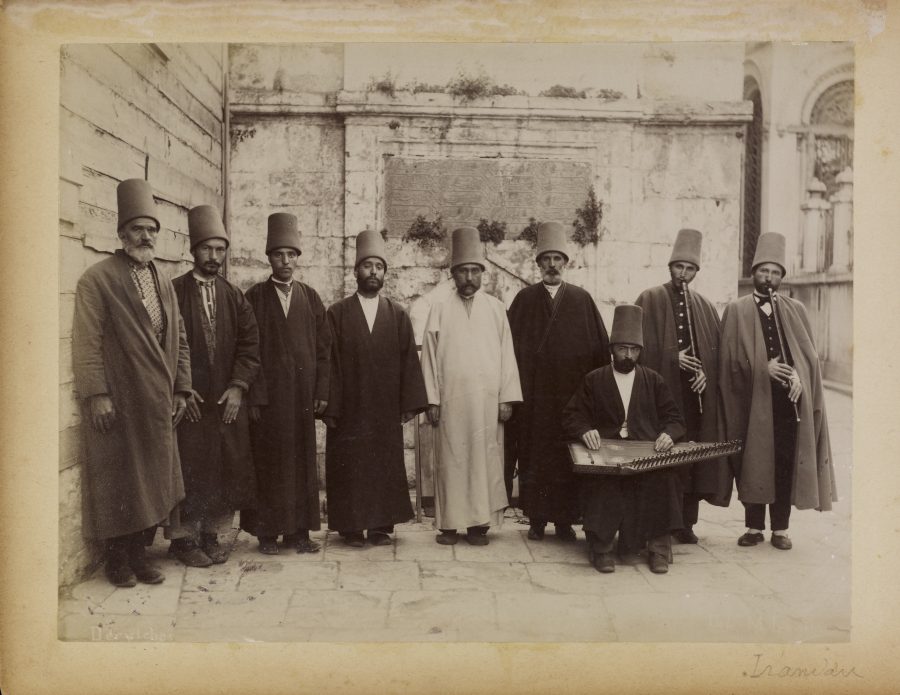
With the advent of photography in the mid-nineteenth century, those images were supplemented, illustrated, and countered by prints depicting Turkish people both in everyday life circumstances and in Orientalist poses.
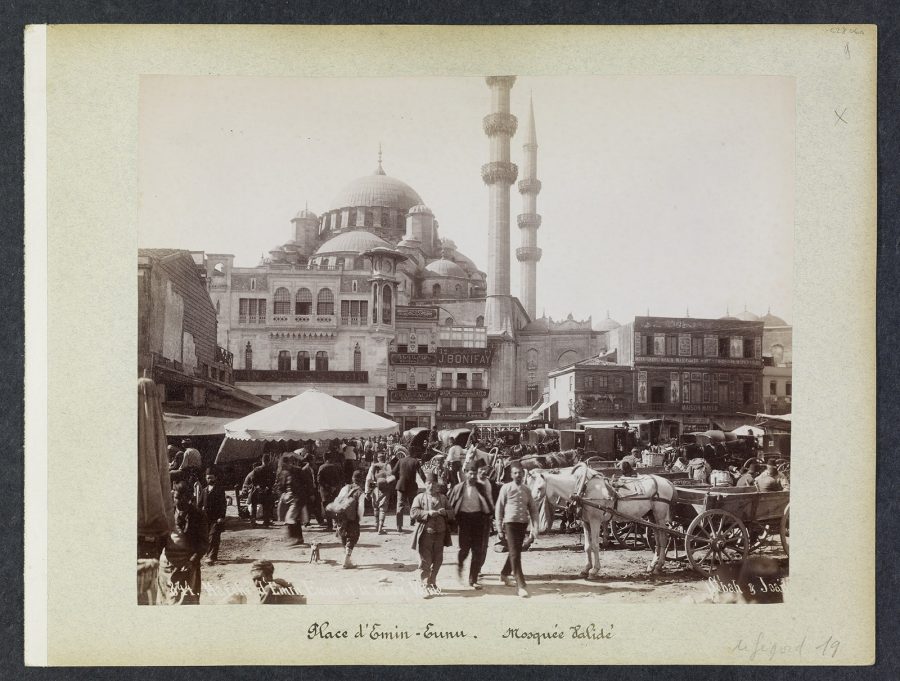
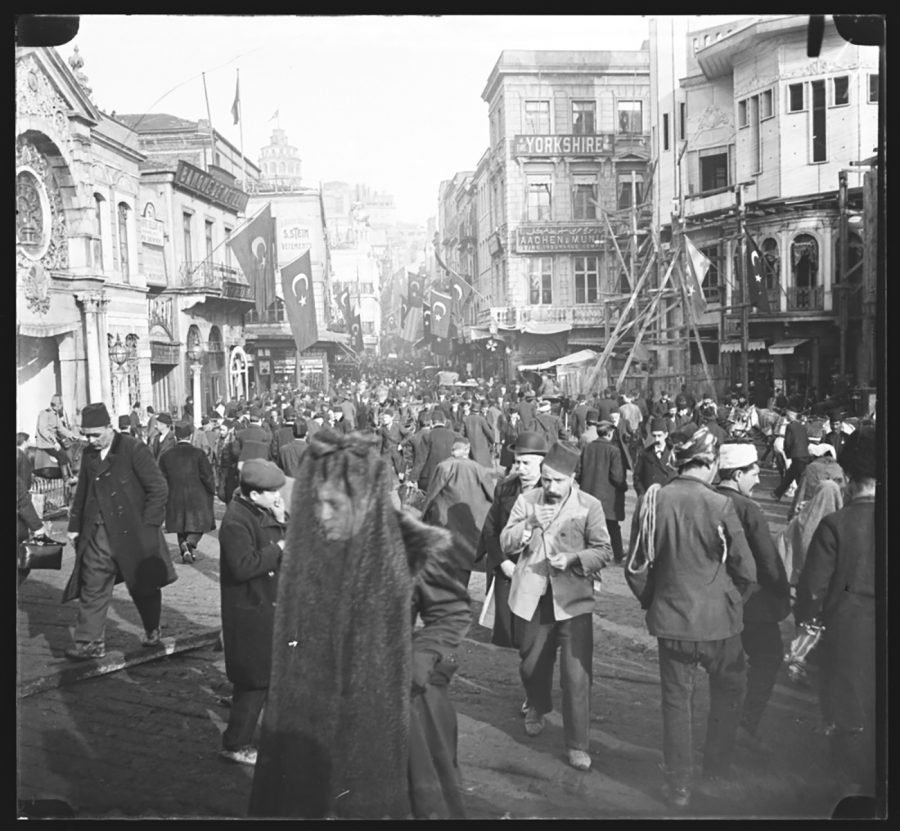
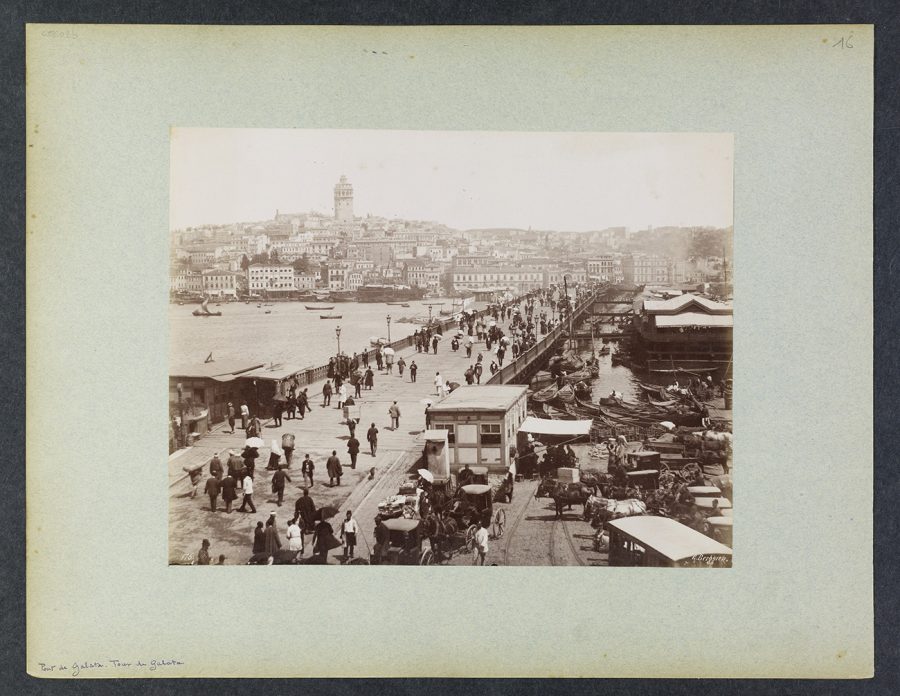
In the final decades of the Ottoman Empire, as modernization took hold all over Europe, viewers might encounter photos of women in poses reminiscent of the Odalisque and street scenes of bustling, cosmopolitan Constantinople, with signs in Ottoman Turkish, English, French, Armenian, and Greek.
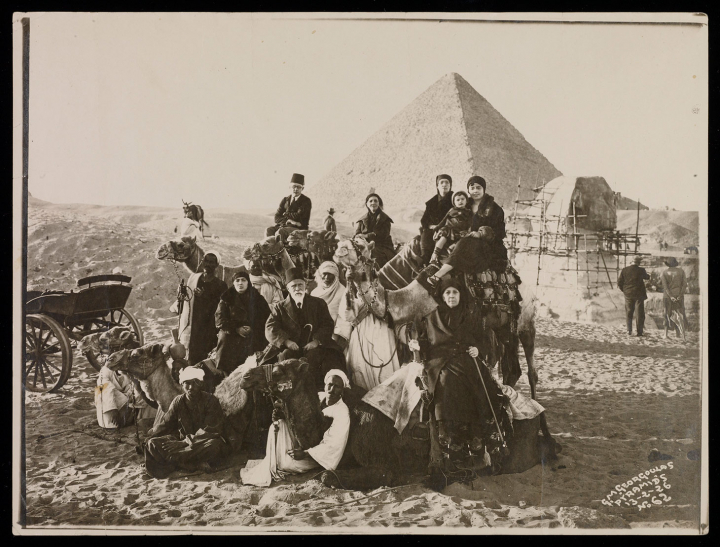
Photos of Enver Pasha—de facto ruler of the Ottoman Empire during World War I and “highest-ranking perpetrator of the Armenian genocide,” writes Isotta Poggi at the Getty’s blog—circulated alongside images like that below, a group of Turkish tourists posed near the Sphinx. These and thousands more such photographs of Ottoman Turkey at the turn of the century and into the first years of the Turkish Republic—3,750 digitized images in total—are now available to view and download at the Getty Research Institute.
The photos come from French collector Pierre de Gigord, who acquired them during his many travels through Turkey in the 1980s. They were taken by photographers, some of whose names are lost to history, from all over Europe and the Mediterranean, including Armenian photographers who played a “central role,” notes Poggi, “in shaping Turkey’s national cultural history and collective memory.” (Read artist Hande Sever’s Getty essay on this subject here.) The huge collection contains “landmark architecture, urban and natural landscape, archeological sites of millennia-old civilizations, and the bustling life of the diverse people who lived over 100 years ago.”
Despite the loss of materiality in the transfer to digital, a loss of “formatting, or sense of scale” that changes the way we experience these photos, they “enable us to learn about the past,” writes Poggi, “seeing Turkey’s diverse society” as photography’s early viewers did, and to better understand the present, “observing how certain sites and people, as well as social or political issues, have evolved yet still remain the same.” Enter the Pierre de Gigord collection at the Getty here.
We're hoping to rely on loyal readers, rather than erratic ads. Please click the Donate button and support Open Culture. You can use Paypal, Venmo, Patreon, even Crypto! We thank you!
Open Culture scours the web for the best educational media. We find the free courses and audio books you need, the language lessons & educational videos you want, and plenty of enlightenment in between.