The Restaurant of Mistaken Orders: A Tokyo Restaurant Where All the Servers Are People Living with Dementia

If you’ve ever been to Japan, you’ll know that in Japan­ese restau­rants, mis­takes are not made. And on the off chance that a mis­take is made, even a triv­ial one, the lengths that pro­pri­etors will go to make things right with their cus­tomers must, in the eyes of a West­ern­er, be seen to be believed. But as its name sug­gests, the Tokyo pop-up Restau­rant of Mis­tak­en Orders does things a bit dif­fer­ent­ly. “You might think it’s crazy. A restau­rant that can’t even get your order right,” says its Eng­lish intro­duc­tion page. “All of our servers are peo­ple liv­ing with demen­tia. They may, or may not, get your order right.”

Un-Japan­ese though that con­cept may seem at first, it actu­al­ly reflects real­i­ties of Japan­ese soci­ety in the 21st cen­tu­ry: Japan has an aging pop­u­la­tion with an already high pro­por­tion of elder­ly peo­ple, and that puts it on track to have the fastest grow­ing num­ber of preva­lent cas­es of Alzheimer’s Dis­ease.

Whole towns have already begun to struc­ture their ser­vices around a grow­ing num­ber of cit­i­zens with demen­tia. But demen­tia itself remains “wide­ly mis­un­der­stood,” says Restau­rant of Mis­tak­en Orders pro­duc­er Shi­ro Ogu­ni in the “con­cept movie” at the top of the post. “Peo­ple believe you can’t do any­thing for your­self, and the con­di­tion will often mean iso­la­tion from soci­ety. We want to change soci­ety to become more easy-going so, demen­tia or no demen­tia, we can live togeth­er in har­mo­ny.”

You can see more of the Restau­rant of Mis­tak­en Orders in last year’s “report movie” just above, which shows its team of servers with demen­tia in action. Some shown are in mid­dle age, some are in their tenth decade of life, but all seem to have a knack for build­ing rap­port with their cus­tomers — a skill that any­one who has ever worked front-of-the-house in a restau­rant will agree is essen­tial, espe­cial­ly when mis­takes hap­pen. We see them deliv­er orders both cor­rect and incor­rect, but the din­ers seem to enjoy the expe­ri­ence either way: “37% of our orders were mis­tak­en,” the restau­rant reports, “but 99% of our cus­tomers said they were hap­py.” This con­tains anoth­er truth about Japan­ese food cul­ture that any­one who has eat­en in Japan will acknowl­edge: what­ev­er you order, the chance of its being deli­cious is approx­i­mate­ly 100%.

via Kot­tke

Relat­ed Con­tent;

The French Vil­lage Designed to Pro­mote the Well-Being of Alzheimer’s Patients: A Visu­al Intro­duc­tion to the Pio­neer­ing Exper­i­ment

In Touch­ing Video, Peo­ple with Alzheimer’s Tell Us Which Mem­o­ries They Nev­er Want to For­get

How Music Can Awak­en Patients with Alzheimer’s and Demen­tia

Demen­tia Patients Find Some Eter­nal Youth in the Sounds of AC/DC

In Japan­ese Schools, Lunch Is As Much About Learn­ing As It’s About Eat­ing

Based in Seoul, Col­in Mar­shall writes and broad­casts on cities, lan­guage, and cul­ture. His projects include the book The State­less City: a Walk through 21st-Cen­tu­ry Los Ange­les and the video series The City in Cin­e­ma. Fol­low him on Twit­ter at @colinmarshall or on Face­book.

See How Zildjian Cymbals Are Made In a Fascinating 10-Minute Short Film

In terms of brand recog­ni­tion, one has to admit it is remark­able that the name Zildjian—stamped on mil­lions of cym­bals worldwide—has such wide cul­tur­al cur­ren­cy. The prod­uct this com­pa­ny makes is not one most peo­ple get very close to out­side of a drum kit in a grade school music room. You nev­er see Zild­jian adver­tise­ments, unless you are a musi­cian, and you won’t encounter a Zild­jian cym­bal at your local all-in-one big box store. Yet Zild­jian cym­bals might even be more famous than icon­ic brands of elec­tric gui­tars like Fend­er and Gib­son or amps like Mar­shall and Vox.

Why is that? It’s easy, the com­pa­ny was found­ed 400 years ago in Con­stan­tino­ple and has remained in the Zild­jian fam­i­ly since an alchemist named Avedis was giv­en the sur­name by Sul­tan Osman II in the ear­ly 17th cen­tu­ry. In all that time, Mozart praised Zild­jians (then just called “Turk­ish cym­bals”), they appeared at London’s Great Exhi­bi­tion, and they have been essen­tial to the kits of jazz and rock drum­mers for as long as both gen­res have exist­ed. It will nev­er be pos­si­ble to buy this kind of pub­lic­i­ty.

How has Zild­jian, who incor­po­rat­ed in the U.S. in 1929, stayed in busi­ness so long and con­tin­ued to main­tain such a rep­u­ta­tion for qual­i­ty? It’s all down, they say, to a secret recipe, passed down from gen­er­a­tion to gen­er­a­tion, descend­ed from Avedis him­self, whose name graces the Avedis Vartere­sian Melt­ing Room, where Zild­jian cast­ings are made. You can watch what hap­pens to those cast­ings in the fas­ci­nat­ing 10-minute video above. “Only 4 fac­to­ry employ­ees and the own­ers of the com­pa­ny are allowed inside” the Melt­ing Room, notes the video’s YouTube page, “due to their knowl­edge of the ‘Zild­jian Secret.’”

We do not learn the secret recipe, nor do we learn how a trade secret can be kept for 400 years, but we do see Zild­jians heat­ed, rolled out, shaped, cut, ham­mered, lath­ed, fin­ished, and, final­ly, “stamped with the Zild­jian Logo as well as the model/size of the cym­bal.” It’s gen­er­al­ly pret­ty cool to watch unre­mark­able, every­day prod­ucts go through the many stages of a fac­to­ry pro­duc­tion process. Watch­ing the Zild­jian process adds a lay­er of his­tor­i­cal leg­end and intrigue, and the allure of see­ing raw mate­ri­als trans­formed into objects of visu­al and aur­al beau­ty.

See Zildjian’s YouTube page for a time­stamped com­men­tary on each step in the pro­duc­tion.

via Laugh­ing Squid

Relat­ed Con­tent:

How Zild­jian Cym­bals Were Cre­at­ed by an Alchemist in the Ottoman Empire, Cir­ca 1618

Vis­it an Online Col­lec­tion of 61,761 Musi­cal Instru­ments from Across the World

The Neu­ro­science of Drum­ming: Researchers Dis­cov­er the Secrets of Drum­ming & The Human Brain

Josh Jones is a writer and musi­cian based in Durham, NC. Fol­low him at @jdmagness.

Miles Davis’ Kind of Blue at 60: A New Video Essay Celebrates the 60th Anniversary of the Iconic Album

As Josh Jones observed yes­ter­day, Miles Davis’ leg­endary jazz album Kind of Blue turns 60 this week. Today, we want to keep the par­ty going a lit­tle longer and fea­ture this video essay from Sweet­wa­ter. They write:

In 1959, Miles Davis went to Colum­bia Records in Man­hat­tan to forge a new style of music impro­vi­sa­tion. With the com­pa­ny of oth­er leg­endary musi­cians, like John Coltrane and Bill Evans, Kind of Blue was record­ed; the great­est sell­ing jazz album of all time. Miles chose to take an inter­pre­tive dance approach to impro­vi­sa­tion, devel­op­ing ideas and using space to cre­ate his unique style. This new style of modal jazz pushed musi­cians to express them­selves through melod­ic cre­ativ­i­ty. Take a look into the his­to­ry and music the­o­ry of Kind of Blue with Sweet­wa­ter’s Jacob Dupre (piano/trumpet), accom­pa­nied by Michael Pat­ter­son (bass) and Sean Parr (drums). Karl Stab­nau (alto sax) per­forms the solo on “Blues For Alice,” as played by Char­lie Park­er.

For a more in-depth study of the time­less album, read Ash­ley Kah­n’s well-reviewed book, Kind of Blue: The Mak­ing of the Miles Davis Mas­ter­piece.

If you would like to sign up for Open Culture’s free email newslet­ter, please find it here. It’s a great way to see our new posts, all bun­dled in one email, each day.

If you would like to sup­port the mis­sion of Open Cul­ture, con­sid­er mak­ing a dona­tion to our site. It’s hard to rely 100% on ads, and your con­tri­bu­tions will help us con­tin­ue pro­vid­ing the best free cul­tur­al and edu­ca­tion­al mate­ri­als to learn­ers every­where. You can con­tribute through Pay­Pal, Patre­on, and Ven­mo (@openculture). Thanks!

Relat­ed Con­tent:

Miles Davis Icon­ic 1959 Album Kind of Blue Turns 60: Revis­it the Album That Changed Amer­i­can Music

1959: The Year That Changed Jazz

Kind of Blue: How Miles Davis Changed Jazz

Her­bie Han­cock Explains the Big Les­son He Learned From Miles Davis: Every Mis­take in Music, as in Life, Is an Oppor­tu­ni­ty

The Influ­ence of Miles Davis Revealed with Data Visu­al­iza­tion: For His 90th Birth­day Today

by | Permalink | Make a Comment ( 2 ) |

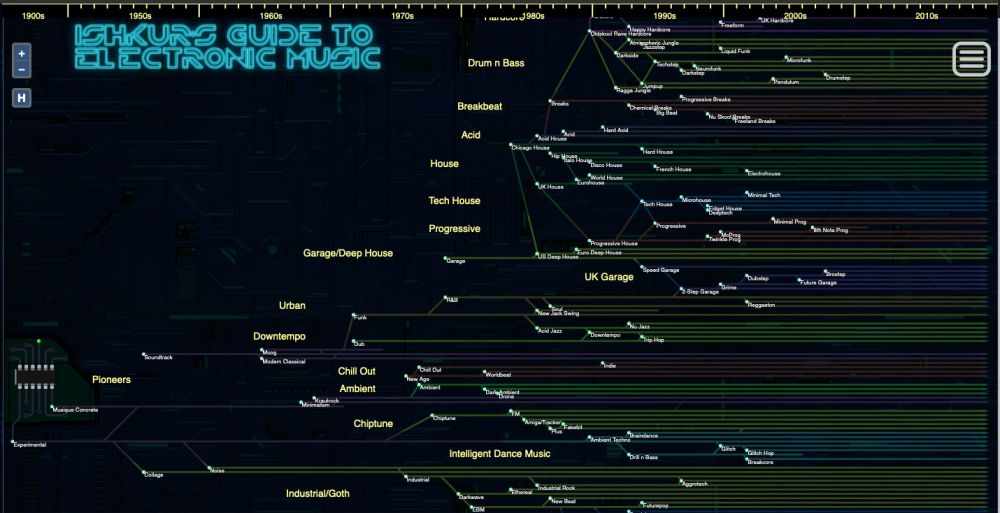
Ishkur’s Guide to Electronic Music: An Interactive, Encyclopedic Data Visualization of 120 Years of Electronic Music

In a very short span of time, the descrip­tor “elec­tron­ic music” has come to sound as over­ly broad as “clas­si­cal.” But where what we (often incor­rect­ly) call clas­si­cal devel­oped over hun­dreds of years, elec­tron­ic music pro­lif­er­at­ed into hun­dreds of frac­tal forms in only decades. A far steep­er qual­i­ty curve may have to do with the ease of its cre­ation, but it’s also a fac­tor of this accel­er­at­ed evo­lu­tion.

Music made by machines has trans­formed since its ear­ly 20th-cen­tu­ry begin­nings from obscure avant-garde exper­i­ments to mas­sive­ly pop­u­lar gen­res of glob­al dance and pop. This pro­lif­er­a­tion, notes Ishkur—designer of Ishkur’s Guide to Elec­tron­ic Music—has­n’t always been to the good. Take what he calls “trend­whor­ing,” a phe­nom­e­non that spawns dozens of new works and sub­gen­era in short order, though it’s arguable whether many of them should exist.

Ishkur, describes this process below in an excerpt from his eru­dite, sar­don­ic “Fre­quent­ly Unasked Ques­tions”:

If fart nois­es were sud­den­ly pop­u­lar, each scene would trend­whore it with fart­step, fart­core, tech­fart, far­t­house, fart trance, etc. It is espe­cial­ly notice­able in clas­sic tracks that are remixed into mod­ern gen­res, which some might con­sid­er sacre­li­gious. A good exam­ple is the Dream Trance hit Robert Miles — Chil­dren, in which there is now a Hard­style ver­sion, a Dutch House ver­sion, a McProg ver­sion, a Euro­trance ver­sion, a Goa Trance ver­sion, and even a Snap ver­sion and a shit­ty Brostep ver­sion. None of these gen­res exist­ed when the orig­i­nal song came out in 1995.

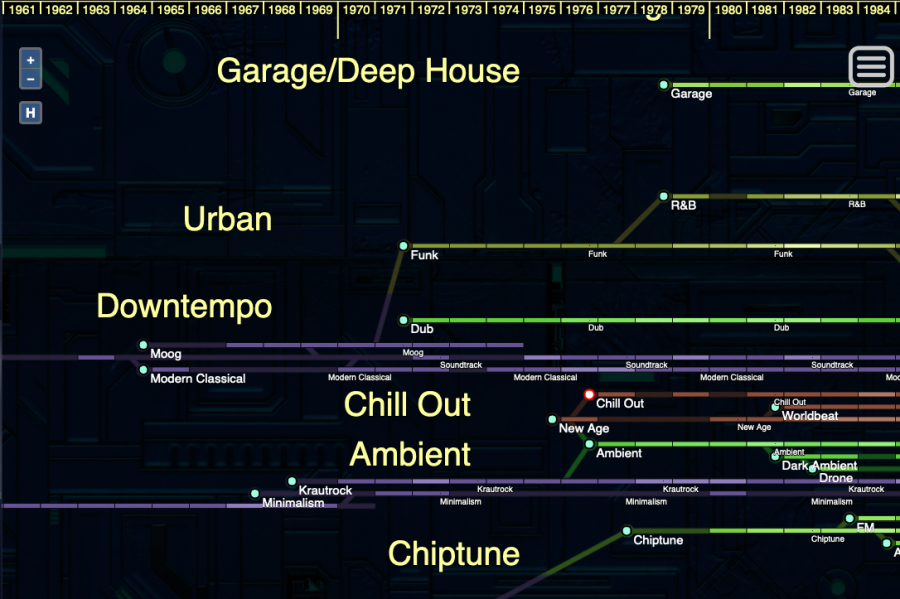
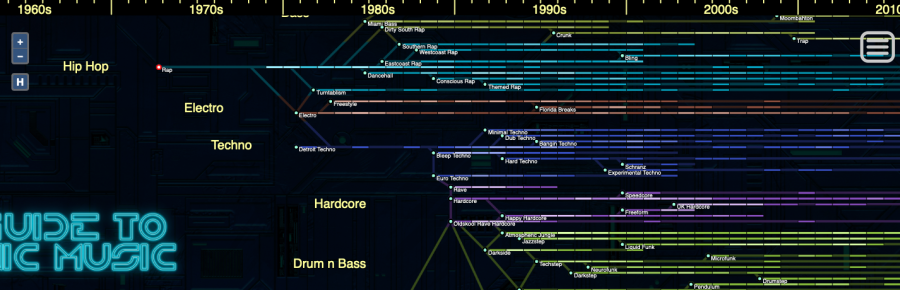
Vicious­ly irrev­er­ent tone and com­pletist atten­tion to detail are typ­i­cal through­out this ency­clo­pe­dia, an inter­ac­tive Flash flow­chart that chron­i­cles the devel­op­ment of 100s of gen­res, sub­gen­res, micro­gen­res, etc., with stream­ing musi­cal exam­ples of every one. It’s a deeply researched, and con­tin­u­al­ly expand­ing project first cre­at­ed by Ishkur, aka Ken­neth John Tay­lor, in 1999. In 2003, Tay­lor updat­ed and expand­ed the project and moved it to its cur­rent loca­tion. He has con­tin­u­ous­ly updat­ed it since then.

The record­ed exam­ples on Taylor’s time­line cur­rent­ly span around 80 years, from 1937 to 2019—a tiny drop in the great ocean of musi­cal his­to­ry. Nonethe­less, the music shows how rich and com­plex elec­tron­ic music his­to­ry tru­ly is, despite its potential—as its devel­op­men­tal speed (and tem­pos) increased—to pro­duce dis­pos­able, deriv­a­tive com­po­si­tions as much as chart-burn­ing clas­sics and inno­v­a­tive, mind-expand­ing cre­ative work.

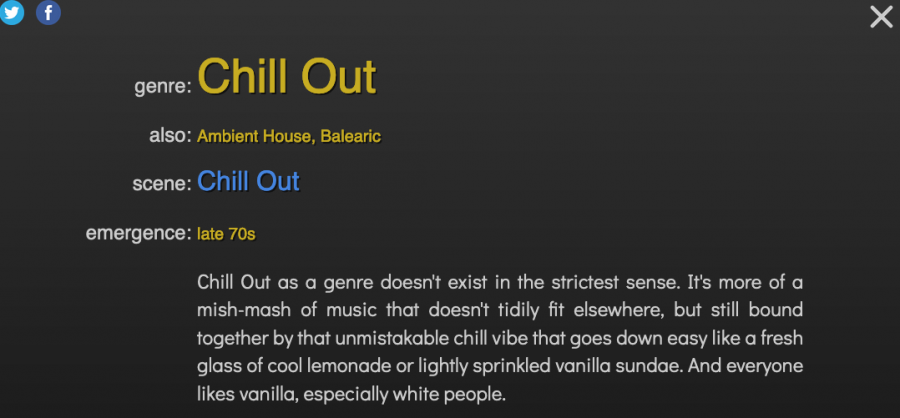
As you zoom into the chart and click on the dots next to each genre, you’ll have the option to pull up Taylor’s wit­ty guides, as infor­ma­tive as they are unspar­ing­ly crit­i­cal. He explains “Chill Out,” for exam­ple, as a grab-bag term for elec­tron­ic easy lis­ten­ing that “goes down easy like a fresh glass of cool lemon­ade or light­ly sprin­kled vanil­la sun­dae…. Not only did it appeal to post-come­down par­ty kids but their moms too, as heard in movie sound­tracks, adver­tise­ment jin­gles, or played over the radio while shop­ping at the mar­ket.”

Does he approve of any forms of elec­tron­ic music? Obvi­ous­ly. No one would spend this much time and effort and amass “30 years of back issues of Elec­tron­ic Music and Key­board mag­a­zine” and “an ungod­ly num­ber of books” on a sub­ject they despised. It’s just that he’s… well, a purist, you might say. Any media, for exam­ple, of any kind, that “uses the acronym ‘EDM,’” he writes “is com­plete don­key balls and should not be relied on as a source for any­thing.” He’s also ambi­tious­ly com­pre­hen­sive, includ­ing Hip Hop and all of its vari­ants in the mix, a move most his­to­ri­ans of elec­tron­ic music do not make, for fear of get­ting it wrong, per­haps, or because of cul­tur­al bias­es and nar­row ideas about what elec­tron­ic music is.

The data visu­al­iza­tion crossed with exten­sive pop musi­col­o­gy crossed with an almost quaint kind of ultra-nerdy online snark has some­thing for every­one. But don’t call it art, as one inter­view­er did. “I feel uneasy about this,” Ishkur answered. “It’s a joke more than any­thing. Very fun­ny. Very sil­ly. I poke fun at a lot of gen­res. It’s meant to be enter­tain­ment.” This is the stan­dard inter­net dis­claimer, but if you fol­low the guide’s branch­ing streams through hun­dreds of expand­ing gen­res and scenes, you might just find you’ve become a seri­ous stu­dent of elec­tron­ic music your­self, while learn­ing not to take any of it too seri­ous­ly.

Ishkur’s guide has recent­ly been updat­ed for 2019. He’s also released a “15 hour DJ set of elec­tron­ic music,” he announced on Twit­ter, “span­ning sev­er­al eras and a wide range of gen­res, all mixed in that inim­itable Ishkur style.” Get the mix here.

Relat­ed Con­tent:

The His­to­ry of Elec­tron­ic Music in 476 Tracks (1937–2001)

Hear Sev­en Hours of Women Mak­ing Elec­tron­ic Music (1938–2014)

Pio­neer­ing Elec­tron­ic Com­pos­er Karl­heinz Stock­hausen Presents “Four Cri­te­ria of Elec­tron­ic Music” & Oth­er Lec­tures in Eng­lish (1972)

Josh Jones is a writer and musi­cian based in Durham, NC. Fol­low him at @jdmagness

Actor Jonathan Joss (King of the Hill, Parks & Rec, Magnificent Seven) Discusses Indigenous American Representation on Pretty Much Pop Podcast #7

Jonathan built his career play­ing 19th cen­tu­ry Amer­i­can Indi­ans on horse­back and is best known for his voice act­ing as John Red­corn III in King of the Hill (start­ing sea­son 2) and then for his recur­ring role as Chief Ken Hotate in Parks and Recre­ation. Eri­ca Spyres, Mark Lin­sen­may­er, and Bri­an Hirt talk to him about those roles plus act­ing in The Mag­nif­i­cent Sev­enTrue Grit, and his cur­rent role as Sit­ting Bull in Annie Get Your Gun (also fea­tur­ing Eri­ca) cur­rent­ly run­ning at the Bay Street The­ater in Sag Har­bor.

Jonathan talks about Hollywood’s record and progress in por­tray­ing indige­nous Amer­i­cans, his own strug­gles to get native views reflect­ed in the works he’s par­tic­i­pat­ed in and the dif­fer­ences between act­ing on stage vs. film and TV. When is an anachro­nis­tic work too far gone to update it, and is it even legit­i­mate to try?

A few rel­e­vant clips from King of the Hill: “Hank asks John Red­corn about tool,” “John Red­corn makes a toast,”, “John wants his son back,” and “Big Moun­tain Fudge­cake.” Here’s the Car­toon Con­spir­a­cy The­o­ry video that Bri­an brings up.

Here’s John as Chief Hotate in Parks and Recre­ation play­ing Jere­my Jamm (John Glaser) like a fid­dle.

Here’s the scene from True Grit (2010) where Jonathan’s char­ac­ter gets hanged.

Here’s Jonathan talk­ing at Indege­nous Com­ic Con 2017 about rep­re­sen­ta­tion and act­ing, and here he is doing a fake pan­el.

The actor in the film Min­utes that Mark refers to is come­di­an Tatan­ka Means. Jonathan brings up native author/activist John Trudell, and Eri­ca brings up the play Tribes about the deaf com­mu­ni­ty.

You may be inter­est­ed in The Par­tial­ly Exam­ined Life’s episode on Amer­i­can Indi­an phi­los­o­phy and the vary­ing reac­tions to it.

This episode includes bonus con­tent that you can only hear by sup­port­ing the pod­cast at patreon.com/prettymuchpop. This pod­cast is part of the Par­tial­ly Exam­ined Life pod­cast net­work.

Pret­ty Much Pop is the first pod­cast curat­ed by Open Cul­ture. Browse all Pret­ty Much Pop posts or start with the first episode.

Miles Davis Iconic 1959 Album Kind of Blue Turns 60: Revisit the Album That Changed American Music

No amount of con­tin­u­ous repeats in cof­feeshops around the world can dull the crys­talline bril­liance of Miles Davis’ Kind of Blue one bit. The album turned 60 three days ago, and it still stands as one of the most influ­en­tial albums, jazz or oth­er­wise, of all time… indeed, as “one of the sin­gle great­est achieve­ments in Amer­i­can music.”

So says one of sev­er­al crit­ics prais­ing the album in the intro­duc­tion to an inter­view with Ash­ley Kahn, author of Kind of Blue: The Mak­ing of the Miles Davis Mas­ter­piece. Kind of Blue is a “cor­ner­stone record, not only for jazz. It’s a cor­ner­stone record for music,” anoth­er voice com­ments. It “cap­tures the essence of jazz.” It’s “sort of like the Bible, in a way. You know, you just have one in your house.”

This would make Davis not only the com­pos­er of a new jazz Bible, but also a Bible sales­man. He had no doubt his prod­uct would sell. “Davis was a can­ny mon­ey man and pro­mot­er of his own image,” wrote David Years­ley on the album’s anniver­sary. One 1960 record com­pa­ny memo stat­ed he “’was pri­mar­i­ly con­cerned with the amount of jazz now on juke­box­es in many areas of the coun­try while he is not rep­re­sent­ed.’”

Colum­bia respond­ed, and as a result, many peo­ple around the U.S. “first heard this music in din­ers and bars over the juke­box.” The cre­ative ten­sions in the Birth of the Cool record­ings, made ten years ear­li­er, announced a new kind of jazz with their full release in 1957. The cool had matured in Kind of Blue’s ful­ly modal turn. “Its icy hau­teur sets the stan­dard for art that draws you in by pre­tend­ing it doesn’t need any­one or any­thing but itself.” It’s quite a con­fi­dent appeal.

Sales are nei­ther nec­es­sary nor suf­fi­cient to make a clas­sic album, but in the case of Kind of Blue, all of the stars aligned: crit­ics uni­ver­sal­ly praise it, musi­cians uni­ver­sal­ly love it, and record buy­ers uni­ver­sal­ly buy it. “The thing about this album,” says Kahn, “that’s dif­fer­ent from what hap­pened with some oth­er well-cel­e­brat­ed albums… is that it became an icon­ic album not when it came out but long after because peo­ple kept buy­ing it. Peo­ple would not let it go out of print.”

Davis knew how to get his work before the pub­lic, but he also knew it deserved to be heard by mil­lions both inside and out­side jazz. Beloved in the jazz world right away, it was the “vox pop­uli” that spread the album’s fame every­where else. Drum­mer Jim­my Cobb talks in the clip at the top about how Davis “fell a lit­tle bit into [the] con­cept” of Bill Evans, the pianist who played a sig­nif­i­cant role in the music’s con­struc­tion. “To me,” says Cobb, the gig was “just anoth­er Miles Davis ses­sion,” with an Evans twist.

None of the musi­cians in the sex­tet had any idea the record would get as big as it did. Yet as Davis him­self said, in a clas­sic line from an ear­li­er record­ing ses­sion, “I’m gonna play it first, and tell you what it is lat­er.” We look back on 1959 as a water­shed year in jazz, thanks in large part to the impact of Kind of Blue. Maybe we still haven’t fig­ured out, 60 years lat­er, what it is. Learn more about the crit­i­cal, musi­cal, and com­mer­cial impor­tance of Kind of Blue in the Poly­phon­ic video explain­er above, “How Miles Davis Changed Jazz.”

Relat­ed Con­tent:

1959: The Year That Changed Jazz

Kind of Blue: How Miles Davis Changed Jazz

Her­bie Han­cock Explains the Big Les­son He Learned From Miles Davis: Every Mis­take in Music, as in Life, Is an Oppor­tu­ni­ty

The Influ­ence of Miles Davis Revealed with Data Visu­al­iza­tion: For His 90th Birth­day Today

Josh Jones is a writer and musi­cian based in Durham, NC. Fol­low him at @jdmagness

Watch Some of the Most Powerful Bass Guitar Solos Ever: Geddy Lee, Flea, Bootsy Collins, John Deacon & More

At her site Ari’s Bass Blog, bass play­er and teacher Ari­ane Cap shoots down many of the argu­ments against solo bass music—that is, music played sole­ly on bass gui­tar. To the objec­tion that “bass­es have a job to do in a band con­text,” she writes, “what this ‘job’ is can vary great­ly!” To anoth­er com­plaint, she responds, “even when imi­tat­ing gui­tar tech­niques on the bass, it is still bass play­ing.” Her defens­es of solo bass (and her fine instruc­tions on how to play it well) work equal­ly for the bass solo, when the often least-noticed mem­ber of the band steps out and takes the lead for a few moments.

The idea that bass play­ers are all wall­flow­ers or invis­i­ble, less-tal­ent­ed mem­bers of the band is, of course, a bad rock and roll stereo­type. Nat­u­ral­ly, the best bass soloists in rock are some of the play­ers who have drawn the most atten­tion to the instru­ment and shown how crit­i­cal it is.

But not all great bass play­ers are great soloists. The solo requires a par­tic­u­lar com­bi­na­tion of pow­er and agili­ty. The bass soloist is some­thing of a musi­cal ath­lete.

A gui­tar solo can coast, so to speak, on tone, on per­fect­ly-cho­sen notes played with just the right vibra­to and sus­tain. A bass solo is anoth­er mon­ster. Whether plucked, picked, or slapped, bass solos usu­al­ly involve a lot of notes attacked very hard and very fast, up and down the neck—a feat any­one who’s held a bass gui­tar will know requires a lot of dex­ter­i­ty and strength.

Mar­vel as you watch the shoul­ders, arms, and fin­gers on left and right hands of these play­ers move with uncan­ny pre­ci­sion, in clips from some of the all-time bass solo greats here. At the top, John Entwistle wins top prize for suc­cinct­ness. His bored expres­sion may seem to give away the pre-record­ed TV game, but even live onstage he nev­er seemed to raise an eye­brow when pulling off licks like these.

Below him, Ged­dy Lee stretch­es out, and makes your arms tired from watch­ing him move all over the fret­board, build­ing from one fig­ure to anoth­er before a final explo­sive shred. Fur­ther up, Stu­art Hamm, onstage with Joe Satri­ani in 1988, gives a solo bass per­for­mance at the Mon­treux Jazz Fes­ti­val, mov­ing effort­less­ly from Beethoven’s “Moon­light Sonata” to a series of gor­geous arpeg­gios to some genre-hop­ping the­atrics the crowd devours.

Though he made his bones as one of the fastest bass soloists on the block, Fleas’s solo bass per­for­mance uses delay and echo effects to slow things down sig­nif­i­cant­ly and expand the pos­si­bil­i­ties of solo bass, bring­ing it into the tonal realm of the gui­tar while still demon­strat­ing the tremen­dous phys­i­cal­i­ty bass play­ing requires. Just above, see Boot­sy Collins pull off a sim­i­lar feat in a full band con­text, prov­ing that bass solos can be made of slow, soul­ful melod­i­cism and heavy, fuzzed-out licks.

Collin’s tour-de-force per­for­mance is hard to top, but for con­trast, and to reem­pha­size the ver­sa­til­i­ty of the bass as a solo instru­ment, whether play­ing all alone or tak­ing a brief turn in the spot­light, see Queen’s John Dea­con pull out a flaw­less, short and seri­ous­ly sweet bass solo live on “Liar,” just above, looped for ten min­utes straight so you can mem­o­rize every note.

Relat­ed Con­tent:

The Sto­ry of the Bass: New Video Gives Us 500 Years of Music His­to­ry in 8 Min­utes

What Makes Flea Such an Amaz­ing Bass Play­er? A Video Essay Breaks Down His Style

Who Are the Best Drum Soloists in Rock? See Leg­endary Per­for­mances by John Bon­ham, Kei­th Moon, Neil Peart, Ter­ry Bozzio & More

Josh Jones is a writer and musi­cian based in Durham, NC. Fol­low him at @jdmagness

The Importance of Film Editing Demonstrated by the Bad Editing of Major Films: Bohemian Rhapsody, Suicide Squad & More

It’s one of cin­e­ma’s great­est ironies that edit­ing can make or break a film, but few movie­go­ers under­stand what an edi­tor actu­al­ly does. Edit­ing involves tak­ing shots and assem­bling them in the right order, yes, but what makes an order — all the tran­si­tions from moment to moment and scene to scene — “right”? Even if we can’t explain good edit­ing, we know bad edit­ing when we see it, and even more so when when we feel it. The hard-to-pin-down sen­sa­tion of a movie being “off” or “wrong” often comes out of incom­pe­tent edit­ing, and by break­ing down the bad edit­ing in a vari­ety of recent pic­tures, these three videos throw into con­trast what it takes for edit­ing to be good.

Most of the nine “Movies that Were Ruined by Real­ly Bad Edit­ing” in the Loop­er video at the top of the post are part of high-pro­file fran­chis­es. Giv­en the size of their bud­gets and the impor­tance of their box-office per­for­mance, you might think such films would­n’t per­mit tech­ni­cal slop­pi­ness of any kind. Yet in Alien: Covenant every­thing hap­pens in an order that kills the dra­mat­ic ten­sion; the chaot­ic Tak­en 3, “a severe case of death by a thou­sand cin­e­mat­ic cuts,” plays out “at the speed any oth­er movie would run if you acci­den­tal­ly hit the fast-for­ward but­ton sev­er­al times”; Trans­form­ers: Age of Extinc­tion goes heavy on the wrong scenes and “treats its robot aliens as a sub­plot”; and Sui­cide Squad pro­vides an exam­ple of “a stu­dio pub­licly adver­tis­ing a movie as one thing, pan­ick­ing, then com­plete­ly reshap­ing the same film all inside of one fran­tic mar­ket­ing blitz.”

“Edit­ing is going down the crap­per these days,” says Fold­ing Ideas host Dan Olson in his in-depth exam­i­na­tion of Sui­cide Squad’s incom­pe­tent cut­ting. “The edit­ing was shock­ing­ly awful in every way,” he says, turn­ing it into a kind of neg­a­tive show­case of the edi­tor’s art: “I would seri­ous­ly advise any­one with an inter­est in the art of cin­e­mat­ic edit­ing to do their own full autop­sy to see just how much went wrong and plain old does­n’t work.” Olson points to exam­ples of Sui­cide Squad’s often inex­plic­a­ble choic­es, such as fill­ing the first half of the film with hyper­ki­net­ic char­ac­ter intro­duc­tions that play more like trail­ers, devel­op­ing char­ac­ters only to sud­den­ly drop them, los­ing track of the phys­i­cal loca­tions of char­ac­ters, and repeat­ed­ly abus­ing the Kuleshov Effect in a way that feels like the “cin­e­mat­ic equiv­a­lent of putting the emphasis on the wrong syllable.”

But then, it would have been more of a sur­prise for a crit­i­cal dis­as­ter like Sui­cide Squad to have been well-edit­ed. What about the Fred­die Mer­cury biopic Bohemi­an Rhap­sody, which won an Acad­e­my Award specif­i­cal­ly for its edit­ing? Its recep­tion of that par­tic­u­lar Oscar is inter­est­ing, says video essay­ist Thomas Flight, “because the movie con­tains sev­er­al scenes that are mas­ter class­es in poor edit­ing.” In one offend­ing sequence, “many of the cuts are unmo­ti­vat­ed,” which mean that the edi­tor made them for no appar­ent rea­son, at least none serv­ing sto­ry or the dra­ma. Oth­ers “ignore spa­tial con­ti­nu­ity,” which makes it dif­fi­cult or impos­si­ble for the audi­ence to under­stand who and what is sup­posed to be where. And “the pace is sim­ply too fast,” mean­ing that the lengths of the shots are too short for the action: edit­ing that suits a rock con­cert does­n’t suit a con­ver­sa­tion.

Even view­ers who oth­er­wise enjoyed Bohemi­an Rhap­sody will have sensed some­thing the mat­ter with the cuts in the scene Flight high­lights. But nobody could have a worse reac­tion to it than John Ottman, the man who edit­ed the film, and whose work has been cred­it­ed with mak­ing (rather than fur­ther break­ing) the trou­bled pro­duc­tion. As men­tioned in March here on Open Cul­ture, that par­tic­u­lar scene was cut not by Ottman but direc­tor Dex­ter Fletch­er, who came in to take Bohemi­an Rhap­sody’s reins after the depar­ture of Bryan Singer. “When­ev­er I see it, I want to put a bag over my head,” Ottman told the Wash­ing­ton Post. Most movie­go­ers don’t see edit­ing when it’s good, only when it’s bad — but when it’s espe­cial­ly bad, it makes edi­tors them­selves long for invis­i­bil­i­ty.

Relat­ed Con­tent:

The Dark Knight: Anato­my of a Flawed Action Scene

Alfred Hitchcock’s 7‑Minute Mas­ter Class on Film Edit­ing

Hitch­cock on the Filmmaker’s Essen­tial Tool: The Kuleshov Effect

A Visu­al Intro­duc­tion to Sovi­et Mon­tage The­o­ry: A Rev­o­lu­tion in Film­mak­ing

Bohemi­an Rhap­sody’s Bad Edit­ing: A Break­down

Based in Seoul, Col­in Mar­shall writes and broad­casts on cities, lan­guage, and cul­ture. His projects include the book The State­less City: a Walk through 21st-Cen­tu­ry Los Ange­les and the video series The City in Cin­e­ma. Fol­low him on Twit­ter at @colinmarshall or on Face­book.

« Go BackMore in this category... »
Quantcast