Very few artists enjoy the degree of recognition that’s been conferred upon the late television educator Bob Ross, though sales of his work hover around zero.
It’s not due to scarcity. Ross pumped out three nearly-identical paintings per episode of his series, The Joy of Painting (watch them online here). That’s 403 episodes over the course of 31 seasons on public television—or 1209 canvases of clouds, mountains, and “happy little trees.”
Shouldn’t economics dictate that these would have only increased in value following their creator’s untimely death from lymphoma in 1995?
Is the painter’s legendary hypnotic appeal a factor? Did he subconsciously manipulate even the most cutthroat collectors into a state of sentimental attachment wherein profit matters not a jot?
As The New York Times-produced video above points out, Ross’ great mission in life was to get others painting—quickly and joyfully.
Which is not to say he blithely tossed the fruits of his labor into the incinerator after that purpose had been served.
The reason Ross’ paintings aren’t on the market is they’re neatly stacked in cardboard cartons at Bob Ross Inc. in Herndon, Virginia. It hardly constitutes archival storage, but the boxes are neatly numbered, and everything is accounted for.
And that is where they’re likely to remain, according to executive assistant Sarah Strohl and president Joan Kowalski, the daughter of Ross’ longtime business partner. (Her mother, Annette is Ross’ former student and the foremost authenticator of his work.)
For now, if anyone endeavors to sell you a Bob Ross original, it’s safe to assume it’s a fake.
Better yet, paint your own. Bob Ross Inc. tends to both the master’s reputation and his lucrative off-screen business, selling instructional books and painting supplies.
Ross, of course, never broke a sweat on camera, which lends a bit of cognitive dissonance to the Times’ video’s frenetic editing. (I never thought I’d have to issue a seizure warning for something Bob Ross-related, but those canvases flash by awfully quickly at the 1:09 mark and again at 10:36. )
No, he didn’t help defeat an implacable zombie army intent on wiping out all life. But English obstetrician John Snow seems as important as the similarly-named Game of Thrones hero for his role in persuading modern medicine of the germ theory of disease. During the 1854 outbreak of cholera in London, Snow convinced authorities and critics that the disease spread from a contaminated water pump on Broad Street, leading to the now-legendary infographic map above showing the incidences of cholera clustered around the pump.
Snow’s persistence resulted in the removal of the handle from the Broad Street pump and has been credited with ending an epidemic that claimed 500 lives. The Broad Street pump map has become “an enduring feature of the folklore of public health and epidemiology,” write the authors of an article published in The Lancet. They also point out that, contrary to popular retellings, the “map did not give rise to the insight” that the pump and its germ-covered handle caused the outbreak. “Rather it tended to confirm theories already held by the various investigators.”
Snow himself published a pamphlet in 1849 called “On the Mode of Communication of Cholera” in which he argued that “cholera is communicated by the evacuations from the alimentary canal.” As he reminded readers of The Edinburgh Medical Journal in an 1856 letter, in that same year, “Dr William Budd published a pamphlet ‘On Malignant Cholera’ in which he expressed views similar to my own.” Germ theory had a long, distinguished history already, and Snow and his contemporaries made sound, evidence-based arguments for it.
But their position “largely went ignored by the medical establishment,” notes Randy Alfred at Wired, “and was opposed by a local water company near one London outbreak.” The accepted, mainstream scientific opinion held that all disease was spread through “miasma,” or bad air. Pollution, it was thought, must be the cause. After the pump handle’s removal, Snow published an 1855 monograph on waterborne diseases. This was the first public appearance of the legendary map—after the removal of the handle.
Helping to inform Snow’s map, another investigator, parish priest Henry Whitehead had “concluded that it was the washing of soiled diapers into drains which flowed to the communal cesspool that contaminated the pump and started the outbreak,” writes Atlas Obscura. Whitehead, a former critic of germ theory, later pointed out that the removal of the pump handle didn’t actually stop the epidemic, which, he said, “had already run its course” by that point.
Nonetheless, Snow and other proponents of the theory were vindicated, Whitehead had to admit, and Snow’s intervention “had probably everything to do with preventing a new outbreak.” The simple, yet sophisticated data visualization would lead to radical new ways of conceptualizing disease outbreaks, helping to stop or prevent who knows how many epidemics before they killed hundreds or thousands. Snow’s map also deserves credit for giving “data journalists a model of how to work today.”
It was hardly the first or only data visualization of cholera outbreaks of the time. “As early as the 1830s,” Visual Capitalist points out, “geographers began using spacial analysis to study cholera epidemiology.” But Snow’s was by far the most influential, and effective, of them all. In his TED talk above, journalist Steven Johnson (author of The Ghost Map:The Story of London’s Most Terrifying Epidemic and How It Changed Science, Cities, and the Modern World) tells the story of how the outbreak, and Snow’s theory and map, “helped create the world that we live in today, and particularly the kind of city that we live in today.”
Read a Q&A with Johnson here; head over to The Guardian’s Data Blog to see Snow’s visualization recreated over a modern, satellite-view map of London and the Soho neighborhood of the famous Broad Street pump; and learn more about Snow and deadly cholera outbreaks in the crowded European cities of the early 19th century at the John Snow Archive and Research Companion online.
Two of the most startlingly original science fiction writers of the past century, Samuel R. Delany and Octavia E. Butler, emerged in the 60s and 70s and created dystopian visions that resonate with us today with more depth and immediacy than the majority of their contemporaries. Both writers also happened to be African American. But why should this detail matter? Why indeed, asked Butler, in an equally relevant question, “is science fiction so white?” She went on to explore the question in a 1980 essay published in Transmission, not with a history of the genre, but with rebuttals to the reasons for excluding people like her.
“A more insidious problem than outright racism is simply habit, custom,” Butler writes. People get comfortable with things as they are—an attitude antithetical to the spirit of sci-fi. “Science fiction, more than any other genre deals with change—change in science and technology, and social change. But science fiction itself changes slowly, often under protest.”
Butler died too young, in 2006 at age 58; but she lived to see resistance to change in science fiction persist into the 21st century. Yet in her most compelling, and slightly terrifying, projection into the future—her mid-90s Parable series of novels—change is the only thing that anyone can rely on.
All that you touch, you Change. All that you Change Changes you.
N.K. Jemison quotes these lines from Parable of the Sowerin her introduction to the book’s reissue this year. Published in 1993, Parable’s futurism didn’t have the same frisson as that of, say, William Gibson at the time. “Roving, uncontested gangs of pedophiles and drug-addicted pyromaniacs? Slavery 2.0? A powerful coalition of white-supremacist, homophobic, Christian zealots taking over the country?” writes Jemison. “Nah, I thought, and hoped Butler would get back to aliens soon.” Set in the context of a U.S. post-massive climate collapse (possibly), hyper-financialization, and corporate rule.… the novel now seems all too prescient to its current-day readers.
But even Butler’s alien stories are stories about humans in radical transition, and collective social actions with both devastating and transformative outcomes. In Dawn, the first novel in her Xenogenesis trilogy (now called “Lilith’s Brood”), human woman Lilith Iyapo “awakens after 250 years of stasis,” following an apocalyptic nuclear war on Earth, “to find herself surrounded by aliens called the Oankali,” as the animated TED-Ed lesson above by Ayana Jamieson and Moya Bailey tells it. These beings want to trade DNA with the remaining humans, thereby creating a hybrid species. The alternative is sterilization.
The chilling scenario in Dawnand its successors has its moments of Lovecraftian dread, but it goes in an even stranger direction, bringing an added dimension to the meaning of the word “dehumanization.” What would it mean to slowly transform into another species? Such profoundly universal questions about the meaning of human identity reached “readers who had been excluded from the genre,” notes Emanuella Grinberg at CNN. Butler peoples her books with humans of every color and ethnicity, and aliens only she might have imagined. But most of her protagonists are black and brown women. Many of the readers Butler influenced, like Jemison, are women of color who became genre-changing sci-fi writers themselves.
Butler’s work “helped define the literary cornerstone of Afrofuturism,” notes Grinberg. Her writing was strategic, a way to confront dehumanizing political and social political realities. Parable of the Sower, the TED lesson explains, was partly a response to Butler’s home state of California’s Proposition 187, which denied undocumented immigrants basic healthcare, education, and basic services. In the follow-up, Parable of the Talents (1998), an authoritarian presidential candidate campaigns on the slogan “Make American Great Again.” Her best-selling novel, Kindred, published in 1979, tells the story of a contemporary woman repeatedly pulled back in time to the Maryland plantation of her enslaved ancestor.
Why should we read Octavia Butler? You’ll have to read her to answer that question yourself. But I’d venture to say—along with the intro to her life and work above—because she had a better read on how the time she lived in would turn into the time we live in now than nearly anyone writing at the time; because she told strange, wonderful, outlandish, compelling stories that stretched the imagination without losing sight of the human core; because, like Ursula K. Le Guin, she challenged the world as it is with profound visions of what it might be; and because she not only excelled as a storyteller but specifically as a committed science fiction storyteller, one who deeply touched, and thus deeply changed, the form.
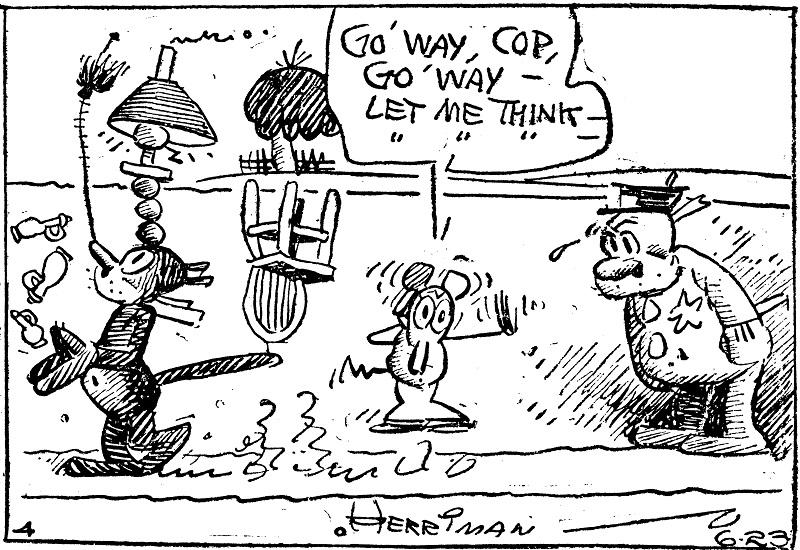
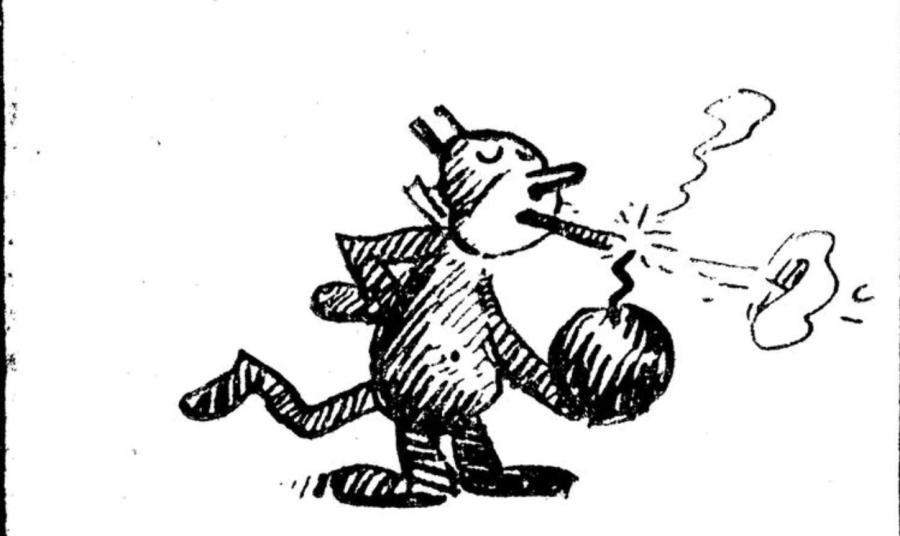
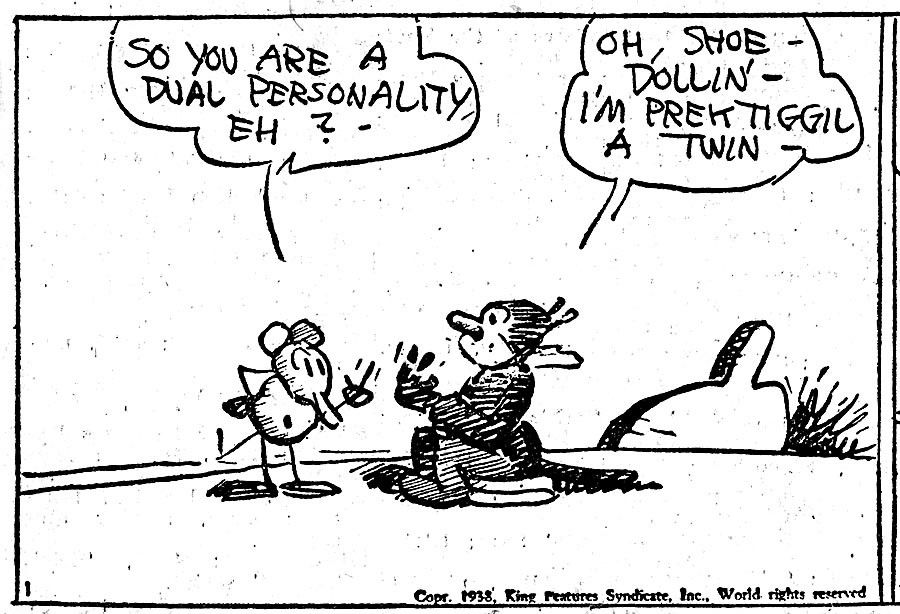
“As a cartoonist, I read Krazy Kat with awe and wonder,” writes Calvin and Hobbes creator Bill Watterson in his introduction to The Komplete Kolor Krazy Kat. The creator of quite possibly the most beloved comic strip of the past thirty years calls Krazy Kat “such a pure and completely realized personal vision that the strip’s inner mechanism is ultimately as unknowable as George Herriman,” the artist who wrote and drew it for its entire three-decade run from 1913 to 1944. “I marvel at how this fanciful world could be so forcefully imagined and brought to paper with such immediacy. THIS is how good a comic strip can be.”
High praise, especially from the hyperbole-resistant Watterson, a sharp-eyed critic of his art form and perceiver of its unrealized potential. “Quirky, individual, and uncompromised, Krazy Kat is one of the very few comic strips that takes full advantage of its medium. There are some things a comic strip can do that no other medium, not even animation, can touch, and Krazy Kat is a virtual essay on comic strip essence.”
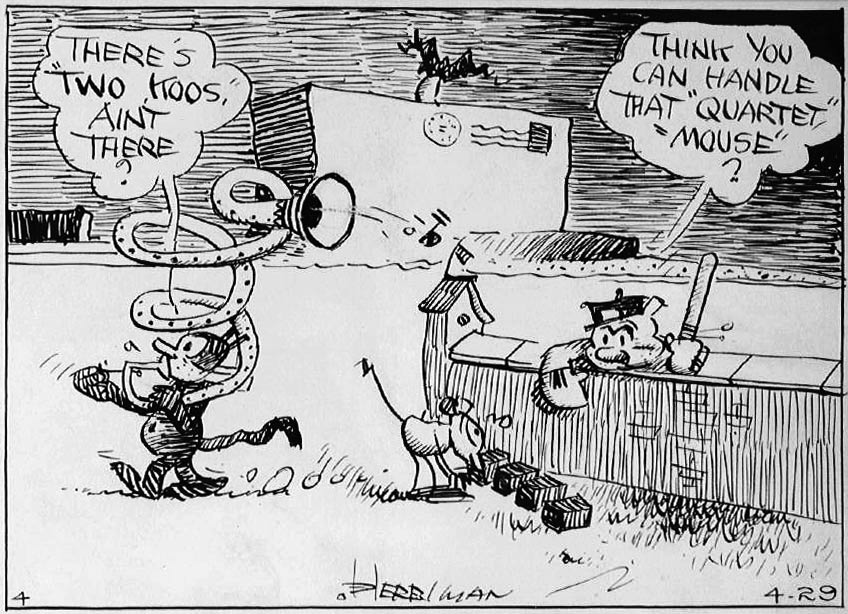
The “self-consciously baroque narrations and monologues” show that “words can be funny in themselves”; “the sky turns from black to white to zigzags and plaids simply because, in a comic strip, it CAN”; its surreal Arizona desert setting “is a character in the story, and the strip is ‘about’ that landscape as much as it is about the animals who populate it,” Ignatz Mouse, Offissa Pupp, and the titular Krazy Kat.
Ignatz Mouse “demonstrates his contempt for Krazy by throwing bricks at her” (though their genders, so modern observers note, were never quite stable), “Krazy reinterprets the bricks as signs of love,” and Offissa Pupp, the desert’s lone lawman, is “obliged by duty (and regard for Krazy) to thwart and punish Ignatz’s ‘sin,’ thereby interfering with a process that’s satisfying to everyone for all the wrong reasons.”
I myself first picked up a Krazy Kat collection as a Calvin and Hobbes-loving elementary schooler, and soon found myself captivated by the sheer density of strangeness in its pages. But read enough of Herriman’s masterwork, and that strangeness takes on a strong meaning that nevertheless differs from reader to reader. “Krazy Kat has been described as a parable of love, a metaphor for democracy, a ‘surrealistic’ poem, unfolding over years and years,” writes Chris Ware, another of the most respected comic-strip artists alive. “It is all of these, but so much more: it is a portrait of America, a self-portrait of Herriman, and, I believe, the first attempt to paint the full range of human consciousness in the language of the comic strip.” And now, 75 years after its conclusion, much more of humanity can enjoy Krazy Kat than ever. Explore digitized scans at Franusic’s web site. Or pick up a copy of the new edition of The Complete Krazy Kat in Color, a color facsimile of the complete pages of Krazy Kat 1935–44.
Based in Seoul, Colin Marshall writes and broadcasts on cities, language, and culture. His projects include the book The Stateless City: a Walk through 21st-Century Los Angeles and the video series The City in Cinema. Follow him on Twitter at @colinmarshall, on Facebook, or on Instagram.
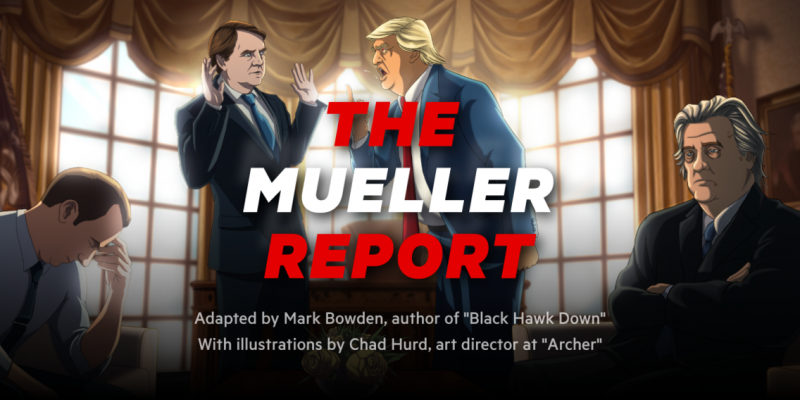
The 448 page Mueller Report doesn’t make for breezy beach reading. That’s for sure. But, “buried within the Mueller report, there is a narrative that reads in parts like a thriller.” Working with that theory, Insider.com “hired Mark Bowden, a journalist and author known for his brilliant works of narrative nonfiction like Black Hawk Down, Killing Pablo, and Hue 1968.” And they gave him an assignment: “Use the interviews and facts laid out in the Mueller Report (plus those from reliable, fact-checked sources and published firsthand accounts)” and create an account that’s “so gripping it will hold your attention (and maybe your congressional representative’s).” They also hired “Chad Hurd, an illustrator from the art department of Archer,” and “asked him to draw out scenes from the report to bring them to life.” Find the resulting illustrated edition of The Mueller Report right here.
If you would like to sign up for Open Culture’s free email newsletter, please find it here. It’s a great way to see our new posts, all bundled in one email, each day.
If you would like to support the mission of Open Culture, consider making a donation to our site. It’s hard to rely 100% on ads, and your contributions will help us continue providing the best free cultural and educational materials to learners everywhere. You can contribute through PayPal, Patreon, and Venmo (@openculture). Thanks!
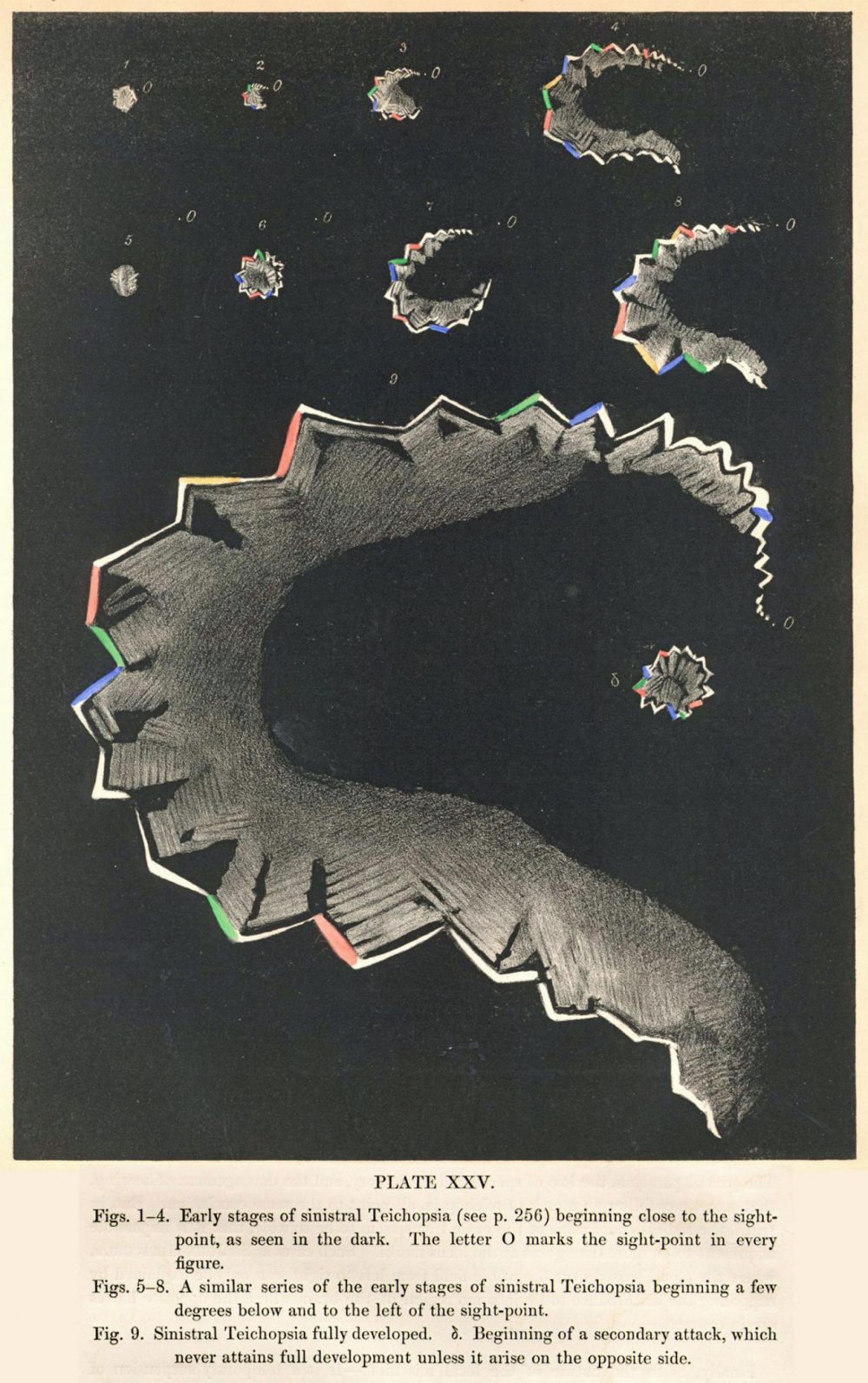
Headaches number among humanity’s most common ailments. The headache-related disorders known as migraines may be rarer, afflicting roughly fifteen percent of the population, but they’re also much more severe. Besides a headache that can last as long as three days, migraines can also come with various other symptoms including nausea as well as sensitivity to light, sound, and smells. They even cause some sufferers to hallucinate: the visual elements of these pre-migraine “auras” might take the shape of distortions, vibrations, zig-zag lines, bright lights, blobs, or blind spots. Sometimes they also come in color, and brilliant color at that.
Those colors jump right out of this 1870 drawing by English physician Hubert Airy, with which he sought to capture his own visual experience of a migraine. He “first became aware of his affliction in the fall of 1854,” writes National Geographic’s Greg Miller, “when he noticed a small blind spot interfering with his ability to read. ‘At first it looked just like the spot which you see after having looked at the sun or some bright object,’ he later wrote. But the blind spot was growing, its edges taking on a zigzag shape that reminded Airy of the bastions of a fortified medieval town.” As Airy describes it, “All the interior of the fortification, so to speak, was boiling and rolling about in a most wonderful manner as if it was some thick liquid all alive.”
To a migraneur, that description may sound familiar, and the drawing that accompanied it in the Philosophical Transactions of the Royal Society in 1870 may look even more so. Called “arguably the most beautiful scientific records of migraine aura ever made” by G.D. Schott in Brain, Airy’s drawings “record the progress and expansion of his own visual disturbances” over their half-hour-long onset. Apart from their stark beauty, writes Miller, the set of drawings “anticipates discoveries in neuroscience that were still decades in the future,” such as the assumption that the hallucinations originate in the brain rather than the eyes and that certain parts of the field of vision correspond to certain parts of the visual cortex.
“There’s still much we don’t know about migraines and migraine auras,” Miller writes. “One hypothesis is that a sort of electrical wave sweeps across the visual cortex, causing hallucinations that spread across the corresponding parts of the visual field” — an idea with which Airy’s early renderings also accord. And what about the source of all those colors? Electrical waves passing through parts of the brain “that contain neurons that respond to specific colors” may be responsible, but nearly 150 years after the publication of Airy’s drawings, “no one really knows.” Migraine research of the kind pioneered by Airy himself may have dispelled some of the mystery surrounding the affliction, but a great deal nevertheless remains. Airy’s drawings, still among the most vivid representations of the visual aspect of migraines ever created, will no doubt inspire generations of future neuroscientists to find out more.
Based in Seoul, Colin Marshall writes and broadcasts on cities, language, and culture. His projects include the book The Stateless City: a Walk through 21st-Century Los Angeles and the video series The City in Cinema. Follow him on Twitter at @colinmarshall, on Facebook, or on Instagram.
In the definitive celebration of two pop culture icons, Barbie honors the ultimate pop chameleon, English singer, songwriter and actor, David Bowie.
This collectible Barbie doll wears the metallic Ziggy Stardust ‘space suit’ with red and blue stripes, flared shoulders and Bowie’s signature cherry-red platform boots.
Special details include bold makeup — featuring the famed astral sphere forehead icon — and a hairstyle inspired by Bowie’s fiery-red locks.
Specially designed packaging makes Barbie David Bowie the ultimate collector’s item for Bowie and Barbie fans alike.
Honor David Bowie’s extraordinary talent and undeniable influence with Barbie David Bowie doll.
The history of the printed word is full of bibliographic twists and turns, major historical moments, and the significant printing of books now so obscure no one has read them since their publication. Most of us have only the sketchiest notion of how mass-produced printed books came into being—a few scattered dates and names. But every schoolchild can tell you the first book ever printed, and everyone knows the first words of that book: “In the beginning….”
The first Gutenberg Bible, printed in 1454 by Johannes Gutenberg, introduced the world to movable type, history tells us. It is “universally acknowledged as the most important of all printed books,” writes Margaret Leslie Davis, author of the recently published The Lost Gutenberg: The Astounding Story of One Book’s Five-Hundred-Year Odyssey. In 1900, Mark Twain expressed the sentiment in a letter “commenting on the opening of the Gutenberg Museum,” writes M. Sophia Newman at Lithub. “What the world is to-day,” he declared, “good and bad, it owes to Gutenberg. Everything can be traced to this source.”
There is kind of an oversimplified truth in the statement. The printed word (and the printed Bible, at that) did, in large part, determine the course of European history, which, through empire, determined the course of global events after the “Gutenberg revolution.” But there is another story of print entirely independent of book history in Europe, one that also determined world history with the preservation of Buddhist, Chinese dynastic, and Islamic texts. And one that begins “before Johannes Gutenberg was even born,” Newman points out.
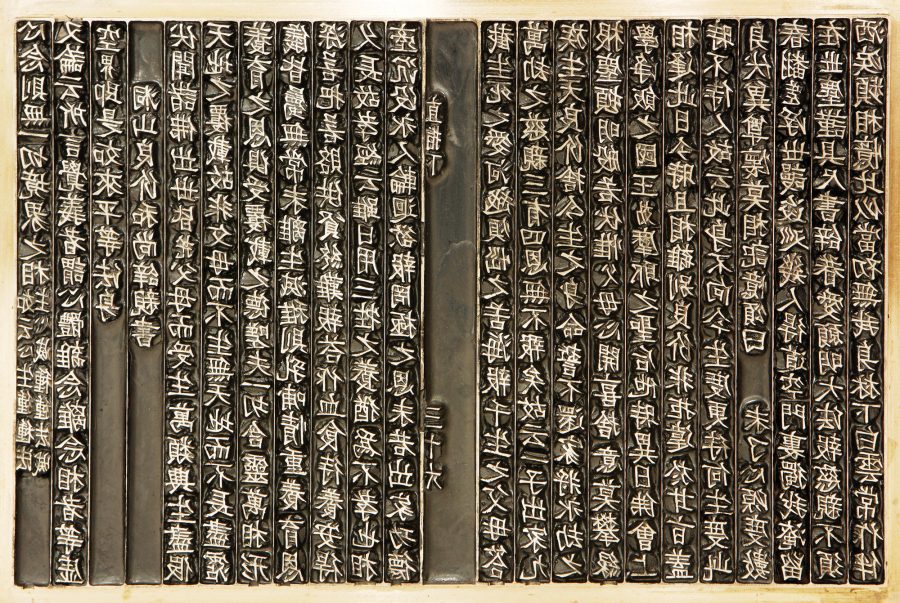
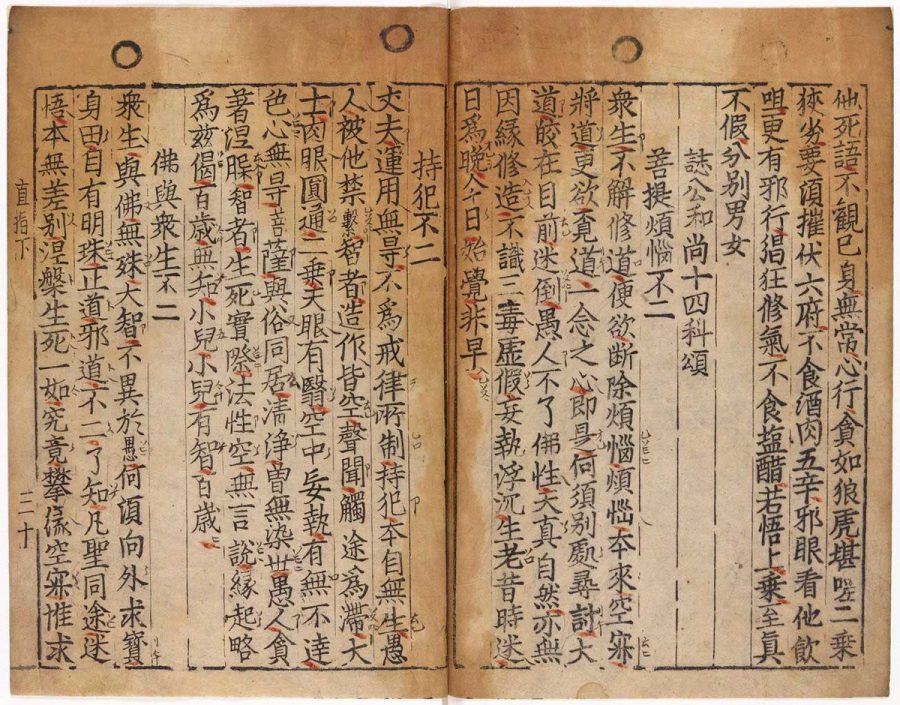
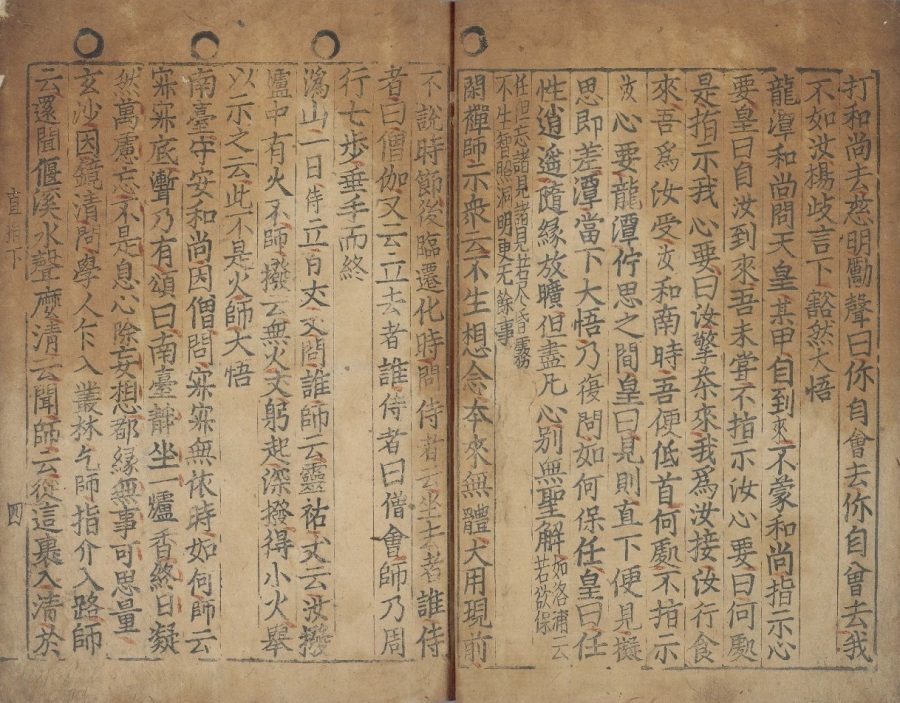
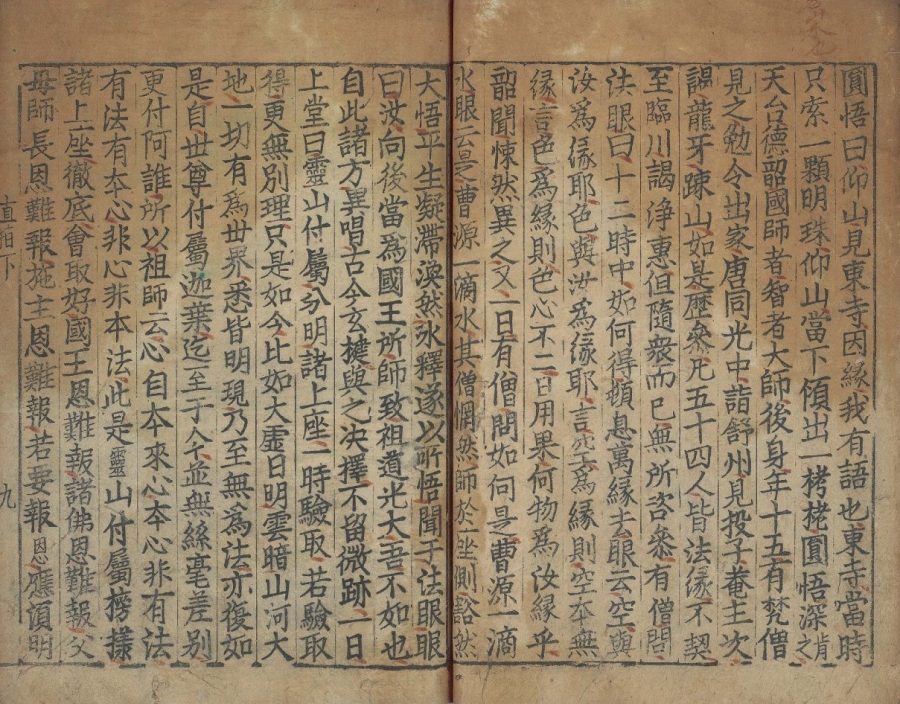
The oldest extant text ever printed with movable type predates Gutenberg himself (born in 1400) by 23 years, and predates the printing of his Bible by 78 years. It is the Jikji, printed in Korea, a collection of Buddhist teachings by Seon master Baegun and printed in movable type by his students Seok-chan and Daijam in 1377. (Seon is a Korean form of Chan or Zen Buddhism.) Only the second volume of the printing has survived, and you can see several images from it here.
Impressive as this may be, the Jikji does not have the honor of being the first book printed with movable type, only the oldest surviving example. The technology could go back two centuries earlier. Margaret Davis nods to this history, Newman concedes, writing that “movable type was an 11th century Chinese invention, refined in Korea in 1230, before meeting conditions in Europe that would allow it to flourish.” This is more than most popular accounts of the printed word say on the matter, but it’s still an inaccurate and highly cursory summary of the evidence.
Newman herself says quite a lot more. In essays at Lithub and Tricycle, she describes how printing techniques developed in Asia and were taken up in Korea in the 1200s by the Goryeo dynasty, who commissioned a printer named Choe Yun-ui to reconstruct a woodblock print of the massive collection of ancient Buddhists texts called the Tipitaka after the Mongols burned the only Korean copy. By casting “individual characters in metal” and arranging them in a frame—the same process Gutenberg used—he was able to complete the project by 1250, 200 years before Gutenberg’s press.
This text, however, did not survive, nor did the countless number of others printed when the technology spread across the Mongol empire on the Silk Road and took root with the Muslim Uyghurs. It is possible, though “no clear historical evidence” yet supports the contention, that movable type spread to Europe from Asia along trade routes. “If there was any connection,” wrote Joseph Needham in Science and Civilization in China, “in the spread of printing between Asia and the West, the Uyghurs, who used both block printing and movable type, had good opportunities to play an important role in this introduction.”
Without surviving documentation, this early history of printing in Asia relies on secondary sources. But “the entire history of the printing press” in Europe” is likewise “riddled with gaps,” Newman writes. What we do know is that Jikji, a collection of Korean Zen Buddhist teachings, is the world’s oldest extant book printed with movable type. The myth of Johannes Gutenberg as “a lone genius who transformed human culture,” as Davis writes, “endures because the sweep of what followed is so vast that it feels almost mythic and needs an origin story to match.” But this is one inventive individual in the history of printing, not the original, godlike source of movable type.
Gutenberg makes sense as a convenient starting point for the growth and worldwide spread of capitalism and European Christianity. His innovation worked much faster than earlier systems, and others that developed around the same time, in which frames were pressed by hand against the paper. Flows of new capital enabled the rapid spread of his machine across Europe. The achievement of the Gutenberg Bible is not diminished by a fuller history. But “what gets left out” of the usual story, as Newman tells us in great detail, “is startlingly rich.”
“Only very recently, mostly in the last decade” has the long history of printing in Asia been “acknowledged at all” in popular culture, though scholars in both the East and West have long known it. Korea has regarded Jikji “and other ancient volumes as national points of pride that rank among the most important of books.” Yet UNESCO only certifiedJikji as the “oldest movable metal type printing evidence” in 2001. The recognition may be late in coming, but it matters a great deal, nonetheless. Learn much more about the history, content, and provenance of Jikji at this site created by “cyber diplomats” in Korea after UNESCO bestowed World Heritage status on the book. And see a fully digitized copy of the book here.
We're hoping to rely on loyal readers, rather than erratic ads. Please click the Donate button and support Open Culture. You can use Paypal, Venmo, Patreon, even Crypto! We thank you!
Open Culture scours the web for the best educational media. We find the free courses and audio books you need, the language lessons & educational videos you want, and plenty of enlightenment in between.