Japanese Designer Creates Free Template for an Anti-Virus Face Shield: Download, and Then Use a Printer, Paper & Scissors

A few years ago we featured the Japanese art of chindōgu, or the invention of amusingly “useless” inventions. The chindōgu canon includes such simultaneously sensible and nonsensical objects as miniature toecap umbrellas (to keep one’s shoes dry in the rain) and chopsticks fitted with miniature fans (to cool down ramen noodles before consumption). Today we present a Japanese invention that may at first glance look chindōgu-like, but would never qualify due to its simplicity and sheer usefulness: an anti-virus face shield that anyone can make in three easy steps. After you’ve downloaded the template, all you need is a printer, paper, scissors, and some kind of clear plastic sheet.

“Healthcare workers around the world are putting their lives on the line to fight COVID-19 but their battle continues to be fought uphill as a shortage of medical supplies threatens to disrupt an already overwhelmed system,” writes Spoon & Tamago’s Johnny Waldman. We’ve all read of the lack of necessities like face masks and ventilators in some of the most afflicted countries, and in such places having access to face shields could make a real difference in the number of lives saved.


“Face shields are typically made with multiple parts and would be difficult to create and assemble at home,” Waldman notes. “But Tokujin Yoshioka’s brilliant idea simplifies the design greatly, allowing it to be held in place with ordinary eyewear.” Best known as an artist and designer, Yoshioka has made his name creating striking sculptures, installations, works of architecture, and many other objects besides.

Yoshioka even designed the torch for the 2020 Summer Olympics in Tokyo, shaped like a Japanese cherry blossom and made with the same aluminum extrusion technology used to manufacture the country’s equally iconic bullet trains. Clearly the coronavirus-caused postponement of the games hasn’t got Yoshioka too down to continue pursuing his calling. “I am grateful to the brave and dedicated healthcare workers for fighting the contagious disease,” he writes in the note accompanying the video at the top of the post that shows you how to make and wear his face shield. As you can see, it’s made to be worn with glasses, so the non-bespectacled will need to stick with other forms of protection against the virus — or take the opportunity to order some fashionable frames of the kind that all the best designers seem to be wearing these days.

via Spoon and Tamago

Related Content:

Watch “Coronavirus Outbreak: What You Need to Know,” and the 24-Lecture Course “An Introduction to Infectious Diseases,” Both Free from The Great Courses

Interactive Web Site Tracks the Global Spread of the Coronavirus: Created and Supported by Johns Hopkins

Why Fighting the Coronavirus Depends on You

The 10 Commandments of Chindōgu, the Japanese Art of Creating Unusually Useless Inventions

Based in Seoul, Colin Marshall writes and broadcasts on cities, language, and culture. His projects include the book The Stateless City: a Walk through 21st-Century Los Angeles and the video series The City in Cinema. Follow him on Twitter at @colinmarshall, on Facebook, or on Instagram.

10 Great German Expressionist Films: Nosferatu, The Cabinet of Dr. Caligari & More

In 1913, Germany, flush with a new nation’s patriotic zeal, looked like it might become the dominant nation of Europe and a real rival to that global superpower Great Britain. Then it hit the buzzsaw of World War I. After the German government collapsed in 1918 from the economic and emotional toll of a half-decade of senseless carnage, the Allies forced it to accept draconian terms for surrender. The entire German culture was sent reeling, searching for answers to what happened and why.

German Expressionism came about to articulate these lacerating questions roiling in the nation’s collective unconscious. The first such film was The Cabinet of Dr. Caligari (1920), about a malevolent traveling magician who has his servant do his murderous bidding in the dark of the night. The storyline is all about the Freudian terror of hidden subconscious drives, but what really makes the movie memorable is its completely unhinged look. Marked by stylized acting, deep shadows painted onto the walls, and sets filled with twisted architectural impossibilities — there might not be a single right angle in the film – Caligari’s look perfectly meshes with the narrator’s demented state of mind.


Subsequent German Expressionist movies retreated from the extreme aesthetics of Caligari but were still filled with a mood of violence, frustration and unease. F. W. Murnau’s brilliantly depressing The Last Laugh (1924) is about a proud doorman at a high-end hotel who is unceremoniously stripped of his position and demoted to a lowly bathroom attendant. When he hands over his uniform, his posture collapses as if the jacket were his exoskeleton. You don’t need to be a semiologist to figure out that the doorman’s loss of status parallels Germany’s. Fritz Lang’s M (1931), a landmark of early sound film, is the first serial killer movie ever made. But what starts out as a police procedural turns into something even more unsettling when a gang of distinctly Nazi-like criminals decide to mete out some justice of their own.

German Expressionism ended in 1933 when the Nazis came to power. They weren’t interested in asking uncomfortable questions and viewed such dark tales of cinematic angst as unpatriotic. Instead, they preferred bright, cheerful tales of Aryan youths climbing mountains. By that time, the movement’s most talented directors — Fritz Lang and F.W. Murnau — had fled to America. And it was in America where German Expressionism found its biggest impact. Its stark lighting, grotesque shadows and bleak worldview would go on on to profoundly influence film noir in the late 1940s after another horrific, disillusioning war. See our collection of Free Noir Films here.

You watch can 10 German Expressionist movies – including Caligari, Last Laugh and M — for free below.

  • Nosferatu – Free – German Expressionist horror film directed by F. W. Murnau. An unauthorized adaptation of Bram Stoker’s Dracula. (1922)
  • The Student of Prague – Free – A classic of German expressionist film. German writer Hanns Heinz Ewers and Danish director Stellan Rye bring to life a 19th-century horror story. Some call it the first indie film. (1913)
  • Nerves – Free – Directed by Robert Reinert, Nerves tells of “the political disputes of an ultraconservative factory owner Herr Roloff and Teacher John, who feels a compulsive but secret love for Roloff’s sister, a left-wing radical.” (1919)
  • The Cabinet of Dr. Caligari – Free – This silent film directed by Robert Wiene is considered one of the most influential German Expressionist films and perhaps one of the greatest horror movies of all time. (1920)
  • Metropolis – Free – Fritz Lang’s fable of good and evil fighting it out in a futuristic urban dystopia. An important classic. An alternate version can be found here. (1927)
  • The Golem: How He Came Into the World – Free – A follow-up to Paul Wegener’s earlier film, “The Golem,” about a monstrous creature brought to life by a learned rabbi to protect the Jews from persecution in medieval Prague. Based on the classic folk tale, and co-directed by Carl Boese. (1920)
  • The Golem: How He Came Into the World – Free – The same film as the one listed immediately above, but this one has a score created by Pixies frontman Black Francis. (2008)
  • The Last Laugh – Free – F.W. Murnau’s classic chamber drama about a hotel doorman who falls on hard times. A masterpiece of the silent era, the story is told almost entirely in pictures. (1924)
  • Faust – Free  German expressionist filmmaker F.W. Murnau directs a film version of Goethe’s classic tale. This was Murnau’s last German movie. (1926)
  • Sunrise: A Song of Two Humans – Free – Made by the German expressionist director F.W. Murnau. Voted in 2012, the 5th greatest film of all time. (1927)
  • M – Free – Classic film directed by Fritz Lang, with Peter Lorre. About the search for a child murderer in Berlin. (1931)

For more classic films, peruse our larger collection, 4,000+ Free Movies Online: Great Classics, Indies, Noir, Westerns, Documentaries & More.

Note: An earlier version of this post appeared on our site in December, 2014.

Would you like to support the mission of Open Culture? Please consider making a donation to our site. It’s hard to rely 100% on ads, and your contributions will help us continue providing the best free cultural and educational materials to learners everywhere.

Also consider following Open Culture on Facebook and Twitter and sharing intelligent media with your friends. Or sign up for our daily email and get a daily dose of Open Culture in your inbox. 

Related Content:

What Is German Expressionism? A Crash Course on the Cinematic Tradition That Gave Us Metropolis, Nosferatu & More

How German Expressionism Influenced Tim Burton: A Video Essay

When the Nazis Declared War on Expressionist Art (1937)

Expressionist Dance Costumes from the 1920s, and the Tragic Story of Lavinia Schulz & Walter Holdt

Jonathan Crow is a Los Angeles-based writer and filmmaker whose work has appeared in Yahoo!, The Hollywood Reporter, and other publications. You can follow him at @jonccrow. And check out his blog Veeptopus, featuring lots of pictures of badgers and even more pictures of vice presidents with octopuses on their heads.  The Veeptopus store is here.
Pretty Much Pop: A Culture Podcast #40 on #MeToo Depictions in TV and Film


These stories are all heavily watched, which means they’re entertaining: The 2019 film Bombshell (about the predations of Roger Ailes), Apple TV’s The Morning Show (about a disgraced anchor), and Netflix’s Unbelievable (about reporting rape) and 13 Reasons Why (about teen suicide resulting from sexual assault). But what’s “entertaining” about sexual assault and harassment? What makes for a sensitive as opposed to a sensationalized portrayal?

Erica, Mark, and Brian consider which stories work and why. How much divergence from true events is allowable in Bombshell or Confirmation (about Anita Hill)? By having characters interpret their situations (Erica gives an example from the show Sex Education), are writers essentially telling audiences how to feel about their own experiences? Should certain depictions be ruled out as potentially triggering, or is it good to “bring to light” whatever terrible things actually happen in the world? Should shows delve into the psychology of the perpetrator (maybe even treating him as a protagonist), or must the message be wholly and unambiguously about the victim? 

Art is about risk-taking and capturing difficult ambiguities; this doesn’t sound much like a public service message. So what responsibility to do show creators have to consult professionals about how to present difficult topics like this?

We drew on some articles to help us look at these questions:

Here’s that weird scene where Jennifer Aniston and Billy Crudup sing on The Morning Show.

If this topic is too depressing, check out our episode #39 from last week about what to watch on TV during quarantine:

Learn more at prettymuchpop.com. This episode includes bonus discussion that you can only hear by supporting the podcast at patreon.com/prettymuchpop. This podcast is part of the Partially Examined Life podcast network.

Pretty Much Pop: A Culture Podcast is the first podcast curated by Open Culture. Browse all Pretty Much Pop posts or start with the first episode.

Take a Virtual Tour of the Andy Warhol Exhibition at the Tate Modern

Not only did Andy Warhol miss out on the internet, but the internet missed out on Andy Warhol. Surely, these days he would be prolifically posting to his Instagram and YouTube from home, indulging multiple celebrity and pop culture obsessions. Warhol’s Polaroid aesthetic and pioneering of the self-as-brand helped create 21st century online culture. Maybe he was the original “influencer,” though Warhol was more of an instigator. But he’s become too familiar for us to appreciate his uniqueness, suggest Gregor Muir and Fiontán Moran, curators of an extensive Tate Modern Warhol exhibit featuring 100 works, which is now only accessible via the 7-minute video tour above.

“Everyone owns Warhol” (though few own a Warhol), argue Muir and Moran. “He is one of those rare artists who transcends the art world, having become widely known as one of America’s most famous artists, if not one of America’s most famous Americans.


Over time, Warhol became—and still is—a big brand, which is just how he wanted it.” Warhol showed how individual artists could circumvent the star-making system, create their own branding, and commandeer the culture with manufactured fame. He “helped shape a century’s worth of pop culture,” writes Luke Abrahams at Harper’s Bazaar, “and helped launch the cult of celebrity.”

Whether that legacy deserves more praise or blame I leave to you to decide. In either case, our posthumous judgments cannot diminish Warhol’s singular achievements in graphic art or his radical approaches to film, photography, and—through his promotion of the Velvet Underground—music. Behind the aloof, eccentric persona is a personal story the Tate exhibit explores as well, through Warhol’s immigrant and queer identity and his concerns with death and religion. Architectural Digest reports on the additional resources the online exhibit offers:

For visitors looking to dive deeper into the exhibition and the artist during the lockdown, there’s also the room-by-room exhibition guide; articles about Warhol, from an investigation into his relationship with his mother to a personal tale written by his friend Bob Colachello; a podcast about personas; and even how-to videos demonstrating Warhol’s printmaking process. 

Tate digital director Hilary Knight knows there’s no substitute for the original, which is maybe an ironic idea when it comes to Warhol. “We are not trying to replicate a museum visit,” Knight says, but “we can still offer a rich, deep, and inspiring experience of Tate online.” Though abbreviated and virtual, this deeper dive into Warhol’s life and work does that indeed. Find more detailed on the exhibition, and each room, here.

Related Content:

Andy Warhol Explains Why He Decided to Give Up Painting & Manage the Velvet Underground Instead (1966)

Andy Warhol Demystified: Four Videos Explain His Groundbreaking Art and Its Cultural Impact

130,000 Photographs by Andy Warhol Are Now Available Online, Courtesy of Stanford University

Lou Reed’s Mixtape for Andy Warhol Discovered by Cornell University Professor: Features 12 Previously Unreleased Songs

Josh Jones is a writer and musician based in Durham, NC. Follow him at @jdmagness

Watch 270+ Short Documentaries of Artists at Work, and Let Them Inspire Your Creative Process

Imagine if comedian Amy Sedaris were self-isolating with artists Marcel Dzama and Raymond Pettibon.

Perhaps they’d barricade themselves into separate rooms, hunched over their individual screens, cursing their roommates for slowing down their livestreams, but we prefer to think they’d busy themselves with projects such as Dzama’s short film, “Dance Floor Dracula, Prelude in C-Sharp Minor.”


Enjoy a glimpse into the friends’ collaborative creative process, above, compliments of Art21’s Extended Play, a short documentary series offering backstage access to living, working artists, from established to emerging.

Much of the content seems germane to the world we find ourselves in now, when the creative playing field feels remarkably open to our participation, thanks to crowdsourced projects like the ongoing photo challenge wherein ordinary citizens are using their phones and household objects to recreate famous artworks at home.

Painter Tala Madani takes viewers through her sketchbook and talks about its value as a method of capturing ideas and as the “most immediate record of the thinking process.” The cartoonish quality of her sketches may help those who’d let a lack of confidence in their artistic ability stop them from attempting to document their observations of our changed reality visually. A sketchbook is also a great place for the seeds of future projects to germinate.

The preparations for Oakland’s Creative Growth Art Center’s annual fashion show, Beyond Trend, could send you scuttling to your closet or recycling bin, inspired by William Scott’s papier-mâché Frankenstein mask—a five day effort—or the patches Christine Szeto embroiders with titles of favorite Taylor Swift songs, then sews to her jeans in orderly columns.

This sort of wearable art doesn’t require advanced needle skills or knowledge of how garments are put together, making it perfectly tailored to those open to exploring new sides of themselves in isolation.

That said, we are sure the featured designers are anxiously awaiting the reopening of Creative Growth, which serves artists with developmental, mental, and physical disabilities.

Community and creativity are showing themselves to be equally essential to our wellbeing.

Watch all 270+ episodes of Art21’s Extended Play here, or right below:

Related Content: 

The Seven Road-Tested Habits of Effective Artists

Moebius Gives 18 Wisdom-Filled Tips to Aspiring Artists

Love the Art, Hate the Artist: How to Approach the Art of Disgraced Artists

Ayun Halliday is an author, illustrator, theater maker and Chief Primatologist of the East Village Inky zine. Follow her @AyunHalliday.

Museum Curators Create a Contest to See Who Has the Creepiest Object: Ancient Body Parts, Cursed Toys, and More

Museums around the world have temporarily closed due to the coronavirus pandemic, and each of these institutions has used its downtime differently. Some have provided online versions of the experiences previously offered in their physical galleries; others have started prolonged battles on Twitter. No, not the kind of prolonged battle one normally associates with Twitter, but a friendlier, more productive competition between professionals. At times, however, the #curatorbattle, as it’s been hashtagged, has looked just as repulsive to the viewer as any Twitter conflict: especially last week, when the Yorkshire Museum threw down the challenge to pull the “creepiest object” out of the archives and post it.

“Museum curators are up to their ears in weird crap, some of which isn’t fit for display,” writes Ruin My Week’s Alison Sullivan. “There are lots of niche museums out there, too, who don’t get the kind of attention the Smithsonian receives. They’re about local history or specific interests, and their collections are the strangest of all.”


The Yorkshire Museum, which bills itself as offering “Britain’s finest archaeological treasures, and a walk through the Jurassic landscapes of Yorkshire,” is no different: they started off the challenge of the week by posting a “3rd/4th century hair bun from the burial of a #Roman lady, still with the jet pins in place” — albeit fully detached from the head it was buried on.

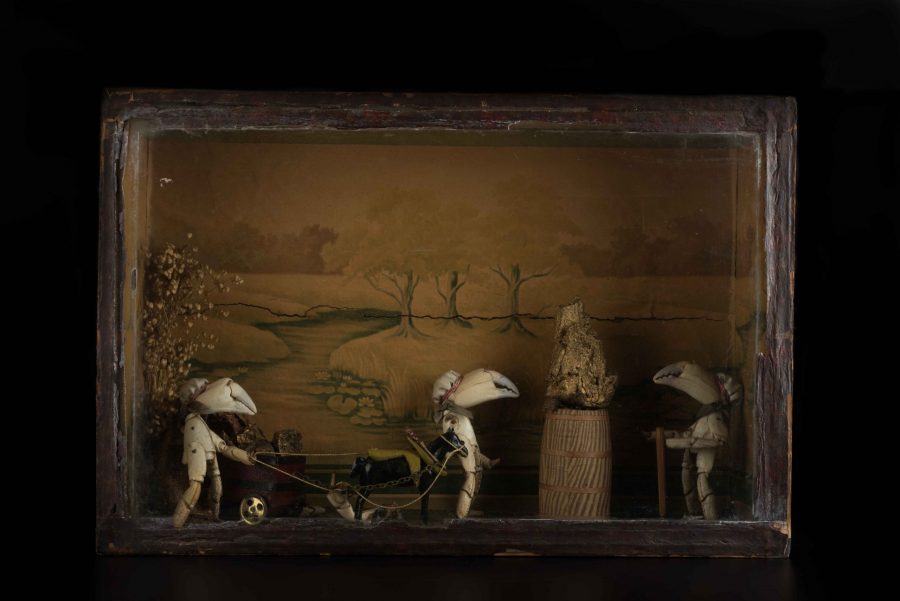
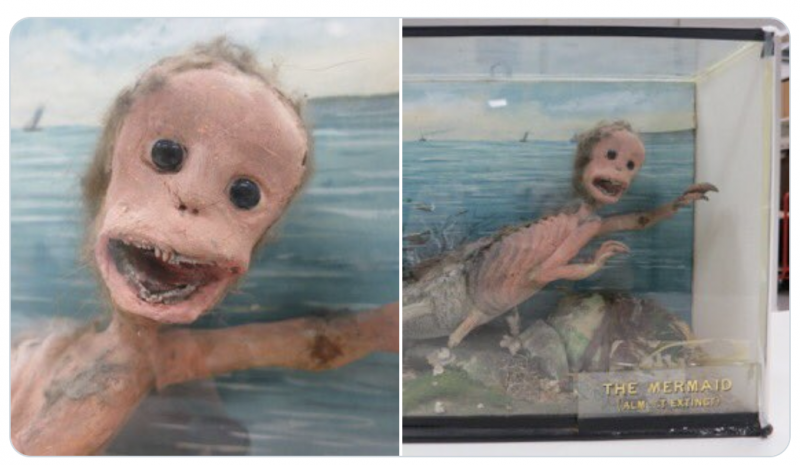
Other participating institutions saw the Yorkshire Museum’s hair bun and raised it a “sheep’s heart stuck with pins and nails, to be worn like a necklace for breaking evil spells,” a P.T. Barnum-style “mermaid” constructed through taxidermy, a “CURSED CHILDREN’S TOY that we found inside the walls of a 155-year-old mansion,” and small dioramas populated by gold-miners and card-players made of crab’s legs and claws.

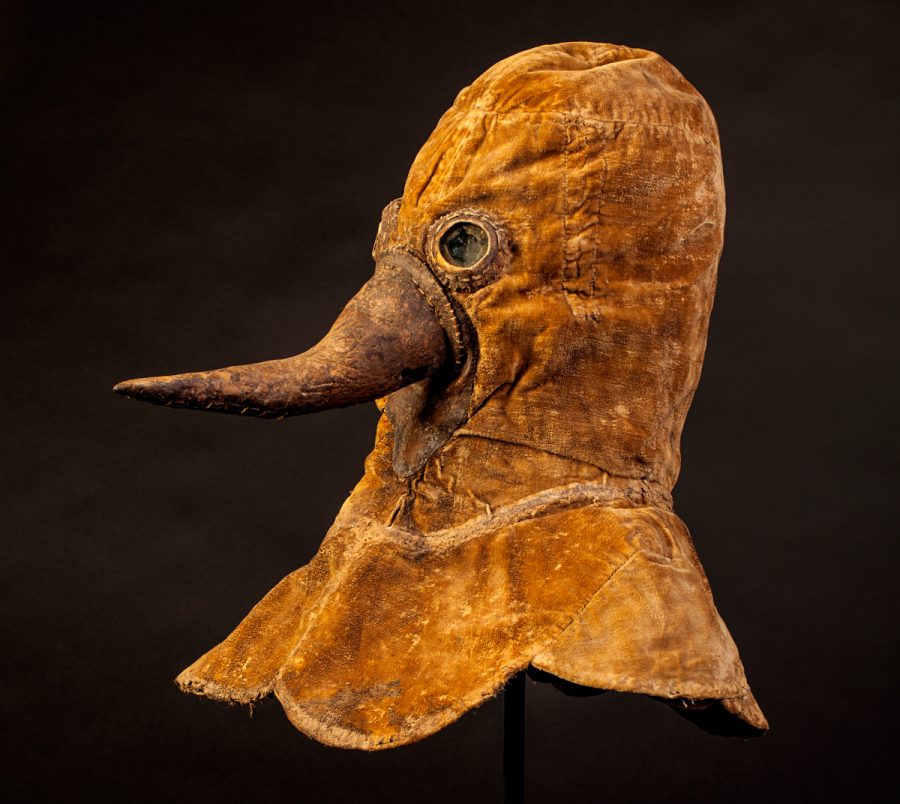
In the tweet posting that last, the York Castle Museum describes the pieces’ creators as typical of Victorians, who “loved weird/creepy stuff.” If your own such love isn’t satisfied by the highlights at Ruin My Week and The Guardian, have a look at the replies below the  Yorkshire Museum’s original tweet. You may not have asked to see a beaked 17th- or 18th-century plague mask at this particular moment, but try to take it in the spirit of cultural exchange. View more creepy objects on Twitter here.

via Artnet

Related Content:

The “Weird Objects” in the New York Public Library’s Collections: Virginia Woolf’s Cane, Charles Dickens’ Letter Opener, Walt Whitman’s Hair & More

Inside the Creepy, “Abandoned” Wizard of Oz Theme Park: Scenes of Beautiful Decay

Hear Thomas Edison’s Creepy Talking Dolls: An Invention That Scared Kids & Flopped on the Market

The Creepy 13th-Century Melody That Shows Up in Movies Again & Again: An Introduction to “Dies Irae”

Charles Dickens Gave His Cat “Bob” a Second Life as a Letter Opener

Based in Seoul, Colin Marshall writes and broadcasts on cities, language, and culture. His projects include the book The Stateless City: a Walk through 21st-Century Los Angeles and the video series The City in Cinema. Follow him on Twitter at @colinmarshall, on Facebook, or on Instagram.

Mark Knopfler Plays a Poignant, Overdriven Version of “The Last Post,” Remembering the Many Lives Lost in World War I

World War I symbolism gets lost on Americans. Our historical memories are short and selective, and the War has “largely vanished from view,” as historian Geoffrey Wawro writes at Time magazine. But in Europe, of course, where some armies suffered ten times the casualties as U.S. troops, and where millions of civilian died and towns were bombed into oblivion, the memory of the Great War is very much alive.

In Ypres, Belgium, the War has been memorialized every day since 1928 (with the exception of four years of German occupation during WWII) by the Last Post Association, a devoted company of buglers who play the military song at the Menin Gate memorial every evening to commemorate the British dead at the Battle of Ypres. As of this writing, they’ve held their 31,748th ceremony.


In Britain itself, and around the world, the tune has a long history as a symbol, like the poppy, of Remembrance Day. Just like Taps in the U.S., the Last Post is “a bugle call,” writes the Last Post Association, “played in the British Army (and in the armies of many other lands) to mark the end of the day’s labours and the onset of the night’s rest…. It has come to represent a final farewell to the fallen at the end of their earthly labours and at the onset of their eternal rest.”

Robert Graves summed up the song’s association with death in his 1918 poem, “The Last Post”:

The bugler sent a call of high romance—
“Lights out! Lights out!” to the deserted square.
On the thin brazen notes he threw a prayer,
“God, if it’s this for me next time in France…
O spare the phantom bugle as I lie
Dead in the gas and smoke and roar of guns,
Dead in a row with the other broken ones
Lying so stiff and still under the sky,
Jolly young Fusiliers too good to die.”

I imagine Mark Knopfler, a lover of poetry, might be familiar with Graves’ verse. In his own rendition of the Last Post, above, Knopfler commemorates 17,000 Northumberland Fusiliers killed in the War, who came from his home region and suffered more casualties than any other regiment. Recorded on Remembrance Day, November 8, 2018, the 100th anniversary of the War’s end, Knopfler’s version is both restrained and fiercely overdriven, recalling Hendrix’s “Star-Spangled Banner” in some of its flashier moments of vibrato. Rather than one of his usual iconic guitars, he plays a custom instrument that howls like a keening bugle.

The recording was part of a project in which musicians around the world played the ceremonial call on a variety of instruments. For comparison with Knopfler’s creative interpretation, see a straightforward rendition played above by a member of the Australian Royal Military College Band. The bugle call reminds us of the war dead we may have forgotten, and the millions killed by starvation and influenza after the armistice. And perhaps it also reminds us of the importance of collective mourning for the dead in our own extraordinary historical moment.

Related Content:

Guitar Stories: Mark Knopfler on the Six Guitars That Shaped His Career

Mark Knopfler Gives a Short Masterclass on His Favorite Guitars & Guitar Sounds

The Great War: Video Series Will Document How WWI Unfolded, Week-by-Week, for the Next 4 Years

Josh Jones is a writer and musician based in Durham, NC. Follow him at @jdmagness

Pink Floyd Streaming Free Classic Concert Films, Starting with 1994’s Pulse, the First Live Performance of Dark Side of the Moon in Full

If you’re feeling a little stressed today—maybe a lot stressed today, maybe severely-rationing-your-social-media stressed—it might do you some good to get comfortably numb. And unless the laws of your locality prevent it, you can reach a safe state of bliss at home with historic live concert films from Pink Floyd. “Following the lead of Radiohead and Metallica and launching a YouTube concert series,” notes Consequence of Sound, “the band will release unseen, rare, or archived material from their vault and stream it for free” over the next few weeks.

It may or may not be necessary to qualify that Pink Floyd these days consists of only two people, David Gilmour and drummer Nick Mason, keyboardist Richard Wright having passed away in 2008 and bassist/rock opera impresario Roger Waters having stormed off to make his own records in 1985, never to return. Perhaps only coincidentally, the first film the band has released is 1994’s Pulse, a 22-song set from the Division Bell tour, the second studio album made without Waters. But it’s got quite a lot to recommend it despite his absence.


“Filmed at London’s now-defunct Earls Court during the band’s record-breaking 14-night residency,” this show is notable particularly for “the inclusion of the first-ever film recording of Pink Floyd playing The Dark Side of the Moon in full.” The 1972 album’s sardonic ruminations on the banality of modern life in an economy that cannot stop its constant grind might strike us as particularly grim while we’re facing such huge collective losses of life and livelihood. But as always, the band knows how to make its medicine go down with some sweet eye and ear candy.

Mixed in 5.1 surround sound and digitally re-mastered by James Guthrie, Pulse also includes some of original screen films used for the 1970s concert performances of The Dark Side of the Moon (which were never filmed) as well as the visual components for the piece which were remade for the 1994 tour.

On their Facebook page, the band promises more “interesting and diverting images, music and video to help us all get through this”—as best as we can, in any case. And if you run out of Pink Floyd to help you get through a tough time of day, head over to see another band bringing blues-based psych-rock, American style, to the shut-in masses this spring. The Grateful Dead have their own weekly streaming series of full concert films. Of the first concert posted, they write, “Its excellence is indisputable and is something that we think pretty much everyone will enjoy in the absence of actually being able to see live concerts.”

Take an hour or two to relax with some classic live shows from classic bands of yore, and maybe make a list of all the current bands you want to go out and support as soon as you get out of quarantine. Something tells me after all this livestreaming, there’ll be waves of renewed appreciation for live music. Goodness knows, musicians everywhere will need it.

Visit the Pink Floyd Youtube channel for more lives streams in the future.

Related Content:

Pink Floyd Films a Concert in an Empty Auditorium, Still Trying to Break Into the U.S. Charts (1970)

The Dark Side of the Moon Project: Watch the First of an 8-Part Video Essay on Pink Floyd’s Classic Album

An Hour-Long Collection of Live Footage Documents the Early Days of Pink Floyd (1967-1972)

Dead & Company Announces Couch Tour, Letting You Stream Free Concerts at Home

Radiohead Will Stream Concerts Free Online Until the Pandemic Comes to an End

Josh Jones is a writer and musician based in Durham, NC. Follow him at @jdmagness

« Go BackMore in this category... »
Quantcast
Open Culture was founded by Dan Colman.