How Vladimir Nabokov Wrote Lolita, “My Most Difficult Book”: A 1989 Documentary

How many of us could write a book with the impact of Loli­ta? The task, as revealed in the BBC Omnibus doc­u­men­tary above, lay almost beyond even the for­mi­da­ble lit­er­ary pow­ers of Vladimir Nabokov — almost, but obvi­ous­ly not quite. It did push him into new aes­thet­ic, cul­tur­al, and com­po­si­tion­al realms, as evi­denced by his mem­o­ries of draft­ing the nov­el on index cards in road­side motels (and when faced with espe­cial­ly noisy or drafty accom­mo­da­tions, in the back­seat of the parked car) while road-trip­ping though the Unit­ed States. The doc­u­men­tary’s sub­ject is the exiled aris­to­crat nov­el­ist’s expe­ri­ence writ­ing and pub­lish­ing Loli­ta, the book that would make him world-famous — as well as the expe­ri­ence that brought him to the time and place that made such a cul­tur­al coup pos­si­ble.

Aired in 1989, a dozen years after Nabokov’s death, My Most Dif­fi­cult Book fea­tures inter­views with the nov­el­ist’s Fer­rari-dri­ving son and trans­la­tor Dmitri, his schol­ar-biog­ra­ph­er Bri­an Boyd, and his younger admir­er-col­leagues includ­ing Mar­tin Amis, A.S. Byatt, and Edmund White. That last describes Nabokov’s nov­els as “great sys­tems of mean­ing in which every ele­ment refers to every oth­er one,” and Loli­ta marked a new height in his achieve­ment in that form.

But the book’s pop­u­lar­i­ty, or at least its ini­tial wave of pop­u­lar­i­ty, may be bet­ter explained by the con­tro­ver­sy sur­round­ing the ele­ments of its by now well-known premise: the refined mid­dle-aged Euro­pean nar­ra­tor, the coarse twelve-year-old step­daugh­ter whom he con­trives to sex­u­al­ly pos­sess — and suc­ceeds in sex­u­al­ly pos­sess­ing — as they dri­ve across Amer­i­ca, a vast land whose look, feel, and lan­guage Nabokov took pains to cap­ture and repur­pose.

“There are a lot of lit­er­al­ists out there,” says Amis, “who will think that you can’t write a nov­el like Loli­ta with­out being a secret slaver after young girls.” That was as true in 1989 as it was in 1955, when the book was first pub­lished, and indeed as true as it is today. Well into mid­dle age, we learn in the doc­u­men­tary, strangers would ask Dmitri what it was like to be the son of a “dirty old man,” and in archive inter­view footage we see Nabokov address the pub­lic con­fla­tion of him­self and Hum­bert Hum­bert, Loli­ta’s pedophil­i­ac nar­ra­tor. A seri­ous chess enthu­si­ast, Nabokov describes him­self as writ­ing nov­els as he would solve chess prob­lems he posed to him­self. What could present a more rig­or­ous chal­lenge than to tell a sto­ry, at a high artis­tic lev­el, from the per­spec­tive of a mon­ster? But Nabokov, as he admit­ted to one inter­view­er, was indeed a mon­ster, at least accord­ing to one def­i­n­i­tion offered by his much-con­sult­ed Eng­lish dic­tio­nary: “A per­son of unnat­ur­al excel­lence.”

Relat­ed Con­tent:

Nabokov Reads Loli­ta, and Names the Great­est Books of the 20th Cen­tu­ry

Hear Vladimir Nabokov Read From the Penul­ti­mate Chap­ter of Loli­ta

Vladimir Nabokov on Loli­ta: Just Anoth­er Great Love Sto­ry?

The Note­cards on Which Vladimir Nabokov Wrote Loli­ta: A Look Inside the Author’s Cre­ative Process

Vladimir Nabokov’s Script for Stan­ley Kubrick’s Loli­ta: See Pages from His Orig­i­nal Draft

Vladimir Nabokov Mar­vels Over Dif­fer­ent Loli­ta Book Cov­ers

Based in Seoul, Col­in Mar­shall writes and broad­casts on cities, lan­guage, and cul­ture. His projects include the book The State­less City: a Walk through 21st-Cen­tu­ry Los Ange­les and the video series The City in Cin­e­ma. Fol­low him on Twit­ter at @colinmarshall, on Face­book, or on Insta­gram.

A Beatboxing Buddhist Monk Creates Music for Meditation

Most of us assume Japan­ese Bud­dhist monks to be silent types. In their per­son­al lives they may well be, but if they want to go viral, they’ve got to log onto the inter­net and make some noise. This is the les­son one draws from some of the Bud­dhist fig­ures pre­vi­ous­ly fea­tured here on Open Cul­ture: Kos­san, he of the Bea­t­les and Ramones cov­ers, or Gyōsen Asaku­ra, the priest who per­forms psy­che­del­ic ser­vices sound­tracked with elec­tron­ic dance music. Depend­ing on your taste in music, their per­for­mances may or may not induce the men­tal qui­et one asso­ciates with Bud­dhist prac­tice, and the music of Yoget­su Akasa­ka, the lat­est Japan­ese Bud­dhist monk to attain inter­net fame, may at first sound equal­ly untra­di­tion­al. But lis­ten and you may well find your­self in a med­i­ta­tive state with­out even try­ing.

“The 37-year-old went viral in May, after post­ing his ‘Heart Sutra Live Loop­ing Remix,’ a video that’s relax­ing like ASMR, and engross­ing like a DJ set,” writes Vice’s Miran Miyano. “With the loop machine, he lay­ers sounds and chants all com­ing from one instru­ment — his voice.” A musi­cian since his teens and a beat­box­er since his ear­ly twen­ties, the Tokyo-based Akasa­ka became a monk five years ago, fol­low­ing the path tak­en by his father, an abbott at a tem­ple in rur­al Iwate Pre­fec­ture.

“Before he was ordained in 2015, he belonged to a the­atre com­pa­ny formed in Fukushi­ma pre­fec­ture, north­east Japan, after the region was dev­as­tat­ed by the 2011 Tohoku earth­quake and tsuna­mi,” writes Richard Lord in the South Chi­na Morn­ing Post. “He has also been a full-time busker in coun­tries includ­ing the Unit­ed States and Aus­tralia.”

A busker Akasa­ka remains, in a sense, albeit one who, from the cor­ner of YouTube he’s made his own, can be heard across the globe. In addi­tion to record­ings like his hit ver­sion of the Heart Sutra, he’s also been live stream­ing per­for­mances for the past two months. Last­ing up to near­ly two hours, these streams pro­vide Akasa­ka an oppor­tu­ni­ty to vary his musi­cal as well as spir­i­tu­al themes, bring dif­fer­ent instru­ments into the mix, and respond to fans who send him mes­sages from all over the world, most­ly out­side his home­land. “I think in Japan, peo­ple often asso­ciate Bud­dhism with funer­als, and the sutra has a lit­tle bit of a neg­a­tive and sad image,” he says to Vice. Indeed, as the say­ing goes, the mod­ern Japan­ese is born Shin­to, mar­ries Chris­t­ian, and dies Bud­dhist. But as Akasa­ka shows us, his tra­di­tion has some­thing to offer all of us, no mat­ter our nation­al­i­ty, in life as well.

via Metafil­ter

Relat­ed Con­tent:

Japan­ese Bud­dhist Monk Cov­ers Ramones’ “Teenage Lobot­o­my,” “Queen’s “We Will Rock You,” Bea­t­les’ “Yel­low Sub­ma­rine” & More

Bud­dhist Monk Cov­ers Judas Priest’s “Break­ing the Law,” Then Breaks Into Med­i­ta­tion

Japan­ese Priest Tries to Revive Bud­dhism by Bring­ing Tech­no Music into the Tem­ple: Attend a Psy­che­del­ic 23-Minute Ser­vice

Beat­box­ing Bach’s Gold­berg Vari­a­tions

What Beat­box­ing and Opera Singing Look Like Inside an MRI Machine

Based in Seoul, Col­in Mar­shall writes and broad­casts on cities, lan­guage, and cul­ture. His projects include the book The State­less City: a Walk through 21st-Cen­tu­ry Los Ange­les and the video series The City in Cin­e­ma. Fol­low him on Twit­ter at @colinmarshall, on Face­book, or on Insta­gram.

Icons of Art Wearing Masks: Frida Kahlo, Mona Lisa, Girl with the Pearl Earring & More

We hear the phrase “unprece­dent­ed times” every day now, but the truth is few calami­ties in human his­to­ry are more prece­dent­ed than plagues and pesti­lences. In West­ern his­to­ry, at least, dis­ease epi­demics seem always to have been fol­lowed by Machi­avel­lian oppor­tunism and cultish con­spir­a­cy the­o­ries that only made things worse.

Dur­ing the 14th cen­tu­ry, almost six hun­dred years before Nao­mi Klein defined the shock doc­trine, the Black Death “strength­ened the pow­er of the state and accel­er­at­ed the dom­i­na­tion of key mar­kets by a hand­ful of large com­pa­nies,” write Eleanor Rus­sell and Mar­tin Park­er at The Con­ver­sa­tion (hel­lo, Ama­zon). In their argu­ment, dis­as­ter cap­i­tal­ism may have pre­ced­ed actu­al cap­i­tal­ism, and it start­ed with the plague.

In his his­to­ry of the Great Plague of 1665, Daniel Defoe described how “every­one behaved bad­ly, though the rich behaved the worst,” as Jill Lep­ore writes at The New York­er, forc­ing their ser­vants to put their lives at risk to pro­vi­sion the great hous­es. “This Neces­si­ty…,” writes Defoe, “was in a great Mea­sure the Ruin of the whole City,” though few in Lon­don then under­stood how to slow trans­mis­sion of the dis­ease.

That was not the case when the Influen­za epi­dem­ic took the lives of hun­dreds of mil­lions around the world between 1918 and 1920. Doc­tors under­stood how the flu spread and rec­om­mend­ed that every­one wear a mask in pub­lic. Cities passed ordi­nances and imme­di­ate­ly resis­tance sprang up, lead­ing to orga­ni­za­tions like San Francisco’s Anti-Mask League, whose rhetoric sounds like that of anti-mask pro­tes­tors of today.

The times may be unique—for the speed at which COVID-19 spread around the world, for instance, along with the disinformation—but humans have lived through many ver­sions of pan­dem­ic, and many dis­as­trous­ly self­ish, oppor­tunis­tic, and short-sight­ed respons­es to it. We may con­tem­plate these his­tor­i­cal rep­e­ti­tions as we admire the Insta­gram cre­ations of artist Genevieve Blais, who has been post­ing images of famous paint­ings, stat­ues, and pho­tographs with their sub­jects wear­ing masks.

More than nov­el­ty memes or high­brow pub­lic ser­vice announce­ments, Blais’ cre­ations are part-whim­si­cal/­part-sober­ing reminders of the per­sis­tence of plagues through­out history—their influ­ence on the rise and fall of dynas­ties and pow­er­ful patrons, and the igno­rance and fol­ly that led to so much pre­ventable death. Tech­no­log­i­cal­ly speak­ing, humans are bet­ter posi­tioned than ever before to com­bat epi­demics of dis­ease. But it’s worth remem­ber­ing the prece­dents for our cur­rent con­di­tions. Plagues have shaped human his­to­ry. We don’t always have to respond to them the same way. See all of Blais’s masked fine art images at her Plague His­to­ry Insta­gram page. If you DM her, she will make you a print.

via Kot­tke

Relat­ed Con­tent:

What Hap­pened When Amer­i­cans Had to Wear Masks Dur­ing the 1918 Flu Pan­dem­ic

Vin­tage Sci­ence Face Masks: Con­quer the Pan­dem­ic with Sci­ence, Cour­tesy of Maria Popova’s Brain­Pick­ings

Down­load Clas­sic Works of Plague Fic­tion: From Daniel Defoe & Mary Shel­ley, to Edgar Allan Poe

Josh Jones is a writer and musi­cian based in Durham, NC. Fol­low him at @jdmagness

Dr. Fauci Reads an Undergrad’s Entire Thesis, Then Follows Up with an Encouraging Letter

Pho­to via the Nation­al Insti­tute of Aller­gy and Infec­tious Dis­eases 

What are some qual­i­ties to look for in a leader?

  • A thirst for knowl­edge
  • A sense of duty
  • The scru­ples to give cred­it where cred­it is due
  • A calm, clear com­mu­ni­ca­tion style
  • Humil­i­ty

Dr. Antho­ny Fau­ci brings these qual­i­ties to bear as Direc­tor of the Nation­al Insti­tute of Aller­gy and Infec­tious Dis­eases at the Nation­al Insti­tute of Health.

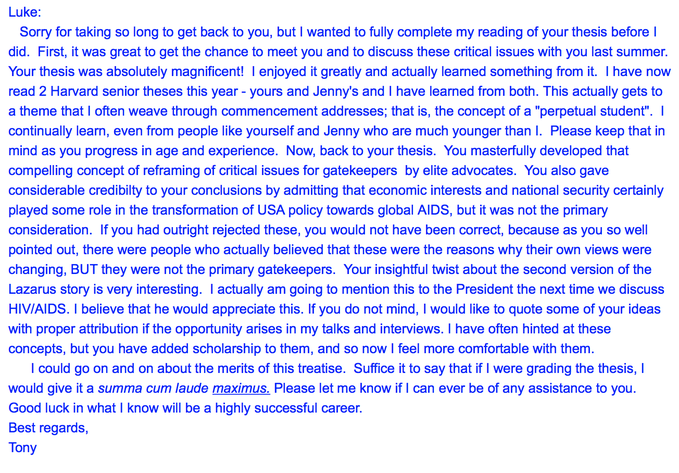
They’re also on dis­play in his mes­sage to then-under­grad Luke Mes­sac, now an emer­gency med­i­cine res­i­dent at Brown Uni­ver­si­ty, whose research focus­es on the his­to­ries of health pol­i­cy in south­ern Africa and the US, and who recent­ly tweet­ed:

13 years ago, I emailed Dr. Fau­ci out of the blue to ask if I might inter­view him for my under­grad the­sis. He invit­ed me to his office, where he answered all my ques­tions. When I sent him the the­sis, HE READ THE WHOLE THING (see his over­ly effu­sive review below). Who does that?!

Here’s what Fau­ci had to say to the young sci­en­tist:

It cer­tain­ly reads like the work of a class act.

In addi­tion to serv­ing as one of the COVID-19 pandemic’s most rec­og­niz­able faces, Dr. Fau­ci has acquired anoth­er duty—that of scape­goat for Don­ald Trump, the 6th pres­i­dent he has answered to in his long career.

He seems to be tak­ing the administration’s pot­shots with a char­ac­ter­is­ti­cal­ly cool head, though com­pared to the furi­ous crit­i­cisms AIDS activists direct­ed his way in the 80s and 90s, he’s unlike­ly to find much of edu­ca­tion­al val­ue in them.

Last March, The Body Pro, a newslet­ter for work­ers on the front lines of HIV edu­ca­tion, pre­ven­tion, care, and ser­vices quot­ed ACT UP NY’s Jim Eigo on the doctor’s response to a let­ter demand­ing par­al­lel track­ing, a pol­i­cy revi­sion that would put poten­tial­ly life-sav­ing drugs in the hands of those who test­ed pos­i­tive far ear­li­er than the exist­ing clin­i­cal tri­al require­ments’ sched­ule would have allowed:

Lo and behold, he read the let­ter and liked it, and the fol­low­ing year he start­ed pro­mot­ing the idea of a par­al­lel track for AIDS drugs to the FDA. Had he not helped us push that through, we couldn’t have got­ten a lot of the cousin drugs to AZT, such as ddC and ddI, approved so fast. They were prob­lem­at­ic drugs, but with­out them, we couldn’t have kept so many peo­ple alive. 

Fau­ci, despite being straight and Catholic, was not only not homo­pho­bic, which much of med­ical prac­tice still was in the late 1980s, he also wouldn’t tol­er­ate homo­pho­bia among his col­leagues. He knew there was no place for that in a pub­lic-health cri­sis.

Speak­ing of cor­re­spon­dence, Dr Mes­sac seems to have tak­en the “per­pet­u­al stu­dent” con­cept Dr. Fau­ci impressed upon him back in 2007 to heart, as evi­denced by a recent tweet, regard­ing a les­son gleaned from Arnold Schwarzeneg­ger in Pump­ing Iron, a 1977 doc­u­men­tary about body­builders:

Schwarzeneg­ger explained how he would fig­ure out what to work out every day by look­ing in a mir­ror and find­ing his weak­est mus­cles. It’s pret­ty good advice for study­ing dur­ing res­i­den­cy. Every shift reveals a weak­ness, and greats nev­er stop look­ing for their own.

In writ­ing to Mes­sac, Dr. Fau­ci allud­ed to his com­mence­ment speech­es, so we thought it appro­pri­ate to leave you with one of his most recent ones, a vir­tu­al address to the grad­u­at­ing class of his alma mater, Col­lege of the Holy Cross:

“Now is the time, if ever there was one” he tells the Class of 2020, “to care self­less­ly about one anoth­er… Stay safe, and I look for­ward to the good work you will con­tribute in the years ahead.”

Relat­ed Con­tent: 

Real Women Talk About Their Careers in Sci­ence

Richard Feynman’s Tech­nique for Learn­ing Some­thing New: An Ani­mat­ed Intro­duc­tion

Nov­el­ist Cor­mac McCarthy Gives Writ­ing Advice to Sci­en­tists … and Any­one Who Wants to Write Clear, Com­pelling Prose

Ayun Hal­l­i­day is an author, illus­tra­tor, the­ater mak­er and Chief Pri­ma­tol­o­gist of the East Vil­lage Inky zine. Fol­low her @AyunHalliday.

Dr. Wise on Influenza: Rare Silent Film Shows How They Tried to Educate the Public About the Spanish Flu a Century Ago (1919)

“Pics or it didn’t hap­pen,” says the Inter­net, a phrase typ­i­cal­ly “used in jest,” writes Erin Ratelle at Space and Cul­ture, as “a counter to an out­ra­geous claim of events. How­ev­er, its root is pred­i­cat­ed on the notion that media is inte­gral to being or exis­tence,” that we must record every­thing. Such implic­it under­stand­ing was only in its infan­cy in 1918, when the influen­za out­break known as the Span­ish Flu began, which per­haps goes some way toward explain­ing why a viral pan­dem­ic that killed mil­lions around the world—far more than World War I—is so under­rep­re­sent­ed in the his­tor­i­cal record.

These days if a Utah coun­ty com­mis­sion meet­ing about masks for chil­dren gets thronged by unmasked pro­test­ers, we get almost-instant video at The Wash­ing­ton Post. Images fil­ter out through Twit­ter and Face­book, or move in the oth­er direc­tion, and mil­lions see them with­in hours. Dur­ing the 1918 flu pan­dem­ic, unmasked pro­test­ers against mask laws also abound­ed, but cov­er­age of their stunts took months to move from local papers to nation­al out­lets, who even­tu­al­ly cov­ered the San Fran­cis­co Anti-Mask League’s stri­dent refusals. The dev­as­tat­ing epi­dem­ic, how­ev­er, esti­mat­ed to have infect­ed one third of the world, was almost entire­ly absent from silent film at the time.

Cin­e­ma of all kinds avoid­ed the sub­ject, writes Bry­ony Dixon at the British Film Insti­tute (BFI): “It’s aston­ish­ing to think how invis­i­ble the first pan­dem­ic in the time of cin­e­ma is from the film record. Apart from one infor­ma­tion­al film, which sur­vives in the BFI Nation­al Archive, the influen­za pan­dem­ic of 1918/1919 doesn’t appear in British film at all. There were no news­reel reports, and no fic­tion films were made that even men­tioned the three waves of the pan­dem­ic that struck the coun­try in the final year of the First World War and would kill 200,000 peo­ple” in the UK and 500 mil­lion world­wide.

This does not mean there are no films about plague and pesti­lence from the time. But the present seemed to have been too painful. Film­mak­ers looked back to Boc­cac­cio, one of whose Decameron sto­ries was adapt­ed for the screen. “It must cer­tain­ly have been eas­i­er,” Dixon writes, “for silent era audi­ences to con­tem­plate pan­dem­ic with­in the moral frame­work of the medieval peri­od.” Edgar Allan Poe’s Masque of the Red Death was adapt­ed by Fritz Lang in a screen­play for Otto Rippert’s 1919 The Plague in Flo­rence. F.W. Murnau’s 1922 Nos­fer­atu is, arguably, about dis­ease, as is its source, Bram Stoker’s Drac­u­la. But fic­tion and doc­u­men­tary most­ly stayed mum about the dead­ly flu pan­dem­ic.

In 1918, the War had near­ly every Euro­pean nation (and the U.S. at that point) pre­oc­cu­pied. Gov­ern­ment con­trol over major media out­lets cen­sored cov­er­age of the dis­ease, osten­si­bly to avoid a pan­ic. The stag­ger­ing death tolls of war and infec­tion were over­whelm­ing. A polit­i­cal nar­ra­tive took shape to sug­gest a cul­prit, Spain, which was neu­tral dur­ing WWI, and the first coun­try to begin cov­er­ing the dis­ease in their press (hence the “Span­ish Flu,” which did not orig­i­nate in Spain). The one excep­tion to the black­out in the BFI archive is the short infor­ma­tion­al film at the top, Dr. Wise on Influen­za.

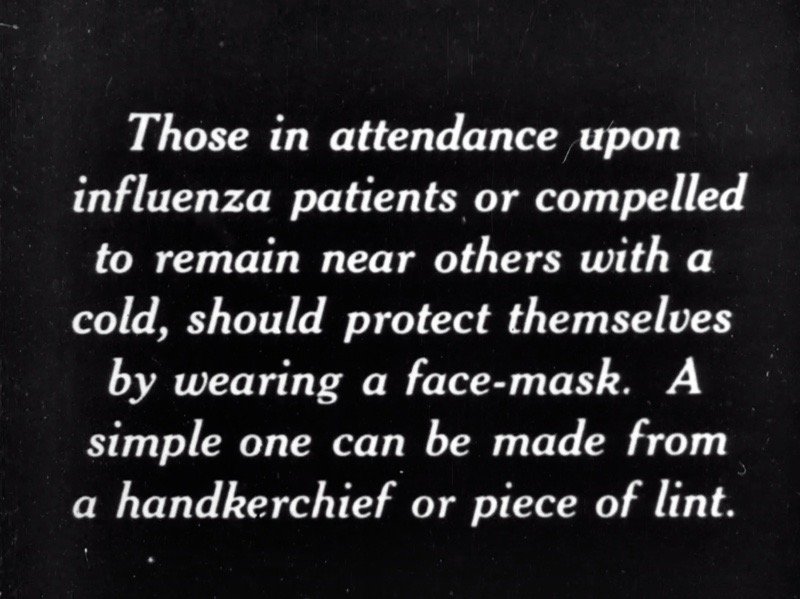
Pro­duced under the aus­pices of Sir Arthur New­sholme, the Chief Med­ical Offi­cer of the Local Gov­ern­ment Board (LGB), the film arrived a lit­tle too late to do much good after the sec­ond wave of infec­tions began in 1919, and it was not wide­ly dis­trib­uted. The short film pro­motes wear­ing masks, and it tells a very famil­iar sto­ry, as Dixon explains:

The ‘doc­tor’ uses the device of a fic­tion­al sto­ry in which a rather dim Mr Brown coughs and sneezes over col­leagues in the office and the street, before going on to infect 100 peo­ple at a the­atre (we see a rare ear­ly glimpse of the Empire Leices­ter Square, which was show­ing a musi­cal, The Lilac Domi­no).

It doesn’t end well for Mr Brown, and an on-screen title lists the grim totals of deaths in British cities, just as we’ve become used to see­ing today. Oth­er par­al­lels with the cur­rent sit­u­a­tion are spooky: the prime min­is­ter, Lloyd George, like Boris John­son, was hos­pi­talised for days with the virus, and an anx­ious nation was told it was ‘touch and go’ for a while.

His­to­ry has been rhyming all over the place late­ly, maybe the most poet­ic thing about the ugly times we’re liv­ing in. As much as we might have believed that the world, or our par­tic­u­lar cor­ner of it, had changed, we’re find­ing out how lit­tle progress we’ve actu­al­ly made. Iron­i­cal­ly, one of the most remark­able dif­fer­ences between the ear­ly 21st cen­tu­ry and every­thing that came before—the omnipres­ence of cam­eras and video—has accel­er­at­ed these real­iza­tions. We can now wit­ness, in ways no one pos­si­bly could have in 1919, just how much of the past we’re drag­ging along behind us.

Relat­ed Con­tent:

What Hap­pened When Amer­i­cans Had to Wear Masks Dur­ing the 1918 Flu Pan­dem­ic

The His­to­ry of the 1918 Flu Pan­dem­ic, “The Dead­liest Epi­dem­ic of All Time”: Three Free Lec­tures from The Great Cours­es

Japan­ese Health Man­u­al Cre­at­ed Dur­ing the 1918 Span­ish Flu Pan­dem­ic Offers Time­less Wis­dom: Stay Away from Oth­ers, Cov­er Your Mouth & Nose, and More

Josh Jones is a writer and musi­cian based in Durham, NC. Fol­low him at @jdmagness

29 Free Short Stories from Some of Today’s Most Acclaimed Writers: Margaret Atwood, David Mitchell & More

Let us call your atten­tion to 29 free short sto­ries, writ­ten by some of today’s most acclaimed writ­ers. They come cour­tesy of The New York Times’ Decameron Project. They write:

Inspired by Gio­van­ni Boccaccio’s “The Decameron,” a 14th-cen­tu­ry col­lec­tion of tales told by a group of 10 char­ac­ters tak­ing shel­ter in an Ital­ian vil­la dur­ing the Black Plague, this [col­lec­tion] fea­tures sto­ries from Mar­garet Atwood, David Mitchell, Téa Obre­ht, Karen Rus­sell, Tom­my Orange, Yiyun Li and oth­ers. The so-called Decameron Project is the first time in the magazine’s mod­ern his­to­ry that an entire issue is devot­ed to new fic­tion.

You can read the sto­ries online here. And if you pre­fer audio, hear two sto­ries read aloud by Tom­my Orange and Edwidge Dan­ti­cat here.

If you would like to sign up for Open Culture’s free email newslet­ter, please find it here. It’s a great way to see our new posts, all bun­dled in one email, each day.

If you would like to sup­port the mis­sion of Open Cul­ture, con­sid­er mak­ing a dona­tion to our site. It’s hard to rely 100% on ads, and your con­tri­bu­tions will help us con­tin­ue pro­vid­ing the best free cul­tur­al and edu­ca­tion­al mate­ri­als to learn­ers every­where. You can con­tribute through Pay­Pal, Patre­on, and Ven­mo (@openculture). Thanks!

Relat­ed Con­tent:

1,000 Free Audio Books: Down­load Great Books for Free

Audi­ble Pro­vid­ing Free Audio Books to Kids & Teens: Intro­duc­ing the New Ser­vice, Audi­ble Sto­ries

Read 9 Sto­ries By Haru­ki Muraka­mi Free Online

10 Free Sto­ries by George Saun­ders, Author of Tenth of Decem­ber, “The Best Book You’ll Read This Year”


Modern English Performs Their 1982 Hit, “I Melt With You,” in Quarantine

Near­ly 40 years after they released their New Wave clas­sic, Mod­ern Eng­lish is back, per­form­ing togeth­er in iso­la­tion, to get us through the pan­dem­ic. Find more social­ly-dis­tanced per­for­mances by Roger Waters, the Rolling Stones and the Doo­bie Broth­ers below.

Relat­ed Con­tent:

The Doo­bie Broth­ers Sing Their 1974 Clas­sic, “Black Water,” Live, in Iso­la­tion

Watch the Rolling Stones Play “You Can’t Always Get What You Want” While Social Dis­tanc­ing in Quar­an­tine

Roger Waters Per­forms a Social­ly-Dis­tanced Ver­sion of Pink Floyd’s “Moth­er”

by | Permalink | Make a Comment ( 19 ) |

Everything You Need To Know About Viruses: A Quick Visual Explanation of Viruses in 9 Images

It’s a great time to tune in to what sci­en­tists are try­ing to tell us.

It’s true that we’ve received a lot of con­flict­ing infor­ma­tion over the last four months with regard to how to best pro­tect our­selves and oth­ers from COVID-19.

Sci­en­tists and health care pro­fes­sion­als have a learn­ing curve, too.

Their bul­letins evolve as their under­stand­ing of the nov­el coro­n­avirus grows, through research and hands-on expe­ri­ence.

There are still a lot of unknowns.

Some peo­ple take any evi­dence-based mes­sag­ing updates regard­ing masks and re-open­ing as proof that sci­en­tists don’t know their ass­es from their elbows.

To which we might counter, “If that’s the case, please take a minute from berat­ing the poor gro­cery store employ­ee who asked you to fol­low clear­ly post­ed state man­dat­ed pub­lic health prac­tices to edu­cate us. For­get the econ­o­my. For­get the elec­tion. Blind us with some sci­ence. Pre­tend we don’t know any­thing and hit us with some hard­core facts about virus­es. We’re lis­ten­ing.”

(Crick­ets…)

Sci­ence writer Dominic Wal­li­man, founder of the Domain of Sci­ence Youtube  chan­nel, may have a PhD in quan­tum device physics, but he also had the humil­i­ty to real­ize, ear­li­er in the pan­dem­ic, that he didn’t know much about virus­es:

So I did a load of research and have sum­ma­rized what I learned in… nine images. This video (above) explains the key aspects of virus­es: how big they are, how they infect and enter and exit cells, how virus­es are clas­si­fied, how they repli­cate, and sub­jects involv­ing viral infec­tions like how they spread from per­son to per­son, how our immune sys­tem detects and destroys them and how vac­cines and anti-viral drugs work.

Wal­li­man ani­mates his 10-minute overview with the same bright info­graph­ics he uses to help stu­dents and laypeo­ple wrap their heads around com­put­er sci­ence, biol­o­gy, chem­istry, physics, and math.

The virus video has been fact-checked by immu­nol­o­gist Michael Bramhall and biol­o­gist Christoph von Arx.

And how refresh­ing to see trans­paren­cy with regard to human error, pub­lished as a cor­rec­tive:

In slide 9 tox­in vac­cines are for bac­te­r­i­al infec­tions like tetanus, not virus­es. 

For those who’d like to learn more, Wal­li­man has tacked a whop­ping 15 links onto the episode’s descrip­tion, from sources such as Sci­en­tif­ic Amer­i­canNatureStan­ford Medicine’s Scope blog, and the Nation­al Cen­ter for Biotech­nol­o­gy Infor­ma­tion.

Down­load a free poster of Domain of Science’s Virus­es Explained in 9 Images here.

Relat­ed Con­tent: 

Spring Break vs. COVID-19: Map­ping the Real Impact of Ignor­ing Social Dis­tanc­ing

A Chill­ing Time-Lapse Video Doc­u­ments Every COVID-19 Death on a Glob­al Map: From Jan­u­ary to June 2020

The Case for a Uni­ver­sal Basic Income in the Time of COVID-19

Ayun Hal­l­i­day is an author, illus­tra­tor, the­ater mak­er and Chief Pri­ma­tol­o­gist of the East Vil­lage Inky zine.  Her lat­est project is an ani­ma­tion and a series of free down­load­able posters relat­ed to COVID-19 pub­lic health Fol­low her @AyunHalliday.

« Go BackMore in this category... »
Quantcast