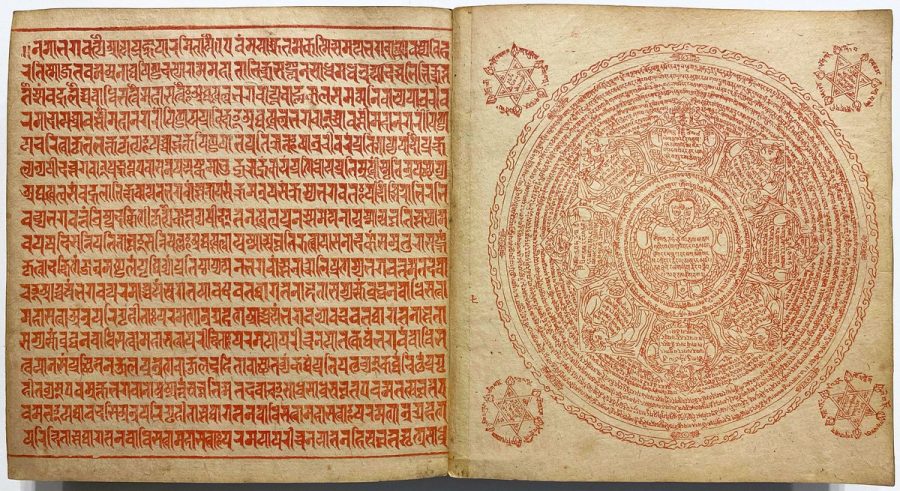
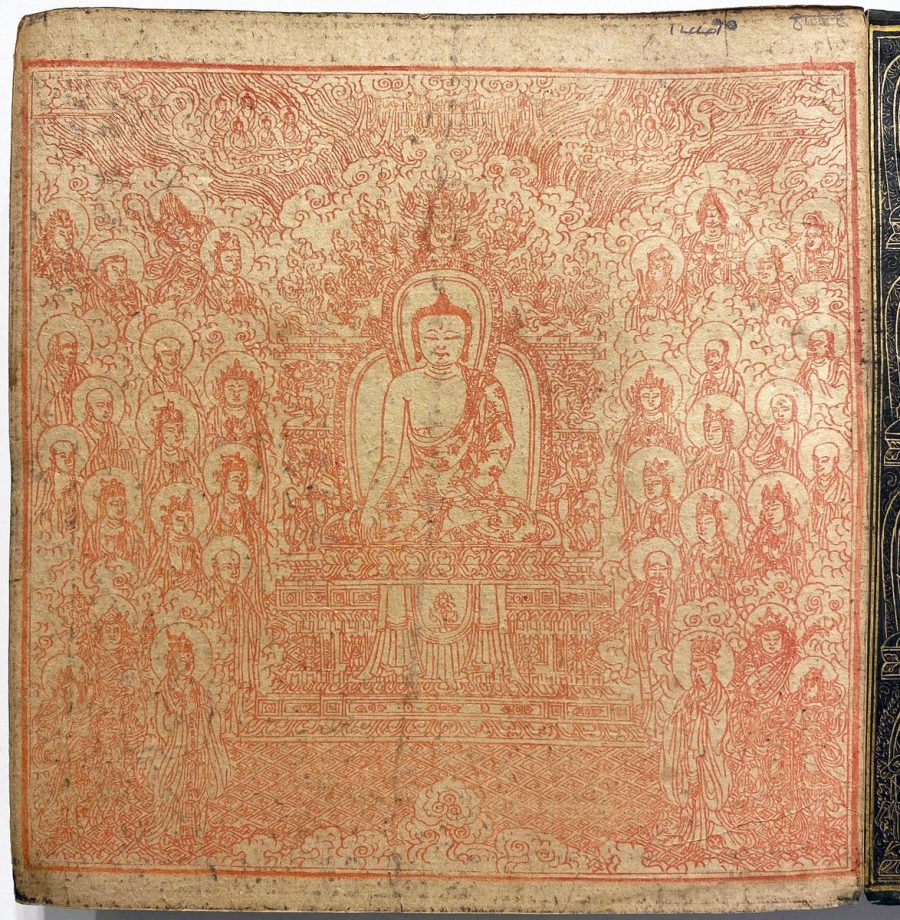
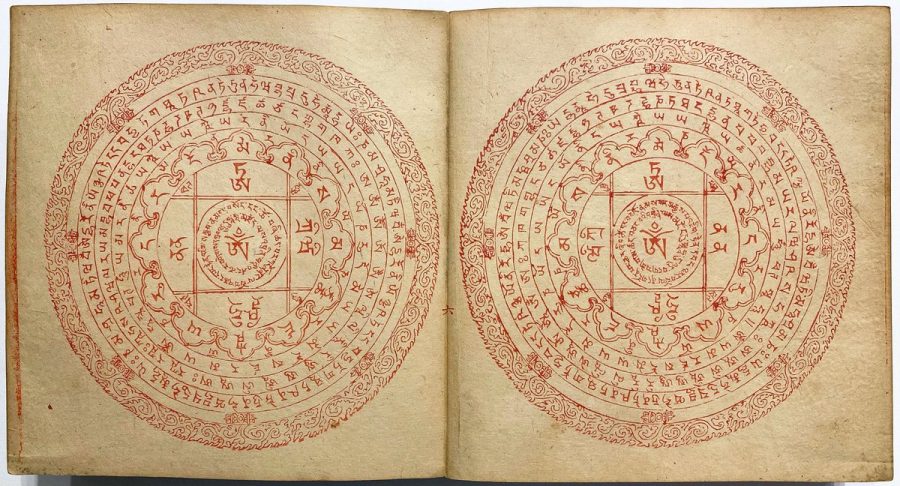
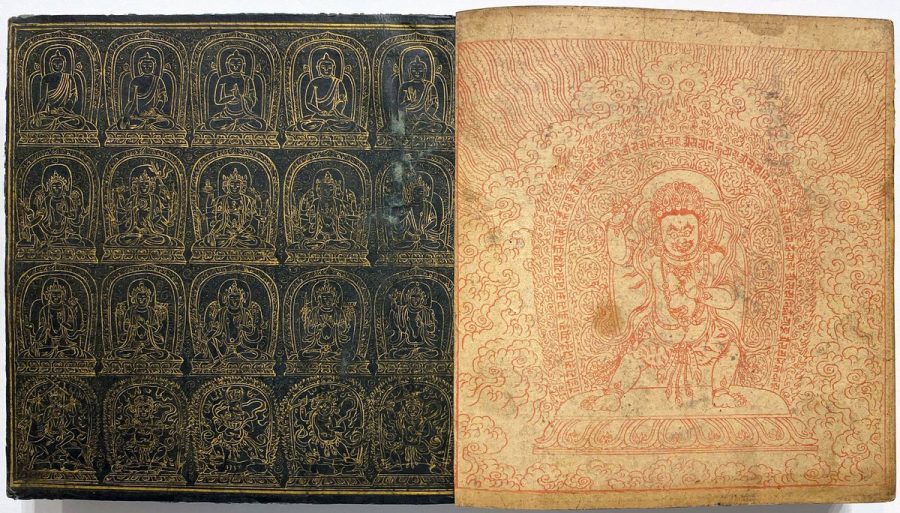
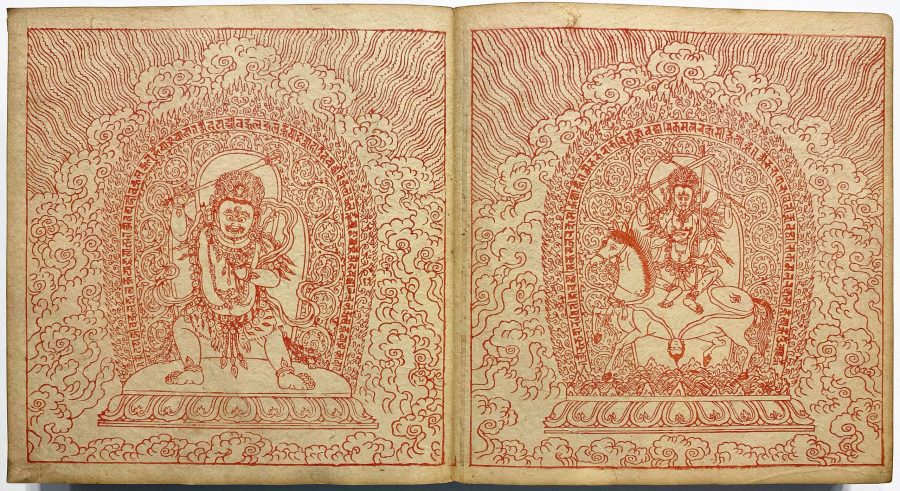
The Gutenberg Bible went to press in the year 1454. We now see it as the first piece of mass media, printed as it was with the then-cutting-edge technology of metal movable type. But in the history of aesthetic achievements in book-printing, the Gutenberg Bible wasn’t without its precedents. To find truly impressive examples requires looking in lands far from Europe: take, for instance, this “Sino-Tibetan concertina-folded book, printed in Beijing in 1410, containing Sanskrit dhāranīs and illustrations of protective mantra-diagrams and deities, woodblock-printed in bright red ink on heavy white paper,” whose “breathtakingly detailed printing” predates Gutenberg by 40 years.
That description comes from a Twitter user called Incunabula (a term referring to early books), a self-described bibliophile and rare book collector who posts about “the history of writing, and of the book, from cave painting to cuneiform tablet to papyrus scroll to medieval codex to Kindle.”
Its text, written in the Tibetan and Nepalese Rañjanā script, “is printed twice, once on each side of the paper, so that the book may be read in the Indo-Tibetan manner by turning the pages from right to left or in Chinese style by turning from left to right.” The book’s content is “a sequence of Tibetan Buddhist recitation texts,” or chants, all “protected at front and back by thicker board-like wrappers,” each “covered in fine pen-drawings in gold paint on black of 20 icons of the Tathāgatas.”
Based in Seoul, Colin Marshall writes and broadcasts on cities, language, and culture. His projects include the book The Stateless City: a Walk through 21st-Century Los Angeles and the video series The City in Cinema. Follow him on Twitter at @colinmarshall, on Facebook, or on Instagram.
Playing the blues is easy, many a budding guitarist thinks—their starry eyes fixed on the mathiest, proggiest, djent-iest (or whatever) guitar pyrotechnics of their favorite 7- or 8‑string slinger. Learn a minor pentatonic blues scale, a few barre chords, some sexy bends, a 12-bar progression and you’re off, right? Why spend time trying to play like Albert King (Jimi Hendrix’s idol) or Buddy Guy when you’re reaching for the ultimate sweep-picking technique, or whatever, in the competitive gamesmanship of guitar heroics?
I’ve encountered this kind of thinking among guitar players quite often and find it baffling given the blues essential place in rock and roll, metal included—and given how much more there is to playing blues than the stereotypical formulas to which the music gets reduced. Black Sabbath started as a blues band, Led Zeppelin never stopped being one, and it was Robert Johnson who turned the devil into rock’s brooding, Byronic hero.
The crossroads story has been told in hindsight as a metaphor for Johnson’s troubled, cursedly short life. But at the time, it was about envy on the part of his fellow bluesmen, who couldn’t believe how good he’d gotten in seemingly no time. Want to emerge from quarantine and inspire similar envy? The devil isn’t offering online lessons, but you can learn the blues from contemporary legend, John Mayer, who posted the lesson above on his Instagram Live a few days back.
As with all such online lessons, everyone will respond differently to the teacher’s style. The format does not allow for Q&A, obviously, but you can pause and rewind indefinitely. Mayer doesn’t move too quickly; if you’re an intermediate player with a grasp on the basics, it won’t be too hard to keep up. He comes across as easygoing and humble (not a quality he’s always been known for), and explains concepts clearly, relating them back to the fretboard each time.
As always, one will get out of the lesson what they put into it. Maybe no one will accuse you of conspiring with the evil one when you’ve mastered some of these techniques and incorporated them into your own playing. But you won’t have to lie, exactly, if you tell people you’ve been jamming with John Mayer. Or, if that’s not cool in your circles, come up with your own legend—abduction by a conspiracy of blues-playing aliens, perhaps.
However you explain it to your friends when we get out of the woodshed, I have no doubt that becoming a better blues player can improve whatever else you plan to do with the guitar.
What makes great paintings great? Unless you can see them for yourself—and be awed, or not, by their physical presence—the answers will generally come second-hand, through the words of art historians, critics, curators, gallerists, etc. We can study art in reproduction, but seeing, for example, the paintings of Rembrandt van Rijn in the flesh presents an entirely different aesthetic experience than seeing them on the page or screen.
Lately, however, the situation is changing, and the boundaries blurring between a virtual and an in-person experience of art. It’s possible with digital technology to have experiences no ordinary museum-goer has had, of course—like walking into a VR Salvador Dalí painting, or through a simulated Vermeer museum in augmented reality.
But these technological interventions are novelties, in a way. Like famous paintings silkscreened on t‑shirts or glazed on coffee mugs, they warp and distort the works they represent.
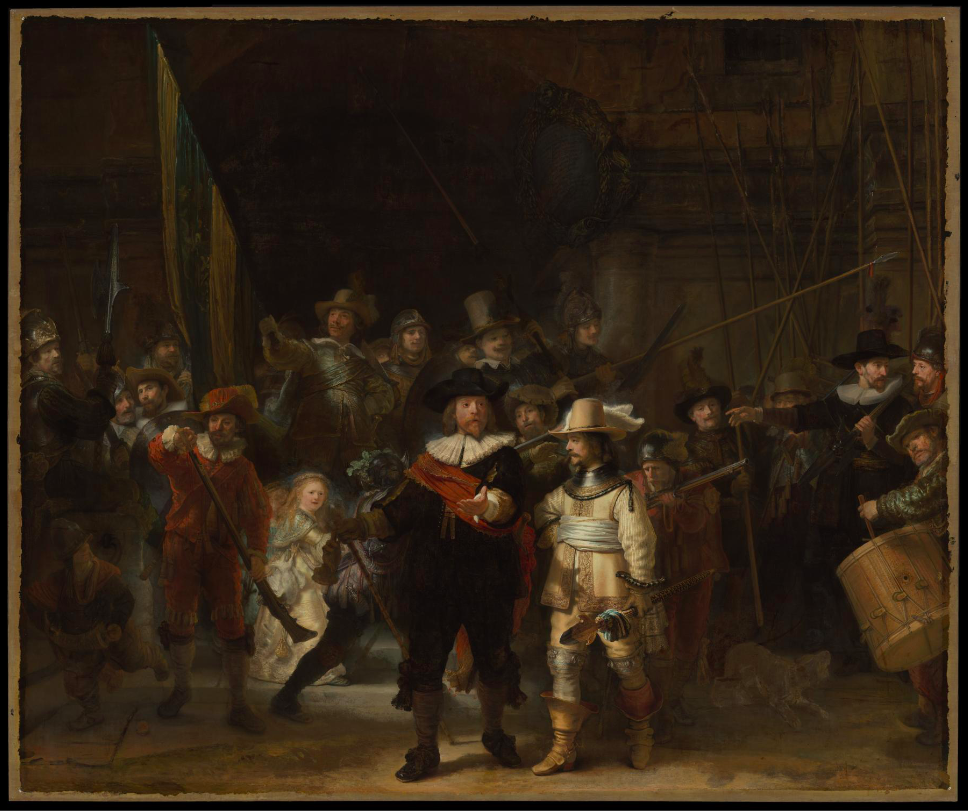
That is not the case, however, with the latest digital reproduction of Rembrandt’s grandest and most exclusive painting, The Night Watch, a 44.8 gigapixel image of the work that the museum has “released online in a zoomable interface,” notes Kottke. “The level of detail available here is incredible.” Even that description seems like understatement. The image comes to us from the same team responsible for the painting’s multi-phase, live-streamed restoration.
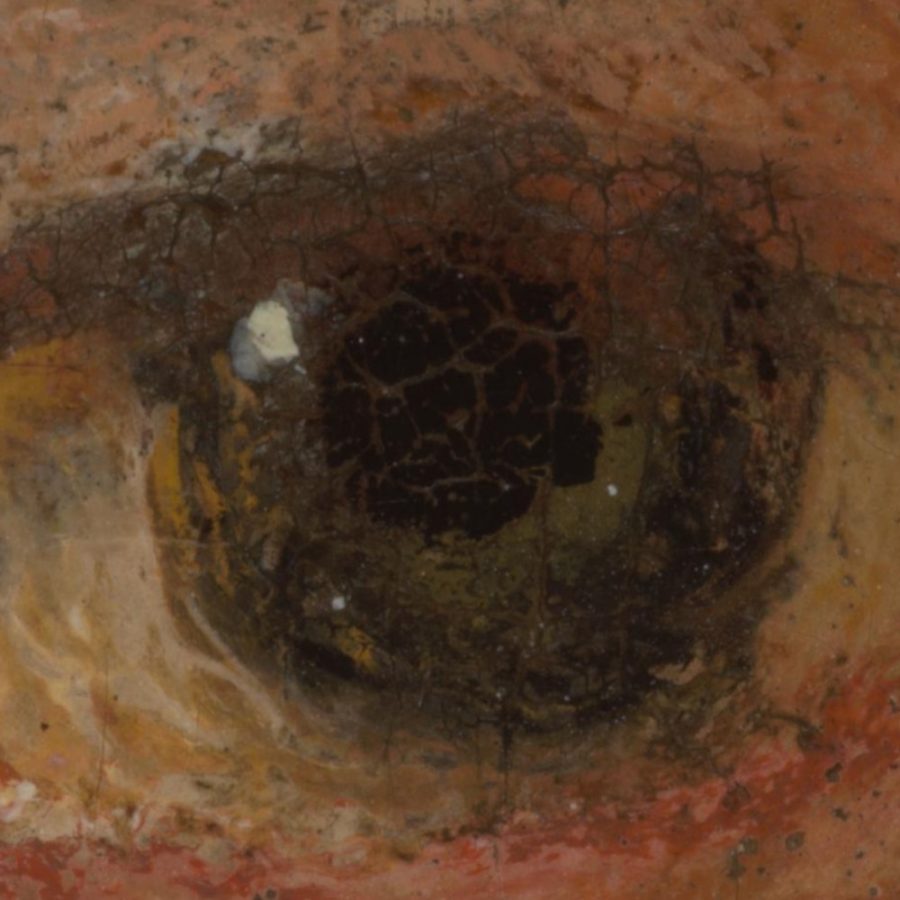
The Rijksmuseum’s imaging team led by datascientist Robert Erdmann made this photograph of The Night Watch from a total of 528 exposures. The 24 rows of 22 pictures were stitched together digitally with the aid of neural networks. The final image is made up of 44.8 gigapixels (44,804,687,500 pixels), and the distance between each pixel is 20 micrometres (0.02 mm). This enables the scientists to study the painting in detail remotely. The image will also be used to accurately track any future ageing processes taking place in the painting.
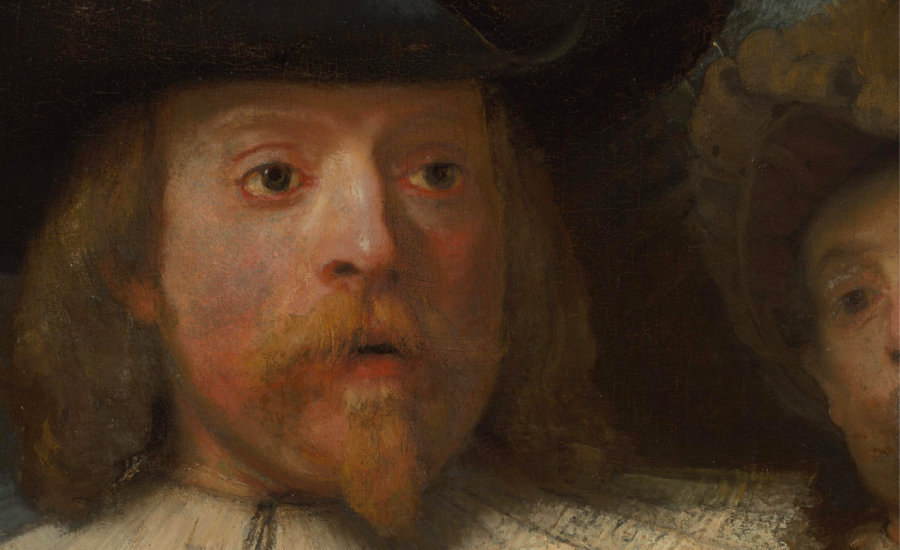
The hugely famous work is so enormous, nearly 12 feet high and over 14 feet wide, that its figures are almost life-size. Yet even when it was possible to get close to the painting—before COVID-19 shut down the Rijksmuseum and before Rembrandt’s masterwork went behind glass—no one except conservationists could ever get as close to it as we can now with just the click of a mouse or a slide of our fingers across a trackpad.
The experience of seeing Rembrandt’s brushstrokes magnified in crystalline clarity doesn’t just add to our store of knowledge about The Night Watch, as the Rijksmuseum suggests above. This astonishing image also—and perhaps most importantly for the majority of people who will view it online—enables us to really commune with the materiality of the painting, and to be moved by it in a way that may have only been possible in the past by making an exclusive, in-person visit to the Rijksmuseum without a tourist in sight. (For most of us, that is an unrealistic way to view great art.)
See the huge photographic reproduction of The Night Watchhere and zoom in on any detail until you can almost smell the varnish. This image represents the painting in the current state of its restoration, an effort that the museum previously opened to the public by live streaming it. Yet, the work has stopped for the past two months as conservationists have stayed home. Just yesterday, the team’s onsite research began again, and will continue at least into 2021. This huge photo of the painting may be the closest almost anyone will ever get to the canvas, and the only opportunity for some time to approximately feel its monumental scale.
For anyone interested, there’s also a 10 billion pixel scan of Vermeer’s masterpiece Girl with a Pearl Earring. Explore it here.
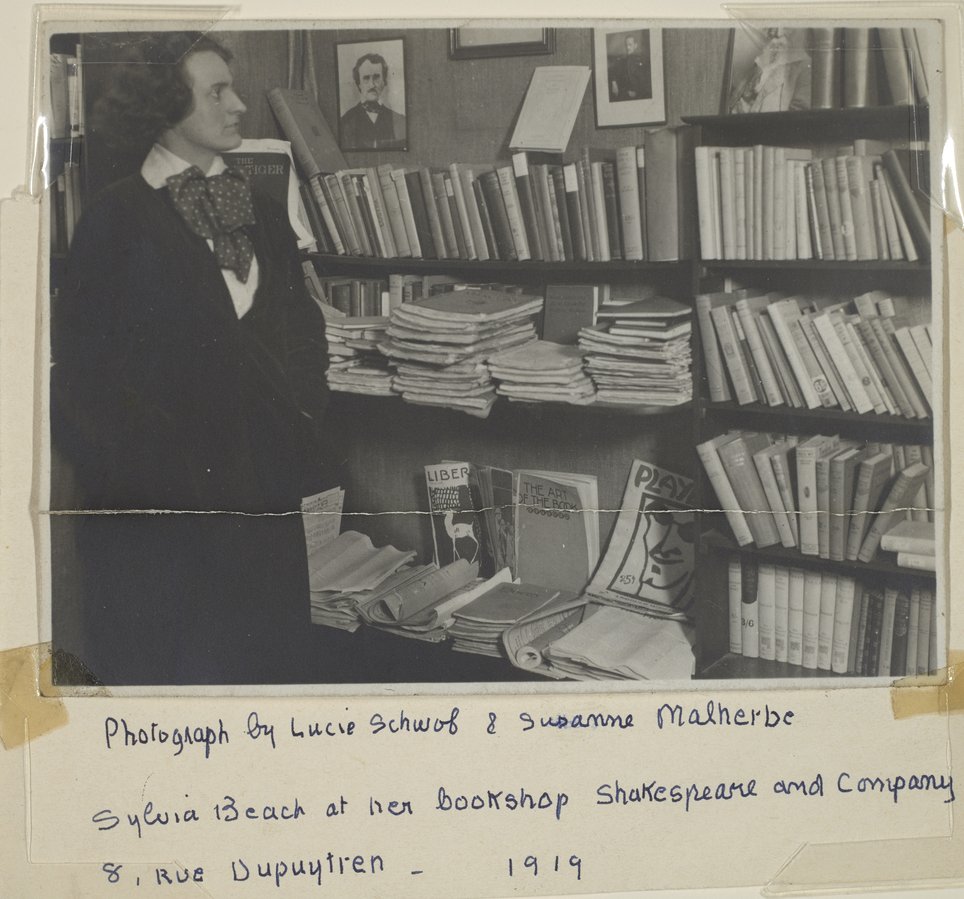
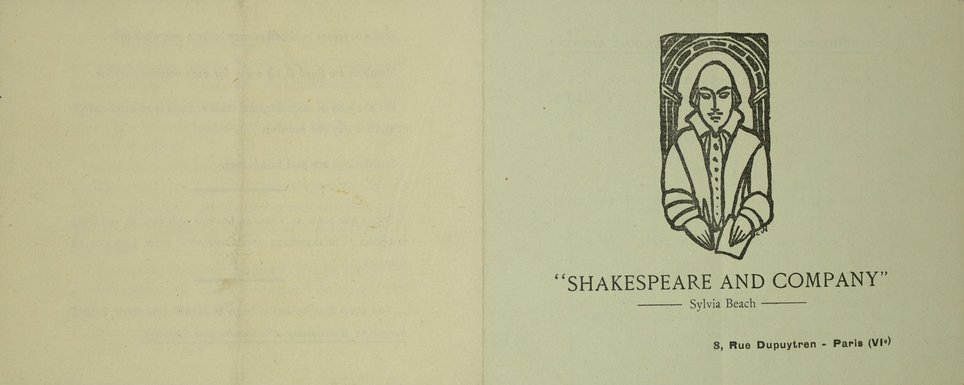
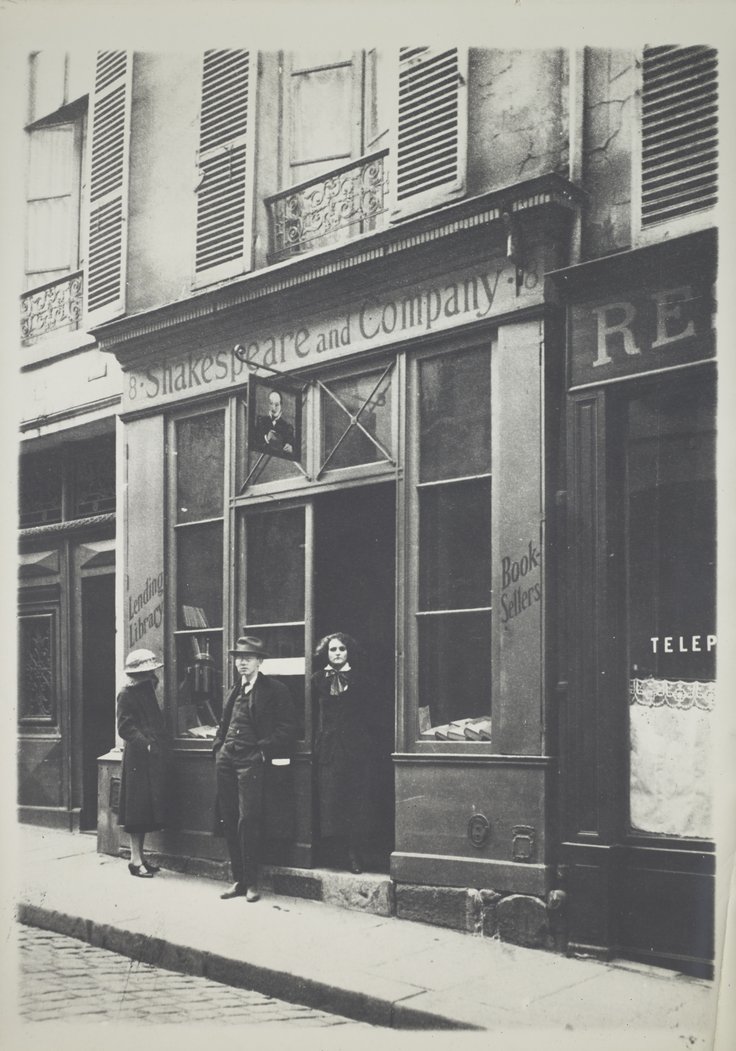
Great writers don’t come out of nowhere, even if some of them might end up there. They grow in gardens tended by other writers, readers, editors, and pioneering booksellers like Sylvia Beach, founder and proprietor of Shakespeare and Company. Beach opened the English-language shop in Paris in 1919. Three years later, she published James Joyce’s Ulysses, “a feat that would make her—and her bookshop and lending library—famous,” notes Princeton University’s Shakespeare and Company Project. (Infamous as well, given the obscenity charges against the novel in the U.S.)
Just as the publication of Allen Ginsberg’s Howl put Lawrence Ferlinghetti’s City Lights at the center of the Beat movement, so Joyce’s masterpiece made Shakespeare and Company a destination for aspiring Modernists.
The shop was already “the meeting place for a community of expatriate writers and artists now known as the Lost Generation.” Along with Joyce, there gathered Ernest Hemingway, Ezra Pound, and Gertrude Stein, all of whom not only bought books but borrowed them and left a handwritten record of their reading habits.
Through a large-scale digitization project of the Sylvia Beach papers at Princeton, the Shakespeare and Company Project will “recreate the world of the Lost Generation. The Project details what members of the lending library read and where they lived, and how expatriate life changed between the end of World War I and the German Occupation of France.” During the thirties, Beach began to cater more to French-speaking intellectuals. Among later logbooks we’ll find the names Aimé Césaire, Jacques Lacan, and Simone de Beauvoir. Beach closed the store for good in 1941, the story goes, rather than sell a Nazi officer a copy of Finnegans Wake.
Princeton’s “trove of materials reveals, among other things,” writes Lithub, “the reading preferences of some of the 20th century’s most famous writers,” it’s true. But not only are there many famous names; the library logs also record “less famous but no less interesting figures, too, from a respected French physicist to the woman who started the musicology program at the University of California.” Shakespeare and Company became the place to go for thousands of French and expat patrons in Paris during some of the city’s most legendarily literary years.
“English-language books are expensive,” if you’ve arrived in the city in the 1920s, the Project explains—“five to twenty times the price of French books.” English-language holdings at other libraries are limited. Readers, and soon-to-be famous writers, go to Shakespeare and Company to borrow a copy of Moby Dick or pick up the latest New Yorker.
You find Shakespeare and Company on a narrow side street, just off the Carrefour de l’Odéon. You step inside. The room is filled with books and magazines. You recognize a framed portrait of Edgar Allan Poe. You also recognize a few framed Whitman manuscripts. Sylvia Beach, the owner, introduces herself and tells you that her aunt visited Whitman in Camden, New Jersey and saved the manuscripts from the wastebasket. Yes, this is the place for you.
Thirty years ago, the internet we use today would have looked like science fiction. Now as then, we spend a great deal of time staring at streams of video, but the high-tech 21st century has endowed us with the ability to customize those streams as never before. No longer do we have to settle for traditional television and the tyranny of “what’s on”; we can follow our curiosity wherever it leads through vast, ever-expanding realms of image, sound, and text. No less a science-fiction writer than Douglas Adams dreams of just such realms in Hyperland, a 1990 BBC “fantasy documentary” that opens to find him fast asleep amid the mindless sound and fury spouted unceasingly by his television set — so unceasingly, in fact, that it keeps on spouting even when Adams gets up and tosses it into a junkyard.
Amid the scrap heaps Adams meets a ghost of technology’s future: his “agent,” a digital figure played by Doctor Who star Tom Baker. “I have the honor to provide instant access to every piece of information stored digitally anywhere in the world,” says Baker’s Virgil to Adams’ Dante. “Any picture or film, any sound, any book, any statistic, any fact — any connection between anything you care to think of.”
Adams’ fans know how much the notion must have appealed to him, unexpected connections between disparate aspects of reality being a running theme in his fiction. It became especially prominent in the Dirk Gently’s Holistic Detective Agency Series, whose wide range of references includes Samuel Taylor Coleridge’s Kubla Khan — one of the many pieces of information Adams has his agent pull up in Hyperland.
Adams’ journey along this proto-Information Superhighway also includes stops at Beethoven’s 9th Symphony, Picasso’s Guernica, and Kurt Vonnegut’s theory of the shape of all stories. Such a pathway will feel familiar to anyone who regularly goes down “rabbit holes” on the internet today, a pursuit — or perhaps compulsion — enabled by hypertext. Already that term sounds old fashioned, but at the dawn of the 1990s actively following “links” from one piece of information, so common now as to require no introduction or explanation, struck many as a mind-bending novelty. Thus the program’s segments on the history of the relevant technologies, beginning with U.S. government scientist Vannevar Bush and the theoretical “Memex” system he came up with at the end of World War II — and first described in an Atlantic Monthly article you can, thanks to hypertext, easily read right now.
Though to an extent required to stand for the contemporary viewer, Adams was hardly a technological neophyte. An ardent early adopter, he purchased the very first Apple Macintosh computer ever sold in Europe. “I happen to know you’ve written interactive fiction yourself,” says Baker, referring to the adventure games Adams designed for Infocom, one of them based on his beloved Hitchhiker’s Guide to the Galaxy novels. Though Adams’ considerable tech savvy makes all this look amusingly prescient, he couldn’t have known just then how connected everyone and everything was about to become. “While Douglas was creating Hyperland,” says his official web site, “a student at CERN in Switzerland was working on a little hypertext project he called the World Wide Web.” And despite his early death, the man who dreamed of an electronic “guidebook” containing and connecting all the knowledge in the universe lived long enough to see that such a thing would one day become a reality.
Based in Seoul, Colin Marshall writes and broadcasts on cities, language, and culture. His projects include the book The Stateless City: a Walk through 21st-Century Los Angeles and the video series The City in Cinema. Follow him on Twitter at @colinmarshall, on Facebook, or on Instagram.
David Lynch hasn’t directed a feature film in thirteen years, but that doesn’t mean he’s been idle. Quite the opposite, in fact: in addition to the acclaimed Showtime series Twin Peaks: The Return, he’s recorded an album, written a memoir, taught a Masterclass, overseen the development of a Twin Peaks virtual reality game, and made a short film about ants devouring a piece of cheese. In his home studio, he’s also continued the visual art practice he started before turning to filmmaker in the 1970s. We may know Lynch best as the man behind Eraserhead, Blue Velvet, and Mulholland Drive, but he seems equally comfortable working in whichever form or medium is at hand. In this time of COVID-19 quarantine, which has suspended filmmaking, filmgoing, and other kinds of human activity, one such medium is the weather report.
“Here in L.A.… kind of cloudy… some fog this morning,” says the respected filmmaker in his weather-report video for May 11, 2020. “64 degrees Fahrenheit; around seventeen Celsius. This all should burn off pretty soon, and we’ll have sunshine and 70 degrees.” All just what one would expect from the climate of Los Angeles, the southern Californian metropolis where Lynch lives and which he often praises — and which, it’s recently been reported, will likely extend its stay-at-home order for at least three more months.
The sudden lack of movement in this famously mobile city has done wonders for the air quality, but so far that element hasn’t figured explicitly into Lynch’s reports. “We’ve got clouds and kind of foggy weather, with some blue shining through,” he says on the morning of May 12th. But just as the day before, that fog “should burn off later, and we’ll have sunshine.” Longtime followers of Lynch’s internet projects will recognize these as a sequel to the daily video weather reports he posted in 2008:
They’ll also recognize most of the objects that surround Lynch in his office, from his set of drawers to his wall-mounted phone to his angular-handled black coffee cup. But the dramatic increase in the resolution of internet video over the past dozen years has made everything visible in a newly crisp detail, right down to the steam rising from Lynch’s hot beverage of choice. More daily weather reports will presumably appear on the David Lynch Theater Youtube channel, each one colored by his signature (and, given the unrelentingly disturbing qualities of his best-known work, seemingly incongruous) optimism. “It’s going to be a different world on the other side,” he told Vice last month. “It’s going to be a much more intelligent world. Solutions to these problems are going to come and life’s going to be very good. The movies will come back. Everything will spring back and in a much better way, probably.”
If you would like to support the mission of Open Culture, consider making a donation to our site. It’s hard to rely 100% on ads, and your contributions will help us continue providing the best free cultural and educational materials to learners everywhere. You can contribute through PayPal, Patreon, and Venmo (@openculture). Thanks!
Based in Seoul, Colin Marshall writes and broadcasts on cities, language, and culture. His projects include the book The Stateless City: a Walk through 21st-Century Los Angeles and the video series The City in Cinema. Follow him on Twitter at @colinmarshall, on Facebook, or on Instagram.
Four years (or what seems like a lifetime) ago, controversy erupted over the casting of actress Zoe Saldana, with darkened skin, as iconic pianist and singer Nina Simone in the biopic Nina. Accusations of racism and colorism met the film, historical attitudes hundreds of years in the making that Simone herself fought throughout her career, especially after she joined the Civil Rights movement in the 1960s and actively made her personal struggles with racism central to her political statements.
“You cannot understand Nina Simone’s life and legacy without taking stock of her identity as a dark-skinned black woman,” says Vox’s Victoria Massie. “That fact was inextricably linked to her life’s trajectory, her art and her politics—to everything that made Nina fearlessly and unapologetically Nina.” Her daughter Simone Kelly put it this way:
We all have a story. My mother suffered. We can go all the way back to when she was a child and people told her her nose was too big, her skin was too dark, her lips were too wide. It’s very important the world acknowledges my mother was a classical musician whose dreams were not realized because of racism.
Simone carried the wounds of those experiences throughout her life, and she sought to heal them through music that affirmed the experience of other young, dark-skinned girls who faced similar obstacles.
The outstanding narrative “Four Women,” from 1966’s Wild is the Wind, articulates the different treatment its characters receive based on skin color. The Village Voice’s Thulani Davis called the song “an instantly accessible analysis of the damning legacy of slavery.” The famous “To Be Young, Gifted and Black,” written for Simone’s friend and mentor Lorraine Hansberry, became an anthem of the Civil Rights movement in the 1970s.
Years later, in “Color is a Beautiful Thing,” Simone revisited the theme in a short, repetitive one-minute piece that is instantly sing-along-able. The song comes from her 1982 album Fodder on My Wings, just re-released last month by Verve. “Color is a Beautiful Thing” is perfectly tailored for young children, who will respond with joy not only to Simone’s rollicking piano but to the beautifully animated video above.
Fodder on My Wings is an overlooked album, Sheldon Pearce writes at Pitchfork, “about personal freedom—about liberating herself from her past and finding the liberty to create as she pleased. It was Simone’s means of working through fear—of death, manipulation, discrimination.” In the liner notes, she herself writes, “What I did on this album was try to get myself deep into joy.”
The method above is mantra-like, the song’s refrain “like something she’s trying to internalize, a coda to 1969’s ‘To Be Young, Gifted and Black.” Simone never seemed to overcome her own pain, but her gift—in addition to her musical brilliance—was to freely share the lessons she learned in the struggle, the bitter and the sweet, and to teach new generations of artists.
Most of us know Mary Wollstonecraft as the author of the 1792 pamphlet A Vindication of the Rights of Women, and as the mother of Frankenstein author Mary Shelley. Fewer of us may know that two years before she published her foundational feminist text, she wrote A Vindication of the Rights of Men, a pro-French Revolution, anti-monarchy argument that first made her famous as a writer and philosopher. Perhaps far fewer know that Wollstonecraft began her career as a published author in 1787 with Thoughts on the Education of Daughters (though she had yet to raise children herself), a conduct manual for proper behavior.
A hugely popular genre during the first Industrial Revolution, conduct manuals bore a miscellaneous character, inculcating a battery of middle-class rules, beliefs, and affectations through a mix of pedagogy, allegory, domestic advice, and devotional writing. Young women were instructed in the proper way to dress, eat, pray, laugh, love, etc., etc.
It may seem from our perspective that a radical firebrand like Wollstonecraft would shun this sort of thing, but her moralizing was typical of middle-class women of her time, even of pioneering writers who supported revolutions and women’s political and social equality.
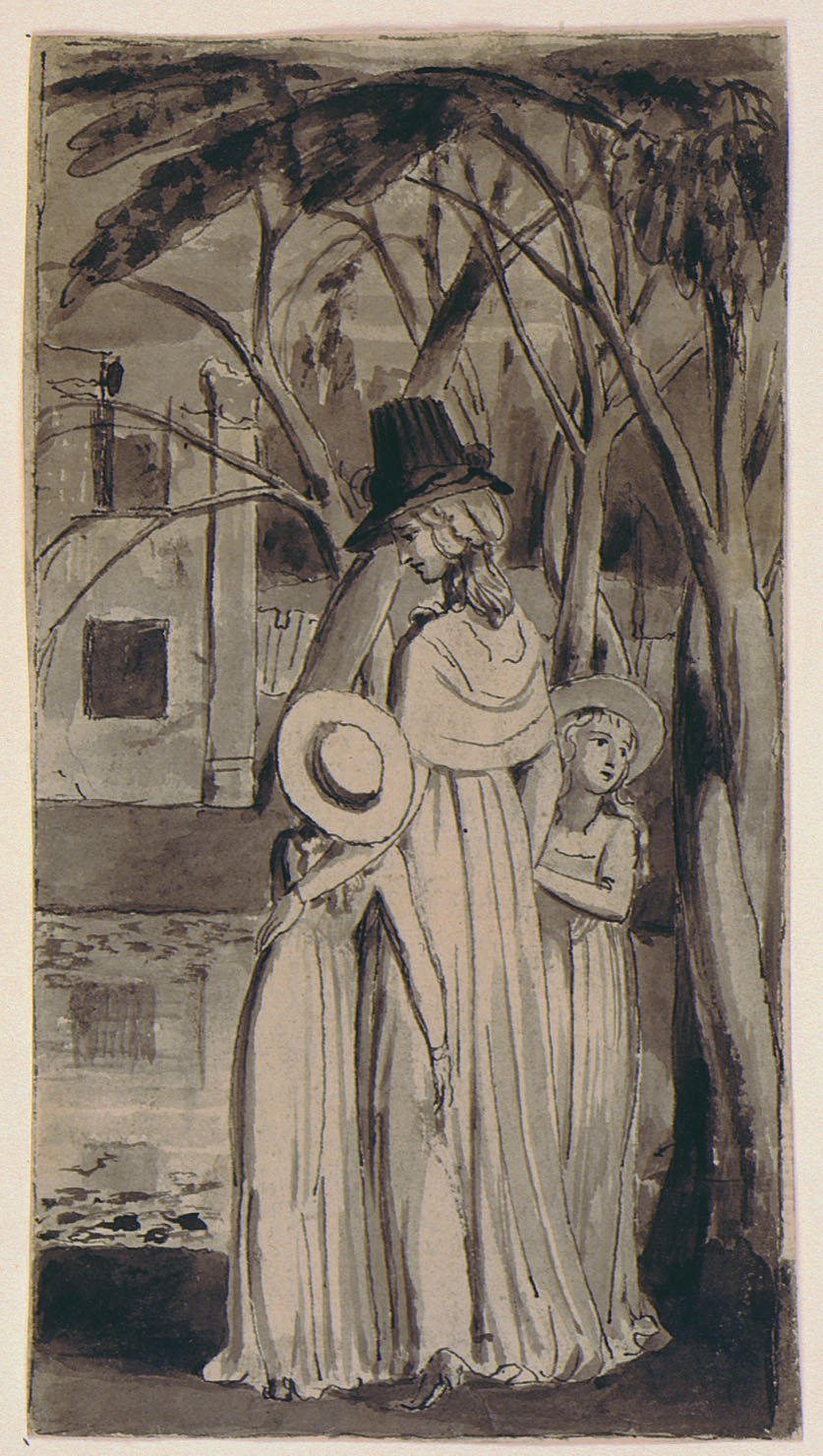
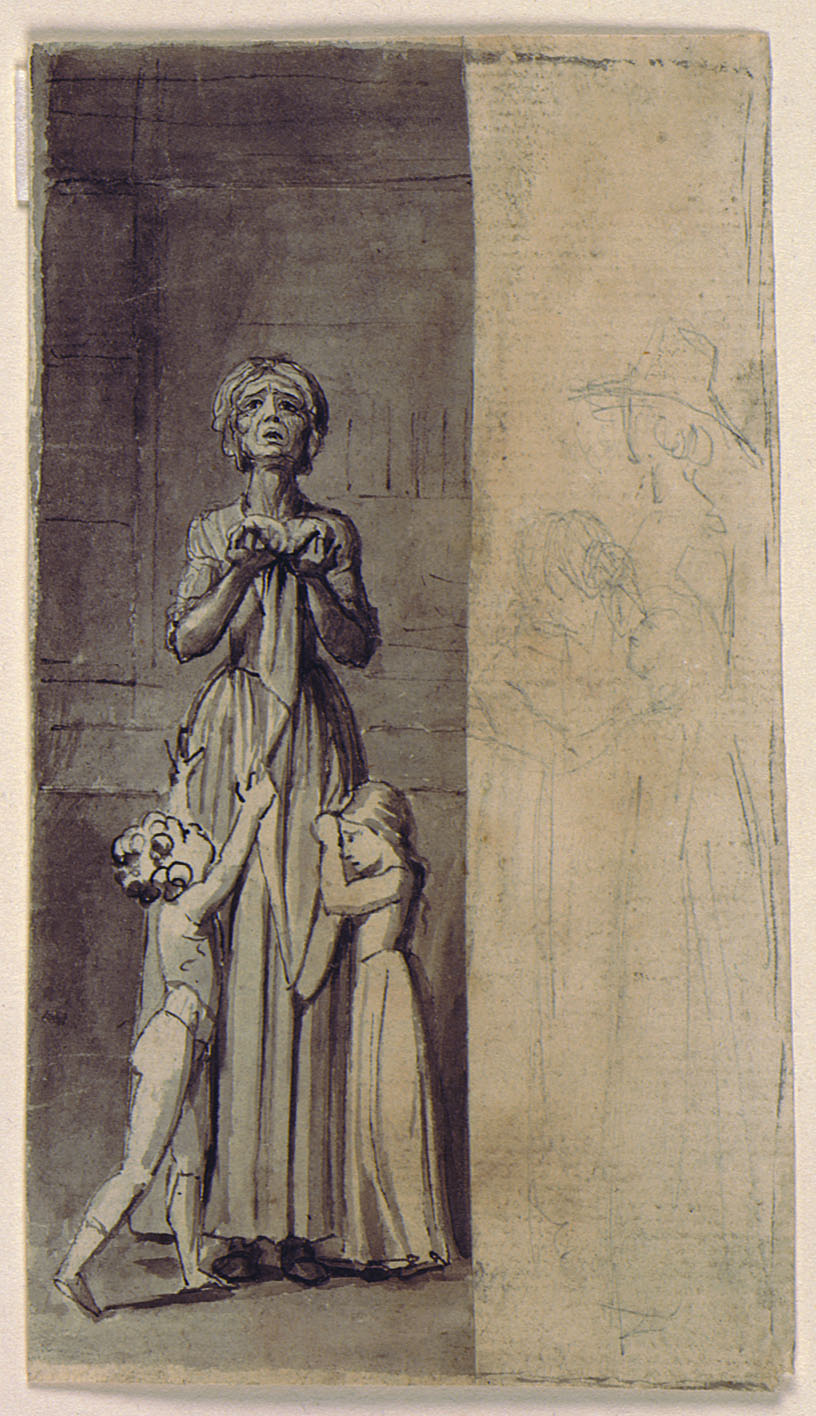
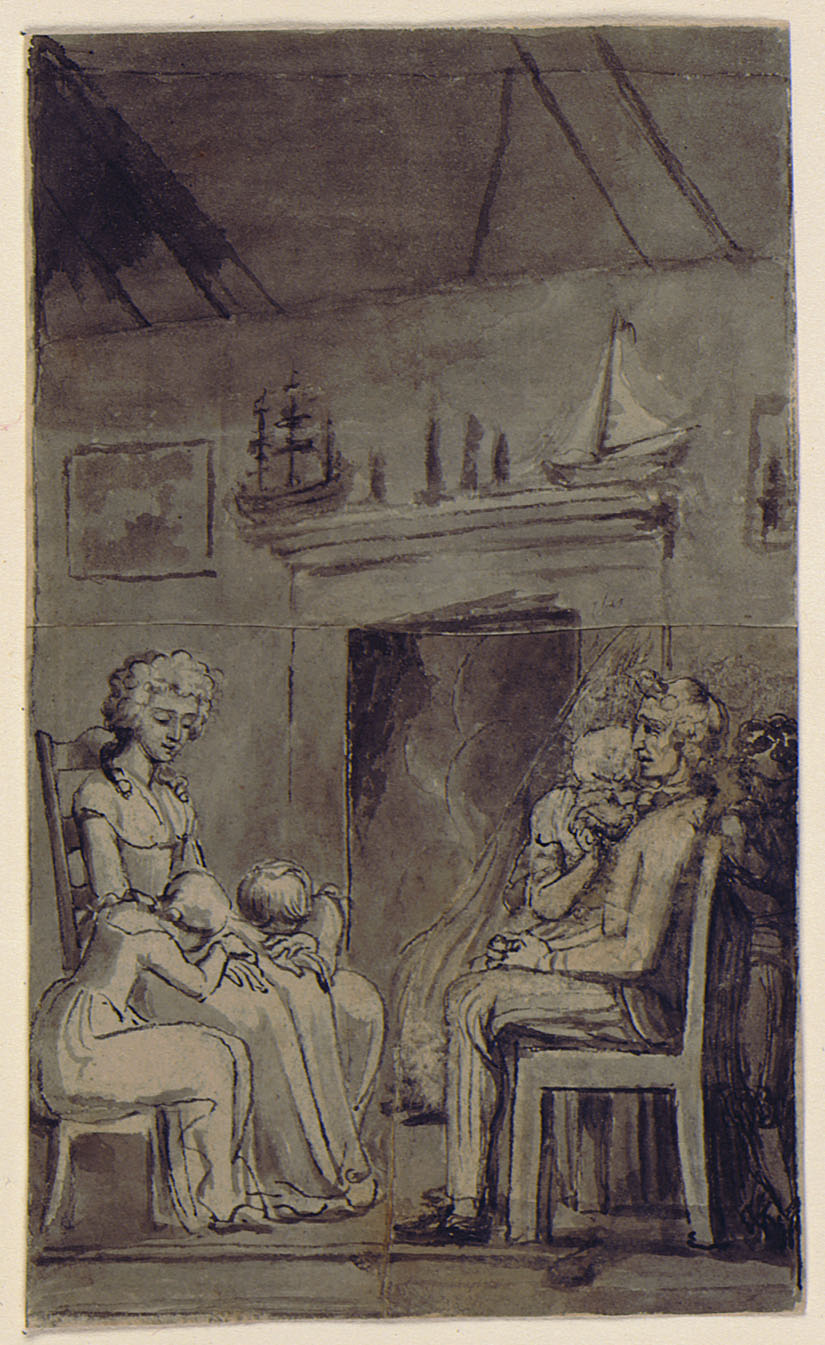
Wollstonecraft’s assumptions about class and character come into relief when placed against the views of another famous contemporary, far more radical figure, William Blake, who was then a struggling, mostly obscure poet, printer, and illustrator in London. In 1791, he received a commission to illustrate a second edition of Wollstonecraft’s third book, a follow-up of sorts to her Thoughts on the Education of Daughters. The 1788 work—Original Stories from Real Life; with Conversations, Calculated to Regulate the Affections, and Form the Mind to Truth and Goodness—is a more focused book, using a series of vignettes woven into a frame story.
The two children in the narrative, 14-year-old Mary and 12-year-old Caroline, receive lessons from their relative Mrs. Mason, who instructs them on a different virtue and moral failing in each chapter by using stories and examples from nature. The two pupils “are motherless,” notes the British Library, “and lack the good habits they should have absorbed by example. Mrs. Mason intends to rectify this by being with them constantly and answering all their questions.” She is an all-knowing governess who explains the world away with a philosophy that might have sounded particularly harsh to Blake’s ears.
For example, in the chapter on physical pain, Mary is stung by several wasps. Afterward, her guardian begins to lecture her “with more than usual gravity.”
I am sorry to see a girl of your age weep on account of bodily pain; it is a proof of a weak mind—a proof that you cannot employ yourself about things of consequence. How often must I tell you that the Most High is educating us for eternity?… Children early feel bodily pain, to habituate them to bear the conflicts of the soul, when they become reasonable creatures. This is say, is the first trial, and I like to see that proper pride which strives to conceal its sufferings…. The Almighty, who never afflicts but to produce some good end, first sends diseases to children to teach them patience and fortitude; and when by degrees they have learned to bear them, they have acquired some virtue.
Blake likely found this line of reasoning off-putting, at the least. His own poems “were not children’s literature per se,” writes Stephanie Metz at the University of Tennessee’s Romantic Politics project, “yet their simplistic language and even some of their content responds to the characteristics of didactic fiction and children’s poetry.” Blake wrote expressly to protest the ideology found in conduct manuals like Wollstonecraft’s: “He calls attention to society’s abuse of children in a number of different ways, showing how society corrupts their inherent innocence and imagination while also failing to care for their physical and emotional needs.”
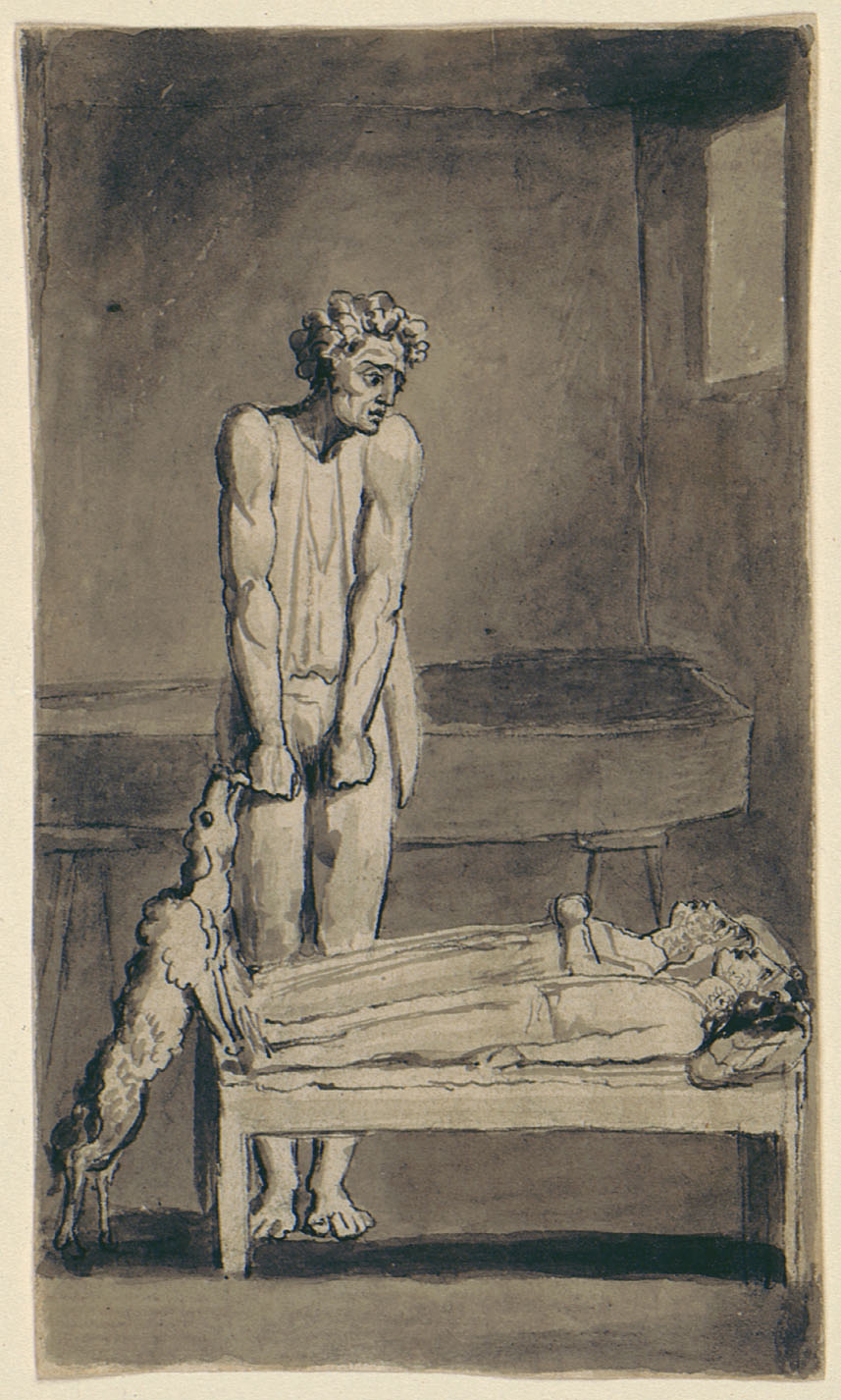
For Blake, children’s big emotions and active imaginations made them superior to adults. “Several of his poems,” Metz writes, “show the ways in which children’s innate nature has already been tainted by their parents and other societal forms of authority, such as the church.” Given his attitudes, we can see why “modern interpreters of the illustrations for Original Stories have detected a pictorial critique” in Blake’s rendering of Wollstonecraft’s text, as the William Blake Archive points out. Blake “appears to have found her morality too calculating, rationalistic, and rigid. He represents Wollstonecraft’s spokesperson, Mrs. Mason, as a domineering presence.”
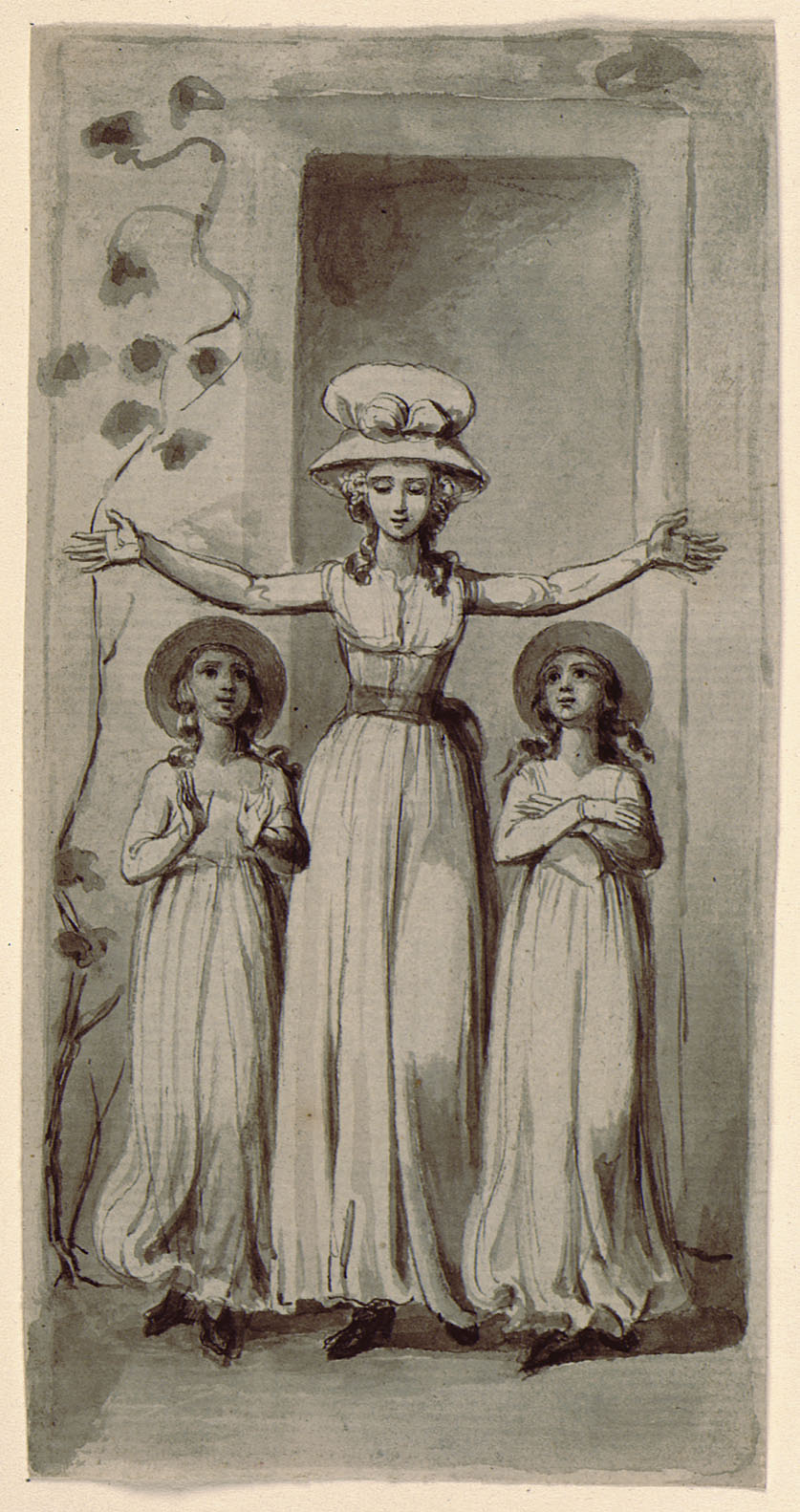
Nonetheless, as always, Blake’s work is more than competent. The style for which we know him best emerges in some of the prints. We see it, for example, in the chiseled face, bulging eyes, and well-muscled arms of the standing figure above. For the most part, however, he keeps in check his exuberant desire to celebrate the human body. “Only a year earlier,” writes Brain Pickings, “Blake had finished printing and illuminating the first few copies of his now-legendary Songs of Innocence and Experience.” Two of the songs “were inspired by Wollstonecraft’s translation of C.G. Salzmann’s Elements of Morality, for which Blake had done several engravings.”
If he had misgivings about illustrating Wollstonecraft’s Original Stories, we must infer them from his illustrations. But placing Blake’s most famous book of poetry next to Wollstonecraft’s pious, didactic works of moral instruction produces some jarring contrasts, showing how two towering literary figures from the time (though not both at the time) conceived of childhood, social class, education, and morality in vastly different ways. Learn more about Blake’s illustrations at Brain Pickings, read an edition of Wollstonecraft’s Original Storieshere, and see all of Blake’s illustrations at the William Blake Archive.
We're hoping to rely on loyal readers, rather than erratic ads. Please click the Donate button and support Open Culture. You can use Paypal, Venmo, Patreon, even Crypto! We thank you!
Open Culture scours the web for the best educational media. We find the free courses and audio books you need, the language lessons & educational videos you want, and plenty of enlightenment in between.