Why has a children’s toy become a brand attached to virtually every media type, partnering with the most ubiquitous franchises, and serving as a pastime for many adult hobbyists who will gut you if you call LEGO a “children’s toy.”
Brian Hirt (our resident AFOL, i.e. adult fan of LEGO) talks with co-hosts Erica Spyres and Mark Linsenmayer about creative play vs. following the printed directions, building purists vs. anthropomorphizers, LEGO qua corporate overlord, the LEGO films and competitive building TV show, and more.
South by Southwest, one of America’s biggest cultural events, won’t happen this year. The cause, of course, is the coronavirus pandemic, its own status as an event unprecedented in our age evidenced by the fact that South by Southwest has never in its 33-year history been canceled before. When SXSW, as it’s now known, launched in Austin, Texas back in 1987, it did so purely as a music festival; cinema came in 1994, when it became the “SXSW Film and Multimedia Conference.” Since then quite a few movies have launched from Austin into international renown, including Jeffrey Blitz’s spelling-bee documentary Spellbound, Kathryn Bigelow’s Iraq War thriller The Hurt Locker, and the entire genre of “mumblecore.”
Spare a thought, then, for the filmmakers with work accepted into SXSW 2020 — or better yet, spare some time to watch their films online. While the festival’s organizers figure out whether and how to reschedule, e‑mail newsletter service Mailchimp and independent film company Oscilloscope Laboratories “have created a digital home for this incredible slate of short films, so you can watch them from wherever you are.”
That slate includes selections from subcategories such as animation, documentary, the “preview of the next filmmaking generation” offered by the work of Texas high-school filmmakers, and even the beloved “midnighters,” officially described as “bite-sized bits for all of your sex, gore, and hilarity cravings.”
One such midnighter, a piece of domestic horror by Janina Gavankar and Russo Schelling called Stucco, appears at the top of the post. You’ll find it on this Youtube playlist of short official selections from SXSW 2020, which also includes Zoe and Hanh, Kim Tran’s examination of “girls, boys, and mothers,” a “triangle of tension since… forever,” and Charlie Tyrell’s Broken Orchestra, a documentary on a Philadelphia community’s effort to breathe life into a troubled public-school music program. There isn’t much overlap between this playlist and the many shorts available to watch free on Mailchimp’s site, so if you want to discover the filmmakers you would have at Austin this year — including the makers of Grand Jury Prize winners No Crying at the Dinner Table, Regret, Just Hold On, and Wish Upon a Snowman — head over there and have your own private SXSW Film Festival.
Based in Seoul, Colin Marshall writes and broadcasts on cities, language, and culture. His projects include the book The Stateless City: a Walk through 21st-Century Los Angeles and the video series The City in Cinema. Follow him on Twitter at @colinmarshall, on Facebook, or on Instagram.
If you would like to support the mission of Open Culture, consider making a donation to our site. It’s hard to rely 100% on ads, and your contributions will help us continue providing the best free cultural and educational materials to learners everywhere. You can contribute through PayPal, Patreon, and Venmo (@openculture). Thanks!
Disease modeling as a science has come into its own lately, for heartbreakingly obvious reasons. What may not be so obvious to those of us who aren’t scientists is just how critical data can be in changing the course of events in an outbreak. Virus outbreaks may be “acts of God” or acts of unregulated black markets and agribusinesses, but in either case, statistical models can show, concretely, how collective human activity can save lives—and show what happens when people don’t act together.
For example, epidemiologists and biostatisticians have shown in detail how social distancing led to a “decline in the proportion of influenza deaths,” one study concludes, during the 1918 flu pandemic. The same researchers also saw evidence in their models that showed “public risk perception could be lowered” when these practices worked effectively, leading people think they could resume business as usual. But “less social distancing could eventually induce another epidemic wave.”
To say that it’s a challenge to stay inside and wait out COVID-19 indefinitely may be a gross understatement, but hunkering down may save our lives. No one can say what will happen, but as for how and why it happens, well, “that is math, not prophecy,” writes Harry Stevens at The Washington Post. “The virus can be slowed,” if people continue “avoiding public spaces and generally limiting their movement.” Let’s take a look at how with the model above. We must note that the video above does not model COVID-19 specifically, but a offers a detailed look at how a hypothetical epidemic spreads.
Created by YouTuber 3Blue1Brown, the modeling in the top video draws from a variety of sources, including Stevens’ interactive models of a hypothetical disease he calls “simulitis.” Another simulator whose work contributed to the video, Kevin Simler, has also explained the spread of disease with interactive models that enable us to visualize difficult-to-grasp epidemiological concepts, since “exponential growth is really, really hard for our human brains to understand” in the abstract, says YouTube physics explainer Minute Physics in the short, animated video above.
Deaths multiply faster than the media can report, and whatever totals we come across are hopelessly outdated by the time we read them, an emotional and intellectual barrage. So how can we know if we’re “winning or losing” (to use the not-particularly-helpful war metaphor) the COVID-19 fight? Here too, the current data on its previous progress in other countries can help plot the course of the disease in the U.S. and elsewhere, and allow scientists and policy-makers to make reasonable inferences about how to stop exponential growth.
But none of these models show the kind of granularity that doctors, nurses, and public health professionals must deal with in a real pandemic. “Simulitis is not covid-19, and these simulations vastly oversimplify the complexity of real life,” Stevens admits. Super-complicating risk factors like age, race, disability, and access to insurance and resources aren’t represented here. And there may be no way to model whatever the government is doing.
But the data models show us what has worked and what hasn’t, both in the past and in the recent present, and they have become very accessible thanks to the internet (and open source journals on platforms like PLOS). For a longer, in-depth explanation of the current pandemic’s exponential spread, see the lecture by epidemiologist Nicholas Jewell above from the Mathematical Sciences Research Institute (MSRI).
It may not sway people who actively ignore math, but disease modeling can guide the merely uninformed to a much better understanding of what’s happening, and better decisions about how to respond under the circumstances.
Robbie Robertson’s “The Weight,” the Band’s most beloved song, has the quality of Dylan’s impressionistic narratives. Elliptical vignettes that seem to make very little sense at first listen, with a chorus that cuts right to the heart of the human predicament. “Robertson admits in his autobiography,” notes Patrick Doyle at Rolling Stone, “that he struggled to articulate to producer John Simon what the song was even about.” An artist needn’t understand a creation for it to resonate with listeners.
A read of the “The Weight”’s lyrics make its poignant themes evident—each stanza introduces characters who illustrate some sorrow or small kindness. The chorus offers what so many people seem to crave these days: a promise of rest from ceaseless toil, freedom from constant transactions, a community that shoulders everyone’s burdens…. “It’s almost like it’s good medicine,” Robertson told Doyle, “and it’s so suitable right now.” He refers specifically to the song’s revival in a dominant musical form of our isolation days—the online sing-along.
Though its lyrics aren’t nearly as easy to remember as, say, “Lean on Me,” Robertson’s classic, especially the big harmonies of its chorus (which everyone knows by heart), is ideal for big ensembles like the globe-spanning collection assembled by Playing for Change, “a group dedicated to ‘opening up how people see the world through the lens of music and art.” The group’s producers, Doyle writes, “recently spent two years filming artists around the world, from Japan to Bahrain to Los Angeles, performing the song,” with Ringo Starr on drums and Robertson on rhythm guitar. They began on the 50th anniversary of the song’s release.
The performances they captured are flawless, and mixed together seamlessly. If you want to know how this was achieved, watch the short behind the scenes video above with producer Sebastian Robertson, who happens to be Robbie’s son. He starts by praising the stellar contributions of Larkin Poe, two sisters whose rootsy country rock updates the Allman Brothers for the 21st century. But there are no slouches in the bunch (don’t be intimated out of your own group sing-alongs by the talent on display here). The song resonates in a way that connects, as “The Weight”’s chorus connects its non-sequitur stanzas, many disparate stories and voices.
Robertson was thrilled with the final product. “There’s a guy on a sitar!” he enthuses. “There’s a guy playing an oud, one of my favorite instruments.” The song suggests there’s “something spiritual, magical, unsuspecting” that can come from times of darkness, and that we’d all feel a whole lot better if we learned to take care of each other. The Playing for Change version “screams of unity,” he says, “and I hope it spreads.”
Many of us right now are sheltering in place, or in quarantine, dreaming of that day when we can once again travel the world. And that day will come, friends, that day will come.
But until then, there are already several YouTube channels set up to provide you with a chance to go on walking tours around the world, with only the sounds of the environment in your headphones.
Above, I started here with this walk through Pimmit View Park in Falls Church, Virginia. Despite an umbrella dipping into view, I found this a relaxing walking in the rain through a verdant wonderland, with occasional pauses to admire the flowing streams. Lovely.
From here I was feeling a bit peckish, so I bopped over to the Phatra Market in Bangkok to have a look at the various foods on offer. LazyTourist, the person who filmed this, never strays too long at any stall, but knows enough to linger.
A YouTuber called 4K Urban Life produces the occasional walking tour of European cities, and here they show us Tuscany, starting in a very non-descript sidestreet until venturing out into the heart of old Italy. This one is nearly four hours long, so bring a bottle of wine but skip the sunscreen. Enjoy the lack of social distancing, and pray for Italy.
Night has fallen and it’s time to venture out into the West End of London in this evocative video from Watched Walker. It’s rainy and wet, but no matter, the streets of London look lovely and this hour-plus takes us through “Covent Garden, Leicester Square, Piccadilly Circus, Oxford Circus, Oxford Street, Carnaby Street and Soho.”
Now let’s drop in on one of New York City’s most popular tourist destinations, Times Square. Wind Walk Travel Videos has a lot of these short (30 mins or less) visits to American locations, and this is one of their most popular. Try not to think about how empty these spaces are now, and enjoy the ambience, sketchy Elmo and all.
Here’s Rambalac walking Shinjuku at night, checking out the side streets and testing out his binaural mic. This is a treat with headphones on, so make this full screen and order in some ramen.
A final thought: recently I’ve been focusing on 4K “remastering” (by way of AI) of turn of the (20th) century films, a look back to a different age. In these above videos, we can see the tradition continues, a fascination in watching life go on as we sit and look into our devices. Think on both those long since deceased folk in the 1900s and a record of our once-normal lives (only a month ago, as of this writing), and keep them both in your hearts.
Ted Mills is a freelance writer on the arts who currently hosts the Notes from the Shed podcast and is the producer of KCRW’s Curious Coast. You can also follow him on Twitter at @tedmills, and/or watch his films here.
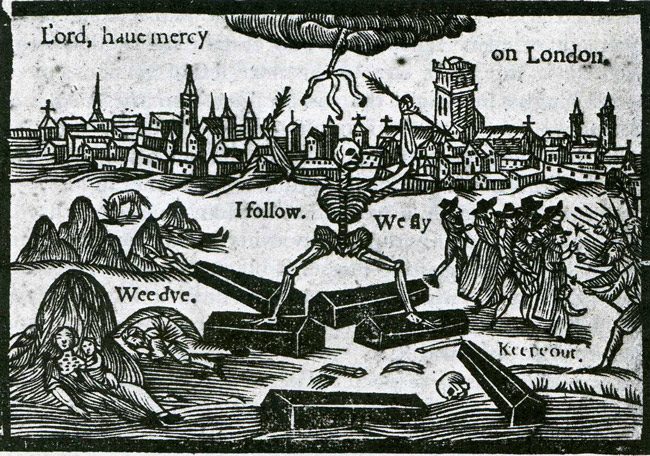
The apotheosis of prestige realist plague film, Steven Soderburgh’s 2011 Contagion, has become one of the most popular features on major streaming platforms, at a time when people have also turned increasingly to books of all kinds about plagues, from fantasy, horror, and science fiction to accounts that show the experience as it was in all its ugliness—or at least as those who experienced it remembered the events. Such a work is Daniel Defoe’s semi-fictional history “A Journal of the Plague Year,” a book he wrote “in tandem with an advice manual called ‘Due Preparations for the Plague,’ in 1722,” notes Jill Lepore at The New Yorker.
In 1722, Defoe had reason to believe the plague might come back to London, and wreak the devastation it caused in 1665, the “plague year” he detailed, when one in every five Londoners died. This was not a story of heroes making sacrifices to save the city. “Everyone behaved badly, though the rich behaved the worst,” Lepore writes. “Having failed to heed warnings to provision, they sent their poor servants out for supplies,” spreading the infection throughout the city. Defoe earnestly hoped to head off such catastrophe. He wrote to issue an admonition, as he put it, “both to us and to posterity, though we should be spared from that portion of this bitter cup.”
The cup, Lepore writes, “has come out of its cupboard.” But so too has the resilience found in Albert Camus’ 1946 novel Le Peste (The Plague), based on a real cholera outbreak in Algeria in 1849. Though fictional, it draws on Camus’ study of historical plagues and his experience as a member of the French Resistance. Camus seems to have found the plague as metaphor particularly uplifting, nicknaming his twins Catherine and Jean, “Plague” and “Cholera,” respectively.
Whether we see it as a story of a siege brought on by sickness, or an allegory of an occupation, Camus wrote of the novel that “the inhabitants, finally freed, would never forget the difficult period that made them face the absurdness of their existence and the precariousness of the human condition. What’s true of all the evils in the world is true of plagues as well. It helps men to rise above themselves.” Defoe might disagree, but plagues in his time were not also accompanied by widespread Nazism, a double crisis that might doubly force us to “reflect on what is real, what is important, and become more human,” says Catherine Camus of the soaring new popularity of her father’s novel.
We can do this through reading in our real-life quarantine. “Reading is an infection,” Lepore writes, “a burrowing into the brain: books contaminate, metaphorically, and even microbiologically” as physical objects capable of ferrying germs. Plagues are mass-existential crises on the level of WWII or the Lisbon earthquake that shook the faith of Europe’s intellectuals. They are also settings for love and terror, from Boccaccio and Gabriel Garcia Marquez to Edgar Allan Poe and Margaret Atwood.
Vulture has published an “essential list” of 20 plague books to read, including many of the classics mentioned above, and a book that is hardly remembered but might be thought of as an ancestor to Atwood’s plague-ridden futures: Mary Shelley’s The Last Man, published in 1826 during the second of two virulent cholera pandemics. In the novel, Shelley claims to have discovered the story in prophetic writing about the end of the 21st century, telling of a disease that wipes out the human race. If you’d rather not indulge that kind of fantasy just yet, you’ll find varying degrees of imaginative and soberly realist fiction and history in the list of plague classics below, all freely available at Project Gutenberg.
Libraries may have shut their possibly contaminated books behind closed doors, bookstores may be deemed nonessential, but reading—and writing—about plague years feels like a necessary cultural activity to help us understand who we are apt to become in such times.
We're hoping to rely on loyal readers, rather than erratic ads. Please click the Donate button and support Open Culture. You can use Paypal, Venmo, Patreon, even Crypto! We thank you!
Open Culture scours the web for the best educational media. We find the free courses and audio books you need, the language lessons & educational videos you want, and plenty of enlightenment in between.