After serving two terms as the first President of the United States of America, George Washington refused to continue on to a third. We now see this action as beginning the tradition of peaceful relinquishment of power that has continued more or less ever since (interrupted, as in recent years, by the occasional troubled transition). At the time, not everyone expected Washington to step down, history having mostly offered examples of rulers who hung on until the bitter end. But the new republic’s creation of not just rules but customs resulted in a variety of unusual political events; even Washington’s election was “weirder than you think.”
So declares history Youtuber Premodernist in the video above, an explanation of the very first United States presidential election in 1789. “There were no official candidates. There was no campaigning for the office. There were no political parties, no nominating conventions, no primary elections. The entire election season was very short, and the major issue of this election was the Constitution itself.” It also took place after thirteen president-free years, the U.S. having been not a single country but “a collection of thirteen separate colonies,” each tied more closely to Britain than to the others; there hadn’t even been a federal government per se.
The U.S. Constitution changed that. Drafted in 1787, it proposed the executive, legislative, and judicial branches of government, whose names every American who’s taken a citizenship exam (and every immigrant who’s taken the citizen test) remembers. Setting up those branches in reality would prove no easy task: how, to name just one practical question, would the executive — the president — actually be chosen? Congress, the legislative branch, could theoretically do it, but that would violate the now practically sacred principle of the separation of powers. The voters could also elect the president directly, but the framers rejected that option as both impractical and unwise.
Enter “the famous electoral college,” a body of specialized voters chosen by the individual states in any manner they please. Having rejected the Constitution itself, North Carolina and Rhode Island didn’t participate in the 1789 election. Each of the other states chose their electors in its own way (exemplifying the political laboratory of American federalism as originally conceived), though it didn’t go smoothly in every case: the widespread division between federalists and anti-federalists was pronounced enough in New York to create a deadlock that prevented the state from choosing any electors at all. The electors that did make it cast two votes each, with the first-place candidate becoming President and the second-place candidate becoming Vice President.
That last proved to be a “bad system,” whose mechanics encouraged a great deal of scheming, intrigue, and strategic voting (even by the subsequently established standards of American politics). Only with the ratification of the twelfth amendment, in 1804, could electors separately designate their choice of President and Vice President. In 1789, of course, “Washington easily got all 69 electoral votes,” and went on reluctantly to prevail again in the next presidential election, which more recently became the subject of its own Premodernist video. Both of them merit a watch in this particular moment, as the run-up to the U.S. contest of 2024 gets into full swing. This election cycle certainly won’t be as short as 1789, but it may well be as weird.
Based in Seoul, Colin Marshall writes and broadcasts on cities, language, and culture. His projects include the Substack newsletterBooks on Cities, the book The Stateless City: a Walk through 21st-Century Los Angeles and the video series The City in Cinema. Follow him on Twitter at @colinmarshall or on Facebook.
According to the laws of physics — at least in simplified form — an object in motion will stay in motion, at least if no other forces act on it. That’s all well and good in the realm of theory, but here in the complex reality of Earth, there always seems to be one force or another getting in the way. Not that this has ever completely shut down mankind’s desire to build a perpetual-motion machine. According to Google Arts & Culture, that quest dates at least as far back as seventh-century India, where “the mathematician Brahmagupta, who wanted to represent the cyclical and eternal motion of the heavens, designed an overbalanced wheel whose rotation was powered by the flow of mercury inside its hollow spokes.”
More widely known is the successor design by Brahmagupta’s twelfth-century countryman and colleague Bhāskara, who “altered the wheel design by giving the hollow spokes a curved shape, producing an asymmetrical course in constant imbalance.” Despite this rendition’s memorable elegance, it does not, like the earlier overbalanced wheel, actually keep on turning forever. To blame are the very same laws of physics that have dogged the subsequent 900 or so years of attempts to build perpetual-motion machines, which you can see briefly explained in the TED-Ed video above.
“Ideas for perpetual-motion machines all violate one or more fundamental laws of thermodynamics, the branch of physics that describes the relationship between different forms of energy,” says the narrator. The first law holds that “energy can’t be created or destroyed; you can’t get out more energy than you put in.” That alone would put an end to hopes for a “free” energy source of this kind. But even machines that just keep moving by themselves — much less useful, of course, but still scientifically earth-shattering — would eventually “have to create some extra energy to nudge the system past its stopping point, breaking the first law of thermodynamics.”
Whenever machines seem to overcome this problem, “in reality, they invariably turn out to be drawing energy from some external source.” (Nineteenth-century America seems to have offered endless opportunities for engineering charlatanism of this kind, whose perpetrators made a habit of skipping town whenever their trickery was revealed, some obtaining patents and profits all the while). But even if the first law of thermodynamics didn’t apply, there would remain the matter of the second, which dictates that “energy tends to spread out through processes like friction,” thus “reducing the energy available to move the system itself, until the machine inevitably stopped.” Hence the abandonment of interest in perpetual motion by such scientific minds as Galileo and Leonardo — who must also have understood that mankind would never fully relinquish the dream.
Based in Seoul, Colin Marshall writes and broadcasts on cities, language, and culture. His projects include the Substack newsletterBooks on Cities, the book The Stateless City: a Walk through 21st-Century Los Angeles and the video series The City in Cinema. Follow him on Twitter at @colinmarshall or on Facebook.
Six months before his assassination, Martin Luther King Jr. spoke to students at Barratt Junior High School in Philadelphia, and asked What Is Your Life’s Blueprint?
Addressing the students, he observed: “This is the most important and crucial period of your lives. For what you do now and what you decide now at this age may well determine which way your life shall go. Whenever a building is constructed, you usually have an architect who draws a blueprint. And that blueprint serves as the pattern, as the guide, as the model, for those who are to build the building. And a building is not well erected without a good, sound, and solid blueprint.”
So what makes for a sound blueprint? The civil rights leader had some suggestions:
Number one in your life’s blueprint should be: a deep belief in your own dignity, your own worth and your own somebodiness. Don’t allow anybody to make you feel that you are nobody. Always feel that you count. Always feel that you have worth, and always feel that your life has ultimate significance.
Now that means you should not be ashamed of your color. You know, it’s very unfortunate that in so many instances, our society has placed a stigma on the Negro’s color. You know there are some Negros who are ashamed of themselves? Don’t be ashamed of your color. Don’t be ashamed of your biological features…
Secondly, in your life’s blueprint you must have as the basic principle the determination to achieve excellence in your various fields of endeavor. You’re going to be deciding as the days and the years unfold, what you will do in life — what your life’s work will be.
And once you discover what it will be, set out to do it, and to do it well.
You can read a transcript of the speech here. As a postscript, it’s worth highlighting a remarkable comment left on YouTube, from the student who apparently recorded the speech on October 26, 1967. It reads:
I cannot believe that I found this footage. I am the student cameraman that recorded this speech. I remember this like it was yesterday. I have been telling my boys for years about this and now I can show them. I thought this was lost years ago and am so happy that it survived the years. I was 12 or 13 years old when he can to Barrett and was mesmerized by what he was saying. I can’t wait to share this with my family. Wow I am elated that I found this.
In 2018, the Pixies performed live for BBC Radio 6 Music, playing some new songs (“In the Arms of Mrs. Mark of Cain”) and old classics (“Here Comes Your Man”). In that latter category, you’ll find a recording of “Gouge Away,” which I keep coming back to again, and yet again. About the video, one YouTuber had this to say: “This production is just badass. The bass, the drums, everything. This specific recording is a masterpiece. To see it taped is a revelation.” That kind of sums it up. Time to share it with you…
The celebrity graffiti artist Keith Haring died in 1990, at the age of 31, no doubt having completed only a fraction of the artwork he would have produced in a life a few decades longer. Upon first seeing his Unfinished Painting of 1989, one might assume that his early death is what stopped him from finishing it. In fact, painting only about a quarter of the canvas was his deliberate choice, intended to make a visual commentary on the AIDS epidemic that had claimed so many lives, and, not long thereafter, would claim his own. Presumably, it never occurred to anyone to “finish” Unfinished Painting — not before the age of artificial intelligence, anyway.
“Last summer, artist Brooke Peachley … posted a photo of the work on X” — the social media platform formerly known as Twitter — “alongside a prompt asking others to respond with a visual art piece ‘that never fails to destroy [them] every time they see it,’ ” write Elaine Velie and Rhea Nayyar at Hyperallergic. “Over six months later, another user responded to the original post with a generative AI image that ‘completed’ Haring’s purposely half-painted work, writing, ‘now using AI we can complete what he couldn’t finish!’ ”
One might, perhaps, sense a joking tone in that post, though the many incensed commenters it continues to draw seem not to take it that way. “The post swiftly caught the ire of the X community, with users describing the action as ‘disrespectful,’ ‘disgusting,’ and a ‘desecration,’ ” says Artnet News. “Some praised the powers of A.I. for ‘showing us a world without AIDS,’ while others deemed the tweet excellent ‘bait’ on an Elon Musk-led online platform that newly rewards outrage with engagement.” As often these days — and very often when it comes to applications of artificial intelligence in popular culture — the reactions to the thing are more compelling than the thing itself.
“The A.I.-generated image doesn’t appear to be faithful to Haring’s style, which often included images of human figures,” writes Julia Binswanger at Smithsonian.com. “These kinds of figures are visible in Haring’s original piece, but the image generator wasn’t able to replicate them.” The algorithmically filled-in Unfinished Painting may be without aesthetic or intellectual interest in itself, but consider how many viewers have only learned of the original work because of it. Nevertheless, stunts like this (or like zooming out the Mona Lisa) ultimately amount to distractions from whatever artistic potential these technologies may actually hold. A.I. will come into its own not by generating images that Haring or any other artist could have created, but images that no human being has yet imagined.
Based in Seoul, Colin Marshall writes and broadcasts on cities, language, and culture. His projects include the Substack newsletterBooks on Cities, the book The Stateless City: a Walk through 21st-Century Los Angeles and the video series The City in Cinema. Follow him on Twitter at @colinmarshall or on Facebook.
From the Royal Society comes a short primer on snowflakes. Narrated by physicist Brian Cox, the video explains how they form, and why no two snowflakes have the exact same dimensions. It also recounts how Johannes Kepler developed a groundbreaking theory about the hexagonal shape of snowflakes in 1611–one proved right 400 years later. And then comes the kicker: snowflakes aren’t actually white; they’re clear.
Along the way, Cox references the first photographs of snowflakes. You can find our post on those 1885photographs here.
If you would like to support the mission of Open Culture, consider making a donation to our site. It’s hard to rely 100% on ads, and your contributions will help us continue providing the best free cultural and educational materials to learners everywhere. You can contribute through PayPal, Patreon, and Venmo (@openculture). Thanks!
When we first travel somewhere, we see nothing quite so clearly as the usual categories of tourist destination: the monuments, the museums, the restaurants. Take one step deeper, and we find ourselves in places like cafés and bookstores, the latter especially having exploded in touristic appeal over the past few years. Take Porto’s grand Livraria Lello, which bills itself as “the most beautiful bookstore in the world” — and has arguably done so too successfully, having drawn crowds large enough to necessitate a cover charge. Perhaps we’d have a richer experience if we spent less time in the livrarias and more in the bibliotecas.
That, in any case, is the impression given by the Kings and Things video above, which presents “Ten Magnificent Historical Libraries,” two of them located in Portugal. Standing on a hilltop overlooking Coimbra, the Biblioteca Joanina “is sumptuously decorated in Baroque fashion,” and “contains intricately carved furniture and bookshelves made of exotic woods as well as ivory, and is embellished with cold and chinoiserie motif.” As for the centuries-old volumes on those shelves, they remain in excellent condition thanks to the Biblioteca Joanina’s being one of only two libraries equipped with “a colony of bats to protect the books from insects.”
The other is in Lisbon’s, Mafra Palace, which “contains what is arguably one of the world’s most beautiful libraries.” Completed in 1755, it’s decked out with bookshelves “decorated in the Rococo style.” The stretch of the aesthetic spectrum between Baroque and Rococo dominates this video, all of its libraries having been built in the eighteenth and nineteenth centuries. Unsurprisingly, most of them are in the Old World, from the Saint Gall Abbey in Switzerland to the Library of Trinity College Dublin to the National Library of France (the Richelieu site in the thirteenth arrondissement, not the modern François-Mitterrand Site decried in W. G. Sebald’s Austerlitz).
Instragrammable though they may have become in this day and age, these venerable libraries all — unlike many tourist-spot bookstores, where you can’t hear yourself think for all the English conversations going on around you — encourage the spending of not money but time. They welcome the traveler looking not simply to hit twenty capitals in a dozen days, but to build a long-term relationship with a place. And not just the traveler in Europe: the video also includes a destination in the United States, the “cathedral of books” that is Baltimore’s George Peabody Library. The true connoisseur will, of course, follow a visit to that august institution by taking the Silver Line north to hit up Normals Books & Records.
Based in Seoul, Colin Marshall writes and broadcasts on cities, language, and culture. His projects include the Substack newsletterBooks on Cities, the book The Stateless City: a Walk through 21st-Century Los Angeles and the video series The City in Cinema. Follow him on Twitter at @colinmarshall or on Facebook.
Why must we all work long hours to earn the right to live? Why must only the wealthy have access to leisure, aesthetic pleasure, self-actualization…? Everyone seems to have an answer, according to their political or theological bent. One economic bogeyman, so-called “trickle-down” economics, or “Reaganomics,” actually predates our 40th president by a few hundred years at least. The notion that we must better ourselves—or simply survive—by toiling to increase the wealth and property of already wealthy men was perhaps first comprehensively articulated in the 18th-century doctrine of “improvement.” In order to justify privatizing common land and forcing the peasantry into jobbing for them, English landlords attempted to show in treatise after treatise that 1) the peasants were lazy, immoral, and unproductive, and 2) they were better off working for others. As a corollary, most argued that landowners should be given the utmost social and political privilege so that their largesse could benefit everyone.
This scheme necessitated a complete redefinition of what it meant to work. In his study, The English Village Community and the Enclosure Movements, historian W.E. Tate quotes from several of the “improvement” treatises, many written by Puritans who argued that “the poor are of two classes, the industrious poor who are content to work for their betters, and the idle poor who prefer to work for themselves.” Tate’s summation perfectly articulates the early modern redefinition of “work” as the creation of profit for owners. Such work is virtuous, “industrious,” and leads to contentment. Other kinds of work, leisurely, domestic, pleasurable, subsistence, or otherwise, qualifies—in an Orwellian turn of phrase—as “idleness.” (We hear echoes of this rhetoric in the language of “deserving” and “undeserving” poor.) It was this language, and its legal and social repercussions, that Max Weber later documented in The Protestant Ethic and the Spirit of Capitalism, Karl Marx reacted to in Das Capital, and feminists have shown to be a consolidation of patriarchal power and further exclusion of women from economic participation.
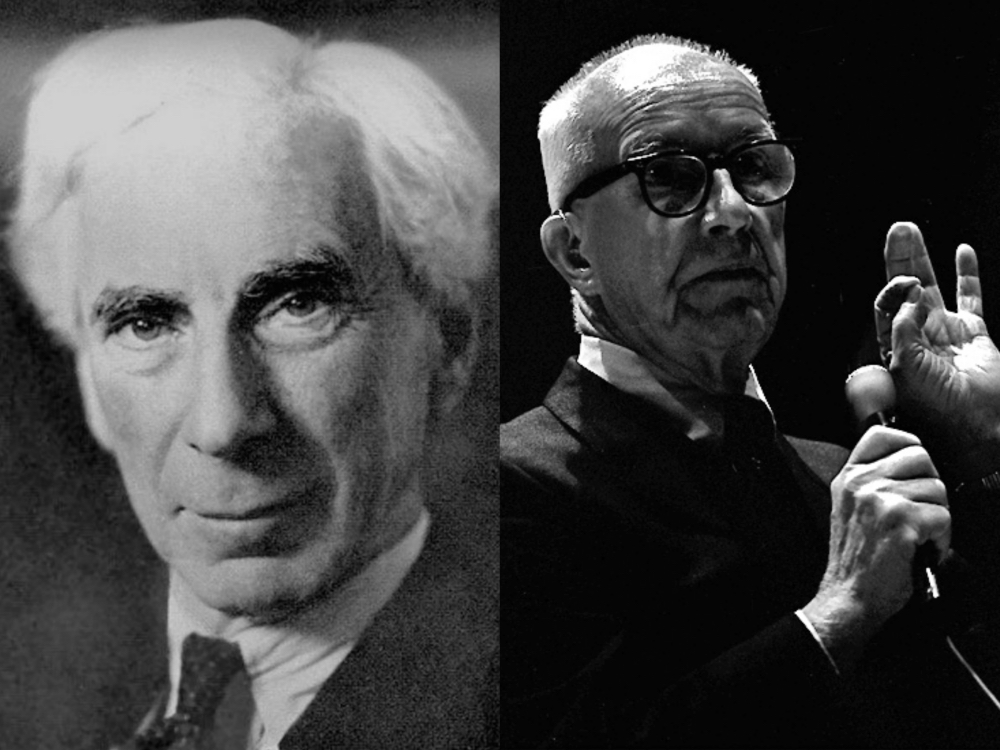
Along with Marx, various others have raised significant objections to Protestant, capitalist definitions of work, including Thomas Paine, the Fabians, agrarians, and anarchists. In the twentieth century, we can add two significant names to an already distinguished list of dissenters: Buckminster Fuller and Bertrand Russell. Both challenged the notion that we must have wage-earning jobs in order to live, and that we are not entitled to indulge our passions and interests unless we do so for monetary profit or have independent wealth. In a New York Times column on Russell’s 1932 essay “In Praise of Idleness,” Gary Gutting writes, “For most of us, a paying job is still utterly essential — as masses of unemployed people know all too well. But in our economic system, most of us inevitably see our work as a means to something else: it makes a living, but it doesn’t make a life.”
In far too many cases in fact, the work we must do to survive robs us of the ability to live by ruining our health, consuming all our precious time, and degrading our environment. In his essay, Russell argued that “there is far too much work done in the world, that immense harm is caused by the belief that work is virtuous, and that what needs to be preached in modern industrial countries is quite different from what has always been preached.” His “arguments for laziness,” as he called them, begin with definitions of what we mean by “work,” which might be characterized as the difference between labor and management:
What is work? Work is of two kinds: first, altering the position of matter at or near the earth’s surface relatively to other such matter; second, telling other people to do so. The first kind is unpleasant and ill paid; the second is pleasant and highly paid.
Russell further divides the second category into “those who give orders” and “those who give advice as to what orders should be given.” This latter kind of work, he says, “is called politics,” and requires no real “knowledge of the subjects as to which advice is given,” but only the ability to manipulate: “the art of persuasive speaking and writing, i.e. of advertising.” Russell then discusses a “third class of men” at the top, “more respected than either of the classes of the workers”—the landowners, who “are able to make others pay for the privilege of being allowed to exist and to work.” The idleness of landowners, he writes, “is only rendered possible by the industry of others. Indeed their desire for comfortable idleness is historically the source of the whole gospel of work. The last thing they have ever wished is that others should follow their example.”
The “gospel of work” Russell outlines is, he writes, “the morality of the Slave State,” and the kinds of murderous toil that developed under its rule—actual chattel slavery, fifteen hour workdays in abominable conditions, child labor—has been “disastrous.” Work looks very different today than it did even in Russell’s time, but even in modernity, when labor movements have managed to gather some increasingly precarious amount of social security and leisure time for working people, the amount of work forced upon the majority of us is unnecessary for human thriving and in fact counter to it—the result of a still-successful capitalist propaganda campaign: if we aren’t laboring for wages to increase the profits of others, the logic still dictates, we will fall to sloth and vice and fail to earn our keep. “Satan finds some mischief for idle hands to do,” goes the Protestant proverb Russell quotes at the beginning of his essay. On the contrary, he concludes,
…in a world where no one is compelled to work more than four hours a day, every person possessed of scientific curiosity will be able to indulge it, and every painter will be able to paint without starving, however excellent his pictures may be. Young writers will not be obliged to draw attention to themselves by sensational pot-boilers, with a view to acquiring the economic independence for monumental works, for which, when the time at last comes, they will have lost the taste and capacity.
The less we are forced to labor, the more we can do good work in our idleness, and we can all labor less, Russell argues, because “modern methods of production have given us the possibility of ease and security for all” instead of “overwork for some and starvation for others.”
A few decades later, visionary architect, inventor, and theorist Buckminster Fuller would make exactly the same argument, in similar terms, against the “specious notion that everybody has to earn a living.” Fuller articulated his ideas on work and non-work throughout his long career. He put them most succinctly in a 1970 New York magazine “Environmental Teach-In”:
It is a fact today that one in ten thousand of us can make a technological breakthrough capable of supporting all the rest…. We keep inventing jobs because of this false idea that everybody has to be employed at some kind of drudgery because, according to Malthusian-Darwinian theory, he must justify his right to exist.
Many people are paid very little to do backbreaking labor; many others paid quite a lot to do very little. The creation of surplus jobs leads to redundancy, inefficiency, and the bureaucratic waste we hear so many politicians rail against: “we have inspectors and people making instruments for inspectors to inspect inspectors”—all to satisfy a dubious moral imperative and to make a small number of rich people even richer.
What should we do instead? We should continue our education, and do what we please, Fuller argues: “The true business of people should be to go back to school and think about whatever it was they were thinking about before somebody came along and told them they had to earn a living.” We should all, in other words, work for ourselves, performing the kind of labor we deem necessary for our quality of life and our social arrangements, rather than the kinds of labor dictated to us by governments, landowners, and corporate executives. And we can all do so, Fuller thought, and all flourish similarly. Fuller called the technological and evolutionary advancement that enables us to do more with less “euphemeralization.” InCritical Path, a visionary work on human development, he claimed “It is now possible to give every man, woman and child on Earth a standard of living comparable to that of a modern-day billionaire.”
Sound utopian? Perhaps. But Fuller’s far-reaching path out of reliance on fossil fuels and into a sustainable future has never been tried, for some depressingly obvious reasons and some less obvious. Neither Russell nor Fuller argued for the abolition—or inevitable self-destruction—of capitalism and the rise of a workers’ paradise. (Russell gave up his early enthusiasm for communism.) Neither does Gary Gutting, a philosophy professor at the University of Notre Dame, who in his New York Times commentary on Russell asserts that “Capitalism, with its devotion to profit, is not in itself evil.” Most Marxists on the other hand would argue that devotion to profit can never be benign. But there are many middle ways between state communism and our current religious devotion to supply-side capitalism, such as robust democratic socialism or a basic income guarantee. In any case, what most dissenters against modern notions of work share in common is the conviction that education should produce critical thinkers and self-directed individuals, and not, as Gutting puts it, “be primarily for training workers or consumers”—and that doing work we love for the sake of our own personal fulfillment should not be the exclusive preserve of a propertied leisure class.
Note: An earlier version of this post appeared on our site in 2015.
We're hoping to rely on loyal readers, rather than erratic ads. Please click the Donate button and support Open Culture. You can use Paypal, Venmo, Patreon, even Crypto! We thank you!
Open Culture scours the web for the best educational media. We find the free courses and audio books you need, the language lessons & educational videos you want, and plenty of enlightenment in between.