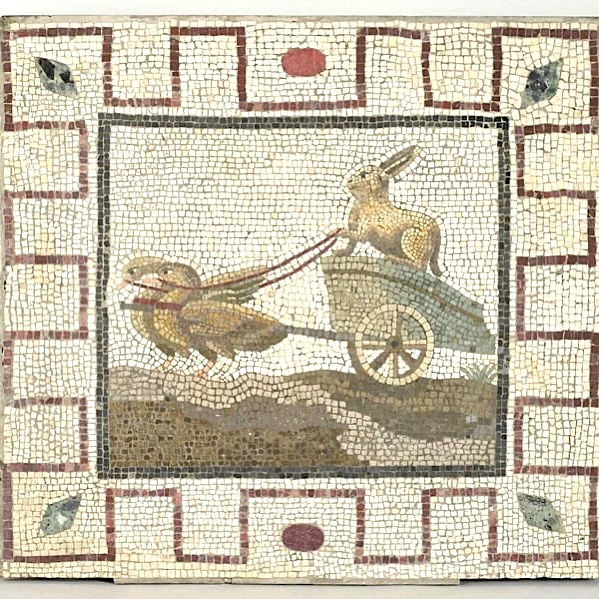
If you head to the Louvre, make sure you visit the Mona Lisa, Venus de Milo, and Liberty Leading the People. But then swing by the Department of Greek, Etruscan, and Roman Antiquities. There you might find (no guarantee!) a Roman mosaic featuring a rabbit riding a chariot pulled by geese. Discovered at Hadrian’s villa in Tivoli, Italy, the mosaic dates back to the 2nd century. About the mosaic, the History Cool Kids writes:
This kind of humorous scene is an example of asária, a type of ancient visual joke where animals behave like humans (anthropomorphism). Such mosaics were popular in Roman domestic decoration, often as floor or wall panels in villas and bathhouses.
This particular mosaic is part of the Louvre’s extensive collection of Greek, Etruscan, and Roman Antiquities. It illustrates how Roman artists loved playful or satirical imagery alongside more serious mythological and realistic scenes. The rabbit, a symbol often associated with fertility and speed, paired with the absurdity of it driving a chariot of geese, reflects both Roman wit and their fondness for decorative exuberance.
Some scholars believe the mosaic plays on a line in Ovid’s Metamorphoses: “Cytherea [Aphrodite] was riding in her dainty chariot, winged by her swans, across the middle air making for Cyprus, when she heard afar Adonis’ dying groans, and thither turned her snowy birds.” But it’s hard to know for sure.
Related Content
Archaeologists Discover a 2,000-Year-Old Roman Glass Bowl in Perfect Condition




Leave a Reply